
You're probably at the stage where the deck is done, the investors want a launch date, and someone in the room has started saying “we can just white label it” as if that solves the hard part.
It doesn't. It solves one hard part.
That distinction matters. White label online casino software can get you live far faster than building your own stack, but speed isn't the decision. The decision is what control you're giving up over payments, provider selection, compliance operations, product mechanics, and eventually your margin. The serious operators ask what they'll still be allowed to control six months after go-live.
I've seen teams sign the wrong deal because they bought a launch plan instead of an operating model. That mistake usually shows up later, when they want a new PSP, a better bonus engine, a cleaner sportsbook-casino wallet, or a different approach to VIP segmentation and they learn the answer is “not on this platform.”
Table of Contents
- The Operator's Decision Point
- What White Label Casino Software Really Is
- Platform Architecture Behind a Modern Stack
- Core Features That Define a Real Turnkey Platform
- Compliance and Multi-Jurisdiction Entry
- Pricing Models and the Real Cost of Going Turnkey
- Implementation Timeline and Migration From Legacy
- When a Turnkey Stack Is the Right Call
The Operator's Decision Point
Every operator hits the same fork in the road. Build a stack in-house and accept a slower path with more moving parts, or license a bundled platform and get to market faster with less engineering burden.
The mistake is treating that as a tech choice. It's a business structure choice first. Once you sign a white-label deal, you're also choosing how much freedom you'll have over cashier logic, game catalogue changes, player data access, fraud workflows, and who carries the practical compliance burden when something goes wrong.
What founders usually focus on first
Most teams start with the obvious questions:
- Launch speed: How quickly can the brand go live?
- Upfront spend: How much internal build cost can be avoided?
- Vendor coverage: Does the package include games, payments, back office, and CRM?
- Licensing path: Can the operator enter target markets without building every regulated function alone?
Those are valid questions. They just aren't enough.
A better first step is to review the main categories of iGaming software providers and decide where you want ownership. Some operators need a full operating stack. Others only need aggregation, wallet, or sportsbook support. If you buy a complete bundle when you only needed two layers, you'll overpay in flexibility.
The question that actually decides your future
Ask this before anything else: what must remain under your control after launch?
If the honest answer is payments, CRM logic, player data portability, and the freedom to swap suppliers, then a strict white-label setup may become a trap. If the honest answer is “we need to get live, learn, and prove acquisition before we optimize the stack,” then white label can be the right call.
Practical rule: If you don't define your non-negotiables before procurement, the vendor will define them for you in the contract.
That's why the contract matters as much as the demo. Sales decks make every platform look complete. Operations after go-live expose what's configurable.
What White Label Casino Software Really Is
You sign with a white-label provider because the demo looks complete, the launch plan looks short, and the commercial terms look manageable. Six months after go-live, the model shows up. You want to change PSPs, move player data into your own CRM, adjust bonus logic beyond the template, or prepare for your own licence. That is the point where white label stops being a shortcut and starts acting like a constraint.
White label casino software is a bundled operating stack sold as a ready-to-run business model. The provider usually supplies the platform, game aggregation, payments setup, back office, KYC and AML processes, reporting, and parts of the compliance workflow. You bring the brand, traffic, and commercial plan. You do not control every layer, and that trade-off is the whole deal.
Industry descriptions often group white label under the broader turnkey model, where one provider packages the operating layers needed to launch faster than a self-built stack, as outlined in this white-label and turnkey overview. The important point is simpler. You are buying a system for running the business, not just software for displaying games.
The legal structure matters as much as the product
A white-label casino often runs under the provider's licence or within a provider-controlled framework, while the operator configures the brand and handles acquisition, as described in this white label solution explainer. That structure decides who can approve changes, who holds the compliance burden, and how easy it will be to leave later.
Ask four questions before you treat any platform as a growth asset:
- Who owns the licence: The provider, the operator, or a separate licensed entity in the middle.
- Who controls the player account: The brand commercially, or the platform through system access and permissions.
- Who carries regulatory liability: The named licence holder, the operating entity, or both under contract.
- Who controls the money flow: The party that sits closest to wallet balances, settlements, chargebacks, and reconciliation.
These are operating questions, not legal fine print. If the provider owns the licence, controls the wallet, and limits data exports, your brand is renting access to an infrastructure you do not fully command.
White label, turnkey, and licensed are different operating models
Vendors blur these terms because it helps them sell range without giving up control. Force precise definitions in procurement.
| Model | License Owner | Player Relationship | Regulatory Liability | Typical Operator Role |
|---|---|---|---|---|
| White Label | Usually provider or provider-controlled framework | Brand-facing, but often mediated through provider systems | Often sits with licence holder in practice | Marketing, acquisition, brand operations |
| Turnkey | Can vary by structure | Usually stronger operator control than pure white label | Shared operational complexity, but depends on legal setup | Runs brand on a bundled platform with more configuration input |
| Licensed | Operator | Direct operator ownership | Operator | Uses software and integrations under its own licence and control |
The commercial mistake is treating these models as different labels for the same thing. They are not. A white-label deal buys speed by giving the provider more control over licensing, data, suppliers, and change management. A licensed setup is slower and heavier to launch, but it gives you far better freedom to shape the product and switch vendors without rebuilding the company around someone else's rules.
If a vendor says “you own the brand” but won't give direct access to data models, PSP selection, or backend logic, you own the skin, not the machine.
That is what white label really is. A fast route into market with built-in limits on control. Good operators accept that trade-off only if those limits are named, priced, and planned around before the contract is signed.
Platform Architecture Behind a Modern Stack
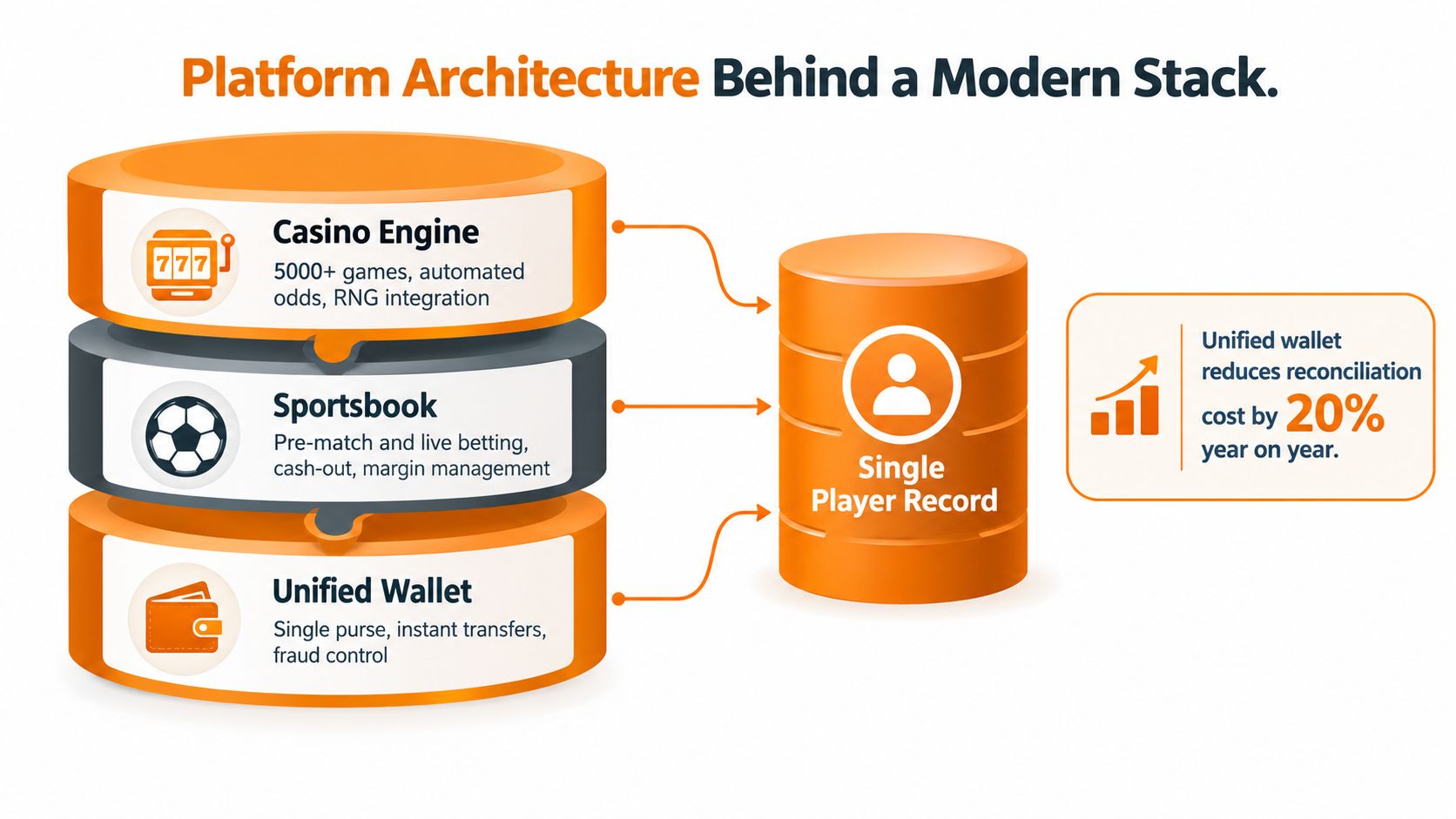
A modern iGaming stack only works cleanly when casino, sportsbook, and wallet operate as one system. If those parts live in separate silos, your support team spends its life reconciling balances, your CRM sees fragmented behavior, and your risk team works with partial information.
Here's the architecture operators should be looking for.
The three layers that matter
At the surface, you have the casino engine. That includes RNG game aggregation, live dealer integration, lobby management, promotional hooks, and session controls.
Next is the sportsbook layer. This is usually a separate trading and settlement environment, but it shouldn't feel separate to the player. If the sportsbook and casino don't read from the same identity and balance framework, your “cross-sell strategy” is just a slide, not an operating reality.
At the base sits the unified wallet. This is the layer too many buyers under-rate during procurement. One balance, one account state, one bonus context, one withdrawal control point. If that wallet isn't solid, the rest of the platform becomes expensive to run.
Why the single player record is the real backbone
For regulated iGaming, KYC and AML aren't standalone checks. They should sit inside a linked player record connecting identity, wallet activity, device and IP data, geolocation, payment method, session history, responsible-gaming controls, and transaction outcomes, as explained in this iGaming ID verification architecture guide. That's how platforms detect risk with context instead of isolated events.
A proper single player record changes daily operations:
- Support gets clarity: One account history instead of multiple disconnected ledgers.
- Risk gets correlation: Deposit behavior, gameplay, device changes, and withdrawal patterns can be reviewed together.
- CRM gets usable segmentation: Casino-first, sportsbook-first, dormant, VIP, bonus-sensitive, and high-risk states become easier to separate.
- Finance gets less pain: Reconciliation improves because wallet activity isn't split across product silos.
The services wrapped around the core
The rest of the stack should support the player record, not fight it.
Look for these components:
- Game aggregation: Not just title count. You want stable routing, consistent metadata, and clear fault handling when a studio feed breaks.
- PSP orchestration: Multiple payment methods are useless if the cashier can't route intelligently by region, risk profile, or transaction outcome.
- Affiliate system: If your acquisition model is affiliate-heavy, make sure the tracking logic isn't bolted on as an afterthought.
- CRM and bonus engine: The useful question is whether the platform can trigger actions across products from shared player behavior.
- Back office with data access: A glossy dashboard isn't enough. You need exports, event visibility, and a realistic path to move data out later.
Buy the stack as if you'll need to remove one major vendor from it later. That mindset exposes weak architecture fast.
Core Features That Define a Real Turnkey Platform
Most vendor decks list features. Operators need to judge whether those features survive real traffic, real fraud attempts, and real support pressure.
A real turnkey platform isn't defined by how many logos appear in the slide pack. It's defined by whether the operating team can control the levers that affect deposits, withdrawals, retention, and risk.
Games and live dealer
A good games setup gives you curation options, not just volume. You need enough control to shape the lobby by player type, market preference, and promotional strategy.
What to check:
- Catalogue control: Can your team manage categories, featured placement, market-specific visibility, and low-performing suppliers without waiting on support tickets?
- Volatility mix: If the platform can't help you merchandize different player appetites, your lobby becomes a warehouse.
- Live dealer fit: Table limits, language alignment, and studio mix should match your target segment. A premium live dealer product means little if the stake profile doesn't fit your audience.
Payments and cashier behavior
Weak white-label setups start to show.
The cashier should support clean deposit routing, clear status handling, and configurable fallback paths. Players don't care how many PSPs you've integrated. They care whether the cashier works on the first attempt and whether withdrawals don't turn into support escalations.
Look for:
- Regional routing logic: The platform should let you shape methods by market and risk context.
- Operational fallback: If one processor degrades, your cashier shouldn't collapse into a dead end.
- Withdrawal controls: Approval states, review queues, and player communication need to be configurable by operations, not locked behind vendor engineering.
KYC, AML, and risk tooling
This area separates proper platforms from cosmetic ones.
Good KYC and AML orchestration means the platform can centralize onboarding checks, sanctions and PEP screening, velocity rules, ongoing transaction monitoring, and enhanced checks for higher-risk cases. Better systems also tie those checks into payment events and responsible-gaming controls instead of treating compliance as a separate page in the back office.
A decent stack should also expose configurable thresholds. If every rule change needs a vendor sprint, your compliance team won't be able to react at operator speed.
Crypto and cross-vertical bonuses
Crypto support only matters if the operational handling is mature. Deposit acceptance is easy. Wallet accounting, volatility exposure, player communication, and withdrawal control are the hard part.
If you're reviewing vendors, ask whether the same bonus engine can handle offers across casino and sportsbook in one wallet context. That's much more valuable than a bloated promo menu.
One option in this category is NexGrate, which provides a turnkey white-label platform combining casino, sportsbook, payments, compliance controls, and a unified backend. That type of stack is useful when you want fewer vendor handoffs, but the same due diligence still applies. You still need to test data access, cashier flexibility, and exit terms before signing.
Compliance and Multi-Jurisdiction Entry
Most operators underestimate how quickly compliance becomes an operating constraint rather than a legal checklist.
In mature regulated frameworks, white label doesn't magically erase responsibility. The global market for online gambling is large, with industry reporting cited in 2026 estimating about $655 billion in total gambling revenue and more than $123 billion from online formats, while the UK Gambling Commission reported 5.0 million online accounts and 24.6 million bets in a single high-profile month, as summarized in this white-label casino platform market overview. Big markets create big opportunity. They also create tighter regulatory expectations.
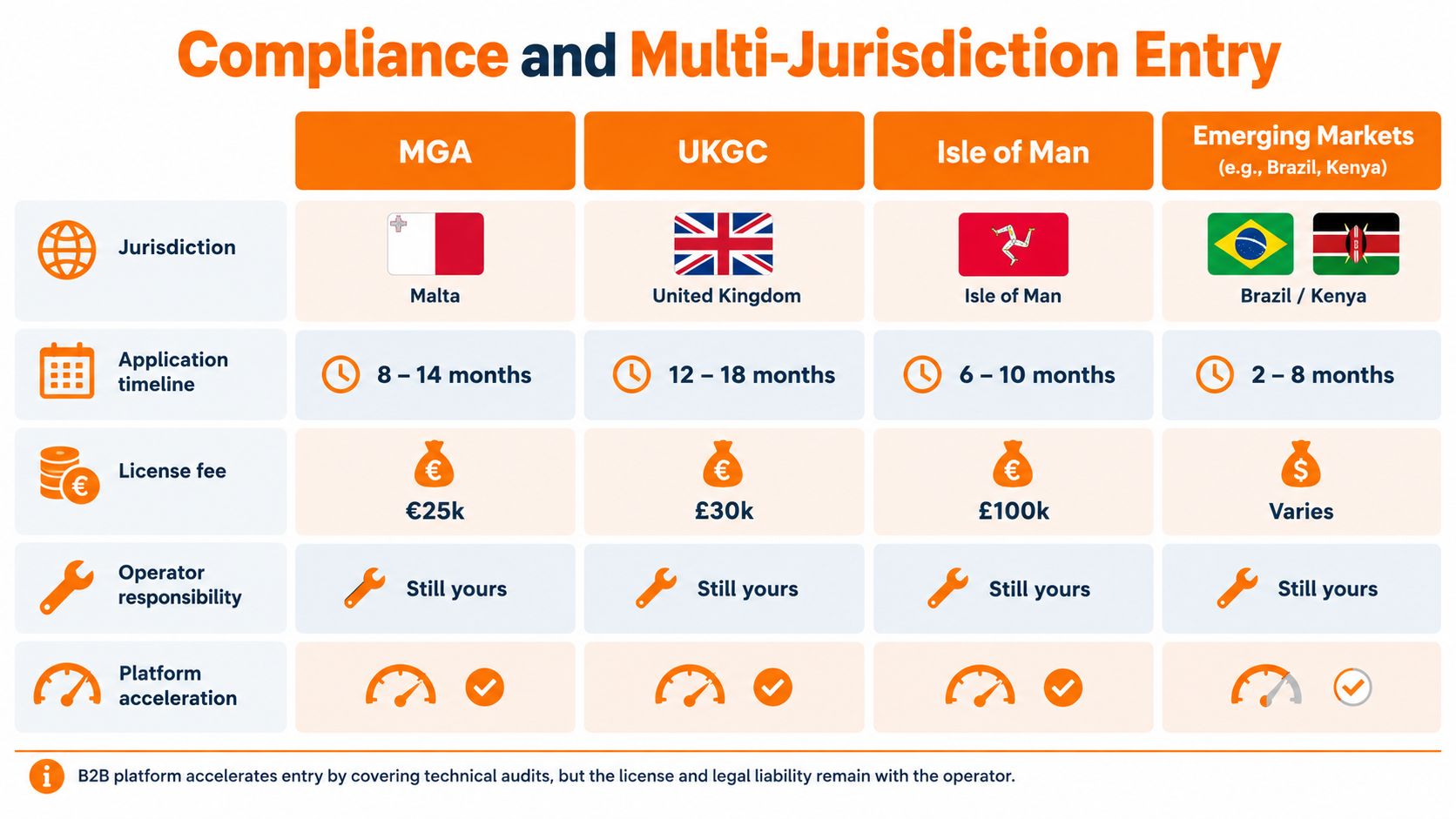
Use this comparison as a reminder of how operators need to think about market entry.
Where platforms help and where they don't
A B2B-oriented platform can absolutely help with technical readiness. It can provide reporting layers, back-office workflows, jurisdiction-aware configuration, game controls, geofencing support, and payment segregation logic.
It doesn't remove operator accountability. In major frameworks such as the MGA, UKGC, and Isle of Man structures, direct operator licensing requirements limit the classic sub-licensed white-label model and push providers toward compliance-heavy B2B delivery rather than simple licence pass-through arrangements, as noted in the linked market overview above.
That means a platform can accelerate technical entry, but it won't carry decisions the operator still owns.
The shortcuts that usually fail
Operators get into trouble when they assume “provider has compliance covered” means “our brand is covered.” It rarely works that way.
Common failures include:
- Marketing without jurisdiction logic: Promotions, copy, and retention flows are launched as if one rule set fits all territories.
- Weak reporting discipline: Teams don't build internal compliance reporting processes early enough, then scramble when audit requests arrive.
- Poor role ownership: Nobody clearly owns AML review, safer gambling escalation, or customer-funds workflow.
- Template governance: The brand copies another market's setup and assumes the regulator will accept the same operating model.
Later in the process, it helps to see how industry teams discuss the issue in practical terms:
The platform can help you enter a market. It can't make you operationally credible if your internal ownership model is vague.
Pricing Models and the Real Cost of Going Turnkey
If you only compare the launch quote, you'll buy the wrong platform.
White-label and turnkey pricing always looks clean in the proposal stage. The mess starts later, when support scope, PSP changes, custom reporting, bonus exceptions, migration support, and extra environments show up as “out of scope.”
The four pricing structures you'll see
There are four common commercial models:
| Pricing Model | Typical Range | Best Fit | Hidden Cost Risk |
|---|---|---|---|
| Revenue share | Varies by provider and deal structure | Early-stage brands that want lower upfront commitment | Margin compression as the brand scales |
| Setup fee | Varies by scope and integrations | Operators that want a defined launch package | “Setup” may exclude key integrations and migration work |
| Monthly SaaS | Varies by platform depth and support | Predictable budgeting for operational teams | Feature gating, user caps, and add-on modules |
| Hybrid | Combined fixed and variable fees | Operators balancing launch speed with medium-term scale | Multiple fee layers across support, payments, and product changes |
What each model really means in practice
Revenue share is attractive when you need speed and want the provider aligned with early performance. The downside is obvious. As revenue grows, the platform becomes more expensive relative to the control you still don't have.
Setup-fee deals can work if your scope is tight and your internal team knows exactly what must be delivered before launch. They fail when operators assume “implementation included” covers migration, custom rules, or payment reconfiguration.
Monthly SaaS works best when the product and support boundaries are explicit. If the contract is vague, fixed monthly pricing becomes a magnet for add-on invoices.
Hybrid pricing is common because it gives vendors downside protection and upside participation. It also makes comparison harder. You need a model that projects cost across launch, stabilization, and scale, not just month one.
Where hidden costs usually sit
Don't just ask for the fee sheet. Ask for the exceptions list.
Focus on these pressure points:
- Integration change fees: New PSPs, KYC vendors, CRM tools, or BI connectors.
- Operational service fees: Manual risk reviews, chargeback handling, or compliance support outside standard hours.
- Environment fees: Staging, extra brands, or market-specific instances.
- Exit costs: Data export, migration support, and decommissioning assistance.
If the contract is generous on launch and restrictive on change requests, the vendor is betting on your future dependence.
That's why total cost of ownership matters more than launch affordability. Cheap entry can become expensive captivity.
Implementation Timeline and Migration From Legacy
The sales promise is usually “we can launch fast.” The operational answer is “only if your data is clean, your payment logic is mapped, and your teams make decisions quickly.”
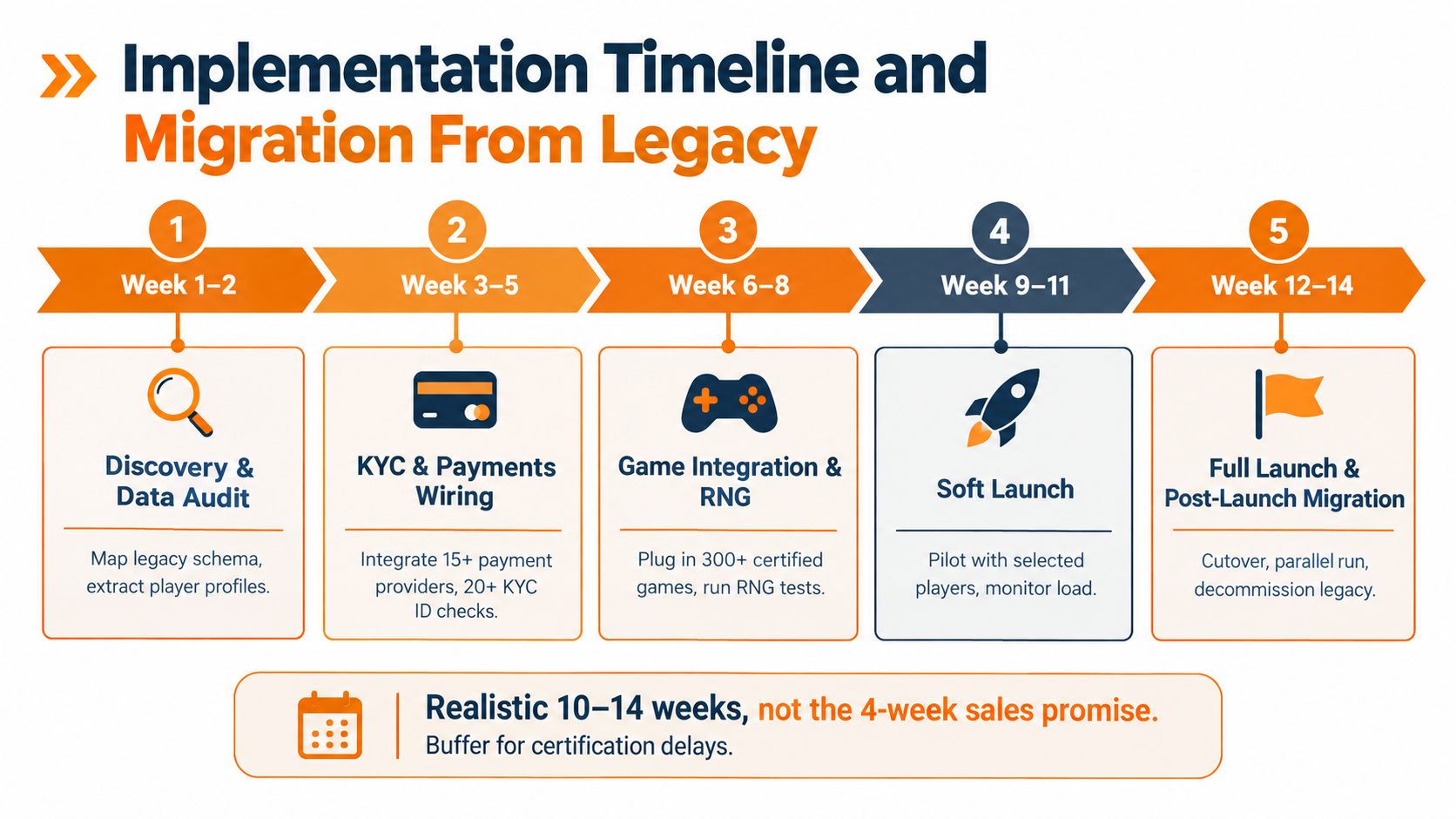
A realistic rollout is often closer to a structured implementation window than a brochure sprint. If you're migrating from a legacy backend, the work isn't branding. It's data interpretation, wallet continuity, and settlement integrity.
The migration path that actually works
The rollout usually succeeds when operators break it into hard gates instead of overlapping everything at once.
Discovery and data audit
Map the legacy schema first. Player states, wallet balances, bonus balances, self-exclusion flags, and historical transaction logic all need interpretation before import.KYC and payments wiring
This phase exposes whether the target platform can replicate your current review flows, payment routing rules, and withdrawal controls.Game and product configuration
Recreate catalogue logic, market-specific restrictions, and existing player journeys. A visually similar lobby isn't enough if promotional behavior changes underneath it.Soft launch and controlled traffic
Start with whitelisted or limited traffic, then watch support tickets, cashier behavior, and edge-case failures.Full cutover and parallel monitoring
Keep enough overlap to validate balances, unsettled events, and customer service continuity before shutting the old environment down.
The data traps that derail go-live
Migration failures usually come from bad assumptions, not bad code.
Watch for these problems:
- Historical bet reconstruction: Legacy systems often store event states differently from the new platform.
- Bonus balance reconciliation: Expired, active, restricted, and wagering-linked balances don't always map cleanly.
- Segmented wallets: Old casino and sportsbook purses may need logic redesign before they can become one unified balance.
- Pending versus settled states: If your migration team mishandles in-flight transactions, finance and support inherit the mess immediately.
If your team is comparing providers during this stage, use a proper online casino software development due-diligence list, not just a commercial checklist. You want to score vendors on API depth, migration support, back-office flexibility, payment routing logic, bonus-engine configurability, support responsiveness, and exit clauses.
Questions worth asking in procurement
Ask vendors these directly:
- Can we export full player, wallet, and transaction data in a usable structure?
- Who handles rollback if migration validation fails?
- What remains configurable by our operations team after launch?
- What support is included during the first post-launch incident window?
Migrations don't fail because the homepage looked wrong. They fail because money state, compliance state, and customer state stopped matching.
When a Turnkey Stack Is the Right Call
You are three months from a market launch. The license clock is running, affiliates are lined up, and your team does not have time to build cashier logic, bonus tools, KYC flows, reporting, and support operations from scratch. In that situation, turnkey is the right call. Speed matters more than architectural freedom, and you can accept provider constraints for a defined period.
That last part matters. A white-label stack works best when you treat it as a stage in the business, not the final form of the business.
Turnkey fits operators that need to get live, prove acquisition, and stabilize operations before they invest in deeper product control. A regional brand entering a new jurisdiction fits this model. An affiliate-led casino launch fits it too. A crypto-first operation can fit if the immediate priority is cashier execution and market entry, not custom backend behavior.
It is a poor fit for operators that already know their edge depends on proprietary logic. If your roadmap includes custom wallet rules, unusual VIP mechanics, direct PSP orchestration, differentiated retention flows, or heavy cross-product personalization, you will hit the platform ceiling early. Groups with an internal product team usually feel that ceiling faster than the sales process suggests.
A simple fit test
| Operator Profile | Turnkey Fit | Primary Risk |
|---|---|---|
| New market entrant with tight deadline | High | Dependence on provider workflow and release priorities |
| Affiliate-led casino brand | High | Weak product differentiation after launch |
| Crypto-focused skin with simple product strategy | Medium to high | Treasury and wallet limits if the model changes |
| Established multi-brand operator | Medium | Margin pressure and back-office limits |
| Operator with strong internal product and risk teams | Low | Roadmap blocked by platform restrictions |
The five-point decision checklist
Ask these before you sign, not after your first six months of growth:
- Control test: Which three operating levers must stay under your team's control after go-live?
- Margin test: Does the model still work once fees keep applying at higher volume?
- Data test: Can you export player, wallet, transaction, and reporting data in a usable structure?
- Differentiation test: Can you shape retention, bonus, and cashier flows beyond skin-level branding?
- Exit test: How hard is it to leave when the stack no longer matches your roadmap?
The hard truth is simple. Turnkey is often the fastest route into the market, but speed usually comes with limits on control, vendor freedom, and product shape. Good operators accept that trade only when the commercial upside is immediate and the exit path is clear on day one.
If those answers are solid, proceed. If they are vague, stop procurement and fix the commercial terms first.
NexGrate fits this type of review if you are comparing all-in-one white-label options. The useful question is not whether the stack covers casino, sportsbook, payments, and compliance on paper. The useful question is whether your team keeps enough control after launch to avoid an expensive second rebuild.