
You're probably in one of two situations right now. You're either planning your first iGaming launch and trying to decide whether a turnkey platform is enough, or you're already talking to vendors and noticing that every demo looks smooth until the conversation reaches compliance, wallets, and migration into regulated markets.
That's where most operator mistakes begin.
The front end is the easy part to visualize. Games, odds, lobby design, promotions, cashier screens. The expensive part lives underneath. An online casino platform has to behave like an entertainment product, a financial ledger, and a regulated system at the same time. If one of those layers is weak, the business starts leaking money long before players notice anything wrong.
Table of Contents
- The Blueprint for Your Online Gaming Empire
- Deconstructing the Core Platform Components
- Platform Architecture and Modern Tech Stacks
- The Build vs Buy Decision Framework
- Navigating the Development Lifecycle and QA
- Understanding Timelines and Cost Drivers
- Your Go-Live Checklist for Platform Selection
The Blueprint for Your Online Gaming Empire
A new operator usually starts with the brand vision. A sportsbook and casino under one name. A clean mobile product. Localized payments. A launch market first, then expansion after the first traction. On paper, that sounds straightforward. In practice, the platform choice locks in how fast you can launch, how much risk you carry, and how painful later expansion becomes.
The business opportunity is real. The global online casino software development market is projected to grow from USD 28.6 billion in 2023 to USD 86.5 billion by 2033, with an 11.7% CAGR, and mobile platforms are projected to hold a 57.3% market share in 2026, according to Market.us research on the online casino software market. That tells you two things immediately. First, competition isn't slowing down. Second, mobile product quality can't be treated as a later optimization.
A modern operator isn't buying software in the abstract. You're building a regulated digital business where every deposit, spin, odds update, withdrawal, bonus condition, and exclusion rule has to work together without creating accounting gaps or compliance failures.
What the platform actually has to do
Most first-time buyers underestimate the number of roles one platform has to perform:
- Entertainment engine: It has to serve casino content, live dealer feeds, and often sportsbook experiences without making the lobby feel fragmented.
- Financial system: It has to maintain balance accuracy, transaction histories, settlement logic, and cashier behavior under load.
- Regulatory control layer: It has to support KYC, AML workflows, audit logs, responsible gaming settings, geofencing, and reporting.
- Operations console: It has to give your risk, support, payments, and VIP teams enough visibility to act quickly.
Practical rule: If a vendor presentation spends most of its time on lobby visuals and game count, ask to see the cashier ledger logic, player restriction controls, and audit records next.
That's the level where good and bad decisions separate. A flashy launch can hide weak backend design for a while. It can't hide it during payment disputes, regulator requests, wallet reconciliation, or migration into a second jurisdiction.
Deconstructing the Core Platform Components
Treat the platform like a high-tech machine. The player only touches the steering wheel and dashboard. Your business survives or fails based on the engine, braking system, and control panel you don't see in marketing screenshots.
Think in systems, not features
The first mistake operators make is shopping by feature list. “Has sportsbook.” “Supports crypto.” “Includes bonuses.” That sounds sensible, but it hides the actual question. How do these modules interact when money, restrictions, and player state all change in real time?
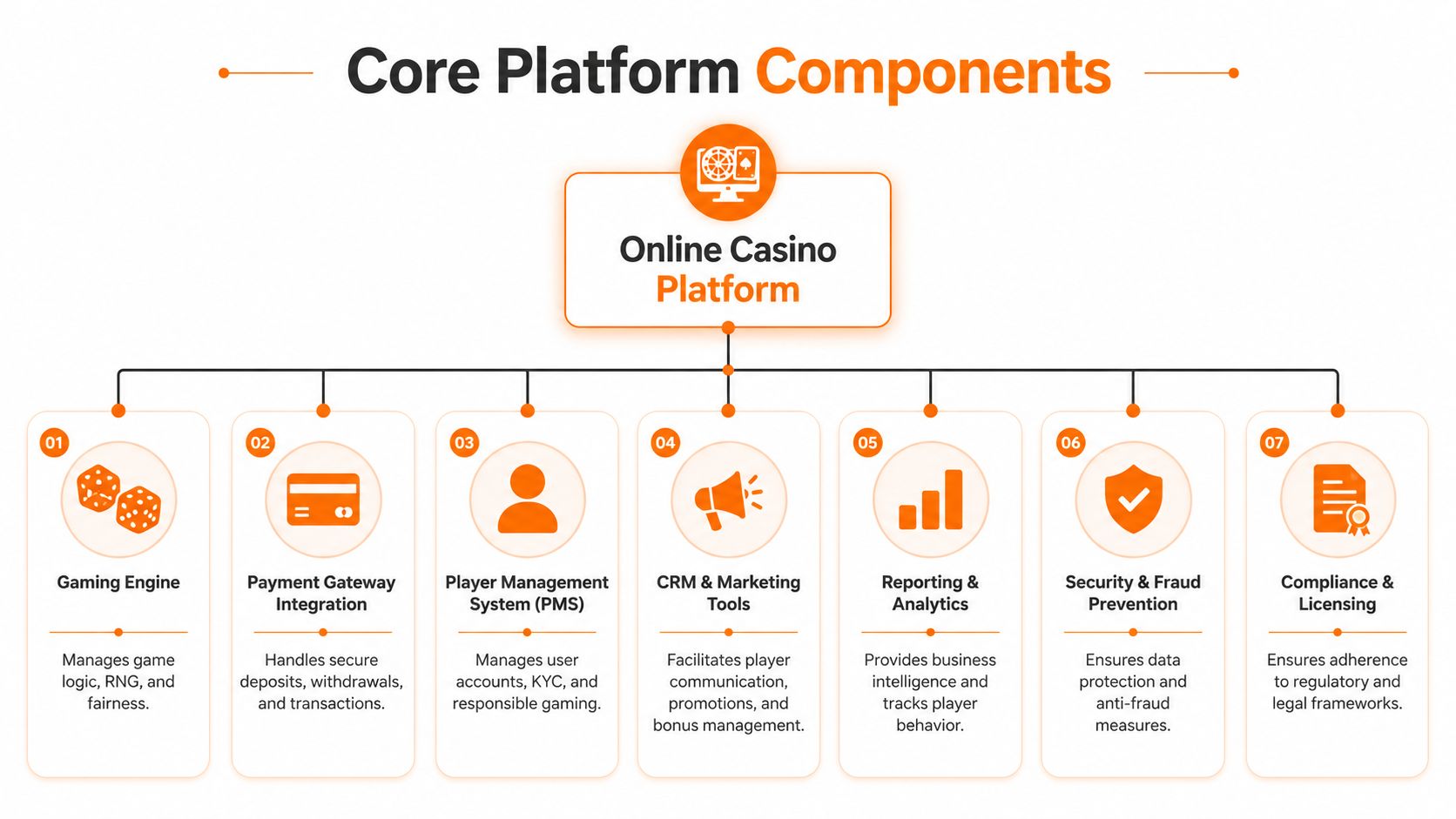
At minimum, the platform needs these working layers:
- Gaming engine: This handles game sessions, RNG-backed content, launch flows, round states, and settlement events.
- Sportsbook layer: This manages odds feeds, market suspension, bet acceptance, settlement rules, and risk controls.
- Player management system: Account creation, login, limits, verification state, segmentation, and account restrictions all live here.
- Payments and cashier: Deposits, withdrawals, pending states, failure handling, and currency support sit in this layer.
- Compliance tools: KYC, AML reviews, source-of-funds workflows, self-exclusion, and audit visibility belong here.
- CRM and bonus engine: Promotions work only when wallet rules, game eligibility, abuse controls, and expiry logic are aligned.
- Back office: Support, fraud, payments, retention, and compliance teams need one command center, not scattered admin panels.
If you're evaluating vendors, a platform architecture comparison for operators is useful. Not because diagrams win deals, but because fragmented stacks create operational drag quickly.
Where operators get burned on the wallet layer
The wallet is the most misunderstood component in online casino software development. Everyone wants “one wallet” because it sounds clean. Players like one balance. Marketing likes one account. Finance likes one top-line ledger.
But a unified wallet becomes harder when it handles both crypto and fiat.
Operators frequently struggle with the operational risk of a single player wallet for both volatile cryptocurrencies and stable fiat currencies, and turnkey solutions often avoid detailed answers on real-time conversion and settlement risks without segregated ledgers, which creates problems in preventing cross-asset fraud, as described in KodeDice's discussion of casino software provider challenges.
That operational friction shows up in practical ways:
- Conversion ambiguity: A player deposits in crypto, wagers in another display currency, and requests withdrawal after price movement. Your backend needs consistent rules for valuation and settlement.
- Fraud exposure: If asset types share the wrong accounting path, attackers look for timing gaps between conversion, bonus triggers, and withdrawal processing.
- Support disputes: If your support team can't explain balance history in plain terms, dispute volume rises fast.
Don't accept “multi-currency support” as an answer. Ask whether the wallet uses one logical balance with separate accounting treatment underneath, or whether everything is mixed into one opaque ledger.
The back office is where profit control happens
Operators love to talk about game content. Operations teams care more about the back office because that's where margin leaks are stopped.
A usable back office should let teams answer questions quickly. Why was this withdrawal held? Why did this bonus convert? Why is this player blocked in one market but not another? Which provider returned a disputed result? If the answer requires engineering intervention every time, the platform isn't mature.
A good command center should expose:
| Module | What your team needs to see | Why it matters |
|---|---|---|
| Player profile | Verification state, limits, segments, notes, exclusions | Support and compliance need one truth source |
| Wallet history | Deposits, withdrawals, wagers, bonus movements, adjustments | Finance and fraud teams need traceability |
| Risk controls | Velocity flags, behavior anomalies, payment triggers | Fraud prevention depends on early signals |
| Bonus administration | Eligibility, wagering logic, game restrictions | Promotions can destroy margin if rules are weak |
| Reporting layer | Operational, financial, and compliance views | Teams can't run blind |
If a vendor can't show these controls in a real admin flow, the “all-in-one” promise is probably stitched together from multiple systems.
Platform Architecture and Modern Tech Stacks
Architecture choices stop being technical trivia the moment traffic spikes, payments queue up, or one provider times out. That's when operators discover whether the platform was built to isolate failure or spread it.

Why monoliths struggle in iGaming
A monolithic platform puts too much in one runtime and one deployment path. That can work early, especially for a narrow product. It starts breaking down when casino sessions, sportsbook events, wallet updates, KYC decisions, and third-party integrations all compete for the same resources.
In iGaming, those failure modes are expensive. A laggy CMS page is annoying. A laggy bet settlement or delayed round result creates support cases, accounting issues, and possible audit trouble.
The architecture pressure is unusually high because modern platforms must do two things at once. They must log every random number call in a tamper-proof ledger and return game results in under 100 milliseconds, which is why vendors move toward microservices where RNG, game logic, and payment ledgers are isolated but coordinated, according to ITCRA's explanation of online casino software architecture.
What modern architecture actually buys you
When a vendor says “microservices,” don't treat it as a buzzword. Ask what problem it solves.
A well-designed microservices stack gives you operational advantages:
- Independent scaling: Slots traffic can surge without forcing the same scale pattern onto wallets, payments, or CRM tools.
- Safer releases: Teams can update a bonus service or payment adapter without redeploying the whole platform.
- Clearer fault boundaries: If one provider integration misbehaves, circuit breakers and service isolation can stop the issue from spreading.
- Audit integrity: Separate ledger logic protects money movement from game presentation logic.
Another layer matters just as much. Many modern casino backends use event-driven architecture with Kafka or NATS for asynchronous game-event propagation and WebSockets for persistent real-time connections, while observability stacks track metrics such as RTP drift, round settlement latency, and rollback rates with tools like Prometheus and Grafana, as outlined in SDLC Corp's backend architecture practices for casino games.
That stack tells you the team understands operational reality. Event streams help systems recover state. Persistent connections reduce communication overhead for real-time interactions. Observability helps teams spot fairness or settlement anomalies before they become public incidents.
A modern platform shouldn't just process events. It should explain them. If your ops team can't trace a wager from request to settlement to ledger entry, the architecture isn't ready for serious scale.
What to ask a vendor
Skip generic technology questions. Ask questions that expose engineering maturity.
- Failure isolation: What happens if a game provider slows down? Does the cashier still operate normally?
- Session recovery: If a player disconnects during a round, how is state replayed and confirmed?
- Observability: Which dashboards do ops teams see for settlement delays, rollback rates, and payment errors?
- Release discipline: Can the team deploy wallet changes independently from front-end promotions?
Good architecture isn't about sounding modern. It's about preserving fairness, uptime, and accounting discipline while the business keeps moving.
The Build vs Buy Decision Framework
The wrong way to make this decision is to ask, “Should we build or buy?” That's too vague. The useful question is this: which model gives you the right balance of control, speed, compliance ownership, and future migration flexibility?
What each path really means
A custom build gives you the most control. You define the product model, own the roadmap, and can shape the back office around your exact operating style. It also gives you full exposure to integration complexity, QA burden, certification work, and maintenance overhead.
A white-label setup gets you to market faster because much of the infrastructure is already assembled. The trade-off is dependence. Brand expression may be limited, product changes may wait on the provider, and moving away later can be painful if data portability is weak.
A turnkey solution sits in the middle. It usually provides a substantial core stack with more operator control than classic white-label, but not the full autonomy of a ground-up build. The key difference depends on what's pre-integrated and what remains configurable versus locked.
Build vs White-Label vs Turnkey Comparison
For many operators, a side-by-side framework is more useful than abstract pros and cons. A turnkey versus white-label versus custom comparison for iGaming operators is a helpful reference point when you're mapping trade-offs internally.
| Criteria | Custom Build | White-Label | Turnkey Solution |
|---|---|---|---|
| Time-to-market | Slowest path because architecture, integrations, and QA all start from zero | Fastest path for launch | Faster than custom, slower than the most restrictive white-label setups |
| Upfront cost profile | Highest exposure to engineering and specialist vendor costs | Lower initial technical spend | Moderate initial spend, depending on scope and included integrations |
| Brand customization | Deepest control across UX, logic, and workflows | Usually limited to the provider's framework | Broader than white-label, but still constrained by core platform rules |
| Operational control | Highest, if your team can actually support it | Lowest because the vendor owns more of the stack | Shared control, often enough for growing operators |
| Compliance burden | You own more of the implementation and evidence trail | Much of the infrastructure is pre-shaped by the provider | Shared burden, but operators still need to verify market fit carefully |
| Vendor dependency | Lower if your internal capability is strong | Highest | Moderate |
| Long-term flexibility | Strong, assuming the architecture was well planned | Often weakest | Better than white-label, weaker than full custom |
A practical way to choose
Use business conditions, not ideology.
Choose custom build if your strategy depends on proprietary flows, unusual wallet logic, or a differentiated operational model that packaged systems won't handle cleanly.
Choose white-label if speed matters most, your target market is narrow, and you're comfortable accepting provider constraints in exchange for launch efficiency.
Choose turnkey if you need a real operating platform, want faster rollout than custom, and still care about controlling payments, reporting, and migration paths.
A simple internal test helps. Ask your leadership team three questions:
- Where do we need unique control? Wallets, compliance workflows, VIP handling, product mix, or front-end only?
- What can we realistically operate? Many teams want custom power but don't have the in-house product, data, and engineering capacity.
- How likely is expansion? If entering additional regulated markets is part of the plan, today's shortcut can become tomorrow's expensive rebuild.
The best choice isn't the most complex one. It's the one your team can run without losing operational grip.
Navigating the Development Lifecycle and QA
Operators often think development is the hard part and testing is the cleanup step. In online casino software development, that thinking causes avoidable damage. QA isn't polish. QA is where financial correctness, fairness, and legal defensibility get proven.
The real development sequence
The work usually starts with commercial decisions, not coding. Which markets are in scope? What payment mix matters? Will sportsbook share the same account and wallet? Which restrictions must be visible at account level versus payment level?
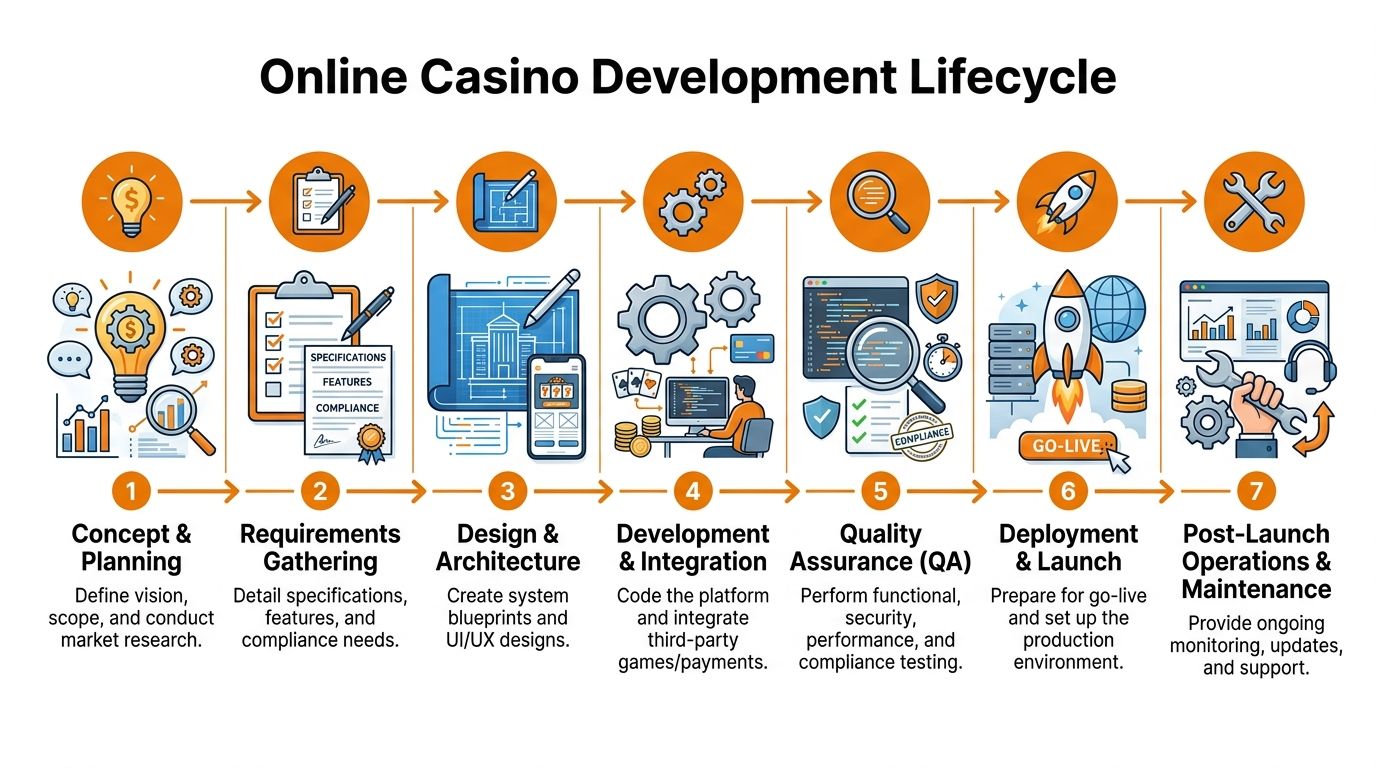
From there, the sequence becomes practical:
- Concept and planning. Product scope, target markets, payment model, and risk posture are defined.
- Requirements gathering. Compliance rules, wallet behavior, bonus logic, and provider dependencies are specified.
- Design and architecture. Data flows, service boundaries, player journeys, and admin tooling are mapped.
- Development and integration. Core platform modules connect to games, payments, KYC services, CRM tools, and reporting.
- Quality assurance. Functional, security, performance, and compliance checks expose what breaks under real operating conditions.
- Deployment and launch preparation. Production readiness, rollback plans, monitoring, and support workflows are finalized.
- Post-launch operations. Teams monitor incidents, tune payment routing, adjust risk rules, and handle provider or regulatory changes.
A short explainer can help non-technical stakeholders understand the flow before a build begins:
QA is where weak operators expose themselves
Generic software testing checks whether pages work. iGaming QA checks whether money, state, and restrictions stay correct under pressure.
That means the QA plan has to cover more than UI bugs:
- Game outcome integrity: Round initiation, settlement, interruption recovery, and replay behavior must all be consistent.
- Wallet correctness: Deposits, bonus credits, wagers, wins, reversals, and withdrawals need coherent ledger movement.
- Permission and restriction logic: Self-exclusion, limits, blocked markets, and verification states must override commercial flows when required.
- Provider failure handling: Timeouts, duplicate callbacks, partial settlements, and broken session resumes must not corrupt balances.
- Operational tooling: Support and compliance teams need to reproduce and inspect incidents without waiting on developers.
Launching without dispute-ready logs is the same as launching without customer support. You won't notice the gap on day one. You'll notice it the first time money goes missing in a player's story.
What good launch preparation looks like
A mature team treats go-live as the start of observation, not the end of delivery.
Use a launch readiness pass that includes:
- Monitoring setup: Real-time alerts for payment failures, session errors, settlement anomalies, and provider disruptions.
- Runbooks: Support, fraud, and payments teams should know exactly what to do when one flow stalls.
- Controlled release strategy: Limit variables at launch. Don't combine major promotions, new payment rails, and a fresh content rollout in one step.
- Post-launch review cadence: Early feedback from support and payments teams often reveals design problems faster than executive dashboards do.
Strong QA shortens the distance between incident and diagnosis. Weak QA turns ordinary platform issues into expensive reputational events.
Understanding Timelines and Cost Drivers
Most budget conversations start in the wrong place. Operators ask what the platform costs. They should ask what kind of complexity they're buying into.
The broad market backdrop is favorable. The online gambling market was estimated at USD 93.26 billion in 2024 and is expected to reach USD 153.21 billion by 2029, and the software layer now spans game creation, platform infrastructure, account management, KYC, payment processing, and bonus management, according to Software Mind's breakdown of casino software development features and practices. That growth attracts new operators, but it also hides how expensive the wrong architecture choices can become after launch.
Why quotes vary so much
You'll see a wide range in proposals because “platform development” can mean very different things. It might mean a lightly adapted white-label stack. It might mean a turnkey environment with some custom logic. Or it might mean a full custom platform with bespoke admin workflows and complex payment orchestration.
The published range is wide for a reason. Custom online casino software development is commonly cited between USD 50,000 and USD 500,000+, and the article above also notes the market's use of turnkey, white-label, and fully customized system models.
That range tempts operators to focus on features. That's where many budgets go wrong.
The hidden cost of entering more markets
The biggest cost driver often isn't content or design. It's regulation.
The variance in total development cost is driven more by regulatory complexity than by features, and compliance with MGA or US state laws requires distinct engineering for geofencing, audit logs, and responsible gaming modules, which can double the initial overhead when scaling to new jurisdictions, according to TIG Casino's analysis of online casino software development cost.
That changes how you should read vendor quotes.
A low quote may still be honest for one market, one payment model, and a narrow compliance posture. It stops being useful once you add market-specific restrictions, localized reports, player data separation rules, or different responsible gaming requirements.
Common cost multipliers include:
- Jurisdiction-specific logic: The same registration and cashier flow can't always be reused unchanged across markets.
- Reporting obligations: Audit expectations can force deeper logging, retention rules, and admin controls.
- Payment geography: A cashier that works in one region often needs a different orchestration model elsewhere.
- Operational staffing: More markets usually mean more manual reviews, more exceptions, and more support edge cases.
If a proposal promises rapid launch across multiple regulated markets but doesn't break out compliance adaptation work, assume the engineering burden still exists. It's just hiding in future change requests.
How to budget like an operator, not a founder in a pitch deck
Useful budgeting separates three categories.
| Budget area | What it includes | What operators often miss |
|---|---|---|
| Initial build or setup | Platform access, configuration, integration work, front-end adaptation | Admin workflows and reporting depth |
| Compliance implementation | KYC flows, audit logging, responsible gaming controls, geofencing | Market-specific variations and evidence requirements |
| Ongoing operations | Maintenance, support, payment handling, game and service vendor management | The internal headcount needed to run the platform well |
The best budget isn't the cheapest one. It's the one that reflects your real operating model for the first market and the next one after that.
Your Go-Live Checklist for Platform Selection
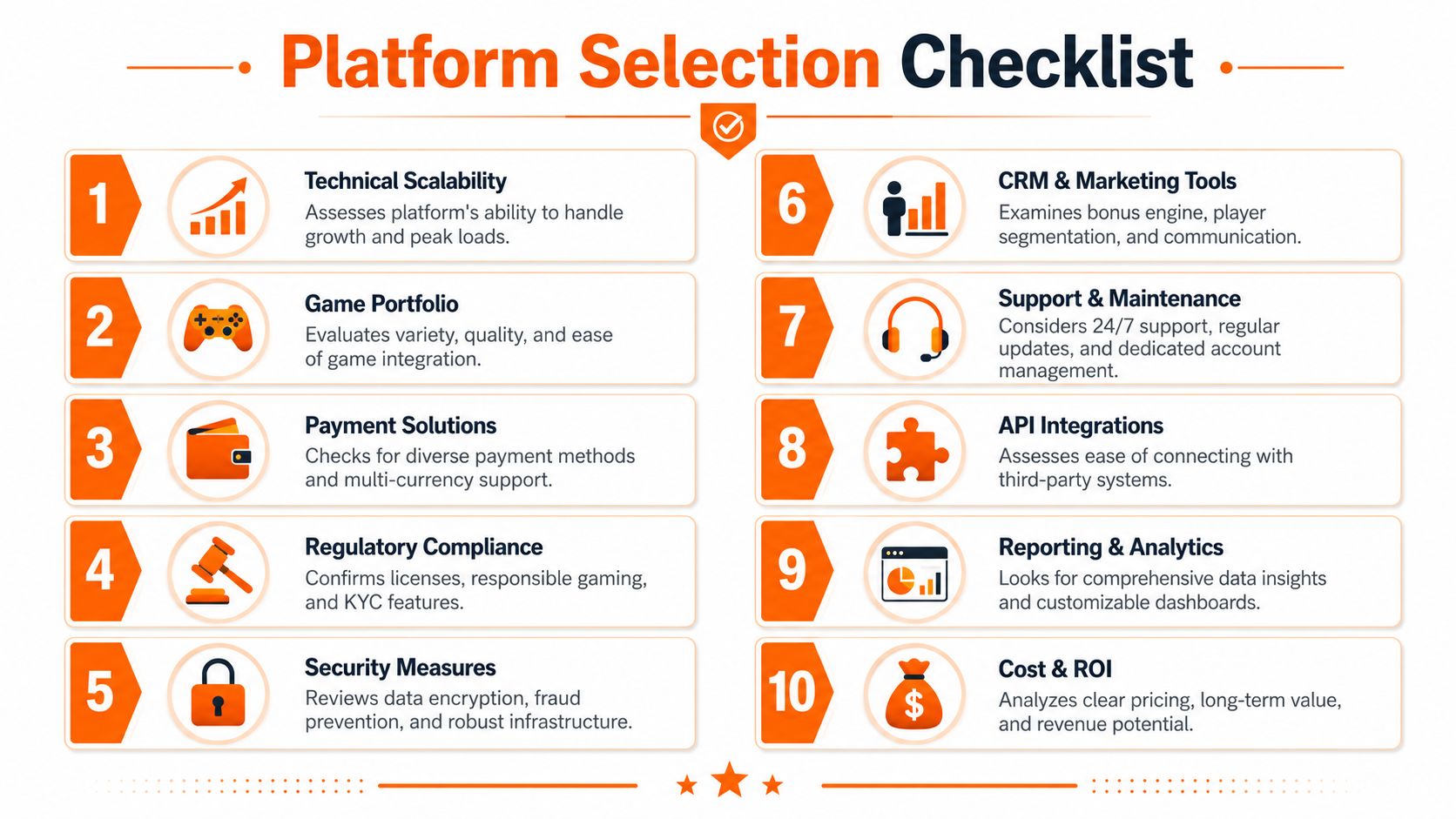
The final review should feel less like procurement and more like risk inspection. Once contracts are signed and migration work starts, your position weakens. Ask the hard questions before that point.
Technology and architecture questions
Start with the product's operating core. You're not checking for buzzwords. You're checking whether the platform behaves predictably under stress.
Ask questions like these:
- How is wallet traceability handled? You want to see deposit, wager, bonus, adjustment, and withdrawal history in a form support and finance teams can both understand.
- What happens during provider failure? A mature vendor can explain timeout behavior, retry logic, and round recovery clearly.
- Can services be updated independently? If every change requires a full-platform release, you'll inherit slow execution.
- What does monitoring show? Request sample dashboards, incident workflows, and examples of operational alerts.
A focused compliance and platform readiness reference for operators can help benchmark the questions, but you still need direct answers from the vendor in your own context.
Compliance and operational control questions
Vendors often drift into vague reassurance. Don't let them.
Use concrete prompts:
- Which jurisdictions has this exact compliance model been adapted for?
- How are geofencing, audit logs, and responsible gaming controls configured and reviewed?
- Can support staff see account restrictions, review outcomes, and payment holds in one admin flow?
- What evidence is available when a regulator or payment partner asks for transaction history?
- How are crypto and fiat wallet paths separated or reconciled operationally?
Good compliance tooling doesn't just block the wrong behavior. It gives your team a clean record of what happened, why it happened, and who approved it.
Commercial and partnership questions
Technology alone won't save a weak delivery model. Many launch problems come from unclear ownership between operator and provider.
Cover the partnership side directly:
- Who owns configuration changes after launch? If everything depends on vendor tickets, response speed matters more than slide decks.
- How are new market requests scoped? You want a repeatable method, not ad hoc promises.
- What does post-launch support look like during incidents? Ask who responds, how issues are escalated, and which teams are on the call.
- How portable is your data? If the relationship fails, exiting cleanly matters.
- What's excluded from the proposal? This answer often tells you more than what's included.
A strong vendor should be able to walk through these questions without hand-waving, especially around wallet design, reporting, and compliance adaptation. If they can't, you're not evaluating a platform. You're evaluating future operational debt.
NexGrate offers a practical route for operators who want a consolidated casino and sportsbook stack without stitching together games, payments, wallets, and compliance tools from multiple vendors. If you're comparing launch models and want to see how a white-label turnkey platform handles back office, crypto and fiat support, and multi-jurisdictional operational needs, review the NexGrate platform.