
Most advice about sports betting starts with picking winners. Inside sports betting means the operator's side of the counter, where a business posts a price, accepts risk, and pays valid winning tickets. Understanding that business requires more than knowing which team looks stronger. It requires following the same wager through market design, pricing, trading, settlement, and the controls that connect them.
Table of Contents
- Inside the Counter Not the Tip Sheet
- Pre-Match In-Play and Prop Markets Compared
- Odds Formats Margin and a Fair Price
- How a Trading Desk Holds the Book
- How Accepted Bets Are Settled
- The Systems Behind a Sportsbook Module
- Confirm the Book Before the First Bet
Inside the Counter Not the Tip Sheet
A bettor sees odds in the shop window. Behind the glass, the operator decides how much to accept, whether the price is still valid, and which rules will determine the payout. The visible number is only the offer, not the whole product.
Say a sportsbook prepares a soccer match for sale. Before its traders publish anything, the operations team must establish where the customer can bet and which markets the operator may offer. A player-prop template that works in one jurisdiction can be inappropriate in another.
The reason is structural: as a Yale School of Management paper.pdf) explains, PASPA, enacted in 1992, largely prohibited single-game sports betting outside Nevada until the Supreme Court invalidated it in Murphy v. NCAA on May 14, 2018, allowing states to make their own legalization decisions.
Rules before prices
The operator therefore needs a jurisdiction-specific operating configuration, not a national switch labeled legal. That configuration should govern:
- Market availability: Which sports, competitions, and bet types customers can access.
- Customer eligibility: Identity, location, account restrictions, and responsible-gambling blocks.
- Operating obligations: Licensing, tax treatment, advertising permissions, reporting, and record retention.
These controls belong in the transaction path. A compliance document doesn't stop an unavailable market from reaching a customer unless the software enforces it.
Operating principle: A price is an offer with conditions, not an unconditional promise to accept any stake.
Once those conditions are established, the operator can choose markets, calculate prices with a margin, manage exposure, grade tickets, and preserve evidence of each decision. These aren't separate departments doing unrelated work. A delayed suspension changes the bets accepted; those bets change liability; their acceptance records determine how disputes can be resolved.
The practical question is therefore harder than picking a winner: how can a book keep offering a price after informed money, late team news, and goals that arrive before the market suspends?
Pre-Match In-Play and Prop Markets Compared
Market families an operator has to run
| Market family | When offered | What is priced | Operator load | Main risk |
|---|---|---|---|---|
| Match result | Hours or days before start | 1X2, moneyline, spread, total | Odds feed plus manual limits | Stale price after late team news |
| Asian handicap and totals | Pre-match and in-play | Line and juice on one number | Continuous line moves | One-sided liability |
| In-play next event | During the event, often seconds | Next goal, corner, or race to a total | Sub-second updates and auto-suspend | Goal or score before the market closes |
| Player props | Mostly pre-match, sometimes live | A named player's points, shots, or cards | Many thin markets | Insider edges and athlete harassment |
| Outrights and futures | Season-long | Winner, top scorer, relegation | Long-lived exposure and settlement obligations | Early information and non-runner rules |
| Same-game parlay | Built from legs of one event | A combined price | A correlation model | Treating dependent legs as independent |
Start with markets you can maintain
Pre-match result markets are a manageable starting point because traders have time to inspect the feed, compare prices, and assign limits. In soccer, 1X2 means home win, draw, or away win. The main operational danger is accepting yesterday's assessment after today's team announcement.
Asian handicaps and totals add another decision: both the line and the price can move. Moving the handicap changes what the customer needs to win; changing the juice changes the return for the same outcome. Traders must distinguish those adjustments rather than treating every exposure problem as a reason to shorten odds.
Soccer makes live capability commercially important: ESPN's examination of the betting market places Europe's sports-betting market at approximately $33.75 billion in 2023, with soccer representing about one-third of sports-betting market share. For an international soccer-focused operator, live trading needs to be a planned capability, not an afterthought.
In-play is a sequence of short-lived markets, not one pre-match market with a changing price.
A next-goal offer expires when the relevant event happens. Its replacement requires a fresh event state, a fresh price, and a reliable reopening decision. A fast odds feed won't solve the problem if acceptance remains open against an outdated state.
More selection brings more obligations
Player props multiply the number of small markets traders must supervise. They also attach betting outcomes to identifiable people, creating a safety concern beyond suspicious pricing: customers can direct anger at an athlete when a performance bet loses. Market approval should therefore include athlete-protection and complaint-escalation rules.
Outrights keep tickets and exposure open across a season. Operators need explicit treatment for withdrawals, participation, and changes to competition status rather than assuming the final standings answer every settlement question.
Same-game parlays require a different model altogether. A team winning and its striker scoring aren't independent events, so multiplying their standalone prices doesn't produce a defensible combined offer.
For a launch, prioritize result, handicap, totals, and a defined live set. Introduce props and same-game parlays only when their additional models, grading rules, and protection controls are ready.
Odds Formats Margin and a Fair Price
The same price in four readings
The following is a hypothetical conversion exercise, not a statement about prevailing market prices.
| Decimal | Fractional | American | Where it shows up |
|---|---|---|---|
| 2.00 | 1/1 | +100 | Even money |
| 1.50 | 1/2 | -200 | Short favourite |
| 3.00 | 2/1 | +200 | Clear outsider |
| 1.91, rounded | 10/11 | -110 | Two-way juice example |
Decimal odds express total return including stake. Fractional odds express profit relative to stake. Positive American odds express profit against a reference stake, while negative American odds express the stake required for a reference profit.
The visual below aligns the formats around the same hypothetical even-money offer.
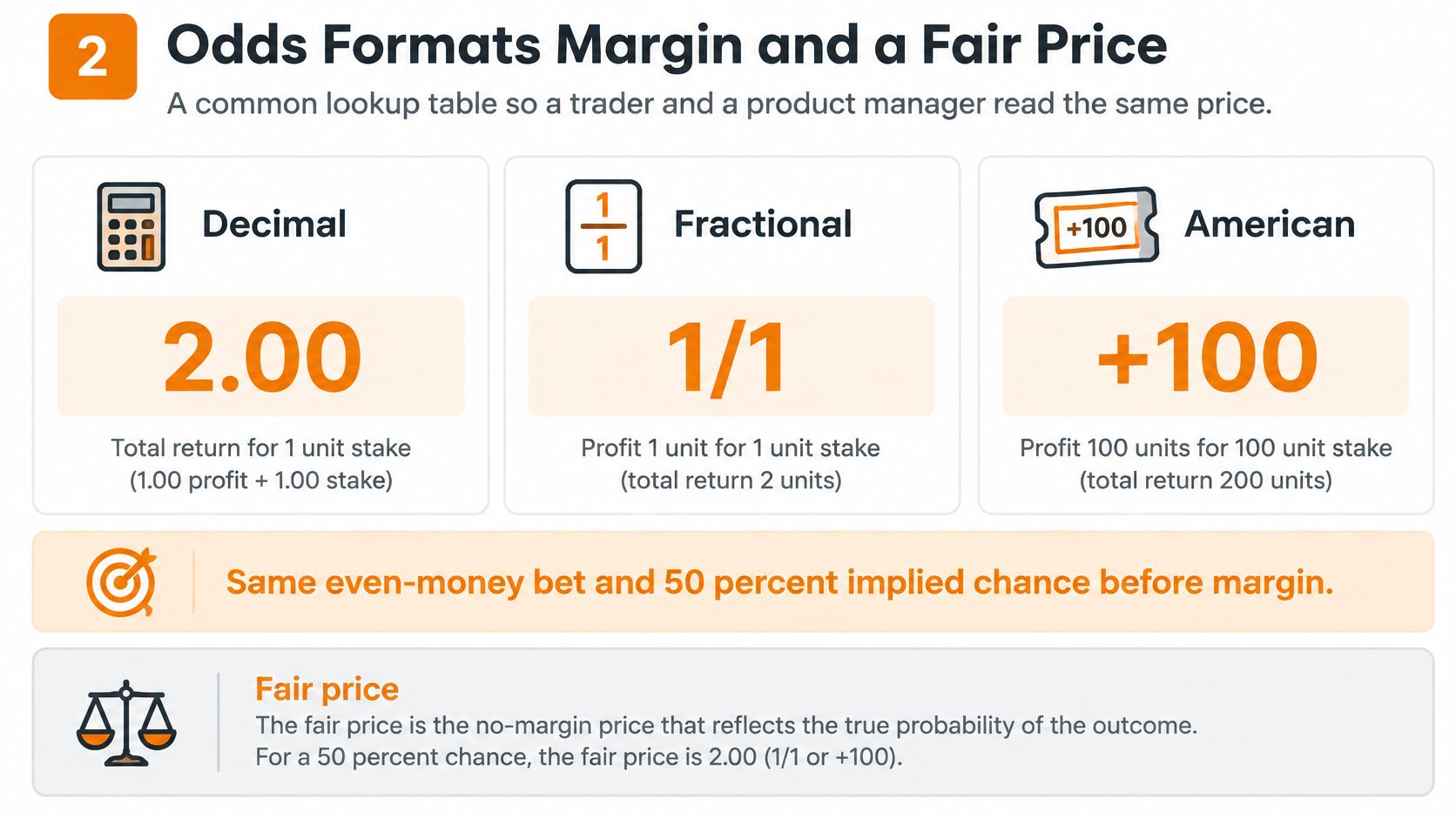
Convert the offer into probability
For decimal odds, calculate implied probability = one divided by decimal odds. In this exercise, decimal 2.00 implies 50%, decimal 1.50 implies about 66.7%, and decimal 3.00 implies about 33.3%. The rounded decimal 1.91 offer implies approximately 52.4%.
These are probabilities implied by prices, not independent evidence of the true chances. For a sport-specific explanation of reading an offer, Top 1 Rank's guide to understanding MPBL betting odds provides a useful companion to the operator calculation.
Now consider a hypothetical soccer market priced at 1.90 for home, 3.40 for draw, and 4.20 for away. Inverting those example prices gives approximately 52.6%, 29.4%, and 23.8%. Their sum is approximately 105.8%, producing an overround of about 5.8 percentage points.
That excess sits inside the prices. It isn't a separate fee applied when the customer withdraws.
Margin isn't guaranteed profit
A trader's fair price reflects an assessment of probability before the commercial adjustment. The offered price then incorporates margin, competitive positioning, and the risk the operator is willing to accept.
Thin props and long-lived futures may justify a wider cushion than a heavily traded match-result market because information is harder to validate and exposure can be harder to offset. Copying a competitor blindly imports both their commercial choices and any pricing error.
Pricing check: Calculate overround across a complete set of mutually exclusive outcomes, not across unrelated selections.
In the hypothetical probability exercise, a complete market summing below 100% would expose the operator to an arbitrage opportunity if customers could obtain sufficient stakes on every outcome. A sum at 100% leaves no built-in pricing margin. Neither calculation replaces liability management, and overround should never be reported as guaranteed realized revenue.
How a Trading Desk Holds the Book
Adverse selection means some bettors know something the posted price doesn't. Accepting their bets at an outdated price can cost the operator money even when the market appears to contain a healthy margin.
Generalized Shin-style pricing models indicate that bookmakers shorten quoted odds when they expect informed betting, and that sufficiently informed order flow can make a market unprofitable to offer. Those models also distinguish insider effects from disagreement among ordinary bettors, so an unusual favorite–longshot pattern isn't proof of manipulation.
The desk has distinct levers rather than a single response to every alert.
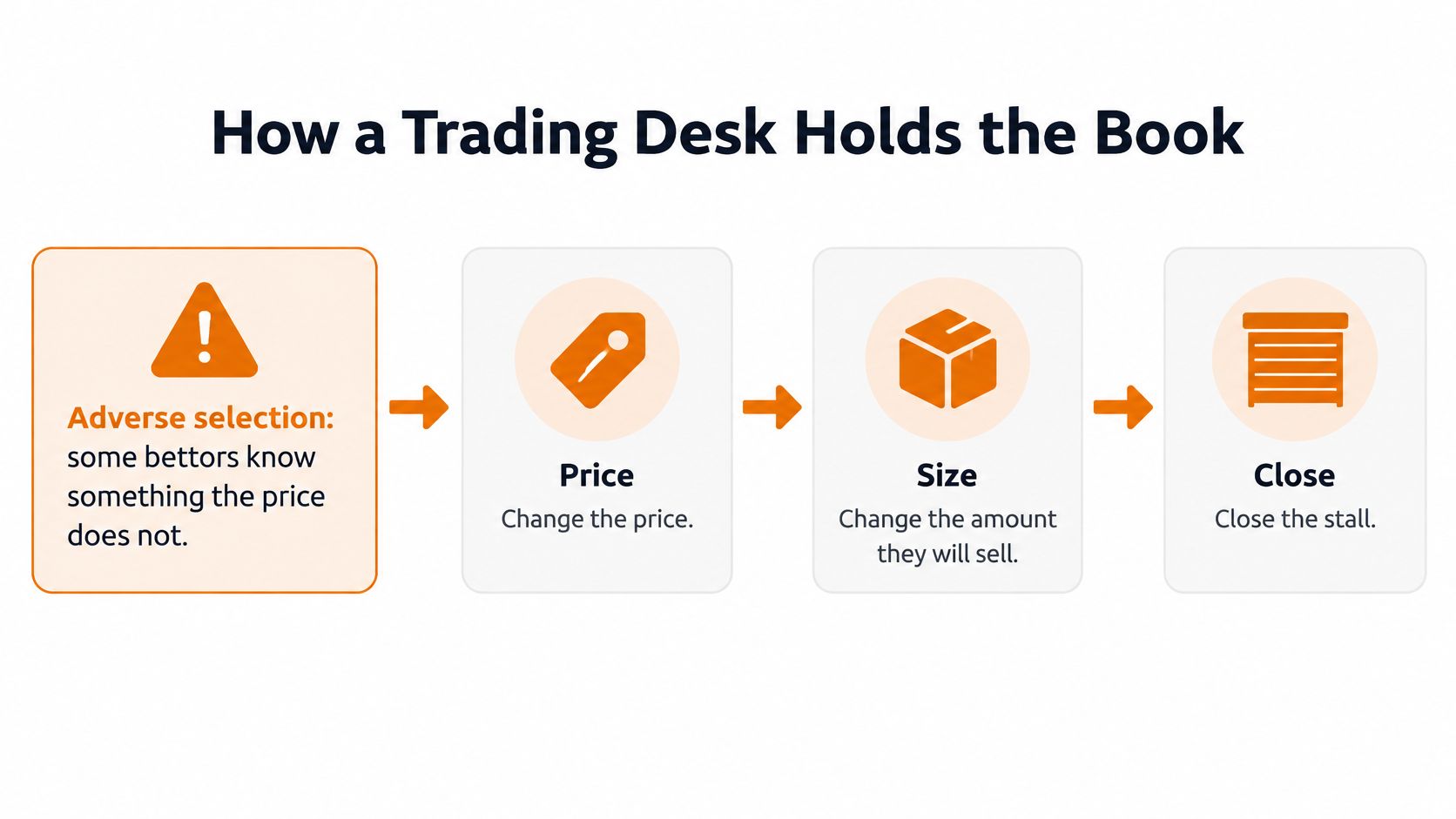
Match the action to the signal
Trading controls and when they fire
| Control | Signal | Action |
|---|---|---|
| Max stake and max payout | Every accepted bet | Refuse or cut the stake above the cap |
| Follow or shade the price | One side shortens quickly | Move the line and reduce limits on that side |
| Pre-news review | Correlated bets before public information | Hold pending requests for manual integrity review under published acceptance rules |
| Danger-state suspend | Set piece, VAR, or likely score | Auto-suspend and reject late requests |
| Account limit | Sustained history of beating the close | Review and lower limits for that account where justified and permitted |
A rapid shortening, often called a steam move, deserves investigation even when current liability is small. The desk should inspect market liquidity, timing, account relationships, and whether public news explains the movement. Following a price without checking its cause can spread an error.
Pre-news controls also require a clear distinction between a pending request and an accepted ticket. An operator shouldn't turn an accepted winning bet into a request awaiting approval.
For a broader operating framework, use the sportsbook risk-management guide to connect exposure monitoring with acceptance controls. The useful question isn't just how much the book could lose, but why customers are selecting this price now.
Protect the market and the participant
Account-level restrictions should follow a documented assessment, not an emotional reaction to a winning parlay. Consistently obtaining better odds than the closing price can justify review, but it doesn't establish misconduct.
Props need a separate response path. Cap exposure by athlete, define when a credible betting-linked threat triggers suspension, and send safety complaints to integrity staff rather than leaving them with traders alone.
Unusual price-sensitive betting is an information problem, not just a liability-threshold problem.
A static maximum stake won't hold a live soccer book when the event state is wrong. The operator needs automatic suspension plus a named owner who can investigate and authorize reopening.
Use this video alongside the trigger-and-action checklist when reviewing trading workflows.
How Accepted Bets Are Settled
Settlement means grading an accepted ticket against published rules and an agreed result. It isn't a trader deciding whether a customer deserves payment, and it shouldn't depend on whether the customer is profitable.
The acceptance-to-payout path needs an explicit record at every handoff.
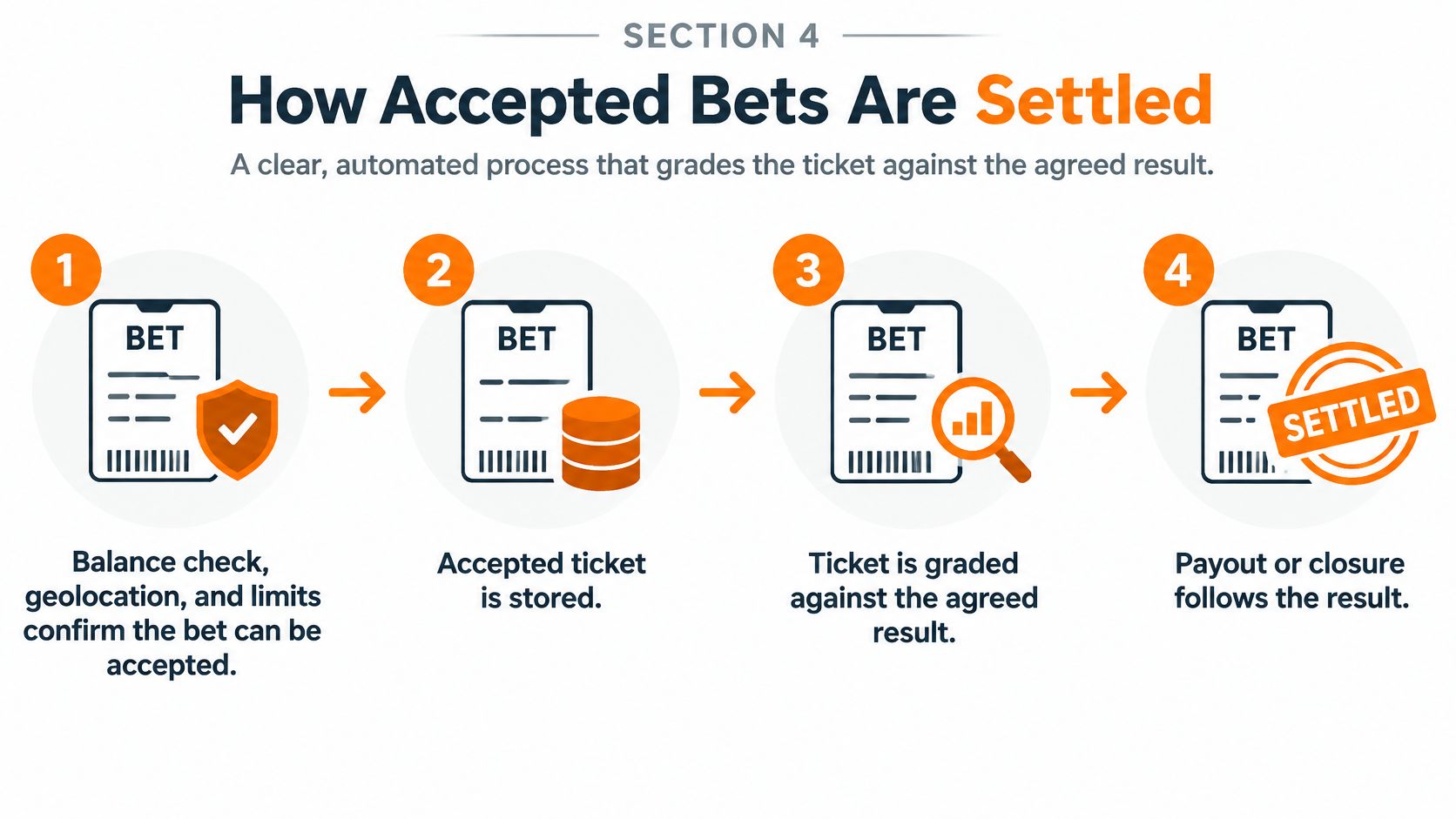
Follow the ticket through grading
Validate and accept. Check balance, eligibility, geolocation, and applicable limits before confirming the wager. Lock the stake and store the accepted terms so a later odds change can't rewrite the ticket.
The ticket remains open while the event proceeds. Cash-out, when available, is a separate offer to close the customer's position at a new value, not payment under the original winning conditions.
Apply the designated result. The settlement service or authorized team grades the selection as win, lose, push, or void using the result source and market rules specified for that product.
A push returns the stake because the result lands on the relevant line. A void returns it because a published condition invalidates the wager, such as non-participation in a prop whose rules require the athlete to enter the game.
Post the wallet entry. Credit the appropriate return and attach the transaction to the original ticket. Preserve the acceptance odds, not merely the price displayed when the match ended.
Control any resettlement. A corrected result or premature grading can require reversal and regrading. Require a reason code, authorized access, linked ledger entries, and customer notification rather than editing a balance without notice.
Resolve timing disputes with evidence
Push and void can produce the same financial return while representing different contractual outcomes. Keep separate reason codes so customer support can explain what happened and reporting can distinguish normal results from exceptions.
A live bet received after a decisive event presents another issue. If the book failed to suspend, apply the published late-bet rule only when reliable timestamps and event evidence establish that the rule applies. Don't assume every wager near a goal is invalid.
The compliance-reporting guide is relevant to how these decisions are documented: the record should show the original grade, the correction, the authorization, and the resulting balance movement.
Before accepting any market, publish its grading conditions and test them against awkward outcomes. Customer support shouldn't have to invent the rule after a disputed ticket wins.
The Systems Behind a Sportsbook Module
A sportsbook needs connected services, not just an odds screen. A practical transaction map separates the responsibilities that must agree before money moves:
- Odds and trading: Publish prices, availability, suspensions, and risk settings.
- Bet acceptance: Check identity, location, eligibility, balance, and limits, then create a durable accepted ticket.
- Wallet and ledger: Reserve stakes and record returns through linked transactions.
- Settlement: Apply results and versioned market rules to the accepted contract.
- Compliance and audit: Preserve evidence, monitor exceptions, and support investigation.
Risk calculations connect to both trading and acceptance. The diagram shows that relationship around the central module.
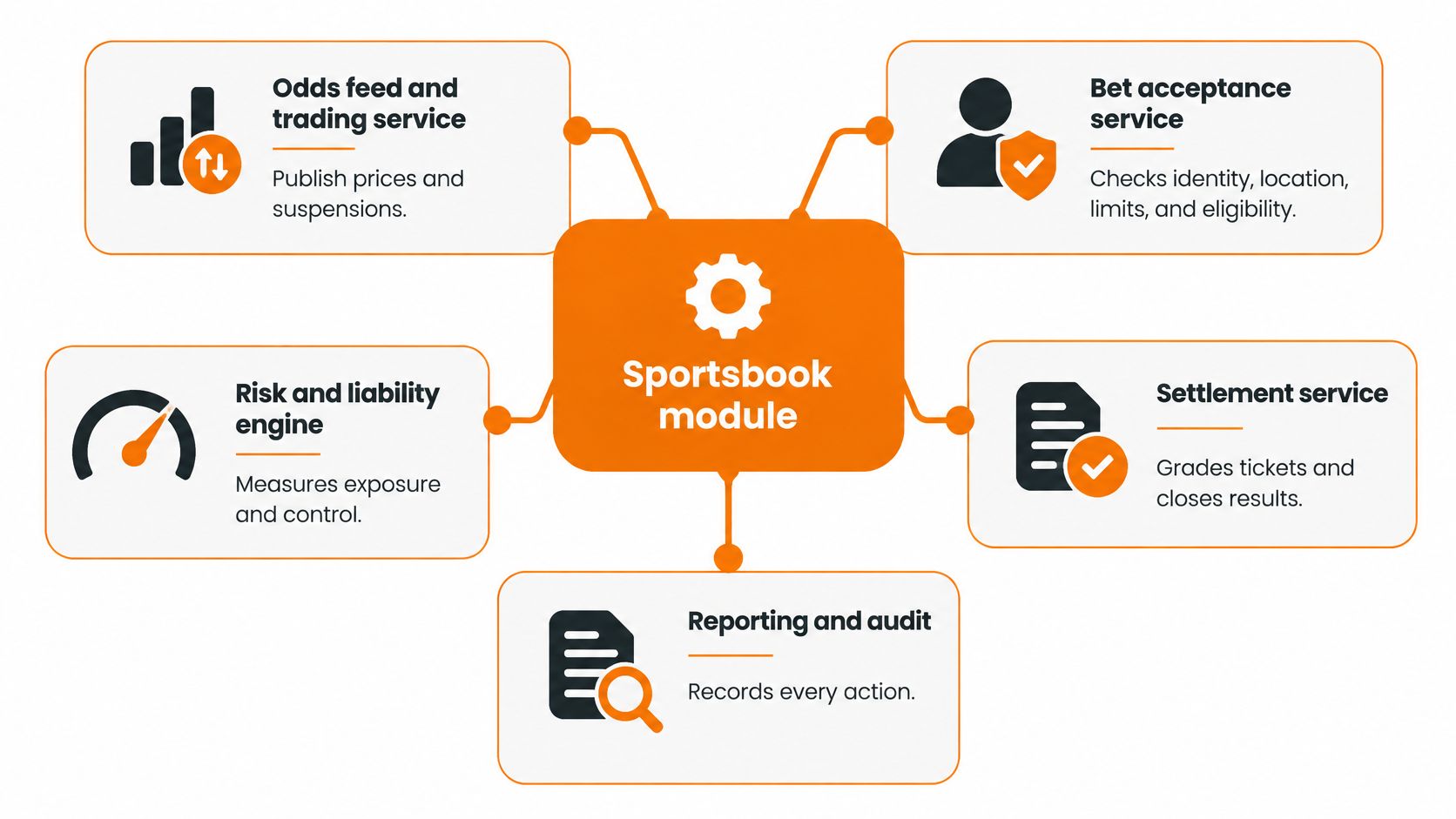
Make integration boundaries explicit
A sportsbook API connects market and bet functions, but the operator must still map ownership of each decision. Specify which service controls funds, which publishes suspensions, and which can reject a transaction.
The cashier layer handles permitted card, bank, or crypto payment routes. KYC and AML workflows support account verification and financial monitoring; geofencing determines location eligibility; responsible-gambling restrictions must reach acceptance before another wager is approved.
Retries deserve special attention. If an acceptance request times out, repeating it must retrieve or complete the original transaction rather than creating another ticket or reserving the stake again. Use stable transaction identifiers and reconciliation queues for uncertain outcomes.
Preserve evidence without presuming guilt
The audit record should include account and device identifiers, location, timestamps, odds snapshots, suspensions, deposits, withdrawals, and account relationships. Keep correction histories for editable records while preserving the original accepted ticket.
A 2025 econometric critique in The Manchester School challenges estimates that 3%–6% of money wagered on professional tennis and European soccer comes from insiders, arguing that the estimation method can return positive insider estimates even without insider trading. Bookmaker costs and competition can also explain pricing variation.
That argument doesn't eliminate integrity risk. It establishes why an odds move alone isn't enough to accuse someone: investigators need to compare activity with ordinary liquidity and price discovery, then examine financial and relationship evidence.
A particularly damaging integration failure occurs when the external sportsbook balance disagrees with the casino wallet. Customers can see inconsistent available funds, while staff struggle to identify which system owns the liability.
The build test is concrete: trace a ticket from the price shown through reservation, grading, and payout using linked records, without reconstructing the transaction from disconnected screenshots.
Confirm the Book Before the First Bet
A launch decision should depend on demonstrated controls, not the size of the market catalogue. Approve the book only when the operating team can complete these confirmations in order.
Confirm the product boundary. Keep the opening catalogue small enough for traders, settlement staff, and support to manage. Leave props and same-game parlays disabled until the relevant correlation, participation, and athlete-protection rules have passed testing.
Confirm the pricing behavior. Have traders demonstrate the margin calculation for each market template and run event scenarios that require suspension. Test feed interruption, delayed team news, and reopening after an uncertain score.
Confirm the customer contract. Require published grading rules and a stored acceptance snapshot. Run disputes through customer support before launch so staff can explain a push, void, or correction using the actual ticket record.
Confirm the financial boundary. Reconcile sportsbook transactions with the wallet and, where relevant, casino activity. Demonstrate that location restrictions and responsible-gambling blocks prevent acceptance rather than merely generating alerts afterward.
Choose the delivery route against those checks
A multi-vendor build gives the operator separate integration responsibilities for feeds, acceptance, payments, and compliance. A turnkey approach is the alternative when the business doesn't want to assemble those components independently.
NexGrate is a turnkey white-label casino and sportsbook platform that operators can use to launch and scale their own brands. We include a sportsbook API among our products; use the confirmations above as acceptance criteria when evaluating the proposed operating configuration.
Open only where the licence, tax treatment, permitted markets, and enforceable controls align. A launch date isn't a reason to accept a bet the operation can't price, document, or settle correctly.
NexGrate offers a turnkey white-label casino and sportsbook platform for operators building their own brands. Visit NexGrate to discuss your market catalogue, wallet requirements, and jurisdiction-specific controls, and use a traceable test wager as a concrete acceptance requirement for your launch.