
You've got a brand concept, a target market and a platform proposal that promises games, payments and compliance in one package. The demo looks convincing. But the agreement still doesn't clearly say who approves a suspicious withdrawal, who answers the regulator or what happens to player accounts when you leave.
That's the key buying decision behind a white label casino. You're not just choosing software. You're allocating regulated responsibilities and deciding how much operational independence to retain.
Table of Contents
- What a White Label Casino Is
- White Label Models Compared at a Glance
- Pros, Cons and Time-to-Market Gains
- Who Carries Compliance Risk
- Technical Checks Before You Sign
- Vendor Selection and Exit Terms
- Shortlist Vendors and Start This Week
What a White Label Casino Is
A white label casino works like a restaurant brand serving its own menu from a shared commercial kitchen. The restaurant supplies its identity and attracts customers; the kitchen owner supplies equipment, operating processes and food-safety credentials. The analogy helps explain the arrangement, but gambling permissions still need checking market by market.

The brand partner contracts for a ready-built casino, including games, wallet, payments, back office and compliance tooling, then adds its identity and promotions. Separate the arrangement into distinct layers:
- Brand: Name, design, promotions and player relationship.
- Platform: Game aggregation, wallet, payments, identity verification and risk rules.
- Licence: Regulatory accountability for conducting the gambling activity.
In the UK, the licence attaches to the operator conducting gambling, rather than independently to every website brand. UK Gambling Commission reporting for 2019–20 identified more than 700 white-label partners, according to the European online gaming market report. That's a historical benchmark, not a current national count; the report identifies no newer official total.
Draw the ownership boundary
Shared infrastructure doesn't remove customer due diligence, responsible-gambling, advertising, complaints or anti-money-laundering obligations. The licensed operator remains accountable, while the brand partner's duties need explicit contractual allocation.
RNC Group's resource on understanding white-label liability is useful context for reviewing the commercial agreement, alongside jurisdiction-specific gambling advice.
Before comparing platforms, sketch the layers your business would own, control and rent. Those aren't interchangeable positions.
White Label Models Compared at a Glance
| Model | Who Controls the Brand | Who Runs the Stack | Typical Time to Launch | Best Fit |
|---|---|---|---|---|
| Full turnkey white label | Partner controls brand, design and marketing | Provider supplies games, payments, licence-backed platform and compliance tooling | Shortest build scope when existing approvals and integrations cover the launch | New brands without an engineering team |
| Managed white label with custom front end | Partner controls brand, front end and promotions | Provider operates back office, wallet, content aggregation and agreed operations | Additional front-end development and acceptance testing | Brands needing a distinct player experience |
| Content-only aggregation | Operator controls game selection and front end | Operator runs wallet, KYC, payments and reporting; aggregator supplies content access | Broad integration scope when operator systems aren't already operational | Operators with technology and compliance staff |
| Direct licence with own platform | Operator controls brand and holds the licence | Operator contracts infrastructure separately | Schedule set by licensing, certification and infrastructure readiness | Established operators with a team and expansion plans |
White label models compared by control, speed and fit should be read as an ownership comparison, not a delivery guarantee. There isn't a reliable market-wide launch benchmark here. Require a schedule built around your actual approvals and integrations.
What each model buys you
Full turnkey white label buys operational consolidation. It suits a team whose immediate work is positioning, acquisition and customer service rather than platform engineering. Confirm what “managed” includes: hosting alone isn't equivalent to payment operations, customer support or compliance case handling.
A managed white label with a custom front end gives designers more room without transferring the entire back end. The hidden work sits at the interface boundary. Registration errors, bonus displays, cashier states and self-exclusion messages must remain consistent with the underlying account controls.
Content-only aggregation isn't a complete white label operating model. It solves access to games while leaving the operator responsible for surrounding systems. It can be straightforward for an established operator with a functioning wallet, but substantial work for a business starting without one.
A direct licence with an own platform separates regulatory ownership from infrastructure procurement. “Own platform” needn't mean writing every component internally. It means your organisation controls the architecture and supplier relationships, with staff capable of governing them.
Choose against your operating capability
Start with your licensing position, engineering capacity and intended markets. An existing licence can change the appropriate procurement route; an absent engineering team can make a highly configurable platform impractical to operate.
Selection rule: Choose the model your team can govern after launch, not the one that gives you the most impressive demo.
For every claimed control, ask for its contractual basis. If you can change a screen but not the underlying workflow, you control presentation, not the product behaviour that matters.
Pros, Cons and Time-to-Market Gains
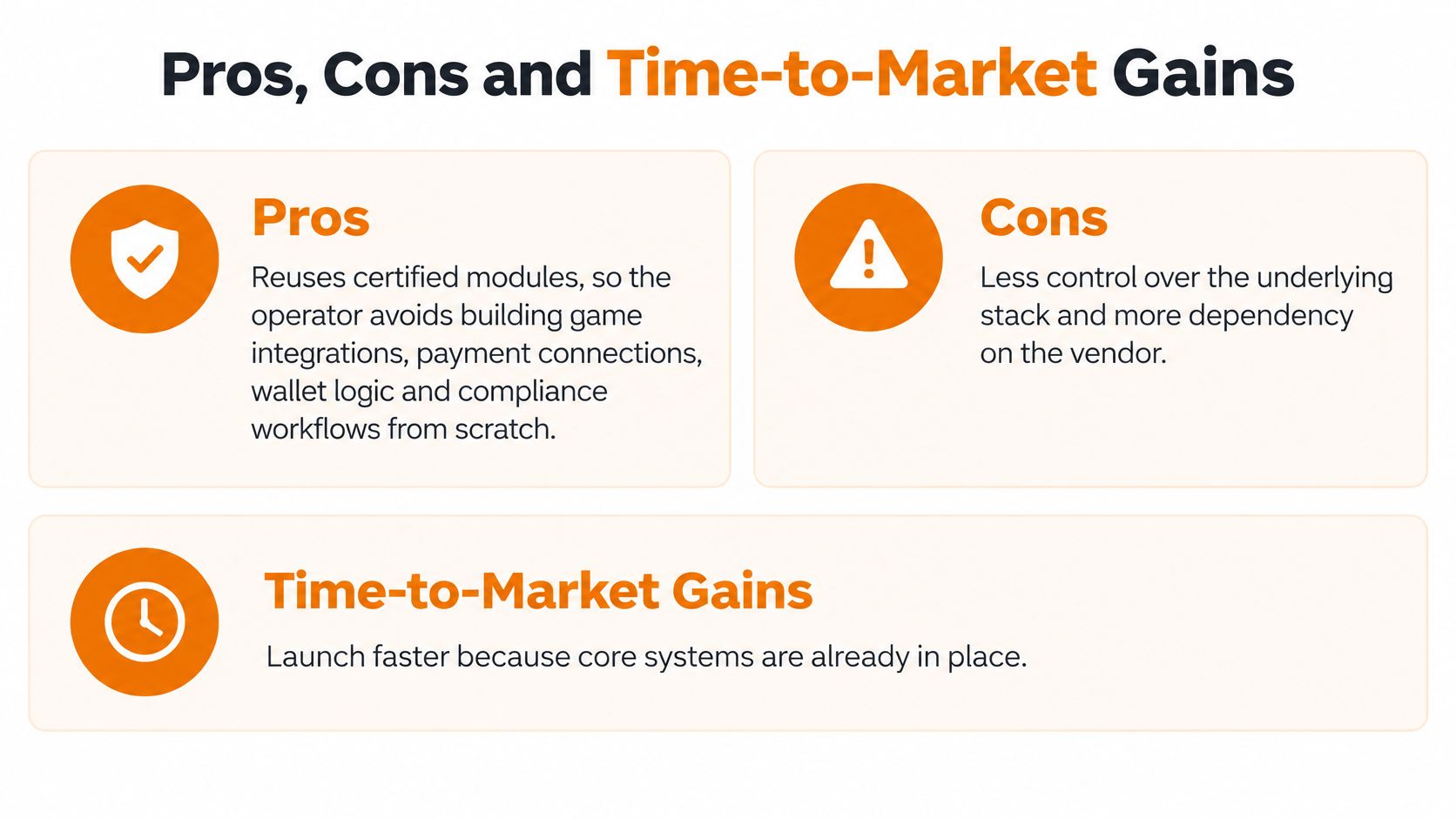
The strongest argument for a white label casino is reuse. Where modules are already integrated and appropriately certified, you don't need to rebuild game connections, payment interfaces, wallet logic and compliance workflows from scratch. You still need to establish that their approved scope matches your launch.
The operational trade-off is straightforward:
What a credible launch sequence looks like
Say a crypto-focused brand wants to enter a regulated market. Its first task is confirming whether the proposed payment model is permitted there, not selecting wallet graphics. After that, the team can agree the operating structure, prepare brand assets, configure permitted content and payment methods, then complete testing and compliance sign-off.
That's an illustrative sequence, not a promised timeline. A missing payment approval or unresolved operating responsibility can prevent launch even when the website is ready.
The useful efficiencies are specific:
- Less integration work: Prebuilt adapters reduce the interfaces your engineers must maintain.
- Fewer supplier relationships: A consolidated service can simplify incident coordination.
- Shared operational tools: Staff can work through connected account, risk and reporting workflows.
- Lower fixed engineering commitment: You can purchase platform capability rather than recruit every specialist internally.
None of those benefits guarantees a lower total operating cost. They change which costs you incur and who controls the work.
Price the constraints as well as the service
Other brands may use the same templates and mechanics, limiting differentiation. Your team also relies on the provider's uptime, release priorities and willingness to develop custom features. A commercially successful promotion can still wait behind another customer's roadmap request.
Request a pricing schedule covering setup and integration fees, monthly minimums, revenue share or margin charges, payment processing, and per-market licensing or certification work. Mark every unquoted item as unpriced, rather than treating an omission as free.
Require definitions for the revenue-share calculation, deductions, minimum commitments and termination charges. Then model the agreement under your own operating assumptions, including a disappointing launch and a successful expansion.
A lower initial engineering bill isn't the same thing as a cheaper business over its lifetime.
If your advantage is distribution and marketing, shared technology may be a sensible compromise. If your advantage is a proprietary player experience, examine feature ownership, release rights and custom-development terms before committing.
Who Carries Compliance Risk
A provider's licence doesn't automatically transfer every compliance risk away from the brand. Regulatory accountability, delegated operational work and contractual compensation are separate questions. A commercial indemnity doesn't rewrite the regulator's powers.
Payment relationships deserve particular scrutiny. A Finextra commentary on gambling enforcement describes German requirements for banks and payment institutions to refuse accounts for unlicensed operators and report suspicious cases within 24 hours, with potential joint liability for unpaid taxes from January 2026 where processing continues after formal notice. Treat that commentary as a reason for local legal verification, not a substitute for it.
Compliance responsibilities in a white label setup
The following is a working allocation to negotiate, not a statement that the brand always holds the legal duty. Where the platform provider and licence holder are separate entities, name both.
| Responsibility | Usually Brand Owner | Usually Platform Provider | Confirm Before Signing |
|---|---|---|---|
| KYC and AML monitoring | Supplies relevant information and follows agreed escalation procedures | Provides workflows and checks; performs contracted monitoring | Licensed compliance owner, decision authority and escalation timeline |
| Marketing and affiliate approval | Produces campaigns and manages affiliates | Supplies approval records and tracking tools | Licence-holder approval, audit rights and takedown authority |
| Withdrawal freezes | Escalates suspicious cases through authorised staff | Provides hold and release functions | Who can decide, execute, review and communicate a hold |
| Regulator requests and notifications | Supplies brand records and supports responses | Produces technical exports and reports | Licence-holder response ownership and notification deadlines |
| Responsible-gambling tools | Handles agreed player communications and escalations | Supplies limits, exclusions and associated controls | Policy owner, testing evidence and intervention responsibility |
| Penalties when controls fail | Bears exposure attached to its conduct and legal role | Bears exposure attached to its conduct and legal role | Applicable law, indemnities, exclusions and recoverability |
Require evidence of decisions
A named owner needs access, authority and cover during absence. Assigning responsibility to a compliance department without identifying who can stop a campaign or restrict an account leaves an operational gap.
Use a defined compliance reporting process to connect alerts, investigations, decisions and retained evidence. Ask for a redacted case record showing who received an alert, what they reviewed and how they authorised the outcome.
The contract should also address subcontractors, regulator access, incident notification and preservation of records during disputes. An unanswered responsibility is a pre-signing issue, not something to resolve when a player complaint reaches the regulator.
Technical Checks Before You Sign
Evaluate the platform as a regulated critical-systems environment, not a branded front end. Customer records, balances, game states and administrative access need demonstrable controls, regardless of how polished the cashier looks.
The UK Gambling Commission's security requirements apply relevant ISO/IEC 27001:2022 controls to critical systems and require an annual independent security audit, with report submission within seven days in the specified request or major-non-conformity circumstances. Ask which systems, entities and services the audit covers.
Turn security claims into acceptance tests
A certification logo doesn't tell you whether your deployment is within scope. Request architecture diagrams, a control inventory and evidence against practical checks:
- Tenant isolation: Demonstrate that administrators for one brand can't access another brand's records.
- Least-privilege access: Separate support, finance, compliance and production-administration permissions.
- Protected audit records: Trace privileged actions and wallet changes to a user or service, timestamp and approval path.
- Encryption and secrets: Inspect protection for stored data, network traffic and production credentials.
- Environment separation: Keep development and test access distinct from production.
- Supplier controls: Identify the game, payment, identity-verification and hosting dependencies, including their failure procedures.
Ask the vendor to demonstrate an access revocation, investigate a balance discrepancy and retrieve a complete transaction trail. These exercises reveal more than a slide listing security features.
Your online casino software development requirements should make those tests contractual acceptance criteria. Specify the evidence required for approval and who can reject an incomplete result.
Verify game integrity separately
The UK Gambling Commission's random-outcomes standard requires acceptably random outputs supported by recognised statistical analysis and prohibits adaptive or compensated game behaviour. Don't accept a platform-wide fairness statement as evidence for every game configuration.
For each release, preserve the certified game version and record the identifier, configuration and round outcome. Check that players can access the applicable rules and probability information before committing to play.
Set launch gates covering supplier certification evidence, test results, version hashes, payout metadata and a tested rollback procedure. Treat live-dealer, RNG and virtual-event products according to their distinct result-recording needs.
A useful dispute test is to select a completed round and reconstruct what the player saw, what the game returned and how the wallet settled it. If the team can't reconcile those records, don't approve that integration for production.
Vendor Selection and Exit Terms
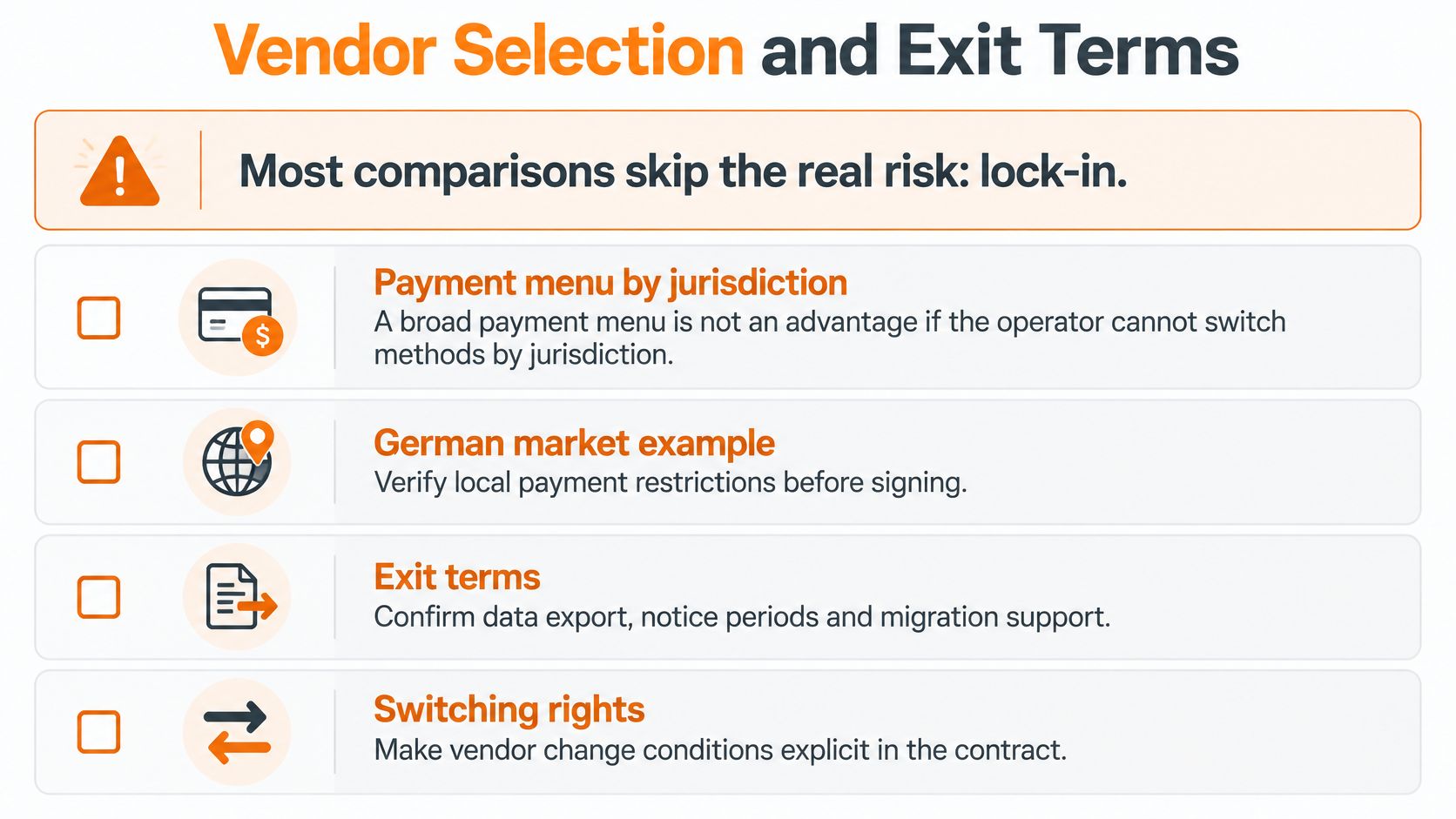
Lock-in is the procurement risk most platform comparisons understate. A broad payment menu has little value if you can't enable the right methods by jurisdiction, introduce another processor or retain usable transaction records when the relationship ends.
The Paypers' review of iGaming payment and compliance pressures highlights jurisdiction-specific payment restrictions and the monitoring demands associated with faster withdrawals. For a German launch, require a locally verified permitted-method matrix rather than assuming that a payment option available elsewhere is acceptable.
Use the following checklist to move the conversation from features to enforceable rights.
Put the exit questions in writing
- Can we export usable player and operational records? Request sample exports for wallet transactions, KYC status, bonuses and responsible-gambling controls, subject to lawful access and transfer.
- Can we add an independent payment provider? Identify integration rights, approval requirements and charges before payment concentration becomes a problem.
- Who settles pending withdrawals after termination? Allocate funding, execution, reconciliation and player communication through the transition.
- Are crypto and fiat workflows appropriately separated? Require clear treatment of screening, conversion, transaction tracing and accounting.
- How is payment-owner matching preserved? Test deposits and withdrawals across supported methods, including exception handling.
- What does migration to direct licensing cost? Include transition assistance, data preparation, testing and any continuing service commitment.
- Which markets and methods are approved for the proposed deployment? Request evidence tied to the contracting entity and actual configuration.
- What does the service-level agreement promise? Define uptime measurement, DDoS protection, incident escalation, recovery obligations and remedies.
Test portability before you need it
An export button isn't an exit plan. Have your technical team inspect field definitions, identifiers, timestamps, reconciliation references and documentation; have legal counsel confirm what can lawfully move and what must remain retained.
MR2 Solutions' guidance to select technology partners with confidence offers a broader procurement perspective. Apply it alongside documented vendor-management practices, with named owners for service reviews, unresolved risks and contract changes.
Exit test: Ask the vendor to explain how it would support a controlled departure while players still have balances and open cases.
The workable agreement preserves continuity without promising unrestricted transfer of everything. Payment accounts, identity records and player relationships each need their own legal and operational migration treatment.
Shortlist Vendors and Start This Week
Choose the model that matches your operating capability, then send every candidate the same written request. Don't let different sales presentations determine what you compare.
Keep the buying team focused on the operating arrangement behind the interface.

Build a comparable shortlist
- Define the deployment: State target markets, intended payment methods and expected brand structure.
- Assign responsibility: Complete the accountability map and flag every unresolved decision owner.
- Request technical evidence: Include audit scope, certification records, acceptance tests and game-release evidence.
- Document departure rights: Seek written answers on exports, withdrawals, migration assistance and termination charges.
- Compare written commitments: Keep candidates on a shared evaluation sheet, separating demonstrated capability from proposed development.
Include us as a candidate, not an exception to the process. NexGrate is a turnkey white-label casino and sportsbook platform that operators can use to launch and scale their own brands; our product pages cover Nex AI, Casino, Sportsbook API, Payments, Compliance and Markets.
Use the accompanying video as discussion material, not as a substitute for contractual evidence.
Ask operations, compliance, finance and engineering to review the same answers. A vendor shouldn't pass procurement because its strongest feature distracted the team from an unresolved regulatory or migration issue.
Send the shortlist request this week, with your market scope and evidence requirements attached. Advance candidates that answer clearly, and require written resolution of material gaps before signing.
NexGrate offers a turnkey white-label platform for launching and scaling casino and sportsbook brands. Visit NexGrate to discuss your proposed operating model, and bring your responsibility map, technical acceptance criteria and exit requirements to the conversation.