
It's a busy sports night. In-play markets are moving, the cashier queue is filling, and the lobby already shows thousands of player balances. One hot wallet is supposed to broadcast those withdrawals in minutes. If that wallet and the internal ledger drift apart, you don't have a cosmetic bug. You have unpaid players and a float you can no longer explain.
Crypto wallet management is the operating job, not another seed-phrase poster. What follows is the lifecycle a payments lead runs for casino and sportsbook funds.
Table of Contents
- What Crypto Wallet Management Means for Operators
- Custody Models for Hot Cold and Hosted Funds
- Key Lifecycle Controls Auditors Expect
- How to Reconcile Balances and Settle Payouts
- Withdrawal Policy APIs and Replay Protection
- KYC AML and Segregation of Player Funds
- Test Recovery Before You Raise Hot Wallet Limits
What Crypto Wallet Management Means for Operators
On a live card, the internal ledger can show thousands of player balances while one hot wallet clears withdrawals in minutes. Crypto wallet management is the set of decisions that keeps those two records aligned: who holds signing keys, which addresses receive deposits, how much value sits online, and which checks must pass before a payout leaves the platform.
Treat the balance a player sees in the lobby as an account, and the blockchain wallet as the settlement rail behind it. The lobby balance is the bar tab. The on-chain wallet is the cash drawer that pays the tab. Staff can rewrite the tab in the back office all night. Only a signer opens the drawer. When the drawer and the tab disagree, you stop paying until finance and payments name the break.
A missing key or a bad approval is an economic loss, not a password reset. A bank will not reverse the transfer.
Read the work in operating order. Put every coin into inbound deposits, the operating float, or reserves before you pick software. Then set key controls, run a shift reconciliation, and lock the API and spending rules. KYC and AML constraints come last because they change address design. A crypto casino software cashier can queue the requests. It still can't decide who may sign.
Custody Models for Hot Cold and Hosted Funds
Assign every coin to one pile before you buy a wallet product. Inbound deposits are waiting on confirmations. The hot float pays the next several hours, or one day, of net withdrawals. Reserves sit in cold storage or with a qualified host. Refill the hot float on a fixed schedule. Don't let whoever is on shift top it up because the queue looks loud.
| Model | Who controls keys | Best used for | Typical speed | Primary risk |
|---|---|---|---|---|
| Hot wallet | Operator, keys online | Deposits and same-day withdrawals | Minutes | Online theft or a bad approval |
| Cold wallet | Operator, keys offline or air-gapped | Reserves above the operating float | Hours to a scheduled window | Slow payouts or lost keys |
| Hosted custody | Third-party custodian | Regulated reserves and outsourced signing | Bound by the custodian SLA | Custodian outage or insolvency |
| Self-custody | Operator-held private keys | Full control of the player float | Set by the operator | Permanent loss if keys are lost |
| MPC | Key shares, threshold signing | Fast treasury moves without one full key | Near hot-wallet speed | Share collusion or signer downtime |
| Multisig | m-of-n independent keys | Large treasury moves and recovery | Policy-gated, often slower | A missing signer freezes funds |
Three piles, three failure modes
A hot wallet is the right drawer for player payouts because it can move in minutes. Cap it. Anything above the next shift's expected net payouts doesn't belong online.
Cold storage protects reserves, and it also stalls a sudden sportsbook cash-out when signers are offline. Write the window for scheduled moves, including who must be reachable and how long a refill is allowed to take.
Hosted custody can bring institutional process, and sometimes insurance. The brand still owes players if the custodian goes down or becomes insolvent. Self-custody keeps full control. It also means a lost or stolen key can make assets inaccessible, or transferable without your consent.
Estimates published in 2025 placed permanently lost Bitcoin at approximately 2.3 million to 3.7 million BTC, about 11%–18% of Bitcoin's fixed maximum supply of 21 million coins, according to the Ledger Academy. That isn't a precise ledger count. Bitcoin doesn't record whether a dormant address was forgotten, inherited badly, saved on purpose, or lost. Analysts infer probable loss from wallets with no movement for five to ten years or more. A narrower 2025 estimate put roughly 1.5 million to 2 million lost BTC on forgotten private keys. For a book that holds player deposits, the lesson is operational: name who controls signing keys, where backups live, how recovery is tested, and how dormant balances are reconciled.
MPC for speed, multisig for large moves
For treasury transfers, MPC uses threshold signing so no single device holds a full key. That suits fast, policy-based moves across chains, at a speed close to a hot wallet. Multisig requires several independent keys to co-sign. That suits large moves and recovery, with one hard edge: a lost signer freezes funds until a replacement is authorized.
Practical rule: Start with a hot wallet for player payouts, MPC or multisig for treasury transfers, and cold storage or a qualified host for reserves.
When reserves have to move as native assets rather than wrapped stand-ins, a Primevault integration for native asset transfers is a useful reference for how institutions keep the asset itself intact across chains. The custody model still decides who can approve that move.
Key Lifecycle Controls Auditors Expect
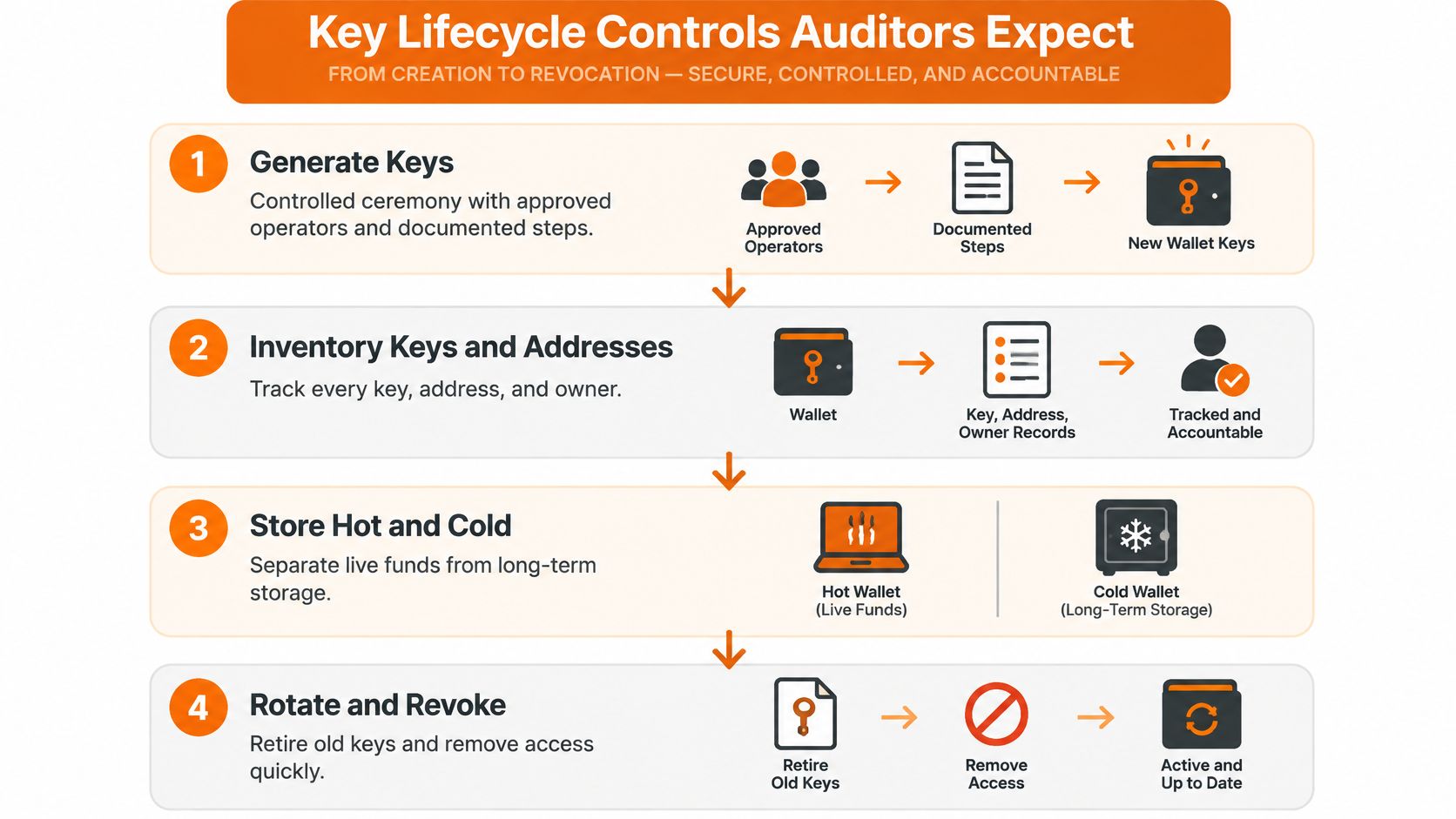
A wallet is a key lifecycle, not an address spreadsheet. NIST SP 800-57 covers generation, storage, distribution, use, backup, archiving, recovery, cryptoperiods, inventory, destruction, and compromise recovery. It also says private keys and sensitive key metadata must be protected from unauthorized disclosure or modification.
One job per key
Generate keys in a controlled ceremony, with named operators and a written script. Inventory every signing key and every address: chain, token, owner, purpose, and last reconciliation date. Include change addresses and retired deposit addresses. Those can still receive funds after you stop advertising them.
Store hot signers apart from treasury keys. Distribute access by role. A cashier can queue a payout and cannot sign it. No single engineer should both deploy the cashier and approve a treasury move. Use a key only for its job. NIST's point is plain: a key should be reachable only by an authorized entity and used only for its authorized purpose. A withdrawal-signing key must not encrypt databases or sign admin sessions.
Set a cryptoperiod, then archive what is no longer live. Destroy or rotate material that is retired or suspect.
A database dump is not a wallet backup
Wallet services should never treat a database backup as recovery. The copy has to hold encrypted key material, integrity checks, restore tests, access logs, and the metadata that identifies derivation paths, networks, and authorization scope. Without the path and the network, you can restore a blob and still not know which player deposits it can spend.
For compromise, write who can pause withdrawals, rotate the hot key, redirect new deposits, and notify finance. That pack is what an MGA-style audit, or a payments partner, will ask to see after an incident. The control isn't a slogan about seed phrases. It is who may sign, for what, and until when. Those records also shrink the blast radius of a compromised application server and make reconciliation evidence you can hand over.
How to Reconcile Balances and Settle Payouts
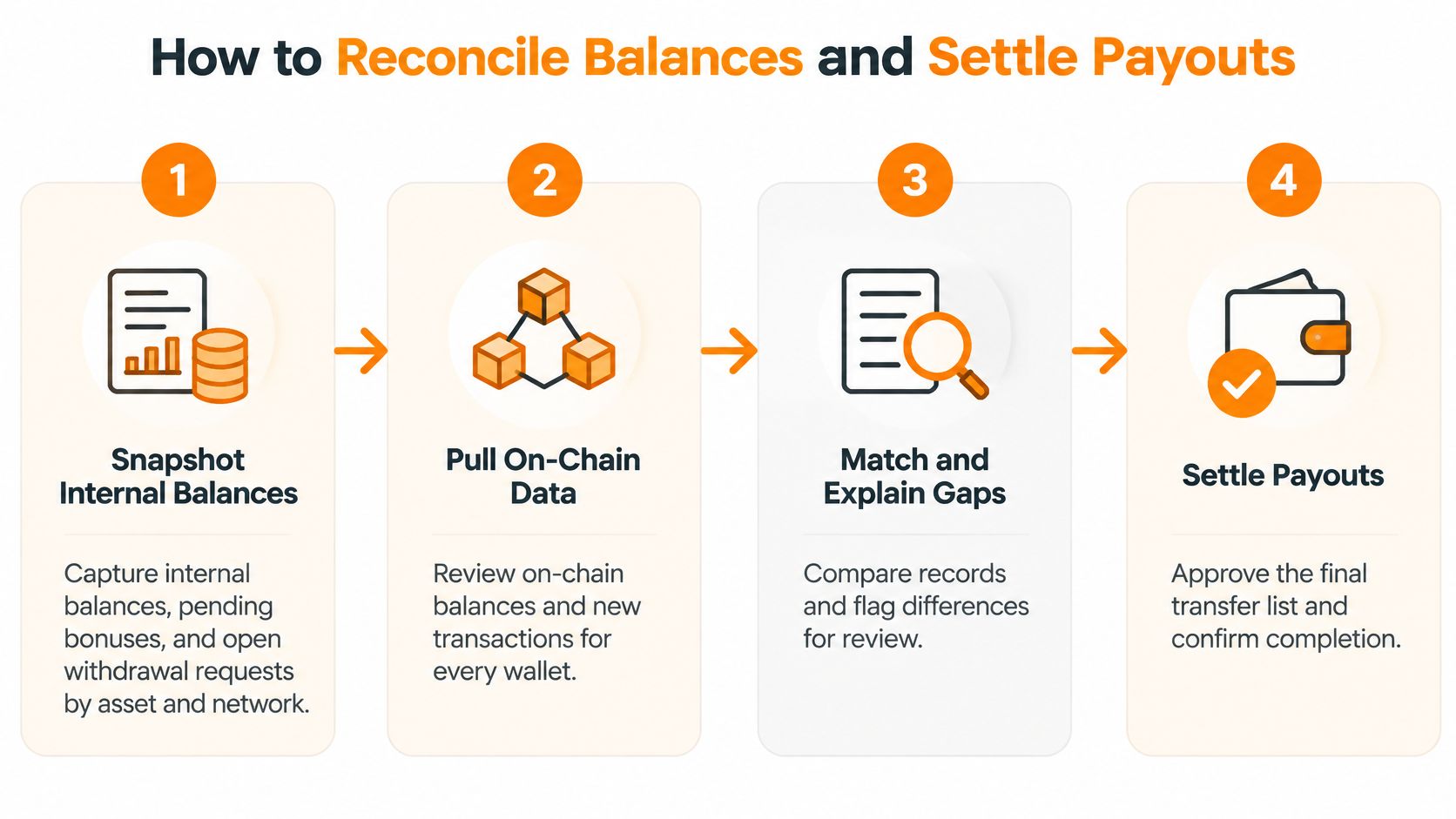
Run this pack every shift, in order. The point is to stop the chain from editing player balances.
- Snapshot the books: Capture internal balances, pending bonuses, and open withdrawal requests by asset and network.
- Pull the chain: Take on-chain balances and new transactions for every hot, cold, change, and deposit address in the inventory.
- Credit only a matched deposit: The tx hash, amount, token contract, and network must match, and the confirmation count for that asset must be met.
- Match every broadcast: Tie each sent withdrawal to an approved cashier request. Stop on any difference in amount, destination, or status.
- Book the friction: Network fees, dropped transactions, and reorgs get their own lines. They must not alter a player balance without notice.
- Test the float: Compare the hot balance with the ceiling. Sweep surplus to treasury, or schedule a top-up if the next shift's expected payouts exceed the float.
- Sign the exception pack: Name each break, its owner, the timestamp, and anything carried forward.
Where a naive match fails
A token can show on a block explorer and still be uncredited because it arrived on the wrong network. A native coin and a same-named token are different assets, so match on asset ID and contract, never on the ticker. Unconfirmed deposits must not fund in-play bets. Bonus chips and free-bet value stay on the internal ledger until they become a real withdrawal. A failed broadcast must not be retried at a new amount until you know the original nonce or request is dead.
| Case | Symptom | Action |
|---|---|---|
| Token sent on wrong network | Visible on block explorer, not credited | Hold and route to recovery queue |
| Native coin vs same-name token | Balance looks wrong on one asset | Match on asset ID and contract, never on symbol |
| Unconfirmed deposit | Funds not yet final | Do not fund in-play bets until the asset's confirmation count is met |
| Failed broadcast | Nonce or request status unknown | Check status before any resend, then retry with the original amount only if dead |
| Amount, destination or status difference | Broadcast withdrawal does not match cashier request | Stop the payout and escalate to finance and payments |
Finance signs the numbers. Payments signs the chain. Neither edits the other's record. A platform such as NexGrate can hold the player ledger, fees, and cashier state next to those chain lines. The shift owner still has to sign the break.
Withdrawal Policy APIs and Replay Protection
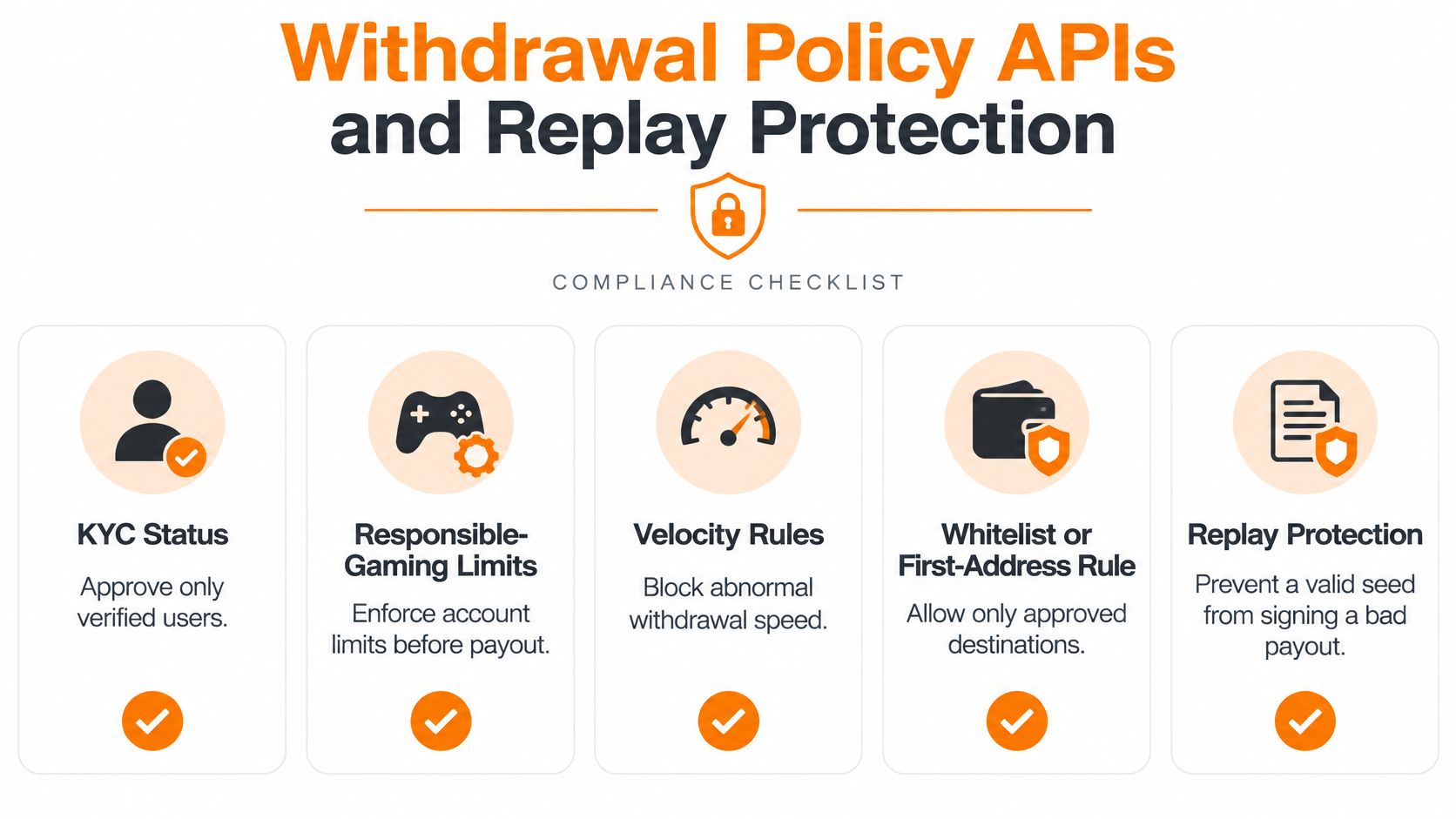
A correct seed can still sign a bad payout. The cashier API should accept a withdrawal only after the request has already passed KYC status, responsible-gaming limits, velocity rules, and a whitelist or first-address hold.
Show the full network fee, including any extra state cost, before a signer approves. Players and treasury both need that quote on the ticket, not buried in a wallet popup.
Nonce keys are audited state
Account-abstraction wallets add a policy problem on top of key protection. The ERC-7902 wallet-capabilities specification allows keyed nonces, limits a wallet to 16 nonce keys, and requires those keys to be strictly increasing and representable as uint256 values. Each newly created key can add state gas charged to the payer. Nonce keys are public and permanent. They can be shared across applications, they stay consumed after a later frame reverts, and they should be derived from a value that contains the origin, such as a hash tied to that product.
Namespace nonce keys by tenant. Casino, sportsbook, and support actions must not share replay space. Reject malformed or reused keys. Alert when an action permanently consumes a single-use key. A reverted transaction can still consume a nonce, so a retry that assumes "nothing happened" will stall the next payout or, worse, look safe when it isn't. Correlate nonce consumption with transaction status before anyone sends again.
Split policy by purpose. Player withdrawals carry a per-transaction cap and a daily cap. Treasury refills need a second approver and an allowlisted destination. Bonus and affiliate payouts should not use the player hot key.
A transaction engine records the quote, the policy result, the nonce, and the final status. A browser wallet clicking through signatures does not.
Simulate the transaction, screen the destination, and revoke token approvals on any operational wallet that talks to contracts. Alert on a new destination, a fee far above the quote, a burst of small withdrawals, or nonce use that doesn't match a successful payout.
KYC AML and Segregation of Player Funds
Compliance has to be able to veto a signature the chain would happily send. Require identity verification before the first withdrawal. Step up checks when volume, source of funds, or a new destination crosses the brand's threshold. Screen destinations against sanctions lists and reject a match even when the player account looks clean. Geofencing and responsible-gaming limits must be able to stop signing, not merely hide a button.
When value moves to another regulated provider, Travel Rule duties can require originator and beneficiary data. The cashier then has to store more than an address. Keep the evidence with the payout: who approved a limit change, which rule blocked a send, and the on-chain hash once it went. That trail is what compliance reporting is for when a regulator asks about one player, not about your architecture diagram.
Omnibus float versus per-player addresses
An omnibus on-chain wallet with a strict internal sub-ledger is simpler to sweep and reconcile. Player protection then depends entirely on that sub-ledger, and on never mixing operating-company funds with the float. Per-player deposit addresses make attribution easier. They also raise key inventory, privacy exposure, and fee cost. Dormant balances still need an owner and a reconciliation row in either design.
MGA-style expectations are a concrete bar for multi-jurisdiction books: segregation, logs, reporting, and the ability to show that player crypto was not used as company working capital. The design test is small. A compliance officer can explain, for one withdrawal, which rule allowed it and which wallet paid it.
Test Recovery Before You Raise Hot Wallet Limits
Don't raise hot-wallet limits because the queue is long. Raise them after you can restore signing and prove the books still separate player funds from company funds.

In February 2014, Mt. Gox disclosed that approximately 850,000 BTC belonging to customers and the company were missing after years of security failures, poor internal controls, and an undetected theft, as recounted by Bitcoin.com's account of Mt. Gox. About 200,000 BTC were later found in an older wallet in March 2014, leaving approximately 650,000 BTC unrecovered. The missing amount was roughly 7% of all bitcoins then in existence. Withdrawals had already been suspended after suspicious wallet activity. Customers, not the internal books, forced the scale into the open.
Put four items on one page before the ceiling moves.
- Float ceiling and refill window: Name the maximum online balance and when treasury is allowed to top it up.
- Signers: Name who can sign, with at least two people for treasury, and confirm a lost approver can't freeze player payouts.
- Shift owner: Name who reconciles each shift and who may not edit the other book's record.
- Restore drill: Restore signing from an encrypted backup on a low-value wallet, check that company funds and player funds stay in separate ledgers and wallets, and record the time to restore.
A drill nobody has run is not a backup. The AuditReady disaster recovery testing guide is a practical way to structure that test so it produces evidence, not a checkbox. Pair it with your own risk management practices so the float limit, the signer list, and the restore time sit in the same operating pack.
Write that one-page policy and finish the first restore test before real player funds depend on the setup.
NexGrate gives casino and sportsbook operators a white-label stack with player wallets, crypto deposits and withdrawals, cashier controls, and compliance tooling in one back office. If you want the ledger, the payout rules, and the audit trail to live in the same platform, visit NexGrate and map the setup to your brand.