
You're probably staring at the same decision many operators face right now. Do you bolt crypto onto an existing casino stack and hope the cashier can carry the load, or do you treat crypto as a core operating model and build the platform around it?
That choice determines almost everything that follows. It affects how fast deposits clear, how withdrawals are approved, how risk is monitored, what your licensing application looks like, and whether your banking partners see a serious business or a preventable compliance problem. Most failed launches don't fail because the lobby looked bad. They fail because the wallet flow, ledger design, fraud controls, and compliance layer were treated as add-ons.
The practical reality for 2026 is simple. Viable crypto casino software needs to do two things at once. It has to deliver the speed and transparency players expect from crypto, and it has to satisfy the controls that regulators, payment partners, and internal risk teams now require. If either side is weak, the brand becomes fragile.
Table of Contents
- Why Crypto Casino Software is Reshaping iGaming
- The Core Architecture of Modern Crypto Platforms
- Essential Platform Modules and Key Features
- Navigating Crypto Payment Flows and Custody
- The New Frontier of Compliance and Regulation
- How to Evaluate and Select a Software Provider
- Your Go-Live Checklist for a Successful Launch
Why Crypto Casino Software is Reshaping iGaming
Crypto stopped being a novelty the moment operators realized it changes more than deposits. It changes the cashier, the risk model, the ledger, the player journey, and in many cases the commercial reach of the brand. If you still think of crypto casino software as a payment plugin, you're already designing the wrong system.
The business case is no longer marginal. The crypto casino tool market is projected to reach USD 114.05 billion by 2035 and grow at a 27.29% CAGR from 2026 to 2035. That same projection says the segment is growing nearly twice as fast as the broader online gambling market. For operators, that means the infrastructure layer itself is becoming a competitive category, not just a technical cost center.
Crypto is now an operating model
A crypto-first brand can move funds across borders differently, handle treasury differently, and market itself differently. But those advantages only hold if the underlying stack was designed for blockchain-aware accounting, chain confirmations, wallet control, and risk review.
That's the gap I see most often. A team buys a conventional white-label platform, adds a wallet widget, and assumes they now have crypto capability. What they have is a fiat platform with a more complicated cashier.
Practical rule: If your internal ledger, withdrawal engine, and compliance workflow don't understand on-chain events natively, you don't have crypto casino software. You have a crypto-themed front end.
The opportunity is large, but the easy version is gone
Operators are attracted to fast settlement, reduced dependency on traditional rails, and a player base that already expects digital assets. Those are real advantages. They also come with engineering and regulatory consequences that aren't optional anymore.
The serious operators entering this space now are not asking, “Can we accept Bitcoin?” They're asking harder questions:
- Can the ledger reconcile chain events and game events cleanly
- Can compliance review a wallet before funds are credited
- Can we support crypto and fiat in one wallet structure without corrupting bonus logic
- Can support teams investigate disputes with full audit visibility
Those questions separate launchable businesses from expensive prototypes.
Why dedicated software matters
Purpose-built crypto casino software isn't just about adding more coins. It's about making sure the platform can survive growth, licensing, and player scrutiny. The operator needs one coherent system that handles game content, wallet activity, settlement logic, player controls, and compliance evidence in the same operating environment.
That's why the strongest builds aren't the most “decentralized” in marketing terms. They're the ones that make hard trade-offs well. They keep the player experience fast, the accounting precise, and the compliance posture defensible.
The Core Architecture of Modern Crypto Platforms
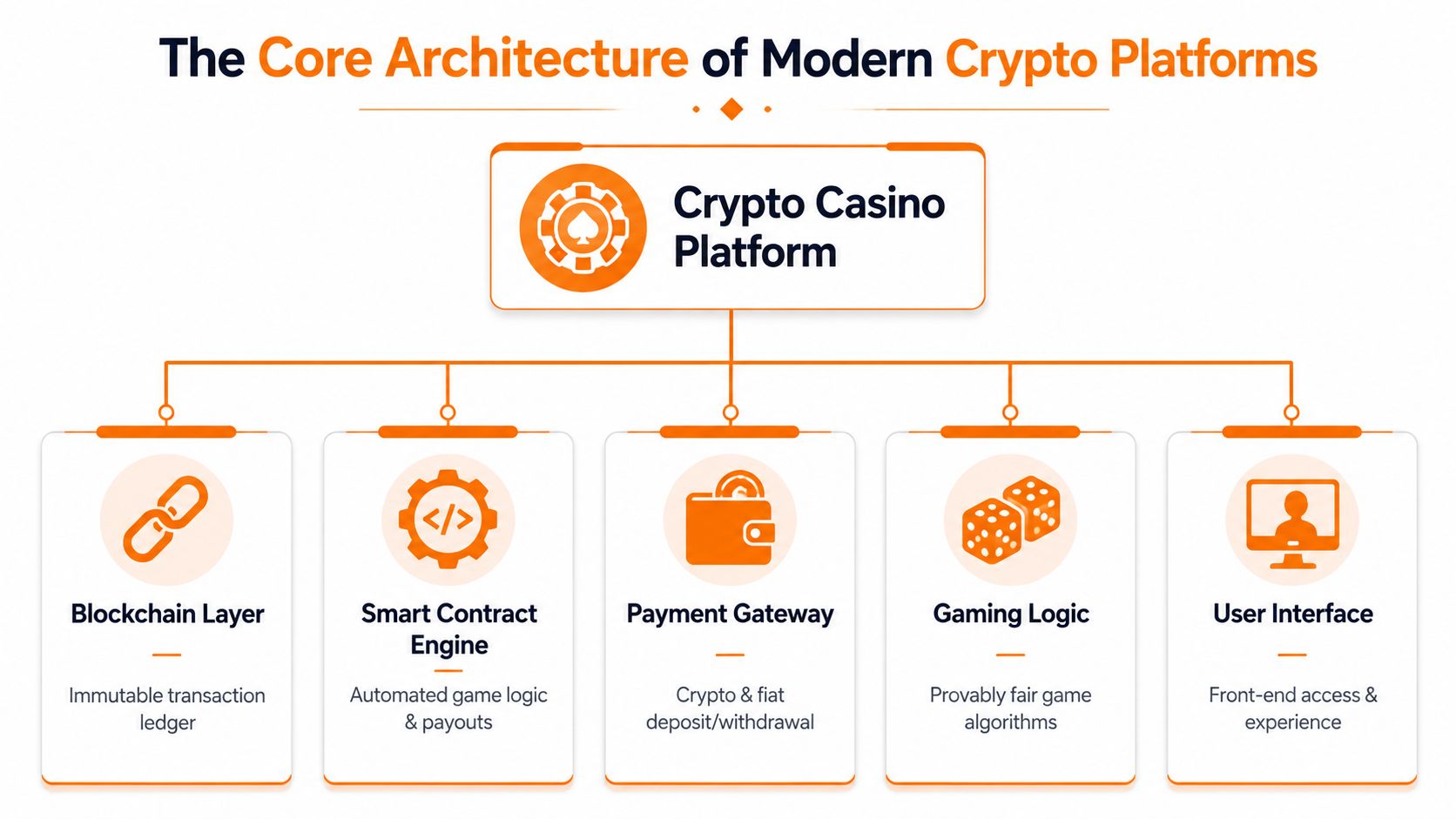
Think of a modern crypto casino platform like a digital bank connected to an entertainment engine. The player sees the lobby, the game client, and the cashier. Underneath that surface, the system has to separate presentation, game logic, wallet management, accounting, and blockchain communication so a fault in one layer doesn't corrupt the whole operation.
The architecture that works in practice is not “everything on-chain.” It's not “keep it all centralized” either. The scalable standard is the hybrid model. The industry standard for scalable crypto casinos is an off-chain game client with on-chain settlement. That design gives operators responsive gameplay without forcing every interaction through blockchain latency.
The front end should stay fast
Players don't care how elegant your architecture diagram looks. They care whether the game opens instantly, whether the bet confirms without lag, and whether the balance updates in a way that feels trustworthy.
That's why rendering, animation, session control, and most client interactions belong off-chain. The front end should manage the user experience with the same standards you'd apply to any high-volume iGaming product. If you push too much gameplay logic directly onto chain, you introduce delay, fee exposure, and avoidable failure points.
A workable stack usually breaks into these layers:
- Client and presentation layer for web and mobile sessions, wallet connection flows, cashier UI, and verification screens
- Game services layer for session handling, result delivery, aggregation, and game event routing
- Financial core for balances, bet debits, win credits, bonus accounting, and the canonical ledger
- Blockchain interaction layer for address generation, deposit watching, signing policies, and settlement actions
- Risk and compliance layer for KYC, AML, KYT, sanctions review, and case management
If a provider can't explain where each of those lives, the platform usually isn't mature enough.
The financial core must be isolated
The most important design choice is the one operators rarely ask about. Is the money engine isolated from the rest of the platform?
It should be. The “financial heart” needs to run as its own controlled service. It handles real-money balances, writes immutable internal ledger events, and receives only validated instructions from upstream services. That separation is what allows dispute resolution, rollback handling, and audit readiness to work without guessing.
A good internal benchmark is simple. A game service should never be able to alter balances casually. It should request a debit or credit through a controlled pathway, and the wallet service should decide whether that event is valid.
For operators reviewing platform options, it's worth examining how a unified iGaming platform architecture exposes those boundaries. If the vendor describes the cashier and wallet as a feature set but not as a protected financial domain, keep pushing.
Keep the chain where it creates trust. Keep the interface where it creates speed.
What the hybrid model gets right
The hybrid pattern works because it respects the strengths of each component. The client remains responsive. The operator retains control over session flow, responsible gambling controls, and support tooling. The settlement layer can still anchor trust through on-chain actions, verifiable commitments, or transparent payout records where appropriate.
What doesn't work is ideological architecture. Fully on-chain systems often struggle with throughput, cost, and product ergonomics. Purely centralized systems struggle to justify their crypto positioning once players ask for transparency.
The winning architecture is rarely the most glamorous. It's the one that survives real-world traffic, treasury operations, and compliance review.
Essential Platform Modules and Key Features
When operators say they need crypto casino software, they often mean they need a crypto cashier plus some games. That's far too narrow. A launchable platform is a collection of tightly connected modules, and each one needs crypto-aware behavior.
The list starts with content, but it doesn't end there. You also need a wallet-aware PAM, a back office that can investigate on-chain events, a bonus engine that doesn't break under fluctuating asset values, and game logic that can defend fairness.
A strong platform usually feels boring to operate. That's a compliment.

Game content and aggregation
Content still drives retention. No amount of wallet sophistication saves a weak lobby. But crypto-specific operations change how aggregation should be implemented.
The aggregator has to do more than deliver titles from RNG and live providers. It needs to support correct denomination handling, session tokenization, balance sync, and bet reconciliation when the player account may be funded by digital assets but the game math is often managed against fiat-equivalent values in the background.
Look for these practical details:
- Single-wallet behavior so players don't bounce between fragmented sub-balances
- Clear mapping between provider rounds and internal ledger events for dispute handling
- Fallback behavior when provider callbacks are delayed or duplicated
- Support for mixed content estates including standard RNG, live dealer, and crypto-native titles
If the provider can aggregate content but can't explain reconciliation, you'll feel that pain in support queues and finance reviews.
Provably fair logic and player trust
This is one of the few features crypto-native players will actively look for. A proper provably fair implementation matters because it gives the player a mechanism to verify that an outcome wasn't altered after the bet was placed.
The accepted pattern is specific. Provably fair RNG uses a server seed that is hashed and published before a bet. After the round, the nonce and player seed are revealed so the result can be checked cryptographically. That's what turns “trust us” into a verifiable process.
What matters in practice is not just the math, but the implementation discipline:
- Seed commitment before play so the operator can't change the result retroactively
- Client-side verification flow so players can inspect outcomes
- Consistent UI messaging because most disputes come from poor explanation, not broken cryptography
- Auditability in the back office so support staff can review the exact round inputs
A lot of brands claim fairness. Fewer expose it properly.
Here's a useful technical walkthrough that helps illustrate how these systems are typically presented and understood by operators and product teams:
PAM sportsbook and back office
The player account management system is where many crypto launches often encounter difficulties. PAM isn't just registration and login. It controls wallet states, identity states, limit states, exclusion states, bonus states, and account review states. In crypto operations, those states interact more often and with higher risk.
A sportsbook adds another layer of complexity because it shares the same wallet but runs a very different liability pattern. Bets can remain unsettled for long periods, odds can shift quickly, and risk controls need to apply across casino and sportsbook activity without corrupting the player balance.
A practical module set should include:
| Module | What it must handle in a crypto environment |
|---|---|
| PAM | Identity checks, wallet linkage, account restrictions, session management |
| Back office | Transaction review, withdrawal approvals, case notes, audit logs |
| Sportsbook | Shared wallet, exposure control, settlement sync, bonus compatibility |
| Bonus engine | Crypto deposits, wagering rules, abuse controls, denomination consistency |
| CRM and segmentation | Wallet-funded cohorts, VIP logic, retention targeting without breaking compliance rules |
If support can't trace a deposit, risk can't freeze a suspicious withdrawal, and finance can't reconcile a provider round, the platform isn't turnkey. It's a bundle of integrations.
Navigating Crypto Payment Flows and Custody
Crypto payments look simple to the player. Deposit, wait, play, withdraw. Operationally, that flow is much more demanding than a card deposit. Every stage involves chain visibility, confirmation policy, internal ledger timing, security controls, and fraud review.
The most important thing to understand is that blockchain finality and player balance availability are not the same event. Mature crypto casino software treats those as related but separate states.
How the transaction lifecycle really works
A deposit starts when the platform allocates or maps a receiving address to a player. The chain-aware payment module then watches the network for the incoming transaction, identifies the asset, checks the amount, and waits for the confirmation rule configured for that chain.
That waiting logic matters. Modern backends isolate the financial core and use a chain-aware module that waits for a set number of confirmations, such as 3 Bitcoin blocks, before crediting funds. This is not a minor implementation detail. It is how you avoid crediting unstable deposits too early.
After confirmation, the platform should post a clean internal ledger event, update the player balance, and expose the transaction status in the cashier and back office. Withdrawals work in the opposite direction, but they require more controls. The system should validate account state, velocity rules, pending reviews, and destination checks before any signing flow begins.
A good operator workflow usually includes these steps:
- Detect the transaction on the relevant chain.
- Validate confirmation status according to asset policy.
- Run risk and compliance checks before credit where required.
- Write the internal ledger event as the canonical accounting record.
- Expose status and evidence to support, finance, and risk teams.
Choosing a custody model
Custody is one of the first decisions that changes your operational burden. Self-custody gives you control, but it also gives you responsibility for wallet security, signing policies, treasury movement, and incident response. A third-party custodian reduces direct handling but adds dependency and process friction.
The trade-off is less about ideology and more about internal capability.
| Factor | Self-Custody (Hot/Cold Wallets) | Third-Party Custodian |
|---|---|---|
| Control | Full control over wallet policy, signing flow, and treasury movement | Less direct control, policy often mediated by provider tooling |
| Security operations | You own key management, wallet segregation, and incident handling | Custodian handles core custody operations, but you still own oversight |
| Integration flexibility | Easier to tailor cashier behavior and treasury logic to your product | Integration can be cleaner initially, but provider limits may shape workflows |
| Compliance coordination | Internal teams must align wallet actions with AML and case management | Custodian may support controls, but you still need platform-level compliance logic |
| Speed of change | Faster if your team is strong and staffed appropriately | Slower when changes require vendor coordination |
| Operational risk | Higher if processes are weak | Lower on custody mechanics, higher on vendor dependency |
Operator view: Self-custody is not “advanced.” It's operationally heavy. Choose it only if your finance, security, and engineering teams can run it like critical infrastructure.
One more point matters here. Game pricing and RTP logic should not float with coin volatility. Good platforms denominate gameplay against a stable fiat-equivalent reference internally, then convert at the cashier layer as needed. That protects the game model from market movement and keeps reporting intelligible.
The New Frontier of Compliance and Regulation
The biggest mistake new operators make is assuming crypto compliance starts after a deposit lands. In licensed markets, that's too late. By the time funds hit the player balance, your platform should already know whether the wallet activity fits your risk policy.
Most public material on crypto casino software is outdated. It talks about wallet UX, token support, or provably fair features, then stops short of the one layer that now determines whether a licensed operation can survive. That layer is native on-chain AML and KYT.
Why KYT has moved into the core stack
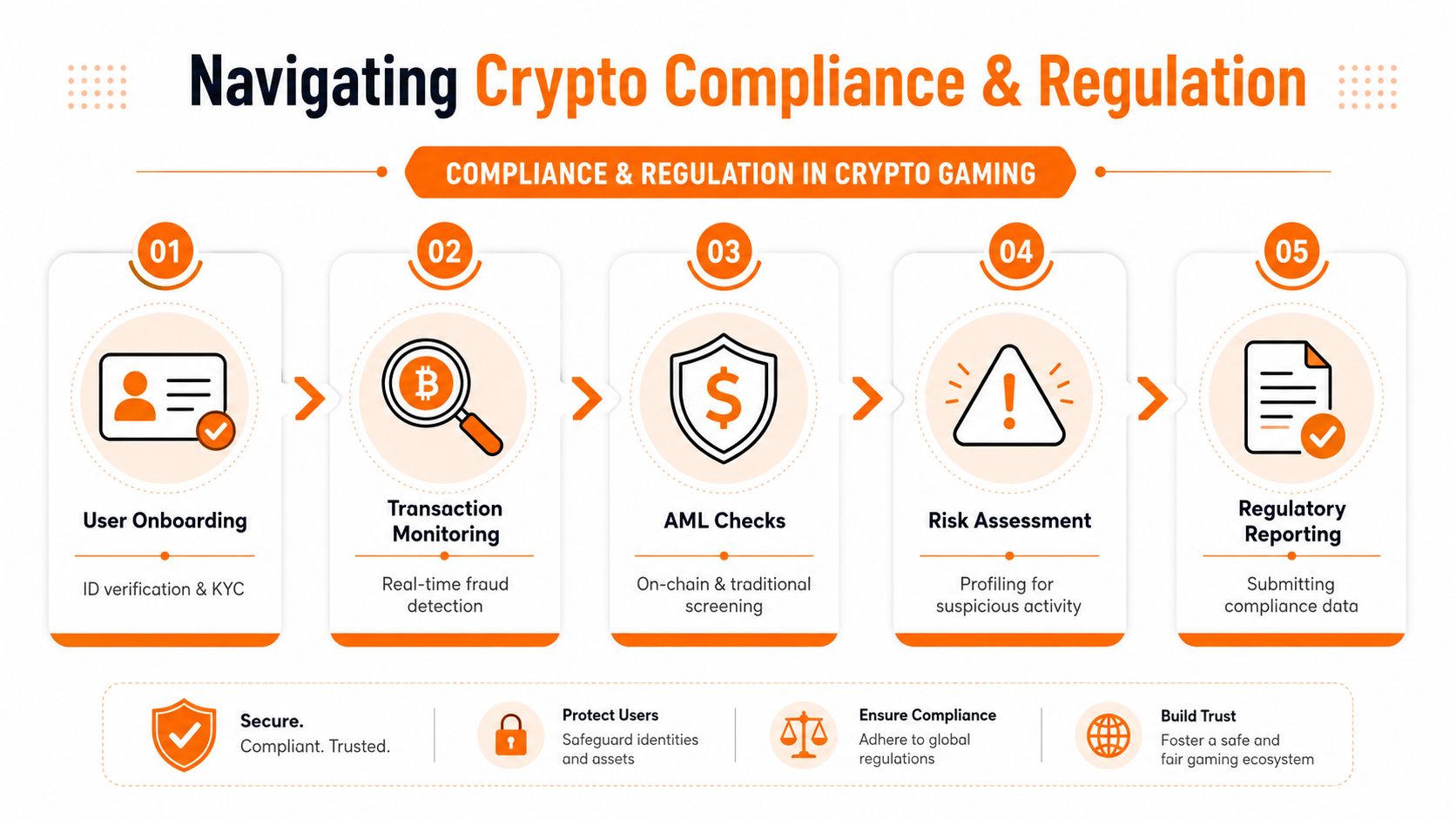
For 2026, the rule is direct. Licensed operations need native on-chain AML and KYT integration that screens incoming transactions against illicit wallet databases in real time. That requirement exists because regulators and banking partners don't want crypto accepted blindly and reviewed later. They want risk identified before funds are treated as playable money.
That means KYT can't sit in a manual spreadsheet process. It has to be integrated into the deposit flow, the case management flow, and the withdrawal flow. If the system credits first and asks questions later, your controls are already weak.
The practical consequence is huge. Compliance is no longer a parallel team operating beside product and payments. It's part of the transaction engine.
How compliant monitoring should work in practice
A defensible workflow links three things in one chain of evidence:
- The player identity
- The wallet or transaction under review
- The action taken by the platform
If an inbound transfer appears high risk, the system should hold the crediting event or escalate it to review according to policy. If a destination wallet on withdrawal triggers concern, the case should route to risk before signing. If a player's behavioral profile changes sharply, the back office should show that context alongside wallet data.
For operational purposes, a dedicated crypto compliance workflow matters. The compliance team needs something stronger than notes in a CRM. They need transaction-level visibility, rule-based alerts, decision history, and exportable evidence for audits or regulator questions.
A usable operating model usually includes:
- Pre-credit monitoring so suspicious inbound funds don't become available by default
- Case queues with severity routing so routine alerts don't bury serious ones
- Withdrawal screening because outbound activity carries as much risk as inbound activity
- Linked audit trails connecting wallet checks, user records, and staff actions
- Policy controls by market since not every jurisdiction expects the same workflow detail
Accepting crypto without built-in KYT is no longer a growth shortcut. It's a licensing and banking liability.
What doesn't work is treating crypto monitoring as a monthly review task or outsourcing judgment entirely to the payment gateway. Vendors can provide data and tooling. The operator still owns the regulatory outcome.
How to Evaluate and Select a Software Provider
Most demos are built to impress commercial teams. They show the lobby, the cashier, a few dashboards, and maybe some provider logos. That's useful, but it won't tell you whether the platform can carry the operational weight of a real crypto launch.
A better evaluation process sounds less like a feature tour and more like due diligence. Ask hard questions early. Good vendors answer them clearly. Weak vendors pivot back to design, speed, or generic scalability claims.
Questions about architecture and ownership
Start with system boundaries. Ask where the internal ledger lives, how wallet actions are authorized, and whether game events can mutate balances directly or only through a protected financial service.
Then ask about failure handling. If a blockchain listener drops, if a provider callback is duplicated, or if a withdrawal request is queued during a compliance hold, what exactly happens? The answer should include state management, retry behavior, and auditability. If it doesn't, the product likely relies on operational workarounds.
Useful questions include:
- Who owns the canonical ledger
- How are deposit states modeled before and after confirmation
- What happens when provider and wallet balances appear to diverge
- Can casino and sportsbook share one wallet without reconciliation hacks
- Which components are multi-tenant and which are isolated per brand
A serious vendor should also explain how the platform evolves. Crypto stacks change quickly. New assets, wallet policies, and compliance requirements don't arrive on a comfortable roadmap.
Questions about compliance and operations
Many vendor evaluations often get too soft. Operators ask whether KYC is supported. They should ask how KYT is embedded, what review evidence is retained, and how compliance actions affect wallet state in real time.
Operational depth matters just as much. Ask how support teams investigate disputed deposits. Ask how finance teams export ledger activity. Ask how long it takes to integrate a new game provider or payment route without destabilizing production.
Use a checklist like this in live meetings:
- Show me the review queue for suspicious crypto transactions.
- Show me the audit trail for a blocked or approved withdrawal.
- Show me the ledger entry behind a single bet, win, and withdrawal sequence.
- Show me how account restrictions propagate across casino, sportsbook, and cashier.
- Show me what your team monitors after launch rather than just what they build before launch.
If you want a provider to prove maturity, ask for a working environment instead of a slide deck. A hands-on platform demo for operators will tell you far more than a polished sales call.
The best vendor answers aren't broad. They're procedural. They show exactly how the platform behaves when something goes wrong.
There's also one cultural test I like. Ask a vendor what usually delays go-live. Honest teams mention payments, compliance review, content certification dependencies, and UAT edge cases. Inexperienced teams say launch is simple.
Your Go-Live Checklist for a Successful Launch
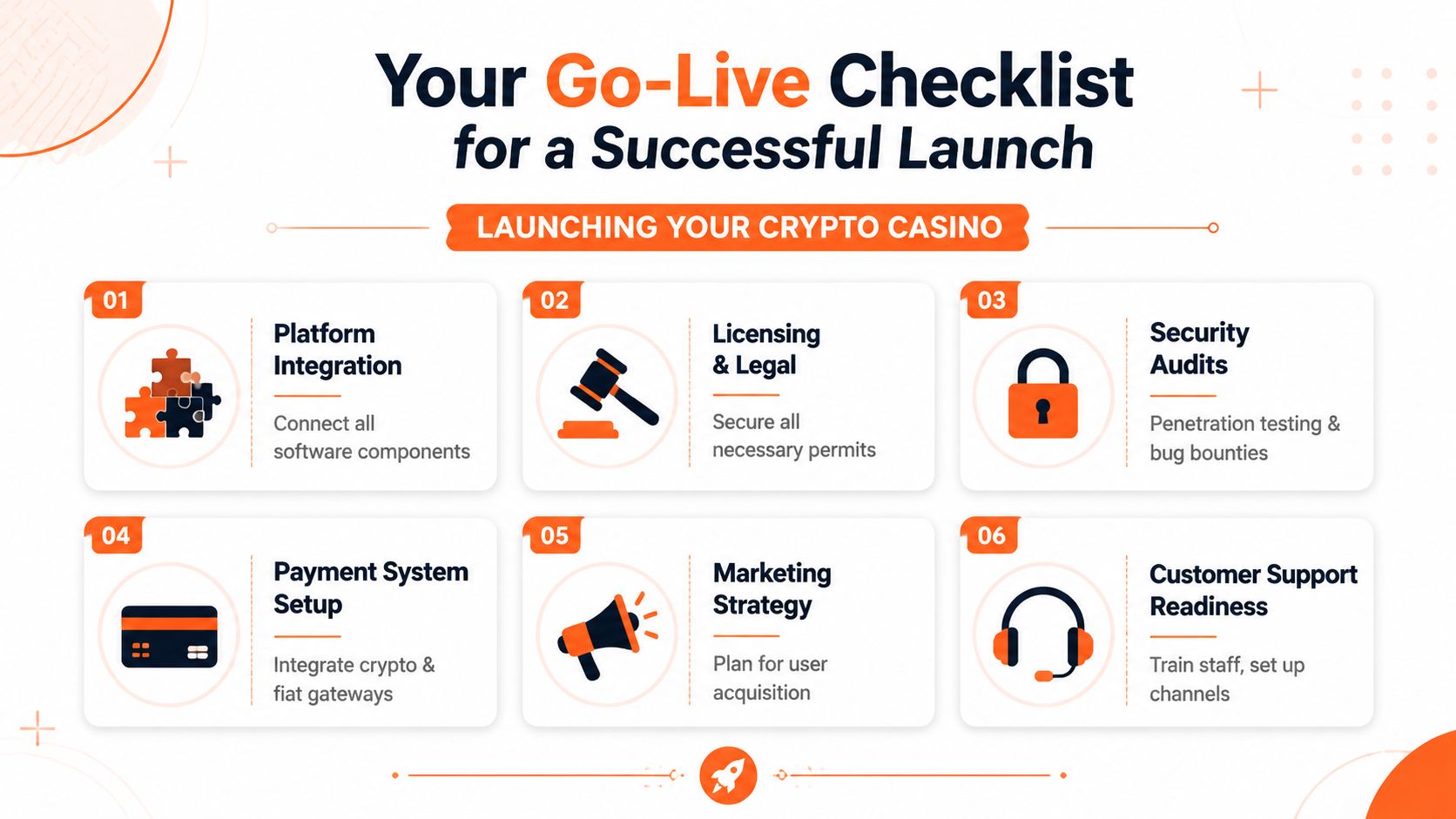
A crypto brand shouldn't go live when the front end looks finished. It should go live when payments, controls, support operations, and reporting behave predictably under load and under scrutiny.
That means launch planning has to include legal, product, finance, compliance, and support from the beginning. When one team is missing, the gap usually shows up in production.
Pre-launch decisions
- Entity and market scope. Decide where you'll operate, what license path fits the brand, and which markets are excluded from day one. Crypto support without jurisdiction discipline creates avoidable risk.
- Provider and stack selection. Confirm who owns content, wallet flows, PAM, sportsbook, and compliance tooling. Ambiguity at the contract stage turns into finger-pointing later.
- Custody and treasury policy. Set wallet responsibilities, withdrawal approval paths, hot and cold wallet usage, and escalation rules before the first player deposit arrives.
Launch preparation
- Cashier and ledger testing. Run deposit, bonus, bet, win, rollback, and withdrawal scenarios repeatedly. Test weird cases, not just happy paths.
- Compliance workflow validation. Make sure KYC, KYT, account restriction, and case review actions all behave correctly and leave evidence behind.
- Support readiness. Train agents to investigate transaction status, explain confirmation delays, and escalate wallet issues with exact internal references.
Post-launch discipline
- Monitor payment behavior daily. Watch pending deposits, delayed credits, failed withdrawals, and manual review queues. Early friction compounds quickly.
- Review risk thresholds. Fraud patterns and player behavior will force tuning. Static rules rarely stay effective for long.
- Audit player journeys. Register, deposit, play, withdraw, and self-restrict as if you were a customer. Operators often discover serious issues only after real users complain.
The strongest launches are usually the least dramatic. That's because the operator has already forced the platform through operational reality before inviting players in.
NexGrate helps operators launch online casino and sportsbook brands on a unified white-label stack that covers front end, wallet and payments, back office, compliance controls, and third-party integrations. If you're evaluating crypto casino software for a new launch or migration, NexGrate is worth a closer look.