A white label casino usually starts with a one-time setup fee, but a revenue share on gross gaming revenue keeps charging after the launch invoice is paid, and it often becomes the bigger long-term cost.
Member companies of the European Gaming and Betting Association generated €13.5 billion in combined online gross gaming revenue in 2024, a 15% year-over-year rise, while holding 321 licenses in 21 European countries, according to the EGBA annual activity report. Casino games accounted for 51% of that combined revenue. These figures show why a platform bill cannot be treated as a software purchase alone. Licence tiers, gaming tax, card fees and provider revenue share all affect the cost as GGR changes. Comparing each line as a share of GGR at low, medium and high volume helps reveal when a low launch cost gives way to a more expensive contract.
White label casino costs combine one-time charges with revenue-linked percentages. The ranges below are published estimates, not a complete quote. Use written provider and regulator figures to model the total cost and payback.
Table of Contents
- White Label Casino Cost Ranges at a Glance
- Licence Fees Compared Across Key Jurisdictions
- Separate Fixed Costs From Revenue-Linked Costs
- Revenue Share at Low, Medium and High GGR
- Costs That Appear After Launch
- Payback Period and ROI Before You Sign
- Build Your Total Cost Model Before You Sign
White Label Casino Cost Ranges at a Glance
The same cost stack behaves differently as GGR grows: fixed fees take a larger share at low volume, while revenue-linked charges rise with revenue. The launch fee is a one-time payment, not a recurring line. Compare it with the ongoing charges rather than treating the headline quote as the full operating cost.
| Cost line | Typical range | Billing basis | Notes |
|---|---|---|---|
| Setup or launch fee | €10,000 to €60,000 | One-time | Headline figure in quotes; excludes licence and payments |
| Licence application, general range | $1,000 to $20,000 | One-time | Wide spread across regulators; see the 2024 gambling-licence cost guide from SDLC Corp |
| Licence application, Curaçao | $15,000 to $25,000 | One-time | 2025 estimate from SoftGamings |
| Licence application, Malta | $36,000 to $55,000 | One-time | 2025 estimate from SoftGamings; the MGA statutory application fee is €5,000 |
| Monthly platform fee | Set in the provider contract; no single published rate | Monthly | Confirm the amount in writing before modelling it |
| Provider revenue share | 10 to 30% of GGR | Monthly, on gross gaming revenue | Rises in absolute terms as GGR grows |
| Card processing | 1.5 to 3.5% of transaction volume | Per transaction | Charged on transaction volume, not GGR |
| Malta gaming tax | 5% of gaming revenue | Ongoing | Plus a monthly compliance contribution |
| UK remote casino annual fee | £394,875 | Annual | Tier for £130 million to £455 million gross gambling yield, per the Gambling Commission fee schedule |
| Regulated-market compliance overhead | $100,000 to $300,000 | Annual | Estimate before gaming tax |
The rows split into two cost behaviours. One-time setup and application fees stop recurring after launch, while annual licence and compliance charges recur. Revenue share and gaming tax vary with gaming revenue; card processing varies with transaction volume. Their shares of GGR therefore depend on the underlying activity and contract terms.
The platform fee has no single market-standard figure in the estimates shown here. Providers may set a minimum, a flat retainer, or a floor that the revenue share must clear. Use the contract amount, not an assumed market rate.
At low GGR, fixed annual costs can weigh heavily against revenue. As GGR rises, those costs take a smaller share, but revenue-linked charges grow with the business. Card fees need separate treatment: they apply to transactions rather than GGR, so the two bases should not be combined as if they were interchangeable.
Classify each line as one-time or recurring, then model it against low, medium and high GGR. Keep licence fees and compliance separate from tax and provider share, and replace estimates with the written statement of work and the regulator's fee schedule before assessing total cost.
Licence Fees Compared Across Key Jurisdictions
Entry price and operating price are different purchases. A 2025 guide from SoftGamings estimates Curaçao licensing at about $15,000 to $25,000 and Malta Gaming Authority licensing at about $36,000 to $55,000. Those figures are published entry estimates. They don't include staff, premises, tax, or the annual charge that arrives after approval.
| Jurisdiction | Application cost | Recurring cost | Other cost notes |
|---|---|---|---|
| Curaçao | $15,000 to $25,000 | Local staff and premises; no standard annual fee in these estimates | Local company, managing director, compliance officer and physical presence required under the post-2024 framework |
| Malta (MGA) | €5,000 non-refundable; one 2025 estimate gives $36,000 to $55,000 | €25,000 fixed annual licence fee | 5% gaming tax on gaming revenue plus monthly compliance contribution |
| Great Britain, remote casino | £40,475 for £3m to £10.5m GGY; £101,895 for £130m to £455m GGY | £394,875 for £130m to £455m GGY; £1,181,625 for £455m to £1.6bn GGY | Fees scale with gross gambling yield |
| General range across regimes | $1,000 to $20,000 | Set by each regulator's own schedule, often tiered on revenue | Wide spread; confirm the exact schedule with the regulator |
What the fee schedule actually buys
The Malta Gaming Authority lists a €5,000 one-time non-refundable application fee and a €25,000 fixed annual licence fee for remote gaming-service operators, plus a 5% gaming tax on gaming revenue and a monthly compliance contribution calculated from that revenue. The dollar band in the 2025 guide is a broader project estimate. The euro figures are the authority's own charges. Don't blend them into one number and call it the Malta licence.
Great Britain shows how revenue resets the licence bill. The Gambling Commission remote casino operating licence sets application fees by annual gross gambling yield: £40,475 in the £3 million to £10.5 million band and £101,895 in the £130 million to £455 million band. Annual fees on the upper bands reach £394,875 and £1,181,625. A platform quote that looks light at launch sits underneath a regulator fee that steps up with yield.
Curaçao's post-2024 framework is not a PDF fee on its own. Operating means a local company, a managing director, a compliance officer and a physical presence, so people and premises are the recurring cost the headline estimate leaves out. A line-by-line budget for that regime sits in this Curaçao gambling licence cost guide.
Three questions for every row
- Paid once: application, initial legal work, and fit-and-proper filings.
- Paid again: annual fees, local officers, tax, and compliance contributions.
- Required to operate: local substance, reporting, and the payment firms and game suppliers that will board you.
If a jurisdiction you need isn't in the table, ask that regulator for the written fee schedule. Don't infer a price from a neighbouring regime.
Separate Fixed Costs From Revenue-Linked Costs
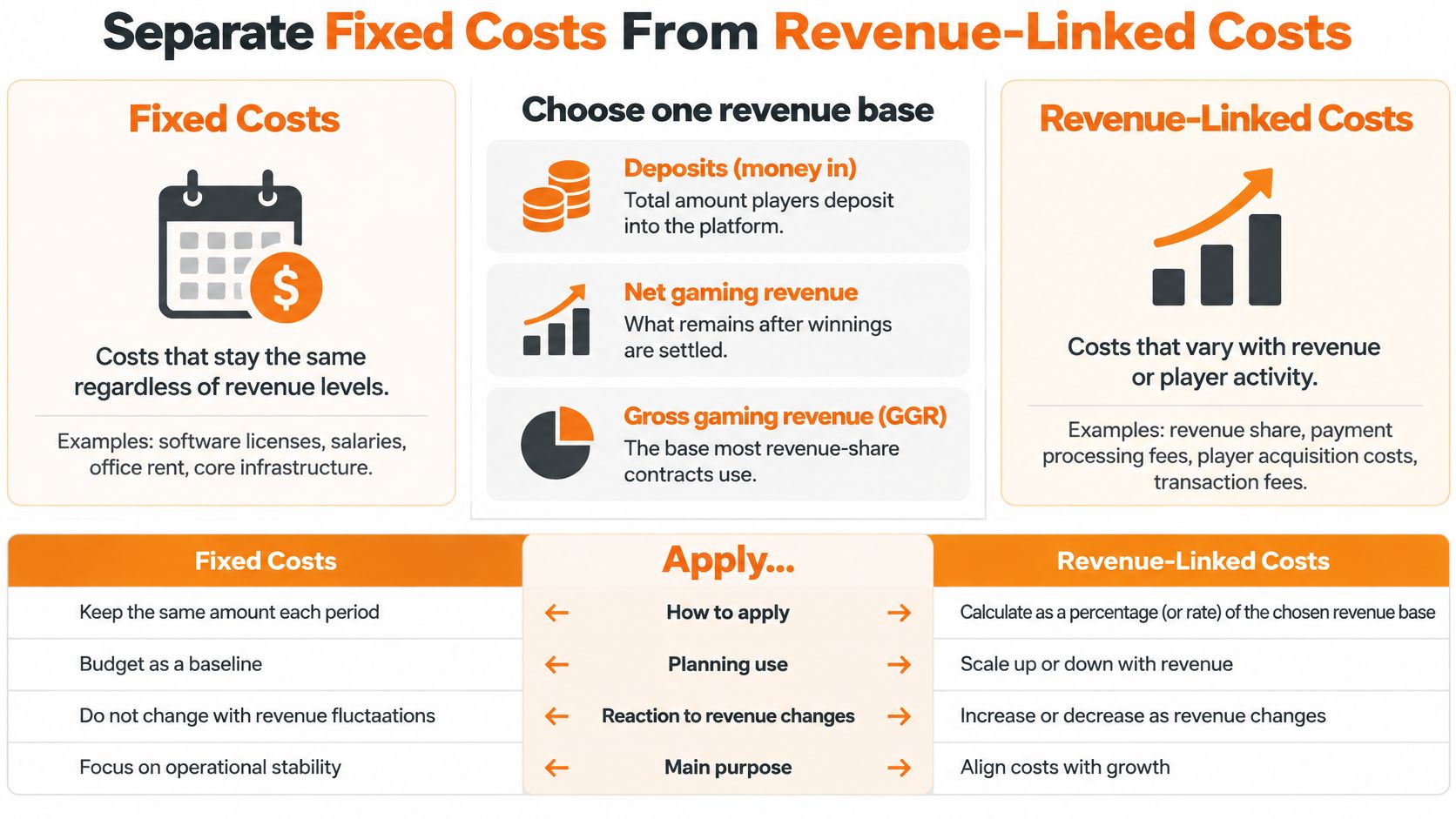
A cost model is only comparable when each line uses the same revenue base. Deposits are money received. Net gaming revenue is what remains after winnings are settled. Gross gaming revenue (GGR) is the base most revenue-share contracts use. Mixing these measures can make a quote appear cheaper than its effective cost.
Sort the lines, then run one month
Fixed costs stay stable as monthly revenue changes. Setup fees, licence applications, annual licence fees and monthly platform fees belong here. Spread an annual fee over twelve months to compare it with a monthly platform charge.
Usage-based costs move with activity. Revenue share, card processing, gaming tax and monthly compliance contributions can rise as the business grows, though their calculation bases may differ. Record each basis separately rather than treating every variable cost as a percentage of GGR.
For a month with €100,000 of gaming revenue under Malta's remote gaming schedule, a €25,000 annual licence fee works out to about €2,083 per month, while a 5% gaming tax equals €5,000. The variable tax is more than twice the monthly licence slice. The €5,000 application fee is paid once, so keep it outside the recurring monthly total. The compliance contribution has no single published amount in the material used here; use the authority's current schedule instead of assuming a rate.
Then add the platform charge and payment costs. Acquirers price payment costs for global businesses according to volume, declines and chargeback risk, so a generic headline rate may not represent the rate a casino cashier incurs.
Practical rule: Divide monthly platform, compliance and payment costs by monthly GGR to calculate their effective rate. A low fixed fee plus a high revenue share posts a higher effective rate at low volume, because the fixed fee is spread over little GGR, and the rate settles toward the revenue-share percentage as GGR scales.
The market figures show why cost comparisons need a consistent denominator. In 2024, European gambling GGR reached €123.4 billion, up 5% from 2023. Online gambling generated €47.9 billion, rising from 37% of total gambling revenue in 2023 to 39% in 2024, according to the EGBA market update. Casino games accounted for about €21.5 billion, or about 45% of online GGR. Compare setup charges, platform fees and revenue share against the revenue base they apply to, not as isolated software costs.
A unified casino, sportsbook, wallet and compliance stack may reduce integration labour, but it does not remove tax or compliance contributions. The short briefing below also distinguishes a flat platform charge from costs that rise with revenue.
Revenue Share at Low, Medium and High GGR
The assumption in most launch decks is that the lowest setup fee wins. It doesn't, once a share rate is applied to real GGR.
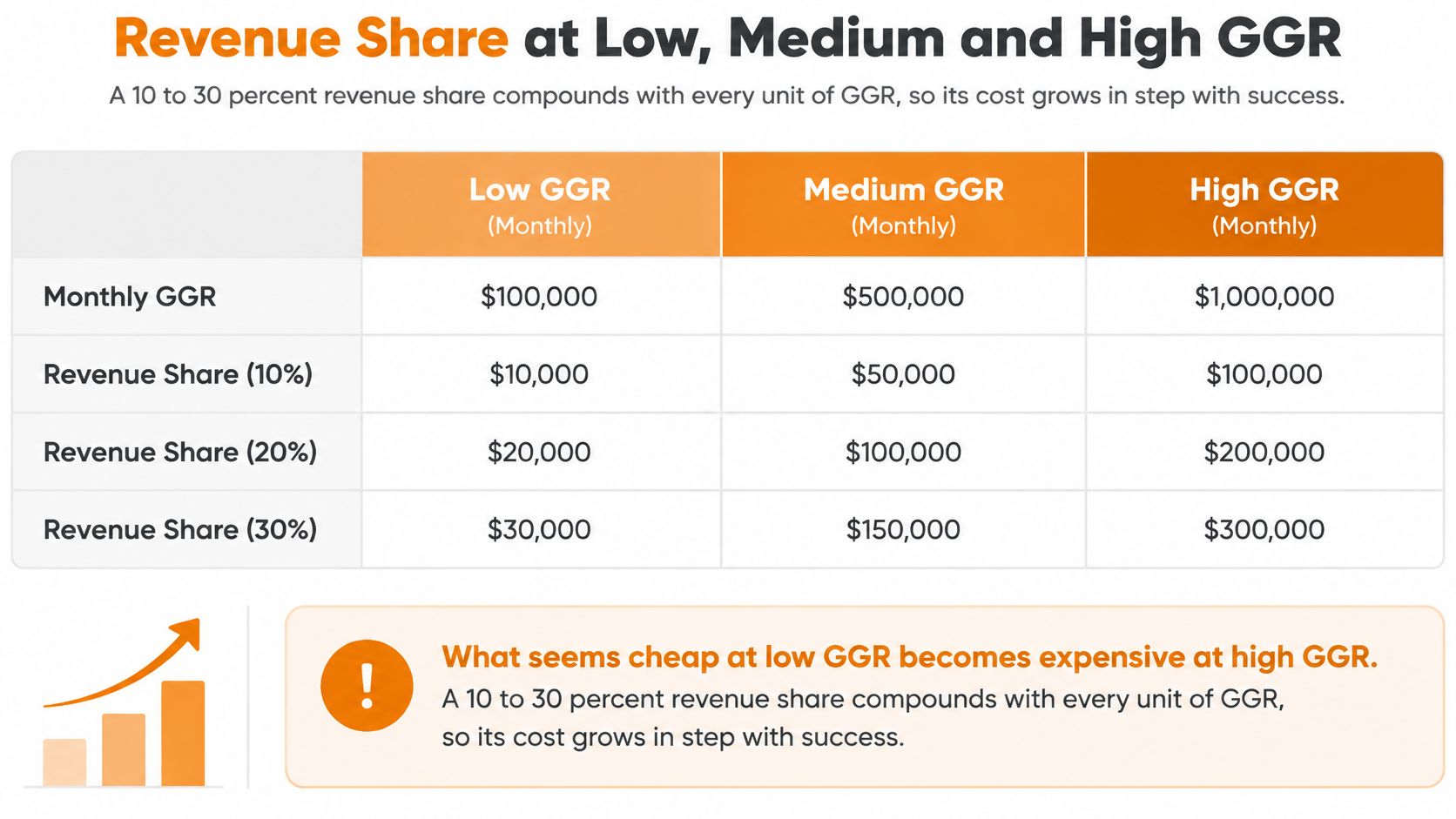
Published estimates put provider revenue share at 10 to 30% of gross gaming revenue, with card processing near 1.5 to 3.5% of transaction volume, while the setup figures most articles lead with often run €10,000 to €60,000, as this white label casino cost breakdown from ICODA sets out. The same estimates put regulated-market compliance overhead alone at $100,000 to $300,000 a year before gaming tax. A high share compounds on every unit of GGR. A larger fixed fee stays flat, so its break-even can arrive earlier than the sales deck implies.
Three tiers, three rates
The table is arithmetic, not a provider quote. Swap the rates for the percentages in the draft contract before you argue about price.
| Monthly GGR tier | Share at 10% | Share at 20% | Share at 30% |
|---|---|---|---|
| Low: $50,000 GGR | $5,000 | $10,000 | $15,000 |
| Medium: $250,000 GGR | $25,000 | $50,000 | $75,000 |
| High: $1,000,000 GGR | $100,000 | $200,000 | $300,000 |
Read the middle row. At $250,000 a month, a 20% share costs $50,000. That single line can exceed the fixed monthly fee of a rival platform. A higher setup paired with a lower share can be the cheaper contract well before the brand is large. At the high tier, a 30% share is $300,000 in one month, which is several times a typical launch fee.
Where a fixed fee ties the share deal
Break-even monthly GGR is the fixed monthly platform fee divided by the share rate. Say a flat contract costs $8,000 a month and the alternative takes 20% of GGR. They cost the same at $40,000 of monthly GGR. Below that point the share deal is lighter on cash. Above it, every extra dollar of GGR makes the share deal worse. Those dollars are illustrative, and they ignore tax. Fold in processing, bonuses and gaming tax and the tie arrives sooner.
The cheapest launch package is not the cheapest contract at scale.
Six-figure annual compliance overhead sits on top of whichever commercial model you pick, and it lands before gaming tax. An offshore launch and a regulated-market launch are not the same cost object. Ask at what monthly GGR the model stops being economical after tax, payments, player incentives and compliance. The setup fee is the wrong first question. Also keep the bases apart: a card percent on deposits and a share percent on GGR are not two slices of the same euro, and adding them as if they were will overstate the rate.
Costs That Appear After Launch
A low licence invoice does not capture the cost of operating a casino. Payment access, supplier restrictions, taxes and migration can all change the margin after launch. Check each line before signing, and ask how it behaves as GGR grows.
Declines and chargebacks. Failed payments and chargebacks reduce the amount retained after revenue share. Request approval rates by payment method and country, rather than relying on a blended figure. Lower approval can also mean more marketing spend is needed to generate the same deposits.
Banks that refuse the jurisdiction. A licence may be relatively inexpensive yet offer limited access to banks and payment providers. The Fintechlex white label cost guide discusses Anjouan coverage, illustrating why licence cost and practical market access should be assessed separately. Ask providers which payment methods they support in each target country.
Studios and ad channels that filter markets. Restrictions can narrow both the game lobby and the available media plan. Confirm which studios and advertising channels are unavailable in each target country before estimating acquisition costs.
Tax that moves after go-live. Tax changes can reduce the margin even when the platform fee stays fixed. Model the applicable tax separately from revenue share, and confirm the current rules with the relevant regulator. Build a process for tracking regulatory changes and updating forecasts; a general authorisation readiness guide for financial firms covers the importance of treating authorisation readiness as an ongoing activity.
Affiliates and bonuses. These costs can rise with acquisition, but may not appear in the platform quote. Ask which bonus assumptions are included in the projected margin and how affiliate costs are calculated. As GGR grows, compare these variable costs with the platform's revenue share and fixed fees.
Migration. Changing jurisdiction or leaving a legacy backend can bring additional work. Request a written scope, data-export format and notice period. Review those obligations as part of a vendor management practice guide, rather than waiting until a transition is under way.
A low-cost launch can become expensive if payment acceptance is weak or operating costs rise with revenue. Price the payment mix and supplier access available in practice, then include tax, bonuses, affiliates and migration in the cost model. Compare each line against GGR at low, medium and high volume to see which costs stay fixed and which grow with the business.
Payback Period and ROI Before You Sign
Payback in months equals total one-time cost divided by the monthly margin left after every recurring cost. It tells you when cash comes back. It doesn't tell you the return on the brand.
Keep each input in its original currency until you convert the whole stack at one rate on one date. Adding a euro setup fee to a dollar licence estimate and calling the sum a budget will throw the month count off before the model even starts.
A labelled hypothetical
Say one-time costs total $60,000, covering setup and the licence cash you have already converted. The brand keeps $12,000 a month after revenue share, tax, processing, bonuses and the platform fee. Payback is five months. If a higher share cuts that kept amount to $6,000, payback doubles to ten months. Neither figure is a market average. Both exist to show the arithmetic.
Run the same division at a low tier, a realistic tier and a high tier, because the margin isn't stable across them. At low volume the fixed fee eats the month. At high volume the share rate eats it. A five-month payback on the optimistic tier can stretch past a year on the tier you can defend to a board. Use the realistic tier as the one you fund working capital against.
Payback is a cash-timing measure. If bonuses, marketing and tax are still inside the margin, the month count is fiction.
Ask each provider which recurring items its quote includes, in writing, line by line. Compare margins only when both quotes deduct the same lines. A vendor that omits tax, or that treats chargebacks as your problem without showing them, will always print a shorter payback. That shorter number is a presentation choice, not a better business.
Build Your Total Cost Model Before You Sign
Build the model before anyone asks for a signature. Nine steps, in the order a finance lead would run them, beat another round of verbal quotes.
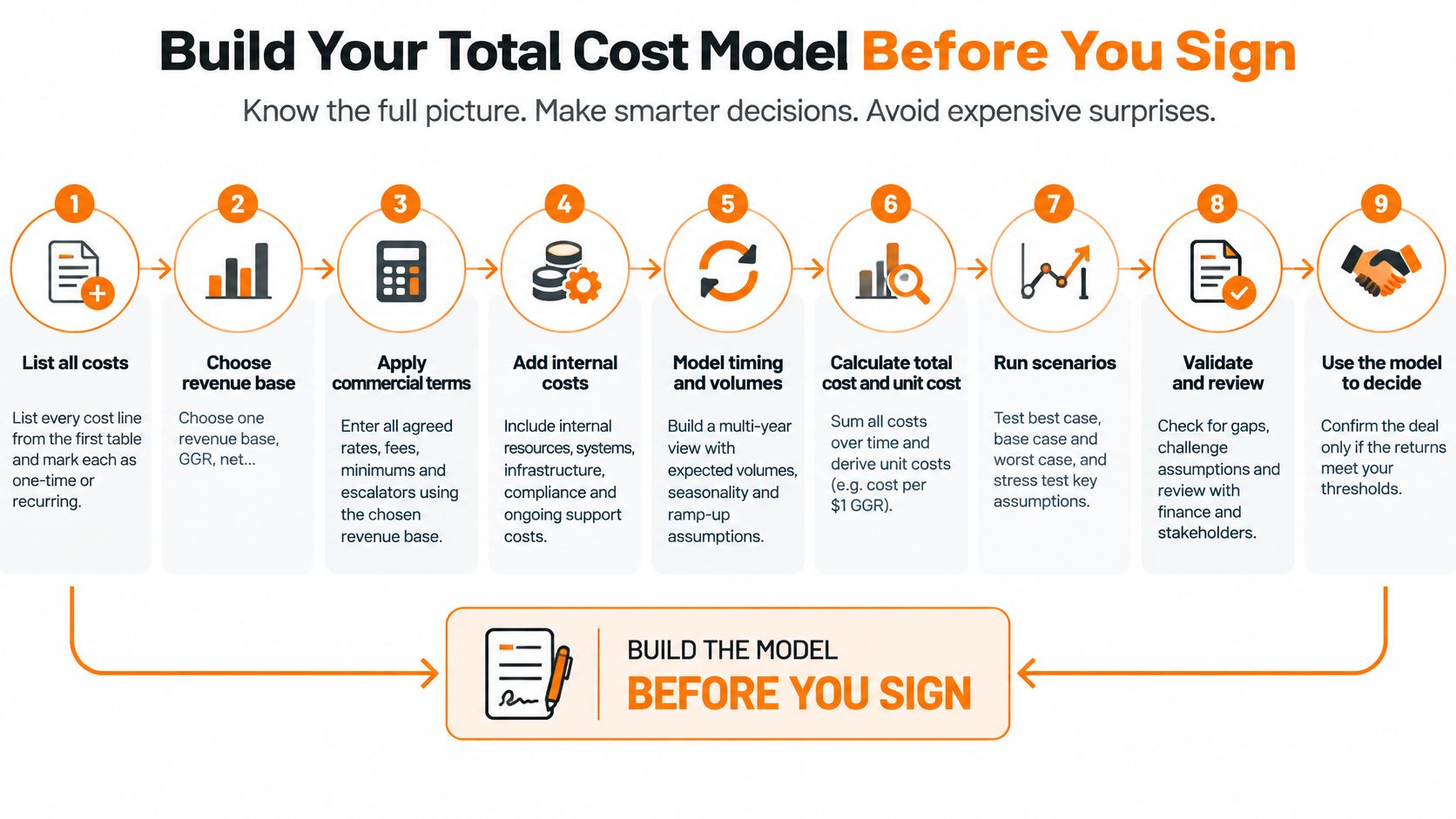
- List every cost line from the component table and mark it one-time or recurring. A line with no written number stays blank. It doesn't become zero.
- Lock one revenue base, GGR, net gaming revenue or deposits, and apply it to every percentage. Write the base in the sheet header so nobody switches it mid-model.
- Forecast three monthly GGR tiers: low, realistic and high. The realistic tier is the one your acquisition plan can fund, not the one in the sales deck.
- Add the fixed block: setup, licence application, annual licence fee and monthly platform fee. Put annual items in as one-twelfth on the monthly view and in full on the cash view.
- Add revenue share at the contract rate on each tier. Where a minimum monthly applies, use the higher of the minimum and the calculated share.
- Add card and bank processing as a percent of transaction volume, plus a chargeback allowance. This line is not a percent of GGR unless the acquirer contract says it is.
- Add tax and compliance contributions, including gaming tax, reporting and audit. Pull the rate from the regulator, not from the platform brochure.
- Add allowances for declines, bonuses and migration. A zero in any of those cells means you chose to ignore them.
- Divide total cost by GGR for the effective cost rate, then subtract total cost from GGR for the margin left before marketing. Marketing is still unpaid at this line, so don't treat the remainder as profit.
Compare two providers on this same sheet, and ask both for written fee schedules before you fill the blanks. A single stack that covers casino, sportsbook, wallet, payments and compliance can cut the integration work of stitching those modules yourself. The commercial model still gets all nine steps. If a custom build is the alternative, put that path in a second column using the same tiers, which is what an online casino software development comparison is for.
Sign only when the margin stays viable at low and realistic GGR and the payment mix is accepted in your target markets. Walk away otherwise. A strong high-tier margin with a negative realistic tier is a reason to stop, not a reason to grow into the contract.
NexGrate provides a turnkey white-label platform that brings casino content, sportsbook, payments and compliance controls into one stack, so the cost lines in this model can sit on a single commercial agreement instead of a pile of separate vendor invoices. If you are pricing a launch, map your low and realistic GGR tiers against that consolidated scope before you commit to a revenue share. Visit NexGrate to review the platform and set your own numbers next to it.