The most common advice about an MGA online casino is also the least useful: check for the Malta Gaming Authority logo, then assume the hard work is done. It isn't. A licence reduces regulatory risk, but it doesn't automatically secure withdrawals, prevent fraud, protect a brand from a copycat domain, or prove that every vendor is operating inside the approved technical boundary.
For operators, the licence is better understood as an operating programme. It connects legal ownership, key personnel, game certification, wallet controls, KYC and AML workflows, responsible-gaming interventions, geolocation, reporting, incident response, and supplier oversight. For players and B2B buyers, the important question isn't only whether a brand appears licensed. It's whether the business can demonstrate that the licence is supported by effective controls.
Table of Contents
- Why an MGA Licence Is Not the Trust Badge Most Players Think
- What an MGA Online Casino Licence Actually Covers
- Why Casino Content Dominates the MGA Regulated Market
- Technical Systems Audit, RNG Certification, and Environment Parity
- Player Funds, KYC, AML, and Geofencing in Practice
- Turnkey White-Label Platform Versus Building In-House
- Launch Sequence and Ongoing Operating Obligations
- Operator Checklist for Entering the MGA Regulated Market
Why an MGA Licence Is Not the Trust Badge Most Players Think
An MGA logo in a casino footer proves less than many review pages suggest. It may identify a legitimate licensed entity, but the logo alone doesn't tell you whether the domain is genuine, whether withdrawals are processed properly, whether player balances are reconciled, or whether a marketing affiliate is presenting an unauthorised copycat brand.
The Malta Gaming Authority's own recent activity makes that distinction clear. In the first half of 2025, the Authority reported 891 player-funds reports, nine data extractions connected with safeguarding funds, and 1,720 player-assistance requests in its 2025 annual report and financial statements. It also reviewed 75 URLs linked to unauthorised gaming activity and found 34 fraudulent references to the MGA or its licensees in the same reporting period and source.
Those figures don't mean an MGA licence is ineffective. They show why a licence isn't a substitute for operational verification. A regulator can supervise a licensed entity, impose requirements, investigate concerns, and act against unauthorised activity. It can't make every payment provider reliable, stop every fraudulent affiliate, or guarantee that a player has reached the authorised domain.
Practical rule: Treat the licence as an entry point for due diligence, not as the conclusion.
The operator journey starts before the application
A serious launch begins with a business case, target jurisdictions, product scope, ownership review, banking strategy, game suppliers, compliance staffing, and a decision about whether to build or buy the platform. The licence application sits inside that programme. It doesn't replace it.
Before signing with a platform vendor, confirm which entity holds which approval, which supplier operates each critical component, and whether the production environment matches the environment reviewed by the independent auditor. A casino that looks polished to a player can still have weak change control, fragmented wallet logic, incomplete audit trails, or unverified affiliate traffic behind it.
Players should verify the operator in the MGA's official register, inspect the exact domain, read withdrawal and identity-verification terms, and understand how complaints are handled. B2B buyers should go further. Ask for evidence of wallet reconciliation, game certification, access controls, geofencing tests, incident procedures, and supplier governance.
What an MGA Online Casino Licence Actually Covers
The MGA regulates licensed gaming activity in Malta and supervises the entities, systems, and people responsible for delivering it. That scope matters because an MGA licence, a technical systems approval, and an ongoing supervisory relationship are related but different things.
A B2C operator offering casino products generally needs the licence category that covers Type 1 games, including casino-style games, slots, table games, and live casino. A platform, game supplier, payments technology provider, or other critical supplier may require a B2B Critical Supply Licence, depending on the service it provides and the regulatory structure applicable to that activity. The brand owner and the technology supplier shouldn't assume that one party's approval covers the other party's responsibilities.
The practical division of responsibility looks like this:
- The B2C operator owns the player relationship, account terms, marketing, responsible-gaming process, complaints, payments oversight, and regulatory reporting attached to its business.
- The B2B supplier must deliver the approved technical services within its authorised scope, maintain controls, support evidence production, and manage changes without creating an unapproved divergence.
- Game and RNG suppliers must provide evidence that their content and random-number systems meet the required technical standards.
- Key functionaries and senior personnel must support governance, compliance, reporting, and accountability rather than treating the licence as a passive corporate asset.
- The independent auditor approved by the MGA evaluates the proposed technical production setup through the required systems-audit process.
Licensing is a chain of evidence
A regulator doesn't only want to know that a game opens and accepts bets. The applicant must document games, RNG technology, hardware and software architecture, information security, disaster recovery, and business continuity. That evidence must remain useful after launch, when suppliers change, releases are deployed, incidents occur, and player complaints require investigation.
For an entrepreneur, the key question is simple: who can produce the evidence, how quickly, and from which system of record? If the answer is spread across disconnected vendors and manual spreadsheets, the licence may be technically obtainable but operationally fragile.
Why Casino Content Dominates the MGA Regulated Market
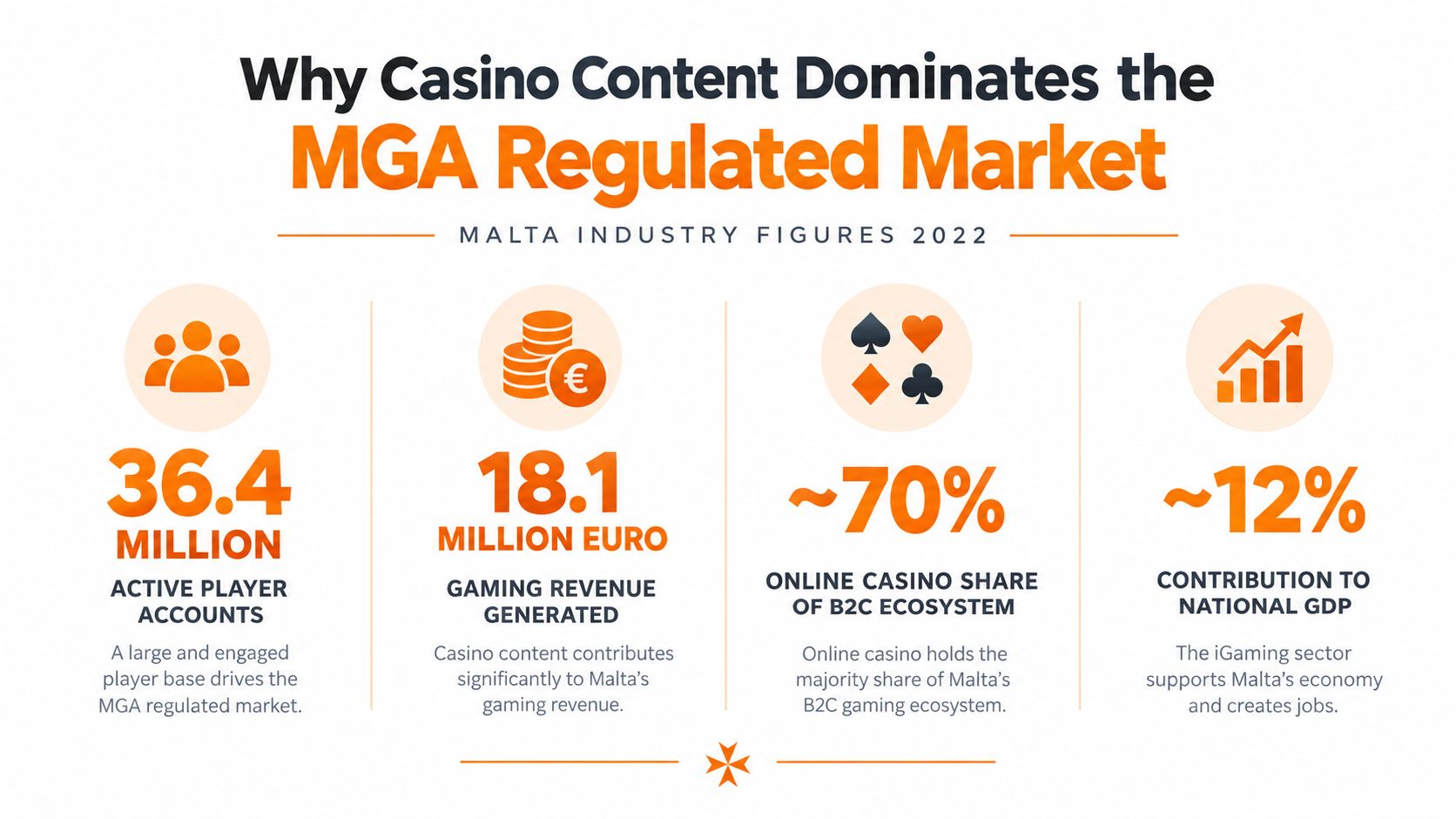
Malta offers a useful benchmark for the scale of a mature regulated gaming hub. The Malta Gaming Authority reported 36.4 million active player accounts on MGA-licensed websites in 2022, up 2.6% year over year, and estimated 18.1 million new active player accounts during that year, representing 9.7% growth compared with 2021, according to its 2022 industry statistics.
These are active accounts, not unique individuals. One person may hold accounts with multiple licensed websites. That distinction matters, but it doesn't reduce the architectural lesson. A mature licensing hub serving internationally oriented operators needs identity controls, account-linking logic, payment monitoring, responsible-gaming tooling, and reliable data extraction that work across brands and jurisdictions.
The revenue mix is even more important for platform planning. Type 1 games generated 73.0% of total gaming revenue among Malta's B2C licensees in 2022, covering slots, casino table games, and live casino in the regulator's classification. Casino content isn't a decorative product category added to a sportsbook. It can be the primary operating workload.
Scale changes the meaning of a “casino backend”
A basic game lobby can display titles. A regulated casino platform must also maintain:
- A durable player identity, with verification status, risk indicators, limits, exclusions, and linked accounts.
- A unified wallet, recording deposits, wagers, wins, withdrawals, bonuses, reversals, fees, and adjustments.
- Supplier-level traceability, showing which game version generated each transaction and outcome.
- Responsible-gaming workflows, including intervention triggers, self-exclusion handling, communication records, and escalation paths.
- Operational reporting, capable of producing consistent records for the operator, auditor, payment teams, and regulator.
Casino concentration also affects vendor selection. Adding more titles increases the number of integrations, configurations, game-risk decisions, settlement records, and supplier relationships. The visible promise of a large game library creates an invisible obligation to control every connection behind it.
Technical Systems Audit, RNG Certification, and Environment Parity
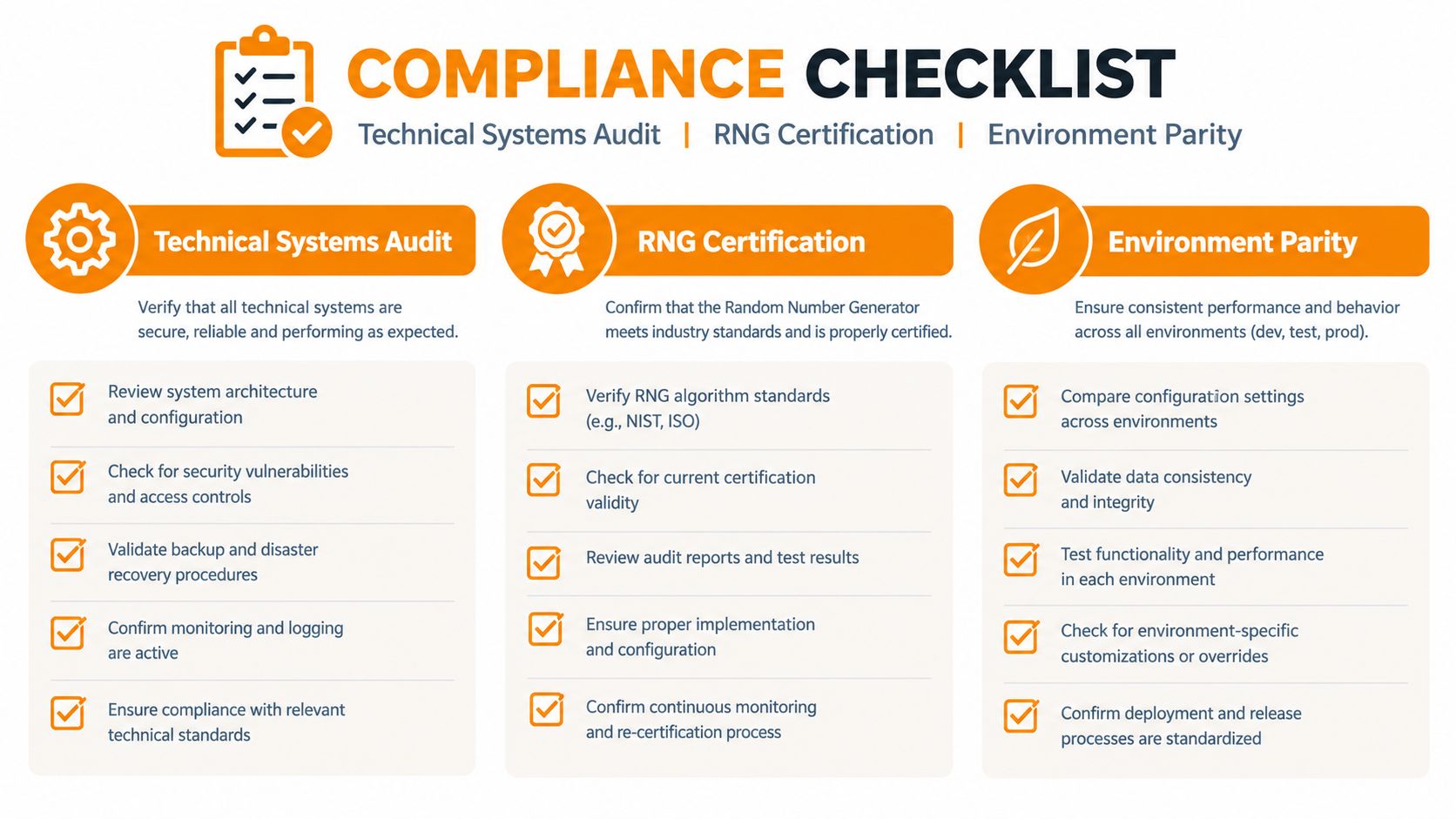
Technical approval is where many launch plans become unrealistic. For an MGA-regulated online casino, demonstrating that the games work is only one part of the submission. The application must cover the RNG, game builds, hardware and software architecture, information-security controls, disaster recovery, and business continuity.
The proposed production setup then goes through a staged systems audit by an MGA-approved independent auditor before the licence can be issued. That process should shape engineering decisions from the start. Retrofitting evidence after the platform has been assembled usually creates gaps between what the team believes it deployed and what it can prove.
Environment parity is a release-control problem
The certified RNG, game builds, wallet logic, payment integrations, configuration files, and security controls in staging should match the production versions. If they don't, the operator may have a casino that appears unchanged to the player but no longer matches the audited technical boundary.
Use concrete engineering controls:
- Version-controlled deployment manifests: Record the exact components and configuration approved for each environment.
- Cryptographic hashes: Track hashes for game binaries and important configuration files so unauthorised changes are detectable.
- Formal change approvals: Require documented review for releases, supplier updates, configuration changes, and privileged access.
- Rollback procedures: Define how the team will restore the last approved version without improvising during an incident.
- Append-only audit logs: Capture timestamps, administrative identities, before-and-after values, ticket references, and privileged actions.
- Recovery evidence: Test disaster recovery and business continuity procedures, then retain the results and remediation decisions.
The MGA requires licensees to retain audit logs of changes to the key technical setup for at least two years, as described in this Malta gambling law and regulation overview. That requirement should influence storage design, access permissions, retention policies, and export capability.
Audit-ready means reproducible. An auditor should be able to connect a player transaction to the relevant account, wallet event, game version, supplier, configuration state, and administrative change history.
For operators assessing game fairness communication, technical certification should remain distinct from marketing language. A plain explanation of provably fair games can help users understand verification concepts, but it doesn't replace the regulatory evidence and system controls required for an MGA-regulated operation.
Player Funds, KYC, AML, and Geofencing in Practice
Player-facing promises become credible only when they map to backend controls. “Funds are protected” should lead to wallet architecture, reconciliation, authorised access, exception handling, and an extraction process that can produce accurate balances quickly. “We verify players” should lead to identity checks, document handling, risk scoring, source-of-funds procedures where required, and ongoing transaction monitoring.
The MGA's reporting on player-funds concerns and data extractions shows why speed matters. A regulator or operator may need a reliable account-level view during a complaint, investigation, insolvency concern, payment incident, or safeguarding review. A platform that can't separate player liabilities from operational accounting creates unnecessary uncertainty at exactly the wrong time.
KYC and AML controls should operate as a connected workflow, not as a single verification button. The platform needs to record failed checks, manual reviews, document expiry, enhanced due diligence, transaction patterns, suspicious-activity decisions, and the staff member or system that made each material decision.
Use the control map during vendor due diligence
| Regulatory Control | Platform Capability | What to Verify |
|---|---|---|
| Player-funds safeguarding | Double-entry wallet, reconciliation, segregated accounting views | Ask how balances, pending withdrawals, bonuses, reversals, and manual adjustments are reconciled |
| KYC and AML | Identity verification, risk rules, source-of-funds workflow, transaction monitoring | Review escalation paths, review queues, evidence retention, and reporting exports |
| Responsible gaming | Limits, self-exclusion, intervention triggers, account restrictions | Test whether controls apply across brands, wallets, devices, and linked accounts |
| Geofencing | Location checks, jurisdiction blocklists, fail-closed access rules | Request test evidence for blocked locations, VPN or proxy signals, and rule changes |
| Unauthorised-domain risk | Affiliate monitoring, domain verification, brand-asset controls | Confirm how the operator identifies misleading domains and escalates fraudulent references |
| Regulatory intervention | Rapid data extraction and complaint workflows | Run a test extraction covering accounts, balances, transactions, communications, and decisions |
Geofencing needs more than a country selector. The operator should define jurisdiction rules, permitted products, blocked locations, location-failure behaviour, and the response when signals conflict. A brand can be licensed while an affiliate, mirror site, or copycat domain misuses its name. Monitor traffic sources and brand references, and make the authorised domain easy for players to verify.
Turnkey White-Label Platform Versus Building In-House
Building in-house offers control, but it also makes the operator responsible for assembling and maintaining every critical layer. That can mean separate game integrations, RNG evidence, payment connectors, KYC vendors, fraud tooling, sportsbook services, wallet accounting, reporting, monitoring, and release controls.
A turnkey white-label model concentrates more of those responsibilities in a coordinated environment. NexGrate, for example, provides a platform combining casino and sportsbook operations, game content, payments, player management, KYC and AML workflows, fraud controls, responsible-gaming features, geofencing, reporting, and audit logs. It's one option for B2B operators that want a consolidated stack rather than a collection of unrelated systems.
Compare the operating burden, not just the launch date
| Decision area | In-house build | Turnkey white-label |
|---|---|---|
| Control over product logic | High, with direct ownership of design and release decisions | Constrained by platform capabilities and partner governance |
| Integration workload | The operator coordinates each supplier and data interface | The provider supplies consolidated modules and prebuilt connections |
| Audit preparation | The operator assembles evidence across internal teams and vendors | Evidence may be more centralised, but scope must be verified |
| Wallet and account model | Customisable, but the operator owns reconciliation and failure handling | Unified wallet and player management can reduce fragmentation |
| Multi-brand operations | Flexible, with more architecture to maintain | Shared services can simplify central controls if configured correctly |
| Supplier dependence | Spread across vendors, but integration responsibility stays internal | Concentrated with the platform provider, creating partner-risk exposure |
The strongest argument for a unified platform is not speed alone. It's control consistency. A single player record, wallet, compliance toolkit, and reporting model makes it easier to apply restrictions and investigate activity across casino and sportsbook products.
The main risk is assuming that a vendor's audit readiness automatically covers the operator's scope. Before signing, map the platform's approved environment to your legal entity, brands, jurisdictions, suppliers, payment routes, data flows, and planned configuration. The relevant question is whether the partner can provide evidence for your operating model, not whether its sales presentation uses the words “MGA compliant”. The white-label casino integration guide should be treated as a starting point for that technical conversation, not as a substitute for documented due diligence.
Launch Sequence and Ongoing Operating Obligations
An MGA launch should follow a controlled sequence rather than a marketing deadline. Start by defining the licensed entity, product scope, target jurisdictions, key functionaries, approved suppliers, and ownership of each control. Then configure the sandbox and staging environments so the game catalogue, wallet, payments, KYC, responsible-gaming rules, geofencing, reporting, and access controls can be tested together.
A practical launch sequence looks like this:
- Confirm the approved operating boundary. List brands, products, suppliers, payment methods, currencies, jurisdictions, and data flows.
- Build and test the controlled environment. Connect games, wallets, cashier services, identity checks, risk rules, and reporting before live traffic.
- Validate player protection. Test limits, self-exclusion, reality checks where applicable, account restrictions, intervention workflows, and complaint escalation.
- Run operational rehearsals. Simulate payment exceptions, failed KYC, suspicious activity, supplier outages, account closure, data extraction, and rollback.
- Control the go-live release. Record the approved build, configuration state, access list, evidence pack, and production change window.
- Monitor from the first player. Watch payments, fraud signals, location failures, game events, responsible-gaming triggers, complaints, and affiliate activity.
The obligations don't end when the first deposit arrives. Teams need procedures for suspicious-activity reporting, complaint handling, responsible-gaming reviews, advertising compliance, supplier oversight, security incidents, and recurring regulatory reporting. Reporting should be designed into the platform, not assembled manually after the reporting period closes. A useful reference for the operating model is this guide to compliance reporting for iGaming operators.
Growth raises the control threshold
The MGA's 2025 figures show that Type 1 games generated 78.9% of gross gaming revenue reported by Malta-licensed B2C online licensees, compared with 73.0% in 2022, according to the Authority's 2025 annual report. The change reinforces a practical point: casino growth adds compliance workload as well as catalogue breadth.
The same 2025 report records 15 full-scope compliance audits and 109 thematic reviews covering compliance, player protection, and sports-betting integrity. Operators should therefore plan for ongoing testing of game-risk classification, payment monitoring, player-funds reconciliation, affiliate oversight, and cross-product controls. An MGA base can support expansion into other regulated markets, but it won't remove the need for jurisdiction-specific rules, reporting, tax treatment, geolocation, and responsible-gaming requirements.
Operator Checklist for Entering the MGA Regulated Market
Use this checklist before committing to a licence application or platform contract:
- Choose the correct licence scope: Separate B2C casino responsibilities from B2B supplier responsibilities.
- Map every critical vendor: Identify who owns games, RNG evidence, payments, KYC, AML, wallets, geofencing, reporting, and support.
- Demand environment parity: Confirm that staging and production use controlled, traceable versions.
- Test the wallet: Review double-entry accounting, reconciliation, player-funds views, withdrawals, reversals, and extraction.
- Verify player protection: Test KYC, AML, self-exclusion, limits, interventions, complaints, and responsible-gaming records.
- Control market access: Document jurisdiction rules, location checks, blocklists, and fail-closed behaviour.
- Prepare audit evidence: Maintain change approvals, hashes, deployment manifests, recovery tests, and retained logs.
- Plan the operating cadence: Assign owners for reporting, incidents, supplier reviews, advertising, and regulatory communication.
An MGA licence is the beginning of the control programme. Select a platform and operating team that can prove what happens after approval, not merely display the badge before launch.
NexGrate provides a turnkey white-label casino and sportsbook platform with integrated games, wallets, payments, KYC and AML workflows, responsible-gaming controls, geofencing, reporting, and audit logs. Review how the platform can support your MGA operating model and visit NexGrate to discuss your launch requirements.