Monday morning, your brand team wants fresh mobile content before the next campaign, operations wants a clean wallet flow, and compliance is checking every supplier claim for jurisdictional and settlement risk. The sales deck calls the product a one touch game, but that label can describe a control pattern, a football tactic, or a B2B studio. Treating those meanings as interchangeable is how operators approve the wrong content, miss a latency problem, or discover too late that the integration only works in a polished demo.
A serious evaluation starts with sharper questions. What does the player tap, and what state changes? Where is the authoritative result settled? Which jurisdictions support the title? Can the platform report wallet, bonus, gameplay, and dispute events without stitching together several dashboards?
Table of Contents
- Why Operators Care About One Touch Games Right Now
- What a One Touch Game Actually Means
- The Mobile-First Design Principles Behind the Pattern
- Spotlight on the OneTouch Studio and Its Game Families
- How One Touch Content Fits a White-Label iGaming Platform
- The Hard Truth About One Touch Latency and Fairness
- Operator Checklist Before You Launch One Touch Content
Why Operators Care About One Touch Games Right Now
Mobile-first content has a narrow margin for failure. A player opens a title from a campaign, taps the primary control, and expects an immediate, understandable response. If the screen hesitates, a button sits under a thumb, or the result appears visually settled before the wallet confirms it, the player doesn't experience a clever casual mechanic. They experience a system they don't trust.
That makes one touch content an operator concern, not merely a product team's design preference. The mechanic promises quick onboarding and low interaction effort, but those benefits only exist when the provider has handled input processing, rendering, wallet communication, bonus rules, and responsible gaming controls as one connected flow.
Operator rule: Never approve a one touch title from a video or a desktop demo alone. Test the complete player journey on the devices, networks, and jurisdictions you actually serve.
The phrase also attracts confusion inside commercial conversations. A supplier might use “one touch” to describe a casual game built around a tap or swipe. A football content partner might use it to evoke first-time passing and coordinated play. A studio brand may appear in an aggregator catalogue under a similar name. Each interpretation creates a different set of diligence questions.
What the buying team must establish
Start with the business outcome, not the label:
- Mobile conversion: Does the title load, orient, and become playable without unnecessary steps?
- Session clarity: Can a new player understand the available action without reading a manual?
- Settlement confidence: Does every paid action create a traceable wallet and game-state event?
- Compliance control: Can the operator restrict the title by jurisdiction, player status, bonus state, and responsible gaming rules?
- Reporting quality: Are input, round, balance, promotion, and error events available to operations?
A consolidated platform can reduce the number of separate interfaces involved, but it doesn't remove the operator's responsibility. You still need to validate the game adapter, the wallet contract, the jurisdiction rules, and the dispute process before launch.
The useful outcome of this evaluation is practical. You should be able to identify which “one touch” product you're being shown, test the demo against real operating conditions, and decide whether the content belongs in a white-label stack without creating a second operational system.
What a One Touch Game Actually Means
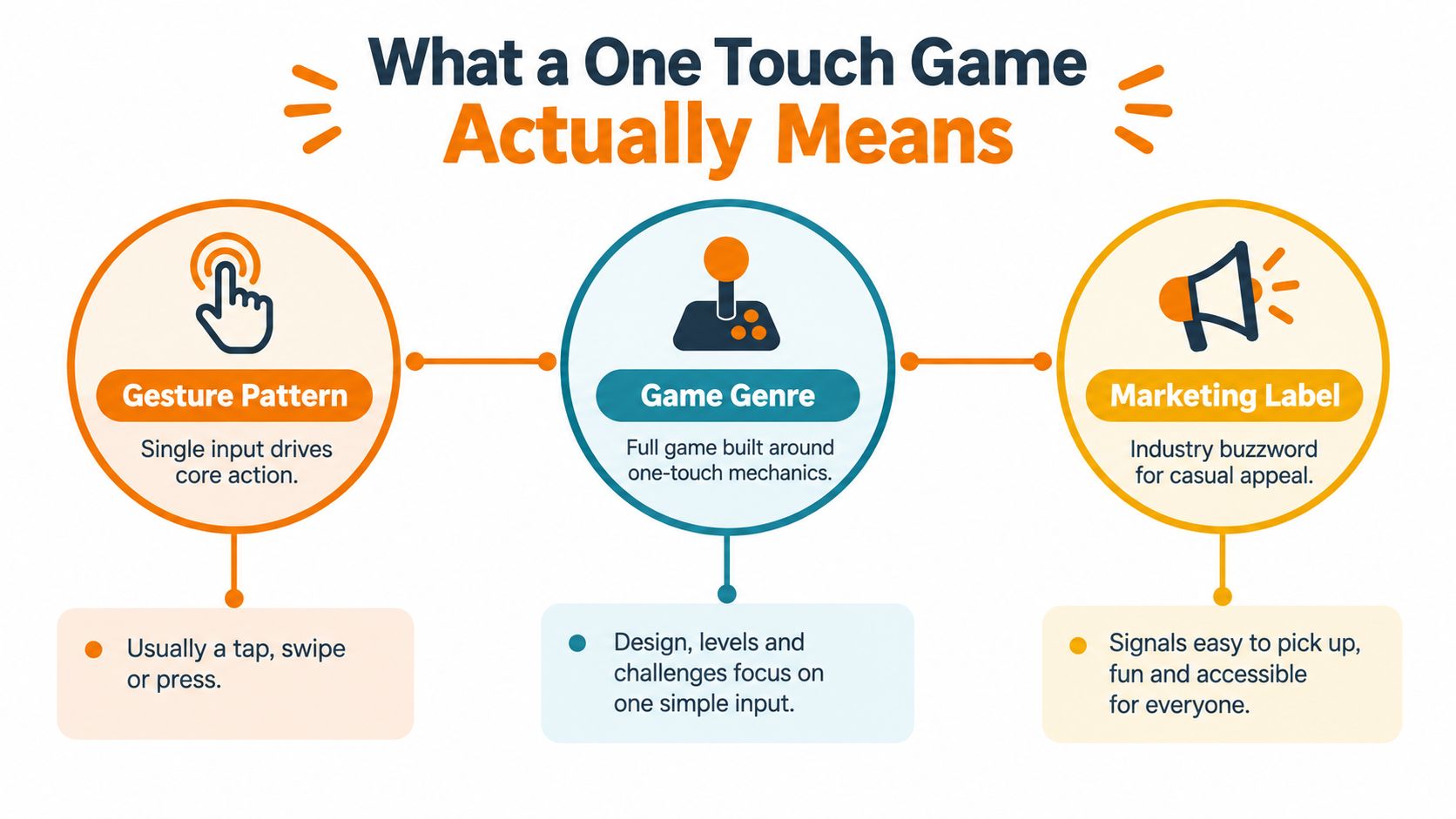
The phrase has three distinct meanings, and sales conversations become much easier once you separate them.
First, it can describe a UX pattern. A tap, hold, swipe, or drawn gesture drives the main game action. The important design principle isn't "fewer buttons." Research reviewing 77 popular one-touch gesture mobile games found recurring relationships between gesture type, in-game action, and interaction model in the study of one-touch gesture games. The operator's question is whether each gesture creates one clear state change.
Second, it can describe a football tactic. In association football, one-touch play means passing or shooting immediately, without first trapping, dribbling, or taking another controlling touch. The approach accelerates circulation and reduces the time defenders have to reorganize. It has been associated with football cultures and teams including the Netherlands of the 1970s, Brazil, Argentina, Spain, Barcelona, Chelsea, and Arsenal, as described in the overview of one-touch football.
Third, OneTouch can refer to a B2B studio or supplier brand presented through casino aggregation. That commercial meaning requires vendor diligence, not a gameplay definition. Ask what the company supplies, which titles are available in your target markets, and whether a game family, the studio's identity, or only a marketing theme describes “one touch”.
Use a simple analogy with internal teams
Think of the UX pattern as the engine, the football tactic as the cultural reference, and the studio as the commercial package. The engine determines how the player interacts. The football reference determines the language and associations around speed, anticipation, and coordinated movement. The studio determines the catalogue, integration, certification, and account relationship.
Those layers can overlap, but they don't prove anything about each other. A drawing puzzle can use one-touch interaction without having any relationship to football. A football-themed title can use several controls. A studio with OneTouch in its name may supply casino content that has no connection to a one-stroke puzzle mechanic.
Ask this before the demo: “Which one touch do you mean, and what exactly is included in the contract?”
That single question prevents the operator from evaluating a brand name as if it were a technical specification.
The Mobile-First Design Principles Behind the Pattern
A one touch interface succeeds when the player can predict the result of a gesture, see feedback quickly, and recover from mistakes without uncertainty. The control set may be small, but the design contract is demanding.
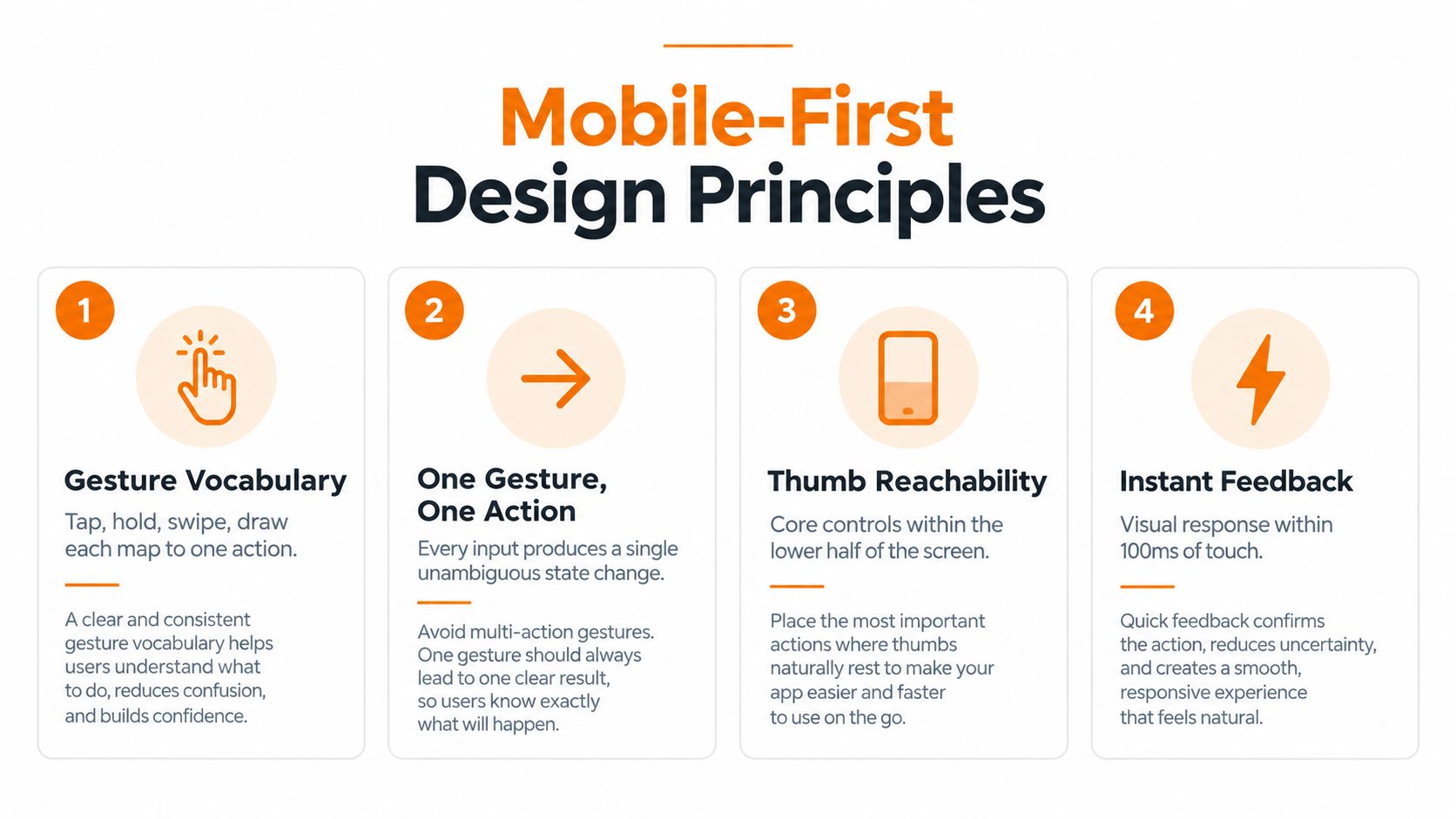
Start with gesture vocabulary
A provider should define its gesture vocabulary before it discusses visual style. Tap, hold, swipe, and draw each need a clear purpose. If a tap can both select and confirm depending on an invisible timing rule, the interface creates ambiguity. If a swipe can trigger a game action and expose an adjacent promotion, the operator inherits an avoidable dispute risk.
A strong mapping looks like this:
- Tap: reveal, select, or confirm one visible target.
- Hold: charge or maintain an action, only when duration is obvious.
- Swipe: move, rotate, or change a clearly signposted state.
- Draw: trace a route where the path itself is the action.
The practical rule is one gesture to one high-value state transition. In a casino-style product, that transition might be reveal, stop, collect, or confirm. It shouldn't also open an ad, switch wallets, or alter a bonus condition without clear feedback.
Treat responsiveness as part of the product
Touch response is measurable, and players can detect small differences. Research on mobile gaming reports that users can reliably perceive touch-latency differences in the approximate 5 to 10 ms range, while total control delay can include touch processing, application work, frame presentation, network time, and server time in research on mobile touch latency.
The same research reported average touch-to-kernel delay of about 40.5 ms on a Samsung S4 and 24.1 ms on a Samsung S7, with total control delay capable of remaining below 50 ms on compatible modern devices. For an operator, this translates into a demo requirement: measure the local tap-to-feedback path, not only the time until the backend settles the result.
Use immediate local acknowledgement for the visual response, but don't confuse it with authoritative settlement. The animation can show that the tap was received. It must not imply that a win, collection, balance update, or wager outcome is final before the backend confirms it.
Accessibility sets the ceiling for retention. Test screen sizes, portrait and tablet layouts, finger occlusion, edge placement, contrast, haptic or audio feedback, and tolerance around small targets. A single-finger gesture can be cognitively simple while remaining physically unforgiving.
Spotlight on the OneTouch Studio and Its Game Families
When OneTouch appears as a studio or content supplier, evaluate it as a B2B vendor rather than as a synonym for casual mobile mechanics. The relevant questions concern the catalogue, distribution rights, certification, technical delivery, and operational support.
A provider conversation should clarify whether the offering is primarily a compact RNG portfolio, whether table or live-dealer content is included, and how the titles are positioned for frequent mobile sessions. Don't infer the math profile from the visual design. A fast interface says nothing about volatility, return configuration, maximum win rules, bonus features, or jurisdiction approval.

Separate studio diligence from mechanic diligence
A drawing puzzle that requires a player to connect a figure without lifting a finger is a casual game example of one-touch interaction. It tells you how to think about gesture tolerance and recovery. It doesn't establish anything about a casino studio's RNG certification or integration quality.
For a broader vendor comparison, operators can use this overview of iGaming software providers to frame the categories that matter across suppliers. Keep the assessment evidence-based. Require title-level documentation instead of accepting a catalogue-wide assurance.
Ask the supplier for:
- Math documentation: Certification, game rules, theoretical return information, volatility description, and configuration controls.
- Jurisdiction coverage: A title-by-title matrix showing where each game is approved, restricted, or unavailable.
- Betting configuration: Minimums, maximums, currency handling, VIP suitability, and responsible gaming constraints.
- Technical format: Confirmation that the title is HTML5-native or a documented explanation of any wrapped legacy component.
- Operational support: Incident ownership, release notices, rollback procedures, and player dispute escalation.
- Reporting detail: Round identifiers, wager and payout events, bonus references, error codes, and settlement timestamps.
The commercial distinction is simple. OneTouch may be the brand or studio you contract with. “One touch game” may be the mechanic you place in front of players. The first needs supplier diligence. The second needs UX and technical testing.
How One Touch Content Fits a White-Label iGaming Platform
A one touch title becomes operationally useful only when it fits the same control plane as the rest of the casino and sportsbook. The cleanest model uses a single content API or a set of prebuilt adapters, then routes game, wallet, compliance, payments, and marketing events through shared services.
The first layer is content ingestion. The platform receives the title metadata, launch parameters, supported currencies, jurisdiction flags, and round events. The adapter should preserve a stable game and round identity so support teams can trace a player complaint from the front end to the provider and wallet.
The second is player and wallet management. A tap that creates a wager or collection request needs a real-time balance check, an idempotent transaction path, and a clear response when the network fails. The player shouldn't be charged twice because a tap was retried, and the interface shouldn't display a completed collection when the wallet rejected it.
The third is KYC, AML, and geofencing. The platform must evaluate eligibility before launch and maintain jurisdiction controls during the relevant gameplay event. A title available in one market isn't automatically available to the same player while travelling or connecting through a different location.
Payments form the fourth layer. Cards, bank processing, multiple currencies, cryptocurrency deposits and withdrawals, and cashier controls should remain connected to the same player account and audit trail. The game itself shouldn't become a special payment exception.
Marketing is the fifth layer. Bonuses, free spins, loyalty tiers, segmentation, affiliate attribution, and campaign analytics need explicit rules for one-tap actions. A single gesture might trigger a bonus round, but the platform still has to distinguish promotional value from cash balance and record the applicable wagering or eligibility state.
Infrastructure is the sixth layer. Monitoring, deployment controls, DDoS protection, and uptime management determine whether the experience remains usable outside a controlled demo.
| Platform Layer | What It Handles | Operator Decision |
|---|---|---|
| Content API and adapters | Game launch, metadata, round events, provider communication | Which titles can launch in each market and channel? |
| Player and wallet services | Balances, wagers, payouts, reversals, transaction identity | What happens when a tap times out or repeats? |
| KYC, AML, and geofencing | Eligibility, player checks, market restrictions, audit records | Where can each title operate, and under what player conditions? |
| Payments and cashier | Cards, banking, currencies, crypto, deposits, withdrawals | Which payment methods and currencies should the brand expose? |
| Bonuses and loyalty | Free spins, promotions, segmentation, affiliate attribution | How are promotional and real funds separated and reported? |
| Hosting and monitoring | Availability, security, releases, incident detection | What response and escalation path applies during an outage? |
A consolidated environment such as a white-label casino integration platform can reduce integration overhead by placing these functions in one operating model. It doesn't turn compliance into a vendor-only task. The operator still owns market approval, player communications, reporting accuracy, responsible gaming execution, and the dispute path.
The launch advantage is speed and consistency. The post-launch obligation is control. Sign only when the supplier can show the logs, failure states, rollback process, and reporting outputs that your operations and compliance teams will use every day.
The Hard Truth About One Touch Latency and Fairness
“One touch” sounds easy because the player performs less. The supplier, however, has to make more invisible decisions correctly. A single gesture must identify the intended target, reject accidental activation, avoid collision with an ad layer, handle finger occlusion, and produce a state change that both the player and the backend understand.
The review of 77 popular one-touch gesture mobile games linked engagement to the relationship between a physical gesture and meaningful game-object behavior, rather than to the number of controls alone. That distinction matters for operators. Removing buttons doesn't remove interaction risk. It concentrates risk into the remaining gesture.
Demand measurable performance
Ask for latency distributions, not a single average. Your acceptance test should capture p50, p95, and worst-case input-to-feedback latency, separated from authoritative server settlement. The local acknowledgement path should remain below 50 ms where possible, based on the mobile latency research cited earlier. Test under realistic device and network conditions, including budget Android hardware and degraded connectivity.
The service-level agreement should define:
- Input acknowledgement: What counts as a received tap, and how quickly is it displayed?
- Settlement authority: Which system confirms the wager, payout, collection, or bonus transition?
- Retry behavior: How does the platform prevent duplicate transactions?
- Failure display: What does the player see when the provider or wallet is unavailable?
- Evidence retention: Which event identifiers and timestamps support a dispute review?
- Escalation: Who owns the incident when the front end, game server, and wallet disagree?
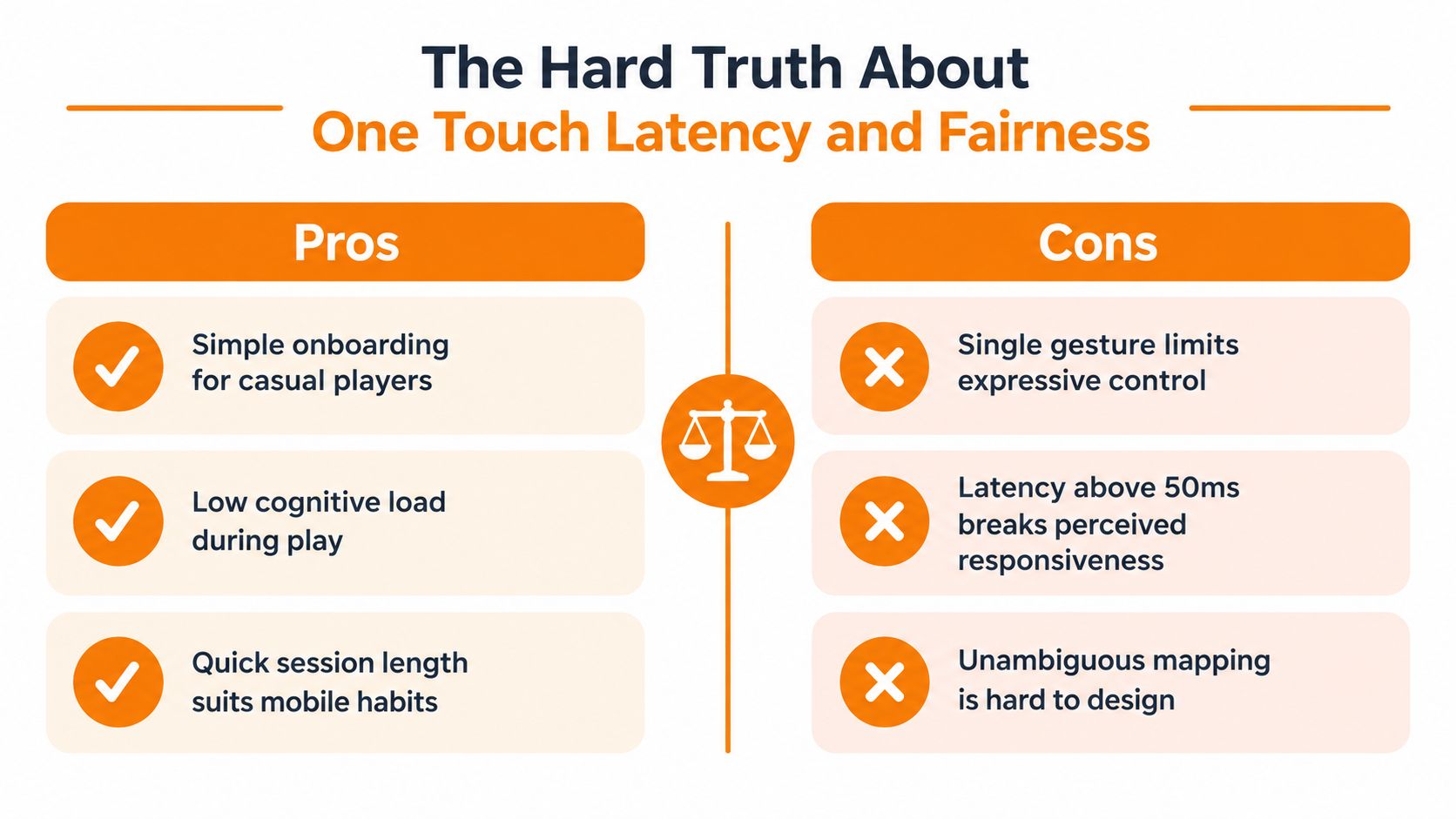
Fairness is separate from animation quality. A provider can render an attractive instant response while the authoritative backend is still processing. That visual response must acknowledge input without promising a confirmed outcome. If the backend rejects the transaction, the player needs a precise, recoverable message and the operator needs a complete audit trail.
For a wider view of game integrity controls, compare the provider's approach with this guide to provably fair games. Don't accept “provably fair” as a slogan. Ask whether the proposed mechanism applies to this title, which party generates the outcome, what the player can verify, and how the operator handles a failed or disputed round.
The hard truth is that a one touch game isn't a shortcut around engineering. It's a concentrated test of engineering discipline.
Operator Checklist Before You Launch One Touch Content
Use the following gates in the launch meeting. If a supplier can't answer one of them with documentation or a reproducible test, the title isn't ready for production.
| Check | Why It Matters | Common Shortcut to Avoid |
|---|---|---|
| Latency budget | Players need immediate acknowledgement, while the backend must settle authoritatively | Approving the title from a fast office Wi-Fi demo |
| Math certification | Rules, outcomes, and configuration need documented technical support | Treating polished animation as evidence of fair or approved play |
| Jurisdiction coverage | Availability may differ by title, market, player, and session context | Assuming one approval covers the entire catalogue |
| Wallet integration | Wagers, wins, reversals, and retries must remain traceable | Allowing a separate wallet flow for promotional gameplay |
| Bonus separation | Free spins and bonus value need distinct accounting from cash | Mixing escrow, cash balance, and display animations |
| Device QA | Finger placement, screen size, performance, and accessibility affect outcomes | Testing only on flagship phones and desktop browsers |
| Error recovery | A player needs a clear path after a timeout, freeze, or reset | Treating every failed tap as player error |
| Monitoring and uptime | Operations need early warning and an accountable incident owner | Relying on provider assurances without shared dashboards |
| Dispute process | Support needs round IDs, event logs, timestamps, and escalation contacts | Asking the player to repeat the same action without investigation |
A progress recovery policy deserves specific attention for puzzle-like one-touch products. Player reviews for similarly named apps describe progress resetting to the first level, freezes during moves, and accidental ad activation. Those reports show why a vendor must document account binding, cloud-save behavior, reinstall recovery, offline limitations, and app-version differences rather than promising that every One Touch title behaves the same.
Accessibility testing should also distinguish puzzle difficulty from interface failure. Check stylus and finger input, portrait and tablet layouts, tiny junctions, unintended snapping, edge targets, contrast, feedback options, and whether a player can pause or retry without an unexplained penalty.
A unified casino and sportsbook backend has practical value. Shared wallet, compliance, payment, promotion, monitoring, and reporting controls make the launch gates enforceable after release, not just visible during procurement.
Make this your action for the week: request the title-level certification pack, jurisdiction matrix, latency test results, failure-state walkthrough, wallet event schema, and accessibility evidence from every shortlisted supplier. NexGrate provides a turnkey white-label environment with casino and sportsbook operations, shared player and wallet services, payment and compliance tooling, content integrations, marketing controls, and hosting support, making it one platform option for wiring mobile casino content into a unified stack. Visit NexGrate to assess whether its integration and operating model match your launch requirements.