
Your launch plan says twelve months from license to live brand. The roadmap looks credible until payments need separate approval, the wallet has to reconcile casino and sportsbook activity, every game release crosses a certification boundary, and compliance reports must match the regulator's format. Suddenly, the decision is no longer “which platform has the most features?” It's which architecture carries the operational risk when volume, regulation, and money movement collide?
That's the decision facing a new casino brand, a sportsbook migrating from a legacy backend, and a crypto operator moving toward regulated markets. A turnkey online casino gaming platform can compress integration work, but it can also concentrate risk in a vendor you don't control. A custom stack gives you ownership, but it leaves your team responsible for every connection, release process, reconciliation rule, and audit trail. The right choice depends on where your organisation has genuine engineering and compliance strength.
Table of Contents
- The Operator's First Decision
- What an Online Casino Gaming Platform Actually Is
- Why Scale Changes the Engineering Problem
- Compliance Architecture and Multi-Jurisdiction Rollout
- Payments, Wallets, and the Crypto Trade-Off
- RNG Certification as a Release-Gating Control
- AI for Fraud, AML, and Responsible Gambling Without Opacity
- The 2026 Buyer's Checklist for an Online Casino Platform
The Operator's First Decision
A founding team usually starts with a spreadsheet. One column lists a custom build, another lists a turnkey platform, and both appear to fit the launch plan. The custom route promises control over the player experience and data model. The turnkey route promises pre-integrated games, payments, sportsbook capability, and back-office workflows.
The spreadsheet rarely captures the operational question: who absorbs failure when the system is live?
A broken campaign is inconvenient. A wallet discrepancy, an incorrectly geofenced player, an untraceable withdrawal, or a game release without defensible certification evidence can become a regulatory and financial problem. The platform sits underneath all of those outcomes, so it isn't a marketing wrapper around games. It's the operating system for identity, balances, transactions, content, controls, and reporting.
Build versus buy is a risk allocation decision
A custom build makes sense when the operator has a mature engineering organisation, a defined multi-market product strategy, and the appetite to own long-term maintenance. It also requires disciplined vendor management for game studios, payment processors, KYC services, geolocation, fraud tools, and reporting systems.
A turnkey platform is more suitable when the business needs a controlled route to launch, has limited internal platform engineering capacity, or wants one operating layer across casino and sportsbook. The trade-off is dependency. You'll need contractual protection around data access, service levels, change management, incident response, and exit support.
For a practical view of the engineering scope behind this decision, compare the requirements outlined in online casino software development. The platform choice should be approved by operations, finance, compliance, security, and product together, not left to a brand team choosing from a demo.
Board-level rule: Don't approve a platform because it can launch a front end. Approve it only when the operator can explain how it will prevent, detect, reconcile, and evidence failure.
The first questions are therefore straightforward. Can the platform keep one authoritative player and wallet record? Can it enforce market rules without custom code for every launch? Can your team inspect transaction histories, release evidence, model decisions, and regulatory reports? If the vendor can't answer those questions in a controlled workshop, the feature list is irrelevant.
What an Online Casino Gaming Platform Actually Is
An online casino gaming platform is the operating system for money, identity, and control. If that core is weak, every product decision sits on concentrated operational risk. A polished lobby, a larger game catalogue, or a faster promotion tool will not protect an operator when wallet records drift, payment exceptions go missing, or compliance actions cannot be evidenced.
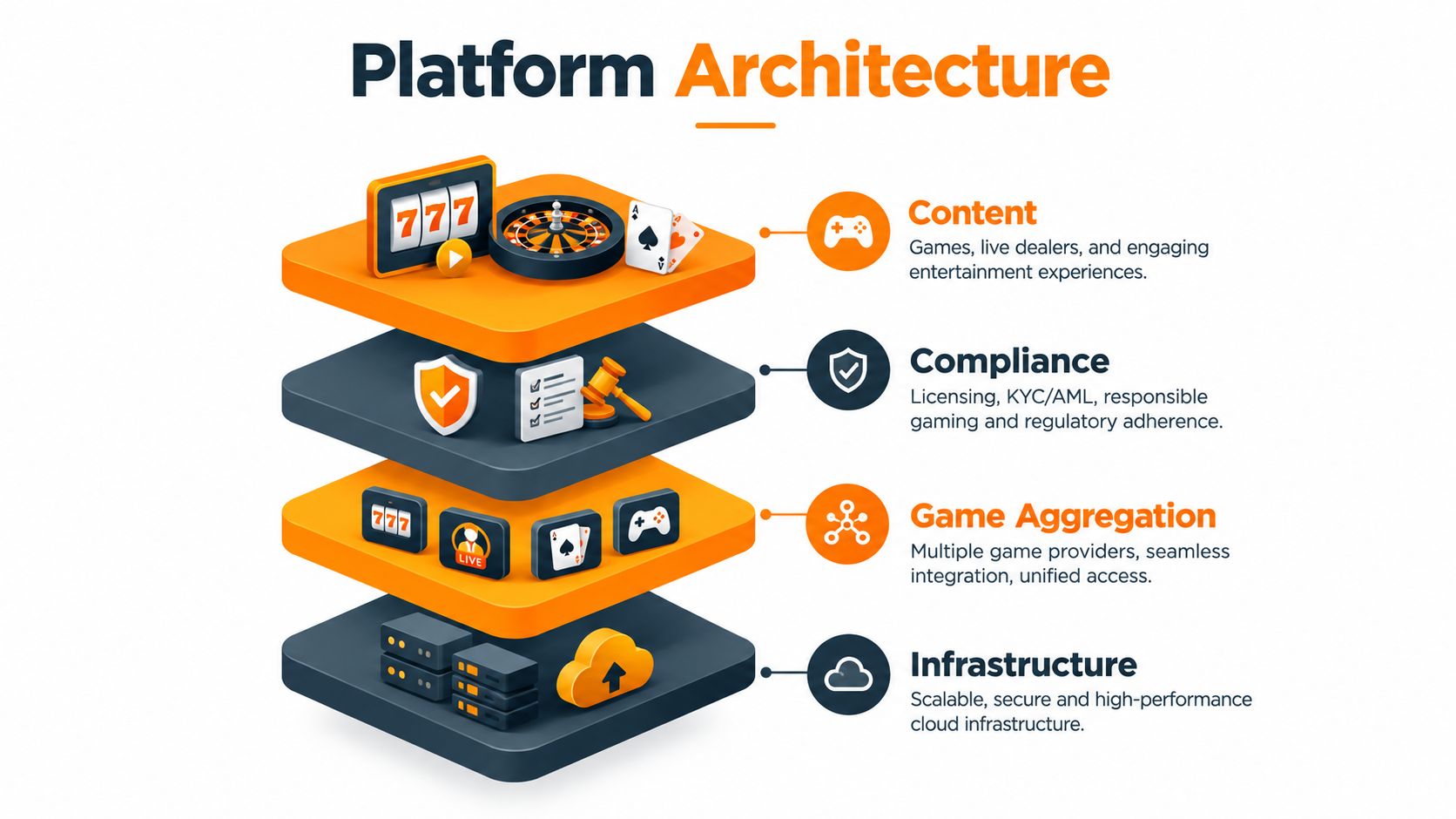
At the content layer, the platform serves RNG slots, table games, jackpots, crash titles, and live dealer products. The game aggregator sits between the operator and the studios, standardising integrations, mapping metadata, passing launch parameters, and returning outcomes with settlement events. That layer must retain enough detail to identify the game, provider, version, jurisdiction, and full transaction route during a dispute or regulator query.
Sportsbook sits alongside casino, but it creates a different operational burden. It has to process pre-match and in-play markets, odds feeds, bet acceptance, suspensions, settlement, voids, and margin configuration. The correct design keeps casino and sportsbook events distinct at product level while posting both into the same player account and financial ledger. That is where risk concentrates. One account, one source of truth, many event types.
The wallet is the structural anchor
The wallet and cashier layer carries more weight than any front-end feature set. It records deposits, withdrawals, bonuses, winnings, reversals, fees, and locked funds. Use a ledger model with a complete event history. Do not accept a platform that relies on an editable balance field and internal notes to explain changes after the fact. If a player deposits through one method, plays casino, places a sportsbook bet, receives a bonus, and withdraws later, operations should be able to reconstruct the exact balance journey without guesswork.
Payments connect that ledger to cards, bank rails, digital wallets, and, where permitted, crypto networks. This is infrastructure, not product theatre. The integration has to cover authorisation, settlement, refunds, chargebacks, withdrawal review, method restrictions, and reconciliation. “Supports a payment method” means very little unless the vendor can show how failures, delays, and manual interventions enter the ledger and appear in reporting.
The back office is the control surface for operations and compliance teams. It should handle KYC, AML alerts, fraud rules, responsible-gaming interventions, player limits, bonuses, affiliates, and account actions. The compliance layer then applies geofencing, audit logs, market-specific configurations, and reporting workflows. AI-driven monitoring can help here, but only if decisions are inspectable and override paths are clear.
The dependency chain is straightforward:
- Identity: The player record controls access, jurisdiction, risk status, and permissions.
- Wallet: The ledger connects approved activity to cash and bonus balances.
- Content and betting: Games and markets generate events that must settle correctly.
- Payments: Cashier activity moves value into and out of the ledger.
- Controls: Compliance, risk, and responsible-gaming rules can interrupt or limit activity.
- Reporting: Every material action needs an auditable record.
The commercial stakes are clear. The UK Gambling Commission's April 2024 to March 2025 industry statistics report £7.8 billion in gross gambling yield for the remote casino, betting and bingo sector, with £5.0 billion from online casino and slots representing roughly 84% of online casino GGY. GGY measures what operators retain from stakes after winnings are paid, not total money wagered.
Why Scale Changes the Engineering Problem
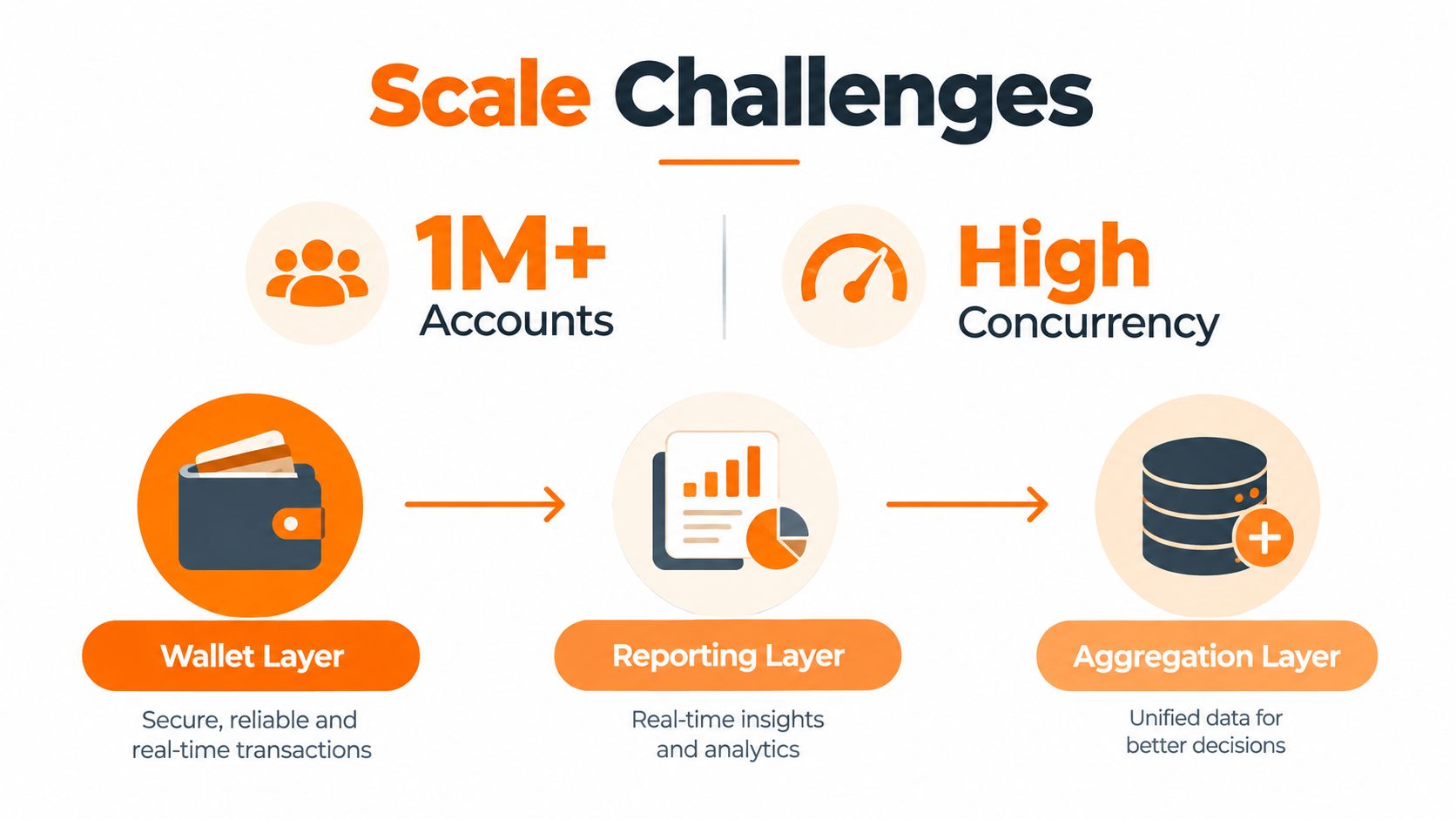
A platform can look stable at launch and still fail the first time growth stops being manageable by people. Once registrations, balances, and gameplay volume rise, operational risk concentrates in a few load-bearing systems: the wallet, the event pipeline, settlement logic, and monitoring. If any of those are weak, support queues grow, reconciliations slip, and compliance teams end up working around engineering defects.
The UK gives a clear reference point. During April 2024 to March 2025, operators recorded 34.0 million new account registrations, 24.4 million active customer accounts at the end of the last reporting quarter, and approximately £1.0 billion in customer balances held by operators, according to the UK Gambling Commission's industry statistics. At that scale, a wallet is not a product feature. It is financial infrastructure that has to survive retries, reversals, partial failures, and audit scrutiny.
Slots expose weak aggregation
High-volume slot activity puts weak aggregation under pressure first. The failure pattern is predictable. A player opens a game, stakes funds, receives an outcome, triggers a bonus feature, then exits. Every one of those actions creates records that have to stay in the right order across wallet services, provider callbacks, reporting tables, and customer support tools.
That is where vendors get exposed. A platform that works in a polished demo can still mishandle duplicate callbacks, lose session context after a restart, or leave an accepted wager hanging when a provider times out before the result is written back. Unified wallets, crypto rails, and AI monitoring do not reduce that risk on their own. If the transaction model is weak, they concentrate more risk in one place.
What to test under load
Do not accept benchmark slides or a scripted walkthrough. Run a controlled failure test and make the vendor show the mechanics.
- Wallet integrity: Show how the ledger blocks duplicate debits, preserves reversals, and separates cash, bonus, restricted, and pending funds.
- Settlement recovery: Interrupt a provider during an active wager and verify idempotent replay, exception handling, and support visibility.
- Aggregation behaviour: Launch games from several studios, then inspect provider identifiers, game versions, jurisdiction filters, and settlement records.
- Reporting continuity: Produce operational and compliance reports during live transaction flow, then reconcile the totals back to the ledger.
- Peak operations: Test account creation, login, deposits, game launches, and withdrawals together. Isolated service benchmarks hide system-level failure.
The acceptable threshold changes with the business. A smaller brand can tolerate a manual exception queue if ownership is clear and resolution times are short. A larger operator needs automated reconciliation, replay controls, queue monitoring, and strict segregation of duties because manual recovery stops scaling long before revenue does.
Ask direct questions. Which transaction states can remain pending? Who can release them? What evidence is captured when they do? What happens if the payment rail, game provider, or reporting service fails mid-flow? Those answers matter more than any feature checklist.
Compliance Architecture and Multi-Jurisdiction Rollout
You launch in one market, then the second licence exposes the platform. A rule that looked minor in procurement, separate limits, a restricted catalogue, a different report schema, a different intervention workflow, can force changes across wallet logic, player-state handling, and audit trails. That is concentration risk. If one platform assumption sits under every market, one bad assumption can block expansion across all of them.
The United States shows this clearly. By the end of 2022, six states had authorised online casinos, while 27 states had land-based commercial casinos, according to the Congressional Research Service overview. The American Gaming Association counted 466 domestic commercial casinos, while total commercial casino gaming GGR reached $60.4 billion in 2022, compared with $53.0 billion in 2021, as reported in the American Gaming Association's commercial gaming data.
This is not one national rulebook. It is a regulated patchwork with different permissions, controls, and reporting duties. Any platform built for that environment needs configurable jurisdiction boundaries, not a single “US mode” bolted onto the product.
Two regulatory models, different platform demands
| Requirement | US state-by-state rollout | Multi-jurisdictional regulated rollout |
|---|---|---|
| Player access | State-level geofencing and eligibility | Market-level access and territorial rules |
| Content | Approved catalogues can differ by state | Game availability varies by licence and market |
| Payments | Permitted methods and controls may differ | Local payment and reporting rules need configuration |
| Reporting | Separate state obligations | Market-specific regulatory submissions |
| Responsible gaming | State-defined limits and interventions | Rules mapped to each regulator and licence |
Use that table as an operating test, not a sales checklist. A modular platform should let compliance teams configure geofencing, identity checks, payment restrictions, game catalogues, reporting templates, and responsible-gaming controls without touching core transaction logic. It also needs to preserve the jurisdiction in force at the moment of registration, deposit, wager, settlement, and withdrawal. If that state is lost or overwritten, disputes, tax treatment, and regulatory reporting get messy fast.
Ask the vendor to launch a new market in a controlled demo using configuration only. Include a restricted game, a payment-method change, a local report, and a responsible-gaming intervention. Then ask what changed in the ledger, event stream, permissions model, and audit log. If the answer is “we need a sprint,” you are buying future delay.
Back-office design matters more than front-end localisation. Operators often buy for a first launch market and discover later that the data model assumes one licence, one tax treatment, one catalogue, and one set of player rules. Those are architectural decisions disguised as product defaults. Replacing them later is expensive, slow, and disruptive.
Practical rule: Treat every market rule as data that can be versioned, tested, approved, and audited. Don't bury it in front-end code or undocumented operational workarounds.
A platform aligned with Malta Gaming Authority licensing and compliance expectations can be a useful base for multi-market governance, but it is not universal approval. The operator still has to confirm each target market's exact obligations and prove that platform controls match them.
Payments, Wallets, and the Crypto Trade-Off
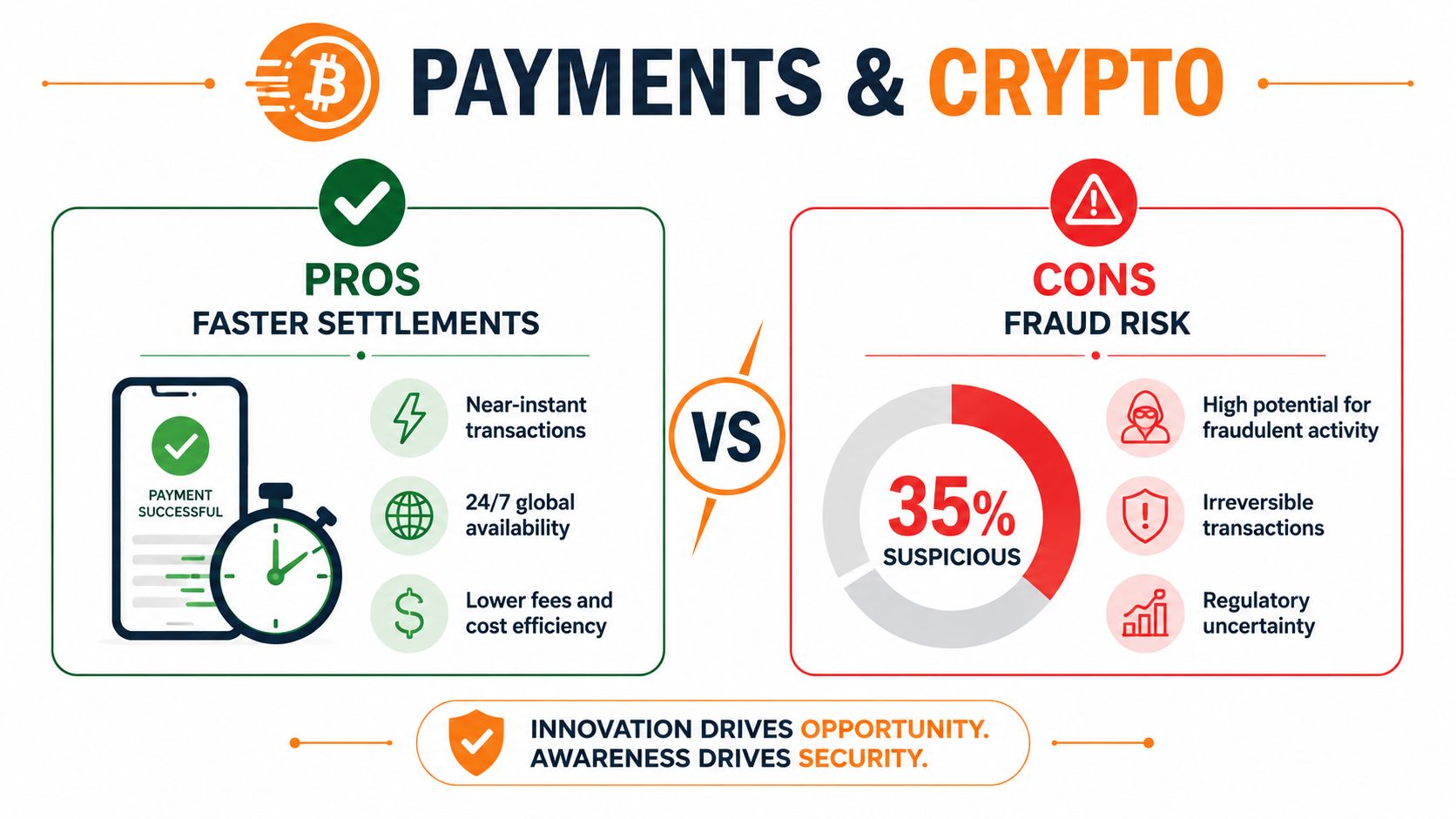
Payment breadth can improve access, but it also increases the number of ways criminals can attack the account and wallet. The relevant question isn't whether a platform supports cards, bank transfers, digital wallets, and crypto. It's whether the operator can apply different risk controls to each rail without fragmenting the financial record.
A 2025 fraud analysis reported that 35% of suspicious gambling transactions identified in 2024 involved crypto rails, and cited a 244% year-over-year increase in identity-fraud and account-takeover attempts across gambling platforms between Q1 2024 and Q1 2025. Those figures appear in Shufti Pro's gambling fraud analysis. They don't prove that crypto is unsuitable. They do prove that payment selection is a risk decision, not merely a conversion decision.
Controls must follow the payment method
For card and bank transactions, require strong customer authentication where applicable, device intelligence, velocity rules, beneficiary matching, payment-method ownership checks, and clear handling for chargebacks and reversals. A platform should show how a withdrawal is linked to the original funding path and how staff review exceptions.
Crypto introduces different evidence and monitoring needs. The platform should support blockchain tracing, wallet risk screening, network and asset restrictions, source-of-funds escalation, and controlled withdrawal release. A public blockchain record doesn't establish who controls a wallet or whether the funds are acceptable under the operator's risk policy.
The wallet must remain unified when activity crosses products and methods. A player might deposit in fiat, play slots, place a sportsbook bet, receive a promotion, convert funds, and request a crypto withdrawal. The ledger should preserve each event, its currency, its status, its exchange-rate treatment, and the approval path.
The multi-currency wallet guidance is relevant to that design question, but a multi-currency feature alone isn't sufficient. Require a transaction-level demonstration.
- Deposit controls: Ask how the platform identifies the device, payment instrument, account, and transaction velocity.
- Withdrawal controls: Ask whether withdrawals can be delayed, routed to an approved beneficiary, and escalated for review.
- Wallet reconciliation: Ask how casino, sportsbook, bonus, fiat, and crypto balances reconcile in one ledger.
- Incident response: Ask who can freeze an account, preserve evidence, reverse a transaction, and notify the right internal teams.
- Customer communication: Ask how the platform explains a hold without exposing sensitive fraud rules or creating inconsistent support outcomes.
NexGrate is one example of a turnkey provider that combines casino and sportsbook operations with payments, wallet management, and crypto support. Evaluate it against the same transaction controls as every other vendor. Payment count is a weak buying criterion. Method-specific control depth is the true differentiator.
RNG Certification as a Release-Gating Control
Fairness starts in the release pipeline, not in a post-launch audit folder. The UK Gambling Commission's testing strategy requires new games and RNGs to undergo testing by an approved independent test house before release, with the resulting report submitted to the regulator.
The assessment goes beyond a vendor's statement that an algorithm is random. Reviewers examine RNG documentation, investigate known algorithmic or hardware weaknesses, inspect source code against the documented implementation, and statistically test raw output and transformed outputs such as scaled values or shuffled decks.
Preserve the certification boundary
A white-label platform should make it impossible to confuse a certified game with a later, modified artifact. The integration layer needs immutable identifiers for:
- Game identity: The exact title and approved configuration.
- RNG version: The algorithm, implementation, and relevant seed handling.
- Platform version: The release environment that runs the game.
- Certificate scope: The test house report, coverage, and limitations.
- Deployment artifact: The build that reached production.
- Jurisdiction: The market in which the certified configuration is available.
A provider adapter that changes scaling, mapping, seeding, or outcome logic may change the behaviour covered by the evidence. That change should trigger a formal review and, where required, a new testing boundary. Don't allow a content manager to update a game package without an automated check against its certification metadata.
Make release evidence operational
Use versioned pipelines with approval gates. Link build artifacts cryptographically, keep certification and production environments materially equivalent, and run automated regression tests for outcome distributions. Preserve release logs so a regulator or player-dispute investigator can reconstruct what ran, when it ran, and under which approval.
The platform should also demonstrate how it handles routine operational events. Ask what happens when a game provider releases a patch, when an adapter changes a parameter, when a jurisdiction removes a title, or when a production rollback is required. A rollback that restores software but loses the associated certification record is not a safe rollback.
Provably fair games can help explain fairness concepts to players, but player-facing transparency doesn't replace independent testing and release governance. The board should ask to see the evidence chain, not just the fairness label.
Release gate: No game or RNG change should reach production until the platform can identify the exact tested version, approval record, scope, and deployment artifact.
AI for Fraud, AML, and Responsible Gambling Without Opacity
AI can help prioritise fraud alerts, detect unusual transaction patterns, and identify behaviour that may require responsible-gaming intervention. It can also make poor decisions faster. A real-time model that blocks suspicious activity while falsely restricting legitimate customers can damage trust, create regulatory exposure, and overload support teams.
Legal analysis published in 2025 stresses the need for AI risk assessment, data governance, continuous monitoring, privacy compliance, and meaningful information about automated decisions. The DLA Piper analysis of AI obligations for online gambling operators supports a governance-first approach.
Replace the AI claim with acceptance criteria
Ask the vendor to separate model performance from operational action. A high-risk score should not automatically mean a permanent account closure. Define which outcomes can be automated, which require human review, and which require a compliance or responsible-gaming specialist.
The evaluation should cover:
- False positives: How often does the system restrict legitimate players, and how does the vendor segment that outcome by player type, jurisdiction, payment method, and account maturity?
- Explainability: Can an investigator see the factors that contributed to an alert without exposing sensitive detection rules?
- Model drift: How does the vendor detect changes in behaviour, payment patterns, fraud tactics, or data quality?
- Auditability: Does every score, rule version, analyst action, override, and customer communication enter an immutable log?
- Human escalation: Can a reviewer pause, release, or challenge an automated action with documented authority?
- Data minimisation: Does the model use only data necessary for the stated purpose, with retention and access controls?
Responsible-gaming decisions deserve special care. A model shouldn't treat a new customer, a cross-border user, or someone using an uncommon payment method as suspicious merely because the profile is less familiar. The operator needs thresholds that trigger support, friction, temporary limits, or formal review for different reasons.
Governance test: Ask the vendor to show one true alert, one false positive, one model override, and one drift investigation from detection through final resolution.
Don't buy “AI-powered” as a feature. Buy a documented decision system with measurable error monitoring, accountable reviewers, and a player challenge process. If the vendor can't explain how a player contests an automated restriction, the system isn't ready for regulated deployment.
The 2026 Buyer's Checklist for an Online Casino Platform
Use the vendor demo as an evidence session, not a sales presentation. Give each shortlisted provider the same scenarios, require written answers, and involve the people who will own the outcome after launch.
Time to market and operating scale
- Launch dependencies: Identify what the vendor supplies, what your team must configure, and which third parties still require separate contracts or approvals.
- Load behaviour: Test registration, deposits, game launches, settlements, withdrawals, and reporting at the same time.
- Recovery: Simulate duplicate callbacks, provider outages, payment reversals, and delayed settlements.
- Migration: Require a dry run for player records, balances, bonuses, transaction history, and responsible-gaming status.
Compliance and reporting
- Market controls: Demonstrate geofencing, jurisdiction-specific content, payment restrictions, and responsible-gaming configurations.
- Evidence: Inspect audit logs for account changes, manual approvals, report generation, and configuration edits.
- Expansion: Add a hypothetical market without altering core ledger or identity logic.
- Ownership: Confirm who maintains regulatory mappings and who notifies you when a control changes.
Payments and wallet integrity
- Accounting model: Review how cash, bonus, pending, restricted, and settled balances are represented.
- Method controls: Test card, bank, wallet, and crypto journeys with different limits and approval rules.
- Reconciliation: Match payment-provider records, wallet events, game settlements, and sportsbook results.
- Exit plan: Confirm how you recover data and continue customer servicing if the commercial relationship ends.
Game governance and AI
- RNG evidence: Inspect certification identifiers, test scope, versioning, release approvals, and rollback records.
- Content changes: Ask whether an adapter or configuration change can invalidate the tested game behaviour.
- Model decisions: Review false-positive monitoring, explainability, drift testing, human escalation, and player challenge workflows.
- Contract protection: Put data access, incident reporting, audit cooperation, subcontractor disclosure, and change management in writing.
The red flags are consistent. A vendor that focuses on front-end themes while avoiding ledger detail is a risk. So is a provider that says compliance is “built in” but can't demonstrate market configuration, audit evidence, or report ownership. Treat untestable claims as unanswered questions.
Run a proof-of-concept with representative integrations, not sample data. Have finance reconcile the wallet, compliance review the audit trail, operations handle exceptions, security examine access controls, and product test the player journey. Sign only when each team can state what the platform does during normal operation and during failure.
NexGrate provides a turnkey white-label stack that brings casino content, sportsbook functionality, payments, wallets, KYC and AML workflows, reporting, and operator back-office tools into one operating environment. Visit NexGrate to assess whether its architecture and controls fit your launch market, payment strategy, and governance requirements.