
A player has just won at your casino. The base game has settled, the payout is visible, and a new prompt appears: double the win or lose it. Product sees a simple engagement feature. Compliance sees a new wager that needs its own rules. Engineering sees wallet, randomness, timeout, and ledger questions.
That gap is where launches become fragile. Double or nothing rules need to work through three lenses at once: the player must understand the choice, the math must be reproducible, and the operator must be able to settle and audit every outcome.
Table of Contents
- What Double or Nothing Actually Means in Gambling
- The Core Double or Nothing Rules You Must Get Right
- Comparing the Main Rule Variants Operators Ship
- Player Experience and UX Flow That Builds Trust
- Payout Math, RTP, and House Edge You Can Defend
- Settlement, Wallet, and Risk Controls Behind the Feature
- Responsible Gaming and Regulatory Reality Check
- Launch Checklist and Key Takeaways for Operators
What Double or Nothing Actually Means in Gambling
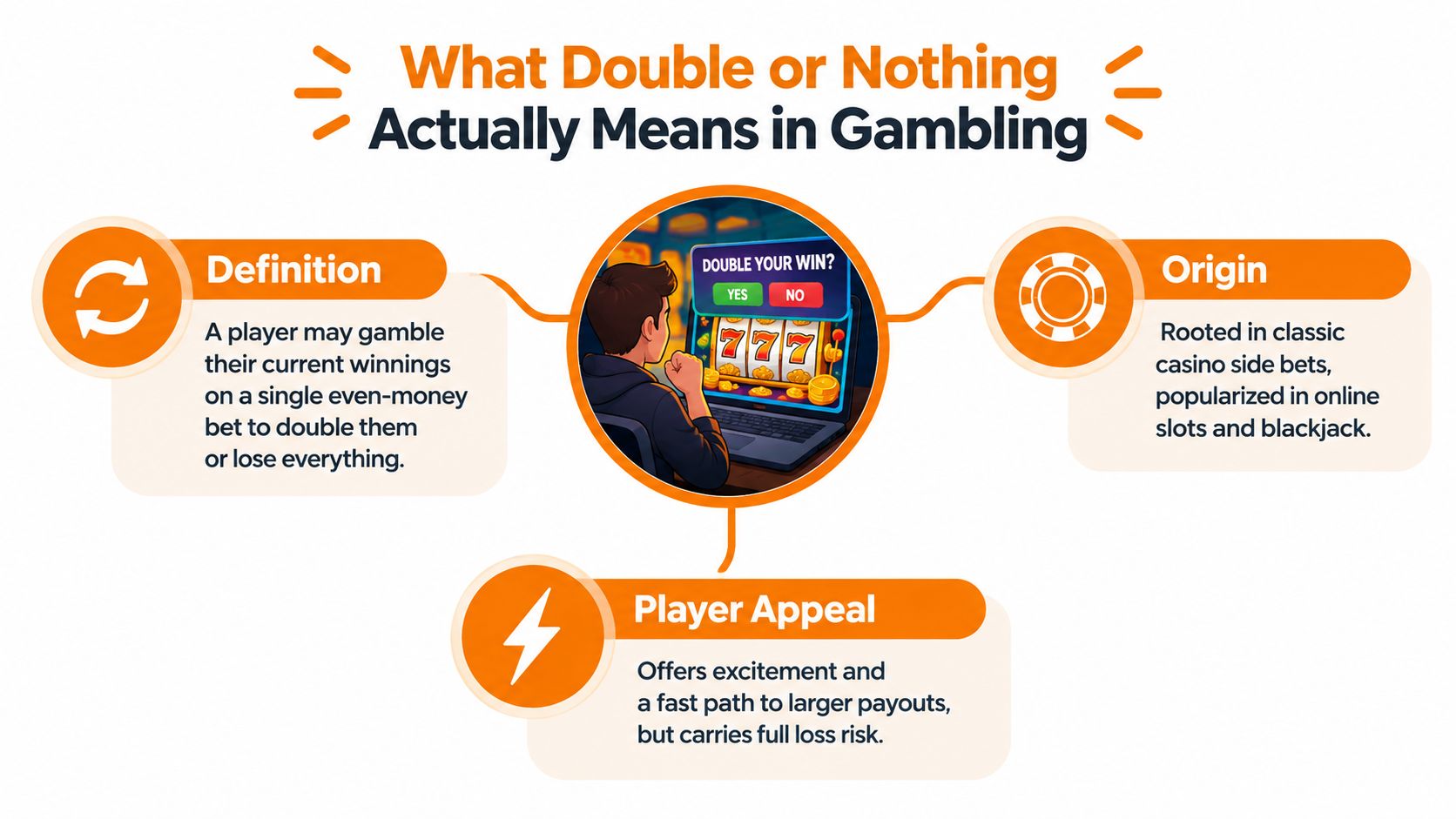
A player finishes a winning spin and sees a balance increase. The next screen offers a choice: collect the win, or risk that win on a new event. If the player accepts and wins, the amount increases. If the player loses, the amount being risked disappears.
That is the practical meaning of double or nothing. It's a separate wager made with an already-settled payout, not a change to the original spin or hand. In the classic version, the player risks the full win on an even-money event, commonly represented by a coin flip or an equivalent random result. A winning result doubles the amount at stake, while a losing result returns nothing from that side wager.
Place the feature correctly
The term has several neighboring meanings. Classic casino side bets helped establish the idea, while online slots and blackjack products made the post-win prompt familiar. It shouldn't be confused with blackjack double down, where a player increases a stake while the original hand remains in progress. It also isn't automatically the same as a blackjack side game such as 21+3, which uses separate hand conditions and payout rules rather than a direct gamble on an existing win.
The product question is straightforward: what exactly is the player risking, and what event decides the result? If the answer changes from one screen to another, the feature isn't ready for release.
For product managers, the rules lens defines the state transitions and player consent. For finance and game mathematics, the math lens explains expected value, volatility, and any operator margin. For compliance and operations, the third lens covers disclosures, limits, records, jurisdictional availability, and dispute handling.
A colleague should be able to summarize the feature in two sentences: a player may risk a settled win on a new, separately resolved event, and a win increases the payout while a loss removes the amount at risk. The operator must then prove that the offer was voluntary, the event was generated correctly, and the wallet recorded the result exactly once.
The Core Double or Nothing Rules You Must Get Right
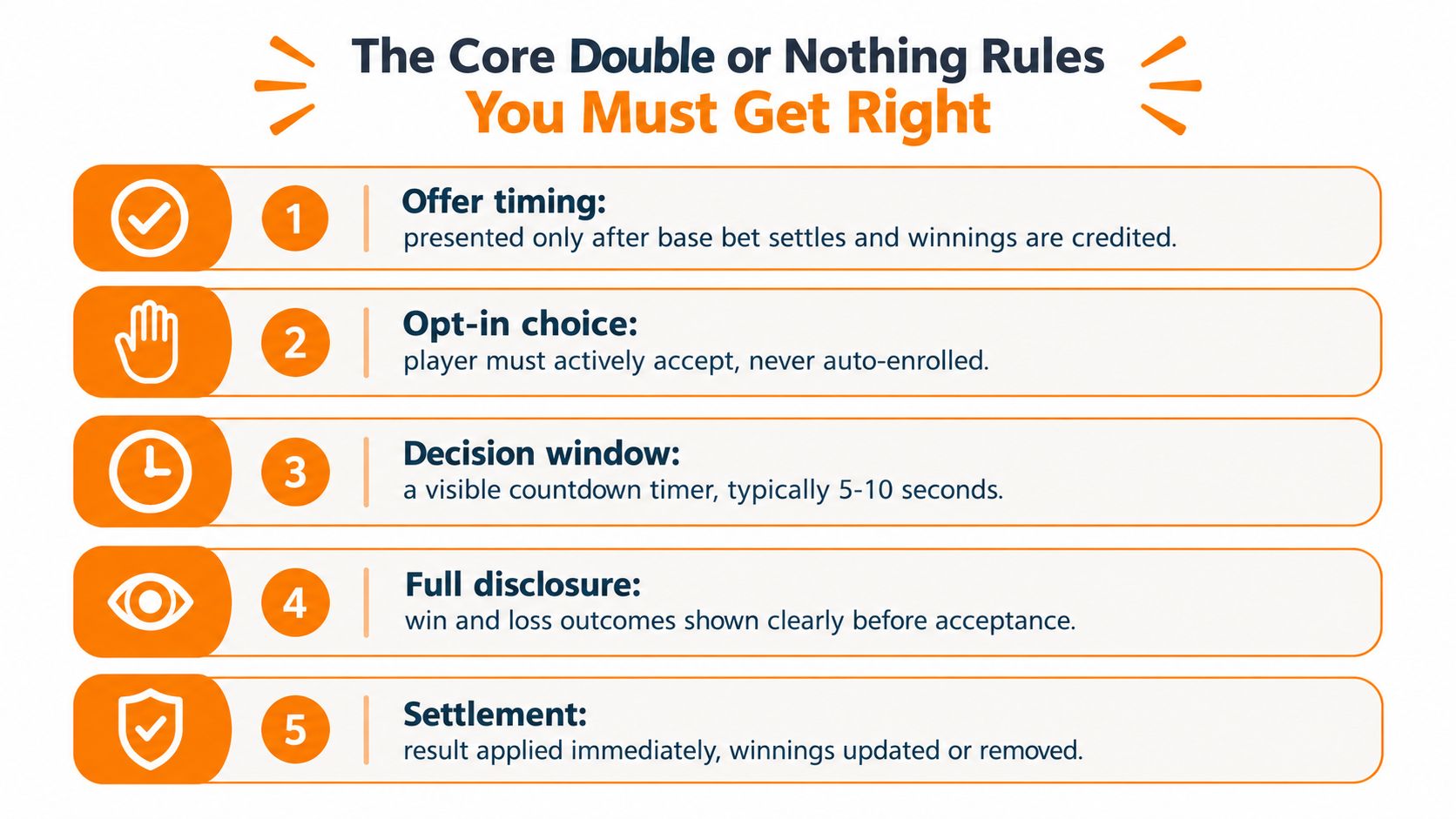
Start with the canonical rule set before choosing animations, labels, or escalation options. A clean implementation follows a defined sequence:
- Settle the base wager. The original game round must reach a final outcome, and the base payout must be credited or made available according to the wallet design.
- Present the offer afterward. The double-or-nothing prompt must be a new decision, not an invisible continuation of the previous bet.
- Require active acceptance. The player chooses to risk the amount. Declining must be easy and visible.
- State the stake and result before acceptance. The interface must show what can be lost and what can be won.
- Resolve one independent event. The result must come from the approved random mechanism and match the published rules.
- Apply the result immediately and consistently. A win updates the balance, while a loss removes the amount at risk. Voids, ties, interruptions, and reversals need written outcomes.
Why the sequence matters
Presenting the offer only after settlement protects the base game's accounting. The original wager has one result, and the optional feature has another. Combining them in a single unresolved state makes it harder to explain the transaction, calculate game performance, and investigate complaints.
Active opt-in protects consent. A player who fails to tap a button shouldn't be treated as having accepted a new risk. The safest default is to collect the available amount or let the offer expire without creating a wager.
The event also needs more than a marketing description such as “fair chance.” The specification should identify the random source, the result mapping, the applicable audit record, and the behavior if the event cannot be confirmed.
Practical rule: If a player, support agent, and auditor can't describe the same outcome from the same rule text, the feature has an ambiguity problem.
Don't use “double down” as a shortcut in interface copy. Players and regulators may read it as a blackjack action, while the wallet and ledger are handling a separate wager. Use a distinct label, display the amount at risk, and define what happens when the player declines, times out, disconnects, or encounters a voided round.
Comparing the Main Rule Variants Operators Ship
The label may stay the same while the risk profile changes sharply. An operator choosing a first release should compare the stake basis, the resolution event, the payout ceiling, and the operational burden rather than selecting the most visually exciting version.
| Variant | Stake Basis | Hit Frequency | Max Payout | Best Fit |
|---|---|---|---|---|
| Classic even-money flip | The full settled win | Determined by the published two-outcome event | A doubled amount for a successful resolution | Operators seeking a simple, explainable side wager |
| Escalation ladder | The current amount after each accepted step | Falls as the player continues through independent steps | A capped multiple defined in the rules | Products with strong session controls and clear cash-out points |
| Wheel or prize bucket | The settled win or a defined portion of it | Depends on the segment distribution | The highest prize attached to an eligible segment | Brands that want visual variety and configurable outcomes |
| Cash-out or lose-all | The amount currently exposed | Depends on the crash or stopping event | The amount at the chosen cash-out point | Products already designed around live, continuous decisions |
Choose the rule before the artwork
The classic flip is the easiest to explain because the player sees one decision and one resolution. Its main advantage is governance, not novelty. Support teams can answer questions without reconstructing a complicated path, and product teams can keep the offer separate from the base round.
An escalation ladder changes the player's decision after every successful step. That creates more opportunities for confusion, rapid re-staking, and unusually volatile session paths. It also requires a firm maximum, a visible cash-out action, and a clear explanation of whether each new step risks the entire current amount.
A wheel or prize bucket may look different from a coin flip, but the compliance question remains the same: does the visual distribution accurately represent the configured outcome probabilities and payouts? A decorative wheel must not hide unequal segments or make a low-frequency result appear common.
The crash-style format carries the greatest UX burden. “Cash out or lose it all” sounds familiar, yet the operator must define the event clock, the cash-out cutoff, server confirmation, delayed requests, and disputes caused by connection latency.
For a first launch, simplicity usually wins. Pick the variant whose stake basis, outcome mapping, and maximum exposure can be explained on one game-information panel and tested through repeatable settlement scenarios.
Player Experience and UX Flow That Builds Trust
The player should understand the feature without opening a help article. A reliable flow starts with a settled balance, shows a concise offer, records an explicit choice, reveals the result, and confirms the final wallet state.

Build the offer screen around consent
Show the current collectable amount, the amount at risk, and the potential result as separate values. “Risk your win” is not enough. A player should see the exact balance consequence before selecting the action.
Use two distinct controls, such as “Collect” and “Double,” with no ambiguous tap area between them. Collecting should be the safe default when the player does nothing. A countdown can communicate that the offer is temporary, but it shouldn't turn inaction into acceptance.
The reveal animation can add context, but it can't be the only way to understand the result. Screen readers need accessible labels for the stake, the action, and the outcome. Color shouldn't be the sole distinction between winning and losing states, and motion-sensitive players should have a reduced-animation option.
Define interruption behavior before design sign-off
A disconnected session must not leave the operator guessing whether a wager was accepted. The server should record the decision event and its timestamp, then return the correct state when the player reconnects. If no acceptance reached the server, the offer should remain unaccepted or expire under the written rule.
A partial decline also needs a defined result. If the variant permits risking only part of a win, the player must see the retained amount and the exposed amount before confirming. If partial risk isn't supported, don't imply that it is through flexible-looking controls.
A visible RNG or fairness indicator may be required in some regulated environments. Where the product publishes verification details, explain the process in player-friendly language rather than hiding it behind a technical label. A guide to provably fair games can help teams distinguish a verifiable design from a generic fairness claim.
The final screen should say what happened and show the resulting balance. Don't end the flow on a reveal animation alone. Players need a settlement confirmation that support can match to a transaction record.
Payout Math, RTP, and House Edge You Can Defend
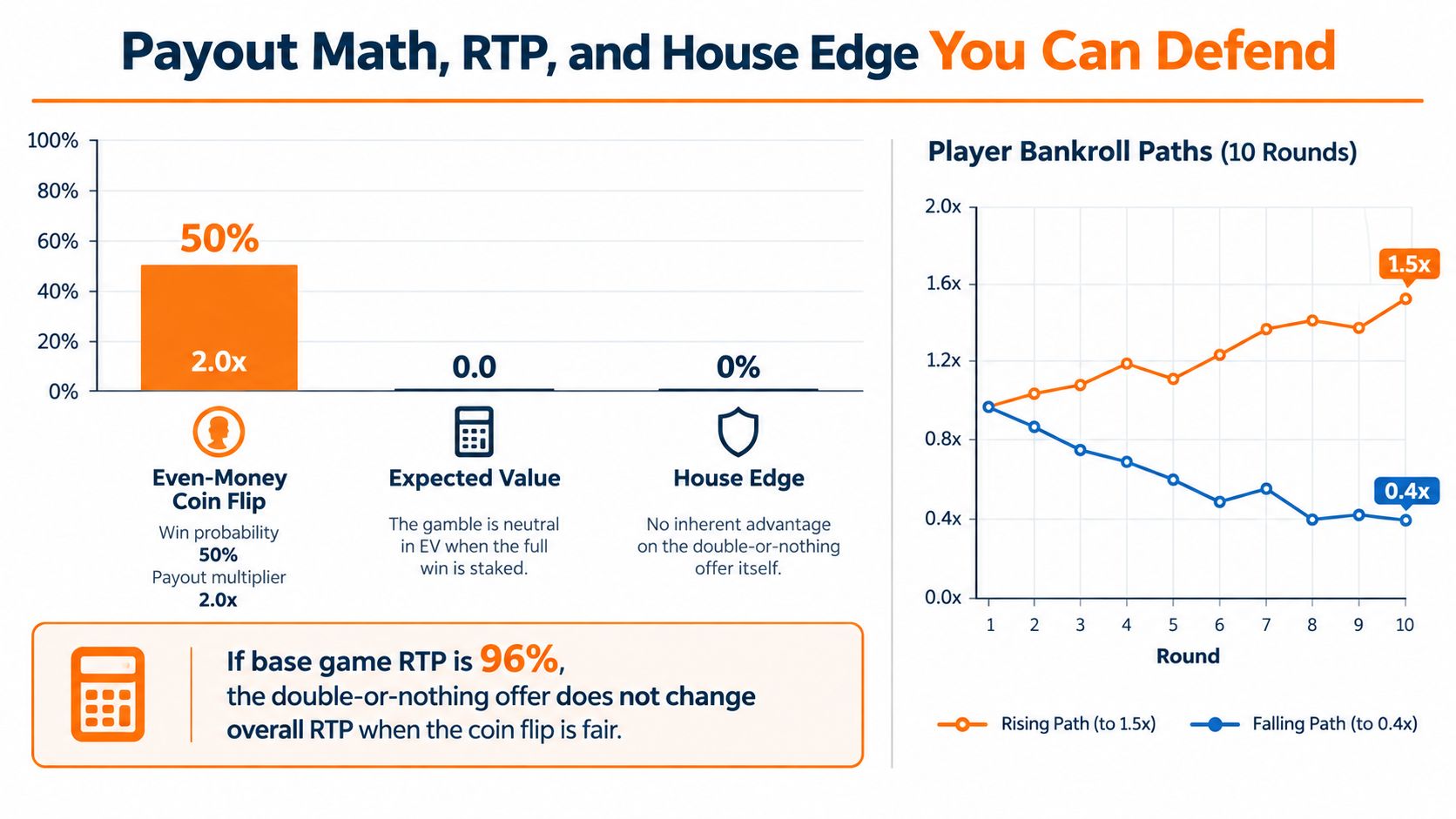
The cleanest model is an even-money event in which the full current win is the stake. Let the stake be W. A successful outcome returns 2W, and an unsuccessful outcome returns 0. With equal probabilities, the expected return is:
EV = (0.5 × 2W) + (0.5 × 0) = W
The expected return equals the amount staked. In that narrow mathematical model, the optional feature has neutral expected value. It doesn't create an additional house edge by itself, and it doesn't repair or worsen the base game's underlying return model. The base game still determines how often and how much the player wins before reaching the offer.
Fair value isn't the same as low risk
Neutral expected value can coexist with high short-term volatility. A player who accepts the offer converts a certain collectable amount into two possible outcomes. The average across a large set of equivalent wagers may be neutral, while an individual session can move sharply in either direction.
That distinction belongs in the game-information panel. Publish the event probabilities, payout mapping, eligibility rules, and any cap. Don't describe a fair event as a guaranteed improvement, and don't describe a high-volatility choice as harmless because the expected value is neutral.
Math check: Calculate the return from the feature separately from the return of the base game, then model the combined player journey.
An operator can introduce an edge in several ways. A fee deducted from the offered stake reduces the player's expected return. An outcome distribution that favors one result does the same. A payout cap can also alter the result if it truncates the amount that would otherwise be returned.
Escalation creates another issue. Each successful step increases the amount exposed to the next decision, so the player's outcome distribution becomes wider even if every individual event follows the same published rule. A cap limits the maximum, but it doesn't remove the increased volatility before the cap is reached.
For review, calculate at least four views:
- Feature return: Compare the expected settlement from the side wager with the amount exposed.
- Combined return: Include the base game outcome and the optional feature in the same player journey.
- Variance: Model how outcomes spread when players accept one step or multiple steps.
- Session exposure: Test repeated offers, rapid acceptance, and escalation behavior against player and operator limits.
The video below can support internal discussion of the feature's mechanics and presentation, but it shouldn't replace your approved game specification or jurisdictional review.
Settlement, Wallet, and Risk Controls Behind the Feature
The interface may show one tap, but the back office needs a controlled transaction sequence. Treat the feature as its own wager with a unique identifier, a parent reference to the settled base round, an acceptance record, an outcome record, and a final wallet entry.
Hold the right balance
The product specification must state whether the stake comes from real-money balance, bonus balance, or a permitted combination. Bonus terms may restrict wagering with promotional funds, and those restrictions can differ between the base game and an optional side feature. Don't let the wallet make that decision implicitly.
A ledger records the transfer into the feature, the resolution, and the final settlement. If the round is voided, the reversal should reference the original feature transaction rather than creating an unexplained manual adjustment. Idempotency matters here. A delayed callback or a player refresh must not settle the same accepted feature twice.
Multi-currency operators also need a consistent conversion point. The stake, outcome, and reversal should use the rate and currency rules defined for the transaction, not whichever balance display happens to be current. A multi-currency wallet design gives teams a useful framework for separating balances, conversion logic, and transaction history.
Control exposure, not only individual stakes
Per-bet limits are necessary but incomplete. Add controls for:
- Session exposure: Restrict the total amount a player can place into optional wagers during a defined session.
- Variant exposure: Limit the aggregate liability created by a specific escalation or wheel configuration.
- Velocity: Flag rapid-fire acceptance patterns that bypass normal play pacing.
- Market availability: Enable or disable the feature by jurisdiction, brand, currency, and player eligibility.
- Configuration access: Require approval for changes to probabilities, caps, labels, and settlement behavior.
Keep configuration, release approval, and financial reconciliation separated across authorized roles. A consolidated casino and sportsbook backend can simplify shared wallet controls, but it also increases the need for careful ownership. A change made for one product must not alter limits, reporting, or eligibility in another.
Responsible Gaming and Regulatory Reality Check
Double or nothing isn't automatically benign because the player is risking a recent win. The prompt adds another decision at a moment when the player may already be focused on recovering, extending, or protecting a fluctuating balance. Escalation variants can intensify that pattern by turning one optional decision into a chain of decisions.
The responsible-gaming review should therefore examine the feature as a re-staking mechanism, not just as a decorative bonus interaction. Include accepted and declined feature stakes in the relevant loss, spend, and activity views. If a player's configured limit applies to gambling activity, the feature shouldn't sit outside that calculation because it uses winnings rather than a fresh deposit.
Controls to specify with compliance
A market-by-market assessment should address:
- Eligibility: Confirm whether the feature is permitted for the target product, player type, and jurisdiction.
- Limits: Apply player limits and operator exposure limits to the feature's stake and resulting settlement.
- Reality checks: Show activity information during extended or repeated decision paths.
- Cooling-off support: Make existing pause, break, and self-exclusion controls effective for the feature.
- Marketing language: Avoid presenting the feature as a way to recover losses or secure an easy profit.
- Escalation behavior: Review repeated acceptance, rapid decisions, and unusually persistent play for intervention triggers.
A side wager can be small in interface area and significant in compliance impact.
MGA-aligned controls may provide a useful baseline, but they aren't a universal approval. Local rules can differ on re-staking, game presentation, promotional messaging, random outcomes, and permitted interaction patterns. Confirm the position with qualified legal and compliance advisers before enabling the feature in a new market.
Record the decision, evidence, configuration version, and approval owner. A structured compliance reporting process makes it easier to demonstrate what was active when a player placed a feature wager and how the operator handled the result.
Launch Checklist and Key Takeaways for Operators
Treat launch approval as a shared gate, not a final product sign-off. Product, engineering, finance, support, responsible-gaming, and compliance teams should approve the same rule set and test the same outcomes.
- Write the rule text for timing, eligibility, stake basis, outcome mapping, caps, ties, voids, timeouts, and disconnections.
- Map every player action to a server-side state, including acceptance, decline, expiry, reconnect, retry, and reversal.
- Publish the probability model, payout calculation, feature return treatment, and volatility implications in the game information.
- Mock the offer, confirmation, reveal, settlement, error, and reconnect screens with accessible labels and non-color cues.
- Test wallet debits, credits, bonus restrictions, currency handling, duplicate callbacks, voids, and ledger reconciliation.
- Configure per-bet, session, variant, market, and player-level controls before enabling the feature.
- Review responsible-gaming behavior, marketing copy, loss-limit treatment, and jurisdictional availability with compliance.
- Monitor acceptance rates, declines, repeated sequences, disputes, failed settlements, and configuration changes after release.
The smallest safe launch is usually the most transparent one. A single defined variant, a short decision path, explicit settlement, and strong limits give the operator a stable baseline before considering escalation or more complex visuals.
NexGrate provides a turnkey white-label casino and sportsbook platform with integrated games, wallets, payments, back-office controls, reporting, and responsible-gaming tools. If you're evaluating how to launch double or nothing with auditable settlement and market-aware controls, visit NexGrate to discuss the platform with its team.