
A white-label casino is a branded online-gambling operation built on a provider's pre-integrated infrastructure, with the brand owner controlling marketing while the provider supplies games, wallets, accounts, payments, and operational technology. The global online-gambling market is estimated at approximately USD 120.9 billion in 2026, with Europe representing roughly 41.0% of global revenue, according to Knowledge Sourcing's global online-gambling market estimate.
You may be looking at a finished casino design, a proposed launch date, and a commercial plan built around acquiring players. The front end feels tangible. You can review the logo, lobby, promotions, and payment buttons in a sales demonstration. The difficult questions sit behind that interface: who owns the wallet ledger, who can change a bonus rule, which entity makes the KYC decision, and whether every transaction can be reconstructed during an audit.
A white-label arrangement divides those responsibilities between a brand and an infrastructure provider. That division can shorten the path to launch, but it doesn't remove the obligations attached to operating gambling services. The licensee remains exposed when controls fail, even if another company supplies the software.
Table of Contents
- Understanding the White-Label Casino Model
- Core Components of a Turnkey iGaming Platform
- Navigating Legal and Compliance Responsibilities
- Weighing the Advantages and Trade-Offs
- Evaluating White-Label Providers for Your Brand
- Actionable Steps to Launch Your Casino
Understanding the White-Label Casino Model
Launching an online casino requires far more than publishing a website. The operator needs player registration, age and identity checks, game integrations, account balances, deposits, withdrawals, fraud controls, responsible-gaming interventions, customer support, reporting, and a legally permitted operating structure. Building each layer internally takes technical capacity and operational experience that many new brands don't have.
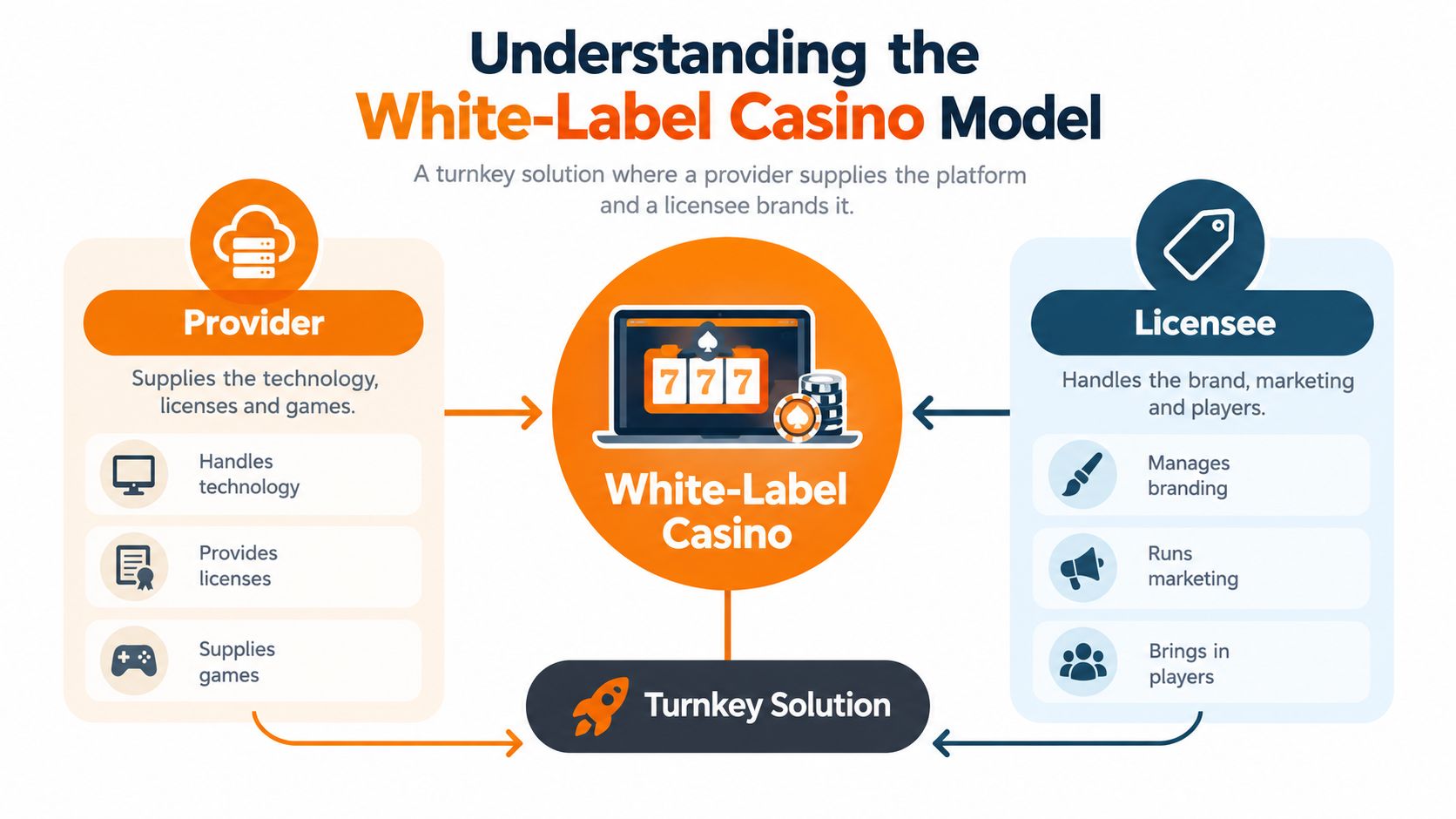
A white-label casino separates the customer-facing brand from that underlying stack. The brand owner usually controls the name, visual identity, marketing, promotions, acquisition channels, and commercial positioning. The provider supplies or manages core services such as casino games, player accounts, wallets, payments, compliance workflows, hosting, and operational tooling. The arrangement is therefore a division of labor, not just a website with different colors.
The brand layer and the operating layer
The brand creates the relationship with the player. It decides how the casino presents itself, which markets it targets, how it acquires traffic, and how its promotions fit the audience. That commercial control matters because players experience the brand, not the provider's internal platform.
The operating layer is less visible but more consequential. It controls registration data, wallet movements, game availability, payment status, risk rules, account restrictions, and evidence for regulators. A useful introduction to the broader ecosystem is available in NexGrate's guide to iGaming, but the operational distinction is straightforward: branding can be delegated, while accountability still has to be assigned clearly.
Malta's Gaming Act, Chapter 583, has governed remote and land-based gaming since 1 August 2018, and the Malta Gaming Authority oversees licensing, approvals, certificates, recognition notices, and operator monitoring, as described in this overview of Malta's iGaming framework. Malta's guidance treats white-label providers as intermediaries or outsourcing providers acting for the licensee. The licensed operator remains responsible for activity conducted under its authorization.
Practical rule: Treat white-label as a turnkey operating arrangement, not as a licence-free route into gambling.
That distinction changes how a launch should be managed. The commercial team can own the brand while the provider runs much of the technical stack, but both parties need a precise responsibility matrix. If a player disputes a withdrawal, the contract shouldn't merely say that the provider handles payments. It should identify who owns the ledger, who investigates the exception, who communicates with the player, and who reports the incident.
Core Components of a Turnkey iGaming Platform
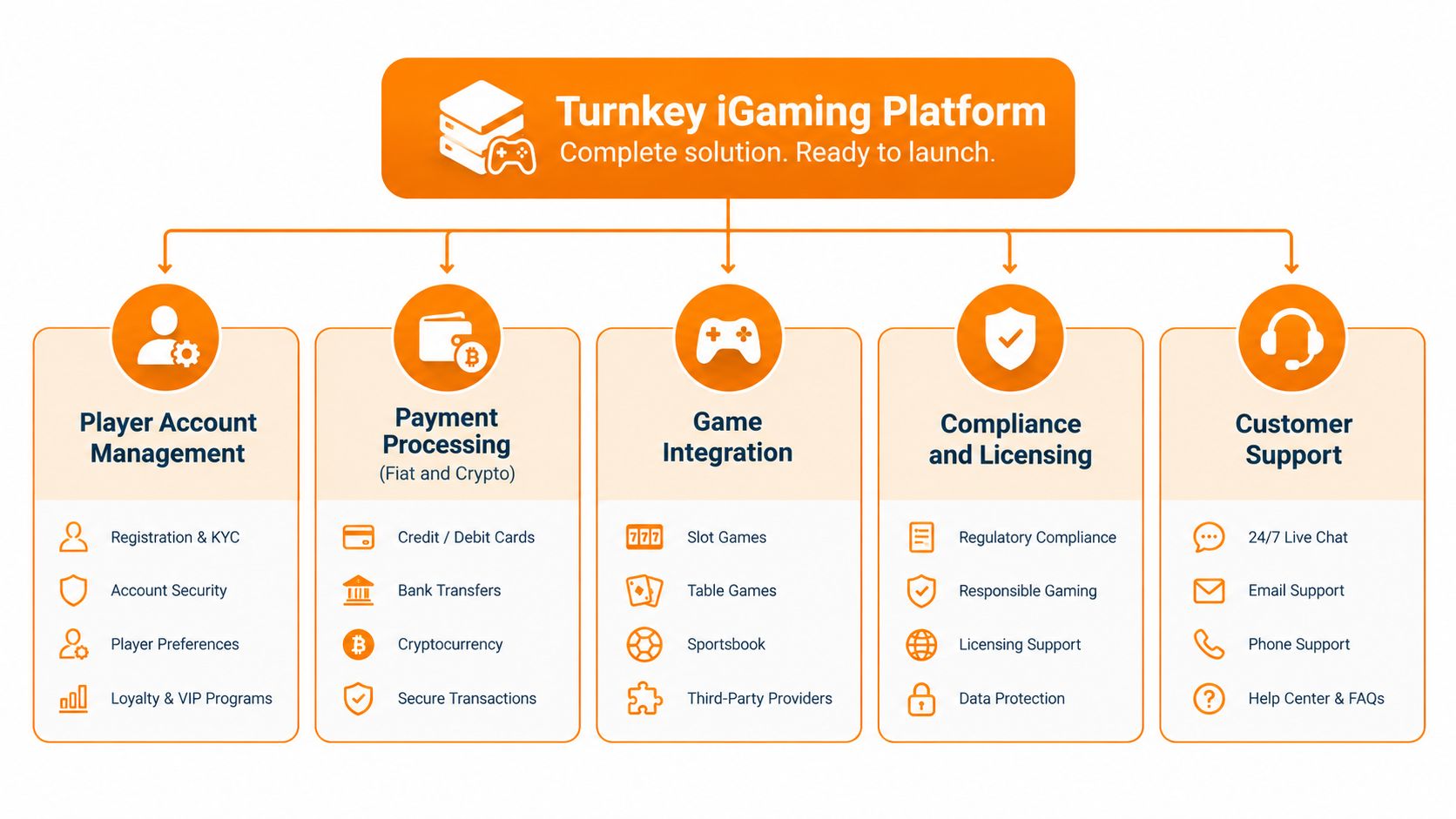
A credible turnkey platform is an operating system for the casino, not a collection of front-end templates. The lobby is only one layer. Underneath it, the platform must maintain consistent player identity, balances, payment states, game outcomes, promotional conditions, support history, and compliance evidence.
Player identity and wallet architecture
The player account management system should provide one authoritative profile for registration data, verification status, restrictions, communication preferences, and activity history. When a business operates casino and sportsbook products together, a unified wallet prevents separate systems from producing conflicting balances or duplicated player records.
Wallet design deserves particular scrutiny. A serious platform should use double-entry accounting, so every credit has a corresponding debit and every movement can be reconciled to a source event. That structure supports accurate gross gaming revenue and net gaming revenue calculations, but its more important function is control. Operations teams should be able to trace a deposit, wager, win, reversal, bonus conversion, withdrawal, chargeback, and adjustment without relying on a spreadsheet assembled after the fact.
A wallet isn't reliable merely because the balance displayed in the player interface looks correct. The underlying ledger needs immutable transaction identifiers, clear state transitions, and controlled permissions. A support agent may need to view a balance, while a finance administrator may approve a correction. Neither should be able to rewrite historical entries without an auditable adjustment record.
Content, payments, and permissions
Game aggregation should expose casino content through a stable integration layer. A single API for RNG and live-dealer providers reduces the number of separate connections that product and operations teams must monitor. It also creates a consistent way to manage game status, jurisdictional availability, technical errors, and settlement messages.
Payment processing needs the same discipline. The cashier may support cards, bank methods, multiple currencies, and cryptocurrency, but the platform must still reconcile provider callbacks against internal wallet events. Interrupted sessions, delayed confirmations, rejected withdrawals, and duplicate notifications are normal operational conditions. The architecture should handle them deterministically rather than asking staff to repair balances manually.
Granular permission keys protect the system from internal misuse. Separate roles for customer support, payments, compliance, finance, marketing, and engineering should limit who can view personal data, release funds, alter bonus parameters, change game availability, or export reports. A platform that gives every administrator broad access may be convenient during setup, but it creates unnecessary exposure as the team grows.
Navigating Legal and Compliance Responsibilities
A white-label launch can look complete while its most serious weaknesses sit behind the brand: unclear ownership of player decisions, weak financial controls, or audit records that cannot reconstruct what happened. Outsourced technology does not transfer regulatory liability. The exact position depends on the jurisdiction and agreement, but the entity offering gambling under the authorization remains responsible for the service.
The UK Gambling Commission states that the licensed operator remains responsible for offering gambling facilities, operating the relevant mechanics, and meeting compliance duties. A white-label partner cannot independently offer gambling without the required licence, as explained in the Commission's guidance on licensee responsibilities for third parties.
Map every workflow to the licensee
Build a responsibility matrix around the complete player journey, then attach each duty to a named role and system.
- Registration and KYC: Specify who collects identity information, makes the verification decision, and can suspend an account.
- AML and risk: Record the triggers for enhanced review, responsibility for source-of-funds checks, and the system holding each decision.
- Responsible gambling: Assign ownership for self-exclusion, limits, interaction triggers, account breaks, and escalation.
- Payments: Define who approves withdrawals, investigates failed transactions, handles chargebacks, and reconciles provider statements.
- Complaints: Set response ownership, escalation routes, evidence requirements, and regulator-facing duties.
- Reporting: Confirm who prepares regulatory returns, preserves audit evidence, and approves submitted data.
The agreement should connect these workflows to named systems, permissions, and escalation deadlines. “The provider manages compliance” leaves material gaps. The licensee needs to know whether a KYC result is authoritative, whether staff can override it, which approval is required, and how quickly the underlying evidence can be produced for a regulator.
Fairness and financial integrity
Fairness requires technical evidence, not a contractual assurance. UK remote-gambling standards require random outcomes to be demonstrably random to a high degree of confidence using generally accepted statistical analysis. Applicable products must undergo testing by an approved test house before release, according to the UK remote gambling and software technical standards.
The production environment should preserve the link between a deployed game and its approved configuration. Store versioned RTP and betting-limit settings, controlled release records, immutable game identifiers, and the test report for the exact build. An immutable audit log should show who changed a configuration, when it changed, which approval supported the release, and whether the change triggered retesting. Without that chain, an operator may be unable to explain a game's state during an audit.
Financial controls need the same discipline. Malta Gaming Authority audit guidance says player-funds account balances should at least equal the aggregate credit in player accounts and indicates that funds should be remitted within five working days, as reflected in the regulatory overview cited earlier. Use double-entry accounting and test reconciliation across reversals, chargebacks, interrupted sessions, bonus conversion, and multi-currency rounding. The contract allocates duties, but it does not prove that balances, approvals, and audit records agree.
Weighing the Advantages and Trade-Offs
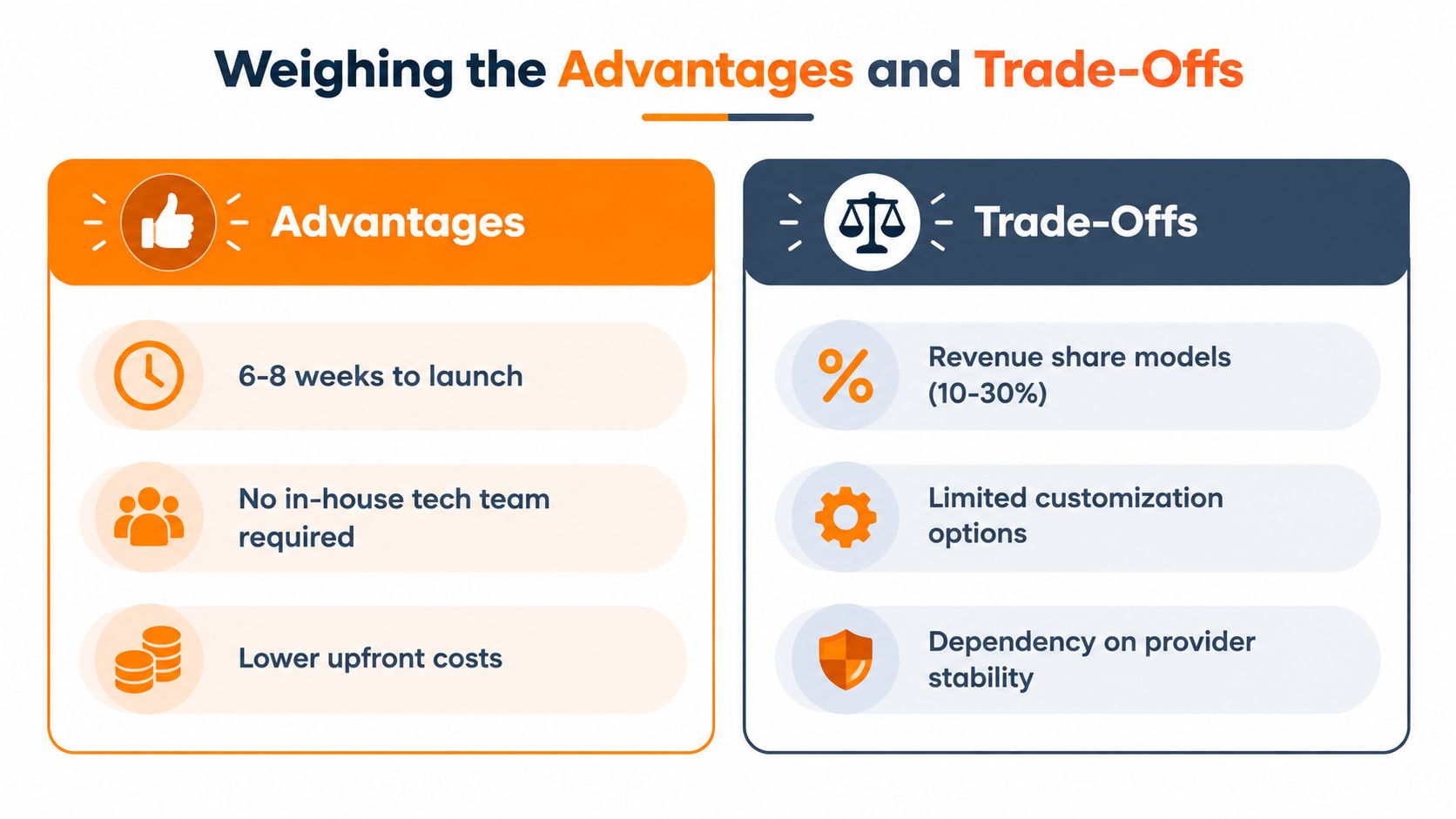
A white-label launch can reach the market quickly because the provider has already assembled the platform, connected content, integrated payment services, and built operating workflows. The brand can focus on positioning, acquisition, promotions, player support, and market selection rather than building every technical component from an empty repository.
The market is large and geographically varied, which creates practical pressure to connect games, payments, verification, reporting, and risk controls without maintaining every integration independently. Global online gambling revenue is estimated at approximately USD 120.9 billion in 2026, while Europe represented roughly 41.0% of global online-gambling revenue in 2024, according to Knowledge Sourcing's market estimate.
Where white-label earns its place
White-label generally suits a launch built around speed, controlled complexity, and rapid commercial validation. It can work for a brand with a defined acquisition strategy that does not want to hire a complete engineering, payments, compliance, and platform operations team before testing demand.
A unified back office can reduce day-to-day integration work by giving marketing, finance, support, and compliance teams one operational view. That reduces the need to reconcile separate vendor consoles, although it does not remove the need to test the underlying records.
The backend deserves particular scrutiny. Confirm that wallet movements use double-entry accounting, that reconciliation covers reversals and chargebacks, and that administrative changes produce immutable audit logs. The licensee remains responsible to the regulator, even when the provider operates the platform and maintains the underlying services. A white-label contract transfers tasks, not the regulatory exposure.
The provider's standard architecture also sets boundaries. Visual identity, content selection, promotional presentation, and selected player journeys may be configurable. Changes to wallet behavior, CRM logic, reporting, or risk workflows may require approval, custom development, or may be unavailable.
Where the model creates friction
White-label economics may combine platform charges with revenue sharing. Model the structure against acquisition cost, payment fees, bonuses, support, taxes, and expected player value. A low initial build cost does not guarantee a low total cost as volume grows.
Control is another constraint. If the provider owns the core platform, the brand may depend on its release schedule, incident response, payment relationships, data access, and willingness to prioritize requested features. That dependency becomes more significant when a successful brand needs a product change that supports its strategy but falls outside the provider's wider roadmap.
Use three tests before committing:
- Choose white-label when speed and reduced technical ownership matter more than deep differentiation.
- Choose a more configurable platform when custom wallet logic, proprietary CRM, specialized compliance flows, or unique player mechanics define the business.
- Negotiate the exit before launch by specifying data portability, player-record access, reporting formats, and migration responsibilities.
White-label exchanges some control for a faster route to a functioning operation. The decision should rest on the controls you can audit, the changes you can make, and the cost of leaving later.
Evaluating White-Label Providers for Your Brand
Provider selection should start with operational evidence, not the size of the game catalogue. A large lobby won't compensate for weak payment reconciliation, unclear licensing responsibilities, or an audit trail that can't explain why a player's balance changed.
Start with infrastructure and access
Ask how the platform handles service interruptions, traffic spikes, backups, releases, and incident escalation. Request an explanation of monitoring, DDoS protection, recovery procedures, and access controls. You don't need every internal implementation detail, but you do need to know who detects an incident, who makes the decision to suspend a component, and how the business receives updates.
Then test the API rather than accepting a slide presentation. Look for stable authentication, idempotent callbacks, clear error states, versioning, rate-limit behavior, and documentation that reflects the current product. A single API can reduce integration work, but only if it gives operations teams reliable status information.
A provider such as NexGrate's iGaming software platform illustrates the type of consolidated scope operators may assess, including casino and sportsbook modules, wallets, payments, KYC and AML workflows, compliance controls, reporting, and third-party integrations. Treat that scope as a checklist for due diligence, not as a substitute for testing the actual environment.
Examine payments and operational controls
Payment coverage needs to match the target markets. Ask which card, bank, local, and crypto methods are available, how withdrawals are reviewed, and how the system represents pending, rejected, reversed, and completed states. Require a demonstration of reconciliation using provider statements and internal ledger entries.
Marketing tools should also be inspected at the rule level. Review bonus escrow, wagering conditions, expiry behavior, free-spin settlement, affiliate attribution, player segmentation, and abuse controls. A promotion that looks simple in the front end can create complex accounting and compliance consequences.
Use the following provider interview checklist:
- Regulatory mapping: Which entity is licensed, which markets are permitted, and which obligations remain with the brand?
- Data ownership: Can the operator export player, wallet, transaction, bonus, and support data in a usable format?
- Audit evidence: Are logs immutable, time-stamped, access-controlled, and retained according to the relevant requirement?
- Reporting depth: Can the back office produce finance, player-funds, AML, responsible-gaming, game, and payments reports?
- Operational support: Who responds during payment incidents, game faults, suspicious activity, or player escalations?
- Configuration control: Which settings can the operator change, and which require provider intervention or a release?
- Migration terms: What happens to data, domains, integrations, and player communications if the relationship ends?
A provider that answers these questions precisely is easier to govern than one that focuses only on branding and launch speed.
Actionable Steps to Launch Your Casino
A launch can look ready while the backend still loses track of money, player restrictions, or audit evidence. Before accepting real-money traffic, prove that registration, verification, wallets, payments, games, reporting, and support work during both routine and failure scenarios.
Build the operating map first
Write the player journey as testable states. Cover registration, age and identity checks, deposit authorization, wagering, wins, bonus conversion, withdrawal review, self-exclusion, account closure, complaints, and data requests. For every state, document the system of record, responsible team, permitted action, audit evidence, and escalation route.
Confirm geolocation rules before launch. Test permitted and restricted locations, location changes during an active session, applicable VPN or proxy detection, and deposit or withdrawal behavior after a location failure. Blocking the landing page while an existing session continues is not a complete control.
Risk rules need realistic test cases. Use synthetic accounts to trigger deposit velocity concerns, repeated payment failures, bonus abuse, unusual wagering, and conflicting identity signals. Confirm that alerts reach the correct queue and that analysts can record decisions without changing the underlying event history. Immutable audit logs matter here because the licensee must explain what happened, when it happened, and who acted.
Reconcile money before inviting players
Run controlled transactions through every supported payment path. Test successful and rejected deposits, delayed confirmations, duplicate callbacks, partial reversals, chargebacks, withdrawal cancellations, interrupted game sessions, bonus conversion, and currency rounding. Compare the payment provider's record, the platform's double-entry ledger, the player balance, the finance report, and the regulatory output.
The wallet should remain balanced after each scenario. If staff must alter a balance manually, require an approved adjustment with a reason, reference, and audit record. A spreadsheet correction does not replace ledger integrity. Require the provider to demonstrate how settlement files, wallet entries, and internal finance reports reconcile after failures.
Certify the game and reporting stack
As covered under compliance responsibilities, applicable products must be tested by an approved test house before release. Obtain the relevant evidence, confirm that the deployed game build matches the tested version, and verify that jurisdictional restrictions operate at the content level. Review how game outcomes, interrupted sessions, player disputes, and provider callbacks enter the audit trail.
Complete a controlled launch rehearsal before public acquisition begins:
- Verify ownership and permissions: Confirm the licensee, provider, administrators, payment roles, and escalation contacts.
- Run player lifecycle tests: Cover registration, KYC, deposits, wagering, bonuses, withdrawals, restrictions, and account closure.
- Reconcile every ledger event: Compare provider settlements with wallet entries and finance reports.
- Test compliance interventions: Trigger geolocation, self-exclusion, responsible-gaming, AML, and fraud rules.
- Review evidence: Ensure logs, reports, test certificates, decisions, and support records can be retrieved.
- Open with controlled traffic: Monitor payment approvals, game errors, support queues, suspicious activity, and complaints from the first session.
For a broader operational checklist, use NexGrate's guide to opening an online casino. Approve the launch only when the operator can explain what happens when systems disagree, payments fail, a player disputes an outcome, or a regulator requests the record.
NexGrate provides a turnkey white-label platform for casino and sportsbook brands, combining games, betting engines, payments, wallets, KYC and AML workflows, reporting, geofencing, and responsible-gaming controls in one operating environment. If you are assessing a white-label launch, visit NexGrate to discuss architecture, compliance responsibilities, integrations, and launch requirements for your brand.