
A white-label solution is a prebuilt, fully managed iGaming infrastructure that a business rebrands and operates under its own license. It can accelerate time-to-market, but it doesn't transfer legal compliance accountability from the operator to the vendor.
That distinction is where most white-label advice becomes too optimistic. Launch speed matters, but a gambling brand can't treat its platform supplier as a legal shield. The operator still has to understand how player verification, payments, responsible-gaming controls, suspicious-activity escalation, reporting, and data migration work in practice.
For a new casino or sportsbook owner, the better question isn't whether a white-label platform can get the brand live quickly. It's whether the platform gives the operator enough control, evidence, and portability to run the business responsibly after launch.
Table of Contents
- Defining the White-Label iGaming Model
- Core Components of a Turnkey Platform
- The Reality of Regulatory Accountability
- Comparing White-Label to Custom Builds
- Evaluating Providers and Exit Portability
- Operational Benefits and Platform Drawbacks
- Frequently Asked Questions
Defining the White-Label iGaming Model
White-labeling separates brand ownership from infrastructure ownership. The customer-facing business controls the name, identity, acquisition strategy, pricing, promotions, and market positioning, while a specialist provider supplies much of the technology and operational machinery underneath. That machinery can include games, sportsbook markets, player accounts, wallets, payment processing, identity checks, reporting, and responsible-gaming controls, as described in this overview of the online gambling white-label model.
The arrangement is more substantial than placing another company's software behind your logo. A genuine white-label service is usually a managed delivery model. The supplier maintains a reusable platform, integrates external services, and adapts the environment to the operator's brand, commercial rules, configuration, and target jurisdiction.
What the operator owns
The operator remains the visible business in front of the player. That creates responsibilities that a vendor can support but not automatically absorb.
The operator typically determines:
- Brand and customer experience: The operator decides how the website presents games, odds, promotions, account messaging, and support.
- Commercial rules: The operator defines bonuses, wagering conditions, limits, player segmentation, affiliate terms, and pricing decisions within the platform's available configuration.
- Market strategy: The operator chooses which jurisdictions, payment methods, products, and acquisition channels to pursue.
- Governance: The operator approves risk thresholds, handles exceptions, reviews incidents, and communicates with regulators where required.
This model works because the supplier's existing infrastructure can serve multiple brands without each operator duplicating every integration. A shared backend may connect game studios, sportsbook feeds, payment methods, and verification services through APIs or prebuilt adapters. The operator gets a practical foundation, but it also inherits a dependency on the provider's data model, uptime, security controls, release schedule, and integration boundaries.
Practical rule: Treat white-labeling as outsourced infrastructure, not outsourced responsibility.
That mindset changes the buying process. Instead of asking only whether the supplier offers a branded front end, ask whether the platform can support the records, approvals, controls, and explanations your business will need throughout its operating life. A white-label solution can reduce duplicated development work, but it won't remove the need for competent operations, compliance, finance, customer support, and risk teams.
Core Components of a Turnkey Platform
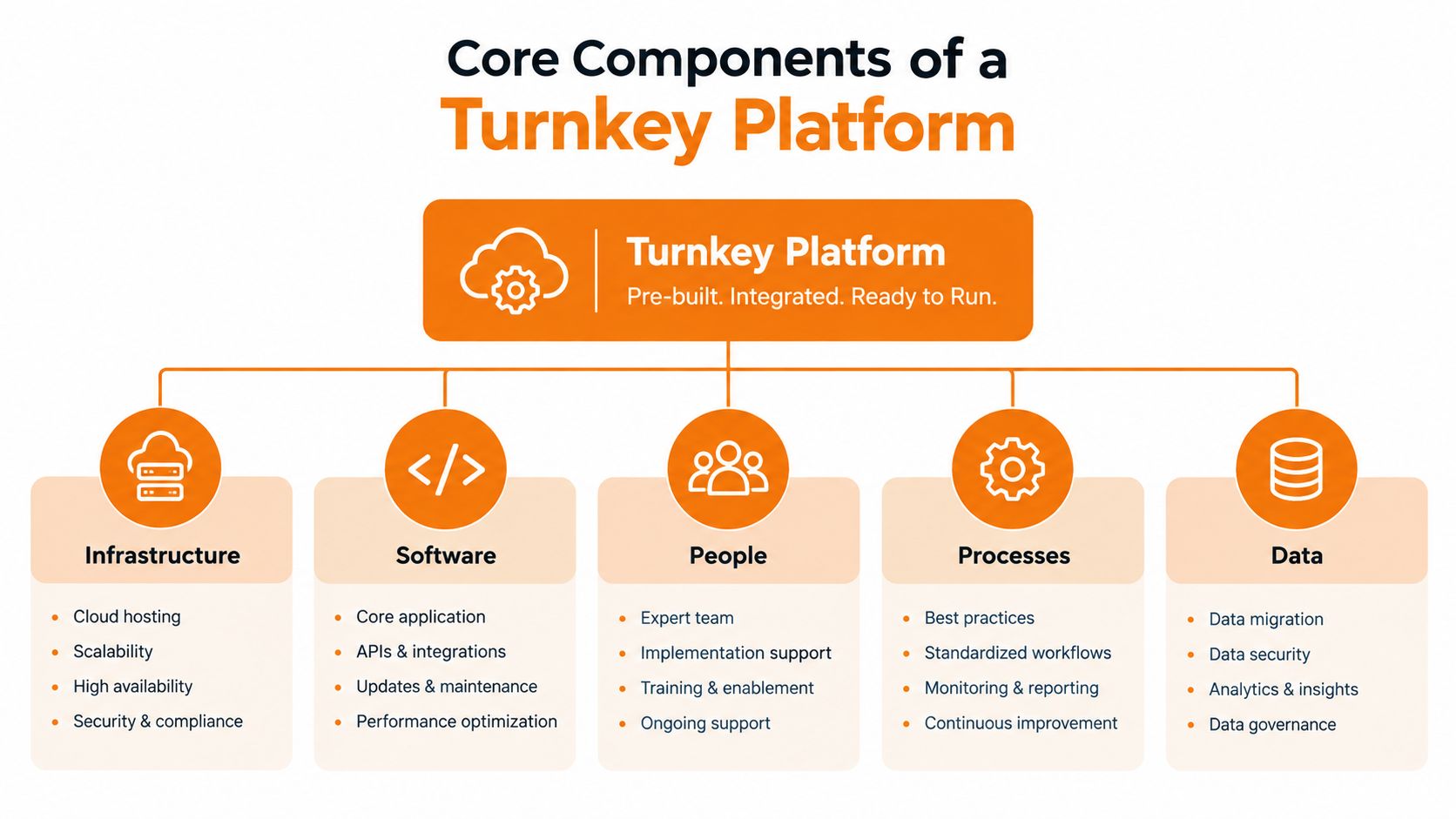
A turnkey iGaming platform is a connected operating system, not a single website template. The value comes from how its modules exchange account, wallet, transaction, content, and compliance data without forcing the operator to manage disconnected systems.
The player-facing layer
The casino and sportsbook front ends are the visible parts of the product. A casino interface may present slots, table games, jackpots, and live-dealer content. A sportsbook interface may handle pre-match and in-play markets, odds display, bet placement, settlement, and account notifications.
Branding goes beyond colors and logos. Navigation, promotional logic, market availability, responsible-gaming messaging, language handling, and customer communications all affect how the operator is perceived. A provider should explain which elements the operator can configure and which are fixed by the platform.
The account and wallet layer
The player account should provide one controlled identity across products. A unified wallet lets the same player balance support casino activity and sportsbook activity without forcing separate registrations, ledgers, or cashier journeys.
That consolidation reduces reconciliation problems, but only when the ledger is properly designed. Buyers should examine how the platform records deposits, withdrawals, bets, wins, bonuses, reversals, chargebacks, adjustments, and manual interventions. A visually smooth cashier can still create operational problems if finance teams can't trace every balance movement.
Content and betting integrations
A single API or integration layer can connect multiple RNG studios, live-casino providers, sportsbook feeds, payment processors, and verification services. Prebuilt adapters reduce the need to create and maintain a separate connection for every external supplier.
The important test is not the phrase “single API.” Ask how the platform handles failed webhooks, delayed settlement, duplicate events, unavailable content, provider changes, and data reconciliation. Integration simplicity is useful only when the underlying event handling is reliable and observable.
Administration and control
The back office brings player management, wallet actions, KYC and AML workflows, risk rules, fraud controls, bonus administration, affiliate tracking, reporting, and permissions into one environment. Granular roles matter because customer support, payments, compliance, trading, and finance teams shouldn't all have identical access.
A platform can look complete during a product demonstration while leaving critical workflows unclear. Request demonstrations of account suspension, withdrawal review, bonus cancellation, self-exclusion handling, audit-log retrieval, and report export. Those scenarios reveal more than a polished homepage.
The Reality of Regulatory Accountability
Outsourcing technology doesn't outsource legal risk. European AML guidance treats the use of a third party for a process the operator would otherwise perform as outsourcing, with retained control, accountability, risk assessment, contractual definition, and ongoing monitoring. The European Gaming and Betting Association AML guidance is clear on the governance principle that matters here: the operator must remain able to control and supervise the outsourced activity.
A platform vendor may provide workflows and automation, but the licensee still needs to define how the business identifies risk, approves exceptions, escalates suspicious activity, applies player restrictions, and responds to regulatory requests.
Controls the platform should support
A serious white-label stack should provide a traceable compliance control plane. Depending on the jurisdiction and operating model, that can include:
- Identity and age verification: The system should apply the relevant checks at the required point in the player journey and retain evidence of the decision.
- Screening and monitoring: Sanctions, politically exposed-person screening, transaction monitoring, and suspicious-activity escalation should produce reviewable records.
- Responsible gaming: Self-exclusion, account restrictions, deposit controls, time-outs, and intervention workflows must be configurable and auditable.
- Geofencing: The platform should detect and restrict access according to the markets the operator is permitted to serve.
- Audit evidence: Registration, device or location checks, deposits, bets, withdrawals, account actions, manual reviews, and decision timestamps should form a reconstructable event chain.
- Reporting: Compliance and regulatory reports should be exportable in a usable format, with clear ownership of the underlying data.
The operator must also verify that controls work under real operating conditions. A rule that exists in a configuration screen isn't enough if staff can bypass it without approval, if the system doesn't preserve the reason for an exception, or if the vendor can't provide the relevant logs.
For practical context on how compliance reporting fits into broader operational governance, review this guide to compliance reporting processes.
The platform should make compliance work more consistent, but automation doesn't replace judgment. The licensee must test vendor performance, retain records, approve policies, investigate alerts, and maintain regulator-facing accountability. That's why procurement should include audit simulations and evidence requests, not only interface reviews.
Comparing White-Label to Custom Builds
There's no universally correct architecture for an iGaming business. The right choice depends on capital, technical staff, regulatory scope, product differentiation, and how much infrastructure the operator wants to own.
A custom proprietary build offers the greatest control over the wallet ledger, betting engine, data model, user experience, and release process. It also makes the operator responsible for every integration, security process, infrastructure decision, operational tool, and maintenance burden. That route suits a business with substantial engineering capacity and a product strategy that depends on deep technical differentiation.
A white-label solution takes the opposite approach. The provider supplies the core platform and manages much of the underlying technology, while the operator configures the brand and business rules. The trade-off is dependency. The operator may launch with less duplicated development, but it must accept the provider's release cycle, supported integrations, data structures, and limits on core customization.
Modular managed services sit between those models. The operator may select separate specialists for payments, player account management, sportsbook, casino content, compliance, hosting, and analytics. This can improve component choice and reduce dependence on one supplier, but the operator then owns the integration architecture and must reconcile data across systems.
| Feature | White-Label Solution | Custom Proprietary Build | Modular Managed Services |
|---|---|---|---|
| Initial development | Uses prebuilt infrastructure and configurable modules | Requires the operator to build and maintain core systems | Combines third-party services through an operator-managed architecture |
| Time to market | Usually supports a faster rollout when requirements fit the platform | Slower because the operator must design, build, test, and certify more components | Depends on integration complexity and supplier readiness |
| Technical control | Strong control over brand and configuration, limited control over the provider's core architecture | Maximum control over product behavior, data structures, and release priorities | Control varies by module and contract |
| Maintenance | Provider handles much of the platform maintenance, while the operator manages business operations | Operator carries the broadest engineering and maintenance burden | Operator coordinates multiple vendors and integration changes |
| Customization | Works well for supported workflows, less suitable for deep structural changes | Suitable for specialized rules and differentiated product experiences | Allows selective specialization, but modules may not align cleanly |
| Portability | Must be negotiated through export rights, contracts, and migration support | Data and architecture remain under the operator's direct control | Portability depends on each supplier and the integration design |
Before choosing an architecture, read the technical questions in this guide to online casino software development. The useful decision isn't “fast versus slow.” It's whether the chosen model supports the operator's target markets without creating unacceptable governance or switching constraints.
Evaluating Providers and Exit Portability
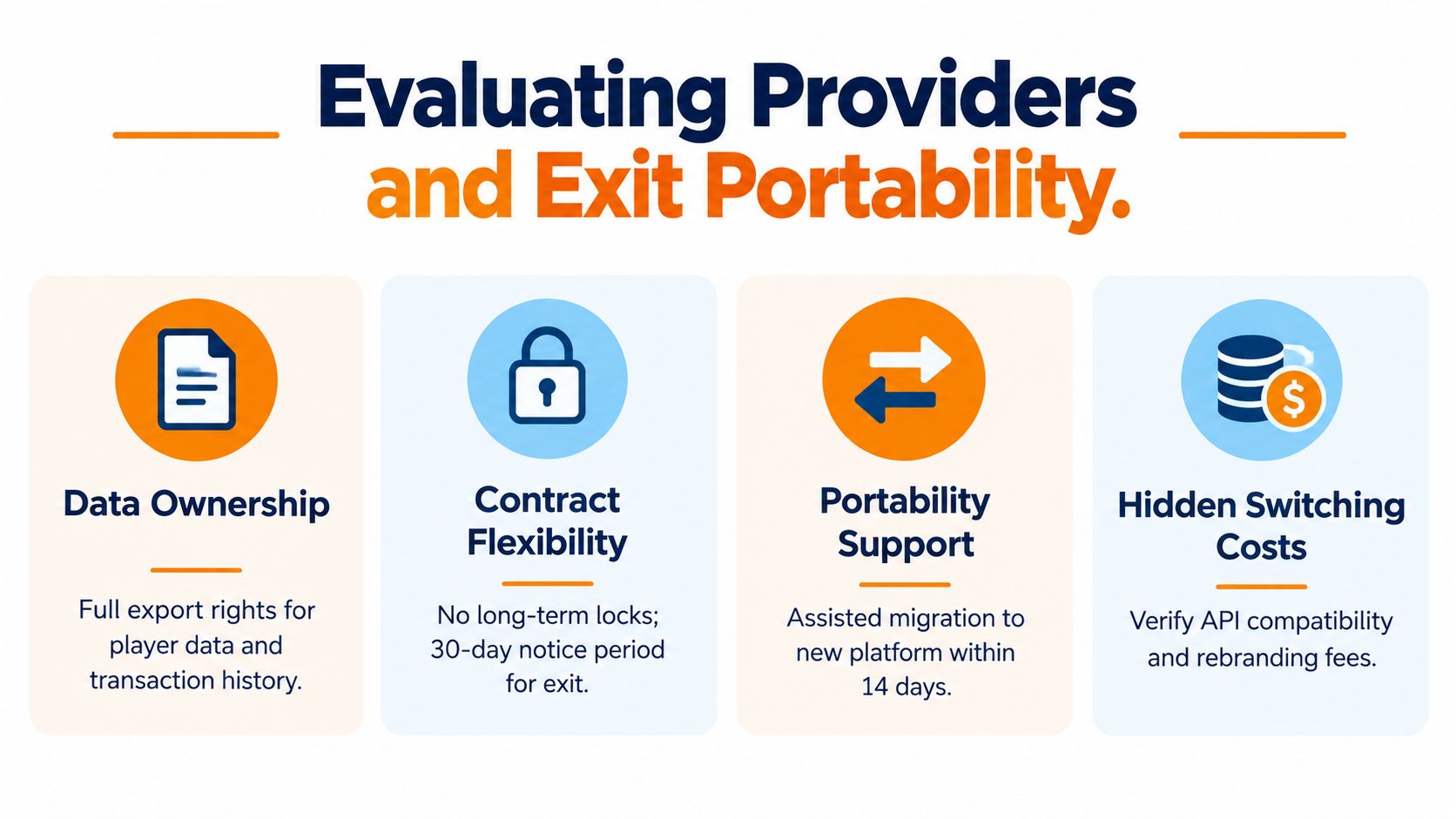
Launch speed is easy to demonstrate. Exit portability is harder, and it's where many buyers underinvest during procurement.
A white-label contract can give the operator access to customer data while still making that data difficult to use elsewhere. An export may contain player records and balances but omit workflow history, configuration, audit context, media relationships, bonus logic, payment metadata, settlement records, or the data model needed to recreate integrations. Independent coverage of white-label solution portability risks highlights why ownership and practical usability aren't the same thing.
Put the exit requirements in the contract
Ask the provider to define the export process before signing. Don't accept a general statement that “data is yours” without documenting how the operator receives it, in which format, with what context, and within which service window.
The agreement should address:
- Player and wallet records: Confirm that balances, transaction history, adjustments, disputes, and reconciliation information can be exported together.
- Compliance evidence: Require access to KYC records, screening outcomes, responsible-gaming actions, account decisions, review notes, and audit trails, subject to applicable retention and privacy requirements.
- Commercial history: Include bonus history, wagering conditions, affiliate attribution, segmentation, campaign records, and player communications where those records are needed for continuity.
- Technical metadata: Request API documentation, event schemas, webhook history, configuration references, payment metadata, odds and settlement records, and relationships between related entities.
- Retention and deletion: Establish what the provider retains after termination, what the operator must retain, and how subprocessors handle the same information.
- Migration support: Define assistance, testing, reconciliation, secure transfer, and continuity obligations rather than leaving migration to an informal support request.
Test portability before you need it
A sample export is more useful than a sales promise. Ask for representative records, inspect whether identifiers remain consistent across tables or files, and test whether another system could reconstruct the player and financial history without proprietary interpretation.
Also ask what happens if the operator exits one jurisdiction but continues elsewhere. Can the supplier separate market-specific data, restrictions, payment methods, reporting configurations, and responsible-gaming records? Can the operator preserve the required audit trail while removing data it no longer has a lawful reason to retain?
The white-label provider evaluation process should include these questions alongside uptime, security, integrations, and pricing. A platform can be operationally sound and still be a poor strategic fit if the operator can't change providers without losing essential records or rebuilding the business from incomplete exports.
Procurement standard: If the vendor can't explain how you would leave, you haven't finished evaluating how you would join.
Operational Benefits and Platform Drawbacks
A unified platform can simplify the daily work of a brand owner. Customer support can access account status, balances, verification progress, bonuses, and payment history from one back office. Payments staff can review cashier activity, while compliance teams investigate alerts and account decisions without stitching together unrelated systems.
The same consolidation can support a casino and sportsbook under one player relationship. An operator may combine fiat payment methods with cryptocurrency deposits and withdrawals, use pre-integrated casino content, manage sportsbook markets, and coordinate promotions through a shared operating environment. Hosting support, monitoring, DDoS protection, deployment pipelines, and uptime management can also reduce the number of infrastructure responsibilities handled directly by the brand.
Where the model works well
White-labeling is a practical fit when the operator needs a proven foundation and can work within supported workflows. It's particularly useful when the business wants to combine casino and sportsbook products, connect established content providers through a common integration layer, or give a small operations team role-based access to a broad back office.
The model also helps teams avoid vendor fragmentation. A single relationship can cover front-end delivery, player accounts, wallets, payments, compliance tooling, reporting, and third-party integrations. That doesn't eliminate supplier management, but it can reduce the number of separate operational handoffs.
Where the model creates friction
The drawbacks appear when the business needs structural changes. A shared platform may not allow the operator to redesign the wallet ledger, alter the betting engine's underlying behavior, create unusual settlement logic, or prioritize a feature outside the provider's roadmap.
Dependency also shows up in incidents and releases. If a payment adapter fails, a sportsbook feed changes, or a platform update affects a workflow, the operator depends on the provider's monitoring, response process, documentation, and testing discipline. The brand still owns the customer conversation even when it doesn't control the underlying fix.
That's why platform selection should weigh operational fit and exit capability, not just launch convenience. A configuration that works for the initial product may become restrictive when the operator adds jurisdictions, payment methods, markets, products, or internal teams.
Frequently Asked Questions
Does a white-label platform remove the need for a gambling license?
No. A white-label supplier can provide technology, integrations, workflows, and operational support, but it doesn't automatically give the brand permission to offer gambling services. Licensing, market access, player protection, advertising, AML governance, reporting, and regulator communications depend on the operator's legal structure, jurisdiction, contracts, and applicable rules.
The operator should map accountability by function before launch. That map should cover licensing, player verification, AML escalation, self-exclusion, geofencing, payment disputes, advertising, incident reporting, and record retention.
Can cryptocurrency payments work alongside fiat processing?
Yes, a turnkey platform can support cryptocurrency deposits and withdrawals alongside card and bank processing when the relevant payment integrations, wallet controls, risk rules, and jurisdictional requirements are supported. The important issue isn't just whether a cashier displays crypto as an option.
The operator should understand how the platform records exchange rates, transaction status, confirmations, reversals, fraud signals, withdrawal reviews, and reconciliation. Compliance and finance teams also need clear ownership of transaction monitoring, payment disputes, source-of-funds questions, and reporting.
How difficult is it to migrate an existing player database?
Migration depends on the quality and structure of the legacy data, the receiving platform's import capabilities, legal retention duties, and the ability to reconcile records. A player profile alone isn't enough. The migration plan may need balances, deposits, withdrawals, KYC evidence, responsible-gaming restrictions, bonus history, affiliate attribution, payment metadata, and audit context.
Start with a data inventory and a representative test export. Then define field mapping, identity matching, balance reconciliation, verification handling, secure transfer, validation, player communications, and rollback procedures. Never approve a migration based only on the promise that the database can be uploaded.
What should a buyer ask before signing?
Ask for API documentation, webhook behavior, role-based access controls, audit-log design, data export formats, incident response commitments, service levels, subprocessor access, retention rules, and migration assistance. Request demonstrations of real workflows, including withdrawals, account restrictions, self-exclusion, suspicious-activity reviews, manual adjustments, and report exports.
The strongest provider is not necessarily the one with the shortest sales cycle. It's the one that can explain how the platform behaves during normal operations, regulatory scrutiny, outages, disputes, and eventual exit.
NexGrate offers a turnkey white-label casino and sportsbook platform with branded front-end delivery, game and betting integrations, payments, cryptocurrency support, player wallets, back-office administration, KYC and AML workflows, reporting, audit logs, geofencing, and responsible-gaming features. If you're assessing a new launch or planning a migration, visit NexGrate to discuss the operating model, integration boundaries, and portability requirements before you commit.