Have you ever watched a progressive jackpot climb and assumed the growing number means the game is becoming more likely to pay out? That assumption exposes the gap in many basic explanations. A rising meter tells you how much the prize could be worth, but it doesn't tell you how the pool is funded, how the game is connected to other machines, or whether the underlying return is attractive.
Progressive slots combine a standard slot game with a jackpot that changes over time. To understand them properly, you need to follow the money from each qualifying wager, identify the network collecting those contributions, and separate the headline jackpot from the base game's normal payouts. The same principles matter to players comparing titles and to operators integrating progressive content into a casino platform.
Table of Contents
- What Are Progressive Slots in Plain English
- How a Progressive Jackpot Builds
- Standalone, Local, and Wide-Area Networks Compared
- Player Odds and the RTP Trade-Off
- Common Myths About When a Progressive Will Hit
- Regulation, Disclosure, and Responsible Gaming
- How Operators Add Progressive Content to a Platform
- Choosing a Progressive to Play or to Launch
What Are Progressive Slots in Plain English
Progressive slots are slot games with a top prize that grows as qualifying wagers are made. A conventional flat-top slot has a maximum payout defined by its game rules. A progressive slot displays a jackpot that can increase while people play, then resets or changes according to the game's payout conditions after a qualifying win.
A communal tip jar is a useful analogy. Players make wagers, and a small portion of qualifying bets flows into a shared pool. The jar keeps filling while the game is active. Eventually, a random outcome or a specific winning combination awards the accumulated prize to one player, after which the pool starts again from its configured starting value.
The player usually sees the current amount above the reels. That display creates the most visible difference between progressive and non-progressive slots, but the important mechanics remain behind the interface:
- Seed value: The configured starting amount after a jackpot reset.
- Contribution rate: The portion of each qualifying wager assigned to the jackpot pool.
- Trigger rule: The condition that determines when the jackpot pays.
- Reset behavior: The rule that determines what happens to the meter after a win.
Progressive jackpots emerged as a major casino innovation in 1986, when International Game Technology launched Megabucks, widely cited as the first progressive jackpot slot system. The first recorded Megabucks win followed on February 1, 1987, when a player won $4,988,842.17, according to the history of progressive jackpots.
The network can be narrow or broad. A single machine may feed its own pool, several games in one casino may share a local jackpot, or games across multiple casinos may contribute to a wide-area prize. That distinction affects how quickly the meter rises and how often the jackpot may be won.
Practical rule: A larger visible jackpot doesn't automatically mean better value. Always check the contribution rules, jackpot trigger, qualifying bet, and game-specific return before treating the meter as evidence of a better opportunity.
The next questions are mechanical. Where does the starting amount come from? How much of each wager enters the pool? What happens after a win? Those answers explain why one progressive crawls upward while another can become a widely advertised multi-million-dollar prize.
How a Progressive Jackpot Builds
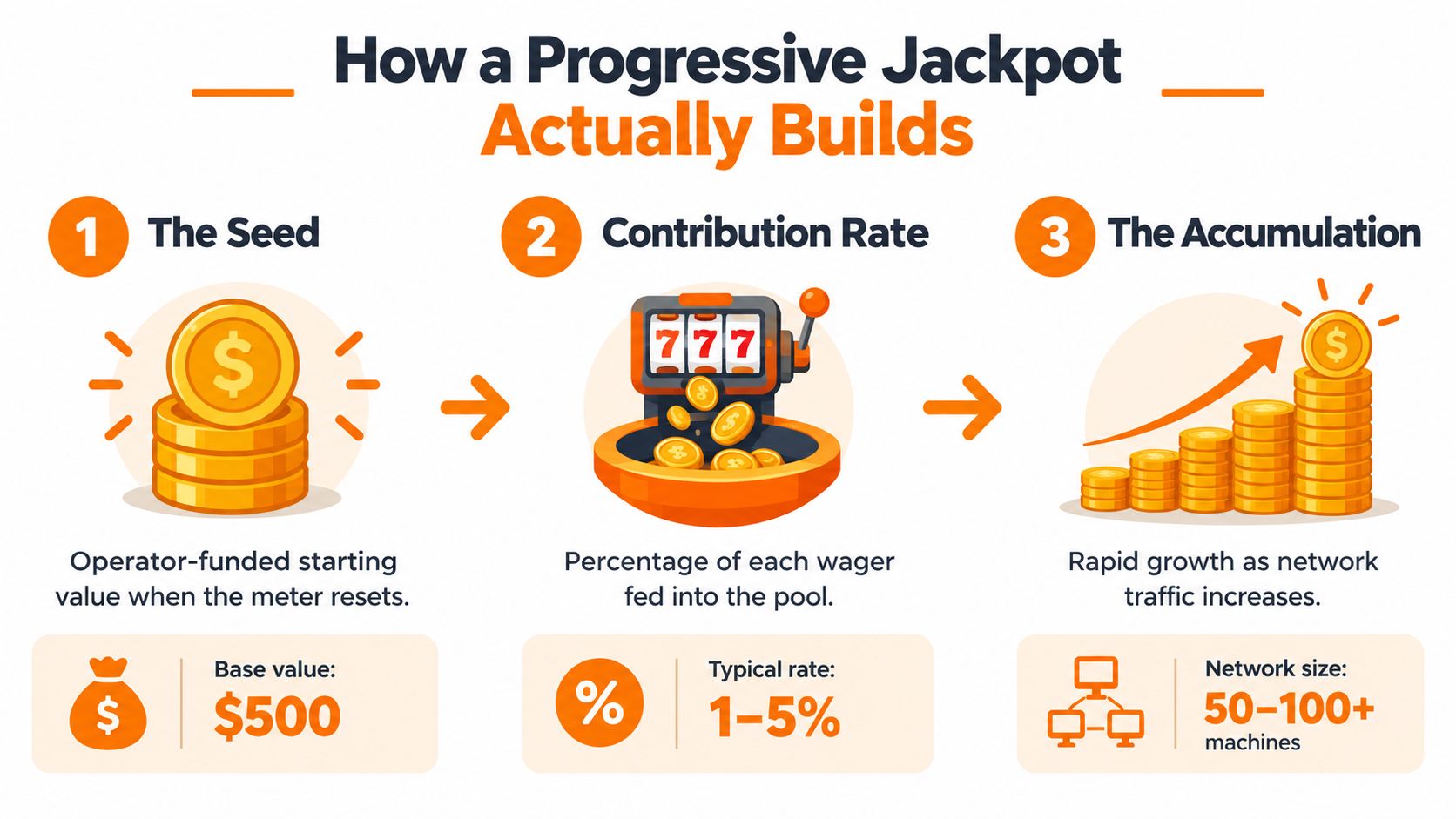
What makes a progressive jackpot rise from its starting amount to a headline prize? Three mechanics account for the movement: the seed, the contribution rate, and the reset rule. Together, they connect the player's visible meter with the accounting behind it.
The seed starts the meter
The seed is the initial jackpot value set when the game launches or after the previous prize is paid. It gives the meter a floor, so the displayed amount does not return to zero after every win. Depending on the arrangement, the operator, game supplier, or network may fund or configure this starting value.
The seed is a starting point, not a guarantee that the jackpot will stay there for a set period. Once qualifying play begins, contributions can move the meter upward. After a win, the game may return to the original seed, apply a different reset amount, or use a rule tied to the jackpot tier.
Contributions make the number rise
Industry descriptions commonly put the share entering a progressive pool at about 1% to 4% of each qualifying wager, as explained in this explanation of progressive jackpot mechanics. Another description places the typical diversion at about 1% to 3%. The overview of progressive slot funding and RTP explains that a small share of each bet can move into a shared pool. These ranges are useful for understanding the mechanism, but the individual game rules determine the actual rate.
At a 3% contribution rate, a player wagering $1 would assign three cents to the progressive pool, with the rest supporting the base game's prize structure, operating economics, and other parts of the title. The example shows the accounting, not a universal rule. A player should check the paytable or help screen before assuming that every game uses the same allocation.
The pool can grow without a jackpot win. More qualifying wagers entering the same pool can also make the meter rise faster. Its speed reflects the volume and value of contributions, not a countdown that guarantees a payout.
The display does not reveal every rule
A live meter shows one part of the system. Some games display a capped or mystery value instead, with the amount hidden until the prize triggers. A mystery jackpot may be awarded when a random event meets the game's configured conditions, even though the player cannot watch the same kind of visible buildup.
A game may also offer several jackpot tiers. Smaller prizes can have different trigger conditions from the top prize, which may require a particular symbol combination, bonus event, or qualifying stake. The help screen should explain whether each tier depends on a symbol outcome, a random selection, or a separate bonus feature.
The contribution is not an extra fee added to the wager. It is one part of the game's mathematical allocation. Sending money to the progressive reserve leaves less of the wager available for the base-game return, so the progressive feature and the regular paytable need to be evaluated together.
The network determines how widely that contribution stream is shared. A standalone pool draws from a narrow source. A local pool combines activity within one property or platform, while a wide-area pool can collect from many connected casinos. For players, that structure helps explain a meter's pace and prize size. For operators, it affects configuration, pool funding, game rules, and the way the progressive content is integrated into a platform.
Standalone, Local, and Wide-Area Networks Compared
The word “progressive” describes the rising prize, but it doesn't identify the size of the network behind it. That missing detail matters. A jackpot connected to one machine behaves differently from one shared across many casinos, even if both games show a steadily increasing meter.
Three network models
A standalone progressive draws contributions from one machine or one specific game instance. Its pool has a narrow inflow, so its meter generally grows more slowly and its headline prize tends to remain smaller. The trade-off may be a simpler configuration and less dependence on external network traffic.
A local progressive links several machines or titles within one casino, property, platform, or supplier arrangement. Every qualifying wager across that group can feed the same pool. The jackpot has more opportunities to grow than a standalone version, while access remains limited to the connected local environment.
A wide-area progressive links games across multiple casinos or online markets. Microgaming's Mega Moolah, launched in 2009 as the first online progressive jackpot slot, illustrates how an online network can support very large prizes. Its reported wins included $6,374,434 in its first year and $19,154,463 in 2015, figures discussed in the account of Mega Moolah and progressive jackpot networks.
| Tier | Scope | Jackpot size | Growth speed | Hit frequency | Typical base RTP |
|---|---|---|---|---|---|
| Standalone | One machine or game | Usually smaller | Slower | Limited to one source of play | May preserve more room for base-game returns |
| Local | A casino, property, or platform group | Mid-range | Faster than standalone | Drawn from the connected local pool | Balances jackpot funding with base play |
| Wide-area | Multiple casinos or markets | Can reach very large prizes | Fastest when network activity is high | Spread across a broad player base | May allocate more of the wager to the progressive reserve |
This table describes structural tendencies, not guarantees. A game supplier can configure different contribution rates, seed values, trigger rules, and return profiles within the same network category.
A wide-area pool can grow quickly because more qualifying wagers enter it. It can also feel more volatile. The jackpot may reset after a win, and a player in one location is competing within a much larger pool of eligible play. The large number on the screen reflects network scale, not a personal improvement in the odds of triggering the top tier.
Recent U.S. coverage shows how visible these networked prizes have become. A reported $22.4 million online progressive jackpot in Michigan in November 2025, alongside multiple seven-figure wins in 2026, demonstrates the scale described in coverage of progressive jackpot trends. Those headlines attract attention, but they don't by themselves answer whether the game's base return, qualifying rules, and volatility suit a particular player.
Player Odds and the RTP Trade-Off
What does a rising jackpot change for the player? It changes the potential prize, while the wager still has to support the ordinary slot game and the progressive reserve.
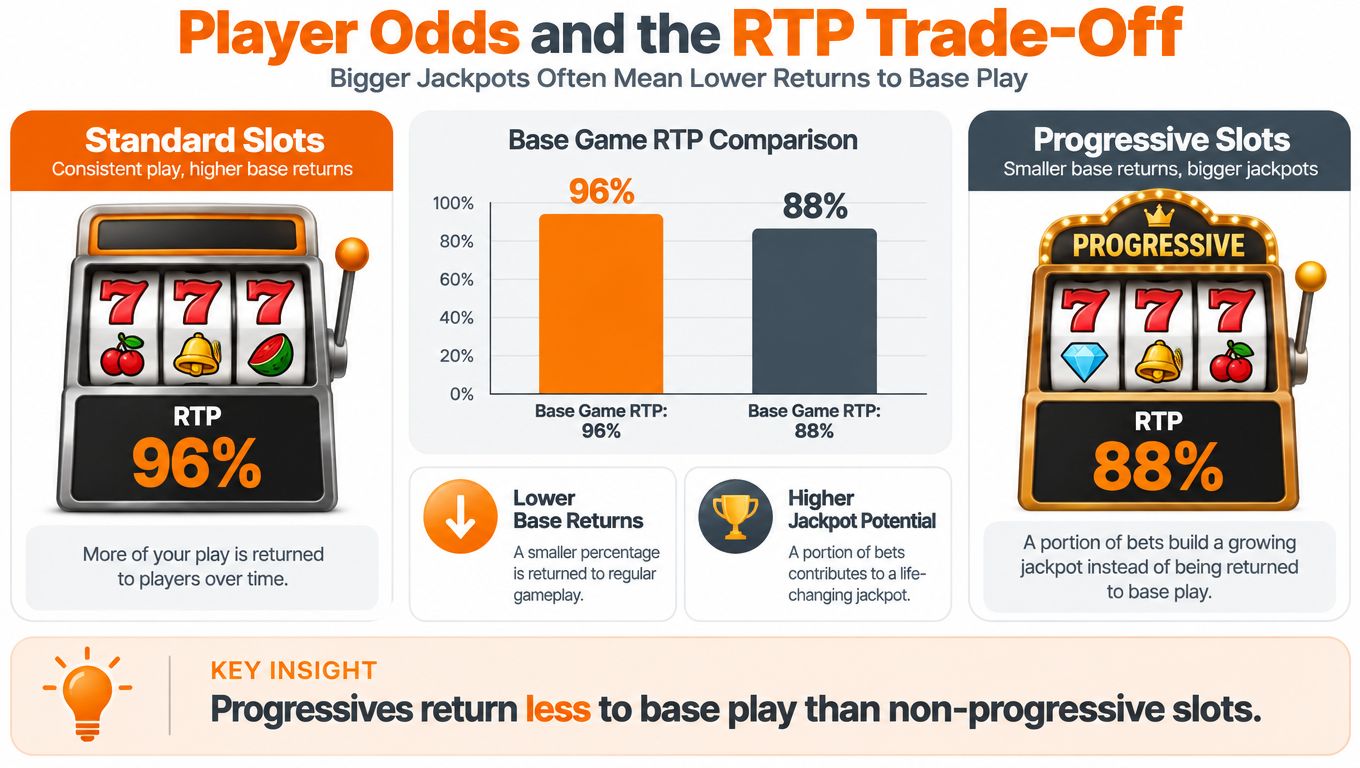
Return to Player, or RTP, works as a two-part accounting model. One part funds the base game, including regular symbol wins and bonus features. The other part is set aside for the progressive pool. A flat-top slot can direct its mathematical return toward the base game because it has no shared jackpot reserve. A progressive title allocates part of qualifying wagers to the prize instead.
The game's own help screen should state the exact contribution rate and explain whether the published RTP includes the progressive. That distinction matters because the visible jackpot can make the game appear more generous than its base-game results suggest.
How the trade-off appears in the maths
Suppose a comparable flat-top has a base RTP of R. If a progressive diverts 2% of each wager from the same return structure, its comparable base-game RTP becomes R minus 2 percentage points, assuming the rest of the configuration is unchanged. The progressive reserve then provides access to a larger, less frequent outcome. This is a trade between more immediate base-game return and a long-tail jackpot opportunity, not free extra value.
The actual result depends on the title's configuration. Check these details in the information panel:
- Published RTP: Confirm whether it covers the base game, the progressive, or a specific jurisdictional version.
- Contribution rate: See how much of each qualifying wager enters the jackpot pool.
- Qualifying bet: Some games require a particular stake or bet level for the top prize.
- Trigger condition: Check whether the jackpot needs symbols, a bonus event, or random selection.
- Volatility: Consider whether you can handle longer stretches of ordinary results while pursuing a high-value outcome.
Operators need the same information for a different reason. Before adding progressive content, they must map the contribution rate, prize logic, and RTP presentation into the platform's game information and player disclosures. Clear labels help players distinguish the base-game return from the jackpot opportunity.
Expected value describes results across a very long playing horizon. It cannot predict an individual session or justify wagering money a player cannot afford to lose.
A rising meter changes the potential payout, not the independence of the next spin.
Treat the progressive as a high-variance feature attached to a slot. Verify the rules, understand what the displayed jackpot represents, and set a spending limit before play begins.
Common Myths About When a Progressive Will Hit
The most persistent misunderstanding is the belief that a jackpot becomes “due” after a long dry spell. It doesn't. Each spin is determined by the game's random outcome process, so the fact that a jackpot hasn't appeared recently doesn't create a debt that the machine must repay.
The machine isn't keeping score
A previous losing spin doesn't make the next spin more likely to win. The visible meter may have risen substantially, but that increase changes the prize amount, not the random trigger logic. Players who chase a jackpot because it “must be close” are relying on the gambler's fallacy.
A second myth says that maximum betting always improves the chance of winning. The rules may require a qualifying bet for the top tier, but qualification and probability aren't the same thing. A larger stake can determine eligibility or alter the amount contributed to the pool, while the game's random mechanism still controls the outcome.
Traffic creates another misconception. More players can make the meter rise faster because more qualifying wagers enter the pool. That doesn't mean a particular time of day makes the jackpot more likely to hit. It means the prize may be larger when the trigger eventually occurs.
Must-hit-by rules are different
A must-hit-by progressive has a configured ceiling or range within which the jackpot must be awarded. That creates a mathematical boundary, but it still doesn't turn a normal progressive into a predictable clock. Players need to read the exact rules because the trigger may occur randomly before the upper limit rather than at a known point.
Hot-and-cold theories have the same weakness. A recent win doesn't make another win less likely, and a prolonged absence doesn't make one more likely unless the game's published mechanics explicitly change the eligible range or trigger condition.
The practical approach is straightforward: choose a stake you can sustain, treat every spin as a separate event, and ignore streak-based reasoning. A larger displayed prize can make a game more exciting, but excitement isn't evidence of improved odds.
Regulation, Disclosure, and Responsible Gaming
Progressive jackpots require more disclosure than a static prize because the operator must explain both the game and the changing pool. The relevant requirements vary by jurisdiction, licence, supplier, and product configuration, so operators should treat the game rules and local approval conditions as controlling documents.
Testing and audit processes generally need to establish that the configured contribution logic, seed value, jackpot trigger, and random outcome process match the approved game design. Operators also need reliable records showing the jackpot value, qualifying wagers, wins, resets, and adjustments. A live ticker should communicate the current prize clearly without implying that the next spin is more likely to win.
Marketing needs the same discipline. Promotional copy should identify the game and applicable conditions, avoid promises about when a payout will occur, and present the jackpot in the currency and context required by the relevant market. Affiliates must also follow advertising and age restrictions rather than presenting a large prize as easy or inevitable.
Responsible gaming controls deserve particular attention because progressive titles can encourage longer sessions and repeated wagering. Operators should make deposit limits, session controls, reality checks, self-exclusion, age verification, and player protection information easy to find. Players should use those tools before chasing a rising meter, not after losses have become difficult to manage.
A significant win can also trigger additional identity and source-of-funds checks under applicable rules. The operator needs an audit trail from the qualifying wager through the trigger, payout calculation, account verification, and settlement. Clear procedures protect the player and give compliance teams evidence that the jackpot was handled according to the approved configuration.
Operators building trust around randomised games can also review provably fair game principles, while remembering that technical transparency doesn't replace licensing, responsible gaming, or jurisdiction-specific certification.
How Operators Add Progressive Content to a Platform
For an operator, a progressive slot is more than another game tile. It is a coordinated financial and technical workflow involving the game supplier, aggregator, wallet, reporting layer, compliance team, and customer support process.
The first decision is commercial and technical. The operator selects a provider or aggregator, confirms the markets where the title is permitted, and agrees how the game will handle the seed, contribution rate, reset amount, currency, and jackpot tiers. The contract should also define settlement responsibilities, service levels, incident handling, and access to event data.
The integration must preserve the money trail
Every qualifying wager needs to map cleanly to the player wallet and transaction ledger. The platform should distinguish the wager amount, the amount assigned to the progressive pool, the base-game result, and any jackpot win. Without that separation, finance teams can't reconcile the meter against provider statements or explain discrepancies during an audit.
Mystery and must-drop configurations need separate treatment. A mystery jackpot may trigger through a random event under the game's rules, while a must-drop structure uses a defined ceiling or campaign condition. The operator must store the relevant configuration and event details rather than treating every jackpot as the same product.
| Parameter | What to define | Operational impact |
|---|---|---|
| Contribution rate | The approved share of qualifying wagers assigned to the pool | Determines reconciliation, margin modelling, and player disclosure |
| Seed and reset value | The starting amount and post-win behavior | Controls the displayed floor and settlement workflow |
| Qualifying bet | The stake or conditions required for each jackpot tier | Affects eligibility messaging and dispute handling |
| Trigger logic | Symbol, bonus, random, mystery, or must-drop condition | Determines event validation and audit evidence |
| Currency treatment | Supported currency and conversion rules | Prevents display and settlement inconsistencies |
| Event feed | Meter updates, contributions, wins, and resets | Supports reporting, monitoring, and customer service |
| Jurisdiction rules | Approval, display, advertising, and responsible gaming requirements | Determines where and how the game can launch |
The platform should expose a reliable jackpot ticker and event feed while protecting the integrity of the provider's certified game logic. Finance needs contribution and payout reports. Compliance needs configuration history and audit logs. Operations needs alerts for delayed meter updates, rejected transactions, and settlement exceptions.
A casino platform that combines content, wallet management, compliance workflows, reporting, and provider integrations can reduce the number of separate systems involved. Operators evaluating white-label casino integration requirements should still verify how the chosen platform handles progressive-specific events rather than assuming that ordinary slot integration covers them.
Before launch, the operator should test the full path in a controlled environment. That includes a qualifying wager, contribution posting, jackpot display update, trigger event, reset, player balance settlement, tax or compliance reporting, and customer-facing history. The provider's certified mathematics must remain aligned with the live configuration, including any market-specific version or return setting.
The jackpot pool also needs clear financial treatment. Operators must know which funds are held by the supplier, which are recorded in the platform ledger, and which responsibilities apply when a provider becomes unavailable or a network event is delayed. A visible prize is only credible when the back office can account for every contribution and payout.
Choosing a Progressive to Play or to Launch
Players and operators ask different commercial questions, but they should inspect many of the same facts. A player wants to know whether the game fits a preferred risk level. An operator wants to know whether the title can run compliantly, reconcile accurately, and support a sustainable margin.
For players, the decision starts with transparency:
- Verified RTP: Check the published game-specific return and confirm what it includes.
- Contribution rate: Understand how much of each qualifying wager supports the jackpot.
- Trigger and eligibility: Read the rules for the top prize, including any maximum-bet requirement.
- Volatility tolerance: Choose a title whose ordinary play fits the bankroll you can responsibly set aside.
- Licensing and controls: Confirm the operator's licence information and use deposit, session, and self-exclusion tools when needed.
For operators, the checklist shifts toward delivery:
- RNG and mathematics certification: Confirm that the approved configuration matches the deployed version.
- Jurisdictional eligibility: Verify that the jackpot mechanic and display are permitted in every target market.
- Reconciliation data: Require contribution, meter, win, reset, and settlement events in usable reports.
- Operational resilience: Review uptime, incident response, wallet integration, and provider support terms.
- Player protection: Make responsible gaming, age verification, and marketing controls part of the launch plan.
The shared standard is verifiable transparency. Players need clear contribution and reset rules. Operators need certified mathematics, reliable event data, and an audit trail that matches the player-facing display. A big number is useful information only when the surrounding mechanics are visible.
The correct pre-deposit or pre-launch checks are therefore practical: identify the licensed provider, confirm the certified game mathematics, find the published contribution rate, understand the qualifying bet, review the reset behavior, and verify how wins are settled. Operators can also compare iGaming software providers by examining their content coverage, integration controls, reporting, compliance tooling, and support for jackpot products.
Progressive slots are not just slots with larger prizes. They're pooled systems in which contribution mechanics, network scope, random triggers, RTP allocation, disclosure, and responsible gaming all shape the experience. Once those elements are visible, the rising meter becomes easier to interpret, and the difference between genuine product value and promotional appeal becomes much clearer.
NexGrate provides a turnkey white-label platform with casino content, jackpot support, wallet and payment management, compliance controls, reporting, and third-party game integrations for operators building or expanding an iGaming brand. Review how progressive content can fit into your platform strategy by visiting NexGrate.