You've opened a new slot, tapped the information button, and found a screen filled with symbols, lines, scatters, and feature rules. At the same time, an operator or product team may be reviewing that same screen before launch, deciding which prizes, symbol frequencies, and jackpot contributions define the game's mathematics. The slot pay table is where those two perspectives meet.
For players, it explains how combinations become awards. For operators, it documents a set of mathematical and commercial decisions that influence theoretical RTP, volatility, bonus economics, compliance records, and revenue forecasts. Read properly, it's more than a help screen. It's the clearest summary of how a slot is designed to behave over the long run.
Table of Contents
- Why Every Slot Player and Operator Stares at the Same Screen
- What a Slot Pay Table Really Is
- Symbols, Paylines, and Ways to Win
- RTP and Volatility From the Same Pay Table
- How to Read Any Pay Table in Five Steps
- Configuring Pay Tables for Game Selection and Bonuses
- Common Misconceptions About Pay Tables and RTP
- A Practical Pay Table Checklist for Operators and Players
Why Every Slot Player and Operator Stares at the Same Screen
A player opens a new slot, taps the information icon, and asks two immediate questions: “What do these symbols pay?” and “How does the bonus start?” The answer may be divided across panels or shown through paylines crossing the reels. A careful read reveals whether a wild substitutes for ordinary symbols, whether a scatter can land anywhere, and whether each displayed award is a credit amount or a stake multiplier.
An operator reads the same screen as a configuration record. Every row corresponds to an outcome defined by the game's rules. The displayed values must agree with symbol combinations, feature conditions, bet scaling, and jackpot treatment. Changing a prize value can alter theoretical RTP. Changing symbol weights can alter the probability profile while leaving the artwork and visible layout unchanged.
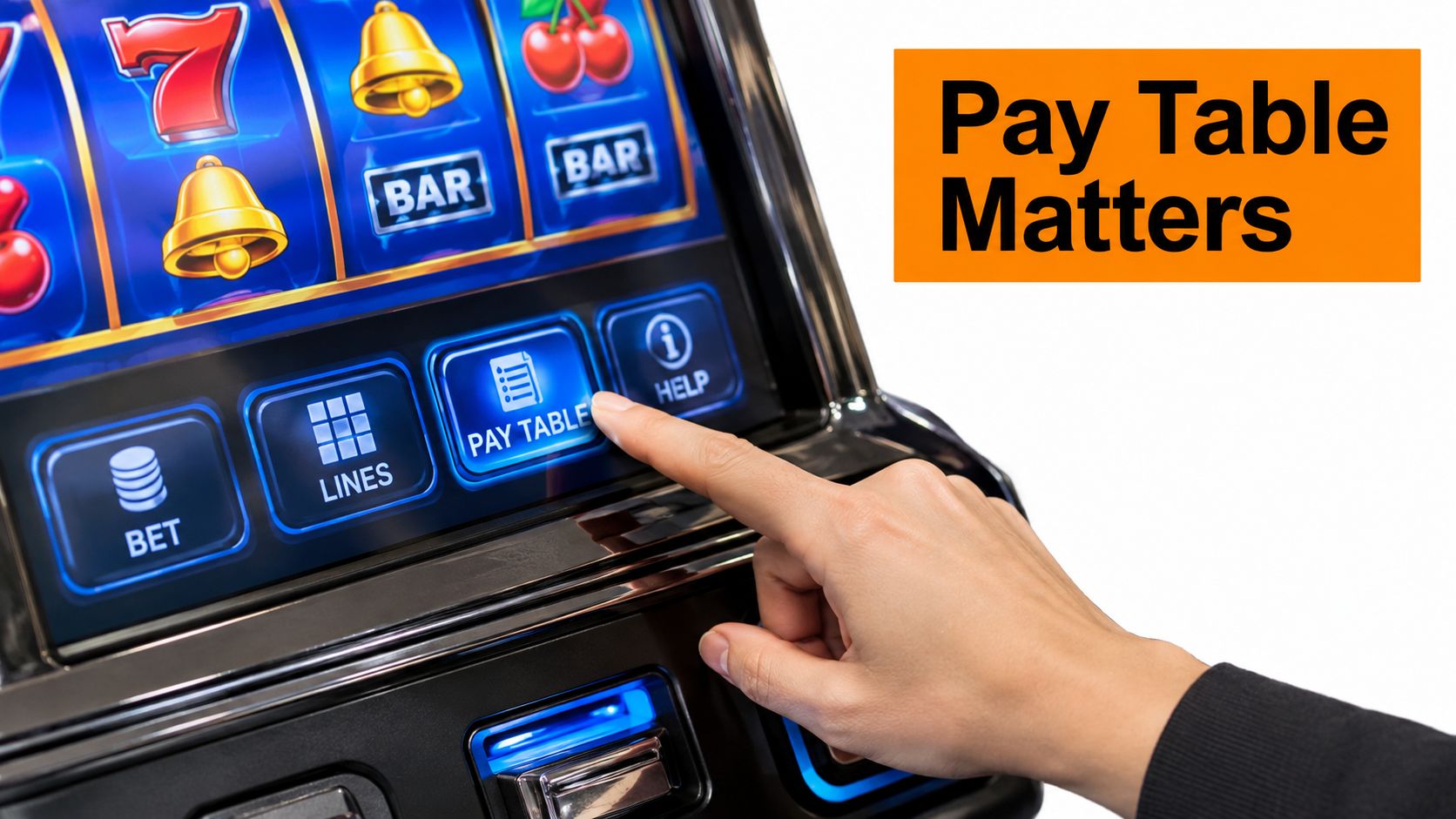
One screen, several responsibilities
The pay table works as a shared reference document. The player reads it before betting, the designer encodes the prize distribution and feature logic in it, and compliance teams use it to document the approved configuration.
- For the player, it explains the rules before a bet is placed.
- For the game designer, it records how awards and features are distributed.
- For compliance teams, it supports checks against the approved game setup.
- For commercial teams, it supplies inputs for bonus valuation and forecasting.
- For support teams, it provides consistent language for payout questions.
The screen sets boundaries on interpretation. It lists possible awards and their conditions, but it cannot predict the next spin or guarantee a session result. Each spin comes from the game's random outcome process and configured mathematics.
Practical rule: If the pay table, game rules, and backend configuration disagree, the player-facing screen is inaccurate.
By the last section, you will be able to verify whether a displayed prize is a credit amount, a stake multiplier, or a line award, then trace which configuration lever moved it. That connection matters to both sides of the screen: player literacy explains what an award means, while operator controls determine how prize values, symbol weights, and jackpot contributions shape RTP and volatility. Nevada's regulatory benchmarks provide a concrete reference for checking that the displayed rules match the approved mathematics.
What a Slot Pay Table Really Is
A slot pay table is a mathematical schedule showing what each eligible symbol combination pays. Reel or virtual-reel weighting shows how often those combinations can occur. Read together, the award values and outcome probabilities determine the game's theoretical return-to-player, or RTP.
A simple three-reel example
Take a basic three-reel slot with cherry, bar, and seven symbols. A simplified pay table might contain these rows:
| Combination | Award |
|---|---|
| Three cherries | 5 credits |
| Three bars | 10 credits |
| Three sevens | 50 credits |
These figures are an illustrative example, not a commercial game specification. The row “three sevens” assigns a value to one particular combination. The reel weighting then determines how frequently that combination can occur.
If sevens occupy fewer weighted positions than cherries, three sevens will generally be less likely than three cherries. Their larger prize compensates for lower frequency within the game's intended mathematical model. Symbol ranking alone therefore says little about return. The pay table pairs award size with outcome probability.
Why the prize list isn't enough
Two slots can show similar symbols and nearly identical prizes while producing different theoretical returns because their reel or virtual-reel weightings differ. The visible pay table is only one part of the calculation.
An operator can leave the reel layout and betting interface unchanged while modifying prize values, symbol frequencies, or jackpot contribution. Each lever can change the theoretical RTP, and changing the distribution between frequent wins, rare wins, bonuses, and jackpots can also affect volatility.
Nevada regulatory benchmarks offer a concrete reference point for operators checking whether displayed awards and approved mathematics align. The screen should match the configured game rules, while the underlying weighting determines how each eligible result contributes to long-run expected return.
For players, the practical question is what a listed award means and what conditions apply. For operators, the deeper question is how much every row contributes to total expected return. A displayed top prize may attract attention, but common awards, feature payouts, and jackpot funding also shape the game's mathematical identity.
The pay table describes the value of an eligible result. It does not promise that the result will appear during a particular session, because each spin is generated by the game's random outcome process.
Symbols, Paylines, and Ways to Win
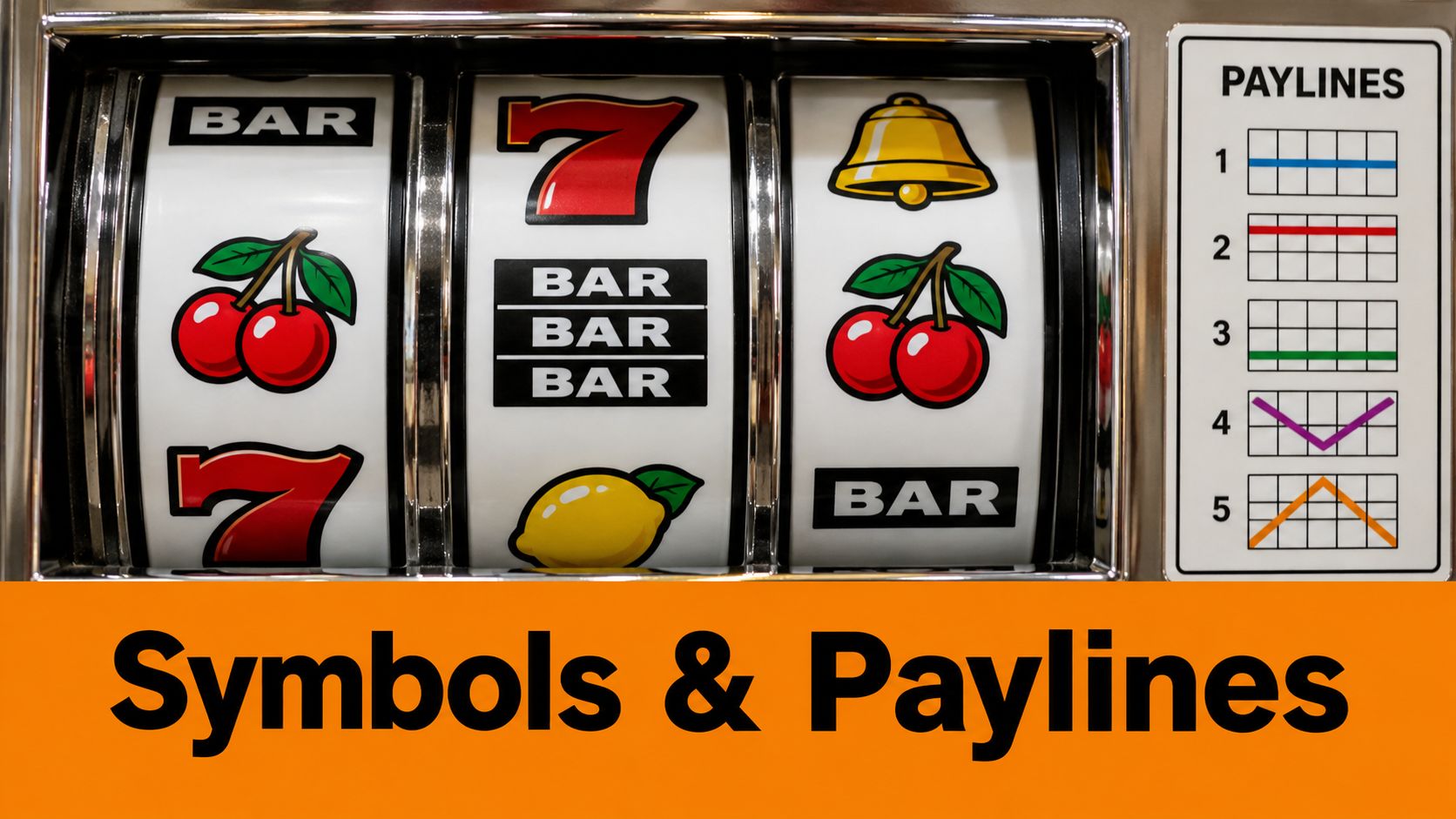
Most pay tables combine several kinds of information. The symbol list identifies ordinary icons and their award levels. The rules then explain how those symbols interact with paylines, ways to win, wilds, scatters, and bonus features.
Low-paying symbols are often familiar card-style icons or simple theme elements. Higher-paying symbols usually carry stronger thematic value and larger awards. Special symbols have a separate function. A wild may substitute for another symbol, while a scatter may pay or trigger a feature without following a standard payline, depending on the game rules.
Classic lines versus modern ways
Consider two common structures:
| Structure | How a win is evaluated | What the pay table must clarify |
|---|---|---|
| Fixed-payline 5x3 slot | Matching symbols land on one of the displayed line patterns | Which lines are active, where matching starts, and how the bet scales |
| Ways-to-win grid | Matching symbols appear in eligible reel positions, often from left to right | How many matching positions are required and how the stake relates to each way |
In a fixed-payline game, the diagram matters. A symbol combination may count only if it lands on a particular zigzag or horizontal pattern. If the game lets players activate lines separately, the number of active lines affects the wager and the set of combinations being evaluated.
A ways-to-win game uses a different mental model. Instead of asking whether symbols occupy one drawn line, the player asks whether matching symbols appear in the required reel positions. Every eligible combination may be live under the game's rules, so the pay table must explain the relationship between the total bet and the available ways.
Features change the reading order
Wilds, scatters, and bonus symbols deserve their own inspection. A wild can substitute for several regular symbols but may not replace a scatter or bonus icon. A scatter might pay wherever it lands, or it might only trigger a feature when a required combination appears. The icon alone doesn't answer that question.
A useful reading order is:
- Identify the ordinary symbol tiers. Compare the required match count and award for each.
- Locate the wild rules. Check substitutions, exclusions, and any special wild behavior.
- Find scatters and bonus triggers. Read the position requirements, not just the displayed prize.
- Confirm the bet relationship. Establish whether values are credits, stake multipliers, or line-specific awards.
The rows with the largest prizes aren't automatically the most important to the player experience. Frequent lower-tier wins, feature triggers, and rare high-value combinations all shape the distribution. Together, they determine what the game can return and how that return is spread across outcomes.
RTP and Volatility From the Same Pay Table
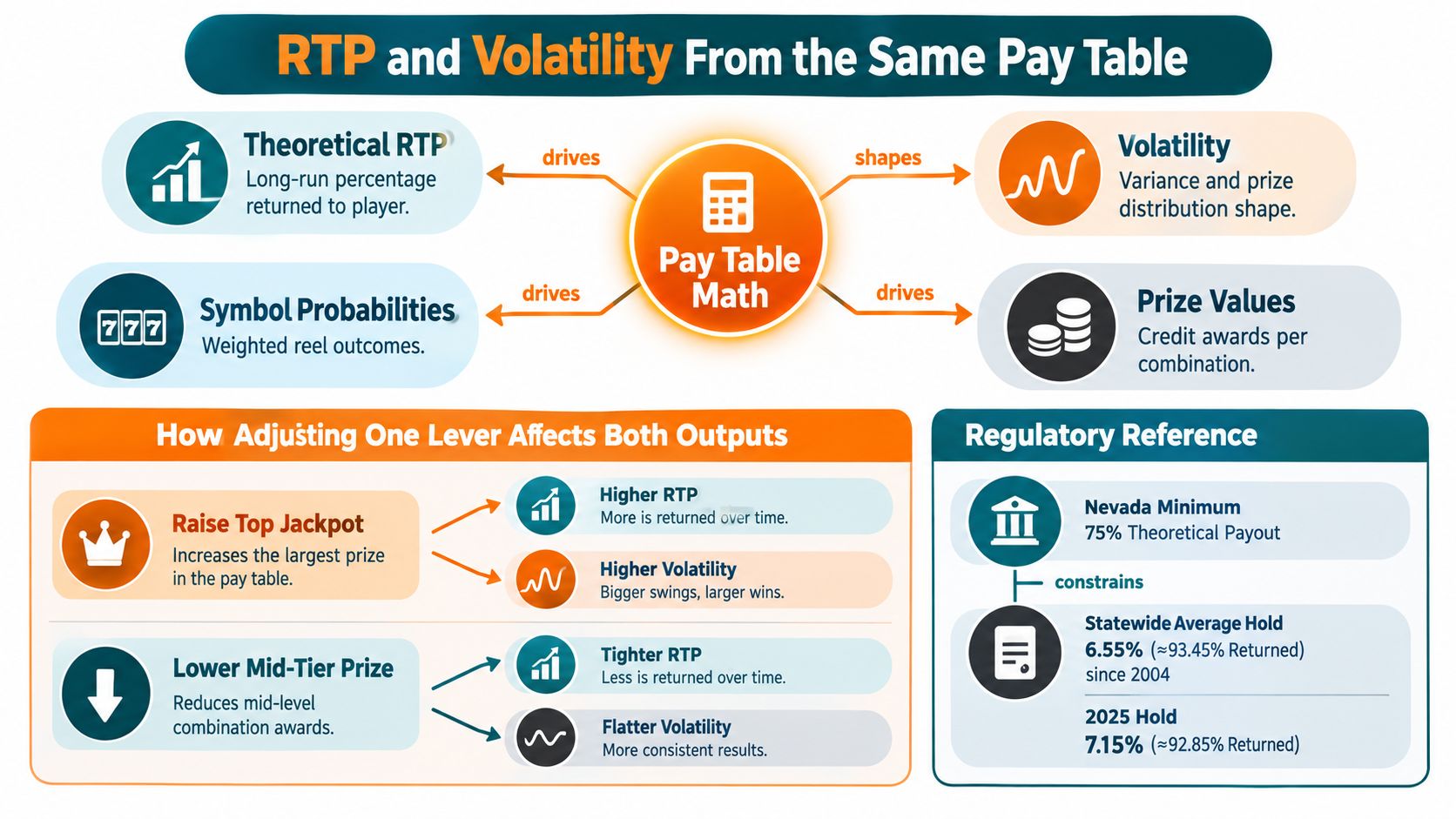
Theoretical RTP is the long-run relationship between wagers and expected awards. Volatility describes how those awards are distributed, including the balance between frequent smaller outcomes and infrequent larger outcomes. They aren't independent settings floating above the pay table. Both emerge from the same combination of prize values, symbol probabilities, feature rules, and jackpot treatment.
How one change affects two outputs
Suppose a game's configuration is otherwise unchanged. If the operator raises the top jackpot prize, the jackpot outcome contributes more to the theoretical return whenever it occurs. That can increase RTP. Because more value is concentrated in a rare outcome, it can also increase variance and make the game's results more uneven.
Now consider lowering a mid-tier prize. That reduces the contribution of that outcome to theoretical RTP. If the mid-tier result occurs more regularly than the top jackpot, reducing its value can also flatten part of the prize distribution. The game may retain its rare headline outcome while delivering less value through the middle of the payout curve.
This is why “high RTP” and “frequent wins” shouldn't be treated as synonyms. A game can allocate substantial theoretical return to rare outcomes, while another can distribute its return across more modest results. The pay table and weighting decide the shape.
The regulatory benchmark
Nevada provides a useful regulatory reference. Regulation 14 requires each gaming device to have a mathematically demonstrable theoretical payout of at least 75% for every wager available on the device. That is a minimum legal threshold, not a typical commercial target. The requirement and the distinction between minimum compliance and product positioning are documented in this Nevada slot regulation and operating data report.
The same source reports that Nevada's statewide average slot hold since 2004 was 6.55%, equivalent to approximately 93.45% returned to players, while the 2025 hold was reported at 7.15%, or approximately 92.85% returned. Hold is the casino's realized win over a defined machine population and period. It isn't the same measurement as the theoretical RTP programmed into an individual game.
| Measurement | What it describes |
|---|---|
| Theoretical RTP | The programmed long-run relationship between wagers and expected awards |
| Hold | Realized casino win across a defined population and period |
| Short-term session result | A limited set of outcomes that can vary substantially from expectation |
Millions of spins generally bring observed performance closer to the programmed expectation, but low-frequency jackpots and other volatile outcomes can create substantial short-term deviations. For operators, that distinction belongs in game documentation, player communication, bonus modelling, and revenue forecasting.
How to Read Any Pay Table in Five Steps
A pay table becomes much easier to interpret when you use the same sequence every time. Don't start with the largest prize. Start with the evaluation rules, because a large award means little if you don't know which combinations qualify.
1. Find the evaluation diagram
Locate the payline map or ways-to-win explanation first. In a 5x3 slot, check whether wins must start on the first reel, whether paylines run left to right, and whether multiple wins can occur on one spin. If the game uses ways, identify the required number of matching reels and how eligible positions are counted.
2. Read the symbol rows from top to bottom
Record the match requirement and award for each ordinary symbol. A row might show awards for three, four, or five matching symbols, but the exact starting point and direction still depend on the game rules.
Compare symbol tiers rather than focusing only on the biggest number. A mid-tier result can have a meaningful role in the overall distribution even if it lacks the visual impact of a jackpot.
3. Separate wild behavior from scatter behavior
Read the wild panel independently. Confirm which symbols it can replace and whether it has restrictions. Then inspect the scatter panel. A scatter may pay anywhere, may trigger free spins, or may do both, but you should rely on the stated rule rather than assuming that all scatters work alike.
4. Check every feature trigger
For a free-spin feature, identify the required symbols, their required positions, and what happens after activation. Look for multipliers, expanding or sticky wilds, bonus picks, and jackpot contributions. These mechanics can account for a meaningful part of the game's theoretical return.
5. Confirm the bet and prize units
Finally, determine whether the displayed award is a credit amount, a bet multiplier, a line award, or a prize that changes with coin value. A player who reads “50” without checking the unit may misunderstand the actual award.
For an operator, this five-step review should be mirrored in quality assurance. The front-end pay table must describe the same configuration used by the game engine, and any bet-level scaling must remain consistent across the interface, wallet settlement, reporting, and support documentation. Teams assessing broader game and platform requirements can also review online casino software development considerations.
Reading habit: Treat every prize as conditional until you've verified the symbol count, position rule, feature state, and bet unit.
Configuring Pay Tables for Game Selection and Bonuses
Operators don't choose a pay table only to make a game look attractive. They configure a product's mathematical identity. Prize values, symbol frequencies, and jackpot contribution can change the theoretical RTP even when the theme, reel artwork, and betting interface remain unchanged.
The same theme can support different products
A low-volatility configuration may spread more value across ordinary and mid-tier outcomes, creating a flatter prize distribution. A high-volatility configuration may place more emphasis on rare features or jackpot outcomes. A middle configuration can balance those patterns. These labels are useful only when they match the actual mathematics and the player-facing description.
The decision can be separated into three questions:
- Prize values: How much does each eligible combination contribute to expected return?
- Symbol frequencies: How often can each combination appear under the reel or virtual-reel weighting?
- Jackpot contribution: How much of the wager or configured return is assigned to a jackpot path?
Changing one lever can affect the others indirectly. Raising a jackpot without reviewing the rest of the distribution may increase theoretical RTP and volatility at the same time. Adjusting symbol frequency can change both the availability of ordinary wins and the frequency of feature triggers.
Why bonuses depend on the published math
Bonus teams need more than a headline RTP value. Free-spin value, wagering contribution, promotional eligibility, and expected campaign cost all depend on the game's configured return and outcome distribution. A bonus that looks identical in the user interface can have a different economic effect across games with different pay-table structures.
That creates a coordination requirement:
| Team | Pay-table question |
|---|---|
| Product | Does the configuration create the intended game profile? |
| Compliance | Does the documented configuration match the approved rules? |
| Marketing | Are RTP, features, and prize descriptions communicated accurately? |
| Finance | Does the forecast account for volatility and jackpot exposure? |
| Operations | Can the platform monitor settlement, reporting, and player queries? |
A white-label or integrated deployment adds another layer. The operator must confirm which party controls the game configuration, how updates are approved, and where the authoritative version is stored. Teams comparing deployment models can use this white-label casino integration overview as a starting point for the platform-side questions.

Operator principle: Don't approve a pay table from a screenshot alone. Approve the prize schedule, weighting, feature logic, displayed rules, and settlement behaviour as one controlled configuration.
Common Misconceptions About Pay Tables and RTP
A player studies a pay table before spinning, while an operator studies the same screen to confirm how prizes, symbols, and features are configured. The table explains the game's mathematical rules. It cannot promise what one short session will return.
A stated RTP isn't a session guarantee
A displayed RTP describes the expected return across a large number of outcomes. It does not guarantee a player's result in one session. A short run can finish well above or below that figure, especially when rare jackpots or other low-frequency awards carry a large share of the theoretical return.
Previous losses do not make a future win more likely. The random process has no memory of earlier spins, so a pay table cannot make a game “due.”
Higher RTP doesn't automatically mean easier wins
Two games can both show 96% RTP and produce very different short-term experiences. One might return much of its theoretical value through a rare 5,000x jackpot. Another might distribute its return through smaller awards, with its largest single win capped at 50x. The RTP is identical, yet the prize distribution, volatility, and likely session rhythm differ.
Operators influence that profile through prize values, symbol weights, feature rules, and jackpot contributions. Players can identify the result of those choices by reading the awards and conditions, rather than treating the RTP label as a description of how often wins will appear.
Hold isn't the same as programmed RTP
As shown in the Nevada comparison above, realized hold, 6.55% as the long-run average since 2004 and 7.15% in 2025, is an aggregate operating statistic, not a game's programmed RTP. Hold reflects results across an operating market, while RTP belongs to the configured mathematics of an individual game.
That distinction prevents a common reporting error. Operators should present theoretical return, possible awards, feature conditions, and random outcomes as separate concepts. A pay table also needs to match the approved configuration, including the weights and contributions that shape its return.
For games with externally verifiable mechanics, provably fair games show how outcome verification can be documented. That verification supports transparency, while the pay table still explains what each outcome pays and which rules govern it.
A Practical Pay Table Checklist for Operators and Players
Players can make a pay table useful with four checks:
- Win structure: Confirm paylines, ways, directions, and required symbol counts.
- Special symbols: Read wild, scatter, and bonus rules separately.
- Prize units: Establish whether values are credits, multipliers, or stake-based awards.
- Feature conditions: Check exactly how free spins, jackpots, and other bonuses activate.
Operators need a parallel control list:
- Mathematical integrity: Recalculate the effect of prize values, symbol weights, and jackpot contributions.
- Configuration control: Keep the approved game engine, pay table, front end, and settlement rules aligned.
- Commercial review: Model bonus economics and revenue exposure against the actual RTP and volatility profile.
- Clear communication: Ensure player-facing descriptions don't imply guarantees or confuse hold with theoretical return.
The strongest pay tables let players understand the product and let operators defend every mathematical choice. As games become more configurable, literacy around those choices becomes part of product quality, compliance, and trust.
NexGrate helps operators launch and manage online casino brands through a turnkey platform covering game content, casino operations, payments, compliance controls, bonuses, and integrations. Review how its unified infrastructure can support accurate game configuration and ongoing operations by visiting NexGrate.