Popular advice treats provably fair games as if the label itself guarantees a fair economic outcome. It doesn't. What it guarantees is narrower, and for operators that difference matters, because a system can be cryptographically honest and still deliver the exact house edge, payout curve, and volatility the math was built to produce.
The practical test is simple. If you can recompute a round from published inputs, the game is provably fair in the cryptographic sense. If you want to know whether the operator's marketing claims about RTP, payout distribution, or edge are true, you need a different set of controls, and those controls are where many platforms get sloppy.
Table of Contents
- What Provably Fair Actually Proves and What It Does Not
- The Cryptographic Workflow Behind Every Provably Fair Round
- Server Seeds, Client Seeds, and Nonces Explained
- Implementation Patterns for iGaming Platforms
- Compliance, Audits, and Regulatory Considerations
- Operational Risks and Trust Gaps Operators Must Address
- Implementation and Verification Checklist for Operators
What Provably Fair Actually Proves and What It Does Not
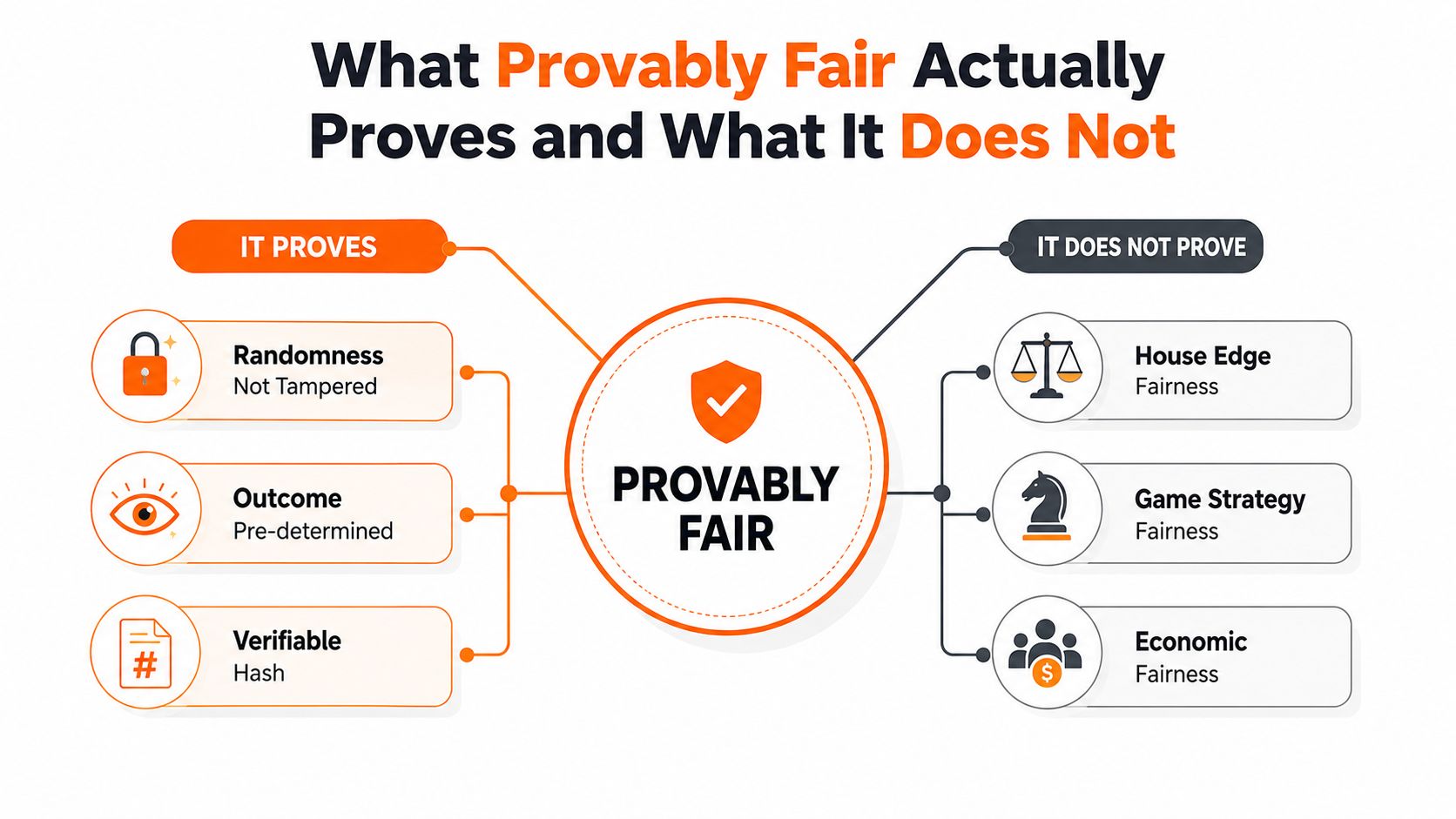
The biggest misconception in this space is that provably fair means economically fair. It doesn't. It means the round outcome can be verified against a published algorithm and a committed seed trail, not that the game pays back what players intuitively expect or what a marketing page promises.
Verifiable randomness is not the same as fairness of economics
A provably fair system proves that a result was generated according to the published algorithm, with the published inputs, and that the operator didn't swap those inputs after seeing the wager. That is a strong technical guarantee. It's not a promise about player value over time.
The clearest way to explain this to a commercial team is to separate mechanical integrity from payout economics. The first is about whether the spin, roll, or crash round can be reproduced. The second is about whether the advertised return profile is accurate.
A crash-style analysis makes the distinction visible. In one published example, a game with a stated 97% RTP showed a 2x cash-out succeeding about 48.5% of the time and a 10x target succeeding only 9.7% of rounds, while the estimated tail exponent landed at α ≈ 1.98, within 2.2% of the theoretical 2.0 value. The math matched the expected heavy-tailed crash behavior, but the advertised 3% house edge still governed the long-run value, which is exactly why operators should avoid implying that provable randomness changes the economic model. (provably fair crash analysis)
Practical rule: market provable randomness as an audit feature, not as a substitute for RTP certification.
What operators should say, and what they should not
If your platform uses provably fair mechanics, the honest claim is that players can verify the round outcome after the fact. The claim you should not make is that the label itself proves the game is generous, balanced, or low edge.
That distinction matters in product, compliance, and affiliate messaging. A white-label operator can have a clean commit-reveal implementation and still fail a trust test if the game math is opaque or if the economic terms are buried.
The best positioning is direct. Say the game is independently verifiable and that its payout structure is documented elsewhere. Keep those promises separate, because players and regulators will separate them whether you do or not.
The Cryptographic Workflow Behind Every Provably Fair Round
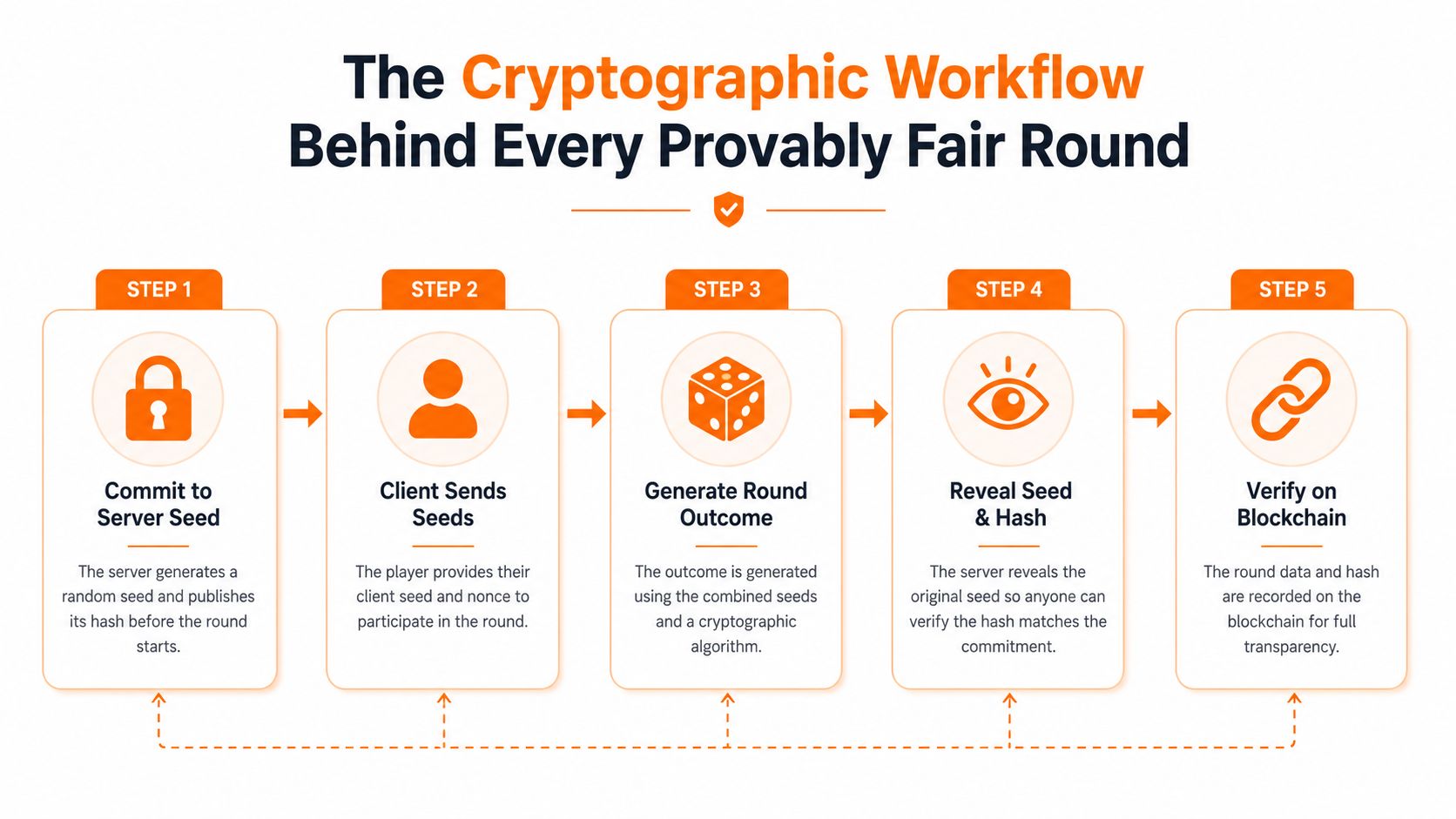
A proper provably fair round starts before the bet is placed. The operator commits to a secret, the player supplies entropy, and the result is generated from inputs that can be checked later without asking anyone to trust the house.
Commit first, reveal later
The operator publishes a hashed server seed before betting closes. That hash is the commitment. Because SHA-256 and SHA-512 are one-way hash functions, the original seed cannot be recovered from the hash, but the revealed seed later has to match the original commitment or verification fails. (commit-reveal workflow)
The ordering is what gives the model value. If the operator could choose a new seed after seeing a bet, the player would have no meaningful protection. By fixing the commitment first, the operator gives the verifier a stable reference point.
A basic dice round follows the same logic. The casino commits to the seed, the player places the bet, the round is resolved, and the server seed is revealed afterward. The player or an auditor can then recompute the exact output locally and check whether the result matches the pre-committed hash.
A verifier is only useful if the pre-commitment happened before the wager was accepted.
Why the workflow is operationally useful
This setup creates an audit trail that is more practical than many teams expect. Every round has inputs, a deterministic output path, and a post-round reveal that can be archived for dispute review. On a live platform, that matters when support, risk, and compliance all need to examine the same incident without arguing over whose record is correct.
The workflow also makes tampering expensive. If anyone changes the server seed after the fact, the revealed seed will not reproduce the original hash. That mismatch is easy to detect and difficult to explain away.
Current implementations use the same core pattern across Dice, Plinko, Keno, Mines, Limbo, Wheel, Crash, and Roulette. The game type changes the math, but not the governance principle. It also does not prove RTP, house edge, or payout fairness on its own, which is where operators still need separate game math disclosure and compliance controls.
Server Seeds, Client Seeds, and Nonces Explained
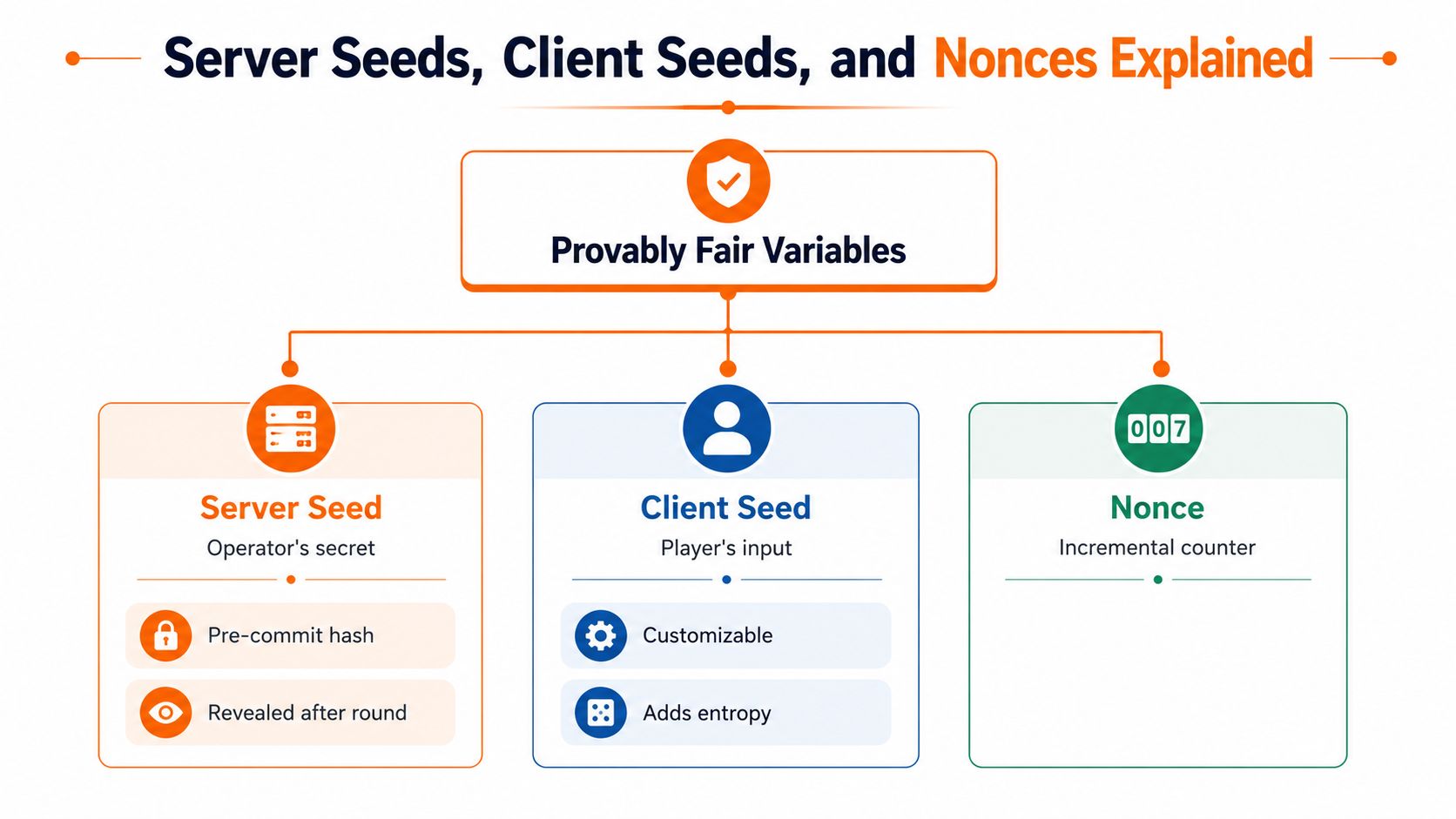
The three-variable model is where provably fair systems stop being abstract and become debuggable. Each variable has a specific role, and if one of them is handled badly, verification degrades fast.
Server seed, client seed, nonce
The server seed is the operator's secret. It stays hidden until the reveal stage, which is why it can anchor a commitment without letting players predict the round in advance.
The client seed is the player-side input. It can be browser-generated or user-customized, and its job is to inject player-controlled entropy so the operator cannot pre-compute a favored outcome. The nonce is the counter that changes with each bet, which prevents identical seed pairs from reproducing the same result over and over.
Industry implementations commonly use HMAC-SHA256 or HMAC-SHA512. That keyed-digest structure matters because the client seed may be public, but the HMAC still preserves integrity when the nonce increments for every round. Providers that expose the exact algorithm and the round inputs make independent reproduction possible, which is the standard operators should expect from serious vendors. (HMAC construction overview)
Why repetition control matters
Without a nonce, repeated play with the same seed pair would create avoidable collisions. That is not just a cosmetic problem, it weakens the confidence of auditors and players who expect each round to be unique.
The nonce also makes support tickets easier to resolve. If a player disputes a round, the operator can reference the exact sequence position rather than arguing about a vague session state. That turns “I think this was wrong” into a reproducible check.
Some crash implementations document 1-seed, 3-seed, and 4-seed variants. The implementation details differ, but the verification idea does not. Commit first, reveal later, then let anyone recompute the same output from public inputs. Operators that want this level of clarity across a broader product stack usually need a platform layer that keeps the verifier logic consistent, such as a unified iGaming platform architecture.
Implementation Patterns for iGaming Platforms
Operators usually choose between three approaches, and the right answer depends on who you're serving and how much control you want to keep. A crypto-native brand, a turnkey white-label casino, and a regulated multi-product platform won't make the same trade-offs.
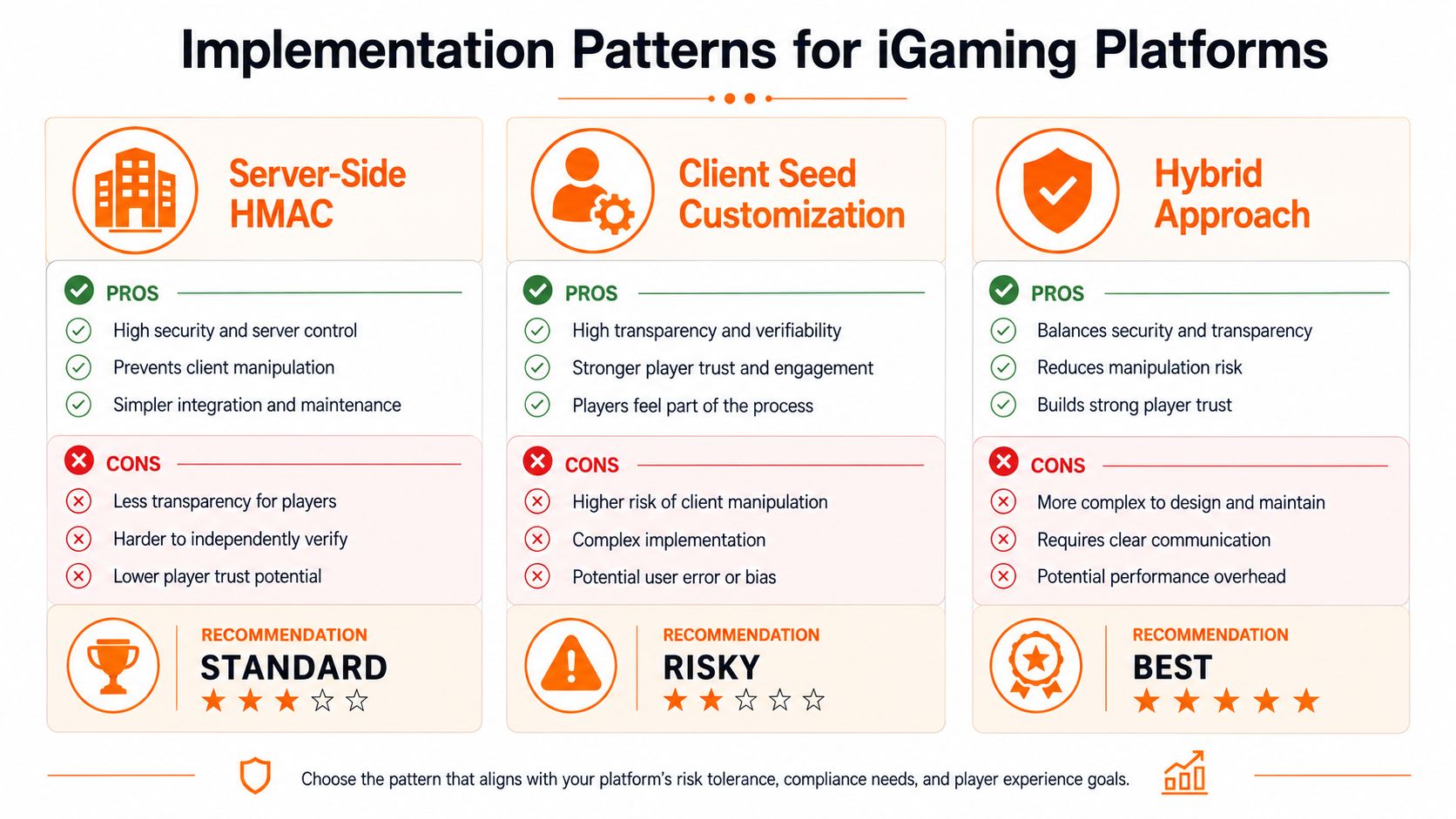
Server-side HMAC, client customization, and on-chain randomness
Server-side HMAC is the default fit for most operators. The provider manages the seed lifecycle, the platform keeps the verifier logic consistent, and the compliance burden stays close to the game engine. It's the least disruptive option for a white-label environment, which is why it tends to be the practical starting point.
Client seed customization gives players a visible sense of control. That can help trust, but it also creates product friction if the interface is clumsy or if support teams can't explain what the seed changes. A poorly designed seed UI can confuse more players than it reassures.
On-chain randomness or blockchain-based verifiable randomness is useful in crypto-native environments, especially where public verifiability is part of the brand. It can also increase infrastructure and integration complexity. If your operator stack isn't already built for that environment, the operational cost is usually higher than teams expect.
How I'd choose in practice
For a turnkey casino, I'd start with server-side HMAC plus a clean verifier and a readable seed history. For a crypto-first brand, I'd consider a hybrid model with player-visible client seeds and stronger public verification artifacts. For a platform that wants to experiment with on-chain proofs, I'd isolate that to the product lines where the audience will care.
A good platform architecture should let you expose provable fairness without fragmenting the rest of the stack. If your back office, wallet, game aggregation, and compliance controls are already unified, the verifier should slot into the same operational model, not become a special-case code path. A practical implementation reference is the NexGrate platform, especially if you need to keep casino, payments, and back-office controls aligned.
Compliance, Audits, and Regulatory Considerations
Provably fair systems are useful in compliance because they create a replayable record. That record doesn't replace regulator-approved testing, but it does give operators a cleaner story when they need to show how a result was produced and why a dispute can be checked after the fact.
The key value is traceability. A seed history, a deterministic algorithm, and a round-by-round output log give compliance teams something they can inspect without reconstructing the game from scratch. That matters when a dispute, an internal review, or an external audit asks for more than a screenshot.
How the audit trail helps
In practice, the strongest implementations make three things easy. They expose the algorithm, they preserve the round history, and they let a support agent or compliance analyst verify the result without relying on engineering to interpret the game state. That's the bridge between cryptography and operations.
Provably fair also fits neatly into existing audit tooling when the platform already keeps strong logs. That includes account activity, wallet movement, and support case history. When those records sit in the same operational environment, the casino can explain not only that a round was generated correctly, but also when it was settled and how it was recorded.
What it still does not cover
Provable fairness does not certify RTP, payout distribution, or house edge. The MIT-based source in the brief makes that gap explicit, and operators should treat it as essential. If the economic model needs certification, the game still needs independent testing and approvals even if the per-round mechanics are fully reproducible. (MIT explainer on the limit of provable fairness)
For teams working inside regulated environments, that separation is healthy. Use provable fairness for reproducibility and dispute handling. Use your formal compliance process for payout economics, reporting, and jurisdiction-specific approval.
A platform like NexGrate compliance tooling fits best when those two layers stay distinct but connected in one operating model.
Operational Risks and Trust Gaps Operators Must Address
The cryptography can be correct and the player experience can still fail. That is the part many explainers skip. In production, trust depends less on the math itself and more on how easily a player can see the proof, use it, and challenge it without friction.
A provably fair feature also does not prove RTP, payout distribution, or house edge. Those are separate controls, and operators still need independent testing and approval for the game economics even when every round can be reproduced. For teams that want a plain-language comparison of those trust layers, see our provably fair comparison guide.
Seed release timing is a governance choice
If the server seed is revealed too late, verification loses urgency. Players may never check it, and support teams will struggle to resolve disputes while the session is still fresh in memory. A delay, or a reveal that sits behind confusing state changes, turns a technical guarantee into a usability problem.
Seed release timing should be a policy, not a vague backend behavior. Operators need a clear rule for when the seed is disclosed, where the history is stored, and how a player moves from a finished session to a checkable result without opening a ticket. If the reveal window is inconsistent across products or brands, the feature may look fair on paper while creating uneven dispute handling in practice.
Verifier usability decides whether transparency is real
A verifier that only engineers can use is a weak verifier. If the player has to decode nonce logic, copy multiple values by hand, and guess which round history entry maps to which result, transparency is mostly a documentation exercise.
If ordinary players cannot verify it, they will assume the feature exists for marketing.
Selective transparency is the other failure mode. Some operators highlight the badge, the hash, or the terminology while keeping the actual verification path awkward to use. That is how a fairness feature becomes a trust prop instead of an operational control.
The standard should be simple. Show the seed architecture, expose a public verifier, publish round-by-round reproducibility, and keep the workflow understandable without internal support. If the process feels like a hidden audit ritual, players will not treat it as evidence. They will treat it as decoration.
White-label operators also have to avoid fragmenting compliance. One brand should not expose one verifier flow, another brand a different seed lifecycle, and a third a different dispute path if the underlying game logic is shared. That kind of inconsistency creates review overhead for compliance teams and makes support harder to train. A single operating model with consistent disclosure rules is easier to govern and easier to explain to players.
Implementation and Verification Checklist for Operators
A usable provably fair rollout needs product, engineering, compliance, and support to agree on the same mechanics. If any of those teams improvises, the feature will look polished on the surface and brittle underneath.
Pre-launch checks
- Document the algorithm clearly. State the hash or HMAC method, the seed fields, and the nonce behavior so players and auditors can reproduce the round.
- Define seed-generation policy. Make sure the server seed is committed before betting and revealed after play, with no manual override path that support staff can abuse.
- Ship the verifier with the game. Put the verification tool where players look for it, not in a buried help page.
Launch-phase checks
- Run test bets end to end. Confirm that the displayed result, the stored round history, and the recomputed output all match.
- Validate hash consistency. Check that the revealed server seed reproduces the original pre-commitment hash every time.
- Test support handoff. Give a live support agent the exact steps needed to resolve a dispute without escalating to engineering.
Ongoing operating checks
- Rotate seeds on schedule. Keep seed lifecycle management routine so the verifier history stays clean and reviewable.
- Maintain audit logs. Preserve round records, reveal events, and verification results in a way compliance can retrieve later.
- Keep the player view simple. Surface the server seed, client seed, nonce, and verification outcome in plain language, not technical jargon.
A platform team should treat this as a release gate, not a nice-to-have. If the system can't be verified quickly, clearly, and repeatedly, it isn't ready for production trust.
If you're building or migrating a gaming brand and want provably fair mechanics to fit inside a broader operating stack, NexGrate can help you connect game content, wallet flows, and compliance controls without bolting on separate systems. Visit NexGrate to see how a unified white-label platform can support a cleaner implementation path.