There is no single global price for a gambling licence. In the United Kingdom, a remote casino operating licence starts at an annual fee of £7,000 when gross gambling yield is below £250,000, and the separate application charge is £463.
Most popular advice still treats that filing charge as the cost of getting licensed. That advice collapses as soon as the product, the market, or the revenue changes. A licence is a recurring, revenue-sensitive compliance budget. The category you need, and the yield you expect, move the bill far more than the number printed on the application form.
Price the activity you will run, in the market you will serve, against a first-year yield you would defend to a finance lead. The schedules below show why those three choices rewrite the total.
Table of Contents
- Why a Gambling Licence Has No Single Price
- Which Licence You Need Decides the Fee
- UK Licence Fees by Gross Gambling Yield Band
- One-Off and Ongoing Costs Beyond the Licence Fee
- How Jurisdiction Changes the Cost Structure
- Build Your First-Year Licence Budget
Why a Gambling Licence Has No Single Price
Regulators do not sell one permit at one shop price. They price the activity, the jurisdiction, and the size of the business. A brand that contracts with players is not, in fee terms, the same thing as a studio that never holds a stake.
Treat the annual charge like a utility tariff, not a price tag. Two households can take the same type of connection and still get different bills, because the bill tracks use. A small remote operator and a large one can hold the same class of authorisation and still sit in different bands, because the regulator is charging for scale.
Keep two payments on separate lines.
One-off application charge. You pay this to open the file. It is spent during assessment. It does not buy the following year.
Recurring annual fee. This continues after launch for as long as you hold the authorisation. It is the line that rises when the business rises.
The published fee is still only one line of a launch budget. Compliance systems, testing, legal work, responsible-gambling controls, and tax sit beside it. None of those vanish because year one's regulatory invoice looks modest.
Practical rule: Lock three facts before you open a fee table. The licence category, the target market, and a first-year revenue figure a finance lead would sign.
Those three facts pick the schedule. Everything after that is arithmetic on top of the schedule, not a substitute for it.
Which Licence You Need Decides the Fee
Asking which licence you need beats asking how much does a gambling licence cost. Fee roundups blur casino, sportsbook, software, intermediary, and supplier permits. Regulators do not.
Answer five questions before you compare prices.
- Who contracts with the player? If your brand takes the bet, you are the operator.
- Who holds player funds? Custody pulls you into a heavier control set than pure technology supply.
- Do you supply software or operate gambling? A studio and a consumer brand are not interchangeable authorisations.
- Which products are offered? Casino, real-event betting, and an exchange map to different schedules.
- Where do customers sit? Permission in one country does not open another.
The UK Gambling Commission remote general betting schedule already splits the lowest annual fees. A remote betting intermediary's lowest annual fee is £5,562. A remote real-events betting licence starts at £5,937. A non-remote gambling software licence starts at £1,094 a year.
| Licence type | Lowest annual fee (GBP) | Typical business role |
|---|---|---|
| Remote casino operating licence | £7,000 | Runs a consumer casino and holds the player relationship |
| Remote real-events betting licence | £5,937 | Accepts bets directly from customers |
| Remote betting intermediary | £5,562 | Arranges bets for other operators |
| Non-remote gambling software licence | £1,094 | Supplies gambling software without direct play |
The cheapest row is often the wrong commercial tool. A software licence does not let you run a consumer casino or take bets in your own name. A permit can authorise an activity and still not allow advertising, payment processing, or player access in every country you want. Local technical standards, tax, data rules, and market-access limits can cost more than the fee.
White-label brands hit the same fork. If a platform holds a licence, check whether that authorisation covers your brand's activity. If it does not, the brand owner remains the licensed operator. Our casino and sportsbook stack can sit under either model, but the legal holder of the player contract still has to match the permit. The activity test in our note on a sports betting licence is the check to run before you assume a supplier permit will carry a consumer brand.
Static cost articles age badly. Fees get revised, and revenue bands multiply the charge as you scale. Price the category you will trade.
UK Licence Fees by Gross Gambling Yield Band
Gross gambling yield is the money a business keeps from player stakes after paying out winnings. That is the measure used to place a remote casino operator in a band.
The chart below sets out annual remote casino operating licence fees by yield band.
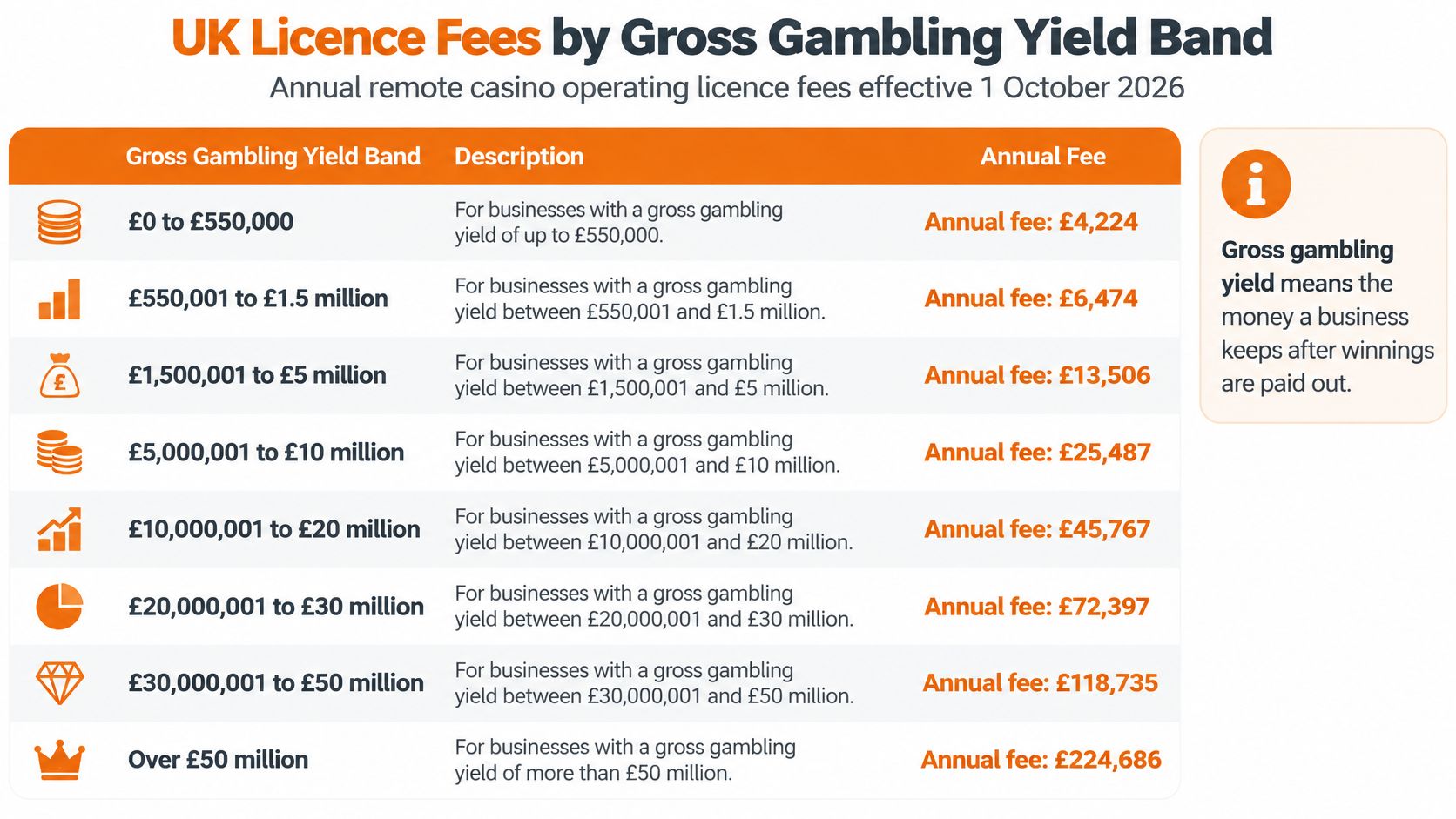
Under the Gambling Commission remote casino operating licence schedule effective 1 October 2026, the annual fees are these.
| Annual gross gambling yield band | Annual licence fee (GBP) |
|---|---|
| Below £250,000 | £7,000 |
| £250,000 to below £875,000 | £12,375 |
| £875,000 to below £3 million | £19,569 |
| £3 million to below £10.5 million | £27,337 |
| £10.5 million to below £36.75 million | Not stated in the cited bands |
| £36.75 million to below £130 million | £112,556 |
| £130 million to below £455 million | £394,875 |
| £455 million to below £1.6 billion | £1,181,625 |
| £1.6 billion or more | £1,453,949 plus £272,324 for every complete additional £200 million |
Where new brands usually land
Most first brands sit in the lower bands. Below £250,000 the annual fee is £7,000. From £250,000 to below £875,000 it is £12,375. From £875,000 to below £3 million it is £19,569. From £3 million to below £10.5 million it is £27,337. Crossing each threshold replaces the previous fee. It does not add a small surcharge on top.
What scale does to the same permit
Larger operators pay on a different slope. From £36.75 million to below £130 million the fee is £112,556. From £130 million to below £455 million it is £394,875. From £455 million to below £1.6 billion it is £1,181,625. At £1.6 billion or more it is £1,453,949, plus £272,324 for every complete additional £200 million of yield. Same licence type. A different size of business.
The gap you should not guess
Between £10.5 million and £36.75 million, the bands cited here do not state a figure. Do not interpolate a midpoint. Open the live Commission schedule and read that row before you lock a model. A missing cell is a research gap, not a discount.
Stress-test the boundary
Say one forecast sits at £240,000. That operator pays £7,000. Move the same forecast to £260,000 and the fee becomes £12,375. The extra £20,000 of yield is not what causes the jump. Crossing the published threshold is. If your base case sits near a line, run the conservative case and the optimistic case on either side of it.
These figures are recurring regulatory fees, not the full cost of market entry. Application charges, compliance systems, testing, responsible-gambling controls, legal work, and tax sit outside the band.
Three steps finish the lookup. Estimate yield on a basis you can explain. Find the band. Use that fee as the annual baseline, then add every cost the invoice leaves out.
One-Off and Ongoing Costs Beyond the Licence Fee
The licence invoice is the visible line. The launch budget is the stack around it. Split that stack by when the cash leaves, because a one-off cost and a permanent cost do not belong in the same mental bucket.
Paid once, during application
Legal structuring. Counsel drafts the application, the corporate chart, and the policies the regulator will read. Scope the quote to the activities you named, not to a generic pack.
Technical testing. Games, the platform, and the random-number or betting engine need certification against the standards of that market. A failed test resets the clock and the lab invoice.
Control build. KYC, AML, and responsible-gambling tools have to exist before you take a player, not after the first complaint. Initial configuration, rule sets, and staff training all land in this bucket.
The regulator's own application charge belongs here too. It opens the file. It does not maintain the licence.
Paid every year, after you are live
The annual regulatory fee. This is the banded charge from the schedule that matches your category. It renews whether or not you had a quiet year.
Audits and reporting. Examinations, regulatory returns, and the people who prepare them continue for the life of the permit. Our note on compliance reporting sets out the return cycle operators run.
People and tooling. A compliance officer, or an outsourced function, personal licences for staff who must hold them, AML and fraud tooling, and updates when standards change. None of these stop at go-live.
Paid in proportion to volume
Banking and payment due diligence. Providers re-check the licence, the ownership, and the flow of funds. Per-transaction charges rise with deposits and withdrawals.
Local gambling tax. This follows the market, not the licence fee. A low annual fee beside a high tax rate is still an expensive market.
More players, more checks. Growth adds KYC volume, more suspicious-activity reviews, and thicker reporting packs. The compliance bill tracks the customer base even when you stay inside the same fee band for a while.
Over five years, the repeating lines usually outweigh the filing costs. A modest application can sit on top of a heavy annual machine.
Many of these figures come from labs, lawyers, and payment firms, not from a public tariff. Ask for written quotes and compare scope. A cheap quote that excludes certification or personal licences is not a saving.
How Jurisdiction Changes the Cost Structure
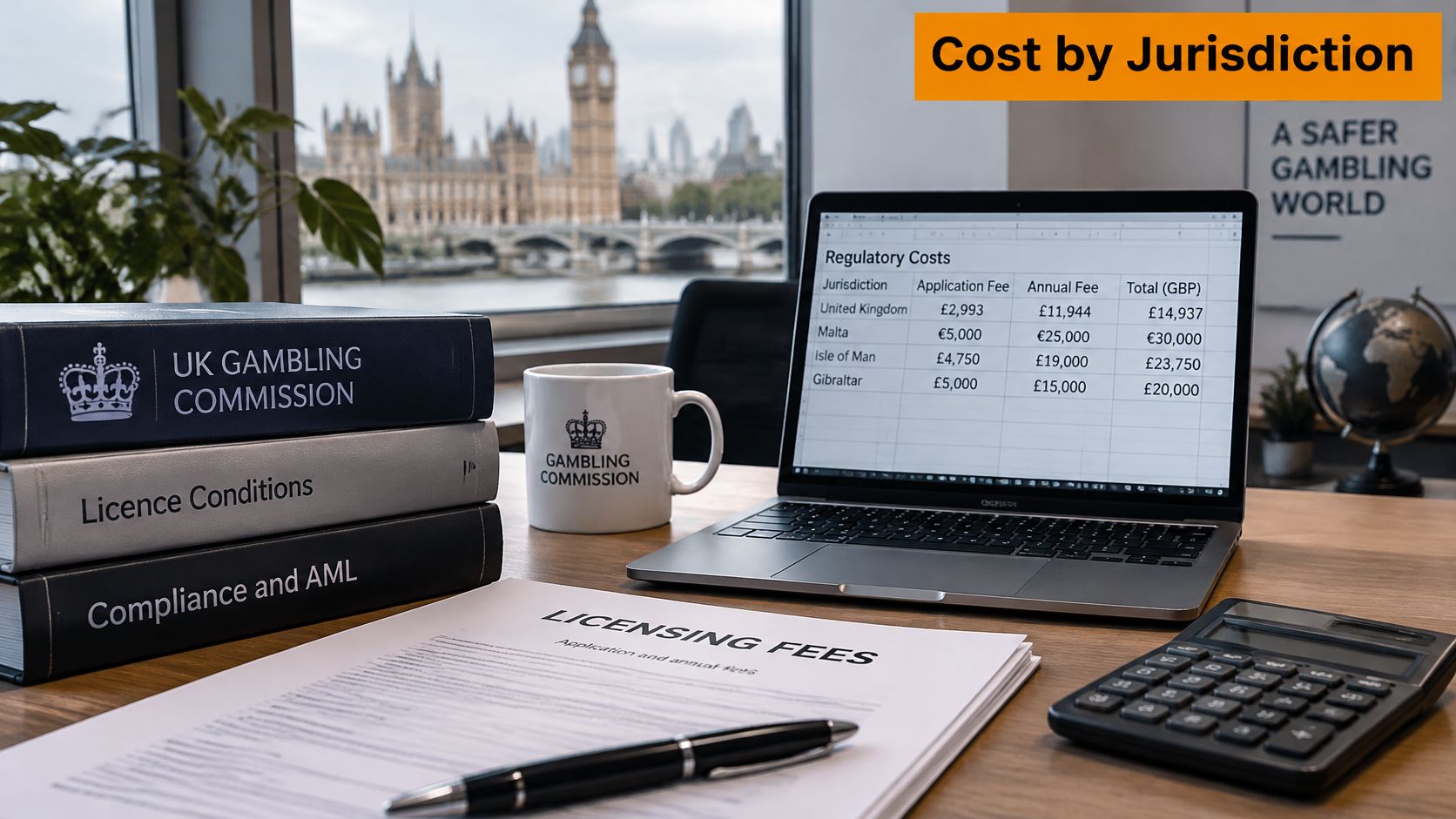
A licence's headline fee can obscure the larger budget question: how the regulator calculates ongoing charges. The UK links the annual fee to gross gambling yield (GGY), while Malta sets fees by licence type and regulated activity. Those models can produce very different costs for the same operator.
What Malta actually separates
The Malta Gaming Authority fee guidance describes two regulatory payments: a one-time, non-refundable application fee and an annual licence fee. The annual fee is payable before the licence is issued and recurs through the licence period. Budget for both.
The amount depends on licence type and regulated activity. Gaming services, controlled skill games, and business-to-business supply functions do not share one fee. Compliance, technical certification, audits, and corporate or local-presence duties may add costs. The cited guidance does not provide a GGY-banded table comparable to the UK casino schedule, so a Malta estimate needs to match the relevant licence and activity rather than rely on a UK-style revenue band.
Compare fee structures, not just application charges
The available comparison supports distinct fee models for the UK and Malta, but not a like-for-like price table across every regulator. Use each regulator's current schedule to establish the fees for the intended activity and application year.
| Regulator | Application charge | Annual fee basis | Scales with revenue |
|---|---|---|---|
| UK Gambling Commission (remote casino) | Separate published application charge | Gross gambling yield band | Yes |
| Malta Gaming Authority | One-time, non-refundable | Licence type and regulated activity | No yield band in the cited guidance |
A UK budget changes as GGY moves between fee bands. A Malta budget depends on the licence type and activities covered. For a brand offering both casino and sportsbook products, confirm how the regulator classifies each activity before estimating fees. The same brand may face different requirements across jurisdictions.
Market access costs sit outside those fee models. US and UK gambling ad rules show why authorisation to offer gambling does not, by itself, determine where or how a business may advertise.
Keep the jurisdiction comparison focused on its fee structure and market-specific obligations. A turnkey platform can reduce technology and integration work, but it does not replace the operator's licence payments or continuing regulatory duties. NexGrate provides a turnkey white-label casino and sportsbook platform, with payments and compliance among its product areas.
Build Your First-Year Licence Budget
The first-year total is the annual fee, plus the one-off charge, plus compliance spend. The UK Gambling Commission cost guide is explicit that a single application fee is not that total. In Great Britain, a remote casino operator in the lowest revenue band pays a £7,000 annual fee, while a remote real-events betting operator in the lowest band pays £5,937. The same guide lists a separate £463 application cost. Annual casino charges rise sharply with revenue, reaching £1,181,625 in the £455 million to £1.6 billion band. Those figures exclude the wider compliance and market-entry workload.
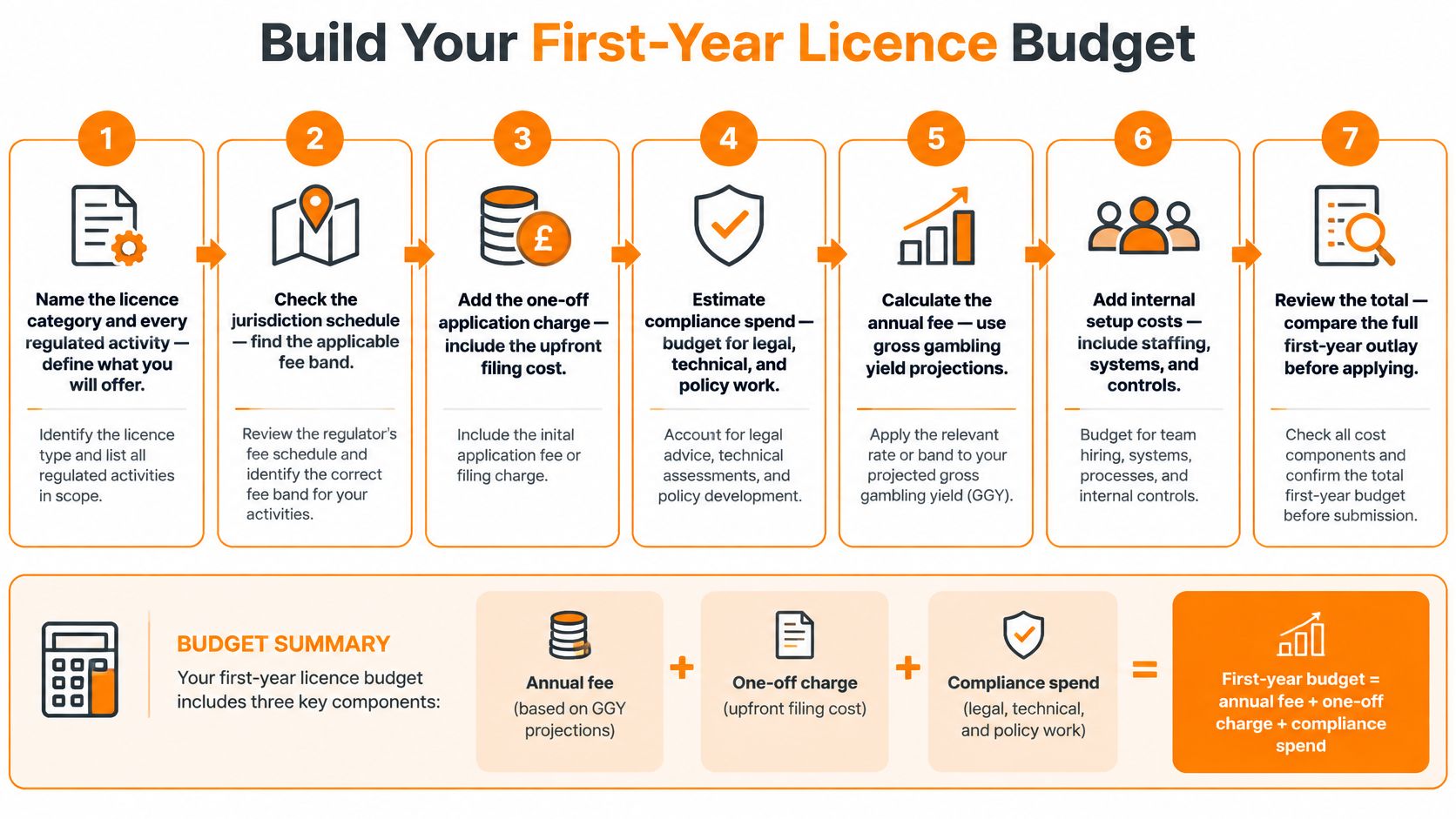
Seven steps, in order
- Name every activity. Casino, real-event betting, and software supply can each need their own licence. Write the list before you look up a fee.
- Forecast year-one yield twice. Build a conservative case and an optimistic case. The band follows the forecast, so a single point estimate hides the fee risk.
- Read the live schedule. Take the annual fee for each case from the regulator's current bands, not from a saved screenshot.
- Add the filing charge. For a UK application, that published cost is £463. It is separate from the annual fee.
- Price the build from quotes. Testing, legal advice, AML and KYC implementation, responsible-gambling controls, audits, and personal licences for key people. If a quote excludes one of these, add it back.
- Add tax and payments per market. Local gambling tax and payment due diligence follow the countries where players sit. They are not a share of the UK fee.
- Hold a timing contingency. An application that runs past plan still burns legal and compliance cost. Cost-saving insights from Action Accountants are a useful way to separate costs you can trim from regulatory costs you cannot.
Three worked cases
Low-volume UK remote casino. Projected yield of £240,000 sits in the lowest casino band, so the annual fee is £7,000. Add the £463 application cost and the regulatory cash before compliance spend is £7,463. Testing, legal work, controls, and tax come on top. This is a floor, not a launch budget.
Casino plus real-events betting. At the lowest band for each, the annual fees are £7,000 and £5,937, which is £12,937 before application charges and before compliance spend. If the casino forecast leaves the lowest band, replace the casino line. Do not keep the starter fee out of habit. Each activity keeps its own renewal.
A second jurisdiction. Repeat the lookup, the filing charge, the tax line, and the compliance quotes for that market. Do not copy the UK total and apply a percentage. Malta, for example, follows type and activity, and other regulators must be read from their own schedules.
Who actually holds the licence
For a white-label brand, ask whether the platform provider's licence covers your activity or whether you remain the licensed operator. We supply the casino, sportsbook API, payments, and compliance tooling that an operator runs day to day. That stack does not stand in for your authorisation. If you are still choosing the corporate path into a brand, our guide on how to open a casino sits next to this budget, not instead of it.
The annual fee is the floor. Compliance spend is the variable that decides whether year one is fundable.
Treat the licence as a recurring, revenue-sensitive cost. Re-forecast yield before each renewal, because a quiet application year and a busy trading year are not the same bill.
NexGrate gives operators a turnkey white-label casino and sportsbook, with payments and compliance controls in one stack, so the technology line of a launch is not a custom build. The licence, the annual fee, and the market's tax remain yours to budget. If you are pricing a first brand or a second jurisdiction, visit NexGrate and map the platform against the permit you need.