You've probably already sketched the exciting parts of the launch. Brand name. Domain. Sportsbook front end. Payment options. Maybe even affiliate plans and a launch market shortlist.
Then the main obstacle shows up. Not odds feeds or UI design. The sports betting license.
That's the point where many first-time operators realize they're not building a media brand with a checkout page. They're building a regulated financial product that takes wagers, holds player funds, settles liabilities, and reports to authorities that can block a launch long before the first bet is placed. The good news is that the path is manageable once you stop treating licensing as paperwork and start treating it as operating design.
Table of Contents
- The Billion Dollar Gatekeeper Your Sportsbook Must Pass
- Understanding the Core Function of a Betting License
- Comparing Key Licensing Jurisdictions
- The Licensing Application Process Demystified
- Beyond Launch Day Ongoing Compliance and Risks
- How a White-Label Platform Accelerates Licensing
- Your Sports Betting License Checklist
The Billion Dollar Gatekeeper Your Sportsbook Must Pass
A new operator usually reaches the same moment. The site mockups are ready, a betting brand is taking shape, and someone asks the question that decides whether the project is real or just expensive draft work: who is licensed to offer the bets?
That question matters because the legal market is large, protected, and unavailable to unlicensed businesses. The global sports betting market was valued at USD 100.91 billion in 2024 and is estimated to reach USD 111.20 billion by 2025, according to Grand View Research's sports betting market analysis. If you're outside the licensing framework, you're outside that revenue stream.
The mistake I see most often is treating the sports betting license like a final approval step. It isn't. It shapes almost every early decision: company structure, banking, technical stack, data hosting, reporting design, wallet controls, KYC flow, responsible gambling tooling, and even who your suppliers can be.
Practical rule: If your licensing plan comes after your platform build, you're usually rebuilding.
There's also a financial reality that founders underestimate. A regulated sportsbook doesn't just need a brand and trading capability. It needs evidence. Regulators want to know who owns the company, who controls player money, how bets are accepted and settled, where data lives, how incidents are logged, and what happens when a player requests a limit or self-exclusion.
That's why the licensing process feels heavy to newcomers. The regulator isn't buying your pitch deck. The regulator is testing whether your business can safely operate under pressure.
For serious operators, the useful mental shift is simple. Stop asking, “How do I get a sports betting license quickly?” Start asking, “What operating model will survive licensing review and ongoing audits?” That question leads to better jurisdiction choices, better vendors, and fewer dead ends.
Understanding the Core Function of a Betting License
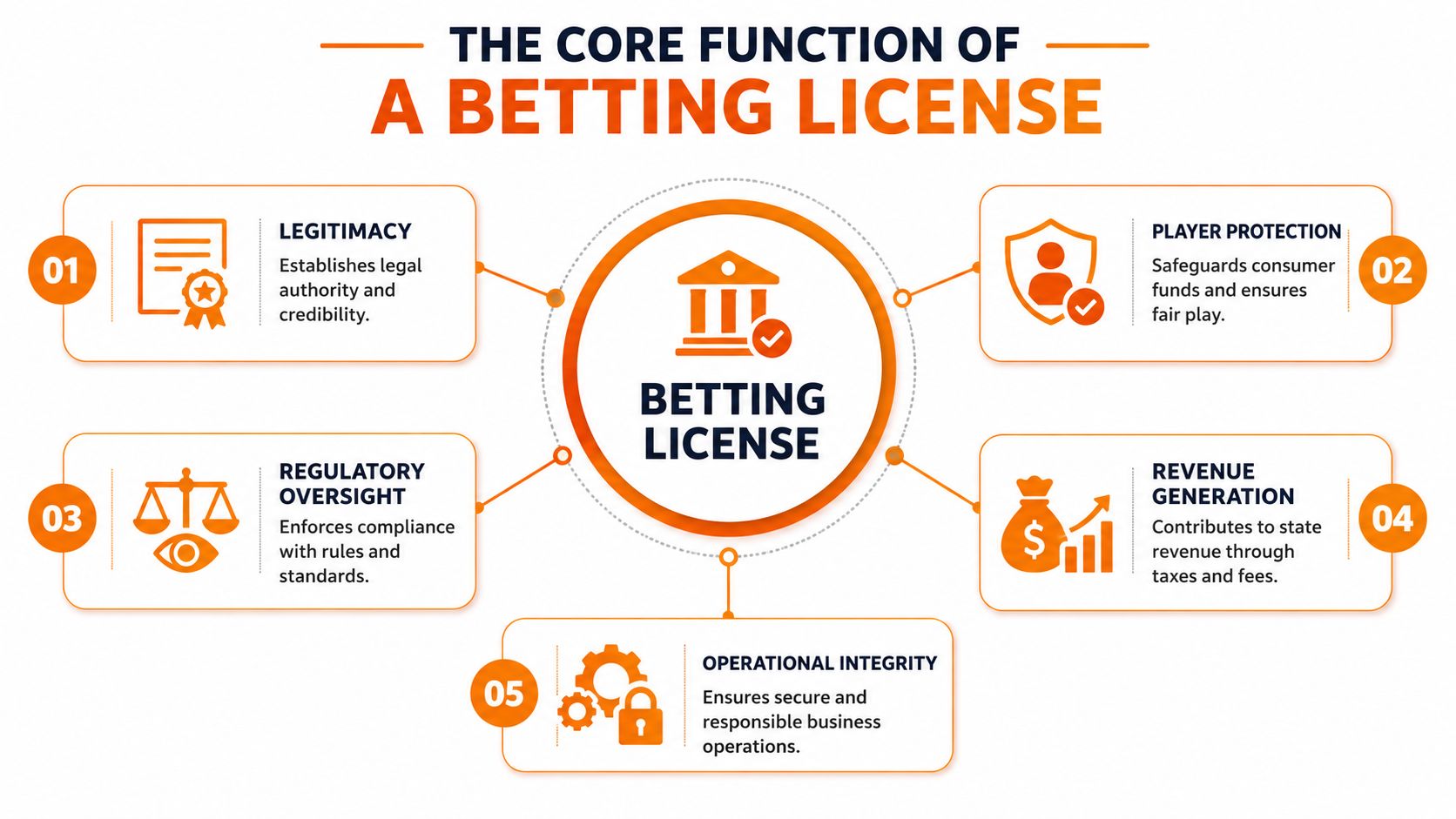
A betting license is the business equivalent of a professional charter. It tells the market that the company has authority to operate, accepts regulatory supervision, and can meet specific conduct standards. Without that approval, your sportsbook may still exist technically, but it doesn't exist legally where regulation applies.
What the license actually authorizes
The practical function of a sports betting license is broader than “permission to take bets.” It usually authorizes a controlled package of activities:
- Accepting wagers from approved users: Not every player in every location is eligible. The license defines where and to whom you can offer services.
- Holding player balances: This is why wallet controls and fund handling matter so much.
- Settling outcomes according to approved rules: The regulator expects auditable logic, not informal operator discretion.
- Using approved systems and vendors: A sportsbook is an ecosystem, and the license often reaches into that ecosystem.
That last point catches people off guard. Operators think they're applying as a company. Regulators often assess the company, its owners, its platform, its controls, and the vendors embedded in the product.
The four pillars regulators care about
Most licensing frameworks are built around the same core concerns, even when the details differ.
- Player protection: Regulators want clear separation between player interests and operator convenience. That means secure handling of funds, complaint processes, privacy controls, and reliable account management.
- Fair gaming: The sportsbook must produce results that can be reviewed. Odds management, event settlement, and software integrity need to be testable.
- Responsible gambling: This usually means practical controls, not policy language alone. Deposit limits, self-exclusion, timeout features, and visible safer gambling workflows matter.
- Anti-crime controls: KYC, AML monitoring, suspicious activity review, and payment scrutiny are standard parts of a regulated operation.
A license doesn't exist to make your launch harder. It exists to make your operating discipline visible.
Operators who understand this tend to prepare better applications. Operators who don't usually fill a data room with corporate documents and still fail because the product logic, reporting design, or control environment is weak.
A useful way to assess your readiness is to ask four blunt questions:
- Can you identify who the player is?
- Can you explain where the money is at every point in the transaction flow?
- Can you prove how a bet was accepted and settled?
- Can you show what happens when a player needs protection?
If the answer to any of those is vague, your licensing problem isn't paperwork. It's operations.
Comparing Key Licensing Jurisdictions
A founder approves the product build, signs the platform deal, and starts planning launch dates. Then the licensing question lands. The target market wants one standard, the payment provider prefers another, and the platform stack was built around a third. That is usually the point where jurisdiction choice stops being a legal formality and becomes an operating decision.
There is no single best sports betting license. There is only the jurisdiction that fits your player geography, banking access, risk model, tax exposure, and internal ability to run compliance properly.
Malta for structured international operations
Malta remains a common base for operators that want a recognized framework for international sportsbook activity. For fixed-odds betting, the licence type matters. If the operator carries the betting risk, the structure generally points to a B2C Gaming Service Licence with Type 2 approval, as explained in this guide to starting a sportsbook in Malta.
That classification has practical consequences. It affects how you document bet acceptance, how settlement rules are controlled, how reporting is produced, and how the regulator will assess your sportsbook logic. Operators that begin with a casino-led setup often underestimate that gap and end up reworking controls later.
Malta usually suits teams that want a stable base for cross-border operations and can support formal governance from day one. The trade-off is cost, preparation time, and a higher standard of documentation across product, ownership, and control functions.
Germany for tightly controlled local market access
Germany is a different proposition. It is a market-entry decision, not a broad international base.
The operational burden is heavier, and the margin for improvisation is small. Hosting choices, reporting design, player control settings, and technical oversight need to line up with local expectations. If your stack depends on loose vendor arrangements or unclear operational ownership, Germany tends to expose those weaknesses quickly.
This matters for budget planning. A jurisdiction with stricter local controls often increases legal review, technical remediation, certification work, and internal compliance staffing before launch.
Curacao for speed, with limits
Curacao is often considered by operators that need a faster route to market or a lower-cost starting point. That can make sense for some offshore models, early-stage rollouts, or transitional structures.
The trade-off is market acceptance. A licence that gets you live faster does not automatically satisfy payment providers, acquiring banks, media partners, or future expansion goals. I regularly see operators save time at the front end, then spend more time later restructuring because their original licence no longer fits the markets they want to enter.
Jurisdiction comparison at a glance
| Jurisdiction | Est. Cost (Year 1) | Est. Timeline | Global Reach | Compliance Burden |
|---|---|---|---|---|
| Malta | Higher than entry-level options | Moderate to lengthy | Strong for international-facing operations | High and structured |
| Curacao | More accessible than top-tier frameworks | Typically faster than stricter regimes | Useful for some offshore or transitional models | Lower at entry, but depends on target markets |
| Germany | Market-specific and operationally demanding | Can be lengthy due to technical scrutiny | Primarily relevant for Germany | Very high |
A practical selection test comes down to three questions:
- Where do you plan to acquire players? A licence should match the revenue plan, not the pitch deck.
- Which banks, PSPs, and affiliates need to be comfortable with your structure? A cheaper licence can become expensive if partners reject it.
- Are you licensing as a direct B2C operator, or relying on a third-party setup to enter faster? That choice changes timeline, documentation, and control ownership.
The third question is where many new operators get confused. A B2C operator licence covers the entity taking bets from players. A B2B supplier licence can apply to the company providing the platform, PAM, trading tools, or other regulated services behind the scenes. Those are different regulatory roles, and regulators do not treat them as interchangeable.
That distinction becomes especially important in white-label models. In a white-label setup, the platform provider may already hold the supplier-side approvals, while the operating structure, brand control, and market permissions sit with the licensed operator entity. Used properly, that can reduce build time and compress market entry. Used poorly, it creates false assumptions about who owns compliance duties, who controls player funds, and who answers to the regulator when something goes wrong.
If you are comparing jurisdictions against your rollout plan, this market entry planning resource for regulated betting markets is a useful starting point.
Pick the jurisdiction that your operating model can support. The cheapest route, the fastest route, and the most respected route are often three different choices.
The Licensing Application Process Demystified
A licensing file usually starts to go wrong before the first form is submitted. The common pattern is familiar. The brand has chosen a market, picked a platform, signed a few vendors, and only then asks whether the legal entity, control framework, and regulatory role allocation fit together.
That last point causes avoidable delays. A regulator does not review a sportsbook brand in isolation. It reviews the licensed entity taking bets, the people controlling it, the systems supporting it, and any third parties performing regulated functions. If you are entering under a white-label structure, the application work changes materially. The platform provider may already cover part of the B2B supplier side, but the B2C operator responsibilities still need to be documented clearly so the regulator can see who owns player protection, funds handling, reporting, and incident response.
Preparation before you file anything
Strong applications are built in the operating model first and written down second.
Before filing, get five areas into one consistent story:
- Corporate structure: Identify the applicant entity, beneficial owners, directors, key persons, and who ultimately controls strategic decisions.
- Regulatory role split: Confirm what sits with the B2C operator and what sits with licensed or approved B2B suppliers, including platform, PAM, trading, payments, and support functions.
- Target market scope: Define where players will be accepted, where the company is based, and whether any local restrictions affect hosting, payments, or marketing.
- Technical setup: Document the platform, integrations, hosting model, security controls, audit logging, and business continuity arrangements.
- Control framework: Show how KYC, AML, safer gambling, complaints, fraud monitoring, and regulatory reporting will work in daily operations.
This stage is where commercial shortcuts usually become expensive. If the applicant says it controls a function that a third party performs, reviewers will ask for the contract, the oversight process, and the escalation path. If the supplier holds a relevant approval, that helps. It does not remove the operator's duty to prove control over the customer-facing outcome.
Infrastructure decisions also matter early. Some jurisdictions are particular about data handling, encryption standards, and where regulated data is stored or accessed. If your platform cannot support those conditions, the problem appears during review and remediation costs more than fixing the architecture before filing. A practical iGaming compliance setup for licensing and operations saves time because it forces these dependencies into the open before the regulator does.
Once the model is settled, the paperwork is usually predictable. Expect to provide constitutional documents, ownership disclosures, source-of-funds material, personal probity records for key individuals, policy documents, financial projections, vendor agreements, and technical descriptions of the product and control environment.
Review audit and go-live
Review is less about volume than consistency. A regulator is checking whether the file, the contracts, the system design, and the actual operating model all match.
The pressure points are usually practical:
- Ownership transparency: nominee arrangements, informal control rights, or missing beneficial owner detail slow everything down.
- Funding evidence: the regulator wants a clear picture of where capital came from and whether the business can meet ongoing obligations.
- System integrity: account controls, betting logic, security access, logging, and reporting need to be explainable in plain language.
- Third-party reliance: if a platform provider, payment partner, or trading supplier performs a regulated activity, the regulator may ask how that relationship is supervised and where liability sits.
- Operational readiness: policies are not enough on their own. Teams need workflows, trained staff, and records that show the controls can be executed.
Go-live approval often comes with conditions. That may include technical certification, penetration testing results, final policy sign-off, key staff approval, or a controlled soft launch. Issuance is only part of the process. The licence becomes commercially useful when the operator can prove the business is ready to run inside the licensed parameters.
The strongest applications are usually boring for the right reasons. One entity. One control model. Clear vendor allocation. Clean funding story. No late changes to ownership, platform, or market scope while the file is under review.
Beyond Launch Day Ongoing Compliance and Risks
A sports betting license is easier to lose than many founders expect. Once the site is live, the regulator's focus shifts from promise to behavior. They stop asking what you plan to do and start examining what you do every day.
That's why launch should be treated as the beginning of the compliance cycle, not the end of the licensing project.
Where operators usually get into trouble
Most post-launch failures aren't dramatic fraud stories. They're operating failures that compound gradually until a regulator or auditor finds them.
Typical examples include:
- Incomplete reporting: Financial, transactional, or player activity reports are late, inconsistent, or unsupported by system logs.
- Weak incident handling: Security issues, payment anomalies, or player complaints aren't escalated in a disciplined way.
- Responsible gambling drift: Tools exist on paper, but staff don't monitor triggers or apply controls consistently.
- Vendor blind spots: The operator assumes a third party is handling a regulated function, but nobody has documented where accountability sits.
At this stage, the compliance burden becomes operational, not legal. Teams need repeatable workflows, reliable audit logs, and clear ownership inside the business. A policy manual won't protect you if the back office can't produce records or explain actions taken on an account.
A broader iGaming compliance operations view is useful here because ongoing obligations usually touch product, payments, fraud, player support, and reporting at the same time.
What good compliance operations look like
Strong operators build compliance into routine management rather than treating it as a separate department that appears before audits.
That usually includes:
- Daily oversight: exception reviews, payment anomalies, account restrictions, and safer gambling triggers.
- Regular internal checks: sample account reviews, policy adherence testing, and change management controls.
- Version discipline: when product rules, payment flows, or terms change, records change too.
- Escalation clarity: staff know when to freeze activity, request additional checks, or involve senior decision-makers.
A regulator can forgive a documented mistake faster than an undocumented process.
The risk isn't only fines or suspension. It's also loss of banking confidence, supplier friction, delayed expansion, and expensive remediation projects. Operators that treat compliance as an internal operating system usually spend less time firefighting and more time growing responsibly.
How a White-Label Platform Accelerates Licensing
White-label can shorten the path to market, but only if you understand what problem it solves. It does not erase licensing responsibility. It changes how responsibility is divided between the brand operator and the technology provider.
That distinction is where many new entrants get lost.
The B2B and B2C distinction operators often miss
Most generic guides talk about “getting licensed” as if only one party matters. In reality, regulators may separate the entity that offers bets to players from the business that provides the platform or operating environment.
That's not theoretical. In some U.S. frameworks, the provider of the “operating system or virtual environment” may need its own supplier approval. The confusion is common enough that North Carolina's applicant guidance highlights supplier licensing questions for platform and service providers. This is one of the most misunderstood parts of the sports betting license puzzle.
For operators, the practical takeaway is simple:
- If you are the B2C operator, you usually carry responsibility for the player-facing activity.
- If your partner provides core systems, that partner may fall into a B2B supplier or service provider category in some markets.
- The allocation changes by jurisdiction, so assumptions are dangerous.
That matters in white-label deals because founders often believe the provider's infrastructure automatically covers their own obligations. Sometimes it reduces work. Sometimes it doesn't. Sometimes both parties need their own approvals or documented status.
Why the platform decision changes the licensing path
A strong white-label platform helps because much of the heavy lifting is already structured: sportsbook engine, wallet logic, KYC workflow, reporting, integrations, and operational tooling are built into one environment rather than assembled from separate vendors.
That changes the application path in practical ways:
- Documentation is easier to produce: A mature platform usually has system descriptions, audit trails, and standard compliance workflows ready for review.
- Vendor sprawl is reduced: Fewer moving parts means fewer unresolved responsibility gaps during due diligence.
- Technical alignment improves: Hosting, reporting, responsible gambling features, and wallet controls are less likely to conflict.
- Launch readiness is stronger: The operator is not inventing core processes from scratch under regulatory pressure.
There's still a trade-off. White-label gives speed and structure, but it also requires careful review of contractual accountability. You need to know who controls player data, who manages incidents, who maintains records, and who supports jurisdiction-specific configuration.
If you're evaluating how a turnkey stack fits into your licensing model, a white-label iGaming platform overview is the right lens. Focus less on front-end polish and more on certifiability, reporting, fund control, and supplier-role clarity.
The best white-label setup doesn't just make launch faster. It makes regulatory answers cleaner.
Operators who choose platforms on bonus features alone often create licensing friction later. Operators who choose on compliance architecture usually move with fewer surprises.
Your Sports Betting License Checklist
The sports betting license process becomes manageable when you reduce it to decisions that can be owned, tested, and documented. Most failed projects don't fail because the market opportunity is weak. They fail because the licensing path, platform choice, and operating model weren't aligned early enough.
The commercial backdrop is strong. The broader online gambling market was valued at USD 121.96 billion in 2025 and is projected to reach USD 279.29 billion by 2034, with a 9.6% CAGR during the forecast period, according to Polaris Market Research's online gambling market outlook. That growth is attractive, but it rewards operators who can enter regulated environments with control, not improvisation.
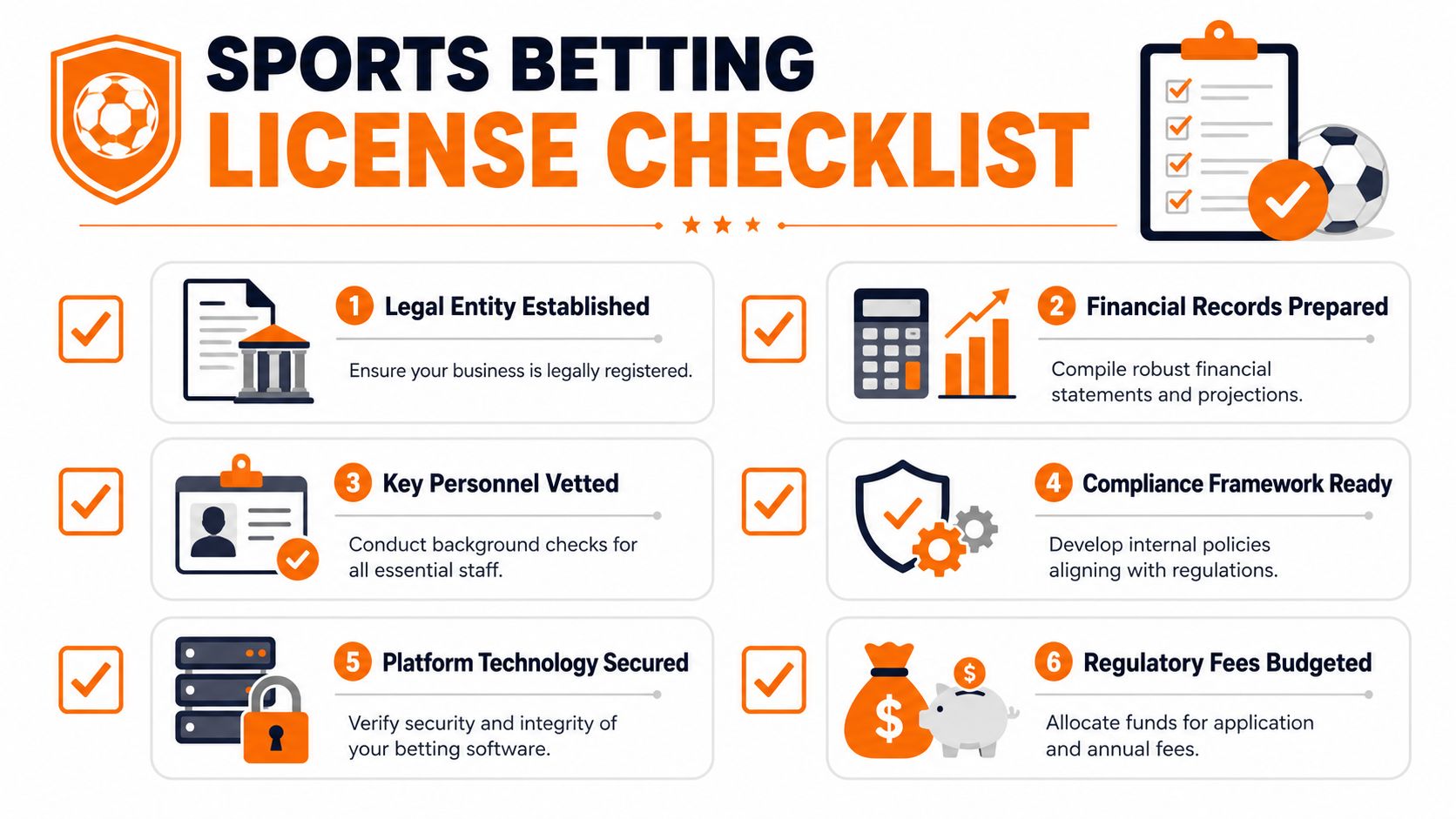
The short list that keeps projects moving
- Define your target markets: Don't apply for a sports betting license in the abstract. Know where you want to operate and which rules apply.
- Choose the operating model early: Decide whether you'll apply directly, use a white-label structure, or combine both across different markets.
- Map B2C and B2B responsibility: Be explicit about whether your platform partner may need supplier status in your target jurisdictions.
- Prepare the evidence pack: Corporate records, ownership transparency, policy documents, funding evidence, and technical descriptions should match one another.
- Stress-test the platform: Check hosting, reporting, settlement logic, KYC flow, wallet controls, and responsible gambling tooling before filing.
- Plan for maintenance, not just approval: Budget internal resources for reporting, audits, updates, and regulatory change after launch.
The operators who get through licensing cleanly usually do one thing better than everyone else. They make fewer assumptions.
If you want a faster route from planning to launch, NexGrate provides a turnkey white-label casino and sportsbook platform with the backend, payments, compliance tooling, and operational stack operators need to enter the market with less integration overhead and a cleaner path to ongoing management.