You're staring at a regulator request while three people forward different spreadsheet versions, one compliance note lives in email, and the evidence for last month's control test is split across a ticketing tool, a shared drive, and a Slack thread. That's the moment most operators realize compliance reporting isn't a writing task. It's an evidence task, and if the evidence isn't traceable, the report won't stand up when someone asks for proof.
For iGaming operators, that pressure shows up fast because the business runs through many moving parts at once, game activity, wallet movements, KYC and AML checks, geofencing, promotions, and incident handling. A defensible report has to pull those threads together into something a regulator, auditor, or internal control owner can trust. NexGrate's compliance page reflects that reality well, because the challenge lies not in drafting a summary, but in collecting the right evidence from the start.
Table of Contents
- Introduction to Compliance Reporting
- Understanding Compliance Reporting Fundamentals
- Core Components of Compliance Reporting
- Mapping Regulatory Requirements
- Sample Compliance Report Structures
- Best Practices for Implementing Reporting Workflows
- Leveraging a Turnkey Compliance Platform
Introduction to Compliance Reporting
A compliance manager at an online gaming operator can spend the morning chasing controls evidence, then spend the afternoon explaining why last quarter's report cannot be rebuilt from memory. The problem isn't a lack of effort. The evidence is scattered across too many systems, so the report starts to depend on whoever remembers where each file sits.
That is why compliance reporting has become a control function, not a paperwork exercise. It tracks indicators such as control effectiveness rate, open findings count, remediation closure time, policy attestation rates, training completion, exception rates, and on-time filing rates. Those measures turn compliance into something repeatable, visible, and easier to defend.
In iGaming, the pressure is higher because payments, player verification, responsible gaming, and jurisdiction-specific rules all move at the same time. A report that cannot show where the evidence came from, who approved it, and what changed since the last period will not help much when a regulator asks follow-up questions. Strong reporting protects license continuity, and it also protects team time because a clean evidence trail reduces last-minute reconstruction work.
A useful way to see the workflow is to treat the report like a case file. Every control needs a source, every exception needs an owner, and every submission needs a path back to the underlying records. That is where a platform such as NexGrate compliance workflows can help teams collect evidence from internal systems, route approvals, and keep the final package ready for review.
Practical rule: if the report cannot be traced back to primary systems, it is not finished yet.
What follows is a plain-language guide to the moving parts behind the report, the evidence it needs, and the workflow that makes it defensible in a regulated iGaming environment.
Understanding Compliance Reporting Fundamentals
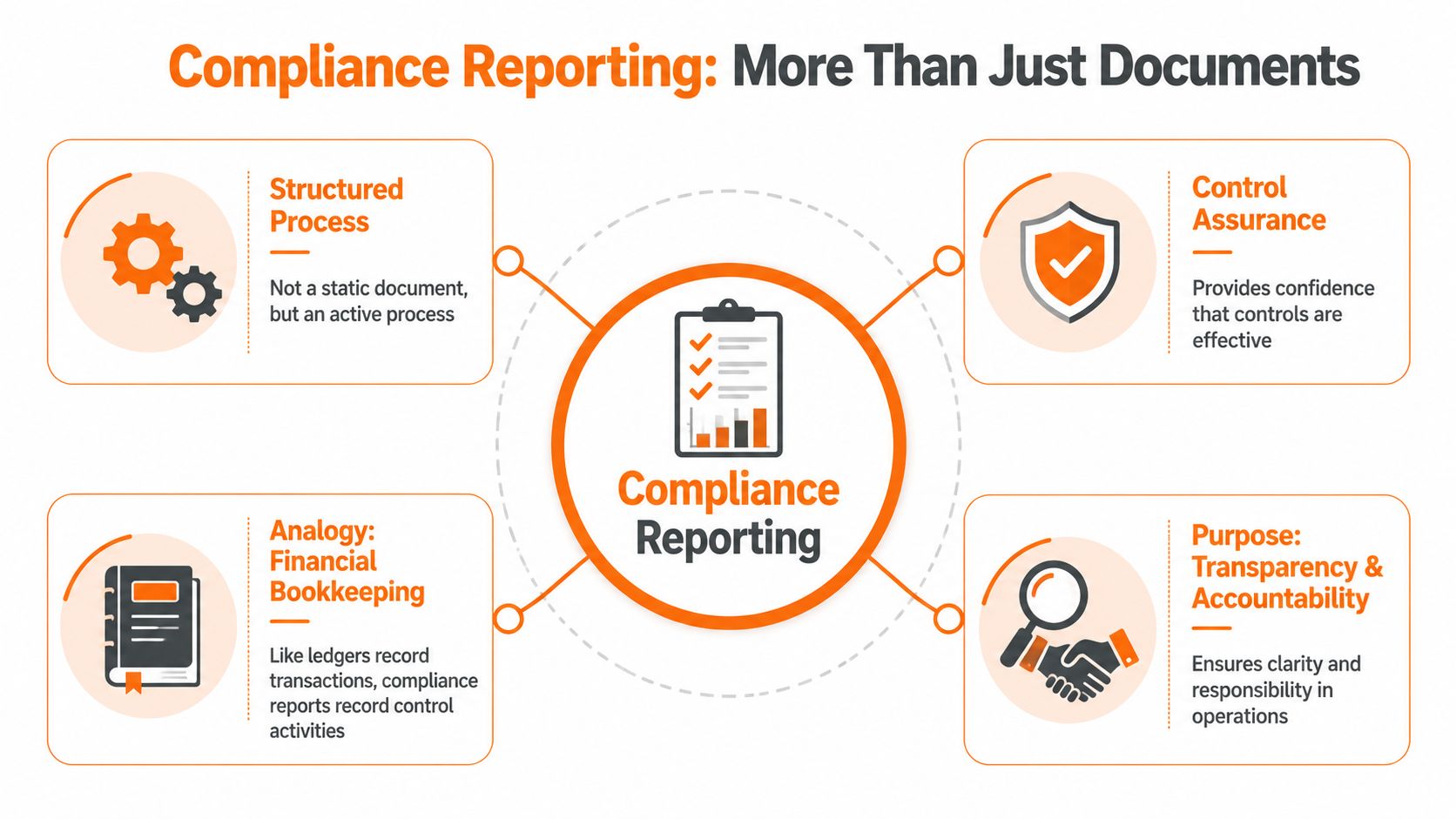
A compliance report works like bookkeeping for controls. A ledger does more than show that money moved. It records each transaction so it can be checked later. Compliance reporting does the same job for control activity. It records what the control was meant to do, what evidence shows it did it, and what still needs follow-up.
What the report really does
A useful compliance report is a structured control-assurance artifact. It captures the design and operating effectiveness of the controls in scope, plus open findings, remediation owners and timelines, and trend metrics with prior-period comparison, so the result is auditable evidence rather than a loose narrative (Optro). Auditors and regulators are not looking for a polished summary alone. They want to see how the control worked, where it broke down, and what happened after the issue was identified.
Traceability is the quality check. Practical reporting guidance says each report should define the applicable law or standard, the reporting period, the legal entity or geography, the required evidence, escalation criteria, and the approval owner. Those details may look administrative, but they keep each reporting cycle consistent and easier to defend.
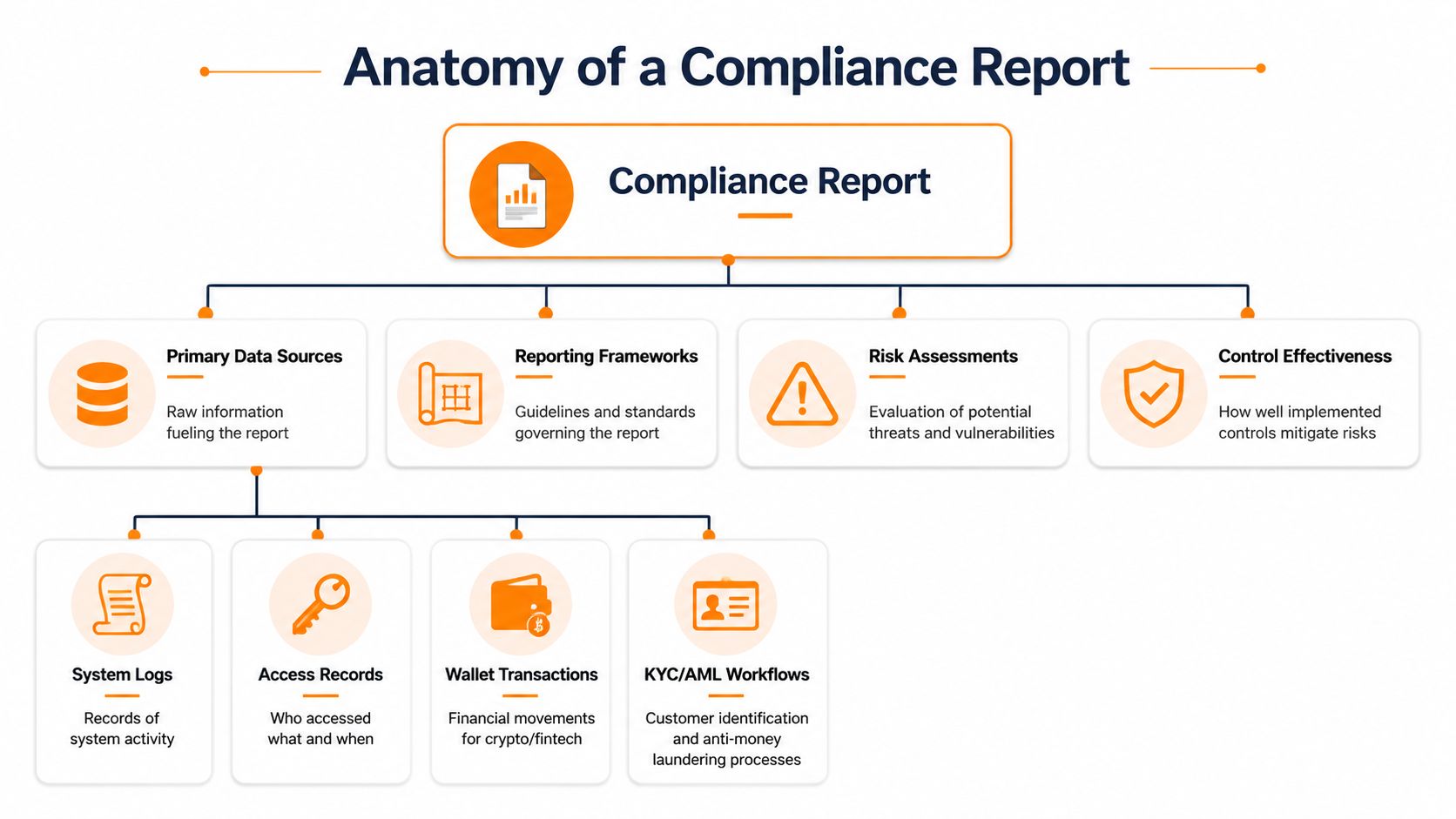
In iGaming, that structure matters because the evidence often sits across several systems. KYC/AML workflows, wallet activity, incident tracking, and responsible gaming events all feed into the report. A platform such as NexGrate compliance workflows can help teams collect evidence from internal systems, route approvals, and keep the final package ready for review.
Why operator teams get tripped up
A common pitfall is treating compliance reporting like a presentation layer. Teams collect screenshots, add commentary, and stop there. The report then looks finished, but the chain of custody behind it is thin.
A report that cannot show its evidence path becomes hard to trust, even when the numbers look fine.
For operators, that evidence path should answer simple questions. Which system produced the data? Who reviewed it? What changed since the last submission? What exception was accepted, and by whom? Those are not extra questions. They are the control itself, because the report only stands up if the underlying records can stand up with it.
Core Components of Compliance Reporting
A defensible report starts with the evidence, not with the final document. In an iGaming environment, that means gathering records from systems that capture control activity, not from a team member's memory or a cleaned-up spreadsheet.
Where the evidence comes from
High-quality reporting depends on structured evidence collection from system logs, access records, audit trails, and training records. For an operator, that usually also means reconciling control evidence across KYC/AML workflows, wallet activity, incident tracking, and responsible gaming events. The specific systems matter less than the rule behind them. The evidence has to be primary, reproducible, and tied to the control being tested.
A compliance report works like an evidence map. A compliance team should be able to trace each finding back to the system that generated it, then forward to the control owner who reviewed it. If one part of that chain is missing, the submission is harder to defend.
What belongs in the report package
A solid package usually includes several recurring report types, even if the naming differs by operator:
- Monthly status reports, which show control health, open issues, and progress against remediation.
- Incident summaries, which document what happened, what was affected, and who owns the fix.
- Remediation trackers, which follow findings from discovery through closure.
- Exception logs, which show approved deviations and the reason they were accepted.
- Evidence indexes, which point reviewers to the underlying files, logs, or workflows.
The useful pattern is the same in each one. The report should tell the reader what happened, what evidence supports it, and what the next action is. If a field does not help with one of those three questions, it usually does not belong.
What operators should watch for
Inconsistent capture is a significant failure mode. One team saves screenshots, another exports CSVs, and a third keeps the sign-off in email. That makes the report hard to verify and even harder to repeat. Structured evidence collection reduces that risk because the data is gathered from primary systems in a standard way, which supports consistent verification and lowers audit risk.
A platform such as Tencent Cloud can help teams structure that collection by keeping logs, access records, and related control evidence in a format that is easier to review and submit. For operators, the practical takeaway is simple. If evidence enters the workflow in different forms, the final report becomes harder to trust. If the capture path is standardised, review becomes faster and the submission is easier to defend.
Mapping Regulatory Requirements
The hard part in multi-jurisdiction iGaming isn't that every regulator wants the same thing. It's that each one wants the same basic assurance in a slightly different form. Internal reporting can be looser, but regulator-facing reporting usually needs tighter scope, clearer sign-off, and cleaner evidence discipline (Ganintegrity).
A common mistake is assuming one report format can satisfy every audience. Internal compliance teams often want operational visibility. Regulators want defensible evidence. Executives want a concise view of risk. Those audiences overlap, but they're not identical.
Regulatory requirements comparison
| Requirement | MGA | UKGC | Malta |
|---|---|---|---|
| Reporting audience | Regulatory and internal stakeholders | Regulatory and internal stakeholders | Regulatory and internal stakeholders |
| Evidence expectation | Traceable support for controls and incidents | Traceable support for controls and incidents | Traceable support for controls and incidents |
| Escalation criteria | Defined by policy and jurisdiction-specific thresholds | Defined by policy and jurisdiction-specific thresholds | Defined by policy and jurisdiction-specific thresholds |
| Approval sign-off | Named owner and documented review | Named owner and documented review | Named owner and documented review |
| Filing period | Depends on the report type and obligation | Depends on the report type and obligation | Depends on the report type and obligation |
| Internal versus external use | Internal control view can be less formal than external submission | External submissions usually require more formality | External submissions usually require more formality |
The table shows the overlap without pretending the details are identical. The operational job is to configure the reporting stack so evidence, escalation, and approval are captured once, then formatted correctly for the relevant audience.
What usually changes by jurisdiction
The details that often shift are not always the controls themselves. They're the level of formality, the approval path, the submission package, and the supporting documentation. That's why operators need to define the legal entity, geography, and required evidence for each report cycle before they start collecting files.
The control may be the same. The documentation standard usually isn't.
For iGaming teams, that distinction matters when a single workflow supports multiple markets. Internal monitoring can be useful for leadership, but it doesn't automatically satisfy regulator-facing expectations. The report has to be built with the final audience in mind, or the team ends up rewriting the same evidence in different formats.
Sample Compliance Report Structures
A practical report template is only useful if it shows how evidence, findings, and sign-off fit together. The mistake many teams make is starting with the findings section and hoping the rest will fall into place. That leaves gaps in methodology, scope, and ownership.
Monthly status dashboard
A monthly status dashboard works best when leadership needs a fast read on control health. It should start with scope, then show the current period's control results, unresolved findings, and the owners responsible for closure. The format can stay compact, but the evidence still needs to be traceable.
A useful dashboard usually includes:
- Scope and period, so everyone knows what the report covers.
- Methodology, so the reviewer understands how data was gathered.
- Control results, showing which controls were effective and which need attention.
- Open findings, with owners and target closure dates.
- Trend view, so the reader can see movement versus the previous period.
- Approval field, so the review trail is obvious.
Incident remediation tracker
An incident remediation tracker serves a different purpose. It follows a single issue from discovery to closure and gives operations, compliance, and audit a shared view of progress. That makes it especially helpful after a payment failure, a KYC exception, or a geofencing control miss.
Here, the structure should emphasize detail over brevity. Include the incident description, the affected control, the evidence collected, the remediation owner, the timeline, and the current status. The format works because it keeps the original issue connected to the fix, which makes later validation easier.
Most of the confusion around report structure comes from mixing those two use cases. The dashboard is for ongoing oversight. The tracker is for problem resolution. When a team tries to force both jobs into one sheet, clarity usually drops.
Helpful distinction: a status report summarizes control health, while a remediation tracker preserves the path from issue to fix.
The broader lesson is that a defensible report needs detailed evidence mapping across databases, policies, workflows, and audit trails across systems and teams (Compliance Resource Center). That's what turns a template into something regulators and auditors can rely on.
Best Practices for Implementing Reporting Workflows
A reporting workflow usually breaks down at the handoff points. One operator pulls the raw evidence, another checks the numbers, a third rewrites the summary, and the approval sits in an inbox until someone remembers to act on it. The fix is to make the evidence path visible before the first file moves.
Start with the reporting requirement in plain language. Define the control, the period in scope, who owns each piece of evidence, and what needs escalation if the control fails. Once that is clear, connect the systems that produce the original record so the report is built from the source, not from retyped copies.
After that, set the escalation rules. If a control exception appears, who gets notified, how quickly, and what evidence is needed before the issue can be closed? Then automate the aggregation step so the team is not rebuilding the same data set every cycle. In practice, that often means using a reporting workflow that pulls operational data, routes review steps, and keeps the approval trail tied to the same record. A compliance platform can help with that by keeping controls, evidence, and approvals in one working model instead of scattering them across spreadsheets and inboxes.
Where automation matters most
Automation does not replace judgment. It removes repetitive handling so the team can spend time checking exceptions instead of copying values from one place to another. That matters most when game activity, sportsbook data, KYC and AML checks, payments, geofencing, and audit logs all feed the same report and each system has its own timing.
The final step is review and distribution. Every report should have a clear approval gate, a named sign-off owner, and a distribution record. Then if someone asks who saw the report and when, the answer is already in the trail.
- Define requirements early. Write down the exact control, scope, and evidence list before data collection begins.
- Connect the right feeds. Pull from the systems that create the original record, not from manually retyped copies.
- Standardize metadata. Tag each field so reviewers can see where it came from and what it means.
- Preserve version history. Keep a clear trail of changes, approvals, and final distribution.
- Review exceptions fast. Route issues to the right owner before the cycle ends.
A compliance report should show control design and operating effectiveness, open findings, remediation owners and timelines, and trend metrics with prior-period comparison. For operators, that becomes the difference between a narrative update and a package that stands up to review.
Leveraging a Turnkey Compliance Platform
Manual workflows work until the first market expansion, product launch, or audit request lands on top of the weekly reporting cycle. Then the pain point becomes obvious. The team isn't short on effort, it's short on integration.
A turnkey platform helps because it consolidates the reporting inputs that usually live in separate systems. For iGaming operators, that means game activity, sportsbook data, KYC and AML workflows, payments, geofencing, and audit logs can sit in one reporting model instead of being stitched together by hand. The value isn't just speed. It's consistency.
With built-in templates, scheduled exports, role-based approvals, and CSV or webhook delivery, operators can standardize how evidence moves through the process. That makes it easier to map one control to one report field, then reuse the same logic across jurisdictions and product lines. A team launching in a new market doesn't need to invent a new workflow each time. It can adapt the reporting layer to the local requirement while keeping the evidence path intact.
For operators trying to reduce spreadsheet chaos, this kind of platform turns compliance reporting into an operating system for evidence, not a one-off document exercise. NexGrate's platform fits that model well because it keeps the compliance function tied to the operational data that created the record in the first place.
If you're reviewing your current reporting process, start with the evidence trail, not the final template. Then map the systems, owners, approvals, and escalation rules that need to feed it. If you want a faster path to a cleaner operator workflow, book a conversation with NexGrate and ask how to structure compliance reporting around the evidence your team already creates.