Your first regulator request may arrive when the launch team is focused elsewhere. Marketing is preparing a new promotion, customer support is handling player questions, and a compliance manager receives a message asking for transaction records, approval evidence, and copies of customer-facing warnings. The request looks simple until someone discovers that the relevant conversation happened in a chat tool, the final promotion was edited in email, and no one can confirm which version was approved.
That scramble exposes the core problem. Regulatory communication in iGaming isn't just a message sent to a regulator. It's a controlled record of what the operator knew, decided, approved, transmitted, and retained. A late response can create concern. An inconsistent response can undermine confidence. An untraceable response can leave the operator unable to prove that its controls worked.
The issue becomes more demanding when a brand operates across casino, sportsbook, payments, affiliates, mobile applications, customer service, and third-party vendors. Each channel can carry regulated content, and each team may hold only part of the evidence. The operator needs a system that connects those pieces before a regulator asks for them.
Table of Contents
- Introduction Why Regulatory Communication Decides Compliance
- What Regulatory Communication Means in iGaming
- Main Types of Regulatory Communication Every Operator Handles
- Legal Triggers and Timelines That Start the Clock
- How to Build an Audit Ready Communication Workflow
- How NexGrate Supports Regulatory Communication at Scale
- Key Takeaways for Reliable Regulatory Communication
Introduction Why Regulatory Communication Decides Compliance
A new iGaming operator often thinks of regulatory communication as a set of emails, forms, and periodic submissions. That view is understandable, especially during launch, when teams are already managing licensing, platform configuration, KYC, payments, game certifications, marketing approvals, and responsible-gaming controls.
The weakness appears when a regulator asks a precise question: who approved this campaign, which player segment received it, what warning appeared in the relevant jurisdiction, and where is the supporting record? A team that stores information across inboxes, spreadsheets, vendor portals, private messages, and voice calls may know the answer informally but still struggle to prove it formally.
Practical rule: Treat every material regulatory exchange as evidence that another person should be able to understand without relying on your memory.
This approach changes how operators handle ordinary work. A report isn't merely exported and emailed. The team records its reporting period, data source, reviewer, approval, submission route, recipient, and retained copy. An incident notification isn't just drafted quickly. The operator preserves the facts available at the time, records later updates, and shows who made each decision.
The scale of regulatory oversight helps explain why this discipline matters. FINRA's published statistics list 70,728 items reviewed in one recent year, 75,125 in another, and 67,239 and 66,085 in prior years. The FINRA statistics on communications review show how regulated communication can operate as a high-volume supervisory process, not an occasional administrative task.
This guide builds the subject from first principles. It defines the communication system, separates the main message types, identifies events that start obligations, and then turns those obligations into an audit-ready workflow. It also addresses two risks that new operators often underestimate: fragmented channels and inconsistent player-safety messaging.
What Regulatory Communication Means in iGaming
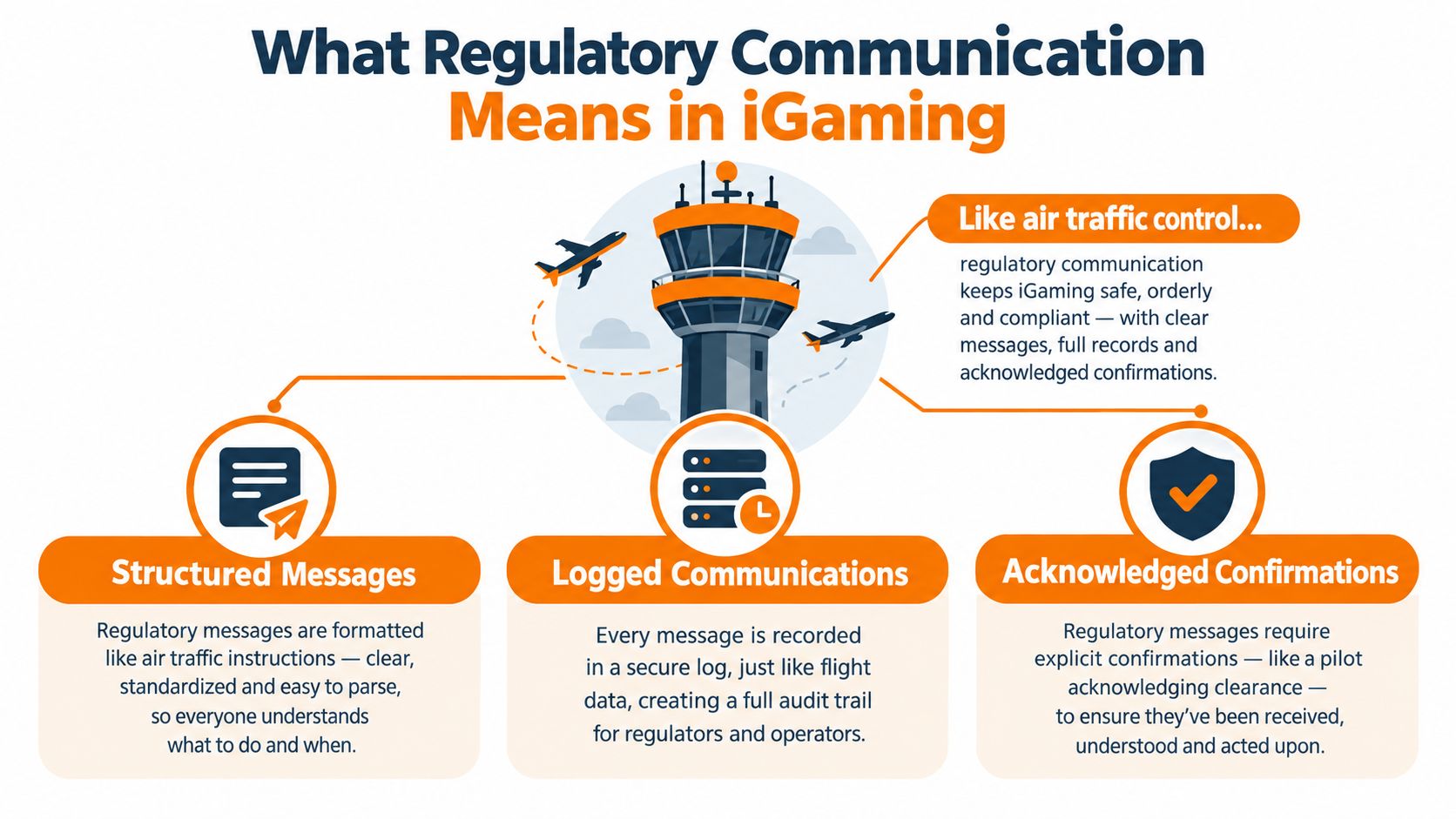
A useful analogy is air traffic control. Pilots don't rely on casual conversation to enter controlled airspace. They use structured messages, recognized channels, logged instructions, and confirmations. The system helps each participant understand what was said, who received it, and what action follows.
Regulatory communication works in a similar way. The message needs a clear purpose, an accountable owner, reliable facts, an appropriate recipient, and evidence of transmission. The operator should also be able to retrieve the surrounding record, including drafts, approvals, attachments, responses, and follow-up actions.
The message is only one part of the record
In iGaming, regulatory communication can include a license submission, a periodic report, an incident notification, a response to an information request, an AML escalation, or correspondence about an enforcement concern. It can also include customer-facing material when the regulator expects the operator to demonstrate that warnings, disclosures, and player-protection messages were accurate and visible.
A routine operational chat is different from a formal regulatory communication. A support agent asking whether a payment provider is available is operational. A compliance manager documenting why a payment control was changed, who authorized it, and which regulator must be informed creates a supervisory record.
The distinction isn't based only on the communication channel. A message sent through chat may become relevant evidence if it contains a decision, approval, interpretation, or instruction connected to a regulated activity. Conversely, a polished email may still be inadequate if it lacks supporting data or a clear approval trail.
Four qualities define a defensible exchange
An effective system gives each communication four properties:
- Accuracy: The statement matches the underlying records and doesn't overstate what the operator knows.
- Timeliness: The team responds within the applicable obligation or agreed deadline.
- Traceability: Someone can connect the final message to its source data, reviewers, approvals, and recipient.
- Retrievability: An authorized reviewer can find the complete record without searching every employee's personal workspace.
The Federal Register and FCC historical record illustrates the broader importance of formal, traceable regulatory communication. The FCC was established in 1934, and the Federal Register began publication in 1936, creating a durable model in which public rules, notices, and actions could be recorded and accessed through an authoritative channel. For an operator, the lesson is practical: compliance communication needs an official home and an evidence trail.
Main Types of Regulatory Communication Every Operator Handles
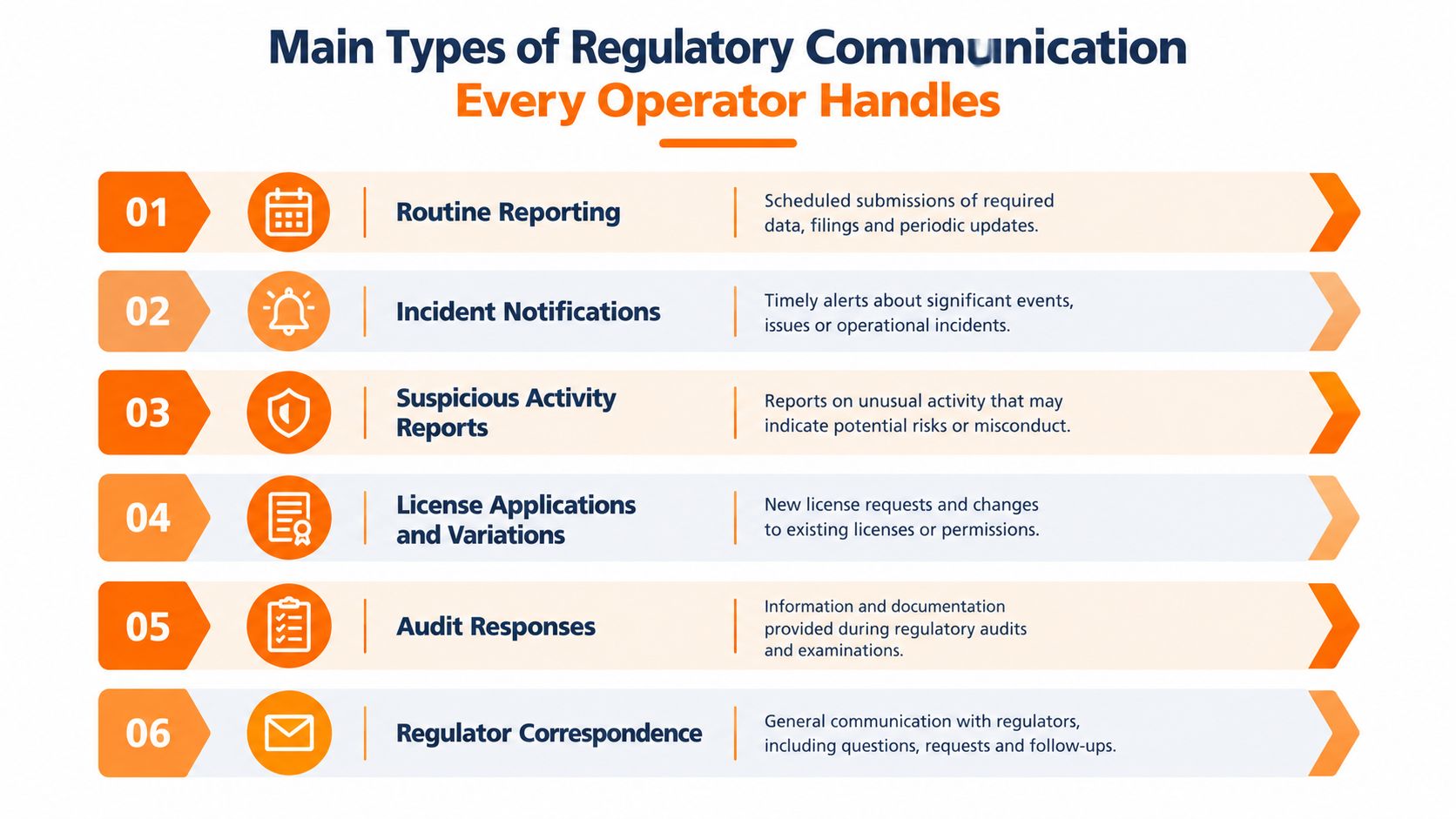
Classification prevents routing mistakes. If a team can't identify what kind of communication it has received or needs to send, it may assign the wrong owner, use the wrong template, or miss information that the recipient expects.
Routine reporting
Scheduled reporting gives the regulator a recurring view of the business. Depending on the jurisdiction and license, this may involve financial activity, player protection, AML controls, sports betting integrity, or operational metrics.
The important feature is predictability. The operator should know the reporting owner, source systems, data definitions, review requirements, submission route, and retained evidence before the due date approaches. A report showing GGR or NGR should use the operator's approved accounting definitions and reconcile with the underlying wallet and finance records.
Incident notifications
An incident notification communicates a material event that may affect players, funds, data, integrity, or regulatory compliance. Examples include a significant security incident, a platform failure affecting wagers, a payment control breakdown, or an event that compromises player protection.
The first notification may contain confirmed facts and clearly labeled unknowns. Later updates should preserve the original record rather than replacing it without mention. The regulator needs to see what happened, what the operator did immediately, what remains under investigation, and how the operator will prevent recurrence.
Suspicious Activity Reports
A Suspicious Activity Report, or SAR, addresses suspected money laundering, terrorist financing, or another reportable financial crime concern. It isn't a general incident report and shouldn't be treated as a customer-service escalation.
The AML function typically owns the substantive assessment, while legal or compliance teams control submission and confidentiality. The operator must protect sensitive information, preserve the investigation record, and avoid communicating restricted details to the player or unrelated teams.
License applications and variations
A license application explains who the operator is, how it will operate, who controls it, how funds and player accounts are managed, and how compliance responsibilities are assigned. A variation request seeks approval for a material change, such as a new product, ownership adjustment, market expansion, or operational model.
These communications need consistency across business plans, policies, platform descriptions, corporate documents, and actual system behavior. A regulator may compare the application narrative with the live operation, so the submission shouldn't describe controls that the launch team hasn't implemented.
Audit responses
An audit response answers a defined request for evidence. It should follow the regulator's questions in order, identify each supporting document, explain any gap, and state the corrective action with an accountable owner.
Vendor records belong here too. Operators that rely on game studios, payment providers, KYC services, or hosting partners should define how third-party evidence enters the response process. The vendor management guidance for iGaming operators can help teams connect supplier oversight with evidence collection.
Enforcement correspondence
Enforcement correspondence carries higher stakes because it may relate to suspected breaches, supervisory concerns, remediation demands, or proposed action. The response should be coordinated by the appropriate senior compliance, legal, and operational owners.
The operator shouldn't answer defensively before it understands the facts. A disciplined response distinguishes confirmed evidence from assumptions, accepts valid deficiencies, challenges inaccuracies with records, and commits only to actions the business can deliver.
Legal Triggers and Timelines That Start the Clock
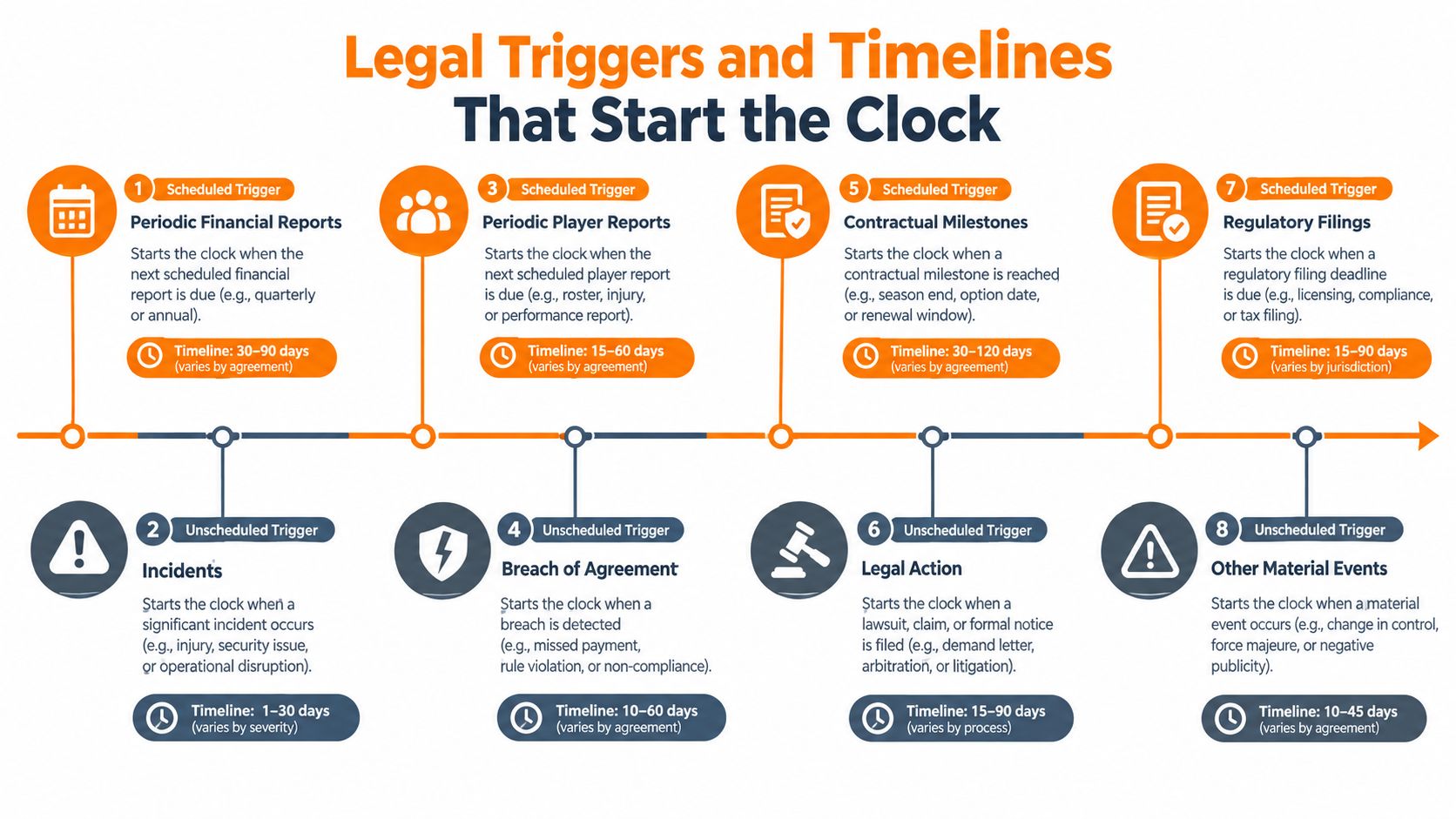
A legal trigger is an event that changes a communication from optional good practice into a required action. Operators often monitor the obligation but fail to monitor the event that activates it. That gap can leave a team surprised by a deadline it should have anticipated.
Scheduled triggers are easier to see. A reporting calendar may require recurring financial, player-protection, or operational submissions. The operator can assign owners, prepare data controls, and set internal review points before the external deadline.
Event-driven triggers require detection. A data incident, threshold breach, suspicious transaction pattern, material ownership change, product expansion, or interruption to a regulated service may require notification or approval. The trigger register should describe the event in operational terms, not only repeat legal language.
Build the trigger register around cause and effect
For each obligation, record five questions:
- What event starts the clock? Define the observable fact, such as a confirmed system outage or a transaction pattern escalated by AML.
- Who detects it? The first person may be in security, payments, customer support, trading, or player protection.
- Who decides whether it is reportable? Assign a qualified compliance or legal owner.
- Who receives the communication? Record the regulator, authority, portal, or designated contact.
- What evidence proves the decision? Retain the alert, assessment, approval, submission, and follow-up.
Don't assume every deadline is measured in the same way. Depending on the jurisdiction and obligation, a clock may be tied to hours, business days, calendar periods, or a specified reporting window. The applicable rule controls, so the register should include the governing license condition, regulation, guidance, or regulator instruction.
A deadline that lives only in a policy isn't operational. The system must connect the trigger to a person, a timer, and an escalation path.
Early detection matters because teams need time to establish facts before they communicate. That doesn't mean delaying a required notification until the investigation is complete. It means separating the initial notification from later updates and recording why each statement was made.
Operators can strengthen their risk management practices for regulated operations by linking the trigger register to incident management, AML monitoring, change control, and board reporting. This turns regulatory communication into part of daily risk detection rather than a separate mailbox owned by compliance.
How to Build an Audit Ready Communication Workflow
An audit-ready workflow should make the correct action easier than an improvised one. It begins when a message or trigger enters the organization and ends only when the operator has retained the evidence needed to explain the full decision.
Start with intake and triage
Create one controlled intake route for regulator correspondence and a documented escalation route for internal triggers. The intake record should capture the sender, date received, subject, jurisdiction, license, affected product, deadline, and responsible owner.
Triage then assigns a category. A routine report follows a different path from an incident, SAR, license variation, audit response, or enforcement matter. The category should determine the required reviewers, security restrictions, template, and escalation level.
Draft from controlled facts
Use approved templates for recurring communications, but don't let templates replace judgment. A strong draft identifies the issue, relevant period, affected population or service, confirmed facts, unknowns, remediation, and requested or completed action.
The author should link every material statement to a source record. Version control matters because a regulator may later ask why the submitted message differs from an earlier draft. Keep the original, tracked changes, reviewer comments, approval, and final transmitted copy.
Review, approve, transmit, and archive
Review should match the risk. Finance may validate figures, AML may assess suspicious activity, security may confirm an incident, legal may review exposure, and a senior compliance owner may approve the final submission. Record the identity and role of each reviewer, not merely a generic “approved” status.
Transmit through the approved channel. Confirm the recipient, attachment set, delivery status, portal receipt, and any reference number. Then archive the complete package, including related chat, voice, email, evidence, decisions, and follow-up actions.
Microsoft Purview documents how communication compliance audit histories can record create, edit, delete, and policy-review actions in a unified audit log. Its communication compliance audit guidance also makes a critical operational point: if auditing isn't enabled, those events aren't recorded, which breaks the evidence chain.
Cross-channel governance deserves special attention. Industry reporting identifies 17% of organizations with a unified archive for voice and digital communications, 79% relying on legacy systems, and 73% using manual capture and retention processes in the cited analysis of communications governance for regulatory scrutiny. For an iGaming operator, that means a customer-service call, VIP message, mobile conversation, or collaboration-tool approval may sit outside the archive used for formal emails.
Use a maturity check
| Control Area | What Good Looks Like | Status |
|---|---|---|
| Intake | Every regulator request and internal trigger receives a recorded case | Not assessed |
| Ownership | Each case has an accountable owner and named backup | Not assessed |
| Source data | Reports and statements link to controlled records | Not assessed |
| Review | Required specialists approve before transmission | Not assessed |
| Transmission | The operator retains proof of delivery or portal receipt | Not assessed |
| Archive | Final and supporting records are searchable by jurisdiction and case | Not assessed |
| Channels | Voice, chat, mobile, email, and collaboration records follow one retention policy | Not assessed |
| Follow-up | Remediation tasks have owners, dates, and closure evidence | Not assessed |
A workflow isn't audit-ready because it has a policy. It becomes audit-ready when a reviewer can reconstruct the case from trigger to archive without asking the original employee to explain what happened.
For a practical foundation, operators can also review what compliance reporting involves and map the reporting output to the archive controls above.
How NexGrate Supports Regulatory Communication at Scale
NexGrate can serve as one platform option for operators that want casino, sportsbook, wallet, payments, and compliance functions connected through a common operating environment. Its relevance to regulatory communication comes from the way platform records can support the evidence chain, rather than from the existence of a standalone reporting screen.
A unified back office gives authorized teams a shared view of player activity and operational controls. The platform provides more than 130 permission keys and a 17-tab player detail view, which can help operators separate duties and investigate player-level questions without granting every employee broad access. Those controls still need correct configuration, periodic review, and documented ownership.
The accounting layer supports MGA-oriented reporting with double-entry treatment, bonus escrow, and GGR or NGR reporting aligned to regulator definitions. That matters when a routine financial submission must reconcile with wallet balances, bonus activity, payments, and finance records. A report is more defensible when the operator can explain how the figures were produced and who reviewed them.
Connecting communication types to platform evidence
For scheduled reporting, the platform includes nine standard reports with CSV export, allowing teams to produce structured files for review and submission. For audit responses, searchable audit logs can show staff actions and support inspector review. The operator should still preserve the case file, approval record, transmission evidence, and any regulator follow-up outside the report itself.
For player protection and jurisdiction control, geofencing and responsible-gaming features help apply market-specific operating rules. A consolidated wallet can reduce reconciliation across separate casino and sportsbook environments, while a single API and prebuilt content adapters can reduce the number of disconnected integration points that compliance teams must monitor.
These capabilities don't remove governance duties. Teams still need a trigger register, approved message library, access reviews, retention rules, incident procedures, and jurisdiction-specific legal interpretation. A platform can make evidence easier to generate and retrieve, but people remain responsible for deciding what must be communicated, when, and to whom.
The platform's most practical contribution is reducing the distance between activity and evidence. When player records, financial data, permissions, operational actions, and compliance outputs sit in connected systems, the operator has fewer places to search during an audit. That supports a more consistent response to routine reports, audit requests, incidents, license changes, and player-safety questions.
Key Takeaways for Reliable Regulatory Communication
Reliable regulatory communication starts with a change in mindset. The operator is not just producing documents for a regulator. It is operating a controlled system that detects triggers, classifies obligations, prepares accurate messages, captures approvals, transmits securely, and preserves evidence.
The six communication categories provide a practical routing model:
- Routine reporting follows a calendar and controlled data definitions.
- Incident notifications explain material events, known facts, unknowns, and remediation.
- Suspicious Activity Reports remain within the confidential AML process.
- License applications and variations must match the live operating model.
- Audit responses connect each answer to evidence and corrective action.
- Enforcement correspondence requires coordinated, fact-based senior review.
Two risks deserve immediate attention. First, fragmented channels can create supervision blind spots when voice, chat, mobile, email, and collaboration tools aren't captured in a unified archive. Second, player-safety messaging is moving beyond vague responsible-gambling language. Spain's proposed approach would require standardized warnings in commercial communications, including advertising and websites, with clearer references to gambling addiction risks and underage participation, as described in the Spain gaming law trends and developments guide. Operators need a way to localize warnings by jurisdiction without allowing affiliates, promotions, and app surfaces to drift apart.
Start with a focused review:
- List the channels: Include customer support, VIP teams, payments, affiliates, marketing, compliance, and vendors.
- Map the triggers: Connect each event to an owner, deadline rule, recipient, and escalation path.
- Test one case file: Reconstruct a recent communication from intake through archive.
- Check message consistency: Compare responsible-gaming warnings across campaigns and markets.
- Assess platform evidence: Confirm that reports, staff actions, approvals, and audit records can be retrieved together.
The result you want isn't a larger document library. It's a communication system that can explain what happened, support the operator's license, and give a regulator confidence in the controls behind every message.
NexGrate provides a turnkey iGaming platform with connected casino, sportsbook, wallet, payments, reporting, audit logs, geofencing, and responsible-gaming controls. Visit NexGrate to assess how its unified operating environment could support more traceable regulatory communication for your next brand launch.