The uncomfortable truth about an audit trail system is that retention alone doesn't make evidence defensible. PCI Requirement 10.7 expects audit-trail history to remain for one year, with at least three months immediately accessible under its stated retention guidance. That requirement points to a broader engineering reality for iGaming operators: a log that can't be attributed, verified, searched, and exported is only storage, not evidence.
A production platform must reconstruct player activity, wallet movements, administrative decisions, and system interventions without changing the original record. The right design treats the trail as a regulated data product with a schema, retention contract, integrity model, query API, and submission workflow.
Table of Contents
- Why an Audit Trail System Is a Regulated Data Product in iGaming
- Core Logging Model and Event Schema
- Storage Architectures for Tamper-Evident Audit Trails
- Tamper-Evidence Primitives and Integrity Controls
- Retention Windows and Hot/Cold Storage Tiers
- API Surface for Querying and Exporting Audit Events
- Reporting Formats and Regulator Submissions
- Compliance Mapping Across Major Frameworks
- Pre-Audit Quick Reference Checklist
Why an Audit Trail System Is a Regulated Data Product in iGaming
An iGaming audit trail is the evidence layer behind questions that can affect licensing, payments, disputes, and responsible-gaming reviews. An operator may need to show who changed a player limit, when a withdrawal was approved, which service credited a wallet, or how a voided bet reached its final state. A dashboard summary won't answer those questions reliably. The underlying event history must establish who acted, what changed, when it happened, and whether the record remained intact.
That makes the audit trail closer to a regulated ledger than a conventional application log. It needs a defined event vocabulary, stable identifiers, controlled access, and an explicit retention policy. It also needs to support reconstruction across services, because a sportsbook bet, payment authorization, wallet entry, fraud decision, and player notification may be created by separate components.
Practical rule: design every event around the evidence an investigator will need, not around the fields that happen to be convenient for the emitting service.
Start with the business questions. For a responsible-gaming review, preserve player identity references, limit changes, self-exclusion actions, timestamps, and the actor responsible. For a payment dispute, connect the transaction, wallet ledger entry, cashier decision, provider reference, and administrative intervention. For bonus abuse, record the rule version, award decision, reversal, and relevant account relationship.
The evidence contract
Every event should have an owner, a schema version, and a retention class. The owner defines which service is accountable for emission. The schema version protects future interpretation. The retention class determines whether the event belongs in immediately searchable storage, long-term archive, or both.
The system should also produce exports that preserve the original event and its verification material. A reviewer must be able to inspect the payload, follow its chain position, identify the signer, and understand any redaction applied to a derivative copy.
NIST guidance emphasizes protecting audit-trail integrity from modification and recommends controls such as digital signatures or write-once media in its discussion of audit and accountability controls. For an iGaming operator, that translates into an isolated write path, restricted administrative access, trusted time, and independent verification.
Core Logging Model and Event Schema
The canonical audit event has four required dimensions: actor, action, target, and state delta. If one is missing, investigators often have to infer the story from unrelated application logs, which creates ambiguity during disputes and regulatory reviews.
The actor identifies the authenticated person, service, job, or external provider. Include the principal ID, session ID where available, device or client context, and source metadata. The action should come from a controlled vocabulary, not free text. Examples include BET_PLACED, WALLET_CREDIT, WALLET_DEBIT, BONUS_AWARDED, WITHDRAWAL_REQUESTED, SELF_EXCLUSION_SET, and GAME_LAUNCHED.
The target identifies the affected object through an internal ID. A target might be a player account, wallet ledger entry, bonus instance, bet ticket, or game round. The before and after values then describe the exact transition, rather than merely stating that “something changed.”
Canonical fields
| Field | Type | Purpose | Example |
|---|---|---|---|
event_id |
String | Globally unique event reference | evt_01J... |
occurred_at |
Timestamp | Time the action happened | 2026-09-13T10:20:00Z |
ingested_at |
Timestamp | Time the trail accepted the event | 2026-09-13T10:20:01Z |
actor |
Object | Person, service, or process responsible | player:u_48291 |
session_id |
String | Links activity to an authenticated session | sess_... |
action |
Enum | Controlled business action | SESSION_LOGIN |
target |
Object | Affected entity and internal ID | player:u_48291 |
before |
Object | State before the action | {status:"logged_out"} |
after |
Object | State after the action | {status:"logged_in"} |
correlation_id |
String | Joins related service events | corr_... |
jurisdiction_code |
String | Regulatory operating context | MT |
product |
Enum | Licence-relevant product | sportsbook |
rule_version |
String | Decision logic in force | wallet-policy-v3 |
prev_hash |
String | Link to the prior record | sha256:... |
A login event might identify player:u_48291 as the actor and target, with a status transition from logged out to logged in. A wallet credit should identify system:cashier_service as the actor, target wallet:w_9912, and a delta such as {amount:"+25.00", currency:"EUR"}. Store monetary values in a representation that avoids floating-point ambiguity, and retain the currency explicitly.
NIST SP 800-171 requires organizations to create and retain records needed for monitoring, investigation, and reporting of unauthorized activity through its audit and accountability requirements. In practice, that means logging authentication, authorization changes, configuration changes, financial state transitions, and administrative operations, not only player-facing transactions.
Storage Architectures for Tamper-Evident Audit Trails
No single storage engine solves integrity, throughput, and investigation speed at once. The practical choice depends on the write path, the query workload, the required retrieval service level, and whether the operator must produce a verifiable evidence bundle on demand.
| Architecture | Write Throughput | Integrity Guarantee | Query Ergonomics |
|---|---|---|---|
| Centralized relational database | Straightforward for moderate, transactional workloads | Strong only with insert-only roles, constraints, and external protection | Excellent filtering, joins, and operational queries |
| Append-only files on WORM storage | High ingestion potential and simple archival | Strong when paired with WORM controls and cryptographic verification | Requires a separate index or projection |
| Dedicated log store | Optimized for high-volume range and text queries | Depends on hardening, access separation, and external integrity anchors | Fast search, aggregation, and investigator workflows |
A PostgreSQL implementation can work well when strict INSERT permissions are separated from query roles and UPDATE and DELETE privileges are revoked. Its weakness is operational discipline. Database administrators, migrations, backups, replicas, and maintenance tooling all become part of the trust boundary, and mutable rows remain a risk if the design relies only on application conventions.
WORM-backed files or object storage provide a clearer preservation boundary. The write service creates immutable segments, a manifest records their sequence, and investigators query an index built from the same source. Search isn't as convenient unless the operator maintains a projection, but the original evidence remains separate from the query layer.
Elasticsearch, ClickHouse, and Loki can make investigations fast, especially across event types and time ranges. They shouldn't be treated as the sole evidence store without additional controls. Index deletion, administrative access, reindexing, and retention jobs must be covered by the integrity model.
The split-path pattern
A design appends events to a hash-chained log or Kafka topic, then projects them into a query-optimized store. A reconciliation process compares counts, IDs, sequence positions, and integrity anchors between the source and projection. Investigators use the projection for speed, while exports and verification resolve back to the preserved source.
The approach works because it separates evidence preservation from evidence retrieval. A compromised application server shouldn't be able to rewrite the archive, and a search cluster outage shouldn't prevent the operator from proving what was originally recorded.
Tamper-Evidence Primitives and Integrity Controls
Tamper evidence comes from combining controls, not from adding a “read-only” flag to a database. The four useful primitives are hash chaining, digital signatures, WORM storage, and trusted timestamping. Each answers a different evidentiary question.
A hash chain links each event to the digest of the previous event. If someone alters, removes, or inserts a record in the sequence, later links no longer validate. A digital signature binds the event or evidence bundle to a signing identity. WORM storage prevents deletion or replacement during the retention period. A trusted timestamp provides an external time assertion that helps resolve disputes across systems with different clocks.
| Primitive | What it proves | Evidence produced | Mitigates |
|---|---|---|---|
| Hash chaining | Sequence continuity | Previous-hash links and verification result | In-place edits, insertion, and silent deletion |
| Digital signatures | Signer control over the payload | Signature, certificate, and verification output | Unauthenticated exports and altered bundles |
| WORM storage | Preservation against routine deletion | Object lock metadata and retention manifest | Administrative erasure and replacement |
| Trusted timestamping | External time anchoring | TSA token associated with a digest | Clock disputes and later backdating |
Use a modern cryptographic hash such as SHA-256 at minimum. Ed25519 or ECDSA P-256 are practical signature choices when the surrounding key-management system supports them. Private keys shouldn't live in application configuration. Use a managed HSM or equivalent custody boundary, rotate keys under documented policy, and preserve verification certificates with exported evidence.
Sign at write time or at controlled batch finalization, never when a user requests a report. Signing at query time proves only that the current query response was signed. It doesn't prove that the underlying record existed unchanged before the request.
Verification should be independent
At a batch boundary, calculate a Merkle root over the events, store the root separately, and periodically notarize it through a trusted timestamp service. An independent verifier should be able to retrieve the source segment, recompute the chain, validate signatures, compare the Merkle root, and report the first failing event.
For game-integrity evidence, the audit trail must remain distinct from the fairness mechanism itself. The relationship can be useful when investigating a game round, as shown in this technical discussion of provably fair games, but the audit system still needs to preserve the operator action history independently.
Retention Windows and Hot/Cold Storage Tiers
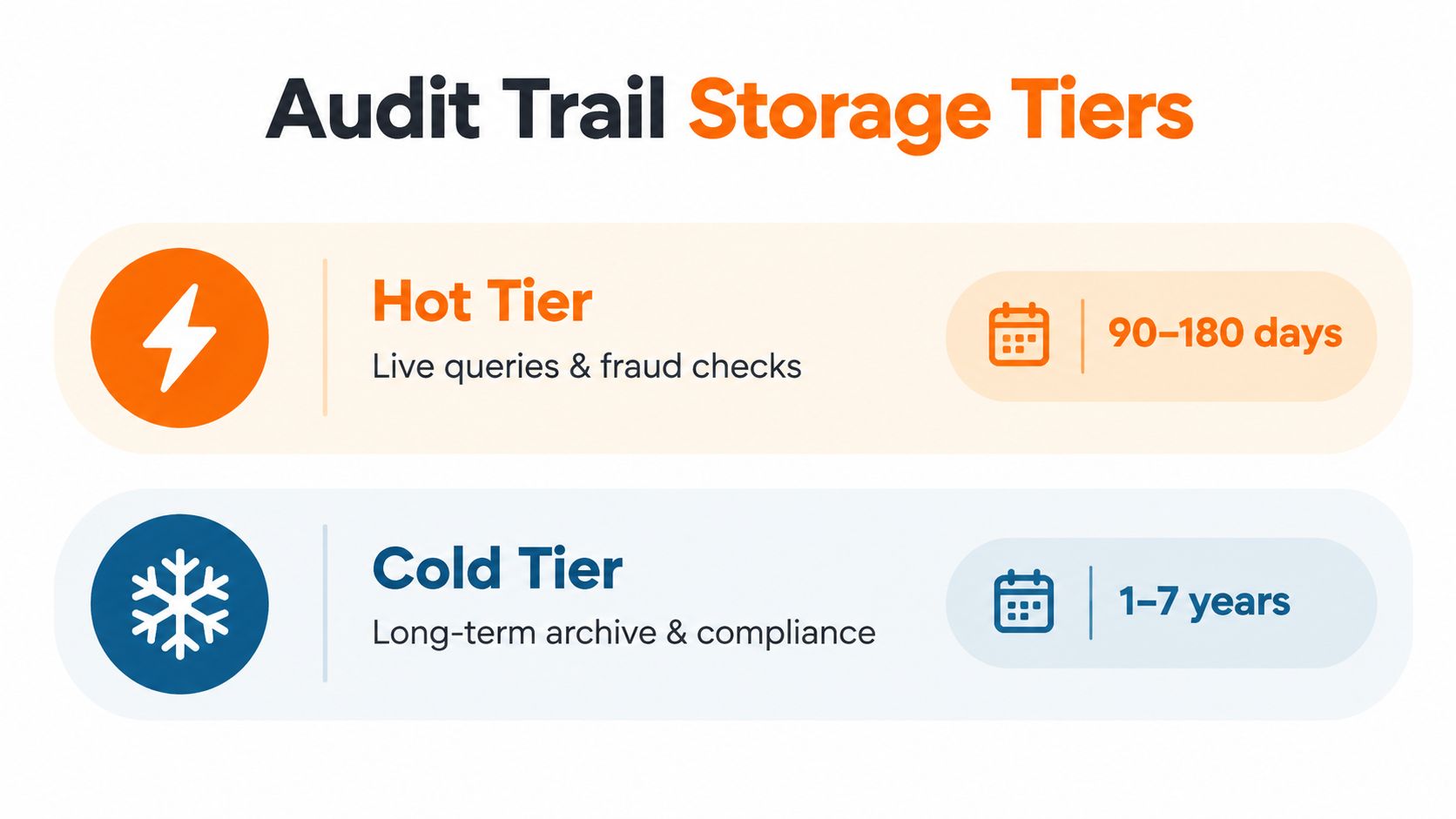
Retention is a product policy, not a single setting. Set it from the strictest applicable obligation, legal holds, investigation needs, and the time regulators or internal reviewers may need to obtain evidence. The one-year PCI baseline covered earlier still requires a defined immediately accessible period under the cited PCI guidance. FDA 21 CFR Part 11 ties audit-trail retention to the electronic record and requires date, time, user identity, and enough detail to reconstruct its history. iGaming operators must also check jurisdiction-specific record-keeping rules, including MGA obligations, before setting a shorter class.
Use a hot tier for active investigations and a cold tier for preserved evidence. Cold records should remain discoverable through manifests, with an assigned owner, retrieval procedure, and restoration test.
Make movement verifiable
Moving events from hot to cold should produce a signed package containing event files, a manifest, sequence range, hash-chain head, Merkle root, retention class, and signer identity. The hot projection can expire under policy, while the archive retains enough metadata to prove that the exported range is complete.
Industry guidance treats 12 months of active access as a practical audit-log benchmark, though a governing rule may require longer preservation as summarized in the retention guidance for audit trails. Object storage with immutability controls can support this model when its permissions and retention locks meet the operator's assurance requirements. Compliance-grade WORM storage may be appropriate where deletion privileges or regulator expectations require stronger evidence.
Cost and response time both matter. A low-cost archive that restores too slowly can delay an investigation, while keeping every debug message hot makes searches noisy and expensive. Classify security, financial, responsible-gaming, AML, and regulatory events separately, then document each retention and retrieval requirement.
API Surface for Querying and Exporting Audit Events
An audit trail system needs an API that supports investigation without exposing the underlying store. A useful surface starts with a filtered event query:
GET /v1/audit/events?from=...&to=...&actor=...&target=...&event_type=...&session_id=...
Use opaque cursor pagination rather than page numbers. A cursor should encode the stable position in the ordered result set without exposing database structure. The response should include the next cursor, query metadata, and an integrity status for the returned records.

The single-event endpoint should return the full cryptographic context:
GET /v1/audit/events/{event_id}
A canonical envelope contains event_id, occurred_at, ingested_at, actor, target, action, before, after, prev_hash, signature, and tsa_token. For a wallet-credit investigation, the client retrieves the event by ID, validates the signature against the published key, recomputes the event digest, and compares prev_hash with the preceding event. A successful response should distinguish “signature valid” from “chain position verified.” Those are separate checks.
Export jobs need their own lifecycle
Use an asynchronous export endpoint:
POST /v1/audit/exportcreates an idempotent export job from a filter and requested format.GET /v1/audit/export/{job_id}returns status, manifest metadata, integrity results, and download references.- A webhook reports completion or an integrity-check failure without requiring constant polling.
Protect the API with scopes such as audit:read, audit:export, and audit:verify. Apply rate limits to expensive wide-range searches, but don't hide evidence behind an interface that only supports a narrow date filter. Record who queried, exported, downloaded, or attempted to access restricted events.
Wallet events often cross fiat and digital-asset flows, so the API should preserve currency, provider reference, ledger entry, and conversion context where applicable. A unified wallet model, such as the one described in this overview of multi-currency wallet architecture, makes cross-product investigation easier when the same player uses casino, sportsbook, and payment features.
The video below illustrates the kind of operational context teams should consider when designing monitoring and retrieval workflows.
Reporting Formats and Regulator Submissions
Export format should follow the recipient's workflow, not the database's internal representation. A regulator reviewing player activity may want a stable, column-oriented file. An incident investigator may need a stream of self-contained records. A licensing authority may need a signed package that can be verified outside the operator's environment.
| Format | Use Case | Regulator Submission | Integrity Control |
|---|---|---|---|
| CSV | Structured player, payment, or activity reporting | Spreadsheet-oriented supervisory and AML workflows | Fixed columns, manifest digest, source query |
| NDJSON | Streaming incident reconstruction | Technical evidence review and event replay | One signed or hash-linked event per line |
| Signed JSON bundle | Forensic evidence and formal assurance | Licensing, enforcement, or dispute submission | Manifest, detached signature, chain head, signer identity |
| Redacted JSON or CSV | Privacy-controlled transmission | Requests requiring limited personal data | Redaction manifest and preserved source references |
CSV is useful when recipients expect fixed columns and familiar spreadsheet tooling. Define the column order, encoding, timestamp convention, null behavior, and amount representation in a versioned specification. Never change a column meaning between exports.
NDJSON suits incident reconstruction because each event remains self-contained and can be processed as a stream. Include the event ID, chain metadata, actor, target, before and after state, and correlation ID on every line where practical.
A signed JSON bundle should contain the data, manifest, hash-chain head, retention class, export parameters, signer identity, and detached signature. The recipient should be able to verify the bundle without calling the production API. That design matters when an investigation concerns the operator's own administrative access.
Redaction must preserve provenance
Run redaction as a derivative export, never as an edit to the source event. Replace unnecessary personal data with stable tokens, record the transformation in a redaction manifest, and preserve the original event ID and digest. The recipient can then see which evidence was withheld without mistaking the derivative file for the canonical record.
The export workflow should also explain the business context. Guidance on what compliance reporting involves is useful for aligning technical fields with operational submissions, but the audit system must retain the raw evidence behind every generated report.
Compliance Mapping Across Major Frameworks
Framework mapping works best when it connects a control to a technical artifact. An operator should be able to point from a requirement to the storage policy, event fields, verification report, and export package that demonstrate implementation.
| Framework / Clause | Control Objective | Audit-Trail Feature |
|---|---|---|
| PCI Requirement 10.7 | Preserve audit history and keep recent evidence accessible | Retention classes, hot-tier retrieval, immutable archive |
| FDA 21 CFR Part 11 | Reconstruct electronic-record history | Timestamp, user identity, before and after state, controlled retention |
| ISO/IEC 27001:2022 | Operate logging and monitoring controls | Centralized collection, access separation, integrity checks, review records |
| NIST SP 800-171 | Support monitoring, investigation, and reporting | Security-event coverage, protected log tools, restricted deletion |
| MGA-style obligations | Reconstruct player, bet, wallet, and administrative activity | Player-level identifiers, trade or bet traceability, reproducible reports |
ISO/IEC 27001:2022 treats logging and monitoring as core controls, so an operator should document not only collection but also review ownership, alert handling, and evidence of control operation. NIST-oriented implementations similarly need to protect the log-management tools themselves, not merely the files they produce.
For iGaming, framework alignment should be expressed in domain terms. A player-level event needs to connect to the relevant wallet, bet, game round, payment, or responsible-gaming action. A control that records only a generic application message may satisfy a technical collection requirement while failing an actual player dispute.
Pre-Audit Quick Reference Checklist
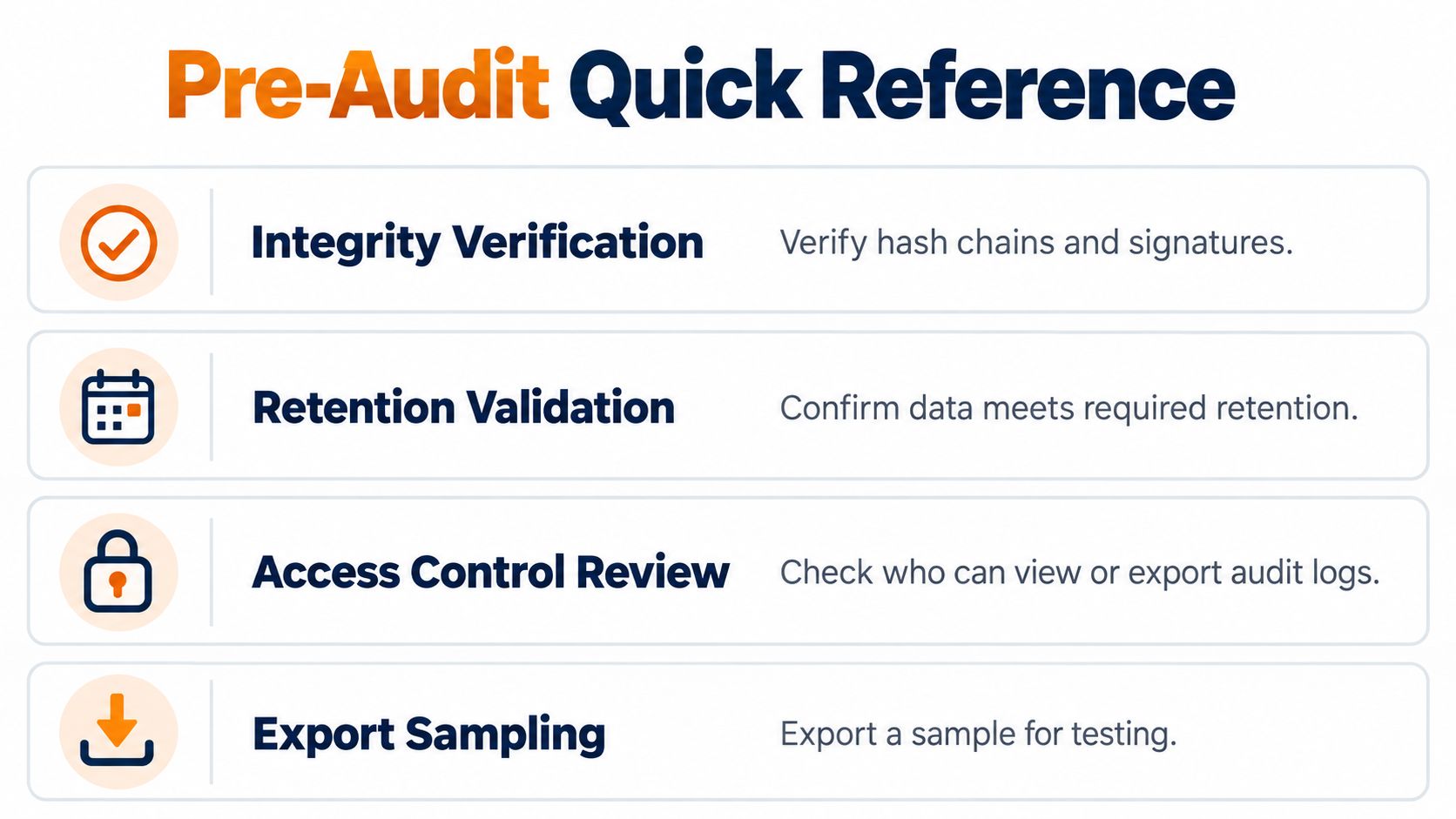
Run this checklist against production configuration, preserved source records, and a sample export. Treat the resulting audit pack as regulator evidence, not a completion tick. Include verification reports, retention manifests, access reviews, export samples, and a signed evidence bundle.
- Integrity verification: Recompute hash-chain links across a selected event range, compare the result with the stored chain head, validate signatures, and record the first affected event if verification fails.
- Retention validation: Confirm that every required retention class contains its source segments, manifests, object-lock state, and retrieval metadata.
- Access control review: List principals with read, export, administrative, signing, and deletion-related privileges. Remove unused access and retain the review record.
- Coverage sampling: Trace a login, wallet transition, bet, bonus decision, withdrawal, self-exclusion action, and administrative change from source event through query projection.
- Export verification: Generate a signed CSV or NDJSON sample. Validate its manifest and signature outside the production service, and record any redaction as a derivative transformation.
- Review evidence: Attach the latest integrity-check result, failed-access events, export history, and the named owner for each retention class.
NIST guidance emphasizes protecting logs from unauthorized access, modification, and deletion. Review the identities and tools that administer the audit platform, including their ability to alter retention, signing, export, or deletion settings.
A consolidated platform can reduce the number of separate systems that operators must reconcile during an audit. Evaluate vendors against required event coverage, retention controls, export formats, and the evidence each workflow can produce before deployment. NexGrate provides integrated wallets, payments, compliance controls, reporting, and searchable activity records for online casino and sportsbook operations. Review its iGaming platform capabilities against those requirements.
NexGrate can connect casino, sportsbook, wallet, payments, and compliance workflows with audit-ready activity records. Visit NexGrate to assess its B2B iGaming stack for traceable operations and regulator-focused evidence workflows.