The regulator's deadline is tomorrow. Your data sits across the player account system, payment gateway, game servers, KYC provider, and warehouse. One jurisdiction wants a CSV, another wants a different field definition, and a late template revision has invalidated the mapping your team tested last week. Someone is reconciling balances in Excel while legal asks whether the evidence will survive an inspection.
That's the reality compliance reporting software has to handle. A polished dashboard is irrelevant if the platform can't preserve source-to-report lineage, isolate jurisdiction rules, manage change, and produce evidence an auditor can follow without trusting your explanations. The right buying decision is therefore not a feature comparison. It's an operational stress test, including the cost of owning the system over three years.
The market signals that this category has moved beyond a narrow back-office utility. The global regulatory reporting solutions market was valued at $6.76 billion in 2025 and is projected to reach $16.2 billion by 2034, with a 10.2% CAGR, according to Dataintelo's regulatory reporting system market analysis. Software represented 62.5% of revenue in 2025, while cloud deployment held 58.3%, reinforcing the direction of travel toward automated, cloud-led reporting.
Table of Contents
- The Moment a New Jurisdiction Goes Live
- What Compliance Reporting Software Actually Does
- Feature Matrix That Survives a Real Audit
- Integration Requirements Most Vendors Downplay
- Pricing and Total Cost of Ownership Over Three Years
- Multi-Jurisdiction Support and Regulatory Change Velocity
- The Operator's Selection Checklist
- When Standalone Reporting Beats a Turnkey Stack
The Moment a New Jurisdiction Goes Live
At 08:00 on launch day, the licence is active and the regulator portal is open. Your compliance lead needs to submit activity from the player account management system, payments ledger, game server, bonus engine, and fraud controls. The same player event appears under different names in different systems, and the regulator's definition of a transaction may not match the finance team's definition.
The first problem is usually not report generation. It's data interpretation. A deposit may be recorded when initiated, authorised, settled, or credited. A bet may carry one timestamp in the game server and another in the warehouse. A player's jurisdiction may depend on session location, account registration, or transaction context. If the platform exports what each source calls the event, your report will be internally consistent and regulatorically wrong.
Where the launch breaks
The predictable failure points are operational:
- Duplicate mappings: Several teams map the same source field independently, producing conflicting logic and expensive reconciliation.
- Jurisdiction-specific definitions: A field that looks universal may carry different meaning, scope, precision, or reporting cadence across regulators.
- Late template revisions: A regulator changes a required column or validation rule after user acceptance testing, forcing hurried remediation.
- Weak evidence retention: The team can submit the file but can't show which source records, transformations, approvals, and exceptions produced it.
- Manual exception queues: Analysts spend their time comparing spreadsheets instead of resolving the underlying data defect.
Practical rule: If the vendor demo only shows a successful submission, ask to see the failed submission, the corrected record, and the complete evidence trail.
That morning is the shortlisting exercise you should have run before signing. A vendor's sales deck can promise broad coverage, automation, and configurable templates. Your evaluation must ask whether the software survives a new licence, a changed schema, a disputed field definition, a failed validation, and an audit months later.
The rest of the decision follows from that standard. Buy for traceability, controlled change, and operational resilience, not for the longest feature list.
What Compliance Reporting Software Actually Does
In operator language, compliance reporting software converts raw business events into regulator-ready submissions. It ingests activity, applies controlled definitions, maps data to jurisdiction requirements, validates the result, routes exceptions, creates the required output, and retains evidence showing how the filing was produced.
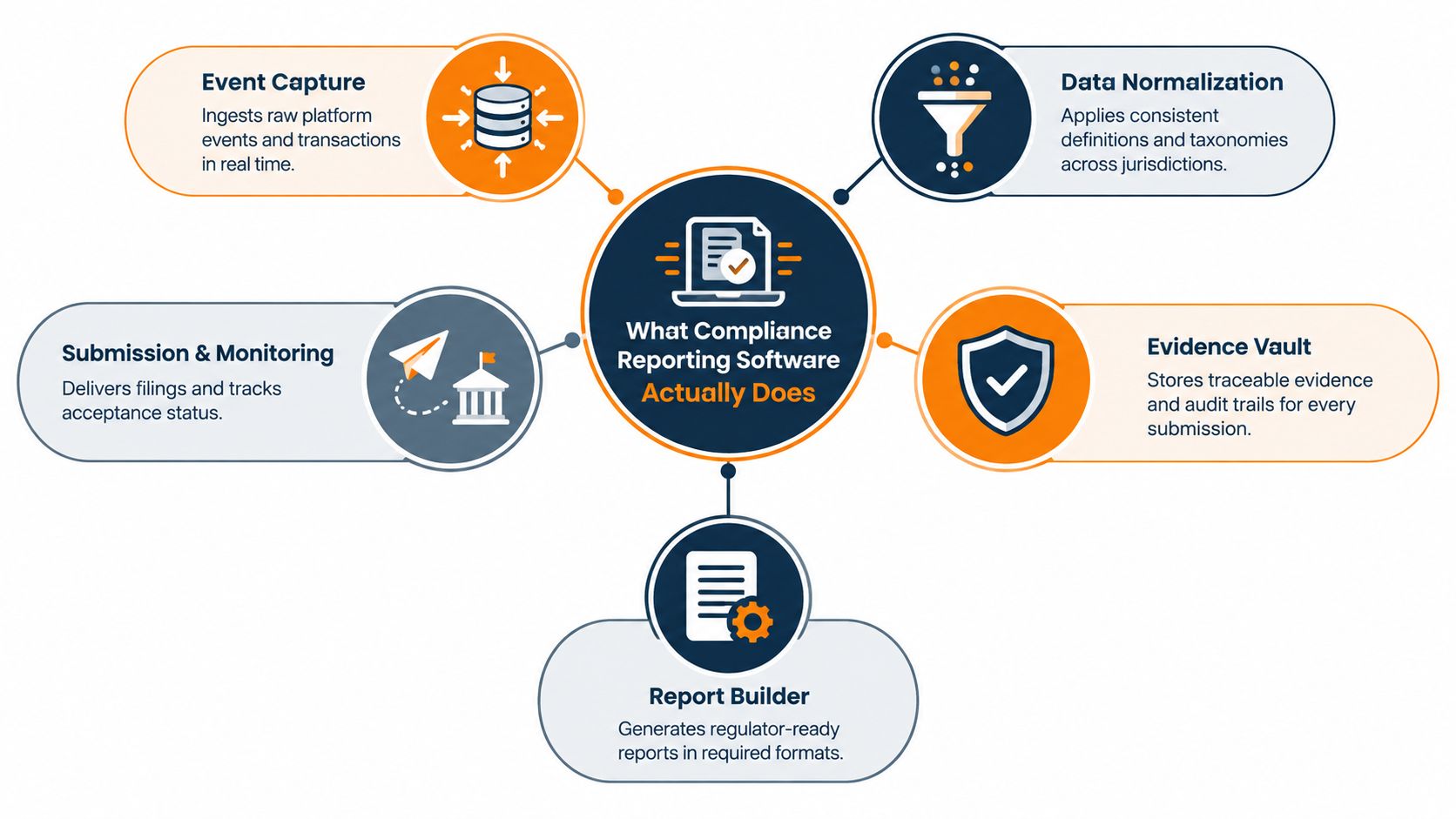
A dependable system performs five connected jobs:
- Event capture: It receives player, transaction, wagering, payment, and operational data from source systems.
- Normalization: It applies consistent taxonomies, time handling, currency treatment, and jurisdiction logic.
- Evidence management: It stores the records, transformations, approvals, corrections, and submission history behind each report.
- Report construction: It generates the required file or structured submission without forcing analysts to rebuild logic in spreadsheets.
- Submission monitoring: It records delivery, validation responses, acceptance status, rejected records, and remediation ownership.
The platform sits inside a wider compliance stack. It may consume outputs from KYC and AML systems, responsible-gaming controls, payment tools, fraud engines, the player account system, and game telemetry. It doesn't replace identity verification, transaction monitoring, sanctions screening, affordability controls, or responsible-gaming enforcement.
That boundary matters because buyers often expect a reporting product to repair upstream data quality. It won't. If the KYC provider sends incomplete country codes, the payment gateway uses inconsistent currency labels, or the PAM stores wallet movements without a reliable event identifier, the reporting layer can flag, transform, or quarantine the problem. It can't make an ungoverned source trustworthy by itself.
The operating model to require
Start with a canonical event model. Define what counts as a player, account, session, deposit, withdrawal, wager, win, bonus, chargeback, and adjustment. Then map each jurisdiction's required fields to that model, rather than allowing every report owner to invent local logic.
The NexGrate guide to compliance reporting is useful for framing the reporting workflow, but the buying question is more demanding: can the software connect each submitted value to a source event and explain every transformation?
A video can help stakeholders understand the workflow, but it shouldn't substitute for a technical demonstration. Ask the vendor to trace one rejected record from regulator response back to the originating event, mapping rule, user action, and corrected resubmission.
Feature Matrix That Survives a Real Audit
Feature breadth is a poor proxy for audit readiness. A vendor may show dozens of templates and still fail to answer a basic question: why does this number appear in the submission?
Score the product against the evidence chain. Reporting depth matters, but configurable definitions, immutable logs, precise location logic, and versioned templates matter more than a large catalogue of lightly supported jurisdictions.
Use the matrix as a challenge script
| Capability | What Good Looks Like | Common Vendor Weakness | Audit-Survival Question |
|---|---|---|---|
| Reporting depth | Supported templates plus configurable rules, field definitions, validations, calculations, and export formats | Templates are fixed, while material changes require vendor services or manual workarounds | Can the team explain and modify a field without breaking prior submissions? |
| Audit logs and evidence | Immutable records of source data, transformations, approvals, exceptions, exports, submissions, and resubmissions | Logs show user activity but not the data lineage or version used in the report | Can you reconstruct the exact report state presented to the regulator? |
| Geofencing | Session and transaction-level location logic, with timestamps, decision rules, overrides, and evidence | Location is captured only at account level or displayed as a dashboard indicator | Can the vendor prove why a specific event was attributed to a jurisdiction? |
| Regulatory templates | Versioned coverage for MGA, UKGC, Curaçao, Ontario, and relevant LATAM frameworks, with update ownership defined | Coverage is marketed by logo, while actual implementation is partial or delayed | What happens when a regulator changes a field, validation rule, or submission channel? |
Reporting depth should be tested with a real report, not a slide. Give the vendor an unusual transaction, a bonus reversal, a multi-currency wallet movement, and a corrected historical record. Ask how the platform recalculates dependent figures and whether it preserves the original submission alongside the amended one.
Audit logging must show chain of custody. A timestamped “report exported” entry isn't enough. You need the source record, transformation logic, user or service account, approval, exception status, output version, and regulator response. If the vendor can't provide that sequence in a sample evidence pack, assume your team will assemble it manually during the audit.
The audit doesn't care that the interface looked modern. It cares whether your evidence is complete, consistent, and reproducible.
Geofencing deserves particular scrutiny in iGaming. Account-level country data can't answer every regulatory question. Session-level and transaction-level evidence should identify the location decision, the signal used, the rule applied, and any override. Test edge cases involving VPN detection, mobile handoffs, interrupted sessions, and payments initiated from a different location.
Template coverage should be evaluated by implementation depth. Ask which fields are native, which are configurable, which require professional services, and who owns updates. Then test timezone conversion, decimal precision, rounding, daylight-saving transitions, and historical restatement. Those details rarely impress during a demo, but they're exactly where reconciliations fail.
Integration Requirements Most Vendors Downplay
Reporting software is only as reliable as the systems feeding it. The minimum integration usually includes the player account management system, payment gateway, KYC and AML tools, game server telemetry, sportsbook or betting engine, bonus system, fraud controls, identity provider, and data warehouse.
Vendors downplay this because connectors sound simple in a sales conversation. “We have an API” says nothing about event completeness, historical backfill, schema governance, retry behavior, or the meaning of each field. A connector that imports a daily file may be technically functional and operationally useless if the regulator expects timely, granular records.
Build the lineage before the interface
Start with the PAM. Confirm how the system identifies players, accounts, sessions, status changes, self-exclusions, limits, and account closures. Then follow money through the payment and wallet layers. Deposits, withdrawals, reversals, fees, chargebacks, conversions, and internal transfers need stable identifiers that survive reconciliation.
Payment and wallet design becomes especially important when balances span currencies or asset types. The NexGrate explanation of multi-currency wallets illustrates why operators must define balance, conversion, settlement, and ledger semantics before mapping them into reports.
| Integration Layer | Why It's Required | Typical Blocker | Risk if Missed |
|---|---|---|---|
| PAM and identity | Establishes player, account, session, status, and jurisdiction context | Duplicate identities, unclear account-state history, incomplete handoffs | Reports attribute activity to the wrong player or licence |
| Payments and wallet | Proves movement of funds, currency, reversals, and settlement | Inconsistent transaction IDs, asynchronous status updates, conversion ambiguity | Financial totals fail reconciliation |
| Game and betting telemetry | Supplies wagers, wins, settlements, voids, and game metadata | Proprietary event formats, missing corrections, different timestamp conventions | Gaming activity can't be reproduced |
| KYC, AML, and fraud | Connects due diligence, alerts, risk decisions, and restrictions | Vendor-specific schemas and privacy boundaries | The report lacks supporting control evidence |
| Warehouse and analytics | Supports aggregation, historical analysis, and cross-system checks | Schema drift, delayed loads, undocumented transformations | Teams submit numbers that don't match finance or operations |
| Regulator channels | Delivers files, acknowledgements, errors, and resubmissions | Portal changes, certificate ownership, format validation gaps | A correct report still misses the filing process |
Require API versioning rules, schema-change notices, replay capability, and documented ownership for every interface. Also ask whether the platform can preserve raw data separately from normalized data. You need both when an auditor challenges a transformation.
Reference checks should focus on live, audited environments. Ask how the customer handled a late source-system change, a historical correction, a rejected submission, and a jurisdiction rollout. A successful pilot proves very little if it never faced production volume, regulator feedback, or an audit request.
Pricing and Total Cost of Ownership Over Three Years
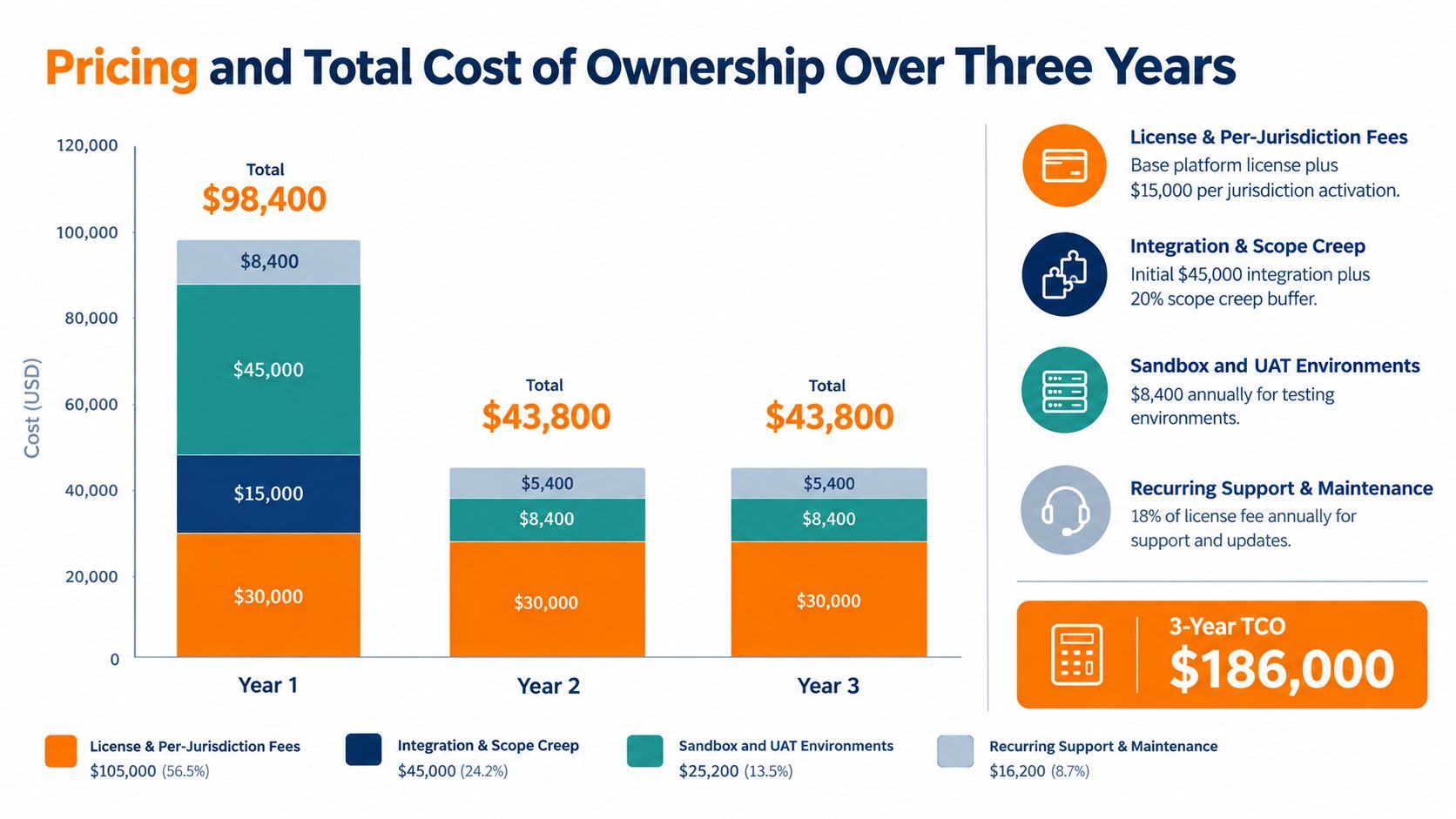
The licence quote is the least reliable number in a reporting purchase. Your three-year cost sits in activation fees, integrations, testing environments, template maintenance, evidence exports, internal review, and exit work.
A useful commercial model separates fixed and variable charges:
- Platform fee: Base subscription, environments, storage, users, service accounts, and support tier.
- Jurisdiction cost: Activation, template packs, local configuration, certification, and future amendments.
- Integration cost: Initial connectors, data cleansing, historical migration, bespoke mappings, and change requests.
- Operational cost: Compliance analysts, data owners, reconciliation, exception resolution, and second-line review.
- Change cost: Regulatory interpretation, testing, approval, documentation, and production deployment.
- Exit cost: Data extraction, evidence retention, migration assistance, termination fees, and continued access to historical records.
The market is large enough that buyers should expect commercial sophistication, not vague packages. One estimate values the broader compliance software market at $60.35 billion in 2025 and projects $229.02 billion by 2035, while another regulatory-reporting estimate places the 2025 category at $7.2 billion and projects $17.8 billion by 2034. These are different market scopes, as shown in Business Research Insights' compliance software market coverage, so don't use them as a pricing benchmark. Use them as a reminder to demand precise definitions from vendors.
A worked scenario without fictional pricing
Don't build a business case from invented assumptions. Build two vendor-priced scenarios using the same scope: a mid-market operator expanding from MGA into Ontario, and a separate LATAM entry covering the actual launch markets under consideration.
For each scenario, request a three-year schedule showing licence, jurisdiction activation, implementation, integrations, sandbox and UAT access, support, template updates, data migration, audit exports, and internal staffing. Ask the vendor to price a regulatory change that requires a new field, a historical recalculation, and a controlled release. If the answer is “services quoted separately,” record that as a material TCO risk.
The FanRuan guide to automated regulatory reporting recommends measuring outcomes such as submission timeliness, first-pass acceptance, data-quality error rate, exception resolution time, manual touchpoints, reconciliation variance, approval cycle time, evidence completeness, regulatory change implementation time, and cost per report. Put those metrics into the contract or proof-of-value plan.
Multi-Jurisdiction Support and Regulatory Change Velocity
“Multi-jurisdiction support” is meaningless unless the contract defines what it includes. A credible platform should provide jurisdiction profiles, parameterised templates, controlled field definitions, versioned evidence packs, update notices, testing support, and clear responsibility for interpreting and deploying changes.
MGA and UKGC obligations may be familiar to an experienced operator, but familiarity doesn't make them interchangeable. Ontario has its own AGCO and iGaming Ontario context. Curaçao's LOK regime introduces a different change-management question. Brazil and Colombia require careful attention to local data models, reporting channels, and implementation timelines. A vendor that treats every market as a renamed template will create local exceptions in your operating model.
| Capability | MGA | UKGC | Ontario AGCO/iGO | Curaçao LOK | LATAM Brazil/Colombia |
|---|---|---|---|---|---|
| Jurisdiction profile | Confirm licence, player, product, and reporting scope | Separate local definitions and cadence from MGA logic | Model regulator and operator obligations distinctly | Validate regime-specific requirements and transition handling | Expect local variations rather than a generic regional profile |
| Template versioning | Preserve historical submissions and amendments | Track revisions without overwriting prior logic | Test portal and schema changes independently | Record changes during regime evolution | Require documented release and rollback controls |
| Evidence pack | Source lineage, approvals, exceptions, and submission response | Same evidence standard, with local field interpretation | Include jurisdiction-specific validation results | Retain transition and remediation history | Keep local mappings and translations controlled |
| Change workflow | Impact assessment, owner, testing, sign-off | Parallel testing where reporting overlaps | Formal release governance | Rapid interpretation and controlled deployment | Local counsel and compliance review may be necessary |
| Operational test | Reconcile report to PAM, wallet, and finance | Trace a player event end to end | Test location, currency, and filing logic | Test historical records through the new model | Test local payment and identity data paths |
One global instance or local deployments
Use one global instance when the operator has a common canonical data model, centralized governance, shared identity and access controls, and enough configuration to isolate jurisdiction rules. A single instance reduces duplicated mappings and makes cross-market controls easier to compare.
Use replicated local deployments when data residency, regulator access boundaries, local operational ownership, or incompatible release schedules make centralization unsafe. Don't choose local instances merely because the vendor's global model is weak. That decision creates multiple evidence stores, duplicated controls, and a heavier upgrade burden.
A 2026 survey cited by Cappitech's regulatory operations report found that 15% of firms had fully automated regulatory operations, while 70% were using or planning third-party automation for reconciliation and data-quality management. The implication is practical: buyers need to assess operationalization, not just filing functionality.
PwC's discussion of renewing regulatory reporting technology also highlights the pressure created by accelerating regulatory change and vendor consolidation in Europe. Ask for evidence of updates delivered during live consultations, not a roadmap slide.
The Operator's Selection Checklist
Start with a scoring sheet before vendor demos. Weight the criteria by the cost of failure, not by how attractive the interface looks.
| Criterion | Suggested Weight | Vendor A Score 1-5 | Vendor B Score 1-5 | Weighted Notes |
|---|---|---|---|---|
| Reporting fidelity | High | Can the platform reproduce the regulator's required definitions and validations? | ||
| Audit-grade evidence | High | Does it preserve source lineage, versions, approvals, and corrections? | ||
| Integration robustness | High | Are production connectors proven across PAM, wallet, payments, and telemetry? | ||
| Jurisdiction coverage | High | Is coverage deep, versioned, and contractually maintained? | ||
| Three-year TCO | High | Are activation, change, services, environments, and exit costs visible? | ||
| Exception management | Medium | Can teams route, own, resolve, and evidence exceptions? | ||
| Change governance | Medium | Can the operator test, approve, release, and roll back changes? | ||
| Usability | Low | Can trained users work efficiently without weakening controls? |
Use a five-point score only after demanding proof. A “5” should mean the vendor demonstrated the capability against your data and supplied evidence. A “3” means it exists but needs configuration or services. A “1” means roadmap, manual workaround, or unsupported claim.
Two decisions that change the shortlist
Choose best-of-breed reporting when your upstream stack is mature, your data model is complex, or your licences have conflicting requirements. Choose an embedded compliance module when the platform owns the underlying events, wallet, player records, and reporting logic, and the operator values reduced integration surface over deep specialization.
Choose one vendor across licences when it can isolate jurisdiction logic, maintain versioned evidence, and meet every regulator's operational needs. Choose specialists when a general platform repeatedly forces manual mapping or cannot prove timely template maintenance.
Red flags are straightforward:
- No sample submission: The vendor won't provide a realistic regulator-facing output.
- Manual mapping dependency: Analysts must maintain critical mappings outside governed workflows.
- Licence-based ambiguity: Pricing is tied to vague licence counts instead of defined jurisdiction templates and services.
- No rejected-record demo: The platform only shows the happy path.
- Weak exit terms: Historical evidence becomes inaccessible after termination.
Use the NexGrate vendor management best practices guide when structuring reference checks, service ownership, escalation, and renewal terms. Then demand a 90-day proof of value tied to one live regulatory report, real source data, a documented exception, and an evidence-pack export. A generic demo proves the vendor can present software. A controlled proof proves your team can operate it.
When Standalone Reporting Beats a Turnkey Stack
Standalone compliance reporting software wins when the operator already has a mature PAM and game aggregator, operates across several jurisdictions with conflicting reporting cadences, or must support regulator-specific data models that a turnkey stack simplifies too aggressively. It's also the safer option during an acquisition, when inherited systems can't be replaced without destabilizing the business.
A turnkey platform is usually the better call for an operator launching from scratch with a small jurisdiction footprint and shared operational infrastructure. Built-in player accounts, wallets, payments, KYC and AML workflows, gaming content, sportsbook functions, geofencing, and reporting reduce the number of interfaces your team must govern. That trade-off is speed and integration simplicity versus the depth and independence of a specialist reporting layer.
NexGrate offers a white-label casino and sportsbook platform with player account management, wallets, payments, KYC and AML workflows, geofencing, audit logs, and jurisdiction-specific reporting capabilities. It can be relevant when an operator wants reporting controls embedded in a broader operating stack rather than added as a separate system.
The decision rule is simple: if reporting exceptions consume more than one full-time equivalent each quarter, standalone reporting pays back within eighteen months. Treat that as an operational threshold to test against your own staffing and exception data, not as a vendor promise.
If you're preparing a new licence launch, replacing a legacy backend, or testing whether your current reporting process can survive an audit, review the integrated casino, sportsbook, payments, wallet, and compliance capabilities available through NexGrate. Ask for a workflow based on your jurisdictions, source systems, reporting cadence, and evidence requirements, not a generic product tour.