Monday starts with four urgent requests and one unreliable spreadsheet. Finance needs Friday's GGR and NGR, compliance needs an MGA submission file, payments wants processor-level exposure, and the executive team wants a concise view of commercial and operational risk before lunch. Each request points to the same underlying activity, but every team rebuilds the answer in a different format.
That workflow creates more than wasted time. It creates version drift, unclear ownership, weak evidence trails, and avoidable questions when a regulator or auditor asks how a figure was produced. Stakeholder reporting works when one controlled dataset can produce several audience-specific views without changing the underlying facts.
Table of Contents
- The Monday Morning Reporting Scramble
- What Stakeholder Reporting Means for an iGaming Operator
- Mapping Stakeholder Groups to Their Reporting Needs
- Critical KPIs and Where the Data Comes From
- Report Templates and Reporting Cadence
- Automating Auditability with NexGrate
- Best Practices and Common Pitfalls
- Putting It Together and Your Adoption Checklist
The Monday Morning Reporting Scramble
At 9 a.m., the finance officer opens the ledger, the compliance lead checks the KYC queue, and the payments manager downloads processor files. The sportsbook team is already looking at live activity, while the chief executive wants a one-page summary that excludes operational detail but still flags anything that could affect the business.
The numbers may look familiar, but they rarely arrive with the same definition. One spreadsheet may treat refunds differently from another. A compliance file may use a reporting period that doesn't match the finance close. A payment report may identify a chargeback by processor reference, while the player team identifies it by account. By the time someone reconciles the files, the deadline has become the main control.
Practical rule: If two teams can produce different answers to the same question, the problem is usually governance before it's formatting.
The underlying issue is that operators treat reports as documents instead of outputs from a controlled data process. A report assembled manually can hide the origin of a value, the person who changed it, and the reason for the change. It also makes the next request harder, because the team has to repeat the same extraction and reconciliation exercise.
The cost of fragmented reporting
A regulator doesn't only need a polished table. The regulator may need to understand who was engaged, what was identified, which decision followed, and what evidence supports the conclusion, particularly where reporting obligations require documented controls. The European Commission describes CSRD reporting as covering risks and opportunities from social and environmental issues, as well as business impacts on people and the environment, with the first affected companies applying the rules for the 2024 financial year and publishing reports in 2025. That broader regulatory example reinforces the direction of travel toward traceable disclosure, even though iGaming reporting has its own licensing requirements. Read the European Commission's CSRD overview.
For an operator, the fix isn't sending everyone the same report. It's maintaining one source of truth, then packaging the relevant evidence for each audience. Finance can receive a close pack, compliance can receive a structured submission, and leadership can receive a concise dashboard, all generated from reconciled records.
What Stakeholder Reporting Means for an iGaming Operator
For an online casino or sportsbook, stakeholder reporting is the controlled presentation of operational, financial, player, payment, and compliance information to people who rely on it. The audiences include regulators, investors, payment partners, game providers, internal teams, and players. Each group needs a different level of detail, but the facts underneath must remain consistent.
Think of the operator as a landlord managing a complex building. Players are tenants using the service, payment providers keep the utilities running, game suppliers occupy commercial space, regulators inspect the building, and investors assess whether the property is being managed responsibly. A landlord wouldn't maintain a separate set of physical facts for every tenant. The operator shouldn't maintain separate definitions of deposits, winnings, refunds, or player status either.
This is different from generic sustainability or ESG reporting. Sustainability reporting often focuses on environmental, social, and governance impacts, materiality, stakeholder consultation, and formal public disclosure. iGaming stakeholder reporting focuses more directly on player protection, KYC and AML controls, funds, wagering activity, payments, bonuses, settlements, and licensing evidence. The disciplines can share principles, but the operational records and submission requirements aren't interchangeable.
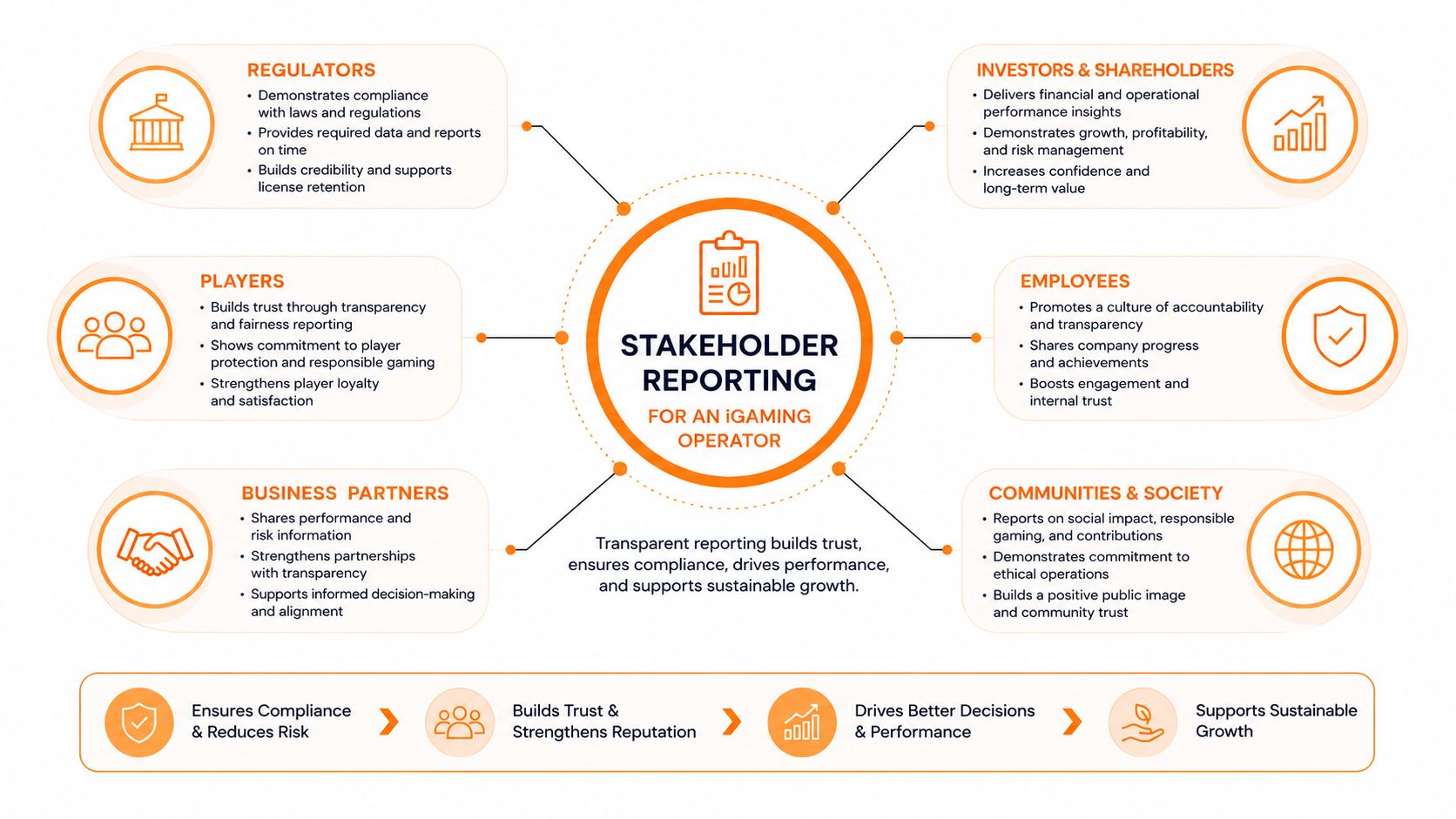
Three properties separate a usable report from a risky one
- Traceability means every reported value can be connected to source records, such as a wager, wallet movement, KYC decision, bonus settlement, or payment event.
- Consistency means the same defined metric produces the same result across finance, compliance, board, and partner views.
- Auditability means another person can reconstruct the calculation, review the relevant controls, and understand any adjustments without relying on the memory of the analyst who prepared the file.
A mature process also preserves context. If a team excludes a record, changes a classification, or applies a reporting rule, the rationale belongs with the data change. A separate email thread is not a durable control.
Mapping Stakeholder Groups to Their Reporting Needs
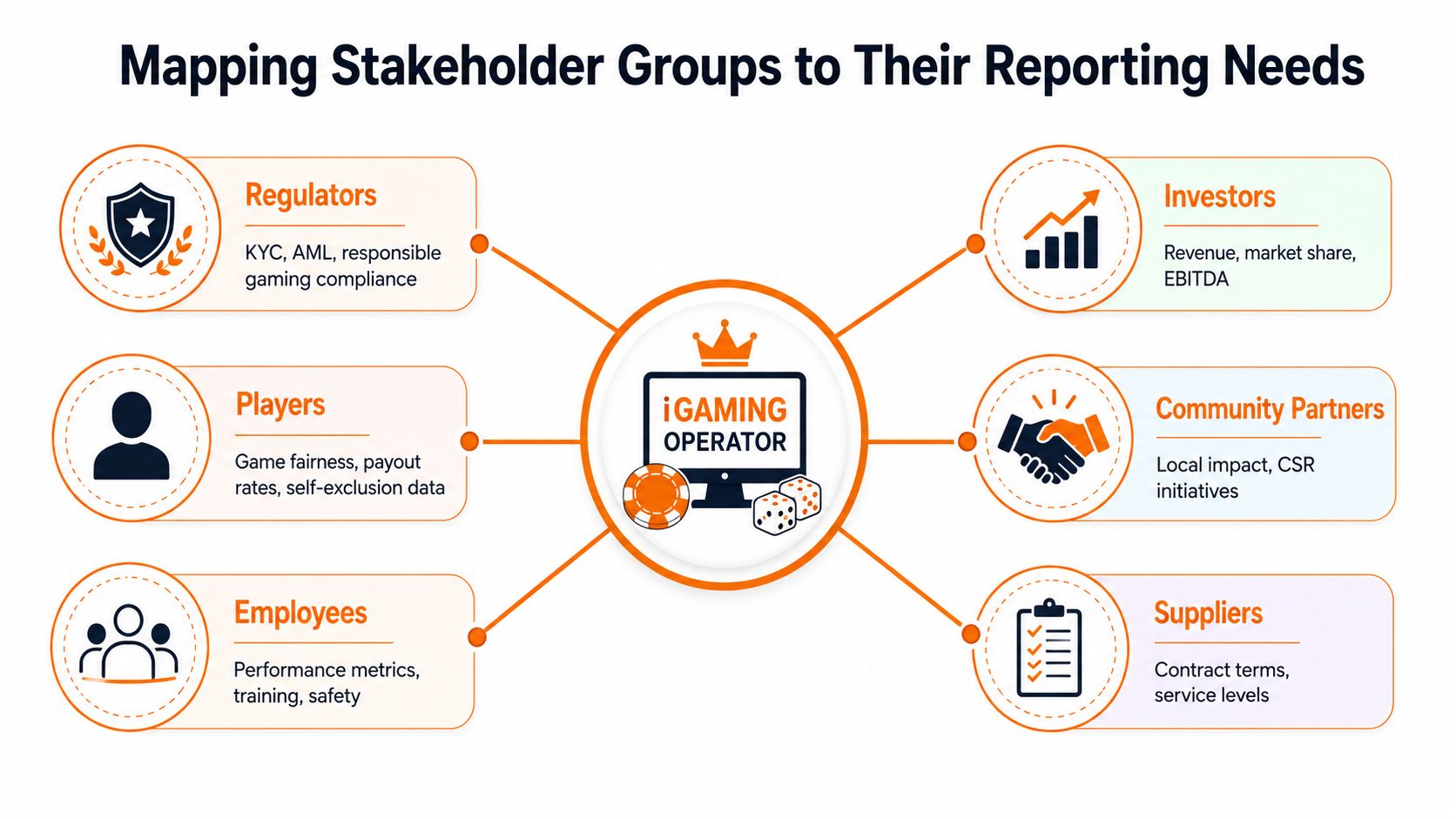
Different stakeholders don't need different truths. They need different views of the same truth. That distinction matters because audience-specific packaging reduces unnecessary detail without creating contradictory versions.
Regulators and licensing authorities
Regulators such as the Malta Gaming Authority and other licensing bodies need evidence that the operator is controlling player risk, handling funds properly, and monitoring suspicious activity. The relevant source areas include Players, KYC, Wallets, Transactions, and Reports.
A regulatory pack should make it possible to identify the population covered, the reporting period, exceptions, decisions, and supporting records. It should also distinguish between a clean result and an incomplete result. Omitting unresolved cases may make a file look tidy, but it weakens credibility when the underlying queue tells a different story.
Investors and the board
Investors and directors usually need a compressed commercial view. They care about revenue performance, margin, player activity, retention signals, material risks, and decisions requiring oversight. The Reports tab and the master dashboard can provide the summary, while Wagers, Wallets, Transactions, and Bonus provide drill-down evidence when a number needs explanation.
The board pack shouldn't reproduce every operational event. It should show what changed, why it matters, and what management is doing about it.
Payment partners and acquiring banks
Payment stakeholders focus on deposits, withdrawals, decline patterns, disputes, chargebacks, processor exposure, and source-of-funds evidence. Wallets, Transactions, Players, and KYC should feed these views. The payment manager may need processor or method filters, while the compliance team needs the player and verification context behind unusual activity.
Providers and aggregators
Game and sportsbook providers need settlement information, gross win, round or bet records, disputes, and reconciliation evidence. Wagers, Transactions, and Reports are the natural backbone. The commercial report may be partner-specific, but the operator's internal settlement record must remain the authoritative version.
Internal teams and players
Marketing, fraud, risk, and support teams need narrower operational slices. Marketing may use Bonus, Players, and Wallets. Fraud teams need Reports, Transactions, and KYC outcomes. Support needs player statements, wallet movements, bonus history, and responsible gaming actions.
Players deserve a clear personal view, not an internal data dump. Their statements should explain balances, deposits, withdrawals, wagering activity, bonus effects, and relevant account restrictions in language they can understand. Role-based access matters because the same platform can serve many audiences without exposing information that doesn't belong in a particular view.
Critical KPIs and Where the Data Comes From
A KPI is only useful when its definition, calculation, owner, and source are fixed. Write those rules down before building dashboards. Otherwise, teams will alter the metric to fit the audience or the available export.
For an operational definition of the wider industry context, see what iGaming means for operators. The same discipline applies to reporting: define the question first, then identify the records that answer it.
| KPI | Definition | NexGrate Source |
|---|---|---|
| GGR | Stakes minus winnings minus refunds | Wagers and Transactions |
| NGR | GGR minus realized bonus cost | Wagers, Transactions, and Bonus |
| Active players | Players meeting the operator's defined activity rule within the reporting period | Players and Sessions |
| Deposit conversion | The operator's defined relationship between depositing activity and the relevant player population | Wallets and Players |
| Bonus cost ratio | Realized bonus cost compared with the operator's chosen commercial base | Bonus and Reports |
| KYC pass rate | Passed KYC cases compared with the defined KYC case population | KYC |
| Fraud flag volume | Flagged activity recorded under the operator's fraud rules | Reports and Transactions |
Definitions need ownership
GGR and NGR deserve particular control because small differences in treatment can affect finance, partner settlement, and regulatory reporting. If refunds, voids, bonus costs, or settlement timing are handled differently by two teams, reconciliation becomes a debate about spreadsheets rather than a review of business activity.
The source tab is not the same as the final audience view. A board report may show a single NGR line, while finance needs transaction-level detail and compliance needs a defined regulatory extract. Both outputs should point back to the same calculation logic.
Build reconciliation into the workflow
Don't wait until month-end to discover that the board pack and the compliance file disagree. Reconcile the core measures at the point of preparation, record the reporting period and filters, and retain the export used to produce the submitted file.
For player-facing statements, clarity matters more than internal terminology. A support agent should be able to trace a player's question from the statement to the wallet movement, transaction record, bonus event, or wager without asking three other teams to rebuild the account history.
Report Templates and Reporting Cadence
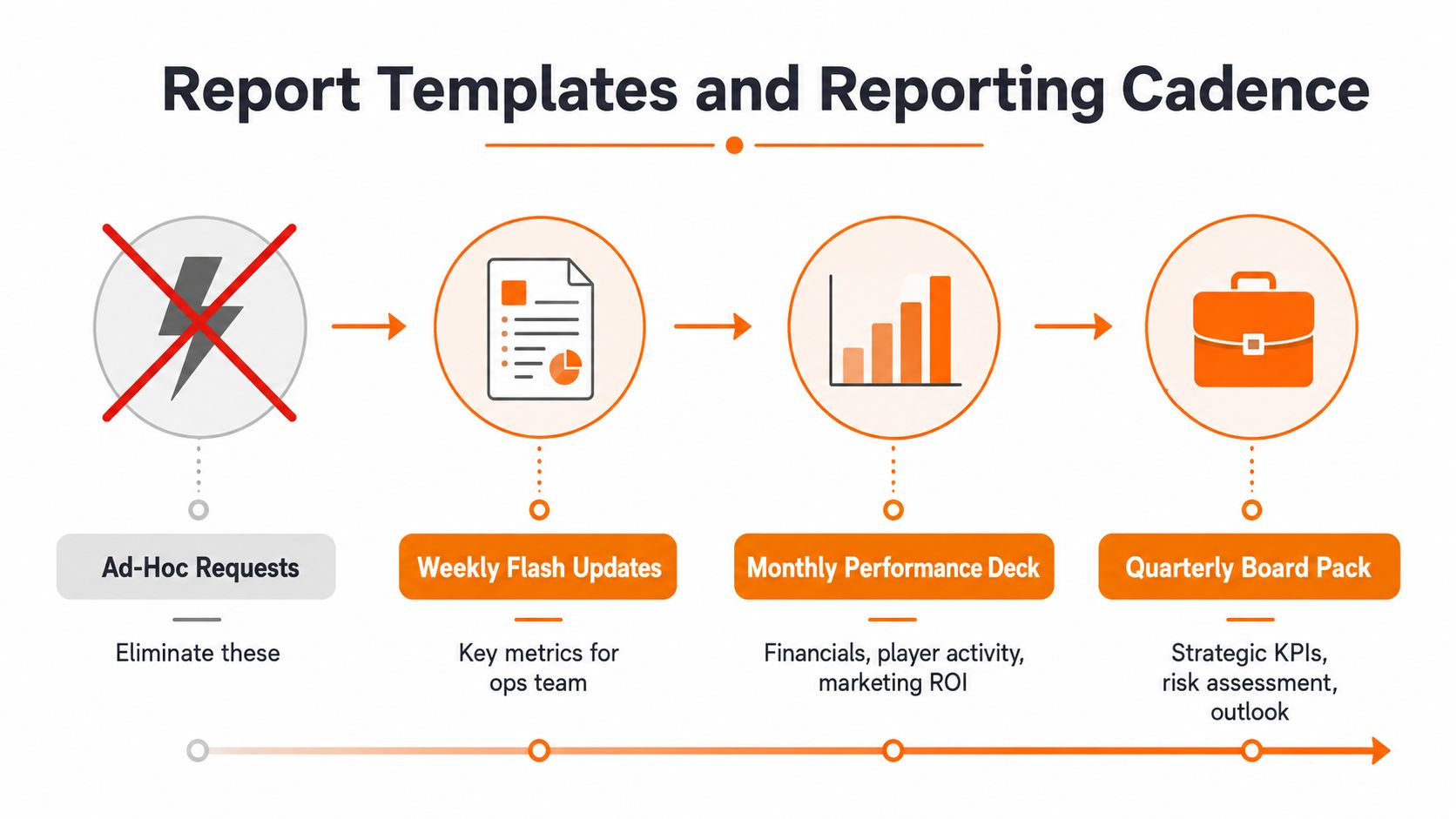
A reporting calendar prevents urgent requests from becoming the default operating model. The cadence should match the risk and decision cycle, not the convenience of whoever happens to own the spreadsheet.
Daily operational control
Daily reporting belongs to teams that need to act while activity is still live. Use dashboard cards for active players, deposit volume, payment exceptions, unresolved flags, and material account restrictions. The output can remain inside the operating environment, provided ownership and escalation rules are clear.
Fraud and responsible gaming teams shouldn't wait for a monthly pack to identify a queue that requires intervention. Daily monitoring is about action, not presentation.
Weekly financial and operational review
The weekly close should cover GGR, NGR, deposits, withdrawals, bonus movements, and material payment or fraud exceptions. Export the relevant reports from the Reports tab with tenant and date filters applied, then preserve the exported file with the reconciliation notes.
A useful weekly review has three parts:
- What changed: identify movements from the previous review.
- Why it changed: connect the movement to wagers, payments, bonuses, player mix, or operational events.
- What requires action: assign an owner and a due date.
Monthly and quarterly governance
The monthly compliance pack should combine KYC, AML, responsible gaming, player-fund, and exception evidence. The format should follow the applicable framework and make the source population clear. Guidance on structuring these obligations is available in NexGrate's compliance reporting guide.
Quarterly board and investor reporting should use the master dashboard and product split, with concise commentary on commercial performance, risk, controls, and decisions. The board doesn't need every record, but it must be able to challenge the summary and obtain supporting evidence.
Annual audit preparation
The annual package should bring together the double-entry trail, bonus escrow movements, provider settlements, access records, reconciliations, and documented decisions. Don't build this archive at year-end. Store the evidence as part of each reporting cycle so the annual package is assembled from controlled outputs rather than reconstructed from inboxes.
Automating Auditability with NexGrate
Automation only helps when the underlying records are structured and linked. A fast export from a weak data model produces a fast, unreliable report. The useful target is an evidence chain that lets a reviewer move from a summary figure to the events and controls behind it.
Start with the transaction trail
Double-entry bookkeeping links each bet to corresponding transaction records. That structure lets finance re-derive GGR from the transaction log instead of trusting a manually typed total. It also supports reconciliation between wagering activity, wallet movements, provider settlements, and reported commercial figures.
Bonus escrow creates another important separation. Real and bonus balances should remain distinguishable, so a reviewer can follow how a bonus was issued, used, settled, expired, or reversed. Without that separation, teams may struggle to explain whether a reported cost represents an actual settled amount or an unreconciled promotional liability.
Control access as part of the evidence
NexGrate provides 130-plus permission keys at page, tab, and field level, allowing administrators to define access to sensitive areas and maintain a controlled permission model. The exact permission assignment should reflect job responsibilities, segregation of duties, and the applicable licensing framework.
TOTP-based two-factor authentication and session metadata capture add context around access. IP, device, language, country, and last-login information can help investigators establish who accessed an account and when. Access logs don't replace review procedures, but they give the review a factual starting point.
Audit question: Can you show the source record, calculation rule, access history, and approval path without asking the original analyst to explain it from memory?
For operators assessing a platform, NexGrate's compliance platform should be evaluated alongside the operator's own policies, jurisdictional requirements, integrations, and review controls. No backoffice removes the need for accountable compliance ownership. It can, however, reduce the amount of manual reconstruction required to prepare evidence.
Best Practices and Common Pitfalls
The cleanest reporting processes make five decisions early. They decide what each KPI means, where it comes from, who owns it, how often it is reviewed, and what evidence must be retained.
Define the data dictionary before the dashboard. Write the treatment for stakes, winnings, refunds, bonuses, voids, player status, and reporting periods. Get finance, compliance, operations, and leadership to approve the definitions before anyone builds audience-specific templates.
Package by audience, not by department. Investors may need a concise trend and risk summary. Regulators need structured evidence and exceptions. Payment partners need processor-specific reconciliation. The dataset stays unified, while the presentation changes.
Attach rationale to changes. If a classification changes or a record is excluded, preserve the reason beside the decision. A separate document may explain the policy, but the record needs its own context.
Automate routine exports. Scheduled CSV exports with tenant and date filters reduce copy-paste errors. Email delivery can notify owners, but the system of record must remain the authoritative location for the underlying data and retained output.
Failure patterns that keep returning
The most common failure is rebuilding the same number in Excel for every stakeholder. Finance adjusts one figure, compliance uses another, and the board receives a third version that nobody can reconcile quickly.
Another failure is treating reporting as a quarterly project. A fragmented record becomes much harder to defend when the team starts collecting evidence only after a submission request arrives. A real-time audit trail, with meetings, decisions, commitments, and supporting records logged when they occur, is more reliable than retrospective reconstruction. See the operational audit-trail guidance for stakeholder engagement reporting.
Incomplete information creates a different credibility problem. If Scope 3, transition costs, or adaptation planning are outside the subject matter, that example from broader sustainability reporting still illustrates a relevant principle for operators: disclose the boundary, explain the methodology, and identify uncertainty instead of presenting partial coverage as complete. EFRAG's ESRS statistics and report portal highlights the continuing importance of methodology, scope, and stakeholder engagement quality in formal reporting.
More reporting isn't automatically better. Consistent packaging from one controlled dataset is better than more pages built from conflicting files.
Putting It Together and Your Adoption Checklist
The Monday scramble disappears when the operator stops treating each request as a new reporting project. Finance, compliance, payments, leadership, providers, and players can receive different views while the records, definitions, and calculation logic remain controlled.
Run these checks this week:
- Reconcile definitions: Confirm that finance, compliance, and board reports use the same GGR, NGR, player, bonus, and reporting-period rules.
- Review access evidence: Verify that player-data access is assigned by role and logged, rather than shared through one administrator account.
- Test submission provenance: Confirm that MGA files come from a system of record with retained filters and exports, not a reconstructed spreadsheet.
- Trace bonus settlement: Follow a bonus from issuance through escrow, use, settlement, expiry, or reversal, and connect it to the relevant transaction records.
- Fix the review rhythm: Schedule a weekly leadership review of the master dashboard, with owners assigned to every unresolved exception.
NexGrate brings player management, wallets, KYC and AML workflows, bonuses, wagering, transactions, payments, and reporting into one backoffice environment. For an operator replacing a fragmented legacy stack, the practical evaluation is whether those records can produce consistent audience-specific reports and an evidence trail that compliance teams can defend.
NexGrate provides a unified white-label platform for online casino and sportsbook operators, with backoffice controls for player accounts, wallets, KYC and AML workflows, payments, bonuses, reporting, and audit support. Review how the platform can support your stakeholder reporting model, then visit NexGrate to discuss your launch or migration requirements.