You've got the license shortlist open, the payment stack spreadsheet is messy, and your first brand still doesn't have a launch date. The question isn't whether iGaming is “a gambling website.” The question is what it takes to run a regulated digital wagering business that can survive deposits, withdrawals, fraud checks, content delivery, player support, and compliance at the same time.
That's where most founders get stuck. They start with the visible layer, the casino lobby or sportsbook home page, then discover that the harder work sits underneath in wallets, game aggregation, risk controls, reporting, and jurisdiction rules. In 2026, iGaming is a mobile-first, regulated mass-market category, not a grey-zone side project. Independent market trackers place the sector at roughly USD 91.63 billion to USD 115 billion in 2025 to 2026, with projections continuing upward in the years ahead, which is a strong signal that this is a serious operating market, not a novelty (industry market report).
The shift to mobile changed the operating model as much as the market size did. In the U.S., the American Gaming Association reported USD 6.19 billion in online sports betting and iGaming revenue in Q1 2025, a record 32.8% share of total gambling revenue, with online revenue growing faster than land-based gaming in that period (AGA Q1 2025 summary). That tells you where player behavior is heading, and why operators now build for phones first, not desktop first.
Table of Contents
- The Reality of Running an Online Gambling Brand
- Defining iGaming and Its Core Verticals
- The Operator Tech Stack From Wallet to Website
- How iGaming Operators Actually Make Money
- White-Label vs Custom Build How Operators Enter the Market
- Licensing Compliance and the Payments Reality
- The KPIs That Separate a Profitable Brand From a Burning One
- Trends Shaping iGaming and Risks Operators Often Miss
The Reality of Running an Online Gambling Brand
A founder can make a brand look real in a week. A logo, a lobby, a bonus offer, a media plan, and a country target are easy enough to sketch. The harder part is understanding that the business behaves more like a regulated payments company with entertainment layered on top than like a normal content website.
That difference matters because every player action touches systems that have to stay accurate under pressure. A deposit needs to clear, a wallet balance needs to update, a bet needs to settle, and the platform still has to preserve auditability if a regulator asks for the trail later. That is why iGaming is not just “online gambling,” it is a high-availability operating business with product, risk, compliance, and infrastructure tied together.
From niche hobby to regulated digital mass market
The question is what it takes to run a regulated digital wagering business at scale. Analysts tracking the sector continue to place iGaming in a large, expanding category, with independent views putting it around USD 91.63 billion to USD 115 billion in 2025 to 2026, and another market view placing the broader online gambling category at USD 88.0 billion in 2025, rising to USD 97.7 billion in 2026 and USD 202.8 billion by 2033 at 11.0% CAGR. Those projections matter less as trivia and more as proof that operators are building inside a market with room for serious competition.
Mobile changed the operating model as much as it changed the user journey. A global industry summary says mobile now contributes roughly USD 83 billion in iGaming gross gaming revenue and is expanding at an 11.2% compound annual rate. The customer journey now starts in a handset, not in a desktop browser on a quiet evening.
Practical rule: if your launch plan assumes desktop-heavy behavior, your product, onboarding, and retention model are already behind.
That is why the rest of the stack matters. A brand can look polished on the surface and still fail if its wallet handling is weak, its compliance path is fuzzy, or its payment mix does not match the target market. The reader who understands that distinction is already thinking like an operator.
Defining iGaming and Its Core Verticals
iGaming means internet-based wagering delivered through digital channels. In plain English, it covers online gambling products that let players place stakes or bets through a website or app instead of a physical venue. The term is broad on purpose, because operators don't just sell one product, they choose a vertical, a jurisdiction, and a delivery model.

The main verticals you'll hear about
Online casino is the most familiar entry point. Players open slots, table games, or jackpots in a browser or app, then stake real money against house-led game logic. Revenue usually comes from the built-in margin of the game over time, not from a one-off ticket price.
Sportsbook is different. A player wagers on a match, a race, or a live event, and the operator manages odds, risk, and settlement. That means the product needs feeds, trading logic, and fast bet handling, not just a set of games.
Live dealer sits between digital convenience and a physical casino feel. A human dealer streams the table in real time, and players interact through the interface while the game runs in a studio environment. This format is often used to add trust and social feel without requiring a land-based venue.
Poker is peer-to-peer wagering, not house play in the same way as slots. The operator typically earns through rake or tournament fees, so liquidity, traffic quality, and community management matter a lot.
You'll also see bingo, lottery-style products, fantasy contests, and adjacent games of chance. A useful mental shortcut is this, if the player is staking online and the operator is handling the digital infrastructure around that stake, it belongs inside the iGaming universe.
The mistake many founders make is treating “casino” and “sportsbook” as interchangeable. They share a wallet and compliance layer, but they behave very differently in traffic, risk, and content needs.
If you're deciding where to start, pick the vertical whose operating rhythm you can support. A simple casino lobby can still be complex if your compliance, payments, and retention tooling aren't ready for it.
The Operator Tech Stack From Wallet to Website
A modern iGaming brand is a stack, not a page. The player sees a lobby, a promo banner, and a deposit button, but behind that front end sits a chain of systems that move money, launch content, enforce rules, and record activity. Industry architecture descriptions usually break this into Player Account Management (PAM), game aggregation, payment orchestration, CRM, security, and analytics (operator tech stack overview).
The kitchen analogy that actually helps
Think of PAM as the kitchen core. It holds the player identity, wallet balance, session state, profile data, and account controls. If PAM is weak, everything else becomes brittle because every transaction depends on it being correct.
Game aggregation is the pantry. It normalizes multiple supplier APIs so slots, live casino titles, and sportsbook feeds can be accessed through one integration path. That matters because a one-off build for every studio would slow launches and make expansions painful.
Payment orchestration is the cashier. It routes deposits and withdrawals through the right rails, handles method availability by market, and supports the practical reality that not every payment method works everywhere.
CRM and analytics sit at the front of house. They decide what offer a player sees, when a reminder is sent, and whether a churn risk should trigger a retention flow. Security and compliance tools sit around the entire operation, not as an afterthought, because you need logs, fraud checks, monitoring, and backup processes just to keep the business trustworthy.
Useful rule of thumb: if a layer changes often, keep it separate. If it must stay stable for transaction integrity, keep it central.
That's why integrated platforms matter. They consolidate the stack so an operator doesn't have to stitch together every supplier and then rewrite the core every time a new market or payment method is added. If you want a closer look at how a unified operating layer is typically presented, see the platform structure at NexGrate's platform overview.
The reason infrastructure quality matters is simple. Operator guidance for production environments emphasizes enterprise-grade servers, NVMe SSD storage, ECC RAM, and Xeon or EPYC-class CPUs so wallet updates and real-time bet handling stay responsive under load (server requirements guide). If those systems lag, the operator doesn't just lose speed, it risks conversion, fraud exposure, and audit trouble.
How iGaming Operators Actually Make Money
Most newcomers ask about revenue too early and profitability too late. They see bets coming in and assume the margin follows automatically. In reality, the operator's money shows up only after the platform takes its cut, absorbs bonuses, pays payment fees, and handles the cost of regulation.
Revenue starts with the game, not the brand
The core concepts are Gross Gaming Revenue (GGR), Net Gaming Revenue (NGR), hold, take rate, and rake. GGR is the raw revenue from player activity before deductions. NGR is what remains after you subtract items like bonuses, fees, and other operating costs tied directly to play.
A sportsbook example is easiest. A player places a wager, the book prices the event, and the operator earns the spread built into the odds if the book manages risk well. In casino, the equivalent is the long-run house advantage built into the game.
The number that matters isn't how many deposits you got. It's how much margin survives after promotional spend and processing costs.
That's why bonus design matters so much. A brand can post healthy top-line activity and still feel tight on cash if the promo calendar is aggressive or if payment rails are expensive. The same is true for churn. A high-volume acquisition month means very little if players don't come back after the first deposit.
What a small brand should watch before it scales
A useful operator view is to separate the monthly math into three layers.
- Top-line player activity, deposits, wagers, and settled play.
- Direct deductions, bonuses, payment fees, chargebacks, and similar operating costs.
- Residual margin, the amount left to cover staffing, compliance, affiliates, hosting, and taxes.
That mental model helps you avoid the classic mistake of celebrating activity while ignoring cash conversion. A brand that retains players efficiently can often beat a larger competitor that spends more on acquisition but leaks margin through promotions and payment friction.
For entrepreneurs, the right question is not “How much can I spend to get a player?” It's “How long does that player stay active, and how much of the revenue survives after the full operating stack takes its share?” If you can answer that cleanly, you're already ahead of many first-time operators.
White-Label vs Custom Build How Operators Enter the Market
Market entry comes down to a practical choice. Do you launch on a white-label platform and move fast, or do you build a custom stack and own more of the product surface? There isn't a single right answer, only the option that fits your capital, timeline, and regulatory ambition.
White-label gives speed, custom build gives control
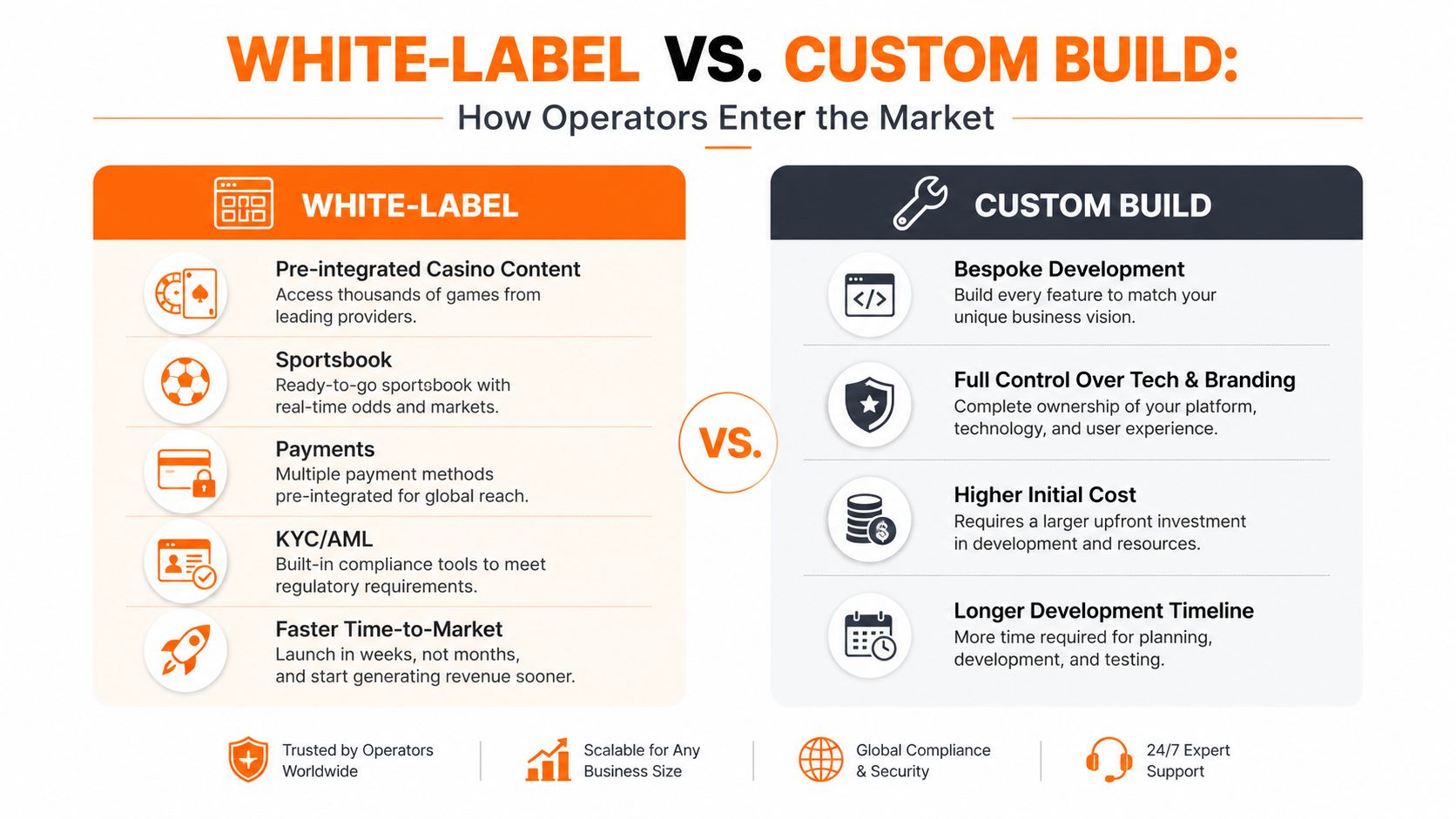
White-label platforms consolidate game content, sportsbook modules, payments, KYC/AML, support tooling, and compliance features so a brand can launch with far less engineering effort (white-label overview). That's why many first-time operators use them. They reduce integration overhead and let the team focus on brand, acquisition, and retention.
A custom build is the opposite trade-off. You own the UX, the internal logic, the risk rules, and the feature roadmap, but you also own the complexity. That means longer delivery cycles, more vendor coordination, and a heavier upfront investment in product and engineering.
Practical rule: if your edge is speed to market, don't start by rebuilding infrastructure you don't yet understand.
There's also a middle path. Some operators use a licensed platform for regulated back-office functions and build a custom front end on top. That hybrid model works when the brand needs a distinct look or flow, but doesn't want to take on the full burden of wallet, reporting, and compliance engineering.
The decision usually comes down to three questions. First, how quickly do you need to launch? Second, how much control do you need over player experience and risk logic? Third, how many jurisdictions do you plan to enter, because every new market increases the operational burden. If you want a deeper side-by-side view of those trade-offs, compare the launch paths at NexGrate's market-entry comparison.
Licensing Compliance and the Payments Reality
A brand can have good games and still fail if the licensing path is wrong. That's because regulation is part of the product, not a separate legal task handed off after launch. Multi-market iGaming is really a jurisdiction-by-jurisdiction operating problem, and that's why the same brand can look simple in one country and impossible in another.
Licensing is a market design decision
Different jurisdictions set different rules for what you can offer, how you can market it, and how you verify a player. Industry commentary on underserved markets shows why this matters, because launches are often shaped by local licensing, payment constraints, and the practicality of serving the market rather than by a generic definition of online gambling (African market commentary).
That's also why geofencing and geolocation matter. If a market only allows access from inside certain borders, the platform has to check location in real time and block attempts to evade the rule. Alberta's 2026 launch materials show how operational this gets in practice, with real-time geolocation verification, anti-spoofing controls, and self-exclusion integration as launch requirements (Alberta operator update).
KYC, AML, and payments all sit in the same workflow
KYC and AML are not paperwork afterthoughts. They're the systems that confirm a person is who they say they are, flag suspicious activity, and keep the operator inside the rules. In practical terms, that means identity checks, address verification, payment ownership checks, and monitoring for behavior that doesn't fit the player profile.
Payments then decide whether the experience feels smooth or broken. Operators typically support cards, bank transfers, e-wallets, local methods, and in some cases crypto, because payment choice affects conversion and withdrawals alike. But the usable mix depends on jurisdiction, processor appetite, and risk posture, so what works in one market may be a bad fit in another.
Explore a compliance-first operating model if you want to see how the same stack has to support reporting, auditability, and player protections at the same time.
Compliance isn't only about avoiding fines. It's also how you keep processors, studios, and regulators willing to work with you.
If you're planning a launch, treat licensing, geolocation, KYC, AML, and payments as one system. Splitting them up on paper usually creates gaps in production.
The KPIs That Separate a Profitable Brand From a Burning One
A dashboard can look busy and still tell you nothing useful. Operators drown in numbers when they really need a short list of metrics that reveal whether the business is compounding or leaking. The best teams track the path from first visit to first deposit, then from first deposit to repeat play.
The few metrics that actually deserve your attention
Start with First-Time Depositor (FTD) conversion. That tells you how many qualified visitors become paying players. If the funnel is strong on traffic but weak on FTDs, the problem is usually in onboarding, trust, or payment friction.
Then watch NGR per active player. This tells you whether the revenue per user is high enough to justify acquisition and retention spend. Pair that with bonus cost as a share of NGR, because promo leakage can eat into profit.
Retention is the other half of the story. You want to know whether players return after day one, then after the first week, then after the first month. A brand that loses most of its users immediately is buying very expensive traffic for very short-lived value.
A simple way to read the dashboard is this:
- High FTDs, weak NGR, your monetization or bonus design is off.
- Good NGR, poor retention, your product or content mix isn't sticking.
- Strong retention, high acquisition cost, your channel mix is too expensive.
- All three weak, the market fit is probably wrong.
Why player value beats raw volume
Player lifetime value (LTV) matters because it tells you what a player is worth over time, not just on day one. Cost of acquisition (CPA) tells you what you paid to bring that player in. The business only works when LTV has enough room above CPA to absorb bonuses, fees, and overhead.
That's why operators often fix retention before they scale paid media. A slightly better returning-player curve can do more for the P&L than another burst of traffic. If the first deposit is the only one, the brand becomes dependent on constant replenishment, and that's a dangerous place to be.
The cleanest operators don't chase every metric at once. They pick the two numbers that tell them where the leak is, then they fix those before spending more.
Trends Shaping iGaming and Risks Operators Often Miss
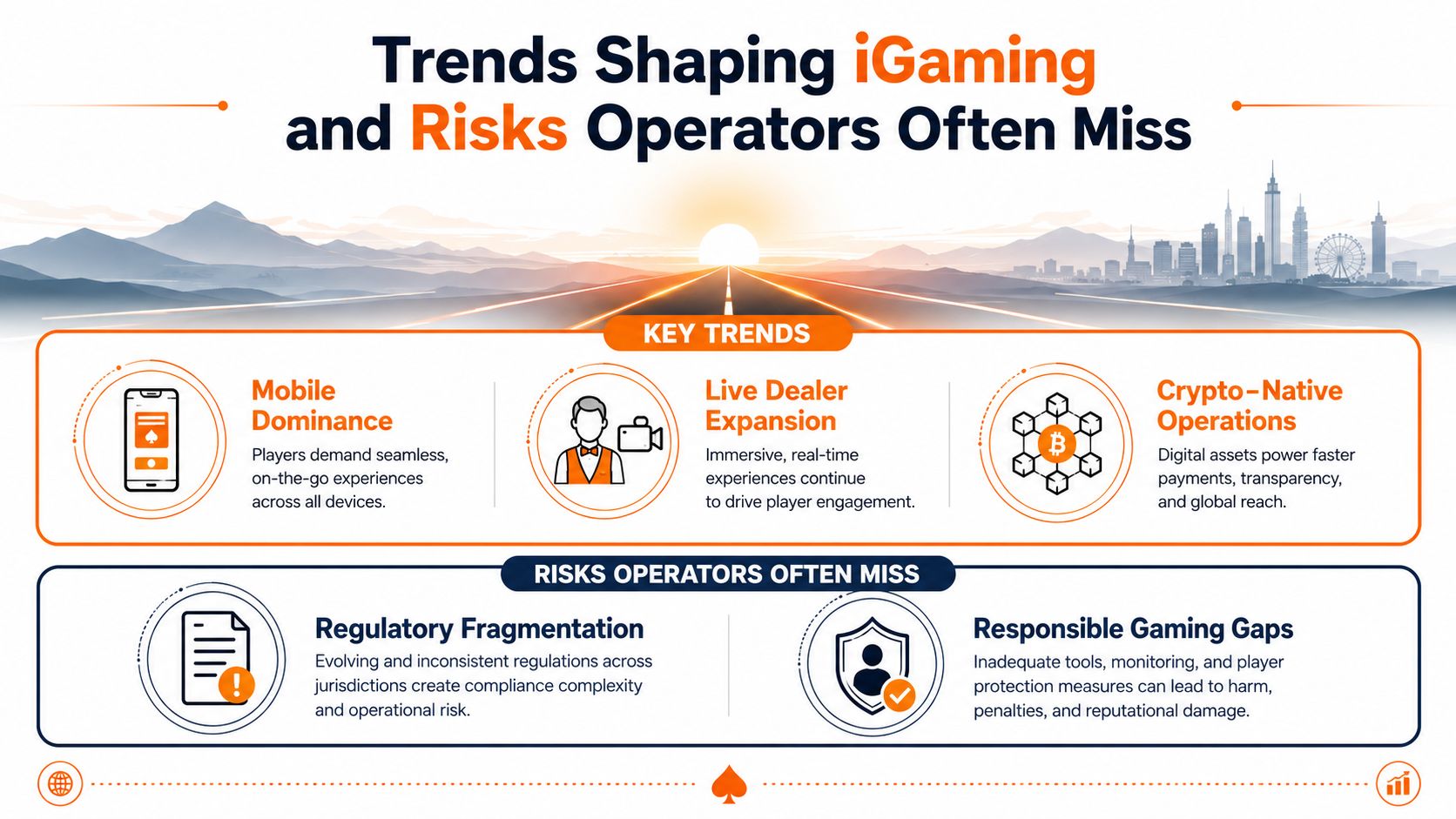
The next wave of iGaming is already visible in product choices and market structure. Mobile remains the default access channel, live dealer content keeps expanding its appeal, crypto-native brands keep finding niche traction, and AI is becoming more useful for personalization, support, and risk scoring. At the same time, more opportunities are opening in underserved markets, especially where regulation is maturing and channelization is still incomplete.
The trend line points toward better targeting and tighter control
The opportunity side is clear. Mobile-first design is now table stakes, not a differentiator. Live dealer products are a bridge for players who want a more social or familiar feel, and AI tools are increasingly useful for tailoring offers and spotting churn risk before it shows up in revenue.
There's also a geography story. Some regions remain underserved, which means the market question is often about licensing path, payments, and local operating friction rather than simple demand. That's where many expansion plans get overconfident. A country can look attractive on paper and still be hard to serve profitably if payment rails, compliance checks, or local rules are awkward.
The risks that quietly kill brands
The failures are usually more mundane than the growth story. Payment friction lowers conversion fast, especially when deposits or withdrawals feel uncertain. Bonus abuse and affiliate fraud can distort acquisition economics before the operator notices the pattern. License suspensions can stop revenue overnight if controls are weak.
There's another failure mode that gets less attention: overdependence on one game provider or one acquisition channel. If a supplier changes terms or a traffic source dries up, the brand can lose its bargaining power quickly. Underestimating compliance overhead is just as dangerous, because the team eventually spends all its time reacting instead of improving the product.
For a 2026 launch decision, the best filter is simple. If you can't answer how you'll handle licensing, payments, player verification, retention, and content sourcing in the first 12 months, you're not ready to scale. If you can answer those clearly, you're finally talking about an iGaming business instead of a branding concept.
If you're evaluating a launch or cleaning up an existing stack, talk to NexGrate about how to turn the operator model, compliance path, and product layers into one launch plan your team can execute.