
Stablecoin transfers on supported networks can cost below USD 0.01 on Base, while comparable USDC transfers on Tron may cost roughly USD 0.30 to USD 1.00, but crypto payment methods in iGaming range from instant on-chain settlement to frictionless custodial gateways, each carrying different compliance and treasury trade-offs. The cheapest blockchain transaction isn't automatically the cheapest payment rail once screening, conversion, reconciliation, and payout controls enter the calculation.
A player in Brazil selects USDT at an MGA-licensed casino. The cashier asks which network to use. The player chooses the wrong one, sends funds to an unsupported contract, and sees a successful transaction on-chain while the casino still has no safe way to credit the account. Support now has to investigate the asset, network, transaction ID, wallet ownership, and whether recovery is even possible.
That scenario captures the core challenge. Crypto payments aren't a single product. They're a collection of assets, networks, custody arrangements, conversion paths, compliance checks, and accounting decisions that happen to present as one button in the cashier.
Table of Contents
- The Operator's Dilemma - Why Crypto Payments Are Harder Than They Look
- Understanding the Five Core Crypto Payment Models
- How Crypto Settlement Works in iGaming
- Stablecoins vs Native Crypto - Choosing the Right Asset
- The Compliance Reality - Why Crypto Increases Workload
- Building a Crypto-First Cashier - Integration Patterns
- Choosing Your Crypto Strategy - A Decision Framework
The Operator's Dilemma - Why Crypto Payments Are Harder Than They Look
A player sees a deposit address and a confirmation screen. The operator manages asset compatibility, network selection, wallet risk, liquidity, accounting, and regulatory controls behind that simple interface. USDT can exist across several networks, each with different fees, confirmation behavior, token contracts, and support requirements. A cashier that says only “send USDT” leaves important decisions unresolved.
Those gaps create failure modes that conventional payment integrations handle differently. A player may send the correct asset on the wrong chain, reuse an expired address, omit a required memo, or fund an account from a wallet that fails sanctions screening. An immutable on-chain record is necessary but insufficient. The payment becomes valid for gaming only after the operator's controls accept the asset, source, network, and account credit.

The strategic choice behind the cashier
Selecting crypto payment methods means selecting an operating model. A brand may accept assets into wallets it controls, send transactions through a processor that converts them to fiat, or pair blockchain deposits with fiat-denominated player balances. Each route changes exposure to custody, price movements, liquidity, refunds, reconciliation, and reporting.
The advertised blockchain fee is only one part of the landed cost. Screening deposits and withdrawals, investigating exceptions, converting assets, matching transactions to player accounts, and handling unsupported transfers can require more operational work than the settlement itself. The cashier therefore needs clear ownership for each control and a ledger that records both the blockchain event and the gaming-account decision.
Licensing jurisdiction matters alongside player geography. A flow suitable for one regulated market may create licensing, source-of-funds, data-transfer, or responsible-gambling concerns in another. The operator must define which wallet activity belongs to the payment provider, which checks remain with the casino, and when a deposit becomes gaming balance.
The Bank for International Settlements survey of 86 central banks found that stablecoin use outside the crypto ecosystem remained rare, with more than half of responding central banks describing domestic use as “trivial” or “negligible.” It also reported that approximately two-thirds of respondent jurisdictions had introduced or were developing frameworks for stablecoins and other cryptoassets, while 63% of central banks had accelerated CBDC work in response to related developments, as detailed in the BIS survey on central-bank digital currencies and cryptoassets.
Practical rule: Treat crypto acceptance as a treasury and compliance decision first, and a frontend feature second.
The technology can move funds quickly. It also shifts responsibility into network selection, wallet intelligence, ledger design, exception handling, sanctions screening, and controls that run before and after settlement.
Understanding the Five Core Crypto Payment Models
Operators often reduce the discussion to hot wallets versus cold wallets. That distinction matters for security, but it doesn't describe the payment experience, accounting treatment, or provider liability. A more useful map has five models.
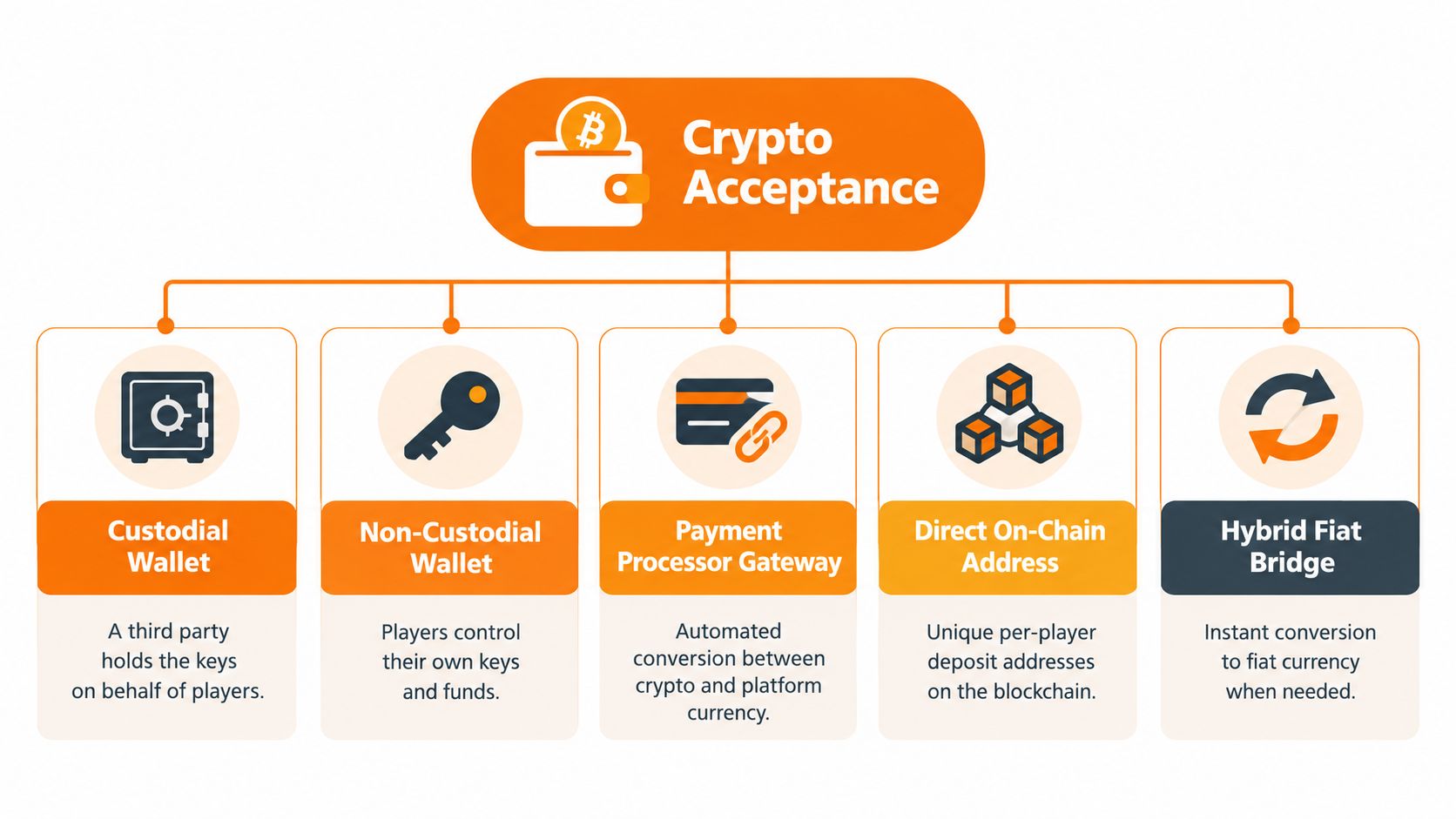
Custodial wallets
A custodial wallet places private-key control with the operator, exchange, or payment provider. The model simplifies the player journey because users interact with an account balance rather than managing keys for every transaction. The trade-off is concentrated custody risk, withdrawal governance, access controls, and dependence on the custodian's licensing and liquidity.
Non-custodial wallets
With a non-custodial wallet, the player controls the keys and sends funds directly. This can appeal to experienced crypto users, but it also increases the chance of wrong-network deposits, lost credentials, address mistakes, and support disputes. The operator still needs wallet screening and transaction monitoring even though it doesn't hold the player's keys.
Direct on-chain addresses
A direct on-chain address model assigns a deposit address or payment reference to the player or transaction. It provides strong transaction-level traceability and gives the operator more control over settlement logic. It also demands reliable address management, chain monitoring, confirmation policies, token whitelisting, and reconciliation.
Payment processor gateways
A custodial gateway abstracts away much of the wallet and conversion work. Providers such as BitPay or MoonPay can offer familiar checkout experiences and settle merchants in fiat or supported digital assets. Integration is easier, but processing charges, conversion spreads, provider limits, account reviews, and third-party availability reduce control.
Hybrid fiat bridges
A hybrid fiat bridge accepts crypto at the customer edge while keeping the operator's treasury and player accounting in fiat. Visa describes settlement models where an issuer settles in USDC over supported blockchains and a digital custodian converts the asset for merchant payout, or where conversion occurs before final settlement, as outlined in its stablecoin settlement overview.
The right model depends on whether the operator values control, speed to market, fiat certainty, or direct ownership of the payment stack. Most regulated brands benefit from deciding this explicitly rather than allowing a processor's default architecture to define the business.
How Crypto Settlement Works in iGaming
Crediting a player account requires a controlled sequence connecting the chain, risk engine, wallet service, and double-entry ledger. A confirmed blockchain transfer becomes usable balance only after the operator has matched it to the intended payment and completed the required controls.
The process starts when the cashier creates a payment instruction. It should define the asset, network, contract address, amount, expiry behavior, player reference, and destination address. A generic USDT label is insufficient. The system must bind the asset to an explicit network identifier, preventing a transfer on an unsupported chain from being mistaken for a valid deposit.
A monitoring service then watches for a matching transaction. At that point, the payment is observed, not yet approved for credit. The operator should retain the transaction ID, source and destination addresses, token contract, amount, block information, and internal payment reference.
Three settlement states
The operator should distinguish three states:
- Observed transaction: The network or node has detected a transfer, but it may remain pending, replaceable, incomplete, or subject to chain-specific uncertainty.
- Sufficiently confirmed transaction: The transaction meets the operator's confirmation policy for that asset and network.
- Economically final transaction: Risk checks, reconciliation, and any required review are complete, so the funds can be treated as available for the intended use.
Public blockchains can provide continuous settlement, and some networks advertise fees near one cent. Those figures depend on the network and transaction conditions, as described in the BIS survey cited earlier. A casino should therefore set customer expectations using its own confirmation, screening, and reconciliation rules rather than a network headline.
The ledger should credit the player only after the transaction matches the expected instruction and passes the relevant controls. A low-value deposit may use a shorter confirmation policy than a high-value withdrawal. Withdrawals require stronger safeguards because the operator is sending value out, while a deposit records incoming funds.
Reconciliation connects the on-chain transaction ID with the player ledger entry, treasury movement, fee, conversion event, and eventual payout. A multi-currency wallet also needs explicit rules for crypto balances, fiat balances, bonuses, and restricted funds. This multi-currency wallet architecture guide provides a useful reference for defining those relationships instead of treating the wallet as one undifferentiated balance.
Stablecoins vs Native Crypto - Choosing the Right Asset
Stablecoins and native cryptocurrencies solve different payment problems. Bitcoin and Ether expose the operator to asset-price movement between deposit, wagering, conversion, and withdrawal. Stablecoins are designed to maintain a relatively stable value, commonly by referencing the US dollar, but they introduce issuer, reserve, contract, liquidity, and depegging risks.
For most casino cashiers, the central question is not whether an asset is popular. It is whether the asset produces a controllable landed cost after network fees, conversion spreads, failed transfers, screening, treasury handling, and payout expenses.
The consumer rationale is practical. In the survey cited by the stablecoin payments economics analysis, 88% of respondents found instant transfers, lower fees, and 24/7 availability appealing. Intended use also leaned toward peer-to-peer payments at 45.1% and online shopping at 44.3%, suggesting that payment utility matters more than speculation for many users.
Asset comparison for iGaming operators
| Asset Type | Volatility Risk | Avg. Fee, Base | Avg. Fee, Tron | Player Appeal |
|---|---|---|---|---|
| Stablecoin | Lower price volatility, but peg and issuer risk remain | Below USD 0.01 | Roughly USD 0.30 to USD 1.00 | Strong for predictable payment value |
| Native cryptocurrency | High exposure to market movement | Network-dependent | Network-dependent | Strong among crypto-native and higher-risk users |
The fee figures in the table come from the cited expert analysis and are not universal quotes. They describe reported USDC transfer economics, not the total cost of a casino deposit or withdrawal. A processor spread, off-ramp charge, failed transaction, compliance review, or treasury conversion can outweigh the chain fee.
Network choice changes the operating profile further. Visa reports Solana block times of approximately 400 milliseconds, average throughput around 400 transactions per second, and peaks above 2,000 transactions per second across use cases. Those figures help explain the appeal of high-throughput chains, but they aren't a guarantee of merchant-level finality, liquidity, or uninterrupted service, as noted in Visa's settlement announcement.
A sensible whitelist starts narrow. Select assets and networks that match player geography, liquidity access, compliance coverage, and payout demand. Add a network only when the cashier, monitoring, ledger, treasury, and support teams can handle its specific failure modes.
The Compliance Reality - Why Crypto Increases Workload
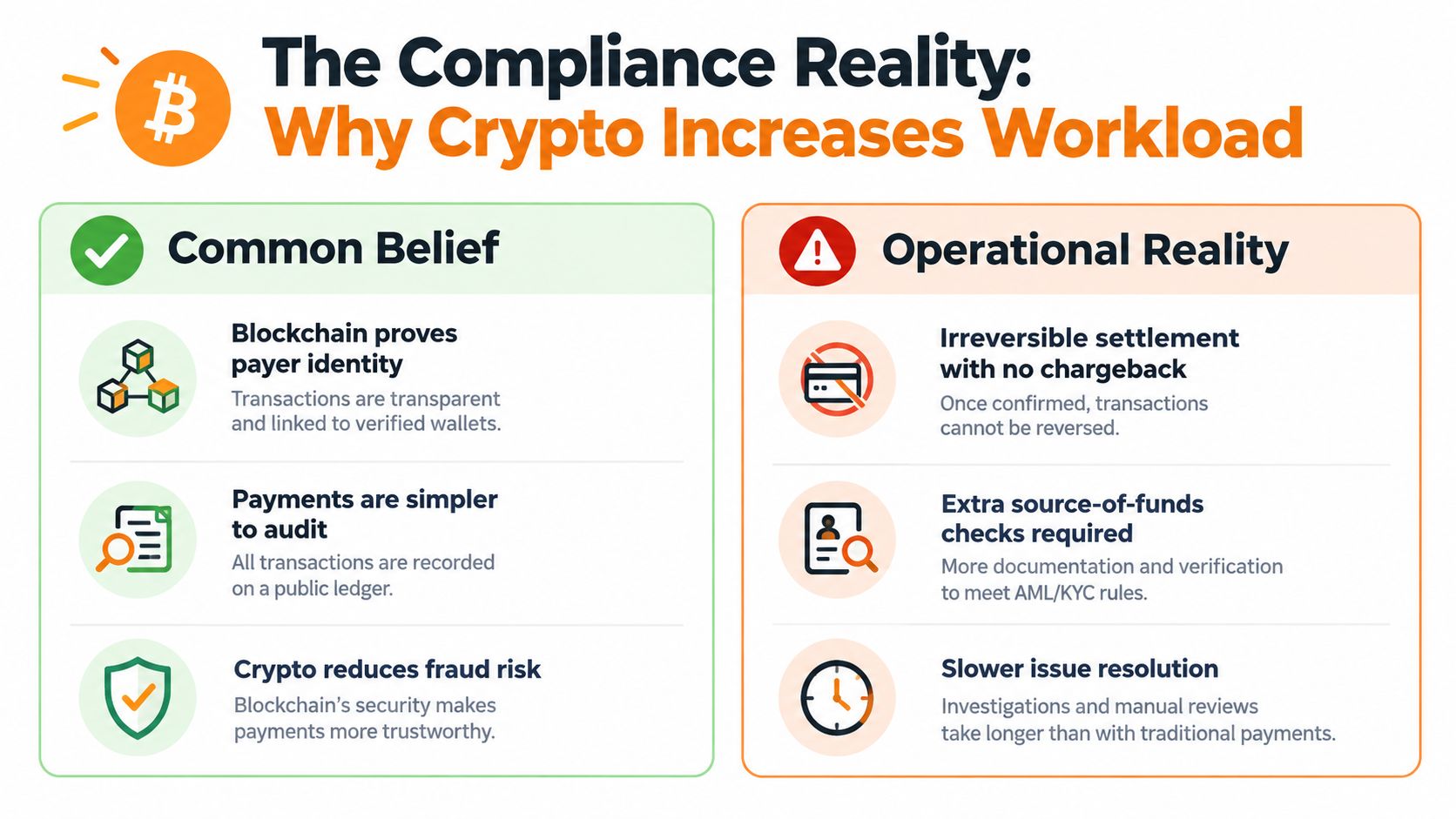
A blockchain confirmation can arrive in seconds while the operator's work continues for hours. The ledger proves that the network accepted a transfer. It does not establish who controls the wallet, whether the funds have acceptable provenance, or whether the player is accessing the service from an approved market.
Crypto settlement also removes the ordinary chargeback path. A card payment can enter a dispute process, while an on-chain transfer is generally irreversible for the operator. A mistaken deposit, sanctioned-wallet interaction, or fraudulent withdrawal therefore requires prevention, investigation, and controlled remediation before funds move.
Checks that continue after confirmation
The cashier should keep compliance controls active after the chain reports success:
- Screen the wallet: Check source and destination addresses against sanctions data, illicit-service exposure, mixer activity, theft indicators, and other risk signals.
- Capture Travel Rule data: The EU Transfer of Funds Regulation requires crypto-asset service providers to transmit originator and beneficiary information on every crypto-asset transfer. FATF Travel Rule obligations generally apply above jurisdiction-specific thresholds often around USD/EUR 1,000, as summarized in the stablecoin payments compliance guide.
- Review source of funds: Identity verification does not clear every deposit. Unusual value, rapid movement, or exposure to a high-risk wallet can require provenance analysis.
- Apply responsible-gambling rules: Deposit limits, cooling-off periods, self-exclusion, withdrawal-velocity controls, and affordability processes must work across bank and blockchain rails.
- Preserve an audit trail: Retain the transaction ID, wallet addresses, screening outcome, decision, reviewer, conversion record, and ledger movements so teams can investigate and support regulatory reporting.
These controls create hidden landed costs. Screening subscriptions, manual reviews, exception handling, treasury conversion, failed transactions, and reconciliation can outweigh the fee displayed at checkout. A fast settlement rail is operationally expensive if finance, compliance, and support teams cannot match blockchain activity to player and ledger records.
Consumer expectations also favor visible safeguards. The survey cited in the compliance material reported that 77.4% of respondents believed stablecoins should be regulated like traditional payment methods, while 66.3% said FDIC-style insurance would increase their likelihood of using stablecoins.
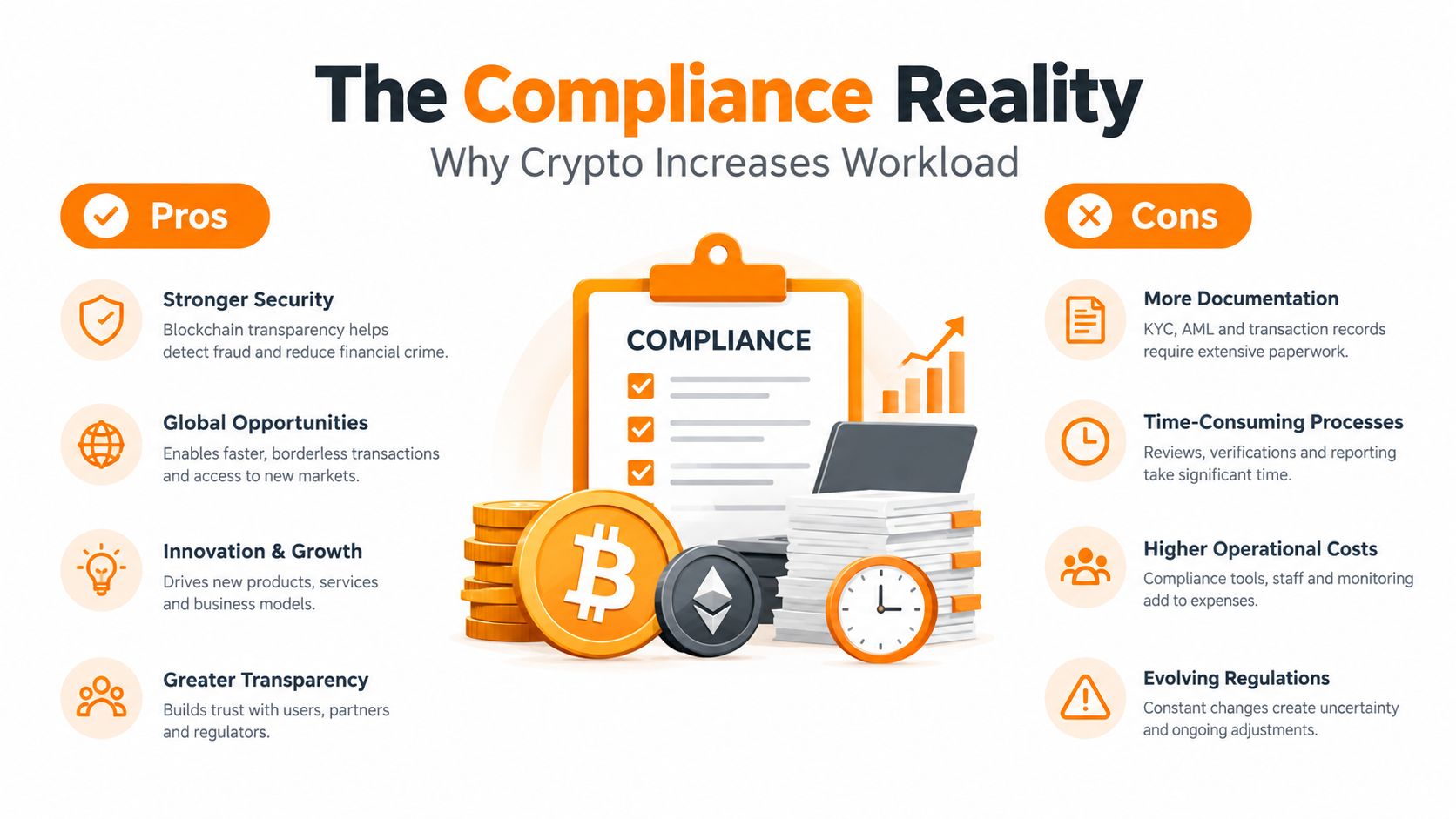
Operators should separate asset-level controls from operator-level obligations. A provider may screen wallets or transmit Travel Rule data, but the casino remains responsible for licensing duties, player protection, market access, and ledger records. A structured compliance reporting workflow helps assign those responsibilities instead of treating the blockchain as the audit system.
Building a Crypto-First Cashier - Integration Patterns
A player chooses a coin, sends funds, and expects the balance to appear quickly. Behind that simple flow, the operator must identify the correct network, screen the wallet, record fees, reconcile the ledger, and handle exceptions. The integration pattern determines who owns each task and who absorbs its cost.
A custodial gateway is usually the quickest route to market. The provider manages wallet interaction, conversion, and part of the compliance workflow. The operator gets a familiar checkout with less engineering work, while accepting processing fees, conversion spreads, provider dependency, supported-asset limits, and reduced access to transaction data. A low quoted fee may still produce a higher landed cost after screening, manual review, failed transfers, and reconciliation work.
A direct on-chain integration gives the operator control over addresses, confirmation policies, supported assets, and treasury movements. That control requires chain infrastructure, key management, transaction monitoring, wallet screening, Travel Rule handling, incident response, and reconciliation. The payment rail may look cheaper at checkout, yet internal compliance, finance, and support workload can make it more expensive to operate.
A hybrid platform combines these approaches. The operator can offer crypto deposits and withdrawals while recording player accounting in a base currency, with provider infrastructure handling selected custody, conversion, or compliance functions. NexGrate is one example of a white-label iGaming platform combining casino and sportsbook operations with wallet management, crypto deposits and withdrawals, compliance workflows, and ledger-based payment handling, as described in this crypto casino software overview.
Controls the engineering team should not postpone
- Network identifiers: Store the asset and chain in separate required fields. Never infer the network from a ticker alone.
- Contract allowlists: Approve exact token contracts and reject unsupported variants, decimals, and transfer behavior.
- Address allocation: Use unique deposit addresses or reliable payment references so incoming funds map to the right player and payment instruction.
- Confirmation policy: Set thresholds by asset, chain, amount, and risk score rather than applying one universal rule.
- Dynamic fee quotes: Calculate withdrawal charges from current network conditions and provider costs instead of displaying a permanent flat fee.
- Ledger reconciliation: Match transaction IDs, conversion events, fees, player balances, treasury movements, and withdrawals before closing the payment record.
The design must also cover failure states. A pending deposit needs a visible status. A wrong-network transfer needs a support route. A blocked withdrawal needs an explainable reason code that does not expose sensitive risk logic. The cashier is finished only when its exception paths work.
Choosing Your Crypto Strategy - A Decision Framework
An operator choosing crypto payment methods should begin with four questions: Where are the players? How large are typical transactions? How much volatility can treasury tolerate? How much compliance and operational capacity exists today?
Geography determines demand, available off-ramps, sanctions exposure, local licensing expectations, and the networks players already use. Transaction size changes the acceptable confirmation policy and the value of manual review. Volatility tolerance determines whether the operator can hold native crypto or should convert stablecoins promptly. Compliance capacity determines whether direct custody is realistic or whether a managed gateway makes more sense.
Match the model to the operating profile
A brand with limited engineering capacity may start with a custodial gateway and fiat settlement. That approach reduces implementation work, but the operator should scrutinize the provider's licensing perimeter, supported jurisdictions, data access, payout rules, conversion pricing, wallet screening, and business continuity arrangements.
A technically mature operator with strong treasury and compliance teams may choose direct on-chain settlement for selected assets and networks. This offers greater control over the cashier and reconciliation model, but the team must own key security, chain monitoring, liquidity, incident response, and regulatory evidence.
A hybrid approach can suit a brand that wants crypto-funded deposits without carrying material token exposure. In that model, the player sees a crypto option, the risk engine evaluates the payment, and the ledger records controlled fiat or accounting balances. The operator still needs accurate transaction-level records because conversion doesn't erase the underlying crypto event.
A provider assessment checklist
Before signing, request clear answers to these questions:
- Asset scope: Which exact tokens and contract addresses are supported?
- Network behavior: How are confirmations, congestion, reorganizations, and outages handled?
- Compliance coverage: Who performs wallet screening, sanctions checks, Travel Rule exchange, and enhanced review?
- Treasury treatment: Are funds held in crypto, converted automatically, or settled through a fiat bridge?
- Reconciliation: Can finance export transaction IDs, fees, rates, screening outcomes, and ledger references?
- Payout controls: Can the operator set per-asset limits, velocity rules, destination restrictions, and manual review thresholds?
- Player protection: Do geofencing, self-exclusion, deposit limits, and responsible-gambling controls apply equally to crypto?
- Failure handling: What happens when a player uses the wrong network, sends an unsupported token, or requests a refund?
The BIS findings point to a market where policy and infrastructure are advancing faster than ordinary payment use. That gap creates an opportunity, but it also punishes operators that launch before they can reconcile, screen, explain, and govern every payment state.
Start with a small, defensible rail set. Test deposits, withdrawals, wrong-network cases, blocked wallets, conversion failures, reporting, and customer support before expanding the asset menu. The strongest crypto strategy isn't the one with the most coins. It's the one whose landed cost, controls, and player experience remain predictable under pressure.
NexGrate provides a white-label iGaming platform with casino and sportsbook modules, crypto deposits and withdrawals, wallet management, compliance workflows, and ledger-based payment handling. Review how NexGrate can help you connect crypto payment methods to a controlled cashier and broader regulated-operations stack.