
An XML odds feed is a structured, machine-readable stream of betting data, including events, markets, selections, prices, and status changes, delivered in XML so sportsbook systems can parse and distribute it. Historical coverage can span more than 30 bookmakers and over 75 sports, with archives available from 2021 onward, but receiving that data doesn't automatically make it safe to use for settlement.
A live bet is accepted during a fast-moving match. An odds update arrives late, a suspension message is missed, or an older revision overwrites a newer price. The front end may look operational while the trading and settlement layers are already working from different versions of reality.
That distinction matters more than the XML syntax. An operator needs to know not only whether a feed is connected, but whether every accepted bet can be traced to the exact event state, price, market status, timestamp, and rule version that applied at the time.
Table of Contents
- What Is an XML Odds Feed
- Core Schema and Key Fields
- The History of Sports Data Standards
- Integration Architecture and Parsing
- Settlement, Reconciliation, and Compliance
- Leveraging XML Feeds with NexGrate
What Is an XML Odds Feed
An XML odds feed is the data bridge between a sports data provider and a sportsbook platform. It packages betting information into structured elements that software can read, validate, store, and distribute. A typical message may describe an event, its participants, available markets, selections, prices, and a change in status such as suspended, reopened, or settled.
The important point is that this isn't a static price list. A live football match can generate a stream of changes as the score, clock, player availability, liquidity, or trading decision changes. Your sportsbook must associate each change with the correct event and market, apply it in the correct order, and expose only the state that risk and betting services have approved.
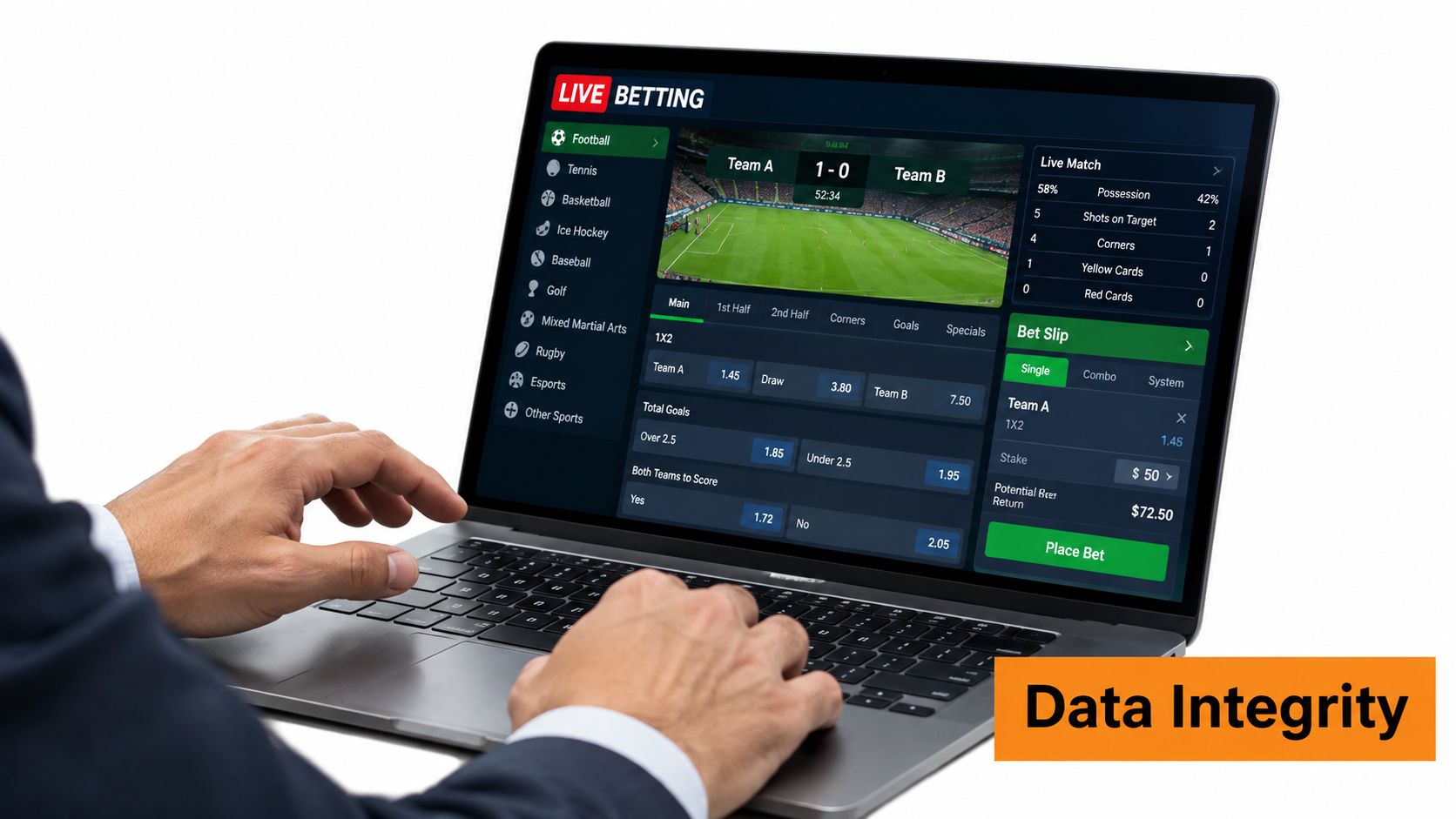
A well-designed feed therefore carries more than odds. It gives downstream systems enough context to distinguish a match-winner market from a player prop, identify whether a selection is active, and understand whether a market can accept bets. The XML format provides the serialization layer, while your integration supplies the controls that turn incoming messages into trusted sportsbook state.
Why the feed is operationally important
Sportsbook software depends on consistent identifiers. If one provider calls an event “Team A versus Team B” while your internal platform uses another naming convention, text matching alone can produce duplicate fixtures or attach a market to the wrong event. Canonical event, market, and selection identifiers reduce that risk, but they still need validation against your own catalogue.
The feed also connects several services that shouldn't operate in isolation:
- Trading uses prices, market availability, and provider revisions to manage exposure.
- Risk services use status changes and limits to decide whether a wager can proceed.
- The front end displays the currently approved market state to the player.
- Settlement needs the accepted price and the rule context, not merely a final result.
- Audit services preserve the evidence needed to reconstruct what happened.
An overview of sportsbook architecture helps place the feed in context. It isn't the sportsbook itself. It's one of the critical inputs into a larger system of trading, wallet authorization, bet acceptance, settlement, and compliance controls.
Practical rule: Treat every odds message as a state transition with evidence attached, not as a number that can be copied into a database.
The format remains useful because it creates a predictable interchange layer between providers and operators. The difficult engineering work starts after parsing, when the platform decides whether a message is valid, current, complete, and safe to use.
Core Schema and Key Fields
A reliable integration begins with the provider's data model, not with a generic XML parser. Before writing transformation logic, map each external object to an internal object and define which fields are required for acceptance, display, suspension, settlement, and audit.
At the top sits the event. It identifies the sporting contest and usually carries participants, competition information, scheduled start time, and an event status. Beneath it sit one or more markets, such as match outcome, handicap, total points, or a player-specific proposition. Each market contains selections, and each selection carries a price and its own availability state.
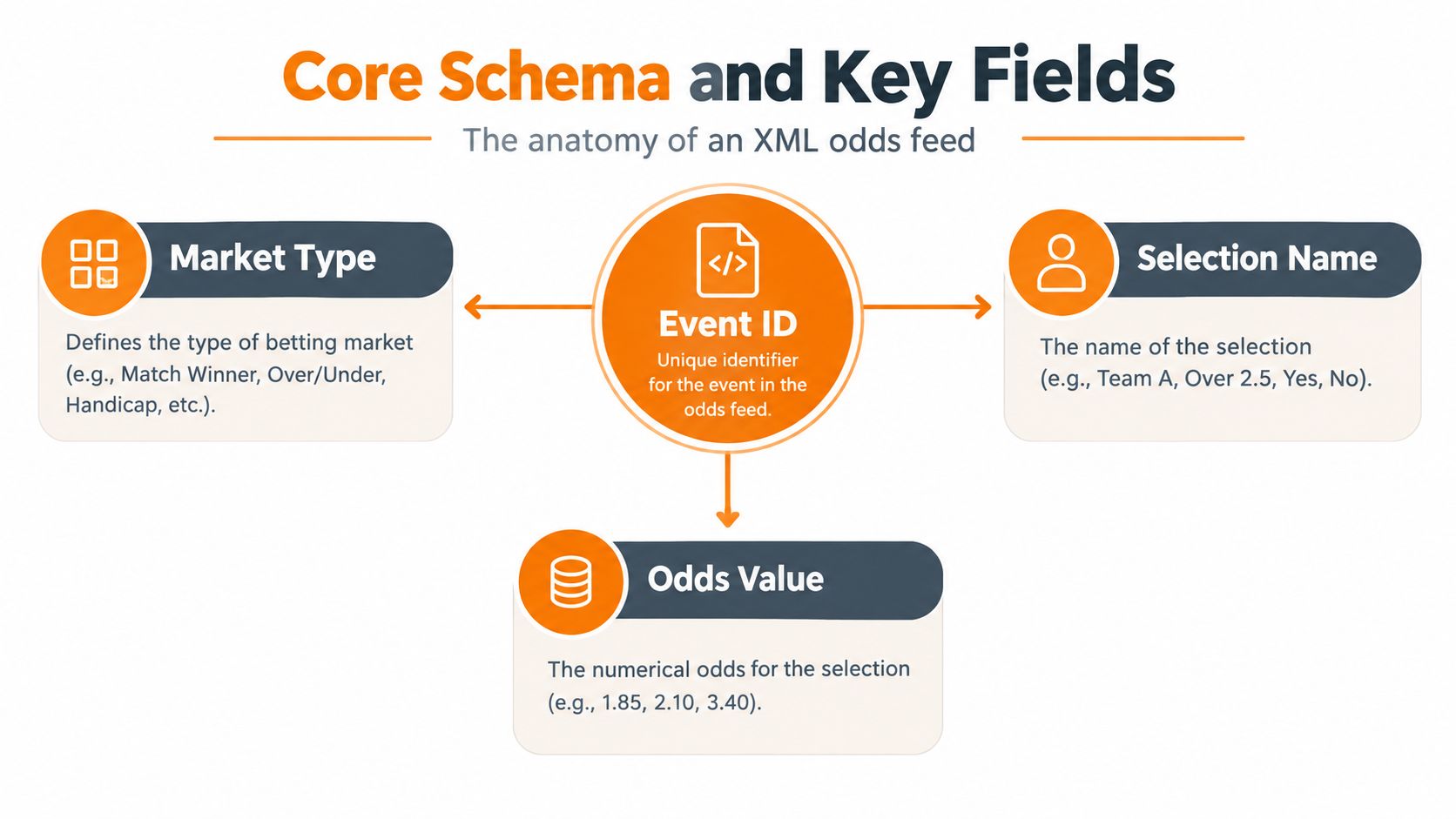
A conceptual message might follow this hierarchy:
- Event ID: The stable identifier for the fixture. Store the provider value and your internal mapping.
- Market ID and type: The unique market reference and its semantic category. A match-winner market must not be confused with a first-half winner market.
- Selection ID and name: The outcome or participant to which the price applies.
- Odds value: The offered price, with an explicit understanding of whether the provider uses decimal or another representation.
- Status: The current condition of the event, market, or selection, including active and suspended states.
- Timestamp: The provider's event time, message time, and, where available, source time.
- Revision or sequence: The ordering information needed to reject stale updates and replay missed messages.
Validate the meaning, not only the XML
A document can be valid XML and still be unusable betting data. Schema validation catches malformed structure, missing required elements, and incorrect data types, but business validation must check relationships as well.
For example, reject or quarantine a market if its event identifier doesn't map to a known fixture. Flag a selection if its market type contradicts its participant structure. Check that a price update doesn't arrive for a selection already marked unavailable, unless the provider's documented state model permits that transition.
The same discipline applies to sport-specific variation. SportsML established a core approach for common concepts while allowing sport-specific detail through plug-ins, a pattern that remains useful when a sportsbook supports different sports and market families. Your canonical model should preserve the common fields while allowing sport-specific attributes without forcing every market into an inaccurate generic shape.
The accompanying XML odds feed data structure video can help teams visualise the hierarchy, but production readiness comes from a field-level contract. Document ownership, null behavior, enumerations, unit conventions, update semantics, and the provider's rules for corrections before you connect the feed to live bet acceptance.
The History of Sports Data Standards
XML remains relevant because sports data needed interoperability before sportsbooks began treating JSON as the default format for many web APIs. The underlying problem was not just how to encode a score. Publishers, leagues, and technology companies needed a shared way to describe events, schedules, participants, results, standings, and statistics across sports and languages.
The International Press Telecommunications Council launched its SportsML project in 2001 after identifying a gap in cross-sport and cross-language XML standards for exchanging sports information. SportsML version 2.0 joined the IPTC G2 standards family in 2008, creating a formal milestone for interoperable sports-data schemas. The IPTC explanation of SportsML and its use describes a core schema for common concepts with sport-specific plug-ins for deeper detail.
That design matters to odds-feed consumers. A sportsbook doesn't need every sport to look identical, but it does need shared concepts to behave consistently. Event identity, timing, scores, standings, and statistical attributes should have predictable meaning, while football, tennis, basketball, and other sports can add fields that reflect their own rules.
Why standardization still affects betting systems
An XML odds feed applies the same broad principle to betting data. It organizes events, markets, selections, prices, and status changes into machine-readable elements that trading, settlement, and front-end services can process. The format doesn't eliminate the need for mapping. It gives the mapping process a structured foundation instead of leaving every provider integration to invent its own interpretation.
JSON has practical advantages in many modern integrations. Developers often find it convenient for web services, and it can be easier to work with in applications built around REST and event-driven services. XML, however, remains valuable where a provider's contract, validation tooling, namespaces, and established schema represent years of operational compatibility.
The trade-off is straightforward. XML can bring more structural overhead and legacy conventions, but a mature schema can make ambiguity visible. JSON can feel lighter, but a lightweight payload isn't automatically a reliable domain model. Operators should judge the integration by identifier quality, status semantics, update behavior, historical support, correction handling, and documentation, not by serialization preference alone.
A modern adapter can accept XML at the boundary and still give internal services a clean canonical model. Replacing the format isn't the same as solving the data problem.
Integration Architecture and Parsing
Build the integration as a stateful, versioned event stream. Independent snapshots are insufficient because the platform must know whether an update is newer, whether a suspension was missed, and whether a reconnect requires replay from a known position.
For in-play betting, push delivery is typically preferable to polling. Polling can introduce multi-second gaps, while documented streaming architectures target approximately 50–200 ms of transport latency according to the technical guide to sportsbook data-feed integration. That transport figure isn't the complete customer experience. Parsing, risk evaluation, wallet authorization, and client delivery each add their own delay.
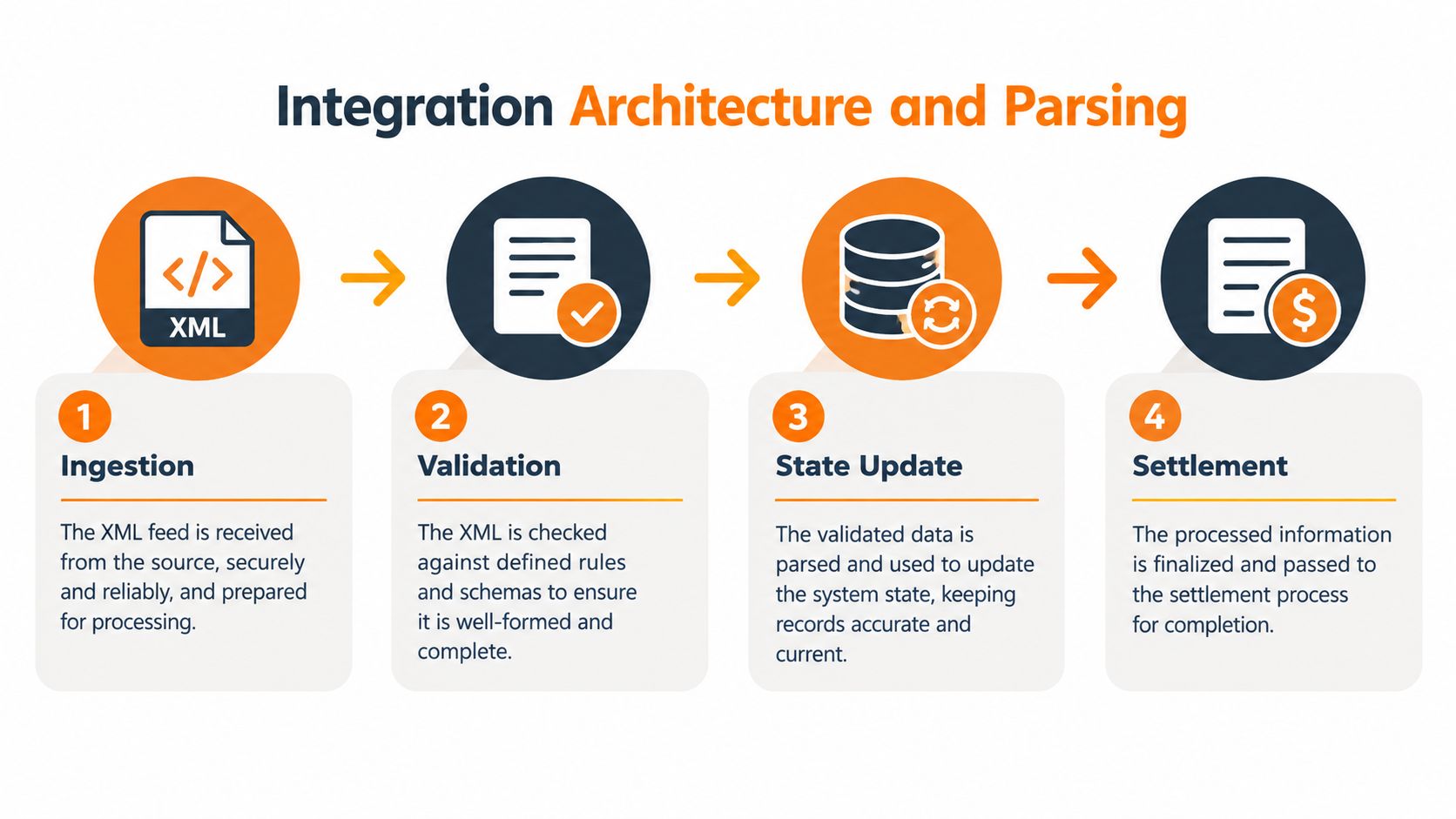
A production ingestion pattern
Ingest and preserve the envelope. Store the raw XML, provider timestamp, connection metadata, event identifier, and message version before transformation. Raw evidence is essential when a normalized record later looks wrong.
Validate structure and identity. Check XML well-formedness, schema expectations, required identifiers, enumerated statuses, and mappings to internal events. Malformed messages belong in a dead-letter queue, not in a partially updated market.
Apply ordering rules. Persist sequence numbers and revisions. Accept only updates that satisfy monotonic ordering for the relevant stream or entity, and make processing idempotent so a duplicate message doesn't create a second state transition.
Publish canonical state. Convert the provider representation into an internal model and distribute the approved update to trading, sportsbook, audit, and front-end services. Keep provider identifiers alongside internal identifiers so operators can trace both sides.
Recover deliberately. On a connection interruption, replay from the last acknowledged offset where supported. If the platform can't establish that it has received every relevant status change, it should suspend affected markets until a trusted state is rebuilt.
The target metrics need separate instrumentation. Industry guidance places desirable median latency around 50–80 ms, p95 below 200 ms, and p99 below 500 ms, with each stage measured independently rather than hidden inside one aggregate number, as documented in the same technical source. Those figures are engineering benchmarks, not permission to accept stale data. A fast parser can still publish an old revision.
Failure control: If feed freshness exceeds a configured threshold, fail closed for the affected market. Continuing to accept bets against uncertain state is not resilience.
A canonical adapter layer is particularly useful for a platform such as NexGrate. It lets the provider-facing XML contract remain separate from internal sportsbook services, so a schema change doesn't force trading, settlement, and customer-facing components to understand every external variation.
Settlement, Reconciliation, and Compliance
A settlement message is not proof that settlement was correct. It is only one input into a decision that should remain reproducible after the live event has disappeared from the screen.
The state machine needs more than active and settled. A practical model can include scheduled, live, suspended, postponed, abandoned, corrected, and settled states. Each transition should have an allowed source, a timestamp, a reason where available, and an idempotent processing rule. Duplicate settlement messages must not pay a bet twice, while a correction must not erase the original evidence.
Reconcile the full decision
At acceptance, preserve the exact odds, market and selection identifiers, market status, source timestamp, provider revision, applicable rule version, and the bet transaction reference. At settlement, attach the official result, the source used to determine it, the transition that triggered settlement, and any later correction.
A reconciliation service should compare at least three views:
- Provider state: What the feed said about the event, market, price, and status.
- Platform state: What the sportsbook accepted, suspended, changed, or settled.
- Official outcome: Which result source and rule determined the final outcome.
If those views disagree, create an exception rather than automatically choosing the latest message. The workflow should support replay from immutable event logs, manual review of disputed outcomes, and controlled re-settlement when an official score is corrected.
Neutral integration guidance recommends finding structural mismatches in leagues, matches, markets, and settlement triggers in a sandbox before production. It also highlights error handling, rate limits, and XML/JSON compatibility as areas to review before development, as discussed in sportsbook integration methods and best practices.
Speed cannot replace lineage
Technical benchmarks call for settlement accuracy above 99.95%, along with explicit handling for abandoned events, official-score corrections, and disputed settlements, according to that integration guidance. The number is useful as a control objective, but it doesn't answer the operational question: can your team prove why a particular bet was settled in a particular way?
Retention requirements vary by jurisdiction and licence. Your compliance design should therefore define which raw messages, normalized states, bet records, rule versions, operator actions, and correction decisions must remain available, and for how long. Compliance reporting for sportsbook operations is not just a reporting export. It depends on the lineage captured while the event was unfolding.
A settlement engine that runs quickly but cannot reproduce the accepted price or market status creates exposure. A slower workflow with clear quarantine, reconciliation, and review paths is usually safer than automatic settlement built on incomplete evidence.
Leveraging XML Feeds with NexGrate
The commercial decision isn't whether a team can parse XML. It is whether building and operating every adapter, canonical mapping, replay process, settlement control, and compliance trail is the right use of internal capacity.
A turnkey platform can reduce the number of components an operator must assemble independently. NexGrate provides a white-label environment with sportsbook support for pre-match and in-play markets, alongside betting engines, wallets, payments, risk controls, settlement, and compliance functions. Its sportsbook platform is relevant when the operator needs the feed to work inside a broader operational stack rather than as a disconnected odds screen.
That doesn't remove the need for technical due diligence. Ask how the platform handles provider identifiers, market normalization, price history, sequence gaps, stale-feed suspension, replay, disputed settlements, and audit exports. Confirm which responsibilities remain with the operator, which are managed by the platform, and how a provider change affects the canonical model.
What to verify before selecting an approach
- Data ownership: Can your team access raw provider messages and normalized records when an incident requires investigation?
- State control: Are suspended, postponed, abandoned, corrected, and settled states explicit rather than inferred from a final result?
- Operational recovery: Does the system support idempotency, replay, dead-letter handling, and controlled resynchronization?
- Compliance evidence: Can reports connect a settled bet to its accepted odds, source timestamp, market status, and rule version?
- Integration boundaries: Is the provider adapter isolated from front-end, wallet, trading, and settlement services?
An in-house build can provide deep control, but it also creates continuing ownership of feed changes, incident response, provider reconciliation, and regulatory evidence. A managed platform can shorten that path, provided its state model and data lineage are transparent enough for your operating and compliance teams.
NexGrate offers a turnkey sportsbook and iGaming platform that brings odds-feed integration, in-play markets, settlement, wallets, risk controls, and compliance operations into one managed environment. Visit NexGrate to assess how its platform can support a feed architecture built around reliable state transitions and auditable settlement, not just incoming prices.