
You're probably looking at a product brief, a vendor deck, or a launch checklist and trying to answer a simple question before the meeting starts, what is a sportsbook in practical terms? The short answer is that it's the place where betting happens, but the useful answer is bigger than the screen a player sees. A sportsbook is the pricing, wagering, risk, and settlement system that turns sporting events into a controlled financial product, whether that product lives in a retail shop, on a website, or inside a mobile app.
Table of Contents
- What a Sportsbook Actually Is
- The Economic Engine Behind Every Wager
- Anatomy of a Modern Sportsbook Platform
- Pre-Match and In-Play as Two Different Products
- Compliance, KYC, and the Operator's Real Job
- Integrations That Make a Sportsbook Run
- Choosing a Sportsbook Solution for Operators
- Frequently Asked Questions for B2B Buyers
What a Sportsbook Actually Is
The launch moment tells the story better than a definition does. A brand goes live with pre-match markets, then layers in live in-play betting, and suddenly the “sportsbook” is no longer just a betting page. It's the product surface players touch, plus the trading system behind it that sets odds, accepts wagers, and settles the result after the event ends.
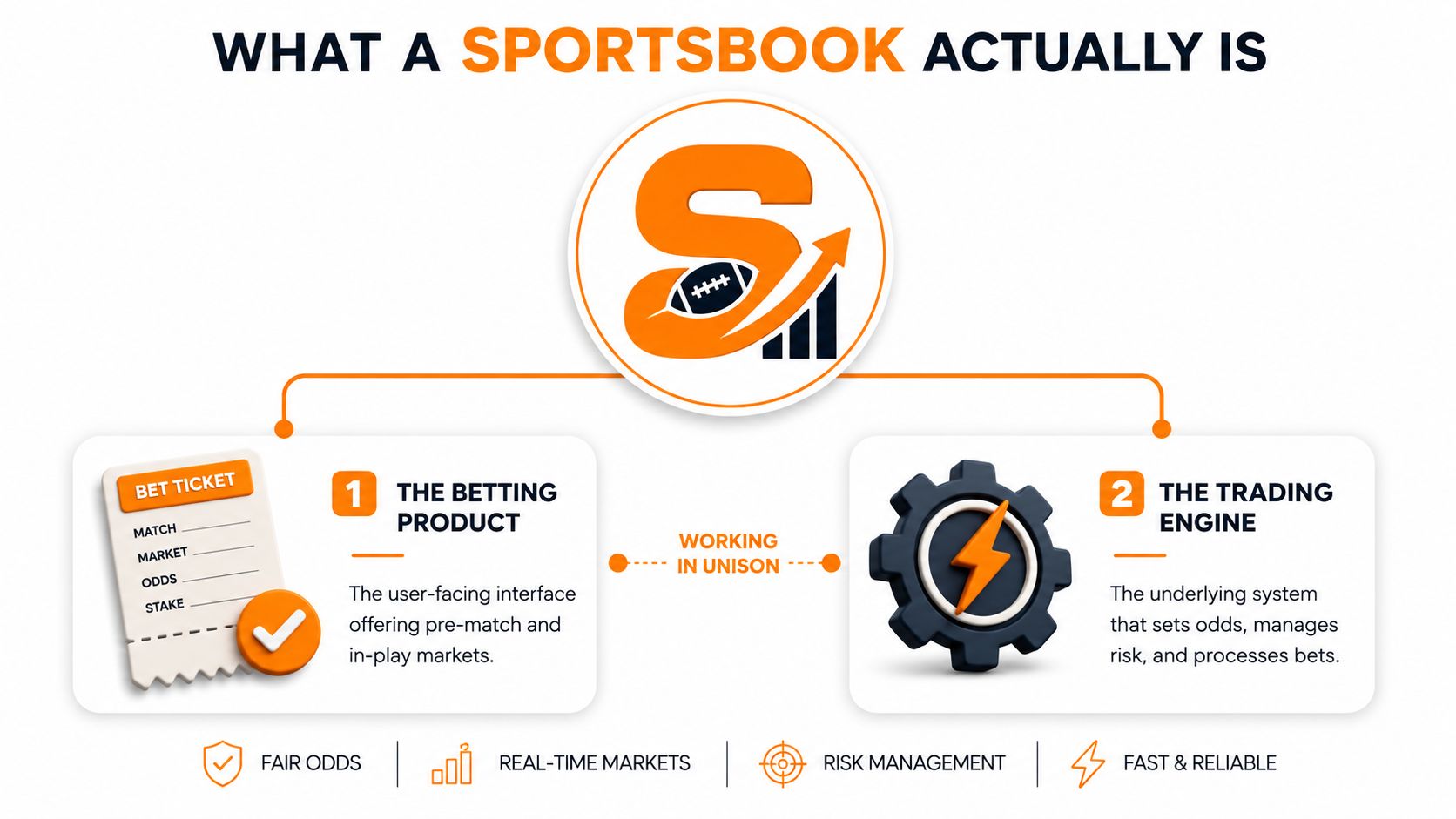
A physical bookmaker counter and a digital sportsbook solve the same problem in different ways. The counter takes bets in person, while the online version has to handle accounts, wallets, market updates, and thousands of simultaneous users without losing track of who staked what and when. That's why modern definitions now include websites and mobile apps, not just retail venues, and why in-play betting has become part of the standard product shape in many markets (Cambridge's definition of sportsbook).
A working definition operators can use
A sportsbook is a wagering platform that prices sporting outcomes, accepts bets on those outcomes, and pays winners according to the posted odds. In modern regulated markets, that also means it has to manage the full path from customer sign-up to settlement, not just display a betting board. The category widened sharply after the U.S. Supreme Court overturned PASPA in 2018, and sports betting was legalized in 38 states plus the District of Columbia (Investopedia on sportsbook expansion).
That legal shift matters because it changed the operating model. Sportsbooks moved from a narrow retail format into a mainstream online and mobile category across major markets, which means operators now buy software, payments, compliance, and trading capability together.
Practical rule: if a vendor only talks about the bet slip and ignores settlement, wallet logic, and risk controls, you're not looking at a full sportsbook stack.
The Economic Engine Behind Every Wager
The business model is built on vig, also called juice. That's the margin baked into the odds, and it's what lets a sportsbook earn on handle rather than on picking winners. In other words, the operator is selling probability with a margin attached, not acting as a predictor.
Why balanced action matters more than picking the winner
Take a simple two-sided market. Team A is priced at -110 and Team B is also -110. A bettor risks $110 to win $100 on either side, so the book collects a built-in margin while trying to keep the action balanced. If more money comes in on one side, the sportsbook may move the line to manage exposure, but the core aim stays the same, balance risk and keep the margin intact (Hub88 on vig and pricing).
The bettor is trying to find a mispriced outcome. The sportsbook is trying to make sure the book doesn't become lopsided. That's why pricing teams care about probability models, market movement, and exposure limits, while bettors care about value. Those are two sides of the same equation.
The book doesn't need to know the winner in advance. It needs to know how to price uncertainty well enough to stay profitable across the whole market.
Market types are just different pricing problems
Moneylines, spreads, totals, props, and futures all sit on the same economic engine. The label changes, but the job doesn't. The sportsbook is still estimating probabilities, publishing odds, and deciding how much risk it's willing to take on each side of a market.
That's also why sports-betting analytics matter. They help estimate probability and compare odds, but they don't guarantee outcomes. Historical data can inform pricing, yet it can't eliminate uncertainty, which is why risk controls stay central even when the model looks strong. A good sportsbook doesn't pretend it can predict every game, it manages the price of being wrong.
Anatomy of a Modern Sportsbook Platform
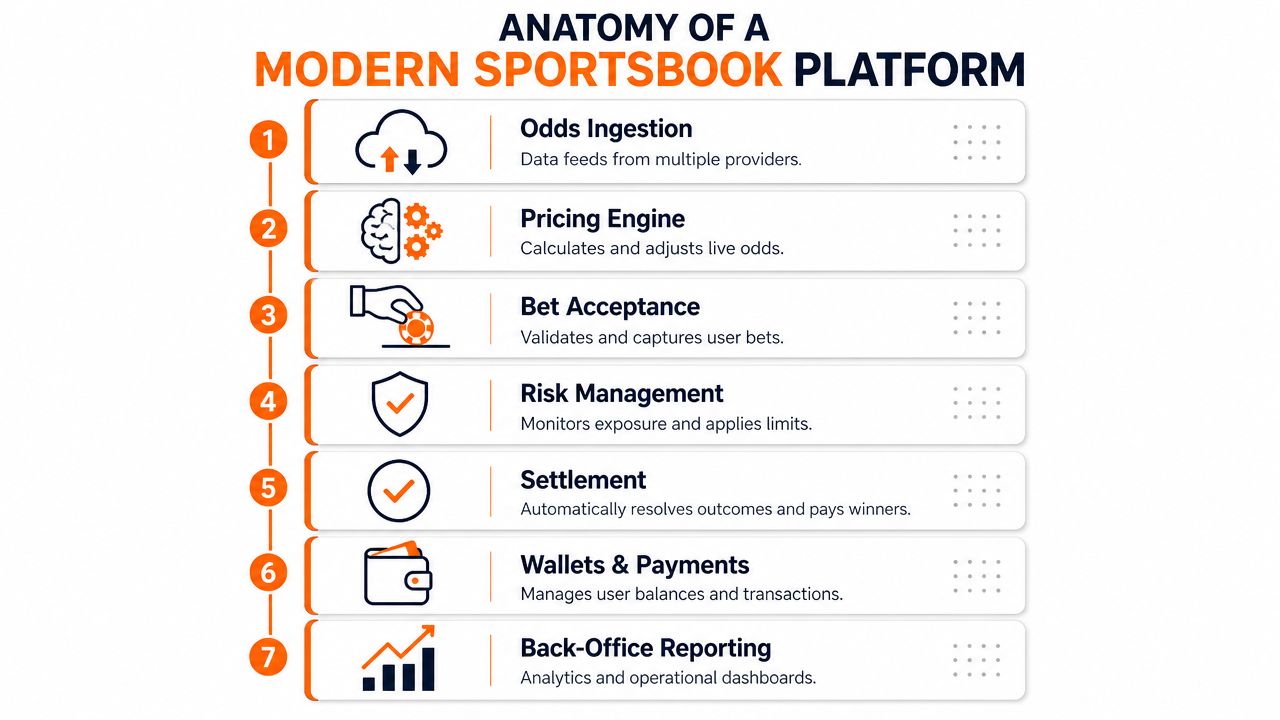
A sportsbook is not a single website sitting on top of a database. In production, it's a distributed system with different layers, different scaling needs, and different failure modes. That distinction matters to operators because a polished front end can still hide a fragile back office.
The stack from odds to reporting
The first layer is odds ingestion, which pulls prices from feeds and external providers. It has to be stateless and horizontally scalable, because it's constantly receiving updates and can't afford to bottleneck the rest of the system. If this layer lags, the sportsbook can show stale prices and accept bets on the wrong line, which creates both financial and customer disputes.
The next layer is the pricing engine, which adjusts those prices based on market movement and risk posture. Then comes bet acceptance, which has to be transactional and atomic so a wager is either captured cleanly or not captured at all. If this layer fails halfway through, you can end up with duplicate bets, broken confirmations, or angry customers who think they've wagered when the system says they haven't.
Further down the stack sit risk management, settlement, wallets and payments, and back-office reporting. Settlement has to be idempotent and auditable so the operator can recreate what happened after the fact. That's not a nice-to-have, it's the difference between being able to prove a bet was handled correctly and being trapped in manual reconciliation.
Why each layer fails differently
The error pattern changes by layer. A stale feed creates line mismatches. An unclean wallet integration creates balance inconsistencies and fraud exposure. Weak reporting creates audit gaps, which become painful during disputes or regulator reviews. That's why this architecture is closer to a financial platform than a simple content site.
Operator takeaway: ask vendors how they prevent duplicate settlement, how they reconcile wallet movement, and how they preserve an audit trail for every bet. Those answers tell you more than a feature list ever will.
For teams evaluating build options, the architecture view is the test. You can start with a platform overview if you want to see how those layers are typically bundled in a commercial product, but the buying question stays the same, which parts are prebuilt, and which parts are still your problem?
Pre-Match and In-Play as Two Different Products
Pre-match and in-play often get described like two modes of the same sportsbook. That's too simple. They're different product surfaces with different latency budgets, different operational stress, and different UX expectations.
Pre-match rewards depth, not speed
Pre-match betting gives the operator room to show a broad menu. Futures, spreads, totals, player props, and niche markets all sit comfortably here because the customer isn't waiting on a pitch, a point, or a possession to resolve before placing the bet. The product challenge is catalog breadth, market organization, and odds movement over time.
That means pre-match teams care about market discovery, promotional placement, and how quickly a bettor can compare prices across events. The pace matters, but it's not the same as live trading. A delay in a pre-match update is frustrating. A delay in in-play can be a liability.
In-play turns the sportsbook into a live trading desk
In-play betting demands fast price updates, suspension logic, and clean reconciliation with settlement. A live market can't stay open when play pauses, and the pricing team has to react to game state changes while protecting the book from unwanted exposure. That's why real-time trading is now a defining capability, not an add-on.
The player experience also changes. A bettor expects live odds to move, cash-out values to update, and confirmations to arrive quickly on mobile. If the interface feels slow, users stop trusting the market. In regulated online and app-based environments, that trust gap can matter as much as the odds themselves.
What operators should ask a vendor
- How fast does the line update under load? Not as a marketing claim, but in actual peak-event conditions.
- What happens when a market suspends? The operator needs to know how reopening is controlled.
- How does cash-out reconcile to settlement? A bet that can be bought back has to land cleanly in the books later.
- How are mobile and live trading kept consistent? The same market should not behave differently on different channels.
Pre-match and in-play are both sportsbooks, but they stress the platform in different ways. A vendor that handles one well and the other poorly is only half-finished.
Compliance, KYC, and the Operator's Real Job
A sportsbook operator is really running a controlled access business. The betting experience is the visible layer, but the actual job is making sure the right person can bet from the right place under the right rules, and that every action can be defended later.
The gates that have to work together
KYC verifies who the customer is. AML monitors financial behavior for patterns that need review. Geofencing enforces where a user is allowed to bet. Responsible gaming tools help the operator manage limits, exclusions, and safer play controls. Regulatory reporting proves the whole system behaved the way it was supposed to, and audit logs preserve the evidence trail.
These are not separate chores. They're connected gates. If identity checks are weak, jurisdictional controls don't mean much. If geofencing is sloppy, the operator can't confidently say it allowed bets only where permitted. If reporting is incomplete, the back office becomes hard to defend during an audit.
Why compliance has to live in the platform
The best compliance setups are designed into the workflow, not bolted onto it later. That means a deposit, a bonus, a wager, and a payout all need to be visible in a way that aligns with the accounting trail. Bonus escrow and audit-ready records matter because promotions and player balances can't be treated as informal adjustments once regulators ask for proof.
An MGA-aligned operator usually thinks in terms of evidence, not just policy. Can you show who approved the account? Can you trace the payment? Can you prove the bet was permitted in that jurisdiction? Those are the questions the platform has to answer without a spreadsheet rescue mission.
The practical buying test
If a sportsbook platform can't show you clean logs, clear jurisdiction rules, and a reporting flow that matches the ledger, it's not ready for regulated operation.
Use this compliance view as a reminder of the control surface operators usually need, but keep your own checklist focused on workflow. Compliance should feel embedded in the product, not layered on top as a separate burden.
Integrations That Make a Sportsbook Run
A sportsbook lives or dies on integrations. The betting front end is only one piece of the machine. Odds feeds, content providers, payments, identity checks, and marketing tools all have to work together or the operator spends more time reconciling than running the brand.
The practical stack operators end up managing
At minimum, the platform has to connect to odds feeds and settlement inputs. Many operators also connect casino content, live-dealer studios, KYC vendors, card and bank rails, crypto rails where supported, and affiliate or CRM tools. Each integration solves a real problem, but each one also adds a point of failure and another place where data can drift apart.
That's why a consolidated stack usually beats a stitched-together one. A single API surface and prebuilt adapters reduce vendor management overhead, shorten launch work, and make troubleshooting less messy. When a wager, a wallet movement, and a bonus event all live in different systems, the reconciliation burden lands on the operator's team.
Unified back office changes the operating model
The operational payoff is bigger than convenience. A unified backend and wallet lets one team run both casino and sportsbook without juggling parallel account systems. That matters for balance consistency, fraud monitoring, and customer support, because the same player should not feel like two different people depending on which product they open.
It also simplifies reporting. If the wallet, wagering engine, and back office sit in one operational model, the operator has fewer handoffs to audit. That doesn't remove complexity, but it removes unnecessary fragmentation.
Good integration design is invisible in the happy path and very visible during a dispute.
If you're building a vendor brief, ask for the integration map, the ownership model for each feed, and the reconciliation process when something downstream disagrees with what the player saw.
Choosing a Sportsbook Solution for Operators
The right platform choice depends on what the business is trying to buy. Some operators need speed. Others need differentiation. Many need both, but not at the same time. That's where the decision between white-label and custom build gets real.
White-label versus custom build
A white-label sportsbook cuts a large amount of setup work because the core stack, compliance tooling, and operational plumbing already exist. That shortens time-to-market and lowers the burden on the operator's internal team. A custom build gives more control over the product and the brand experience, but it also creates integration debt, longer maintenance cycles, and more responsibility for every future change.
There isn't a universal winner. If your team needs to launch, learn, and adapt quickly, white-label usually makes the cleaner business case. If your moat depends on highly specific product behavior and you have the engineering and compliance capacity to carry it, custom can make sense. The cost is not just build time, it's ongoing ownership.
What to score before you sign
- Time-to-Market: Can the vendor get you live without a long integration program?
- Scalability: Will the platform hold under peak traffic and active in-play trading?
- Crypto Support: If you want crypto deposits or withdrawals, how does the platform handle KYC and wallet flows?
- Unified Wallet: Does casino and sportsbook share one balance, one ledger, and one back office?
- Licensing Footprint: Can the stack support the jurisdictions you plan to enter?
- Geo-Fencing and Reporting: Will the platform help you prove where bets were placed and how they were handled?
Crypto deserves a separate conversation. It can be a useful payment and product differentiator, but it also adds KYC attention, wallet handling questions, and volatility considerations that need to be designed into the cashier flow rather than patched in later. A unified wallet can reduce fragmentation, but only if the ledger logic stays clean.
The buyer's lens
Use this vendor comparison framework as a reminder to compare solutions on operations, not slogans. Ask for proof of MGA-grade reporting, jurisdiction controls, wallet behavior, and how the system handles both sportsbook and casino inside one operating model.
Frequently Asked Questions for B2B Buyers
How is a sportsbook usually licensed?
It's typically licensed under the gaming rules of the jurisdiction where the operator wants to accept bets, and the platform has to support those local obligations. For multi-jurisdiction rollout, the hard part is not the license name itself, it's making sure the product can enforce the right rules in each market.
What integrations should I expect on day one?
Expect odds feeds, payments, KYC, wallet and cashier logic, settlement, and reporting. If the plan includes casino alongside sportsbook, the platform should also show how those pieces share the same back office without creating duplicate account logic.
How do trading and operations teams use the back office?
Trading teams watch market movement, exposure, and line behavior. Operations teams use the same environment for reconciliation, settlement review, bonuses, and customer issues. The platform has to support both without making either team rely on spreadsheets to finish the job.
What does total cost of ownership usually include?
It includes more than the license or platform fee. Operators also carry integration work, compliance upkeep, payment costs, reporting effort, and the day-to-day overhead of keeping feeds, wallets, and regulatory controls aligned.
If you're evaluating a launch or a migration, start with the operating model, not the homepage. NexGrate builds the kind of consolidated casino and sportsbook stack this article describes, with a unified backend, wallet, payments, and compliance tooling designed for regulated operators. Visit NexGrate if you want to review how a turnkey platform can fit your launch plan.