
The sports betting software provider with the longest feature list isn't automatically the best choice. A casino-first brand adding sports, a retail operator replacing trading infrastructure, and a new entrant seeking a white-label launch have different implementation problems. Comparing them against the same checklist can leave you buying capabilities you won't use while overlooking responsibilities nobody has agreed to own.
Define your operating model before requesting proposals. Identify your target jurisdictions, intended launch date, internal technical capacity, and control boundaries. Decide whether you want to run trading, own the customer interface, retain your existing player-account system, or delegate most technology operations.
The buying criteria should follow those decisions:
- Launch speed and integration effort: Separate platform configuration from licensing, payment approvals, migration, and acceptance testing.
- Betting engine and data: Establish who owns the technology, contracts for feeds, sets limits, and resolves settlement disputes.
- Payments and compliance: Identify who operates the wallet, approves withdrawals, maintains regulatory rules, and supplies audit evidence.
- Support and change control: Confirm who handles incidents, approves releases, and pays for market-specific development.
Turnkey, white-label, modular, API-first, omnichannel, and enterprise describe operating choices, not a quality ranking. An API-first route deserves consideration when your engineers can own orchestration and monitoring. A consolidated stack deserves consideration when avoiding that work matters more than controlling every component.
The following sports betting software providers are best compared through those boundaries, rather than treated as interchangeable products.
Table of Contents
- 1. NexGrate
- 2. Kambi
- 3. Altenar
- 4. EveryMatrix / OddsMatrix
- 5. Sportradar
- 6. Sportingtech
- 7. SOFTSWISS
- 8. Playtech Sports
- 9. OpenBet
- 10. BetConstruct
- Top 10 Sports Betting Software Providers: Side-by-Side Comparison
- Choose for Control, Speed, and Long-Term Fit
1. NexGrate
Best suited to operators seeking a unified, branded casino-and-sportsbook launch. NexGrate's turnkey white-label model combines the customer-facing experience with sportsbook, casino content, payments, player wallets, affiliate management, and operational administration. Its appeal is reducing the number of separate systems an operator must assemble and maintain.
For a new brand, that means evaluating a complete operating environment rather than purchasing a betting engine and building everything around it. For an existing casino operator, the more important question is whether adopting that environment justifies replacing established account, cashier, or back-office arrangements.
NexGrate's described tooling includes branding configuration, player administration, bonuses, KYC workflows, fraud controls, reporting, and role-based permissions. Its NexAI assistant is intended to let authorized staff query live platform data in plain language, which deserves testing against actual operational questions rather than a scripted presentation.
What to verify before committing
- Unified operations: Follow a player from registration through a sportsbook wager, casino activity, withdrawal review, and account restriction. Confirm which records staff can access without switching systems.
- Compliance evidence: Inspect audit trails, responsible-gambling workflows, permissions, and reporting exports. Alignment with a regulatory framework isn't the same as authorization to operate in a particular jurisdiction.
- Commercial scope: Request an itemized proposal covering deployment, content, feeds, payment integrations, support, customization, and termination assistance.
- NexAI access: Test whether restricted staff can retrieve sensitive information indirectly and whether answers can be traced to underlying records.
Practical rule: Treat a rapid-launch proposal as a configuration schedule until licensing, payment acceptance, and market-specific controls have been confirmed.
The trade-off is consolidated delivery versus supplier dependence. NexGrate merits a close look when your team wants a full stack, but the contract should still establish data portability, change-request ownership, and the support available when an issue crosses sportsbook, wallet, and compliance functions.
2. Kambi
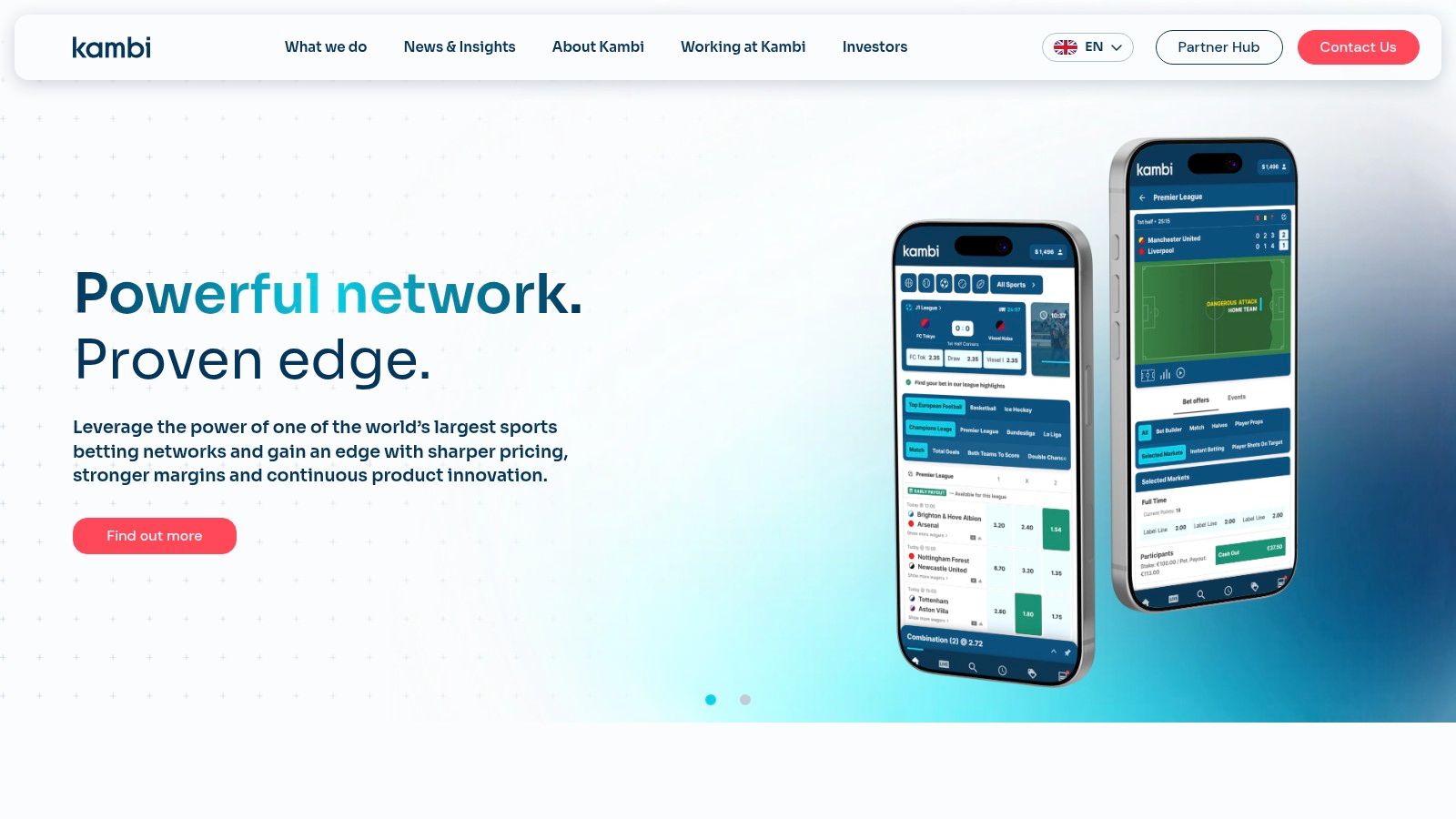
An operator without a substantial trading function should assess Kambi as a managed operating relationship, not just a software purchase. Kambi's sportsbook offering spans turnkey and modular services, including platform technology, trading, pricing, risk management, and online and retail capabilities.
That scope can suit an operator that wants to concentrate on brand, acquisition, and customer experience while buying specialist sportsbook services. It also creates a procurement question that feature comparisons rarely resolve: which decisions can your team make independently, and which require the supplier?
Establish the trading boundary
Ask Kambi to demonstrate how an operator changes exposure limits, adjusts its product presentation, investigates a disputed settlement, and escalates unusual betting activity. Distinguish configurable controls from requests that enter a managed-service queue.
The advantage is access to a broader service scope without assembling every function internally. The limitation is that a managed arrangement may be unnecessary if your requirement is only an odds feed or a narrowly defined technology component.
For a wider sports betting platform comparison, keep service ownership separate from interface customization. A branded front end doesn't establish ownership of trading logic, release schedules, or underlying intellectual property.
Before signing, document incident escalation, front-end integration responsibilities, data access, and the process for changing service scope. Request a commercial breakdown rather than assuming platform, trading, feeds, and support are bundled on identical terms.
3. Altenar
Keep the existing platform or replace more of it? That's the useful starting point for Altenar's sportsbook solutions, which include an integrable sportsbook module alongside turnkey and white-label deployment options.
A casino operator with a functioning player-account system may prefer the modular route. A new entrant may find a broader package more appropriate, particularly when front-end and account-management capabilities are also required.
Altenar's described offering includes live betting, Bet Builder, configurable limits, promotional tools, and retail technology. The implementation burden depends less on that feature inventory than on how the sportsbook communicates with your existing wallet, customer records, and operational controls.
- For modular deployment: Examine API documentation, authentication, transaction identifiers, retry behavior, and settlement notifications.
- For white-label deployment: Confirm licensing responsibilities, customer-data access, branding scope, and which operational services are included.
- For retail expansion: Ask how terminal management, remote configuration, account restrictions, and reporting connect with online operations.
Test the exception paths
A successful bet placement isn't enough evidence of integration quality. Ask the demonstration team to handle a wallet timeout, a duplicate request, a subsequently voided selection, and an account restriction applied during an active session.
Altenar's flexibility is valuable when you know which components you want to retain. Without that architectural decision, comparing its deployment options can become an exercise in comparing different scopes rather than different prices.
Require a responsibility map alongside the implementation proposal. It should identify who fixes failures at each interface and who owns reconciliation when sportsbook and account records disagree.
4. EveryMatrix / OddsMatrix
OddsMatrix deserves separate consideration from the wider EveryMatrix stack. EveryMatrix's OddsMatrix sportsbook supports sportsbook-focused deployments, while the broader platform can bring together casino, player-account management, payments, and operational services.
That distinction matters for an established operator. Replacing a sportsbook while preserving the account platform is a different project from migrating customer accounts, balances, payments, and gaming operations together.
The described sportsbook capabilities include pre-match and live betting, Bet Builder, Cash Out, front-end options, and controls for margins, bonuses, and content. Online, retail, and omnichannel options make the supplier relevant beyond a purely digital launch.
Don't buy the wider platform simply because it's available. Buy it when consolidating systems solves a defined operational problem.
Compare the deployment scopes separately
Request a sportsbook-only proposal and, where relevant, a broader platform proposal. Compare migration work, retained vendors, reporting continuity, release dependencies, and ongoing operational responsibilities, not just the headline commercial offer.
The strength is choice between focused and consolidated deployment. The complication is coordinating a wider project when multiple customer-facing and financial systems change together.
For a migration demonstration, provide representative account histories and unsettled-bet scenarios. Ask how the proposed approach preserves balances, historical reports, bonus conditions, and support visibility while systems transition.
Finally, establish which configuration changes your staff can make directly. A configurable product is only operationally useful when permissions, approval workflows, and testing environments let your team use those controls safely.
5. Sportradar
For operators assessing platform and sports data together, Sportradar's sportsbook platform offers a different procurement starting point. Its offering combines sportsbook technology with access to its broader sports-data and betting-product portfolio, with online and retail positioning.
The potential benefit is simpler coordination between platform and data services. That doesn't remove the need to identify exactly which feeds, products, operational services, and market permissions the proposal includes.
An operator considering Sportradar should distinguish an end-to-end platform engagement from purchasing specific betting components. Those routes require different internal capabilities and shouldn't share an assumed implementation schedule.
- Data continuity: Demonstrate how delayed updates, corrected results, and interrupted feeds affect market suspension and settlement.
- Operational control: Confirm who can override a result, approve a correction, and inspect the supporting event history.
- Contractual coverage: Verify rights and availability for the sports, territories, channels, and products you intend to offer.
Evaluate the failure response
A useful demonstration starts with an interrupted live event rather than a perfectly functioning betting screen. Ask how staff identify the problem, communicate with customers, reconcile affected wagers, and document the resolution.
When comparing iGaming software providers, separate breadth of portfolio from the services contracted. Access to related products doesn't establish that integration, support, or commercial rights are included.
Sportradar warrants investigation for data-led and omnichannel operating plans. Teams seeking narrowly scoped components should compare its integration boundaries against modular alternatives before committing to a broader platform relationship.
6. Sportingtech
A localized sportsbook requires more than translated navigation. Operators should examine how Sportingtech's sportsbook platform lets staff configure content, pricing, limits, exposure, and promotions for their intended audience.
Its described features include Bet Builder, Cash Out, Fastbet, Bet Assist, custom events, boosted odds, and promotional tools. The wider platform also covers casino and back-office functions, making Sportingtech relevant to operators evaluating a combined gaming environment.
The strongest use case is an operator seeking product configuration within a broader platform. The implementation question is whether the available controls match the team's authority, staffing, and approval processes.
Separate marketing freedom from risk authority
Ask the demonstration team to create a localized promotion, change an exposure limit, and restrict an event. Watch which actions require approval and whether the system records who changed what.
- Feed scope: Identify included data sources and any separately contracted services.
- Promotion controls: Test eligibility, exclusions, settlement behavior, and reporting for free bets and boosted odds.
- Permissions: Separate campaign creation from approval of risk-sensitive pricing or limit changes.
A practical sportsbook risk-management assessment should examine how those functions interact. Promotional flexibility isn't enough if the trading team can't see the resulting exposure.
The trade-off is configuration breadth versus configuration governance. More controls can help an operator differentiate its product, but staff need clear permissions and safe release procedures.
Request a quote that identifies which features, integrations, and operational services belong to the proposed deployment. Validate important capabilities in the target-market configuration rather than relying on a general product demonstration.
7. SOFTSWISS

Adding sports to a casino shouldn't automatically require replacing the casino. SOFTSWISS Sportsbook offers standalone and integrated routes within a wider ecosystem that also includes casino technology and game aggregation.
That makes it relevant to casino-first operators deciding how much existing infrastructure to retain. Its described sportsbook functions include pre-match and live betting, sports and esports coverage, and odds and risk-management tools.
The integration assessment should concentrate on player identity, balances, restrictions, bonuses, and support visibility. A consistent design matters, but operational consistency matters more when a customer moves between casino and sportsbook.
Put the shared customer journey under pressure
Ask for a demonstration in which a player deposits, places a sports bet, uses casino content, reaches a limit, and requests a withdrawal. Inspect whether the resulting records remain understandable to customer support, finance, and compliance staff.
The importance of that experience has independent support: ACSI's satisfaction benchmark rated mobile-app quality at 80, with reliability, privacy, and navigation each at 79, reinforcing the need to evaluate platform delivery alongside betting functionality (ACSI sportsbook and iGaming analysis).
The advantage is deployment choice for casino-led businesses. The limitation is that a broad supplier ecosystem doesn't prove every module fits your architecture or target market.
Confirm available functions for the proposed deployment, define cross-product support ownership, and request commercial terms covering the actual modules you'll use. Don't assume shared branding means shared operational responsibility.
8. Playtech Sports
A retail estate changes the buying decision. Playtech Sports combines digital and retail sportsbook technology with managed trading options, pricing and risk tools, sports-content services, and retail estate-management capabilities.
Its clearest suitability is an operator that must coordinate shops, terminals, and digital channels. For an online-only brand, some of that breadth may be unnecessary.
An omnichannel demonstration should go beyond showing the same branding on different screens. The operator needs to understand how staff administer devices, distribute configuration changes, investigate disputed tickets, and maintain service when connectivity fails.
Buying distinction: Retail capability is useful when it solves estate-management and operational problems, not merely when a supplier also sells terminals.
Examine managed trading and retail together
Ask how trading decisions reach retail and digital interfaces, how staff detect inconsistent market states, and who can suspend affected products. Then examine the operating procedures for offline devices, software updates, and incident escalation.
Managed trading may reduce the amount of trading capability you need to build internally. It also requires explicit agreement about pricing authority, exposure decisions, escalation rights, and the treatment of exceptional events.
Request a deployment plan that distinguishes central platform work from shop-level installation, device configuration, training, and support. Otherwise, a technically ready backend can be mistaken for an operationally ready retail rollout.
Commercial evaluation should establish market-specific availability and the scope of each managed service. Compare the proposed package with your actual channel strategy, not with an abstract ambition to become omnichannel.
9. OpenBet
OpenBet belongs on an enterprise shortlist when the requirement extends beyond a ready-made launch package. OpenBet's sportsbook technology and services include betting-engine capabilities, trading, pricing, risk management, sports content, and custom services for regulated-market operators.
For a substantial sportsbook operation, the relevant question is how those components fit the operator's architecture and internal teams. A broad engagement may make sense when product, engineering, trading, and compliance functions already have detailed requirements.
The corresponding burden is program ownership. Bespoke scope needs acceptance criteria, integration accountability, migration planning, and agreement on who supports the resulting system.
Require operational evidence, not enterprise labels
- Performance: Request testing against your proposed traffic mix, settlement workload, and integrations rather than accepting an unrelated capacity statement.
- Delivery: Identify which components are standard, configured, or custom-built, with separate acceptance criteria.
- Service scope: Confirm which trading, content, risk, and support functions are included in the contract.
Responsible-gambling governance deserves equal attention. The SCCG gambling industry report describes expanding monitoring, player-protection, and audit requirements, supporting an evaluation that goes beyond a generic compliance-feature label.
Ask prospective suppliers to demonstrate explainable alerts, human review, intervention records, market-specific rules, and regulator-ready exports. Automation without a clear review trail shouldn't satisfy procurement.
OpenBet is worth investigating for a substantial, specific sportsbook program. Smaller teams should establish whether the proposed delivery model matches their capacity to manage it, rather than selecting enterprise scope as a precaution.
10. BetConstruct
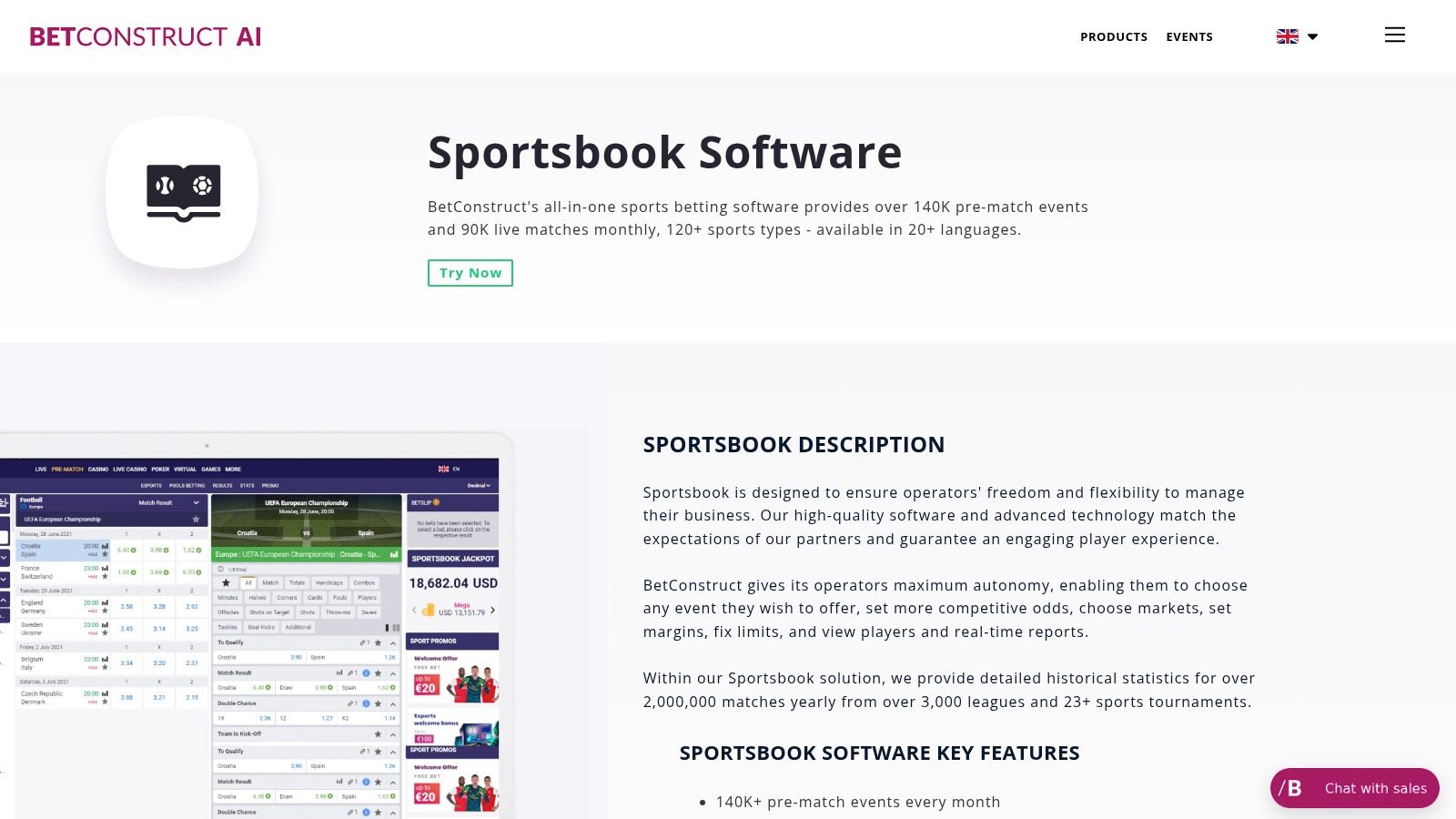
BetConstruct's sportsbook sits within a broader gaming portfolio that includes virtual sports and other products. It merits investigation when an operator wants to compare a sportsbook purchase with a wider supplier relationship.
The practical caution is scope clarity. Features described for virtual sports, hosted services, or other portfolio products shouldn't be assumed to apply to the sportsbook deployment under discussion.
For teams exploring a modular route, the first task is to establish what can be separated. Ask for the proposed architecture, interface documentation, operational-service boundaries, and a clear account of which existing systems can remain.
- Product boundaries: Distinguish sportsbook functions from adjacent gaming products and optional services.
- Integration requirements: Confirm wallet, account, reporting, payment, and customer-support interfaces.
- Operational visibility: Review available service-status information alongside contractual incident notification and escalation procedures.
Make the demonstration resolve uncertainty
Provide a realistic scenario involving an accepted bet, an event correction, a withdrawal review, and a customer dispute. Require the supplier to show the staff workflow and resulting records, not just describe them.
The broader portfolio is a reason to investigate, not evidence that every integration is already solved. A demonstration should establish available functionality for your target market and deployment model.
Request explicit commercial terms for implementation, included operational support, optional products, and future changes. BetConstruct should advance on the shortlist when those answers fit the existing architecture, rather than because a broad catalog appears to cover every eventual requirement.
Top 10 Sports Betting Software Providers: Side-by-Side Comparison
| Provider | Core Platform Scope | Standout Strengths | Best Suited For | Pricing / Value |
|---|---|---|---|---|
| 🏆 NexGrate | Casino, sportsbook, payments, player wallet, compliance, and back office | ★ Unified white-label stack; ✨ 10,000+ games, 300+ cryptocurrencies, 25 languages, and NexAI; vendor-stated launch in as little as six days | 👥 Operators launching or scaling branded casino-and-sportsbook businesses | 💰 Quote-based; request a demo |
| Kambi | Sportsbook technology, trading, risk, and online/retail operations | ★ Turnkey or modular services; trading and risk-management expertise | 👥 Licensed operators seeking sportsbook services or an omnichannel setup | 💰 Not publicly listed |
| Altenar | Sportsbook module, turnkey/white-label platform, and retail technology | ✨ Integration or turnkey routes; live betting, Bet Builder, and retail support | 👥 Operators adding sportsbook or combining online and retail betting | 💰 Not publicly listed |
| EveryMatrix / OddsMatrix | Sportsbook or broader casino, wallet, payments, and platform services | ★ Flexible scope; ✨ Cash Out, Bet Builder, and online/retail options | 👥 Operators seeking sportsbook-only services or a broader platform | 💰 Not publicly listed |
| Sportradar | Online and retail sportsbook technology plus sports data | ★ Platform and data capabilities from one supplier; broad sports coverage | 👥 Regulated-market operators prioritizing sports data and omnichannel products | 💰 Not publicly listed |
| Sportingtech | Sportsbook, casino, back office, data, and compliance tools | ✨ Risk controls, localized products, Bet Builder, Cash Out, and promotions | 👥 Operators seeking configurable sportsbook and casino services | 💰 Quote-based |
| SOFTSWISS | Standalone sportsbook or wider casino and game-aggregation ecosystem | ★ Modular options; sports and esports coverage with pre-match and live betting | 👥 Casino-first brands adding sportsbook or operators preferring modular integration | 💰 Not publicly listed |
| Playtech Sports | Digital and retail sportsbook, trading, risk, and estate management | ★ Managed trading; ✨ retail tills, terminals, and omnichannel capabilities | 👥 Operators with substantial retail estates or managed-trading needs | 💰 Not publicly listed |
| OpenBet | Sportsbook technology, content, trading, and tailored services | ★ Broad support for large-scale operations and regulated markets | 👥 Licensed operators with substantial sportsbook requirements | 💰 Not publicly listed |
| BetConstruct | Sportsbook and wider gaming portfolio, including virtual sports | ✨ Virtual sports and broader gaming products; validate sportsbook details in a demo | 👥 Operators seeking sportsbook alongside other gaming products | 💰 Not publicly listed |
Choose for Control, Speed, and Long-Term Fit
There isn't a universal winner among sports betting software providers. There's a provider whose deployment model matches the work your organization wants to own, the capabilities it can support, and the markets it intends to enter.
For a unified casino-and-sportsbook launch, examine NexGrate's turnkey white-label model. For a configurable sportsbook within a broader platform, compare Sportingtech, SOFTSWISS, and EveryMatrix against the systems you intend to retain.
Operators requiring trading services, data capabilities, or omnichannel infrastructure should investigate Kambi, Sportradar, Playtech Sports, and OpenBet. Teams considering a more modular route should test Altenar and BetConstruct against their existing architecture, without assuming that similarly named deployment options contain identical services.
Turn the shortlist into a working evaluation
Request demonstrations using your own market scenarios. Include failed payments, corrected settlements, account restrictions, responsible-gambling interventions, and reporting requests, not just successful registrations and bet placements.
Map every integration and assign an owner to each interface. Confirm licensing responsibilities and regulatory availability separately from technical readiness, then require a delivery plan that includes payment approvals, configuration, migration, testing, and operational training.
- Model total operating costs: Include platform access, feeds, content, integrations, managed services, hosting, support, change requests, and exit assistance.
- Test financial continuity: Inspect reconciliation, transaction histories, wallet retries, withdrawal reviews, and the distinction between bet settlement and cash withdrawal.
- Prove governance: Review permissions, intervention explanations, manual overrides, audit records, retention settings, and reporting exports.
- Contract for responsibility: Specify who investigates failures, communicates incidents, restores service, and supplies evidence to the operator.
Payment evaluation deserves particular scrutiny. Paysafe found that 42% of surveyed bettors expected instant or near-instant payouts, while another 46% accepted a wait of up to 24 hours, making withdrawal orchestration a practical platform-selection issue (Paysafe's global bettor payments research).
That doesn't justify bypassing fraud or compliance reviews. It means your team should be able to distinguish a legitimate review from a technical delay, explain the transaction state, and identify who can resolve it.
The strongest proposal makes responsibilities easier to inspect, not harder to question.
Choose the provider whose control boundaries and operating economics match your launch plan. Speed matters, but so do the changes you'll need after launch, the evidence your compliance team must produce, and the systems you may eventually want to replace.
NexGrate offers a turnkey white-label casino and sportsbook platform that brings branded delivery, payments, player wallets, and operational controls into a unified stack. Visit NexGrate to request a demonstration using your target-market scenarios and clarify the integrations, responsibilities, and commercial terms required for your launch.