
You're probably staring at a launch calendar that looked clean two months ago and now feels held together with sticky notes. Casino on one back office, sportsbook on another, payments patched in by a third vendor, KYC sitting somewhere else, and everyone still saying the wallet will be “fine” once integrations are done. That's how brands miss launch dates and then spend the next quarter reconciling player balances, bonus rules, and reporting exports by hand.
The hard truth is simple. iGaming software providers are not a shopping list of features, they're an operating model choice. The wrong one doesn't just limit content or pricing, it forces your team to absorb avoidable risk in wallets, compliance, payments, and cutover. The market is large because operators keep buying infrastructure instead of building every layer themselves, with one 2026 report valuing the global iGaming software market at USD 5.31 billion in 2025, rising to USD 5.90 billion in 2026 and projected to reach USD 12.09 billion by 2032 at a 12.45% CAGR (market report). But size doesn't help you if the stack falls apart when you try to move a live brand.
Table of Contents
- The Operator's Real Problem With iGaming Software Providers
- The Four Types of iGaming Software Providers Explained
- Core Platform Features That Actually Run an iGaming Brand
- How iGaming Software Providers Get Paid and What Each Model Costs You
- MGA Aligned Compliance and Multi Jurisdictional Controls
- Crypto Casino Support Beyond the Marketing Page
- Migration Risk and the Vendor Evaluation Sequence
- Evaluation Checklist and Phased Migration Roadmap
The Operator's Real Problem With iGaming Software Providers
A brand wants to go live in eight weeks. The deck says the platform is “full stack.” The demo looks slick. Then the integration call starts, and the truth lands hard. Casino sits on one back office, sportsbook on another, payments are handled through a separate cashier, and KYC is bolted onto the side with a different admin login. The player wallet is not unified, which means finance, risk, and customer support are all looking at different versions of the same account.
That's the moment operators realise they didn't buy a platform, they bought a pile of dependencies.
The wrong vendor decision creates friction in the places that matter most. When wallets are fragmented, bonus logic gets misapplied. When KYC lives outside the core system, re-verification becomes manual. When payments are not designed into the platform, settlement and chargeback handling turn into a support problem. Industry research on platform and sportsbook software shows how central this layer is, with the software component holding 62.4% of that market in 2025, equal to about USD 9.2 billion, and the B2B end-user segment holding 58.3%, or roughly USD 8.6 billion (market breakdown). That's not content money. That's infrastructure money.
Practical rule: If a vendor can't explain how player balances, bonus balances, KYC state, and payment status stay consistent during a live cutover, don't sign.
The core buying question is not “How many games do you have?” It's “How much of my live operation can you replace without breaking accounting, compliance, and player trust?” If the answer is fuzzy in the demo, it'll be ugly in production. This is why platform selection should be treated as an integration and migration decision first, and a feature decision second. A good stack can be swapped in. A bad one keeps you trapped.
The Four Types of iGaming Software Providers Explained

Think of the ecosystem like a restaurant. Most operators get into trouble because they confuse the kitchen with the supplier, or the supplier with the chef.
The kitchen, the wholesaler, the chef, and the dining room
The PAM or turnkey platform is the kitchen and waitstaff. It owns the player account, wallet, cashier, compliance flows, bonus logic, and back office. If this layer is weak, everything above it becomes harder.
The game aggregator is the wholesale supplier. It connects you to many studios through one integration, which is why operators use it to expand content without stitching together dozens of direct deals. That matters when your lobby has to stay fresh, but it also means the aggregator sits close to your content dependency chain.
The game studio is the chef with a signature dish. Evolution, Pragmatic Play, and similar studios make the content people open the app for. They don't run your business. They supply the experience that keeps players engaged.
The standalone sportsbook provider is the bar. It has its own rhythm, its own risk logic, and its own operational quirks. It can be integrated cleanly, but it often creates pressure on wallet handling, settlement, and reporting if the main platform wasn't designed to support it properly.
The key point is that mixing layers is normal. Mixing them without a unified wallet is where pain starts. That's why a modular stack only works when the architecture underneath it is designed for single-player truth across every product. If you want a clean vendor map before you evaluate options, this platform overview is the kind of reference that should sit beside your procurement notes.
The quickest way to classify a vendor is to ask what they own when a bet is placed and what they own when it is settled.
If they only talk about lobby design, they're not the platform. If they only talk about feed quality, they're not the sportsbook. If they only talk about content depth, they're a supplier, not an operating system. Once you see the stack this way, the integration risks become obvious before a contract is signed.
Core Platform Features That Actually Run an iGaming Brand
Most vendor demos waste time on nice-to-have screens. That's the wrong frame. The features that matter are the ones that break your operation when they're implemented badly.
Unified wallet is non-negotiable
A unified player wallet across casino and sportsbook is the first thing I check. If the operator has separate balance logic for different products, you'll get reconciliation drift, bonus disputes, and support tickets that nobody can solve quickly. A wallet isn't a cosmetic feature, it's the accounting core of the brand. Every balance movement has to line up with settlement, bonuses, reversals, and withdrawals, or your finance team ends up cleaning up a mess they didn't create.
KYC, AML, cashier, and live dealer all touch each other
KYC and AML workflows are not just onboarding forms. They determine whether a player can deposit, wager, withdraw, or get flagged for review. If those rules are disconnected from the cashier, players can pass one gate and get stuck at another, which is where churn and compliance friction start.
The cashier itself has to be built into the platform, not glued on. Card, bank, and crypto methods all need to map into the same balance logic, and live dealer aggregation has to sit comfortably inside that same framework. If a provider treats live casino as a separate add-on with separate reporting, you'll feel it the first time finance asks for a clean day-end view.
Bottom line: If the platform can't show a single player state across deposit, bonus, gameplay, KYC, and withdrawal, it's under-engineered.
The architecture matters because regulated iGaming lives or dies on auditability. A REST-facing game server model keeps game logic server-side, where the RNG, state machine, win calculation, and audit logs belong, rather than exposing that logic through the client (architecture overview). That separation reduces tampering risk and keeps dispute resolution rooted in server-side records, not front-end screenshots.
For a deeper vendor walkthrough, keep the platform feature map beside your checklist. If the provider can't explain how these components interact under load, you're looking at a demo, not a system.
How iGaming Software Providers Get Paid and What Each Model Costs You
The commercial model shapes the vendor's behaviour. Ignore that, and you'll overpay in the exact place the sales deck made sound harmless.
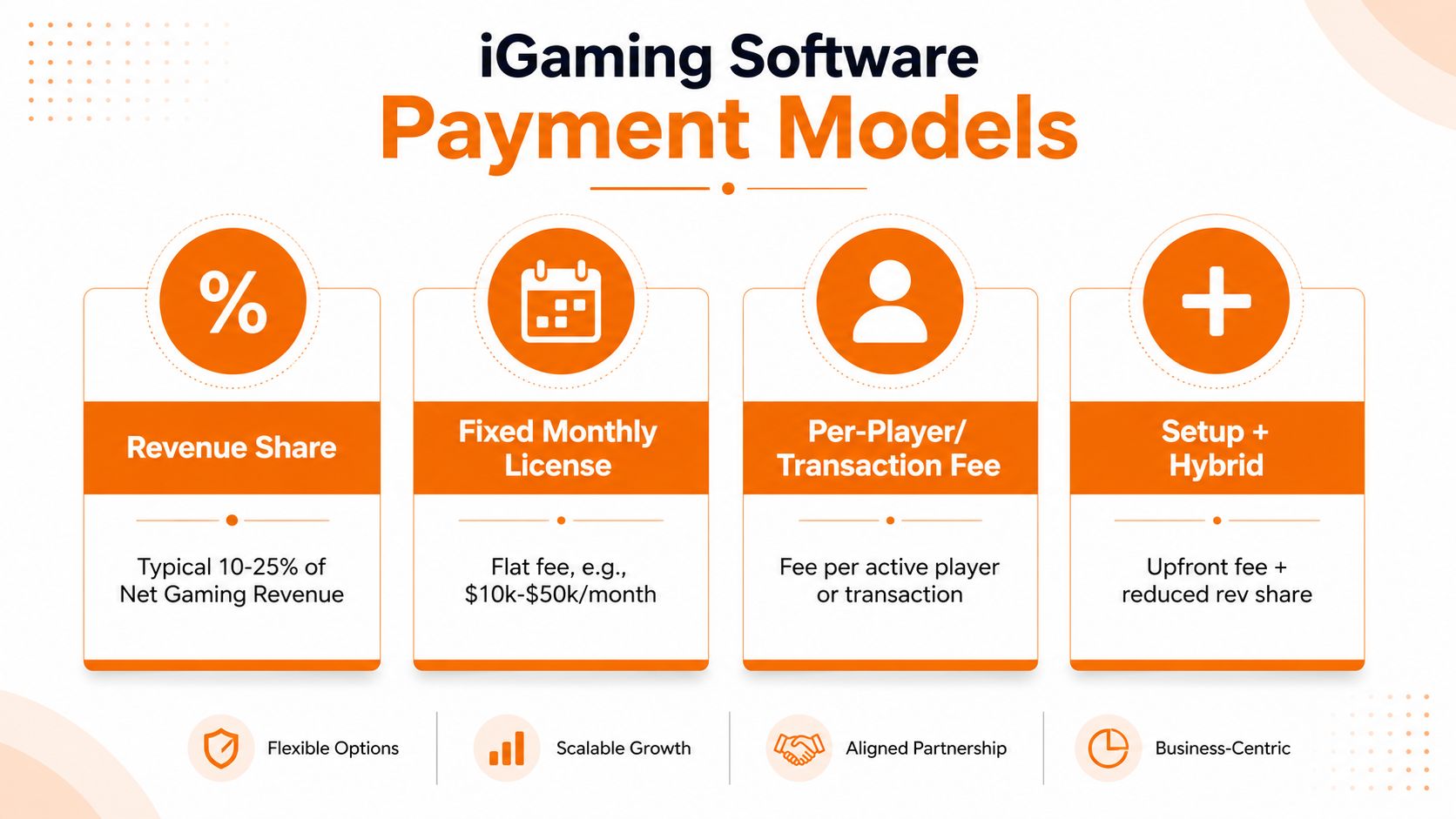
Revenue share rewards speed, then gets expensive
Revenue share on net gaming revenue is easy to start with because it lowers upfront pain. The vendor is motivated to help launch quickly, because they only win if you win. The downside is obvious. Once volume grows, the vendor participates in your upside forever, even if the support quality doesn't improve.
Fixed licensing gives control, but not always flexibility
A fixed monthly license makes budgeting cleaner. You know what the platform costs, and the provider has less incentive to skim the top line. The trade-off is that you may have to pay extra for integrations, support, premium modules, or changes that should have been included in the first place. That's where the hidden cost shows up.
Per-player and per-transaction fees punish scale
Per-player or per-transaction pricing looks fair on paper. It often isn't. If your traffic or engagement rises, the invoice rises with it. That model can work for a small or tightly controlled product, but it becomes painful fast when volumes grow or when you run multiple brands through the same stack.
Setup plus hybrid is where negotiation matters most
Hybrid deals often combine an upfront fee with a reduced ongoing share or reduced monthly cost. That can be the best fit for mature operators who want a more balanced long-term profile, but only if the contract doesn't bury you in add-ons. The fee that doubles in year two is usually the one tied to modules you assumed were standard.
For an early-stage brand, revenue share can be a sensible bridge. For an established operator, fixed licensing or a hybrid structure usually makes more sense. Crypto-first products need close scrutiny on payment and compliance add-ons. Multi-license groups should push hardest on portability, reporting access, and price protection across brands. In every case, negotiate the renewal mechanics first, because that's where vendors get comfortable and operators get trapped.
MGA Aligned Compliance and Multi Jurisdictional Controls
Compliance is architecture. If a provider treats it like paperwork, you'll end up rebuilding it market by market.
Start with the controls that regulators expect to see functioning together. Geofencing keeps restricted jurisdictions out. Audit logs record what happened, when, and by whom. Segregation of player funds protects operational discipline. Responsible gaming tools need to be active, not buried in a submenu. Segregation of duties matters because one admin shouldn't be able to alter every critical control path. Reporting exports must be consistent enough that compliance and finance aren't arguing over whose numbers are real.
What a compliance-ready demo should show
A decent vendor demo should let you toggle jurisdictional rules without creating a new system every time. If you are adding a second license to an existing stack, the provider should show how player verification rules change, how reports split by jurisdiction, how audit trails remain intact, and how responsible gaming thresholds are enforced in practice. If they can't show that, they're not compliance-ready, they're marketing-ready.
MGA alignment becomes useful as a spine rather than a destination. A platform built around clear auditability, player fund handling, and reporting discipline usually adapts more cleanly to other regulated markets than a stack built around front-end speed alone. The value is in the controls, not in the logo on the slide.
Operators also need to stop accepting vague “compliance support” language. The useful questions are specific. Can the platform export logs in a way your auditors can use? Can geofencing be verified without engineering intervention? Can responsible gaming settings be applied by market, brand, and player segment? If you're evaluating a platform with a compliance lens, keep the compliance reference handy and press every vendor on the exact control, not the promise.
Good compliance software reduces launch friction. Bad compliance software just creates new admin work.
The providers worth your time make controls visible. They don't hide them behind service tickets.
Crypto Casino Support Beyond the Marketing Page
“Crypto-friendly” is one of the most abused phrases in this market. A vendor can say it and still leave you with a brittle payment stack that fails under real operating pressure.
Real crypto support starts at wallet level. You need multi-currency balances, clean separation between on-chain and off-chain handling, and a cashier that doesn't create reconciliation problems when a deposit lands on one rail and a withdrawal leaves on another. If the platform only accepts a token through a third-party processor, that's not genuine support. That's a bolt-on.
The AML side is where weak providers get exposed. A serious crypto stack has to accommodate source-of-funds checks, monitoring logic, and transaction review flows that can stand up to scrutiny. If the vendor can't explain how suspicious activity is reviewed or how blockchain-linked payment events map back to account-level controls, they're not ready for regulated scale.
Regulator expectations are not the same everywhere
Jurisdictional tolerance for crypto varies, and that matters more than the marketing page. Some markets are comfortable with certain flows, others are tightening fast. A platform can't just say it supports crypto and assume that makes it launch-ready everywhere. The operator still has to know where deposits are accepted, where extra scrutiny applies, and where the commercial upside doesn't justify the compliance drag.
The cleanest test is simple. Ask the vendor to walk through a crypto deposit, a bonus credit, a withdrawal, and a compliance review in one flow. If they skip the wallet state, the AML checks, or the off-ramp, they're talking about payments, not operations. The embedded video below is worth a look if you want to pressure-test how vendors talk about this gap.
If the answer is just “we accept BTC,” move on. That's not a crypto strategy, that's a checkout label.
Migration Risk and the Vendor Evaluation Sequence
The riskiest part of choosing iGaming software providers is not the contract. It's the switch.
When you move live brands between stacks, the first things to break are usually the least glamorous ones. Wallet reconciliation slips. Bonus rules reapply badly. KYC states don't translate cleanly. In-flight payments get stuck between old and new systems. Affiliate tracking loses continuity. If the provider has never supported a migration, they'll act surprised by problems that every operator has already seen once.
Run the evaluation backward from cutover
Start with the end state and work in reverse. Ask how the vendor handles data migration, what gets mapped automatically, what must be cleaned manually, and how rollback works if settlement or balance integrity fails. A good provider won't just talk about launch timelines. They'll talk about what happens if the cutover goes wrong at hour two.
A useful four-week diligence sequence is blunt and practical.
- Reference calls with two migrated brands. Not one happy customer, two brands that moved from another stack.
- Sandbox load testing. Push wallet actions, bonus issuance, and settlement events hard enough to see where the system gets unstable.
- Controlled migration of 5% of the database. Enough to expose mapping errors without risking the whole brand.
- Documented rollback plan. If the provider can't explain exactly how you revert, they don't own the risk.
That sequence matters because public provider coverage tends to focus on feature breadth, not the operational cost of switching. Industry review material makes the point indirectly, noting that provider capabilities span reporting, payments, compliance, mobile, PAM, cloud hosting, and multi-currency accounting, which means migration touches every critical workflow at once (software review material). That's the core problem. You're not replacing a front end. You're replacing the spine.
Ask the vendor which teams stayed on the project after the first production incident. Their answer tells you more than the sales deck ever will.
The operators who save themselves pain are the ones who force the migration conversation early. They don't wait for procurement to finish before asking about rollback, reconciliation, and data integrity.
Evaluation Checklist and Phased Migration Roadmap
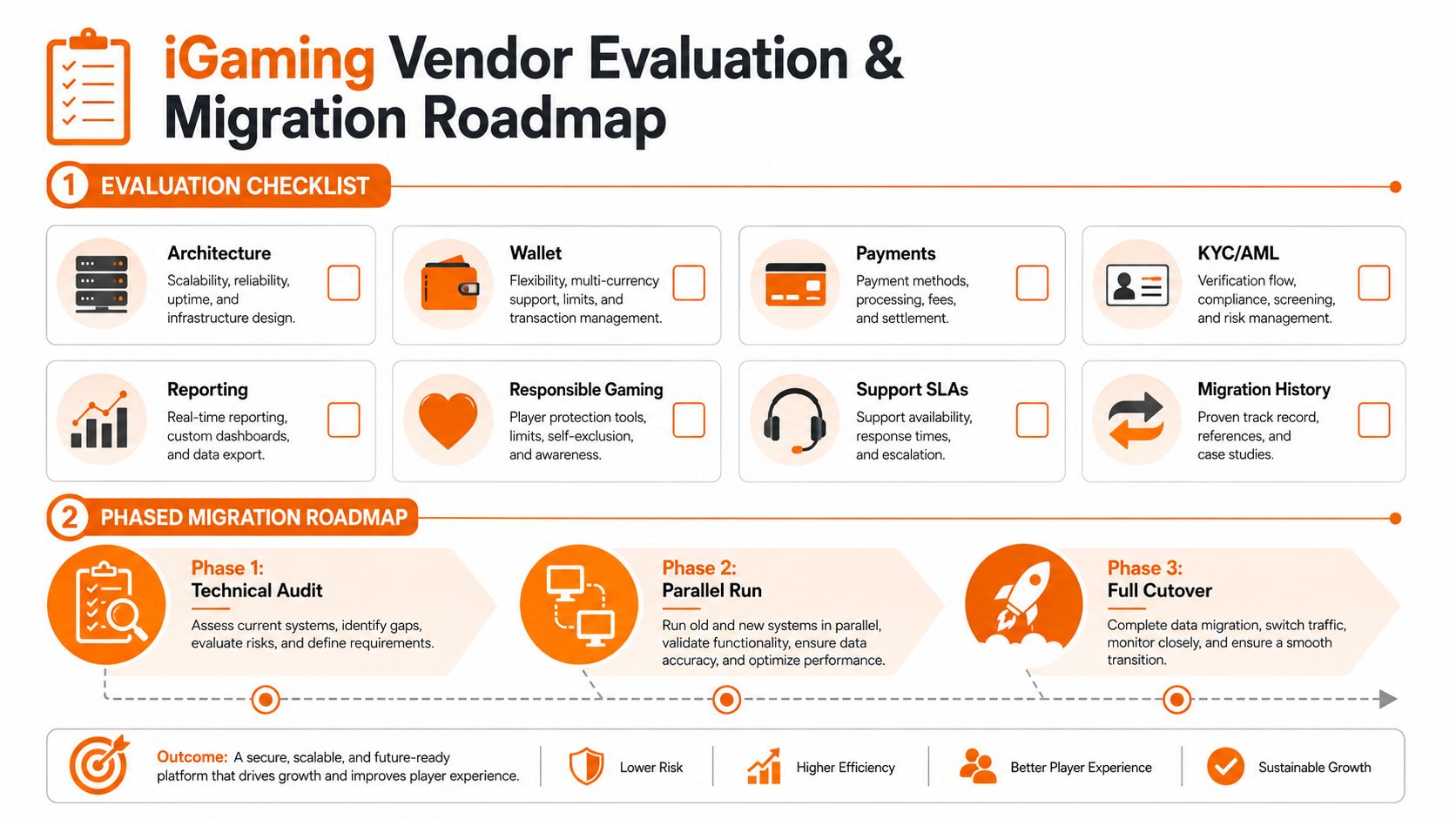
A vendor list is useless unless it turns into a decision tool. Use the checklist below to force every provider into the same frame.
Vendor evaluation checklist
- Architecture: Can the provider explain how game logic, wallet, and reporting are separated?
- Wallet: Is there one player wallet across casino and sportsbook, with clean bonus balance handling?
- Payments: Does the cashier support the methods you need without separate reconciliation work?
- KYC/AML: Are onboarding, re-verification, and monitoring built into the platform flow?
- Reporting: Can finance and compliance extract audit-ready reports without manual manipulation?
- Responsible gaming: Are limits, blocks, and intervention tools configurable by market?
- Support SLAs: Who handles incidents, and what happens outside normal business hours?
- Migration history: Has the vendor moved live brands before, and can they prove it?
Phased roadmap that reduces blow-ups
Phase 1, Technical audit. Verify data mapping, wallet logic, payment flow, and reporting before anything else moves.
Phase 2, Parallel run. Run the new stack beside the old one long enough to catch discrepancies in balances, bonuses, and settlements.
Phase 3, Full cutover. Switch only when the rollback plan is documented, tested, and signed off by the right people.
The operator pain from the opening scenario is avoided by discipline, not optimism. The back offices have to be unified. The compliance spine has to be visible. The migration path has to be conservative enough that finance, compliance, and engineering all trust the same source of truth.
If you're selecting a platform now, use this checklist before you talk about content libraries or front-end themes. That's how you keep launch on track and stop the next platform change from becoming a six-month fire drill.
If you're planning a launch or a migration and want a cleaner way to evaluate the stack, NexGrate builds for exactly this problem. It's worth speaking with a team that understands unified wallets, compliance controls, and what breaks when you swap providers in a live market.