Your verification vendor says approved. The player passed passport and selfie checks, funded by card, and played slots without incident. Two weeks later the withdrawal request lands for crypto, to a fresh wallet, for an amount that does not fit anything you know about the account. That gap between a clean onboarding file and unexplained money movement is where most iGaming AML programs fail.
Table of Contents
- Why a Strong AML KYC Process Matters in iGaming
- Core Concepts Behind the AML KYC Process
- How the Player Lifecycle Drives AML and KYC Workflows
- KYC Tiers and When to Step Up Due Diligence
- Ongoing Monitoring, Alerts, and SAR Filing Discipline
- Crypto Deposits and Withdrawals Require Proportional Controls
- Closing the Loop With Governance, Audit Trails, and Reporting
- Operator Checklist for a Defensible AML KYC Process
Why a Strong AML KYC Process Matters in iGaming
That withdrawal is not a payments problem. It's a control problem, because your team verified who registered but never established what normal looked like for that player. Without an expected activity baseline, analysts can't judge whether deposits, gameplay, and withdrawals make commercial sense together.
A strong AML KYC process closes that gap. It links identity data to payment instruments, devices, gameplay, and withdrawal destinations, then keeps testing that story as behavior changes. More friction at signup alone won't do it. Continuous, event-triggered review is usually more proportionate and more useful.
Why Gambling Attracts Laundering Attempts
Online gambling creates plausible cover for moving value. Funds enter, some wagering happens, and money leaves looking like winnings. A typology analysis describes online-gambling methods including low-volume betting followed by withdrawal, coordinated betting, chip dumping, stolen cards, and cryptocurrency transfers that can make criminal funds appear legitimate.
Sportsbook adds another layer. Players can back opposing outcomes across accounts, accept a small loss, and withdraw the remainder with a betting history attached. Casino play can do similar work through low-risk wagers or collusive play. Your monitoring has to read financial and gambling activity together, not in separate queues.
Regulators judge that whole chain. In the United States, the Bank Secrecy Act requires covered institutions to maintain an effective AML program, understand customers, monitor transactions, and report suspicious activity, a framework summarized in the NERA analysis of BSA customer identification and SAR reporting history. That analysis notes approximately 306,101 SARs were filed in 2002, compared with far larger later volumes as electronic services and monitoring expanded.
Practical rule: If a withdrawal forces your team to start learning about the player from scratch, onboarding captured documents, not a risk profile.
Weak controls also carry commercial damage beyond fines. Payment processors ask harder questions, banks restrict accounts, and licensing reviews slow down. Treating these controls as part of your wider iGaming risk management practices protects conversion too, because legitimate players get proportionate checks while risky accounts face scrutiny when their behavior earns it.
Core Concepts Behind the AML KYC Process
Operators often use AML and KYC as interchangeable labels. They're not. AML is the full program, policies, monitoring, investigations, reporting, governance. KYC is the customer knowledge component inside it, the identity, risk, and expected activity record that monitoring later tests.
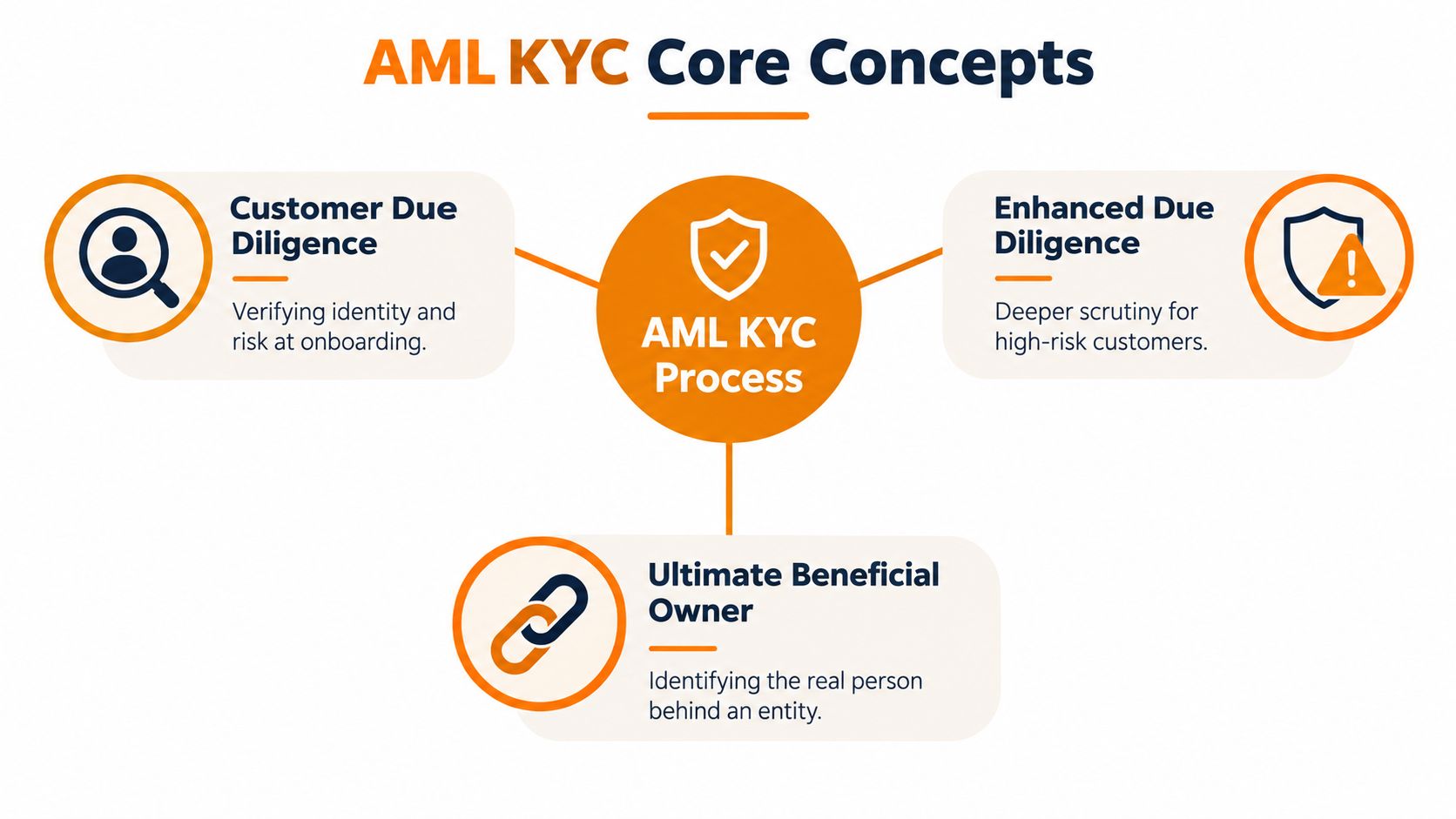
The diagram below maps the three concepts your team will use daily.
Customer Due Diligence Builds the Baseline
Customer Due Diligence (CDD) answers who the customer is and whether the relationship makes sense. In platform terms, that's verified identity attributes, residence and jurisdiction, intended use of casino or sportsbook services, expected deposit and withdrawal behavior, payment instruments, and occupation or business activity. Each field should feed your risk scoring model, not sit unused in a profile page.
The FATF Recommendations on identifying customers and beneficial owners require institutions to identify and verify the customer and beneficial owner, understand the relationship's purpose, and perform ongoing scrutiny so transactions stay consistent with known business, source of funds, and risk profile. That's the regulatory logic behind the baseline, you can't spot inconsistency without first recording what consistency looks like.
Enhanced Due Diligence and Beneficial Ownership
Enhanced Due Diligence (EDD) is deeper work when risk rises. Analysts seek source of wealth or source of funds evidence, corroborate explanations against documents and open sources, and document why the relationship should continue, continue with limits, or end. EDD is not merely asking for more documents. It's testing an explanation.
Ultimate Beneficial Owner (UBO) work matters when accounts connect to companies, affiliates, agents, or syndicates. For legal entities, verification should address ownership and control structures using reliable, independent information, not merely collect a registration number. The person controlling funds is the risk subject.
- Sanctions screening: Decides whether the relationship is prohibited outright, at onboarding and whenever lists change.
- PEP screening: Flags politically exposed persons whose position raises corruption risk and usually triggers senior approval and EDD.
- Adverse information checks: Give analysts context CDD forms rarely capture, especially for high value players.
Each block has a distinct job. CDD identifies, UBO traces control, EDD explains money, screening decides permissibility. Confusing them produces files that look thick but prove little.
How the Player Lifecycle Drives AML and KYC Workflows
Treat onboarding as the start of a continuous control loop. Every lifecycle stage produces evidence the next stage needs, and gaps compound. A missing timestamp or unexplained analyst decision at signup becomes a serious problem when an auditor reconstructs a withdrawal months later.
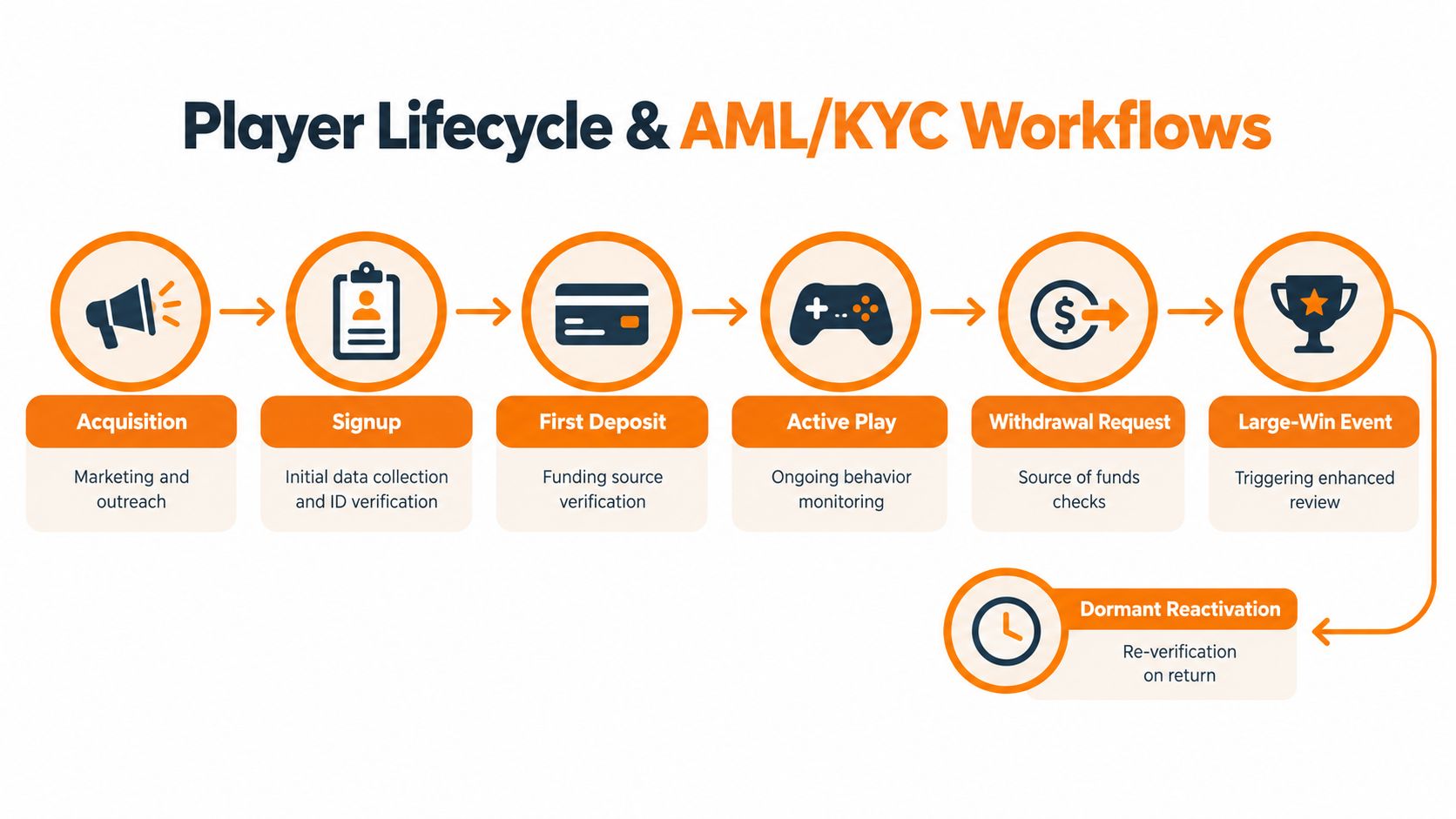
The flow below shows where controls fire across that lifecycle.
From Signup to First Deposit
Acquisition matters because affiliate source and jurisdiction shape initial risk. At signup, capture the structured baseline described earlier and retain it as versioned evidence, document images, verification results, timestamps, screening outcomes, analyst decisions, and reason codes. If the player edits key details later, your team should see both versions and who approved the change.
First deposit tests the baseline immediately. Does the payment instrument belong to the verified player? Does the funding jurisdiction match residence? Does the amount fit declared circumstances? Third party funding should stop the journey early, because letting it in and investigating at withdrawal is slower, costlier, and harder to defend.
Active Play, Withdrawal, and Reactivation
During active play, combine deposits, bets, session behavior, devices, linked accounts, and payment events. A material deviation, rapid deposits followed by withdrawals, multiple accounts sharing devices or payment credentials, abrupt volume changes, activity inconsistent with declared income, should trigger refreshed information, EDD, or escalation. FinCEN's position is that account opening information should support a risk profile against which expected activity can be assessed, updated on a risk basis during normal monitoring.
Withdrawal is where truth surfaces. Destination changes carry risk, especially a switch from card funding to a new bank account or crypto wallet. Large wins need review too, not because winning is suspicious, but because payout size, gameplay plausibility, and source of the original stake all need to reconcile before release.
Players don't object to checks they understand. They object to surprise checks at withdrawal that your team could have triggered weeks earlier at deposit.
Dormant reactivation deserves re-verification proportionate to absence length and changed details. Documents expire, addresses change, sanctions status changes. Offboarding should preserve the full record, restriction rationale, communications, and reporting decisions, so the file survives staff turnover and regulator requests long after the account closes.
KYC Tiers and When to Step Up Due Diligence
Tiering is where commercial and compliance interests align. Apply heavy checks to everyone and conversion suffers while analysts drown in low value work. Apply light checks to everyone and high risk players build history before anyone asks real questions. Tier by risk, and document the tier decision itself as evidence.
FATF's digital ID guidance supports a risk based approach where providers assess assurance level and reliability against money laundering, terrorist financing, fraud, and other risks, rather than accepting every method equally. Your tier rules should reflect that logic, stronger assurance where consequences of error are higher.
KYC Tier Comparison
| Tier | Typical Triggers | Required Checks | Review Cadence |
|---|---|---|---|
| Simplified | Low risk jurisdiction, low limits, no adverse indicators | Basic identity data, sanctions screening, payment ownership check | Event driven, limit increases trigger upgrade |
| Standard | Default for most verified players | Government ID verification, address confirmation, PEP and sanctions screening, expected activity profile | Periodic refresh plus event triggers |
| Enhanced | PEP status, high risk jurisdiction, large unexplained deposits, mismatched data, unusual gameplay | Source of funds or wealth evidence, corroboration, senior approval, tighter monitoring limits | Frequent scheduled review and immediate event review |
Simplified due diligence isn't no due diligence. It's reduced depth justified by low limits and clean indicators, and it should automatically expire when behavior outgrows it. If a simplified tier player suddenly deposits aggressively, the platform should step them up before further play, not after a withdrawal request.
Standard CDD is your default operating tier. It establishes the full baseline, enables meaningful monitoring, and suits most legitimate players. Keep it fast through good document capture and clear player messaging, not by skipping fields you'll need later.
What Forces a Step Up
Configure explicit triggers rather than relying on analyst instinct. Cumulative deposit velocity inconsistent with the profile, new high risk payment methods, device links to restricted accounts, adverse screening hits, and rigid structuring around internal review thresholds all justify escalation. So does gameplay with no economic purpose, such as minimal risk betting designed only to cycle funds.
- Mismatch signals: Payment name, geography, or device data conflicts with verified identity.
- Velocity signals: Deposit and withdrawal cycles accelerate sharply against the established baseline.
- Network signals: Shared identifiers connect the player to previously restricted or collusive accounts.
Record who approved each tier change, what evidence supported it, and what limits apply afterward. A tier is only a control if the platform enforces different permissions for each one.
Ongoing Monitoring, Alerts, and SAR Filing Discipline
Monitoring is the control operators under build most. A rules engine with a few static thresholds creates false positive storms, trains analysts to close alerts quickly, and misses adaptive behavior that stays just under each limit. Legitimate high value players alert constantly. Launderers who study your thresholds don't.
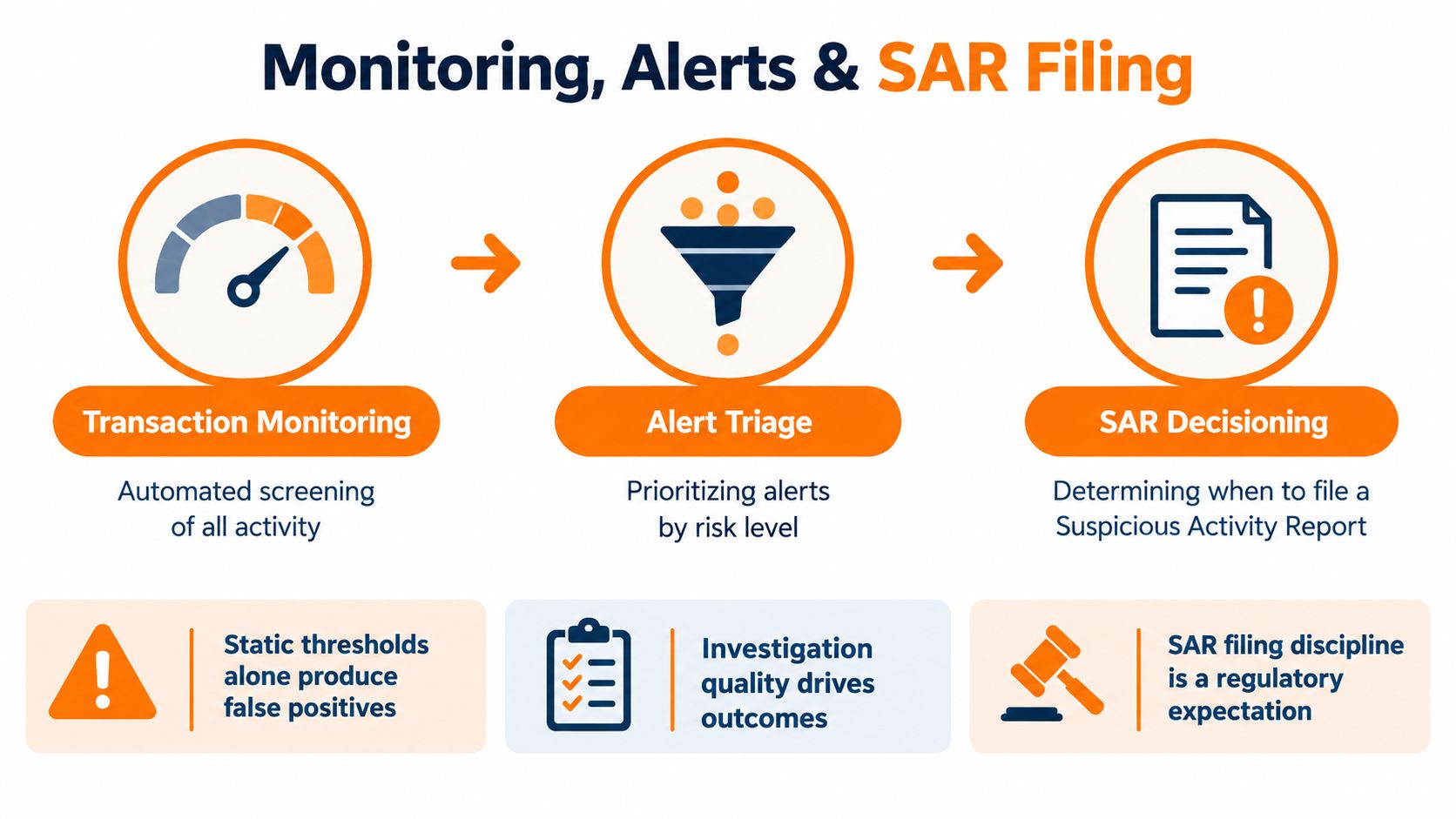
The stronger model combines deterministic rules with customer specific expectations, as shown below.
Building Alerts That Analysts Can Actually Work
Normalize deposits, withdrawals, bets, chargebacks, wallet addresses, devices, IP geolocation, payment tokens, beneficiaries, and linked accounts into a common event model. Without that, casino, sportsbook, and payments data stay fragmented and network patterns stay invisible. Rules then catch high signal behavior, rapid in and out movement with limited gameplay, third party payment use, sanctioned jurisdiction exposure, coordinated accounts sharing identifiers.
Behavioral analytics add context rules can't. Establish expectations from the onboarding profile, recalibrate as legitimate behavior changes, and keep alert features explainable so analysts can state why activity looked wrong. FinCEN states in its CDD Rule FAQs on ongoing monitoring and updating customer information that monitoring should detect activity inconsistent with the relationship's original nature and purpose. Use separate risk scores for customer, transaction, payment instrument, wallet, and network, because one blended score hides which element drove the risk.
SAR Timeliness Is a Measurable Control
Investigation quality and filing speed are where regulators test discipline. The FinCEN consent order concerning USAA Federal Savings Bank's late SAR filings found 3,873 SARs filed late between August 31, 2017, and August 31, 2021, with an average delay of 226 days. Those late reports represented almost 10% of the bank's SAR filings during the period, and FinCEN imposed a $140 million civil penalty.
The applicable U.S. rule generally required filing within 30 calendar days when no suspect was identified, or 60 days when a suspect was identified. Your jurisdiction's deadline will differ, but the principle doesn't. Track investigation aging like an operations queue, with escalation before deadlines, not after.
Measure what reveals control health, nothing vanity.
- Alert precision: Share of alerts that become cases worth investigating.
- False positive rate: Where rule tuning or better baseline data is needed.
- Escalation and SAR conversion: Whether triage decisions hold up under review.
- Investigation aging: Cases approaching internal or regulatory deadlines.
Back test rules against confirmed cases and documented typologies periodically. If a confirmed laundering pattern wouldn't alert today, that's your highest priority fix.
Crypto Deposits and Withdrawals Require Proportional Controls
Crypto doesn't change the regulatory expectation. It changes the evidence available and the speed money moves. Blanket rejection loses legitimate players, while generic wallet screening with a binary pass or fail misses how risk accumulates across signals.
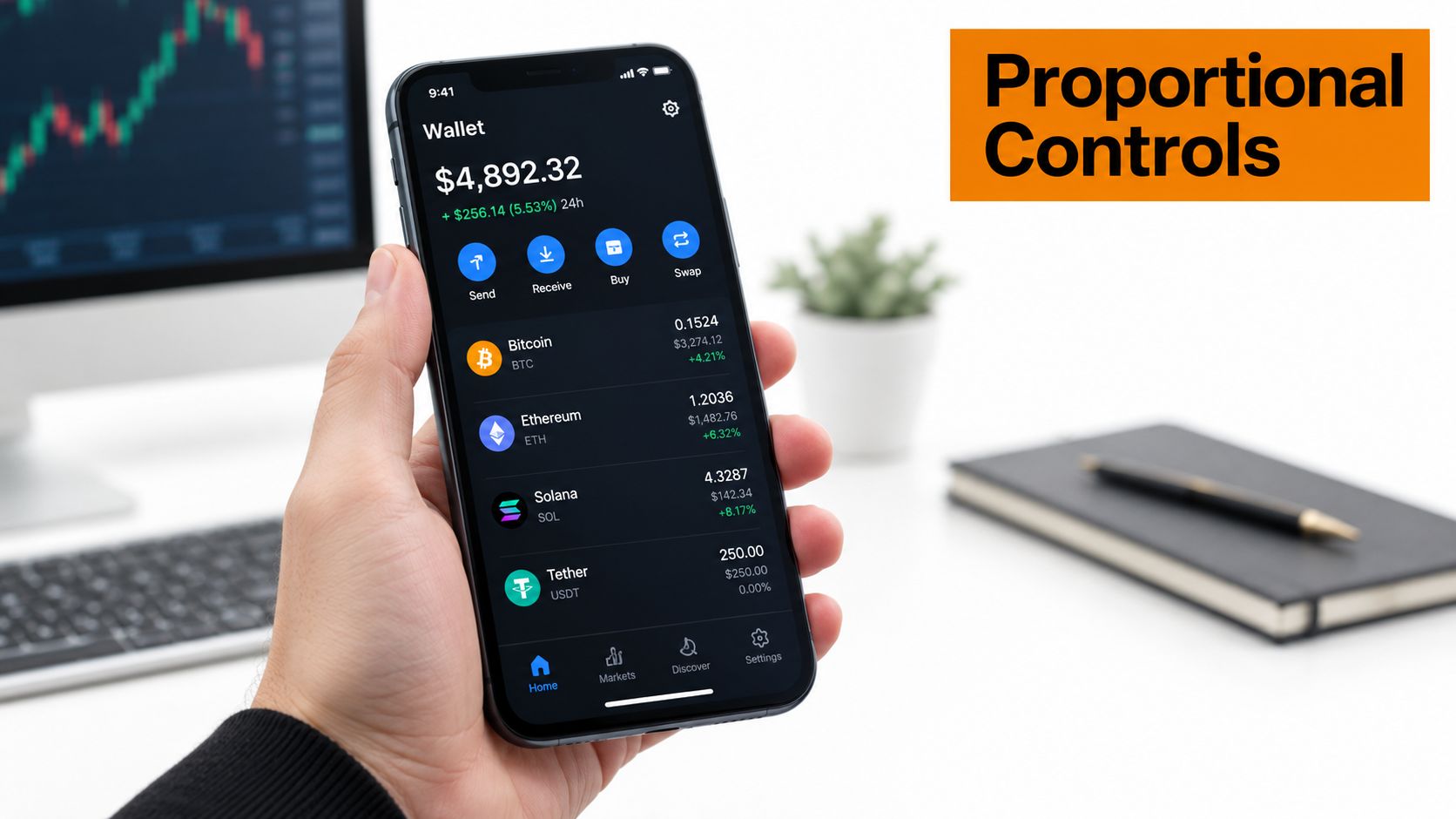
Player funding from a phone wallet, as shown here, is ordinary behavior on its own.
Signals That Actually Raise Crypto Risk
Assess combinations, not asset type alone. Mixer exposure, sanctioned services, high risk counterparties, rapid wallet turnover, and provenance that contradicts declared source of funds each raise risk. Add rapid deposit, bet, withdraw cycles or conversion between crypto deposits and fiat withdrawals through your multi-currency wallet arrangements, and analysts have a pattern worth escalating.
Blockchain controls should include address screening before crediting, exposure and provenance analysis, address clustering, and withdrawal address checks against sanctions and internal restriction lists. Screen on the way out as carefully as on the way in. A clean deposit history doesn't sanitize a sanctioned withdrawal destination.
Recent FATF material on proportionate AML measures, tiered due diligence, and financial inclusion emphasizes tiered customer due diligence, artificial intelligence monitoring, and digital identity as tools supporting inclusion. Apply that proportionality per jurisdiction. A single global rule declines low risk markets unnecessarily while actors route around it.
The walkthrough below shows how wallet screening fits into a wider verification journey.
Escalation needs clear player communication. Tell the player what evidence resolves the review, such as proof of wallet ownership or source of funds documentation, and record every request and response. Screening vendors score exposure, but your analysts own the decision and its rationale.
Closing the Loop With Governance, Audit Trails, and Reporting
Controls without governance collapse under audit. An examiner won't ask whether your policy document reads well. They'll pick cases and ask your team to reconstruct who decided what, when, from which evidence, and under which rule version. If that reconstruction takes days across spreadsheets and inboxes, you've already failed the practical test.
One Evidence Store for the Whole Loop
Onboarding records, screening results, monitoring alerts, investigation notes, and reporting decisions should live in one retrievable system with immutable audit logs. Analysts use disposition codes consistently, high risk actions get four eyes approval, and rule changes are versioned so historical alerts remain interpretable. This is also where disciplined compliance reporting for gaming operators turns raw case data into management information leadership can act on.
Capital One's enforcement history shows the cost when reporting obligations break down at scale. FinCEN imposed a $390 million penalty in January 2021 for BSA violations, and the bank admitted negligently omitting Currency Transaction Reports for approximately 50,000 reportable cash transactions representing more than $16 billion. Different business, same lesson, unusable customer data eventually becomes unfiled reports.
Documentation discipline is the cheapest control you'll ever buy. It costs process design, and it saves you in every audit, processor review, and internal investigation afterward.
Platform tooling should enforce this rather than rely on analyst habits. NexGrate, for example, includes AML and KYC workflows with sanctions and PEP screening, transaction monitoring, alert generation, case review, and reporting inside its casino and sportsbook back office. Whatever stack you choose, test it by reconstructing a random closed case end to end. Governance metrics, alert aging, overdue refreshes, EDD backlog, reporting timeliness, belong on the leadership dashboard beside revenue, reviewed with the same seriousness.
Operator Checklist for a Defensible AML KYC Process
Run this against your live platform. Each gap you find is a finding a regulator, bank, or processor can also find, usually at a worse moment.
The One Page Test
- Onboarding baseline: Identity, jurisdiction, expected activity, payment instruments, and source of funds indicators captured and versioned at signup.
- Tier enforcement: Simplified, standard, and enhanced tiers carry different limits, checks, and review cadences in the platform, not just in policy.
- Monitoring coverage: Casino, sportsbook, fiat, and crypto events feed one event model with rules, behavioral baselines, and network signals.
- Alert handling: Triage priorities, disposition codes, investigation aging, and escalation paths measured weekly.
- SAR discipline: Filing deadlines tracked per jurisdiction with escalation before breach, and decision rationale recorded for non filings too.
- Crypto controls: Deposit and withdrawal addresses screened, exposure reviewed in combination with behavior, evidence requests documented.
- Refresh triggers: Document expiry, dormancy, limit increases, and material deviations automatically reopen KYC.
- Governance evidence: Immutable logs, four eyes approvals, rule versioning, and periodic back testing against confirmed cases.
Prioritize by audit exposure. Fix evidence gaps and overdue investigations first, because regulators find those fastest. Then tune rules that generate noise, then close crypto and network blind spots. A defensible AML KYC process isn't the one with the most checks. It's the one where every decision, approve, restrict, report, or release funds, can be explained from evidence your system captured as events happened.
NexGrate provides a turnkey white label casino and sportsbook platform with built in KYC tiers, sanctions and PEP screening, transaction monitoring, case review, and reporting across fiat and crypto payments. If your current setup can't reconstruct a player decision end to end, visit NexGrate to see how the compliance workflows fit into the full back office.