
Your launch campaign is booked, the game catalogue looks ready, and the vendor demo makes the cashier look effortless. Then someone asks who fixes a missing withdrawal callback, whether the sportsbook can reverse settlement safely, and which compliance rules apply to the next market. Nobody gives the same answer.
That's the point where choosing an iGaming software solution stops being a feature comparison. You're choosing who controls money, who can explain a disputed transaction, and who carries the pager when players arrive.
Table of Contents
- What This Guide Is For and Who It Is For
- Defining an iGaming Software Solution in Operator Terms
- Core Modules Every Modern Stack Must Cover
- Casino, Sportsbook, and Crypto Casinos as Different Workloads
- Compliance and RNG as Architectural Commitments
- Scaling Across Jurisdictions Without Forks or Fines
- Payments, Fraud, and Crypto as One Risk Lifecycle
- Evaluating, Migrating, and Operating the Stack
What This Guide Is For and Who It Is For
Buy the platform around your operating constraints, not the sales presentation. Start with your permitted markets, product mix, payment journeys, and internal staffing. A launch date isn't credible until those requirements have named owners and testable acceptance criteria.
This is a purchasing and migration decision manual for operators who need to distinguish reusable infrastructure from unfinished implementation work. The useful question isn't whether a vendor offers a module. It's whether your team can operate that module without becoming the integration support desk.
Match the decision to your launch pressure
Different buyers should challenge different parts of the pitch:
- New-launch casino operators: Demand a complete journey from registration through game launch to withdrawal. A branded lobby doesn't prove that support staff can resolve a stuck round.
- Integrated sportsbook operators: Put trading authority, settlement corrections, and account restrictions ahead of cosmetic front-end flexibility. Clarify which decisions your traders retain.
- Crypto-casino builders: Establish custody, asset support, conversion policy, and treasury ownership before approving the cashier design. Accepting a token and operating its withdrawal rail are different commitments.
- Legacy-platform teams: Prioritize export quality, historical transaction continuity, and rollback options. Your existing players shouldn't become test subjects during cutover.
Compliance and operations teams belong in the room from the beginning. They'll inherit the queues, exceptions, and reporting obligations that commercial teams can overlook during procurement.
Buying rule: Choose the stack your staff can explain and control during a difficult weekend, not the stack with the longest feature list.
Turn the pitch into evidence
Work through the decision in operating order: define the delivery boundary, assign module ownership, select the right workload profile, test regulatory architecture, and establish payment-risk controls. Only then negotiate migration and ongoing support.
Ask vendors to demonstrate failure paths as well as successful journeys. Bring an unsettled bet, a delayed payment notification, and an account restriction into the demonstration. Their handling of exceptions will tell you more about launch readiness than another tour of the dashboard.
Defining an iGaming Software Solution in Operator Terms
An iGaming platform is your operating console, not your website's content management system. It connects the player-facing brand to the systems that authorize gambling, record balances, process payments, manage content, and produce evidence for oversight.
Use the architecture map to separate those responsibilities before discussing branding.
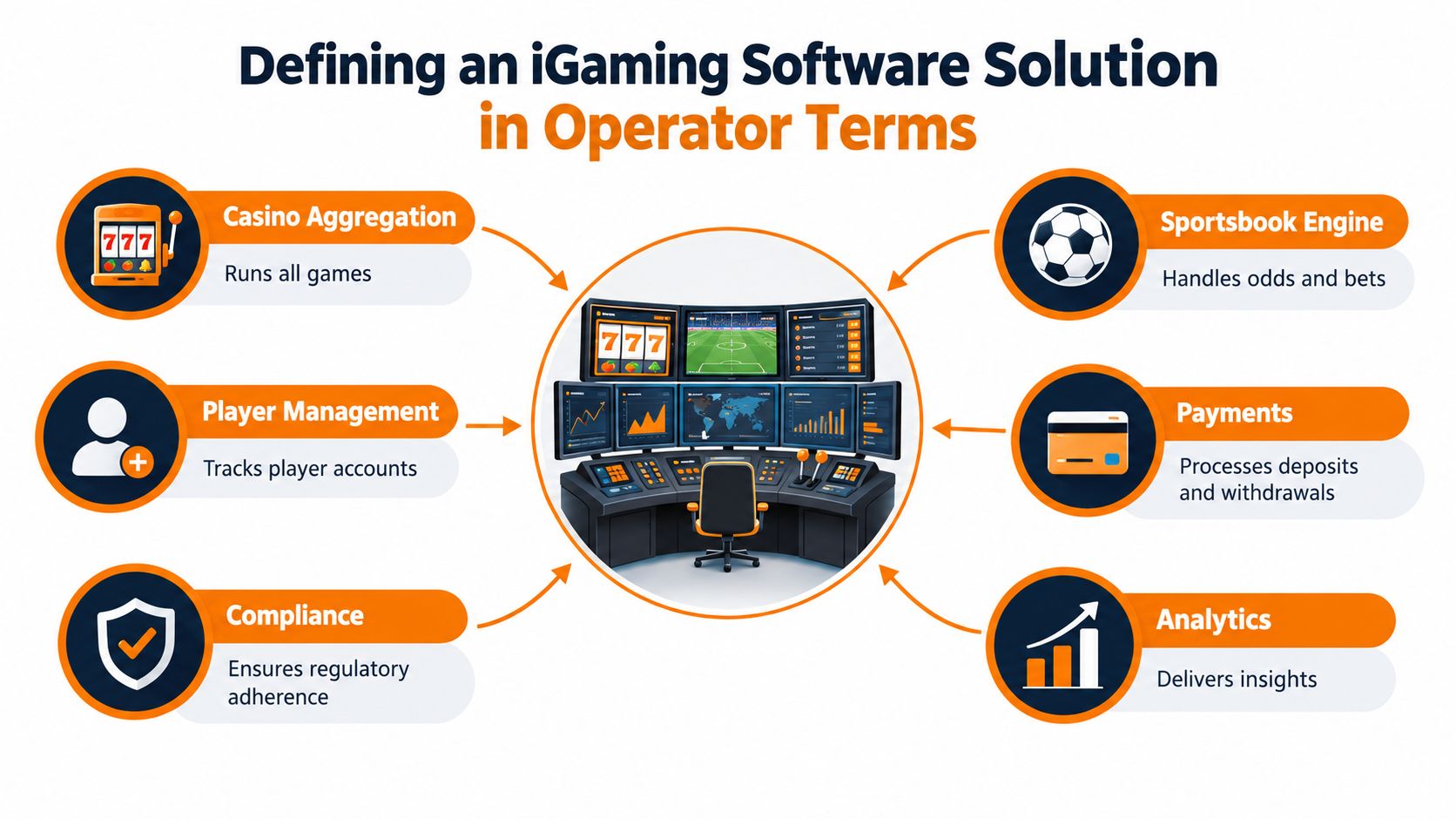
The purchasing scope typically spans casino, sportsbook, backend, payments, compliance, integrations, marketing, and hosting. Treat these as contract boundaries rather than interchangeable dashboard tabs. Each needs an owner, an interface specification, and a support obligation.
Great Britain illustrates why this is an operating-system decision rather than a website purchase: the Gambling Commission reported more than 2,300 licensed operators across online and land-based activities in 2023, with industry GGY of £15.1 billion for April 2022–March 2023, according to its annual report and accounts. That's a regulated ecosystem with multiple operational dependencies.
Translate delivery labels into contract scope
| Delivery model | What to expect | What to establish before signing |
|---|---|---|
| Turnkey | A configured stack with connected operating modules | Which workflows are production-ready and which need implementation |
| White-label | A platform presented under your brand | Who controls hosting, releases, supplier relationships, and operating permissions |
| Software licensing | Rights to use defined software components | Who assembles, deploys, maintains, and supports the remaining stack |
Neither turnkey nor white-label should be treated as a promise of regulatory permission. Require the contract to identify the licensed operating entity, jurisdictional coverage, and responsibilities retained by your business.
Pre-wired integrations also need precise language. Ask whether they include production credentials, supplier approval, supported currencies, reporting mappings, and tested failure handling. A connector available in a code repository isn't necessarily a launch-ready service.
Identify the work outside the package
Keep a separate implementation register for exclusions: bespoke account journeys, local payment methods, specialist reporting, front-end modifications, and connections to your existing data systems. Request acceptance criteria and change pricing for each item.
The trade-off is straightforward. A packaged stack can remove assembly work, but you may surrender release autonomy and deep customization. A licensed stack can offer more control, but your team must carry more engineering and operational responsibility. Choose deliberately.
Core Modules Every Modern Stack Must Cover
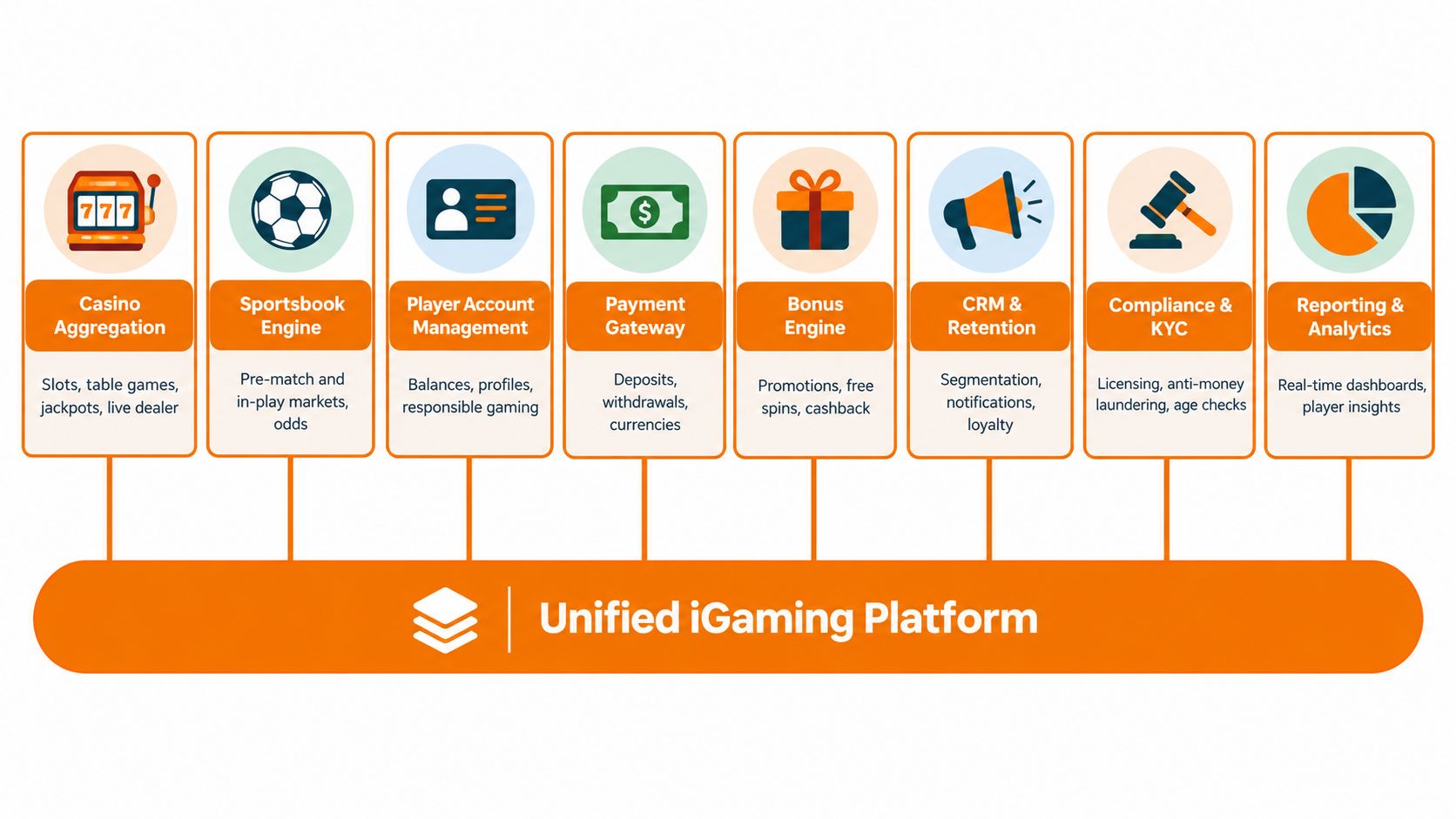
Module ownership is the consolidation test. If a vendor sells the complete stack but sends every incident to a different supplier, you've bought a bundle, not an accountable operating platform.
Use this module map during the demonstration, then request evidence behind each box.
Product and money responsibilities
- Casino aggregation: Require ownership of slots, table games, jackpots, and live-dealer availability. Test game launch failures, interrupted sessions, catalogue restrictions, and provider reconciliation. Ask who resolves an incomplete round.
- Sportsbook engine: Examine pre-match and in-play markets, odds-feed dependencies, bet acceptance, settlement, and margin configuration. Have the vendor show where platform support ends and managed trading begins.
- Backend and player management: Demand an authoritative account record, balance administration, KYC/AML workflows, risk rules, and staff permissions. Support agents need enough access to investigate without permission to alter financial history indiscriminately.
- Payments and cashier: Verify actual card, bank, currency, and crypto journeys. Coverage should mean a supported deposit and withdrawal route for your operating entity, not a payment-provider logo on a slide.
Control and service responsibilities
Compliance tooling should cover reporting, geofencing, audit records, and responsible-gaming administration. For MGA-aligned controls, request a mapping from your requirements to configured behavior; alignment isn't a substitute for jurisdiction-specific review.
Content integrations need more than a single API. Require prebuilt adapters for RNG and live studios, documented callback behavior, compatibility policies, and a clear process for supplier changes.
Marketing and retention tools should expose bonus eligibility, free-spin allocation, loyalty tiers, segmentation, affiliate attribution, and campaign reporting. Have an operator demonstrate cancellation and correction workflows, not just campaign creation. Promotions create accounting and support work when conditions are ambiguous.
Hosting and operations must include deployment pipelines, monitoring, DDoS protection, incident escalation, and contractual availability commitments. Ask who can roll back a release and whether your team can see service health without opening a ticket.
Don't accept “our partner handles that” unless the contract explains who coordinates the incident and communicates with your operators.
For each module, collect a responsibility matrix covering configuration, incident response, data ownership, and supplier escalation. Reject vague shared ownership: name the party accountable for restoring service.
Finish by testing cross-module permissions. A marketing employee shouldn't acquire withdrawal authority merely because both functions share a back office. Consolidation should streamline operations without flattening control boundaries.
Casino, Sportsbook, and Crypto Casinos as Different Workloads
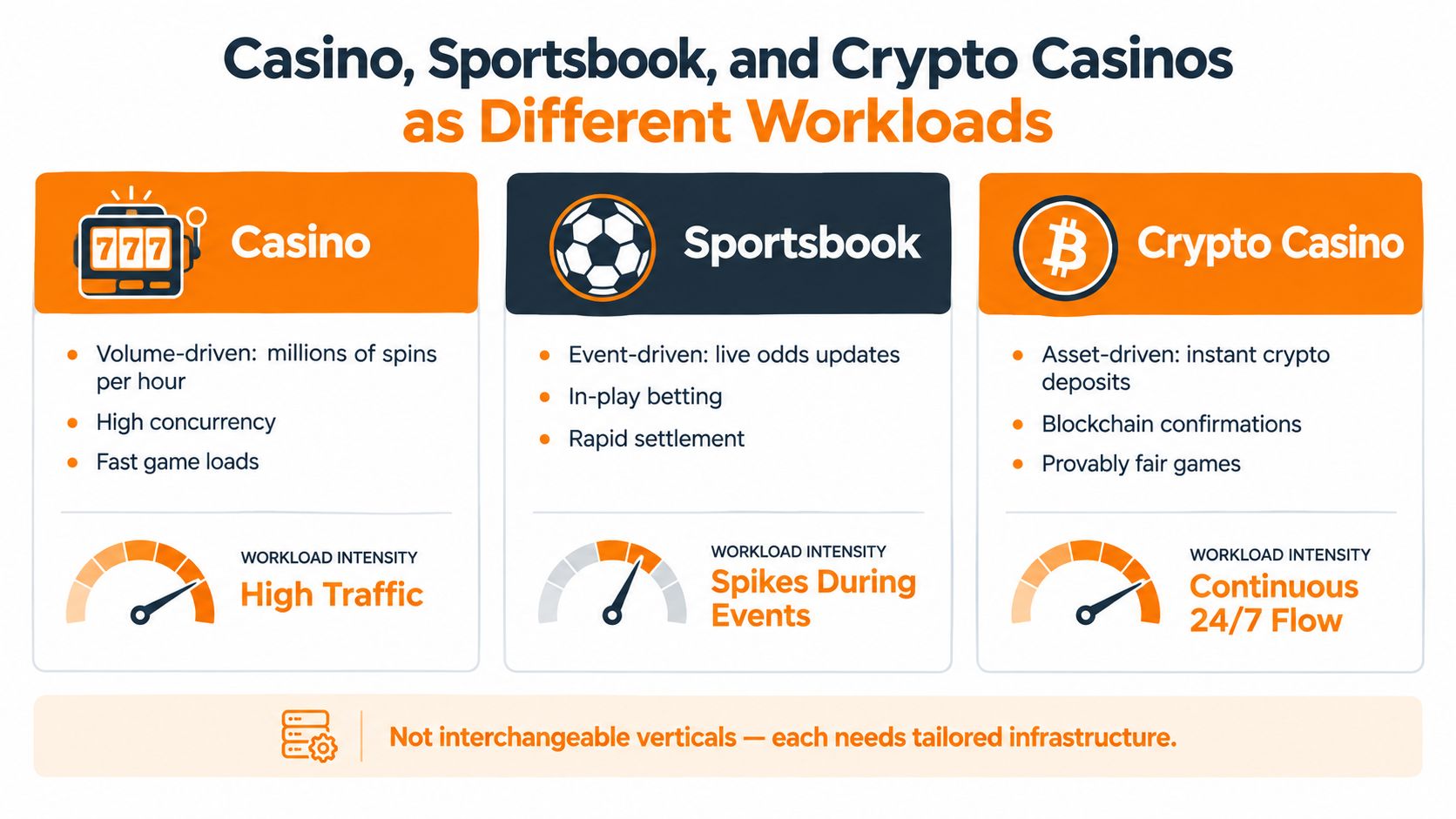
Choose infrastructure for the business you intend to operate. Casino, sportsbook, and crypto-led products require different capacity tests, different exception handling, and different specialist staff.
The comparison below is a workload guide, not a performance guarantee. Crypto deposits still need an explicit confirmation policy, and continuous operation requires staffed support.
Compare the critical paths
Casino is transaction-intensive. Game rounds require reliable balance changes, provider acknowledgements, jackpot handling, and recovery from interrupted sessions. In April–June 2024, UK online slots recorded 22.4 billion spins and £642 million GGY, while real-event betting generated £625 million GGY, according to the Gambling Commission's operator market overview. Those distinct workloads justify different tests, not a generic concurrent-user benchmark.
Sportsbook is event-sensitive. Demand demonstrations of odds changes, market suspension, delayed feeds, and corrected results. Your acceptance test should establish exactly when a bet becomes binding and how reserved funds behave if acceptance fails.
Crypto casino adds asset and treasury work. Require separate treatment of on-chain funds, internal player liabilities, pending confirmations, network fees, and conversion exposure. Don't let a vendor describe a blockchain transaction as equivalent to a settled cashier entry.
Make the wallet model explicit
A unified wallet can let players move between casino and sportsbook without manual transfers. That removes a product-navigation barrier, but it doesn't justify combining every asset and balance category into an undifferentiated total.
Require the ledger to distinguish available cash, reserved stakes, promotional funds, and asset-specific balances. Product teams can then evaluate cross-product engagement without confusing bonus consumption or currency conversion with genuine player value.
The embedded video provides an additional viewing resource; use the workload questions above to keep any product demonstration focused.
Don't buy sportsbook complexity for a casino-first launch unless it supports a committed product plan. Equally, don't approve a casino-oriented platform for serious in-play betting without testing its trading and settlement paths.
Compliance and RNG as Architectural Commitments
A KYC badge doesn't prove that an unverified account can't gamble. An RNG certificate doesn't explain whether your operator can reconstruct the balance changes around a disputed game round.
The UK Gambling Commission requires identity verification before gambling, covering at least the customer's name, address, and date of birth. It also prohibits requesting withdrawal information that could reasonably have been requested earlier, as set out in its customer identity verification condition. Implement verification as account state, not a document folder that staff inspect after a payout request.
Test control enforcement
Registration should create a verification status. Wagering must depend on the appropriate verified state, while deposit permissions should follow applicable rules and your configured policy. Withdrawal processing should use existing evidence rather than automatically restarting identity collection.
Give evaluators test accounts with pending, failed, and revoked verification. Then test the API directly, not just disabled buttons in the browser.
Compliance Feature versus Architectural Test
| Compliance Area | Marketing Claim | Architectural Test |
|---|---|---|
| Identity verification | Built-in KYC | Attempt gambling through every channel while verification is incomplete |
| AML | Automated screening | Inspect case ownership, escalation history, and decision evidence |
| Responsible gaming | Player-protection tools | Verify restrictions across products and active sessions |
| RNG | Certified games | Inspect certification scope and outcome-generation boundaries |
| Auditability | Complete reporting | Reconstruct a round and its ledger entries from exported records |
Separate randomness from commercial logic
The Commission's remote gambling and software technical standards require acceptably random outcomes demonstrable through generally accepted statistical tests, relevant activity records, and support for account or session suspension. Treat these as separate requirements to inspect.
My engineering recommendation is to isolate outcome generation from bonus logic, segmentation, and operator administration. Demand protected entropy and seeds, cryptographically strong generation where your system owns the RNG, and restricted access to outcome-generation secrets.
For provider-hosted games, examine the supplier's evidence and your integration boundary rather than pretending your platform operates its RNG. Require tamper-evident round records containing the bet, outcome reference, wallet mutation, and timestamp. Independent reconstruction should survive a supplier dispute or application outage.
Scaling Across Jurisdictions Without Forks or Fines
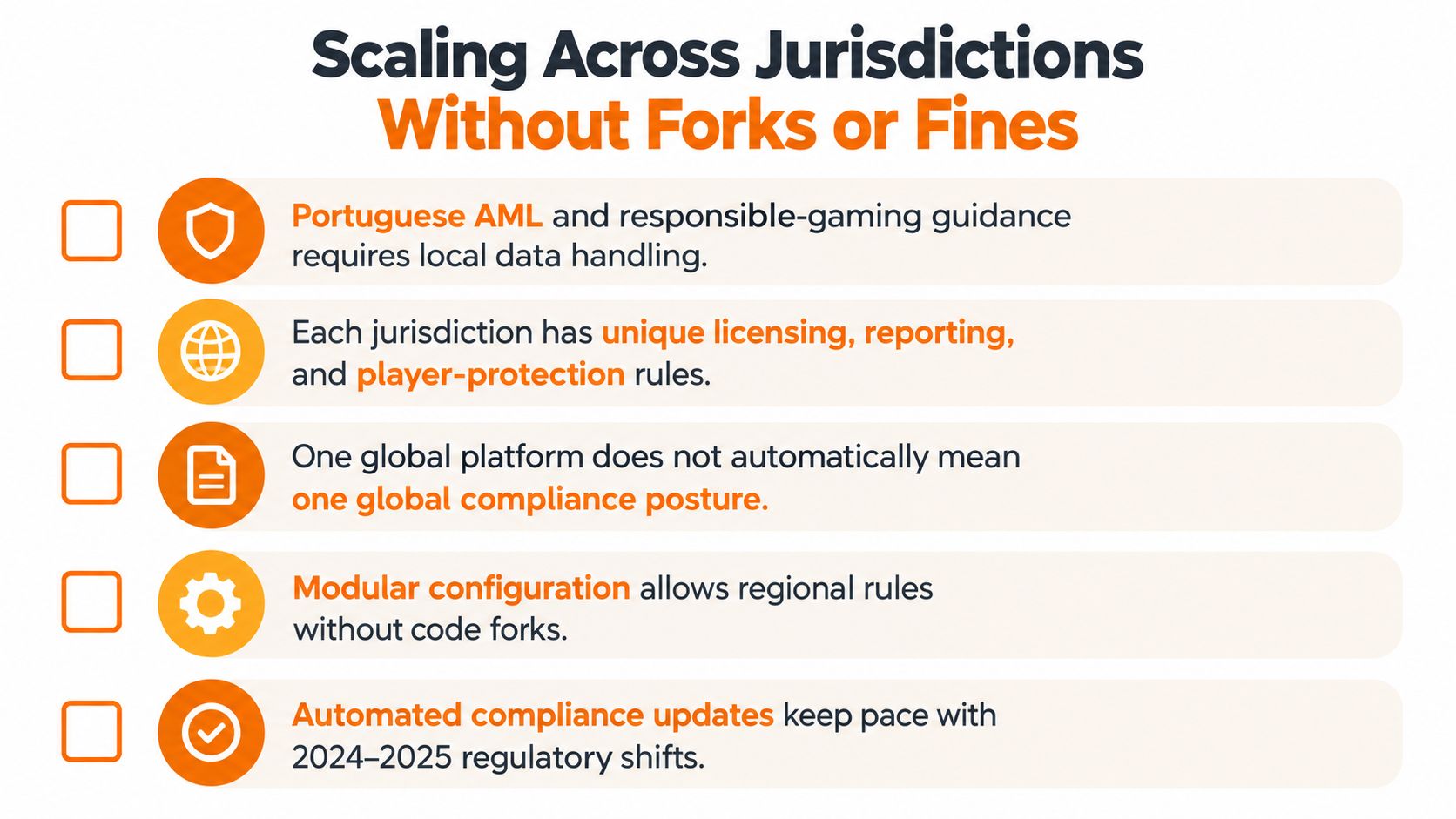
A global codebase isn't a global compliance process. Don't approve market expansion because the vendor can add a country to a dropdown. Ask whether that configuration changes eligibility, reporting, retention, advertising permissions, and player-protection behavior appropriately.
Portuguese guidance illustrates the specificity involved: registration identity checks, enhanced due diligence for higher-risk cases, ongoing monitoring, seven-year record retention, immediate suspicious-transaction reporting, and incident reporting for failures affecting AML or responsible-gambling controls appear in the Chambers comparison of Portuguese gambling requirements. Configure those obligations through reviewed local rules, not assumptions imported from another market.
Use this checklist as a governance prompt. Automated updates still need accountable approval and testing.
Assign decisions before configuring rules
- Legal and compliance: Own interpretation, market-access approval, and the requirements register.
- Platform provider: Own implementation evidence, supported configuration boundaries, and release documentation.
- Operator operations: Own intervention queues, incident escalation, and completion of required submissions.
- Engineering and security: Own deployment controls, access management, and recovery testing.
Store jurisdictional rules as versioned policy, with effective dates and documented approvals. Historical decisions must retain the policy version used at the time; otherwise an auditor sees today's settings rather than the reason yesterday's transaction was permitted.
Require controlled failure behavior
Define what happens when geolocation, verification, screening, or reporting dependencies fail. Don't accept a universal fallback that keeps gambling enabled while a critical control is unavailable. Specify which journeys stop, which incidents require escalation, and how staff prove recovery.
Review what compliance reporting involves when designing the submission workflow, then demand sample outputs against your actual reporting schema.
Avoid market-specific code forks where configuration can express the rule safely. But don't force incompatible obligations into one default just to preserve architectural neatness. A shared platform needs local accountability, not uniform behavior everywhere.
Payments, Fraud, and Crypto as One Risk Lifecycle
An approved identity isn't a permanent approval of everything that account does. Fraud review must continue through payment changes, betting activity, account recovery, and withdrawal.
Veriff reports a 21% increase in fraud between its 2024 and 2025 reports in its Future of iGaming report. That makes lifecycle visibility a practical procurement requirement. Adding more registration friction alone won't address activity that appears after onboarding.
Demand a connected risk record
Ask the vendor to correlate identity, device, payment instrument, wallet, affiliate attribution, and betting behavior within the permissions and lawful data-use boundaries of your operation. Investigators need the event sequence, not separate dashboards with incompatible account identifiers.
Use proposed scenarios to test the workflow:
- Account recovery followed by payout changes: Trigger risk review when a recovered account introduces an unfamiliar withdrawal destination.
- Shared payment credentials: Investigate connected accounts without assuming every shared household is fraudulent.
- Bonus-linked activity: Show investigators the campaign, qualifying transactions, and relevant wagering history together.
- Crypto movement: Connect transaction references, destination screening, asset type, and internal ledger activity to the same case.
These are evaluation scenarios, not universal rejection rules. Require configurable decisions and recorded reasons so operators can distinguish intervention from automatic account closure.
Risk principle: Escalate scrutiny around suspicious behavior, not around every customer equally.
Measure decisions rather than promises
Demand observed approval rates, false-positive rates, review rates, prevented-loss estimates, risk-decision latency, and investigation time. Ask how each metric is defined, what evidence supports it, and whether your team can segment results by payment route and jurisdiction.
For chargebacks, require links between disputes, original deposits, subsequent wagering, withdrawals, and supporting evidence. For suspected mule accounts, require case linkage and controlled escalation rather than isolated account flags.
Crypto scrutiny belongs in that same investigation workflow. Screening a destination doesn't replace identity analysis, and an irreversible transfer doesn't remove the need to investigate compromised credentials.
Use risk-management practices for iGaming operations to structure ownership and review procedures. Keep the commercial objective explicit: approve legitimate activity efficiently while making high-risk decisions explainable.
Evaluating, Migrating, and Operating the Stack
Before signing, make the vendor demonstrate staff permissions, double-entry accounting, payment-method coverage, jurisdictional control mappings, observability, and hosting commitments. Include commercial terms for supplier changes, custom work, data export, and termination assistance.
Migrate with reconciliation gates
- Export and map: Inventory player records, balances, open bets, exclusions, verification evidence, bonus liabilities, and transaction history. Resolve inconsistent identifiers before importing.
- Rehearse in a sandbox: Run representative journeys against mapped data and compare expected ledger entries. Test interrupted processes as carefully as completed ones.
- Control cutover: Prefer an explicit write-authority boundary. If dual-writing is necessary, demand idempotency, ordering controls, and a reconciliation procedure before enabling it.
- Reconcile and release: Compare liabilities and unresolved transactions, document exceptions, and keep rollback criteria agreed with the operating team.
Don't treat a successful data import as a successful migration. Staff must still locate historical evidence, explain pending balances, and service players whose activity spans both systems.
Inspect the debt after launch
In month six, examine the integration work your team still owns: provider-specific scripts, manually corrected callbacks, mismatched report fields, and payment exceptions that require database access. These are warning signs that the launch package shifted unfinished work into operations.
Maintain a watchlist covering chargeback patterns, bonus abuse, payout service commitments, KYC review times, unresolved rounds, and supplier incidents. Assign each metric an owner and an escalation action.
Turnkey delivery should remove repetitive platform assembly. Your business still owns brand localization, jurisdiction-specific player-protection messaging, market-specific marketing, and operational judgment. Use a vendor-management framework to keep release dependencies and remediation commitments visible after procurement ends.
NexGrate offers a turnkey white-label platform combining casino, sportsbook, payments, back-office operations, and compliance controls. Visit to discuss your target markets, payment rails, and migration constraints, and request a demonstration built around the failure paths your operators need to manage.