A licence approval can feel like the finish line. Then the first product release is due, a payment provider asks which customers it may serve, and an auditor wants to see exactly how a player limit was enforced. The legal authorization is in place, but the operating system still has to turn its conditions into controls that work every time.
That's the practical challenge behind iGaming regulations. Compliance isn't a binder that sits beside the platform. It's a set of jurisdiction-aware decisions across player accounts, games, payments, marketing, and reporting, with evidence that lets an operator explain what happened and why. A rule that exists only in policy, but can't be demonstrated in a transaction or an audit trail, is a weak control.
Table of Contents
- Why iGaming Regulations Now Read Like a Product Spec
- How European iGaming Licensing Works
- Major Licensing Frameworks Compared
- KYC, AML and Continuous Customer Risk
- Technical Standards as Engineering Requirements
- Payment Rails as a Primary Enforcement Surface
- Geofencing, Responsible Gaming and Player Limits
- Mapping Controls to a Unified White-Label Stack
- Continuous Compliance and Configurable Rules
- Operator Checklist for Entering a Regulated Market
- Quick-Reference Map of Jurisdictions and Controls
- Frequently Asked Questions on iGaming Compliance
Why iGaming Regulations Now Read Like a Product Spec
A newly licensed operator typically receives conditions, technical obligations, reporting expectations, and player-protection requirements. Someone has to convert each one into a product behavior. Can a player in a restricted location reach the cashier? Does the system apply the right limit to the right account? Can an investigator reconstruct a withdrawal review without relying on staff memory?
Those questions aren't solved by a one-time certification. The United Kingdom's Gambling Act 2005 came fully into force in September 2007, established the Gambling Commission as the principal regulator, and covered online gambling alongside other forms of gambling. In 2014, the law was amended to cover online operators serving customers in Great Britain regardless of where those operators were based. The government's review also recorded that online gross gambling yield in Great Britain rose by 18% in real terms between 2015/16 and 2018/19, while the overall market grew by 4% (UK government review of the Gambling Act 2005). That commercial context makes clear why regulatory obligations became operational requirements, not merely legal text.
A workable method is to map every obligation to four things: the responsible system, the event that triggers the control, the action the platform takes, and the evidence it stores. For example, a deposit-limit rule needs a defined calculation, a point at which the cashier blocks or warns, and a record of the applied rule. A general statement that “limits are available” isn't enough for an audit.
Practical rule: If a control can't be tested in a realistic player journey and traced in an audit record, treat it as unfinished.
The rest of this guide follows that product-engineering approach. It covers European licensing, framework differences, customer risk, technical standards, payment rails, player protection, white-label platform modules, change management, and a market-entry checklist. Use it as a working map: start with the jurisdictions you serve, then identify the runtime controls and evidence each one requires.
How European iGaming Licensing Works
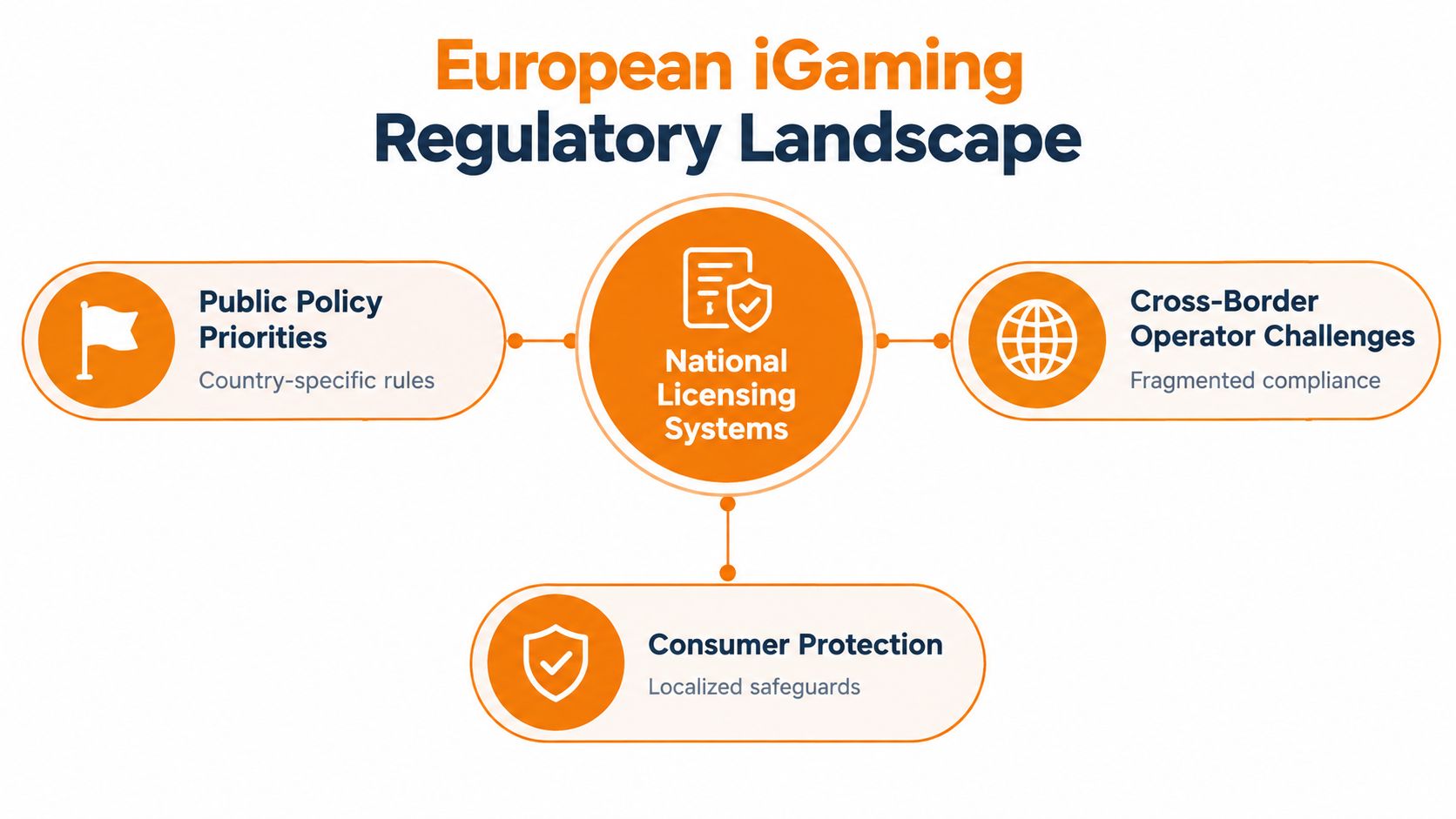
A licence in one European country does not automatically authorize an operator to serve customers in another. Europe has no single EU-wide gambling licence. National systems operate within a connected digital market, and the European Commission has described the sector as having a “diversity of regulatory frameworks,” with relatively few Member States prohibiting internet games of chance entirely (European Commission communication on online gambling).
National rules reflect different policy priorities, including consumer protection, fraud and money-laundering prevention, protection of minors, and public order. For a platform team, each priority must map to an enforceable control: licensing checks before market entry, location checks at relevant player journeys, game availability by jurisdiction, and local advertising and tax requirements. A country flag in the front end cannot enforce those rules across a casino-and-sportsbook stack.
The UK's 2014 point-of-consumption change tied market access to serving customers in Great Britain, rather than to the operator's place of incorporation. The practical requirement is market awareness at runtime. Registration, gameplay, payments, and marketing must use the customer's jurisdiction to apply the appropriate rules, with logs showing which configuration was active.
The same method applies beyond Europe. Assess the destination market's licensing and product rules before enabling traffic or payment methods. The South American gaming market overview can inform jurisdiction-by-jurisdiction research, but country-level findings still need to become specific product settings and operational controls.
A multi-market stack should support configurable controls by jurisdiction and retain evidence of the configuration applied. This takes more work than maintaining one checklist, but it gives compliance and engineering teams a clearer audit trail and avoids relying on rules built for a different regulator. Payment methods belong in that configuration too: market eligibility should be enforced at the cashier, not left to a policy document.
Major Licensing Frameworks Compared
A licence comparison is useful only if it reveals what changes in the platform. The relevant questions are practical: what activity triggers the licence, which player and transaction data must be captured, what reporting is expected, and which controls should be ready for inspection?
The UK framework provides a clear example of a destination-based trigger. The UK Gambling Commission's Remote Gambling and Software Technical Standards (RTS) also translate into requirements around fairness, player-account functionality, information disclosure, security, and operational resilience. Malta's MGA framework likewise calls for jurisdiction-aware controls and auditable records, but operators should confirm the exact obligations that apply to their licence and product rather than assuming that UK requirements transfer unchanged.
| Framework | Licence trigger | Reporting cadence | Notable control areas |
|---|---|---|---|
| UKGC | Serving customers in Great Britain | Confirm against licence conditions and reporting requirements | RTS, player protection, technical evidence, regulatory reporting |
| MGA | Offering regulated gambling under the relevant Malta licence | Confirm with the MGA and licence conditions | Player and financial records, responsible gambling, AML controls |
| Curaçao | Offering services under the applicable Curaçao authorization | Confirm with the licensing authority and current conditions | Operator authorization, player safeguards, AML and reporting |
| Netherlands | Serving customers under Dutch gambling rules | Confirm with the Dutch regulator and licence conditions | Market-specific authorization, advertising and player-protection controls |
| Ontario | Serving customers under Ontario's regulated framework | Confirm with the applicable regulator and operating arrangement | Registration, market access, game and player safeguards |
The table is a scoping aid, not legal advice. Reporting cadence and licence triggers depend on the precise entity, product, and authorization. Don't build a launch plan around informal summaries. Ask licensing counsel to identify the legal entity, customer territory, product scope, reporting calendar, and technical evidence the regulator can request.
Curaçao operators should be especially careful not to rely on legacy assumptions. A framework transition can affect authorization, documentation, and oversight expectations, so existing operators should verify their status and obligations directly before continuing or expanding service. The useful platform decision is to make market rules configurable from the outset, rather than hard-coding one licence's assumptions into shared wallet or game logic.
KYC, AML and Continuous Customer Risk
KYC and AML work best as a continuously evaluated risk process. Identity verification is an important entry point, but it can't answer whether a later deposit, account connection, betting pattern, or withdrawal needs review. A production risk engine should bring together identity and verification status, payment instrument, jurisdiction, device and account linkages, transaction velocity, source-of-funds indicators, and unusual betting or withdrawal behavior.
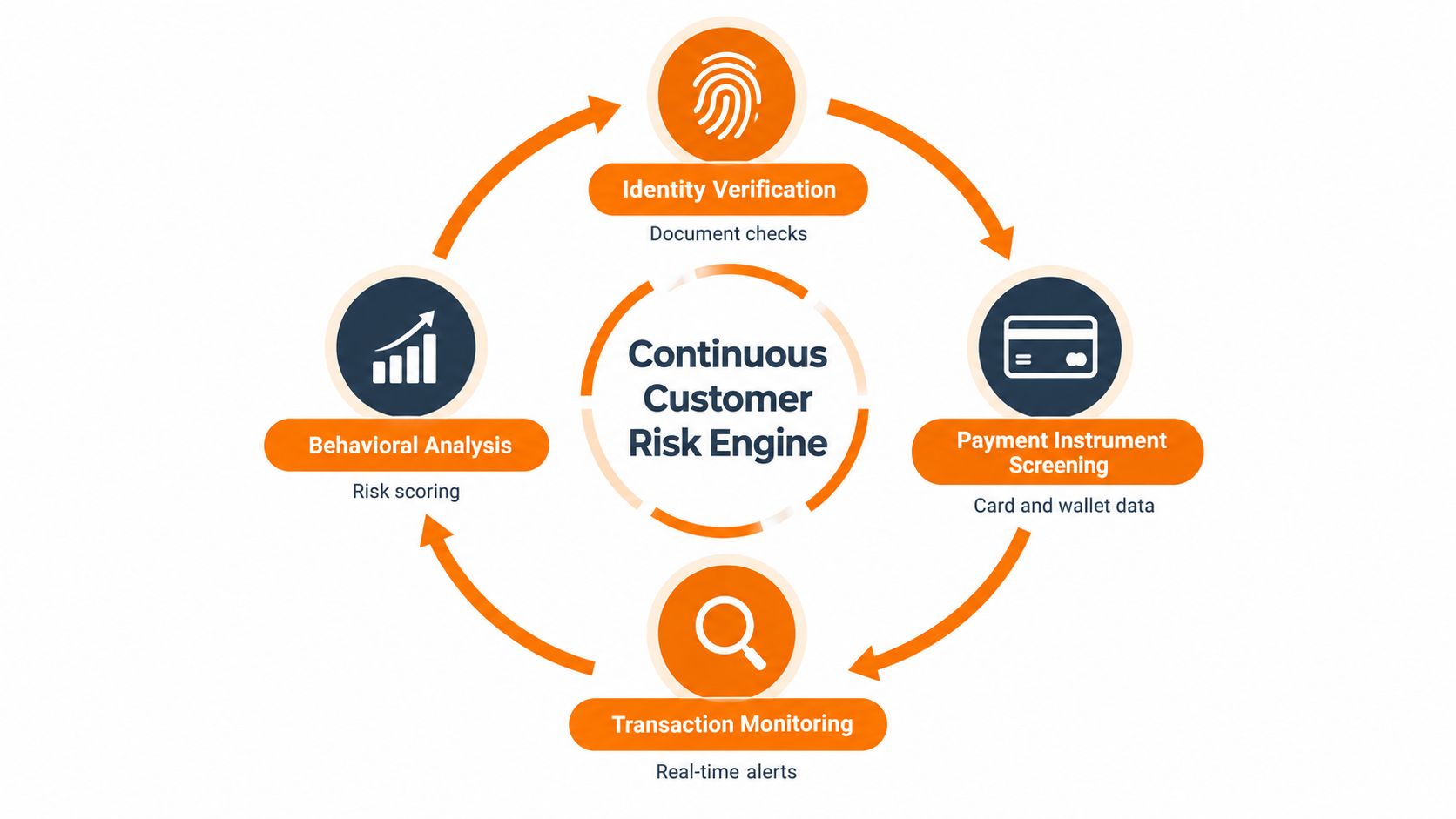
An investigator needs to reconstruct a decision, not just see a risk score. The record should show the triggering event, the data considered, the rule version, the reason code, the action taken, the staff member who reviewed it, and any override with its rationale. Without that chain, a dashboard may flag risk but still leave the operator unable to explain the outcome.
Graduated actions are more useful than a single pass-or-fail gate. Depending on the case, the platform may request enhanced due diligence, send a transaction for review, apply a limit, place a temporary hold, escalate to a compliance investigator, or support suspicious-activity reporting. UK guidance describes risk assessment as a structured evaluation of threats, vulnerabilities, likelihood, impact, and consequences; its casino risk categories include geographic and customer risk (MGA Compliance Audit Manual).
A risk engine should explain its decisions in a way an investigator can reproduce, not just produce a score no one can interpret.
Crypto deposits need the same discipline. A digital asset payment doesn't remove the need for identity checks, traceability, source-of-funds review, or documented escalation. The risk process should also connect with responsible-gambling controls, so a financial-crime review doesn't accidentally bypass a player limit or self-exclusion decision. For a practical companion on structuring these controls, see risk-management practices for gaming operators.
Technical Standards as Engineering Requirements
Technical standards become easier to manage when teams treat them as release requirements. Under the UKGC's RTS, operators and software providers must address fairness, account functionality, information disclosure, security, and resilience. New products should be tested by an approved test house before release, and the operator should retain evidence for regulatory review (UKGC Remote Gambling and Software Technical Standards).
For RNG-based games, the test evidence should cover statistical analysis of the random-number generator and the scaling or mapping logic that turns random outputs into game outcomes. Keep game-version records tied to the relevant test evidence. A generic certification file that can't be matched to the live release creates avoidable ambiguity.
Sportsbook operations need equally specific records. A pricing workflow should show whether the customer accepted a price fluctuation after requesting a bet. Settlement dependencies should be documented, and incident playbooks should specify when to suspend an affected market, restore state, or void a wager. When an outage interrupts an event, the platform needs enough state to determine what happened before the interruption.
Wallet and account interfaces are part of the control surface. Players should be able to see balances and relevant transaction information clearly, while staff access and changes remain traceable. That visibility supports both customer understanding and regulatory review.
The engineering pattern can be standardized even when market rules differ. Use release-level test evidence, immutable game-version records, documented dependencies, and auditable rollback or void procedures. Map jurisdiction-specific obligations onto that shared delivery discipline, then test the resulting product behavior before deployment. A compliance binder is still useful, but it shouldn't be the only place where the control exists.
Payment Rails as a Primary Enforcement Surface
A licensed operator can still lose market access if its payment providers won't process transactions. Brazil's 2025 framework reportedly prohibits payment institutions from processing transactions for unlicensed operators, placing payment access directly within market enforcement (International Gaming Law coverage of Latin American regulation). Banks, e-money institutions, processors, and platform intermediaries can therefore constrain operations alongside licensing authorities.
Map compliance obligations by payment rail, as well as by country. Cards, bank transfers, instant payments, e-wallets, and crypto may each require different onboarding, transaction monitoring, and records. For each method, define when KYC must be complete, how source-of-funds checks apply to deposits and withdrawals, which events trigger review, and whether the processor verifies the operator's authorization.
The trade-off is broader payment access versus tighter control. A new method may help serve customers, but its provider also raises questions about authorization checks, traceability, account ownership, refunds, and monitoring. Technical compatibility alone does not make an integration suitable for the operator's compliance requirements.
White-label businesses carry shared risk: one wallet or cashier may serve several brands, so a configuration error can affect multiple operators. Keep market eligibility, brand authorization, provider permissions, and customer-risk decisions distinct in the system. A shared integration must not expose a prohibited route because another brand is allowed to use it.
Make authorization an explicit runtime control before accepting a transaction. Record the brand, market, customer, and payment method, then retain the decision and any review outcome for audit. Payment-provider selection belongs in compliance and product design, not only in procurement. This gives teams a traceable control at the point where market access meets customer funds.
Geofencing, Responsible Gaming and Player Limits
Geofencing is necessary, but it can't carry player protection by itself. A location check answers where the customer appears to be; it doesn't determine whether the customer is old enough for a product, subject to a limit, self-excluded, or eligible to receive a marketing message. Those decisions require a wider runtime view.
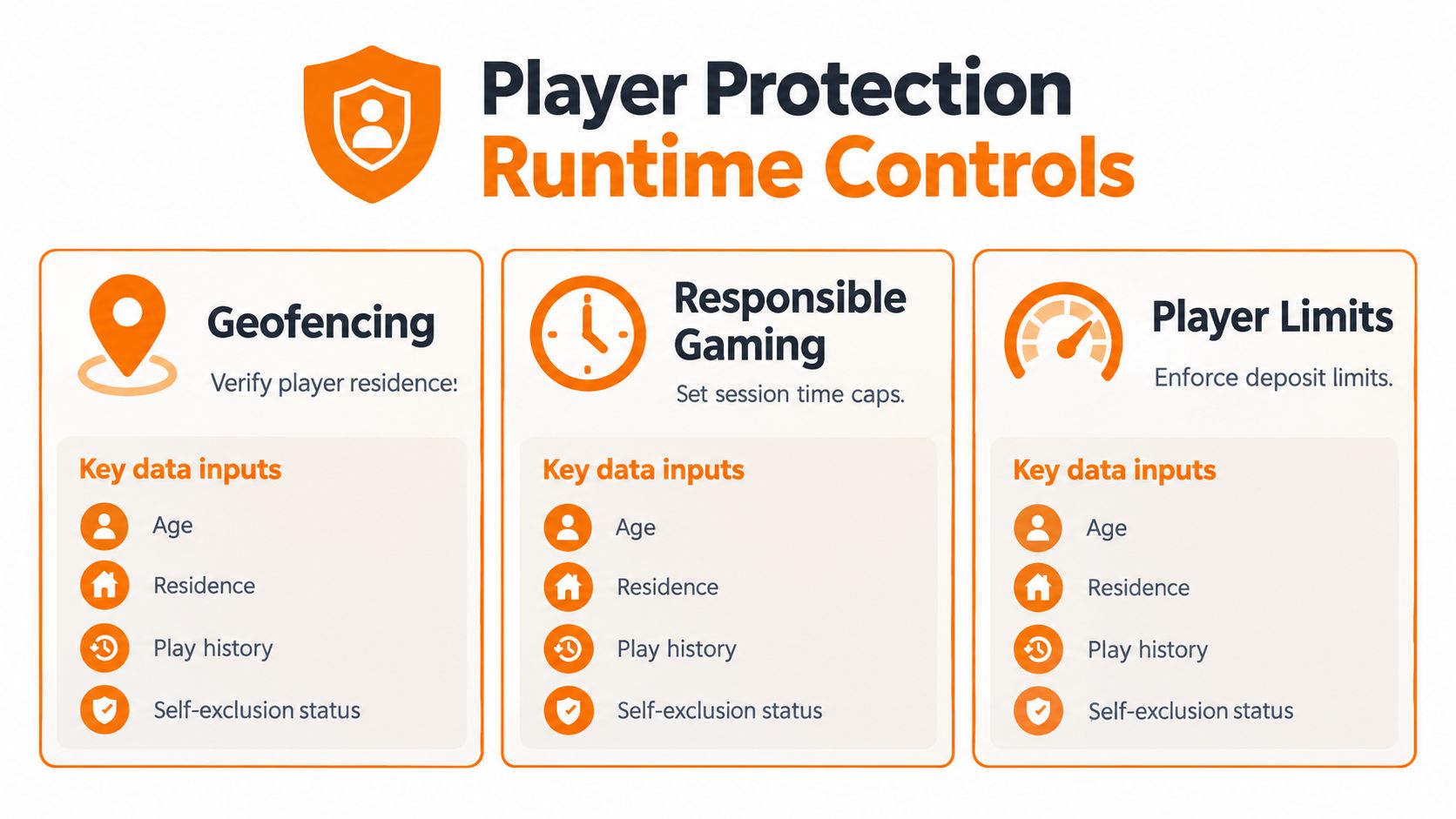
A protection engine should evaluate age, residence, licence, product type, game characteristics, payment activity, marketing consent, and self-exclusion status. It then applies the relevant market and player rules at the point of action. For example, a deposit attempt may need to check account limits and exclusion status before the cashier completes the transaction; a campaign send should check market permissions and consent before delivery.
Remote licensees are expected to operate customer-interaction processes aimed at minimizing gambling-related harm. Technical standards may also require account-level financial limits, including gross deposit limits over defined periods. These controls should be enforced by the platform, not left to a support agent to remember after a player has already acted.
Self-exclusion deserves particular care in a multi-brand environment. If a customer's status is known, the system needs to apply it consistently across the relevant brands and products. Staff should be able to see the status and its effect without gaining unnecessary access to unrelated personal data.
The cleanest design connects these checks to the same decision pipeline used for customer risk. That doesn't mean treating harm risk and financial-crime risk as identical. It means sharing dependable identity, event, access-control, and audit infrastructure while preserving distinct rules and outcomes. A location decision, deposit-limit action, customer interaction, or exclusion should leave a timestamped record that explains what the platform did.
Mapping Controls to a Unified White-Label Stack
A unified platform is useful when an operator can point to the module that enforces a requirement and produce the evidence behind it. The platform map should connect customer controls, staff permissions, accounting, and reporting, rather than treating the back office as a collection of unrelated screens.
Player management should expose the compliance-relevant account state: KYC level, verification status, country, balance, deposits, and any applicable risk or protection restrictions. A VIP label can support service segmentation, but it must never override a legal restriction or risk decision.
Permissions determine whether the control survives day-to-day operations. Page-, tab-, and field-level access helps separate duties, while TOTP-based two-factor authentication can strengthen staff access. The audit question isn't just whether a setting exists; it's who could change it, who did change it, and what record the change produced.
Accounting and reporting need stable definitions. Double-entry bookkeeping supports traceability, while bonus escrow can keep promotional balances distinct from withdrawable funds. GGR and NGR definitions should be documented and applied consistently. Standard reports should cover GGR, NGR, player and transaction activity, bonuses, fraud, KYC, affiliates, and provider data.
| Platform area | What an auditor may ask | Evidence to keep |
|---|---|---|
| Player account | Which restrictions applied to this customer? | Account state and decision history |
| Staff permissions | Who could alter the rule or player record? | Role configuration and access logs |
| Wallet and ledger | How did the balance change? | Transaction records and accounting entries |
| Reporting | Can the figures be traced to source events? | Report definitions and export history |
A common white-label weakness is unclear ownership: the operator assumes a platform provider holds the evidence, while the provider assumes the operator owns the control. Assign an accountable party for each module and agree how records are retained, reviewed, and exported. NexGrate is one platform option that consolidates casino and sportsbook operations with player management, payments, compliance controls, and reporting; operators should still verify how each feature maps to their own licence conditions and responsibilities.
Continuous Compliance and Configurable Rules
Responsible-gambling compliance is increasingly a systems-engineering task. The UK introduced online-slot stake limits in April 2025, including a lower limit for customers aged 18 to 24, while the Netherlands was reported to be pursuing mandatory spending caps and stronger advertising controls (report on global iGaming regulatory shifts). These kinds of changes require more than a policy update. The platform must apply the correct rule to the right player and product, then preserve evidence that it did so.
A configurable rule should combine the inputs that matter for the decision: age, residence, licence, product, and marketing consent. The same principle applies to stake and spending controls. If a regulator changes a threshold or an advertising rule, teams need to know which configuration becomes effective, which products and players it affects, and how to prove the transition was tested.
That calls for disciplined change management. Keep versioned rule definitions, testing evidence, approvals, effective dates, rollback procedures, and audit records. Do not edit a live limit and rely on staff to remember when the new setting took effect. The reporting model should make it possible to identify the player-facing control that applied at a particular time.
A unified casino-and-sportsbook stack makes this especially important. A shared wallet, bonus engine, or affiliate campaign can cross market boundaries if its rules are configured too broadly. Separate the configuration by jurisdiction and product, then test the customer journey across registration, deposit, play, marketing, and withdrawal. For the reporting layer that supports this audit trail, see compliance reporting practices.
Operator Checklist for Entering a Regulated Market
Market entry should produce evidence at every stage. A checklist is only useful if each action leaves behind an artefact that compliance, operations, and product teams can inspect.
Before launch
- Confirm the authorization path. Record the target market, legal entity, product scope, and licence advice in a market-entry decision file.
- Complete a jurisdiction gap analysis. Map local requirements to product, payments, marketing, player protection, and reporting in a signed control matrix.
- Design the data model. Confirm that player, transaction, game, and staff events carry the fields needed to apply and explain controls. Save the data dictionary and event map.
- Configure risk and protection rules. Keep a versioned export of the active rules, including the approval and test record.
At launch
- Complete technical testing. Retain test-house evidence, release identifiers, and sign-off for the games and software in scope.
- Enable market-specific payment rails. Store provider approvals, permitted-market settings, and transaction-monitoring procedures.
- Verify geofencing and player journeys. Keep test results for access, registration, deposit, play, and withdrawal scenarios.
- Train staff on escalation. Record the training materials and completion evidence, with clear ownership for incidents and customer reviews.
After launch
- Track reporting obligations. Maintain a reporting calendar and copies of submitted reports or submission records.
- Exercise incident response. Keep incident logs, investigation outcomes, and documented recovery or rollback decisions.
- Review configuration changes. Preserve approvals, effective dates, test evidence, and rollback records for rule changes.
- Refresh policies against operations. Document the review and resulting actions, not just the policy version.
The practical test is simple: can another team member locate each artefact and explain how it proves the control operated? If the answer depends on one person's memory, the evidence process needs work.
Quick-Reference Map of Jurisdictions and Controls
Use this map to orient an audit or market-entry review. It doesn't replace local legal advice; it shows where to focus platform questions.
| Market or framework | First control question | Platform evidence to locate |
|---|---|---|
| European markets | Is each country treated as a separate authorization and ruleset? | Market configuration, geofencing, permitted products |
| UKGC | Can technical and player-account controls be demonstrated? | Test evidence, release history, player and transaction records |
| MGA | Can regulatory and player data changes be reconstructed? | Audit trails, access history, exportable records |
| Curaçao | Is the operator's current authorization and transition status confirmed? | Licence records, controls mapped to current conditions |
| Netherlands and Ontario | Are local product, player, and reporting rules configured? | Market-specific rules, reports, and approvals |
| Payment methods | Is each rail authorized and monitored for the relevant market? | Provider settings, transaction review and escalation logs |
For AML, player protection, and technical standards, the key platform modules are the risk engine, account and wallet, game-release pipeline, cashier, staff permissions, and reporting layer. Ask teams to show the active configuration and a real audit record, not just a policy description.
Frequently Asked Questions on iGaming Compliance
Can one platform support multiple licences without separate wallets?
Yes, if it can apply market-specific rules to accounts, payments, products, and reporting. A shared wallet is a design choice, not proof of compliance. The operator must demonstrate that each transaction is checked against the correct brand and jurisdiction controls.
How should a regulated operator handle crypto deposits?
Apply the same risk discipline used for other payment methods. Verify the customer, assess the payment and source-of-funds indicators, monitor activity, record review decisions, and preserve traceable evidence. Crypto shouldn't be configured as an exception that bypasses limits or escalation.
What should an immutable event log contain?
It should let an investigator reconstruct what happened: the event, timestamp, account or transaction reference, rule version, decision, reason code, actor or service, and any override. Restrict edits and record administrative changes so the audit trail remains credible.
How do you prepare for a technical inspection?
Match live releases to test evidence, show how operational incidents are handled, and demonstrate that controls work in player journeys. Keep owners clear for each control and make the evidence exportable without depending on a developer to interpret raw system records.
NexGrate provides a white-label casino and sportsbook platform with integrated payments, player management, compliance controls, and reporting. If you're mapping licence obligations to runtime controls or assessing a platform for a regulated launch, review the capabilities at NexGrate.