
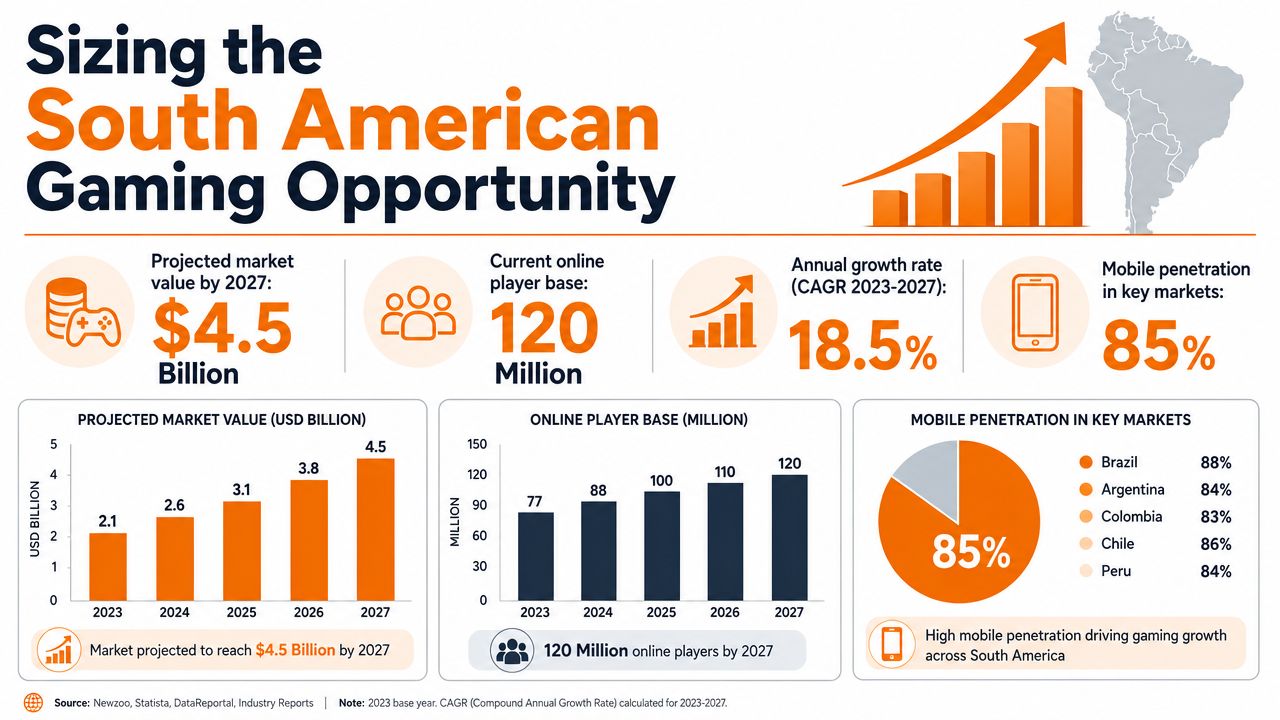
South America's gaming market was valued at more than USD 9.23 billion in 2024, and the mobile segment is projected to reach USD 5.21 billion by 2030 at a 10.01% CAGR, with Android holding 86.22% of the mobile market according to Research and Markets on the South America gaming outlook. That should change how operators think about South American gaming.
Too many launch plans still treat the region like a localization exercise. Translate the site, add a local payment method, source some football markets, then go live. That approach usually breaks the moment the business hits real operational pressure. The actual challenge is orchestration. Payments, compliance, content, wallets, geofencing, bonus controls, KYC, reporting, and infrastructure all need to work together in one operating layer.
That's why the best South American gaming launches don't start with a country list. They start with platform design. If your stack is fragmented, every market-specific requirement becomes slower, more expensive, and harder to control. If your stack is unified, market entry becomes a repeatable process instead of a custom build every time.
Table of Contents
- Sizing the South American Gaming Opportunity
- Navigating a Fragmented Regulatory Landscape
- Aligning Your Product with Player Demand
- Mastering Regional Payments and Payouts
- Building Your Technology Stack for Scalability
- Integrating Compliance and Responsible Gaming
- Your Go-to-Market Launch Checklist
Sizing the South American Gaming Opportunity
South America's gaming market exceeded USD 9.23 billion in 2024. That is already large enough to punish weak market-entry design. Teams that treat the region as a translation project usually find their primary limitation later, when payments, product rules, reporting, and player journeys start breaking across markets.
What changes the economics is not demand alone. It is whether your platform can carry multiple country models without forcing a rebuild every time you add a payment method, adjust bonus logic, or change onboarding flows. In practice, the operators that scale here are usually running one core system for wallet, player account management, content delivery, and controls, then adapting the front end and local integrations by market.
Mobile shapes the operating model
Mobile is the commercial baseline in South America. Earlier market data cited in this article shows strong mobile growth, high Android share, and heavy reliance on in-app spending behavior. For an iGaming operator, that has direct implications for platform design.
Registration has to be short. The cashier has to load fast on mid-range Android devices. Session recovery, identity checks, bonus presentation, and withdrawal requests all need to work cleanly inside short mobile visits. If those journeys sit across disconnected vendors, latency and handoff failures appear fast.
I usually advise clients to test one simple question before launch: can a new player discover the brand, register, deposit, place a bet or open a casino session, and request a payout from a phone without hitting a dead end? If the answer depends on which vendor responds first, the stack is too fragmented.
Market size supports real operating investment
This is not a niche expansion play. The region is large enough to justify dedicated payments work, local CRM planning, market-specific content operations, and a platform team that can support country-level configuration instead of one global default.
That matters because revenue in South America rarely comes from a single product line or a single country forever. Brands that last usually combine sportsbook, casino, live content, and localized promotions under one account and one wallet structure. A unified platform makes that possible. It keeps the player experience consistent while giving the operator room to adjust tax handling, bonus rules, payment routing, and reporting logic by jurisdiction.
The trade-off is straightforward. A patchwork stack can get a brand live in one market quickly. It usually becomes expensive by market two or three, when every new launch creates duplicate integration work and separate operational queues.
What strong entry plans usually get right
The strongest launch plans I see tend to share four traits:
- Mobile-first product design: Core journeys are built for Android-heavy traffic and smaller screens from day one.
- One wallet across products: Sportsbook and casino activity sit in the same financial system, reducing friction and improving retention.
- Configuration over custom rebuilds: Country differences are handled through rules, integrations, and permissions inside the platform, not by spinning up separate backends.
- Shared operational data: Payments, player activity, fraud signals, and support history live in one environment, so teams can act on the same view of the customer.
Weak plans usually have the opposite pattern:
- Surface-level localization: Translated copy without local cashier logic, local payment support, or market-specific player flows.
- Vendor sprawl: Separate systems for wallet, KYC, bonuses, and reporting, which increases failure points and slows issue resolution.
- Single-market architecture: A stack built for one launch country that becomes hard to adapt once product rules or payment preferences change.
- Late operational design: Support, fraud reviews, reconciliation, and reporting are treated as post-launch fixes instead of launch requirements.
If you are comparing expansion paths, South American market coverage options by jurisdiction and operating model are useful as a planning reference. The main point is simpler. In South America, platform architecture is not back-office plumbing. It is the layer that determines whether localization, payments, compliance, and product growth work together or pull the business apart.
Navigating a Fragmented Regulatory Landscape
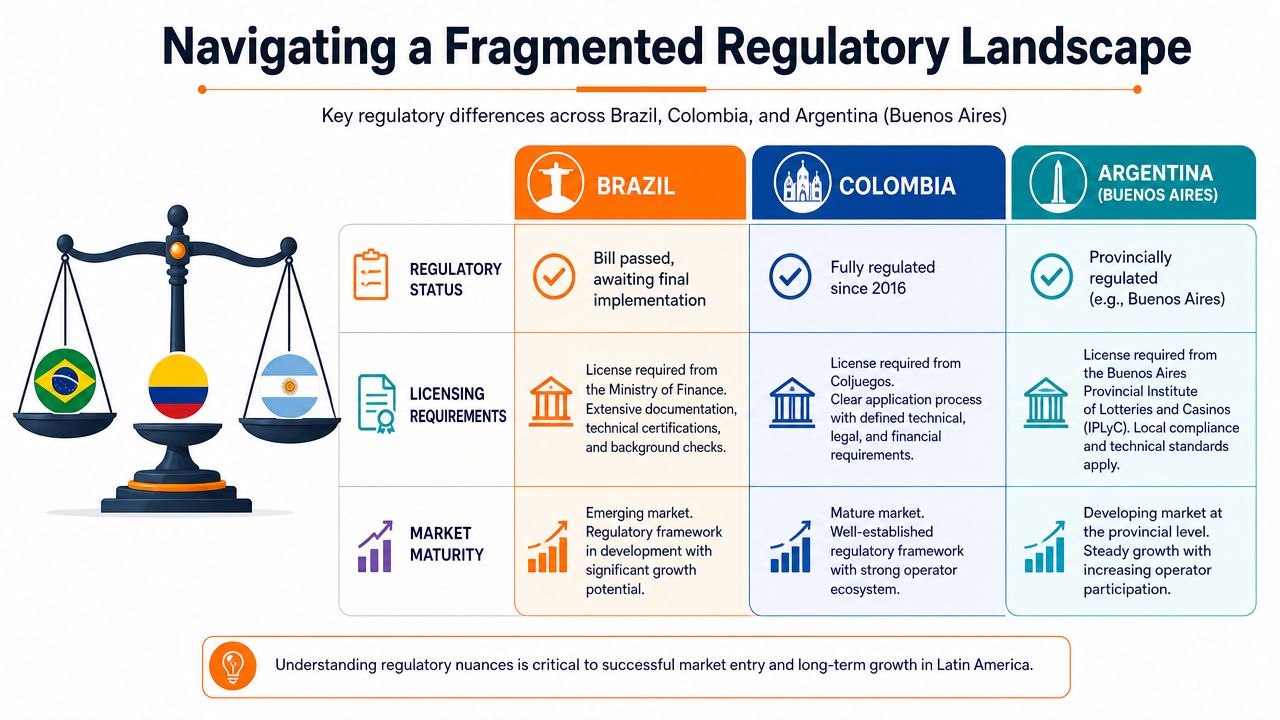
Regulatory structure, not market size, usually determines whether a South American launch reaches revenue on time or gets stuck in legal rework. The operators that scale cleanly in the region treat regulation as a system design input from day one, because licensing, payments, geolocation, KYC, tax handling, and reporting all sit inside the same operating model.
Demand is clear, as noted earlier. The harder question is whether your platform can support very different rule sets without forcing separate workflows, duplicate vendors, and manual exceptions in every country.
Market selection should follow operational fit
A common planning error is to choose the first launch market on traffic potential alone, then ask legal, product, and payments teams to adapt around that decision. That order creates delays. It also produces expensive architecture choices, especially if country rules are being managed across multiple third-party tools.
A better filter is straightforward. Can the business enter legally, report accurately, localize the cashier, enforce player controls, and adjust market-specific rules without rebuilding the stack?
That question changes how expansion priorities look.
| Market | Practical regulatory reality | Operating implication |
|---|---|---|
| Brazil | Large opportunity with a newly regulated environment | Strong upside, but launch teams need disciplined implementation and local readiness |
| Colombia | More mature licensing framework | Often easier to model operationally because rules and workflows are more established |
| Peru | Recently formalized market structure | Promising, but procedures and operating detail need close review before launch |
| Argentina | Province-based regulation | Expansion is possible, but each jurisdiction can create separate approval and compliance work |
The trade-off is simple. A bigger market can still be the wrong first move if your platform cannot switch reporting logic, bonus restrictions, document flows, and payment methods by jurisdiction. In practice, the unified platform matters here because it turns regulatory variance into configuration, permissions, and routing rules instead of separate operational silos.
The legal model changes product and operations
Brazil often leads launch discussions because of scale. That is commercially rational. It also demands execution quality across onboarding, cashier behavior, customer support, fraud review, and audit readiness. If those functions live in disconnected systems, small rule changes become cross-vendor projects.
Colombia is often easier to model because the framework is more established. Operators can usually define approval steps, reporting routines, and player handling processes with fewer unknowns. That reduces ambiguity, but it does not reduce the need for disciplined setup.
Argentina requires a different mindset. Province-based regulation affects more than licensing. It can affect where players can access the product, what content can be shown, how controls are applied, and which reports need to be generated. Teams that treat Argentina as one national deployment usually create avoidable rework.
Entering Argentina with a single national playbook usually creates rework. Province logic needs to be built into platform rules, support processes, and reporting ownership.
Peru can be attractive, but recently formalized markets require tighter assumption testing. Legal interpretation, processor readiness, and local partner diligence all matter more while operating patterns are still settling.
To ground the regulatory discussion in a broader market context, this overview is worth watching before building a rollout plan:
What disciplined launch teams do before go-live
The strongest operators start with the market they can run well, not just the market they want most. They design the first launch so the same core platform can support later expansion with controlled changes, not fresh infrastructure.
That usually means four things:
- Choose one anchor market with manageable rule complexity. Use it to validate licensing workflow, reporting accuracy, cashier logic, and support escalation.
- Convert legal requirements into system behavior. Geofencing, KYC steps, bonus eligibility, tax treatment, and reporting triggers should sit inside platform rules, not in spreadsheets and legal memos.
- Separate shared capabilities from local obligations. Wallet structure, CRM, player account management, and fraud monitoring can often stay centralized. Jurisdiction-specific restrictions should be layered on top through configuration.
- Assign ownership for regulatory change. Someone needs authority to translate rule updates into product settings, operational procedures, and audit records after launch.
Manual compliance across several jurisdictions breaks down fast. It slows releases, creates inconsistent player handling, and raises the chance of reporting errors. A unified platform does not remove regulatory complexity, but it gives operators one control layer for payments, localization, compliance, and support. That is what makes multi-market expansion workable.
Aligning Your Product with Player Demand
A South American gaming launch fails quickly when the product feels imported. Not foreign in branding. Foreign in behavior. The lobby order is wrong, the promotions miss the rhythm of the market, the sportsbook feels detached from local sports culture, and the casino catalogue doesn't reflect how players browse and play.
That's why product-market fit in this region is less about adding local flags and more about curating the experience. The question isn't whether you offer sportsbook and casino. The question is whether both products feel native inside one brand.
Sportsbook has to feel immediate
In many South American markets, football drives attention, acquisition, and retention. That has obvious implications for event coverage, but the more important implication is interface behavior. Users expect quick navigation to major fixtures, straightforward bet-slip handling, and reliable in-play performance.
A common operator mistake is to import a sportsbook structure built for a different audience. The menu taxonomy is too dense, the market naming is inconsistent, and the live experience is cluttered. Even if the odds feed is solid, the product feels slower than it needs to.
Teams usually get better results when they focus on:
- Fast path navigation: Users should reach headline competitions and popular markets with minimal taps.
- Clear market hierarchy: Don't bury common football betting options under excessive submenus.
- Unified promotions: Sportsbook offers should connect to the wider wallet and CRM instead of living in a silo.
Casino needs curation, not volume alone
A large game library helps, but catalogue size by itself rarely creates traction. What moves the needle is relevance. In South American gaming, players respond better when the casino floor is curated around familiar play patterns, accessible themes, strong live dealer presentation, and promotional mechanics that make sense in context.
The weak version of localization is simple translation. The stronger version is merchandising.
That means thinking about:
- how the homepage rotates featured content
- which game categories appear first on mobile
- how live dealer tables are presented
- how bonus copy reads in local language variants
- whether campaign timing reflects local calendars and sports moments
The best localized casino isn't the one with the most games. It's the one where the right games are easiest to find.
What works in practice
I'd separate product alignment into three operating layers.
Content layer. Choose suppliers and game categories that support both breadth and local merchandising flexibility. You want the ability to surface live casino, slots, tables, and promotional content differently by market.
Commercial layer. Bonuses, loyalty structures, and event-led campaigns should be configurable without development every time. If marketing has to wait on product teams for each local variation, the brand will always feel late.
Experience layer. Registration, wallet access, content discovery, and support need to feel consistent across casino and sportsbook. If the user experiences separate systems, trust drops.
A practical review before launch is to test your site as if you were a first-time mobile user arriving from a football campaign. Can you register, verify, deposit, place a bet, switch to casino, claim an offer, and request a payout without confusion? If not, the issue usually isn't demand. It's product alignment.
Mastering Regional Payments and Payouts
Payments determine whether acquisition turns into revenue. In South American gaming, that's not a finance department issue. It's a product issue, a trust issue, and a retention issue.
Operators often focus heavily on getting deposits live and leave payouts as an operational afterthought. Players notice that immediately. A brand can survive a limited cashier longer than it can survive a cashier that feels unreliable.
Local fiat methods reduce friction
Support for local payment behavior matters because players want familiar rails and predictable settlement. In practice, that means bank-connected methods, regionally relevant transfer options, and checkout flows that don't push users into unfamiliar steps.
Brazil is the clearest example. Pix has become a reference point in almost every regional payment discussion because it changes how users think about speed and convenience. Even when you don't build your whole market-entry thesis around one payment method, it shapes expectations across the wider region. Players compare your cashier against the fastest experience they already know.
The operator takeaway is straightforward. Fiat payment coverage should be broad enough to match local habits, and cashier UX should be simple enough that payment method variety doesn't create confusion.
Crypto adds flexibility, but it doesn't replace localization
Crypto can solve some operator-side problems well. It can simplify cross-border treasury workflows, broaden deposit options for certain user segments, and create flexibility where banking coverage is inconsistent. It can also complicate compliance, customer support, and player communication if it's bolted on carelessly.
That's why I don't treat fiat versus crypto as a winner-takes-all decision. In South American gaming, the better model is usually a flexible cashier that can support both, while keeping wallet logic, monitoring, and reporting consistent.
A practical comparison helps.
| Payment approach | Where it helps | Where it creates pressure |
|---|---|---|
| Local fiat methods | Familiar user experience, stronger trust, easier everyday adoption | Requires market-specific integrations and operational maintenance |
| Crypto support | Useful for flexibility, certain user segments, and treasury options | Needs tighter controls, clearer messaging, and stronger compliance coordination |
| Hybrid cashier | Covers broader demand while preserving operator flexibility | Only works well if one backend governs balances, risk, and reporting |
If you want to evaluate what a modern cashier should include across casino, sportsbook, wallet, and payment orchestration, this overview of NexGrate products is a practical benchmark.
Payouts are where trust is won
Many launch teams over-optimize for first deposit and underinvest in withdrawal operations. That's backwards. Deposits create conversion. Payouts create credibility.
Good payout design usually includes:
- Clear rules: Users understand verification requirements and withdrawal conditions before they transact.
- Unified review logic: Fraud checks, AML review, and player status are managed in one back office.
- Consistent communication: Support, cashier messaging, and account notices all say the same thing.
Poor payout operations usually come from fragmented systems. Payments sits in one dashboard, KYC in another, fraud rules elsewhere, and support has partial visibility. That setup slows reviews and creates contradictory messages to players. In a competitive region, that damages the brand faster than most operators expect.
Building Your Technology Stack for Scalability
Latency tolerance is measured in seconds, but the cost of a bad stack shows up for months. In South America, operators deal with uneven connectivity, mixed device quality, fragmented vendors, and country-specific operating rules at the same time. The platform layer determines whether those moving parts stay coordinated or turn into a constant stream of manual fixes.
A lot of launch plans still treat infrastructure, payments, product, and compliance as separate workstreams. In practice, they are tied together. The stack that routes transactions also affects fraud review. The wallet model affects bonus logic. Hosting and session management affect live betting performance, support load, and retention. A unified platform matters because it connects these operating dependencies inside one system.
Insufficient cloud computing infrastructure remains a real constraint in parts of the region, and operators need technology built to manage latency, uptime, and geofencing under uneven connectivity conditions, according to EdgeUno on digital gaming infrastructure in Latin America.
Why fragmented stacks fail faster in this region
A fragmented setup can survive longer in a mature market with stable infrastructure and fewer localization variables. South America puts more pressure on every handoff between systems. If the sportsbook, casino, wallet, CRM, fraud tools, and reporting layer all maintain their own version of player state, operating costs rise quickly and errors spread across teams.
The failure points are predictable:
- Latency under load: Live betting, in-play updates, and live dealer sessions suffer when hosting and routing are not aligned.
- Conflicting player status: Support, payments, and risk teams see different account states and give different answers.
- Slow country expansion: Every new market adds custom logic across multiple vendors instead of one configurable layer.
- Inconsistent controls: Reporting, bonus restrictions, and jurisdiction rules drift when they are managed in separate systems.
The commercial issue is straightforward. Every extra integration creates another point of delay during launch, another reconciliation task after launch, and another vendor dependency when something breaks.
One operating layer reduces operational drag
The better model is one core platform governing player accounts, wallet state, content access, payments orchestration, promotional logic, and control rules. External providers still matter. Payment methods, game studios, KYC vendors, and analytics tools may all sit around the core. But the operator needs one operating layer that decides how the business runs.
That architecture solves a practical problem many teams underestimate. South American expansion rarely fails because a feature is missing. It fails because five connected functions behave differently across channels, countries, or vendors.
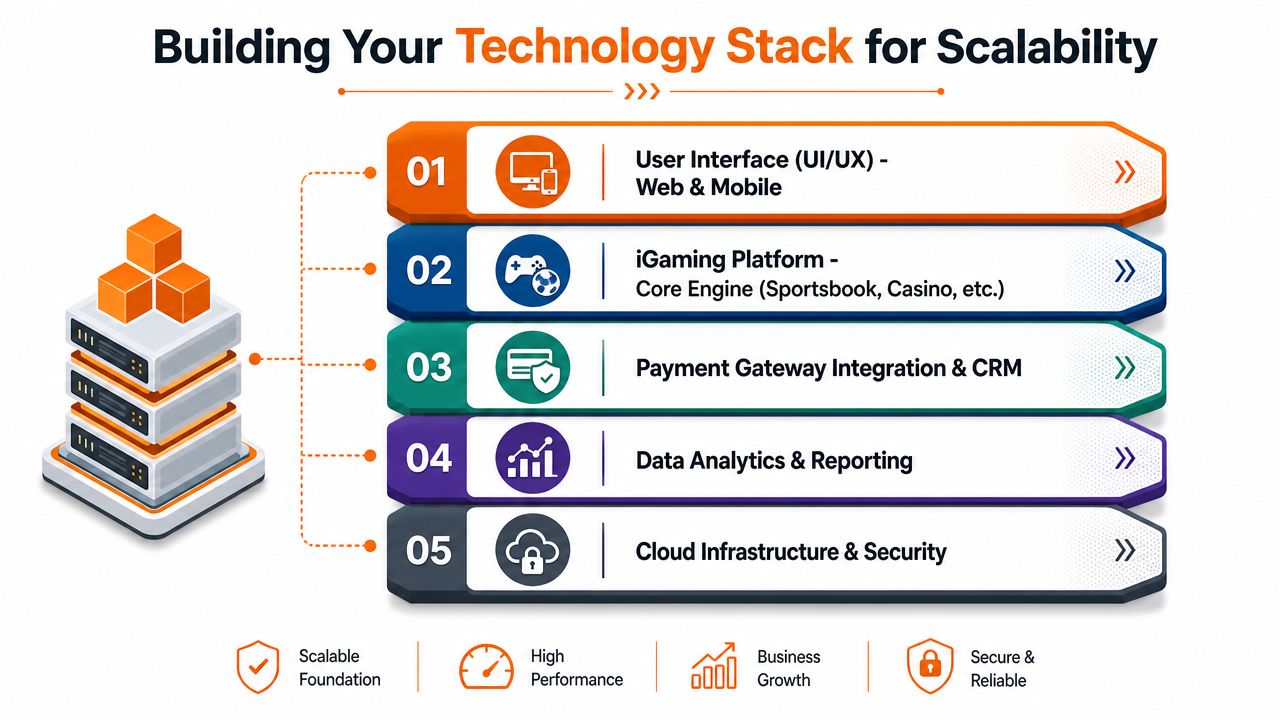
Here is the minimum a scalable stack should cover.
| Stack layer | What it should do |
|---|---|
| Front end | Deliver a consistent web and mobile experience across casino and sportsbook |
| Core gaming engine | Manage player accounts, sessions, wallet state, and game access |
| Payments and cashier | Orchestrate fiat and crypto methods, deposits, withdrawals, and balance logic |
| CRM and bonuses | Run segmentation, offers, loyalty mechanics, and campaign controls |
| Compliance toolkit | Support KYC, AML workflows, reporting, geofencing, and responsible gaming rules |
| Hosting and security | Provide monitoring, DDoS protection, uptime management, and environment stability |
The compliance layer is part of the same decision. A provider that treats controls as a bolt-on product usually creates manual reviews and reporting gaps later. A platform with integrated compliance infrastructure for iGaming operations keeps account controls, wallet permissions, and reporting logic tied to the same player record.
White-label often gives better operating economics
White-label is frequently the right answer for market entry teams that need to launch on schedule without building a large internal integration program. The trade-off is not control versus convenience. Instead, the actual trade-off is configurable control inside a unified system versus custom development across too many moving parts.
That distinction matters in South America. Operators need local payment coverage, market-specific rules, flexible bonus tools, multi-brand support, and stable uptime. Building all of that from separate vendors can work, but it usually requires a stronger internal product, engineering, and operations function than early-stage market entrants expect.
A well-structured white-label platform reduces that burden. It also shortens the path to adding a new country, content provider, or payment method because the core wallet, player profile, and back office are already in place.
If your team needs separate projects to launch a cashier, add a market, change a bonus rule, and update compliance controls, the stack is too fragmented.
What to test before you sign
Vendor demos rarely expose the operating weaknesses that appear during launch week. Push past feature lists and test how the platform behaves across real workflows.
- Can casino and sportsbook run under one wallet and one player profile?
- Are content providers connected through one API layer or through repeated custom integrations?
- Can jurisdiction rules, geofencing, and bonus restrictions be configured by market without code changes?
- Does one back office show payments, support history, player status, and risk signals together?
- How are uptime, traffic spikes, DDoS protection, and incident response handled in practice?
Ask for examples from live operations. Ask who owns the integration layer. Ask how long market-specific payment additions take. Those answers tell you more than a polished roadmap.
The right stack does more than support scale. It gives the operator one control point for payments, localization, player management, and compliance, which is exactly what South American expansion demands.
Integrating Compliance and Responsible Gaming
A failed verification flow or missed exclusion rule can stop revenue faster than a content gap. In South America, where payment behavior, jurisdiction rules, and player risk controls vary by market, compliance has to run inside the same platform logic that governs wallets, sessions, bonuses, and support workflows.
Operators run into trouble when compliance is treated as a legal workstream instead of a product and operations function. The result is familiar. Manual reviews pile up, player treatment becomes inconsistent, withdrawal handling slows down, and regulator exposure rises.
The practical fix is a unified control layer. Registration, identity checks, wallet activity, promotions, session limits, geolocation, fraud screening, and reporting should share the same player record and rule engine. That structure matters even more in a region where technical performance can vary by market. Xsolla makes a similar point in their analysis of Latin American gaming infrastructure and localization gaps. If the core platform is slow, fragmented, or dependent on workarounds, compliance starts failing at the process level before it fails at the policy level.
Compliance controls have to work in live operations
Every operator can name the core requirements. KYC, AML, geofencing, responsible gaming, auditability. Execution is where market entry plans usually break.
A platform that can support regulated growth should at minimum connect these controls directly to player actions:
- KYC tied to account state: Verification status should automatically affect deposits, withdrawals, and bonus access.
- AML monitoring tied to wallet behavior: Transaction reviews need to happen inside the cashier flow, not in a disconnected tool.
- Geofencing at the access layer: Market rules should determine login, wagering rights, and content visibility before a bet is placed.
- Audit logs in the back office: Teams need a clear record of status changes, rule edits, and user actions.
Separate systems create handoffs. Handoffs create exceptions. Exceptions create risk.
That trade-off is operational, not theoretical. If support, payments, and fraud teams all see different versions of the same player, disputes take longer to resolve and restricted activity slips through more easily.
Responsible gaming only works when enforcement is centralized
Responsible gaming tools are only useful if the platform enforces them everywhere. Deposit limits, cooling-off periods, self-exclusion, affordability triggers, and account restrictions should all be applied by the same backend that controls balances, session access, and campaign eligibility.
Otherwise, one system blocks a player while another still sends offers or processes activity. That is the kind of failure regulators remember.
I advise clients to test responsible gaming controls as a conflict case, not just a feature demo. Put a player into exclusion. Trigger a withdrawal. Apply a bonus rule. Open a support ticket. If every team and every interface reflects the same status immediately, the control is real. If not, the platform is asking staff to compensate manually.
A responsible gaming process that depends on staff remembering cross-system updates is not a control. It is an operating weakness.
What to audit before go-live
Before launch, the review should focus on evidence, not policy documents:
- Verification triggers are defined and enforced. The team knows when checks start, what blocks the account, and what releases it.
- Geolocation rules are tested in real user scenarios. Border cases, VPN attempts, and mobile handoffs should be part of QA.
- Withdrawal reviews inherit KYC and risk logic automatically.
- Responsible gaming restrictions override CRM and promotional rules without exceptions.
- Regulatory and internal reports can be generated from system records, without rebuilding data in spreadsheets.
This is also where platform choice shows its value. A purpose-built control stack reduces manual intervention, shortens audit preparation, and keeps compliance decisions consistent across markets. For a practical reference point, NexGrate's compliance platform features show how reporting, audit trails, geofencing, and responsible gaming controls can operate inside one system.
Your Go-to-Market Launch Checklist
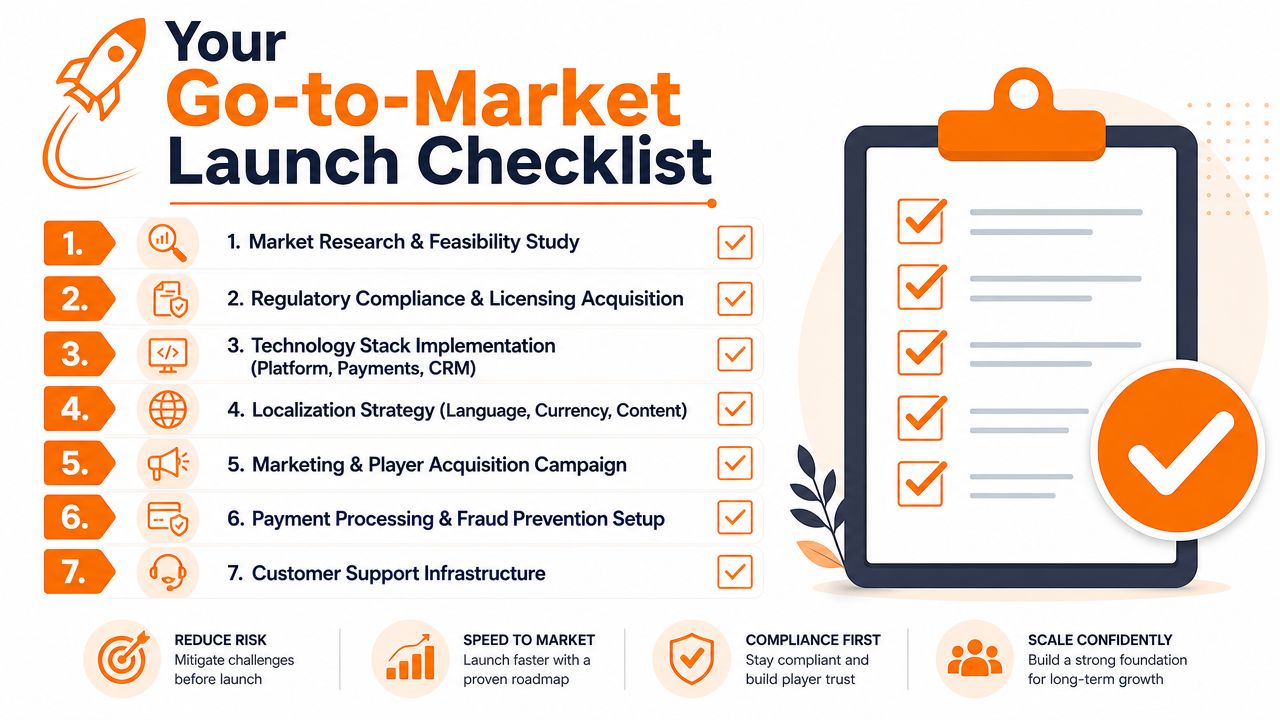
South American launches rarely break on strategy alone. They break at the handoff points between payments, product, compliance, CRM, and support. A unified platform reduces that failure rate because the same operating layer controls the player account, wallet, rules, and reporting from day one.
Speed still matters. As noted earlier, the regional market remains fragmented enough to leave room for new operators, but only if launch execution is tight. In practice, that means choosing a setup your team can run cleanly, not one that looks impressive in a pitch deck and creates manual work in week two.
Pre-launch sequence that actually holds up
Choose the anchor market
Start with the jurisdiction your team can support operationally. Licensing path, local payment coverage, fraud exposure, support hours, and reporting obligations should all be realistic for the team you have now.Fix the platform model early
Decide whether casino, sportsbook, wallet, payments, CRM, and compliance will run through one backend or across multiple vendors. That choice shapes everything that follows. Multi-vendor stacks can work, but they usually add reconciliation work, slower change cycles, and more edge cases around bonuses, withdrawals, and support.Convert market rules into live system logic
Local requirements should sit in product settings, not in internal documents. Payment methods, limits, geofencing, bonus restrictions, tax handling, and reporting fields need to be configured at platform level so teams are not translating policy by hand.Build a launch product that can convert
A large lobby does not fix a weak first-session experience. Launch with a focused mobile-first offer, clear cashier journeys, local language support, and promotions that match how players deposit and return.Test money-out, not just money-in
Deposit success is only the start. Run end-to-end tests for verification triggers, withdrawal approval, failed payout handling, support visibility, and player communications. If payout exceptions require staff to jump between systems, the issue is in the operating model, not in the QA script.Set up commercial operations before traffic goes live
Affiliates, CRM journeys, bonus approvals, and support workflows should already be working in the same environment. A brand is not launch-ready if acquisition can spend but retention and support cannot see the full player record.Assign ownership for change control
Post-launch drift starts fast. Payment providers update requirements, local rules change, and promotional logic creates conflicts. One team should own release control, rule changes, and exception review across the full platform.
Final launch standard
A strong launch is operationally quiet.
The cashier works predictably. Support sees the same account state as compliance. Marketing cannot override restrictions by accident. Finance can reconcile without rebuilding reports offline. That is what a unified platform gives an operator. It turns separate launch tasks into one controlled system.
If the brand depends on manual vendor coordination, repeated support escalations, or country-specific workarounds to process routine activity, it may be live, but it is not ready to scale.
NexGrate helps operators launch and run online casino and sportsbook brands on a unified white-label platform. If you need one operating layer for payments, content, wallet management, compliance, and back-office control, explore NexGrate.