You're reviewing a withdrawal that doesn't match the player's betting history. At the same time, the KYC queue is growing, a sportsbook settlement dispute is waiting for evidence, fraud analysts are checking possible duplicate accounts, and marketing wants to launch a campaign before the day gets away from them. Each team has data, but not necessarily the same data.
That's the operating problem a player account management system, or PAM, is built to solve. It gives the operator one controlled account record for identity, authentication, balances, sessions, compliance status, bonuses, and activity. The important question isn't whether a PAM includes a long list of modules. It's whether those modules preserve one accurate version of the player while casino, sportsbook, payments, KYC, and marketing services keep exchanging events.
Table of Contents
- What a Player Account Management System Does on a Monday Morning
- The Core Engine Inside a Player Account Management System
- Wallet and Balance Models Built as a Ledger
- Session Management and Identity at Scale
- KYC and AML Workflows Inside the Account Lifecycle
- API and Integration Patterns for a Composable Stack
- Why a Unified Casino and Sportsbook Backend Wins
- Operator Checklist and Frequently Asked Questions
What a Player Account Management System Does on a Monday Morning
At 8:30 on Monday, a support agent opens a player profile because a withdrawal has been paused. The finance team sees the transaction, the compliance team sees the verification state, and the fraud team sees device and payment relationships. If those views come from separate systems, someone has to reconcile them before deciding whether the payout can proceed.
A second queue contains new registrations awaiting identity checks. A third contains bonus-abuse alerts. On the sportsbook side, an unsettled event has created questions about a bet outcome, while the marketing team is preparing a promotion that should exclude players with certain limits or safer-gambling restrictions.
The PAM is the hub behind these decisions. It doesn't replace every specialist service. Instead, it maintains the player record and coordinates the rules that determine what each connected service may do. Ontario's regulated iGaming framework illustrates why this layer matters. Every player account must be uniquely identifiable, a player may have only one account with an operator, and the operator must maintain an auditable trail for account creation, activation, deactivation, and changes. The standards also require accurate logging of player account transactions through the AGCO player account management standards.

The practical definition
A PAM answers operational questions such as:
- Who is this player? The account connects registration data, authentication, verification, jurisdiction, and risk status.
- What can this player do now? The account applies deposit limits, self-exclusion, account locks, and market permissions.
- Where is the money? The wallet records deposits, wagers, settlements, bonuses, withdrawals, and held funds.
- What happened? The system preserves events that support customer service, reconciliation, fraud review, and regulatory audits.
Operator to operator, the useful test is simple: ask whether your team can reconstruct a disputed transaction from one player record without opening several unrelated admin tools. If the answer is no, you may have connected products, but you don't yet have dependable account orchestration.
The Core Engine Inside a Player Account Management System
A useful PAM mental model has five functional pillars. Think of a hotel front desk. The desk verifies the guest, issues access, records charges, knows whether the room is occupied, and can produce the history when management asks what happened.
Identity and authentication
The account begins with a unique player identity. Registration creates the record, authentication confirms that the person can access it, and authorization determines which actions are available after login. These are related but different responsibilities. A successful password check doesn't automatically mean the player can deposit, withdraw, or place a bet.
Wallet and balance management
The wallet is the financial control point. It should distinguish available funds, promotional value, and money held for unresolved activity rather than presenting one unexplained balance. A deposit, stake, win, refund, or withdrawal must create a traceable financial event.
Session and device state
Authentication answers, “Did the player sign in correctly?” Session state answers, “What is this player allowed to do in this active session?” The PAM can associate a session with device context, location signals, language, limits, and risk decisions. That context helps other services apply the same account rules.
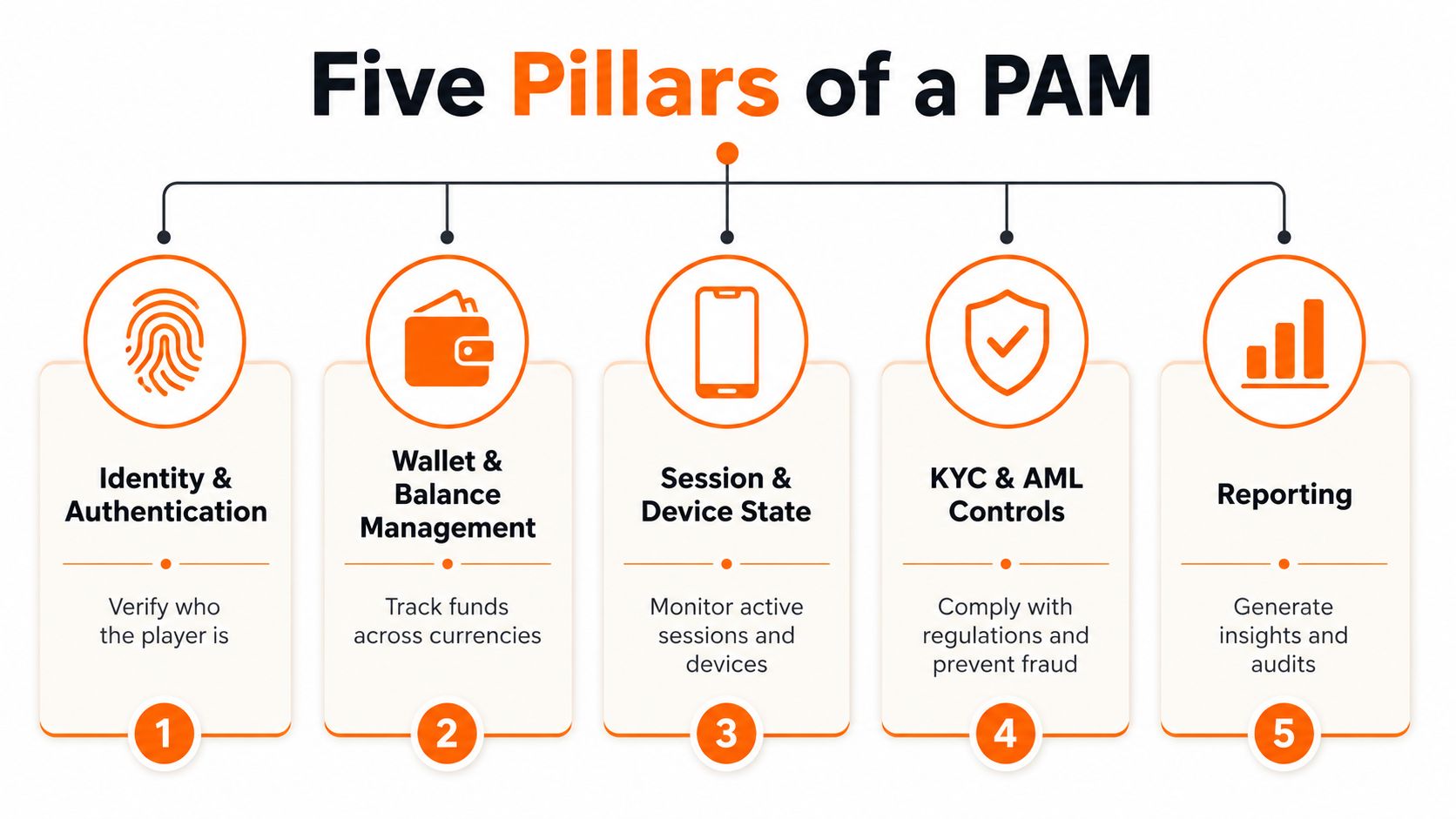
KYC and AML controls
Compliance status belongs to the account lifecycle, not just the registration form. The PAM stores verification outcomes, review states, restrictions, and relevant decisions so a payment, casino game, or sportsbook can enforce the same eligibility rules.
Reporting
Reporting turns account events into operational evidence. Finance needs transaction and reconciliation views. Compliance needs audit trails. Support needs account history. Marketing needs permitted audience attributes. A report is only as reliable as the account and ledger events beneath it.
A CRM is not the same thing. A CRM manages communications, segmentation, retention, and campaign activity. A payment gateway processes a payment instruction. A sportsbook engine manages odds, markets, and bet settlement. The PAM owns the player relationship that connects those services and decides how their results affect the account.
Architecture rule: A specialist vendor may execute an action, but the PAM should own the account state that records whether the action was allowed, completed, reversed, or still pending.
Wallet and Balance Models Built as a Ledger
A single mutable balance field is easy to read and hard to trust. If a player's balance changes after a deposit, wager, settlement, bonus credit, refund, and withdrawal request, the operator needs to know not only the latest number but also which events produced it.
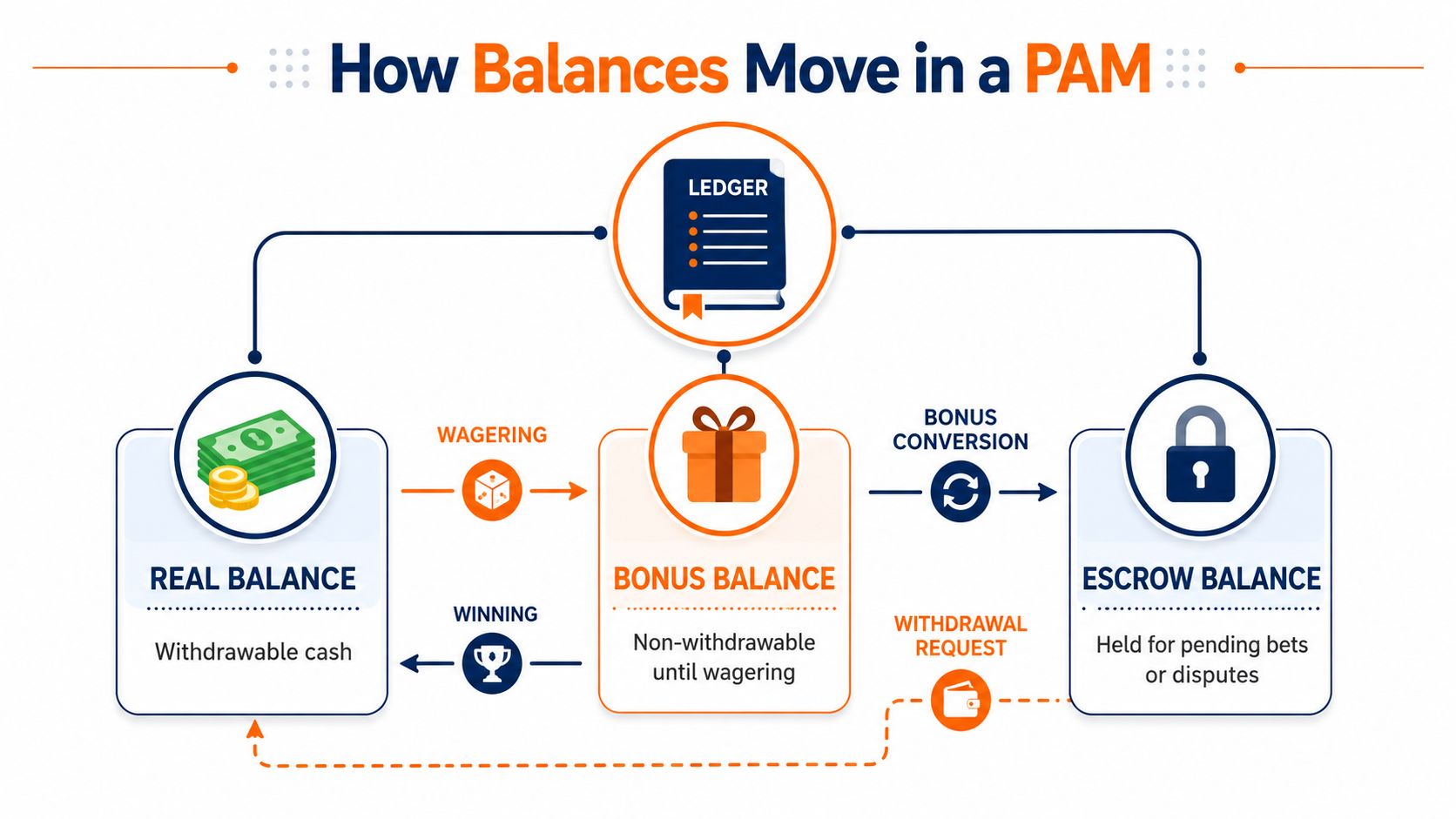
A serious PAM uses a multi-currency, multi-balance ledger. Each movement becomes an immutable record with an event type, account reference, currency, source, destination, status, and related transaction identifier. The displayed balance is then derived from ledger entries, rather than being treated as the only source of truth. This is the model described in iGaming infrastructure guidance on wallet and ledger design.
Separate balances by purpose
A casino-plus-sportsbook operation commonly needs distinct accounting treatment for:
- Real balance, representing cash that may be available for play or withdrawal, subject to applicable rules.
- Bonus balance, representing promotional value with conditions attached.
- Escrow or held balance, representing funds reserved for pending bets, disputes, or another unresolved state.
The separation prevents the interface from disguising obligations. A player may see one total, but the back office must understand which portion is withdrawable, restricted, reserved, or awaiting settlement.
Follow the event, not just the outcome
Consider a sportsbook bet. The PAM can record the stake leaving an available balance, the amount moving into a held state, the settlement result arriving from the sportsbook, and the resulting release or credit. If the event is voided or corrected, the system can append a reversal instead of editing history.
Casino activity has a different rhythm. A game session may produce a stake and outcome in rapid succession, while a sportsbook market may remain unresolved until an event finishes. Both products can use the same account ledger while preserving their own transaction references and settlement logic.
This is why wallet consistency is a ledger problem, not a synchronization problem. Synchronization asks whether two systems currently show the same number. Ledger design asks whether the operator can prove how that number was produced and reconcile it deterministically.
For a deeper treatment of currency handling and wallet separation, see multi-currency wallet architecture.
Practical rule: Never make a support agent infer the origin of a balance from a final total. Show the chain of deposits, stakes, settlements, credits, holds, and reversals.
Session Management and Identity at Scale
A player record is incomplete if it only stores registration details. The PAM also needs to understand who is active, from which device, under which session, and with what permissions.
Authentication is the entry checkpoint. Session management is the live control plane. When a player signs in, the PAM creates or updates a session record and associates it with relevant context, such as device information, location indicators, language, login time, and active restrictions. Connected services can then ask the PAM whether the player is permitted to perform a particular action.
That distinction matters during fraud review. Several accounts may share device or payment signals, but those signals are not automatically proof of misconduct. They are evidence for a risk workflow. The PAM should preserve the signal, the rule that triggered review, the analyst decision, and the resulting account restriction without overwriting the original event.
Session state also supports responsible-gambling controls. If a player activates a time-out, reaches a configured limit, or enters self-exclusion, the account's current permission state must reach the cashier, casino, sportsbook, and customer-service tools. A banner on the website isn't enough if the wallet or betting service still accepts the action.
For operators considering low-friction registration, pay-and-play account design still requires careful separation between a fast entry journey and the underlying identity and compliance state. Reducing visible friction doesn't remove the need to control eligibility.
The UK Gambling Commission's consumer-journey study reports that 48% of respondents had ever used a gambling management tool. That adoption gap means the PAM must make limits, time-outs, and self-exclusion available inside the account journey, explain their status clearly, and enforce them consistently rather than assuming players will discover or configure them independently.
A useful implementation pattern is to make every sensitive action depend on a current authorization decision. The cashier checks account and session status before deposit or withdrawal. The sportsbook checks it before bet placement. The support console checks it before an agent changes account settings. One identity source, one permission state, and a complete session trail make disputes far easier to investigate.
KYC and AML Workflows Inside the Account Lifecycle
KYC and AML controls should follow the player from registration through closure. Treating verification as a one-time checkbox creates gaps because risk, eligibility, and regulatory obligations can change during the account's life.
Registration
Registration creates a unique account and captures the information needed for identity, age, jurisdiction, and contact validation. The PAM should apply market rules before the player reaches real-money functionality. It can also check whether the submitted identity resembles an existing record, helping prevent duplicate accounts.
The account shouldn't become fully active just because a registration form was completed. Its state should express what has happened, what remains pending, and which actions are blocked.
Verification and review
The PAM coordinates identity verification with external providers, but it owns the resulting state. A vendor may return a pass, fail, or manual-review outcome. The PAM stores that outcome, supporting documents or references, timestamps, reviewer actions, and any restrictions attached to the decision.
AML workflows can add sanctions and PEP screening, transaction monitoring, source-of-funds requests, and escalation rules. These checks shouldn't live only in a compliance dashboard. A withdrawal service needs to know whether the account is cleared, pending review, or restricted.
Active play
During active play, controls continue to operate. Deposit and withdrawal limits, account restrictions, self-exclusion, and responsible-gambling settings must be evaluated when the player attempts an action. A player who was eligible yesterday may not be eligible for the same action today because a limit, review, or exclusion state has changed.
Compliance principle: Store the decision and its evidence, not just a green or red status. Auditors and support agents need to understand why the account reached its current state.
Closure
Closure should preserve the required account and transaction history while preventing further play. The PAM records whether the account was closed by the player, restricted by the operator, or closed after a compliance decision. It should also manage outstanding balances, pending withdrawals, disputes, communications, and retention obligations according to the applicable market.
This lifecycle is where the PAM belongs. The marketing site can present registration and account controls, but it shouldn't be the authority for eligibility. Payments, casino, sportsbook, and support need the same compliance answer from the same account record.
API and Integration Patterns for a Composable Stack
A modern PAM works best as an API-first orchestration layer. The operator can replace a payment provider, KYC vendor, sportsbook feed, or game aggregator without rebuilding identity, wallet logic, or account history.
That flexibility depends on ownership boundaries. The PAM owns the canonical player identifier, account status, permissions, ledger, bonus state, compliance state, and audit events. A connected vendor owns the specialist process it performs, such as payment authorization, identity document analysis, odds delivery, or game content.
| Integration | What the PAM owns | What the vendor owns |
|---|---|---|
| Payment provider | Player-wallet relationship, transaction intent, limits, status, ledger entry, reconciliation reference | Payment authorization, processor response, method-specific handling |
| KYC provider | Verification workflow, account state, review status, evidence reference, restriction | Document and biometric checks, data-source response |
| Sportsbook engine | Player eligibility, wallet authorization, stake event, account transaction, bonus impact | Odds, markets, bet acceptance response, event settlement data |
| Casino or game aggregator | Session authorization, stake and win ledger events, player restrictions | Game content, game-session mechanics, outcome messages |
| CRM and marketing tools | Consent, eligible segments, account restrictions, bonus authority | Campaign execution, messaging, delivery reporting |
The event contract matters as much as the API endpoint. Each integration should define idempotency, retries, timeout behavior, duplicate-message handling, reversal events, and reconciliation procedures. Without those rules, a vendor replacement can create duplicate accounts, orphaned balances, or bonus states that no longer match the player's actual activity.
The operational risk is especially clear during migration. If a new payment service uses a different player identifier while the PAM fails to map it correctly, deposits may attach to the wrong record or remain unassigned. If a sportsbook sends settlement events without a stable bet reference, finance may not be able to reconcile the wallet.
Operators comparing integration partners can use iGaming software provider considerations as a starting point, but the technical evaluation should go further. Ask for API documentation, sandbox behavior, event schemas, error contracts, data export capability, and a tested migration plan.
Make the PAM the stable center
A composable stack doesn't mean every service can define its own version of the player. It means specialist services can change while the system of record remains stable.
Use canonical IDs, versioned events, explicit ownership, and reconciliation reports. Keep jurisdiction rules configurable around the core identity and ledger rather than forking the entire account model for every market. That approach reduces migration risk without pretending that all markets have identical compliance requirements.
Why a Unified Casino and Sportsbook Backend Wins
A unified backend gives the player and the operator one account relationship across two products. The same KYC record can authorize casino and sportsbook access. The same wallet can distinguish casino stakes, sportsbook holds, winnings, bonuses, and withdrawals. The same self-exclusion or restriction state can reach both products.
That's an operational advantage before it becomes an architectural one. Support agents don't need to ask which product created a balance. Finance doesn't need to reconcile two unrelated transaction histories. Compliance doesn't need to compare two identity records and hope that both represent the same person.
The alternative is often a stitched environment. A casino platform owns one account, a sportsbook owns another, and a separate payment layer tries to keep balances aligned. That arrangement creates questions that are expensive to answer:
- Which account is authoritative? Duplicate profiles can produce inconsistent verification and restriction states.
- Which balance is withdrawable? Separate wallets make cross-product funds harder to explain and reconcile.
- Which bonus rule applies? Promotions can be credited in one product while wagering activity occurs in another.
- Which history does the regulator review? Fragmented records make an end-to-end account narrative difficult.
A shared ledger doesn't erase product-specific logic. Casino sessions, sportsbook bets, settlements, cash-outs, and game outcomes still need their own references and workflows. The PAM provides the common identity, authorization, balance, and audit foundation that both products use.
A unified account is valuable because it gives every team the same operational truth, not because it puts two logos inside one dashboard.
This model also supports expansion more cleanly. Adding a new game supplier or sportsbook feed changes an integration boundary. It shouldn't require the operator to create another identity store or duplicate financial controls.
Operator Checklist and Frequently Asked Questions
Use this checklist during vendor evaluation:
- Ledger integrity: Can the system preserve immutable, traceable movements across currencies and balance types?
- Compliance depth: Does it support verification, AML review, restrictions, self-exclusion, and market-specific rules?
- Session capture: Can teams investigate devices, active sessions, permissions, and account events?
- Permissions: Are role-based access controls and administrative audit logs built in?
- API coverage: Are identity, wallet, bonus, compliance, payment, casino, and sportsbook events documented?
- Migration readiness: Can you export player records, balances, transaction history, and compliance evidence safely?
- Jurisdiction support: Can rules change by market without forking the core account and ledger model?
How does a PAM differ from a CRM?
A CRM manages communication, segmentation, loyalty, and campaign execution. A PAM manages the account itself, including identity, permissions, balances, compliance state, and transaction history.
What should operators check first when migrating from a legacy backend?
Start with the data model and ledger. Map every player identifier, balance type, transaction event, bonus condition, restriction, and compliance record before selecting a cutover method.
How can multi-market rules change without forking the core?
Keep the canonical identity and ledger shared, then apply jurisdiction-specific policy modules, limits, verification requirements, reporting formats, and account permissions around them. The core should record the decision and market context without duplicating the player.
NexGrate provides a turnkey white-label platform with player account management, wallets, casino and sportsbook modules, KYC and AML workflows, payments, back-office tools, and third-party integrations. If you're evaluating a unified PAM for a new launch or legacy migration, visit NexGrate to review how its platform can support account, ledger, compliance, and product orchestration in one environment.