You're probably staring at the same problem a lot of operators face right now. The acquisition team wants a cleaner first-deposit path, the compliance team wants fewer headaches, and the product team wants a faster launch, but the current funnel still looks like a patchwork of registration forms, verification steps, and cashier friction.
Pay N Play sounds simple on the surface, and that's exactly why people misread it. It isn't just a smoother checkout. It's an architecture decision that changes how identity, payments, and compliance are wired together from the first click onward.
Table of Contents
- The First Ten Seconds on a Pay N Play Site
- What Pay N Play Actually Is
- How the Operator Stack Changes Underneath
- The Compliance Reality Behind a Frictionless Front End
- Operator Benefits, Costs, and Market Limitations
- Choosing a Provider and Planning the Integration
- KPIs and an Implementation Checklist
- When Pay N Play Is Worth It and When It Is Not
The First Ten Seconds on a Pay N Play Site
A player lands on your homepage, picks a deposit amount, and clicks through. There's no registration form to complete, no password to invent, no email to confirm, and no document upload waiting in the wings.
The next screen is the bank authentication step. The player signs in through their bank, confirms the deposit, and the platform receives the identity signal and the payment confirmation in one sequence. In the background, the operator account is created automatically, so the player moves straight into the product instead of dropping out halfway through a long onboarding flow.
That part matters more than most founders admit. The player doesn't experience a “payment” followed by “verification”, they experience a single uninterrupted action. That's why Pay N Play is so effective at attacking registration drop-off, the friction point that traditional casino onboarding has always struggled with.
What changes on your side is less visible and much more consequential. You're no longer asking a customer to manually prove who they are before they can deposit, you're relying on a bank-mediated identity event to carry that burden in the background, using systems such as BankID, Mobiilivarmenne, Smart-ID, and iDIN where available. That reorders the entire first-session journey, and it forces your internal stack to behave like a real-time identity system, not a static signup form.
Practical rule: if the player can't reach a first bet in one continuous flow, you're not running Pay N Play, you're just adding another deposit screen.
What Pay N Play Actually Is
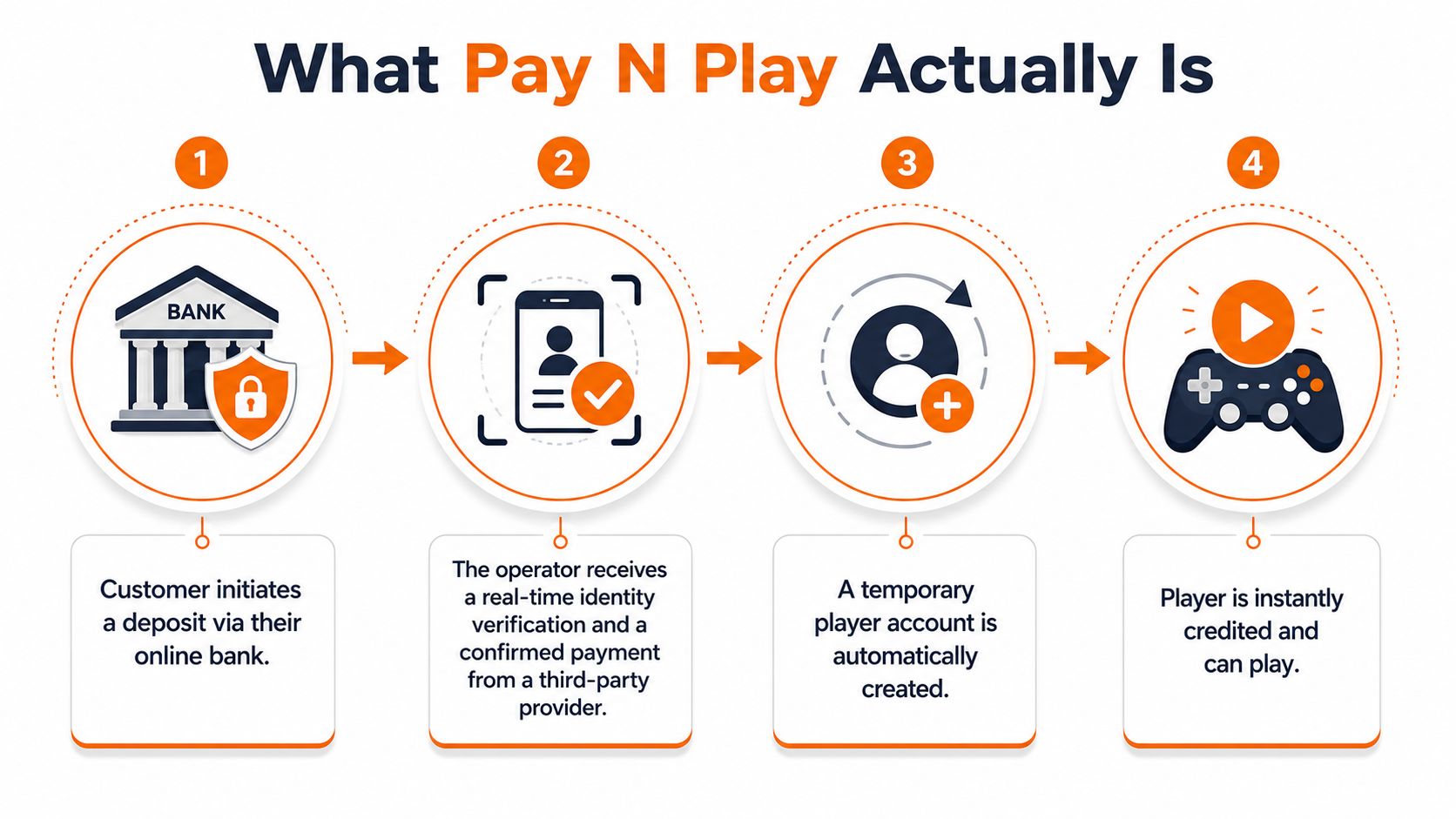
Pay N Play is not a card payment method, and it's not just a faster cashier. It's a unified identity-and-payment rail where the player's bank login both authenticates the user and triggers the deposit, while the operator receives the verified identity data needed to open the session and complete KYC in the background. In the market narrative, Trustly is widely credited with inventing the model in 2016 and with making the no-account casino flow commercially recognizable, with the model described by 2026 as being used by 250+ licensed operators across regulated European markets including Sweden, Finland, Estonia, Germany, and the Netherlands. That historical footprint comes from industry coverage of the model's evolution.
How the bank flow replaces the legacy funnel
The cleanest way to understand it is to compare the old stack with the new one. In a conventional funnel, the player registers, confirms an email, waits on KYC, goes to the cashier, and only then starts betting. In Pay N Play, those steps are merged into a single bank-authenticated action, and the operator's backend fills in the account and compliance record after the fact, not before the first bet.
The mechanism is simple in concept but strict in execution. The player authenticates through their bank. The payment provider returns a verified identity signal and a confirmed deposit. The operator auto-creates the player account, attaches the identity payload, and lets play begin.
Industry reporting says that this architecture can cut average login time from 48 seconds to under 10 seconds and returning-player time-to-bet to under 20 seconds when a recognized user is re-identified by Trustly's Azura data engine, according to iGaming Payment Solutions. Those are not cosmetic gains. They're evidence that the model compresses the journey because the system stops asking the player to prove identity through forms and documents.
Short version: Pay N Play is a transaction that also acts like an identity event. That's the whole point.
How the Operator Stack Changes Underneath
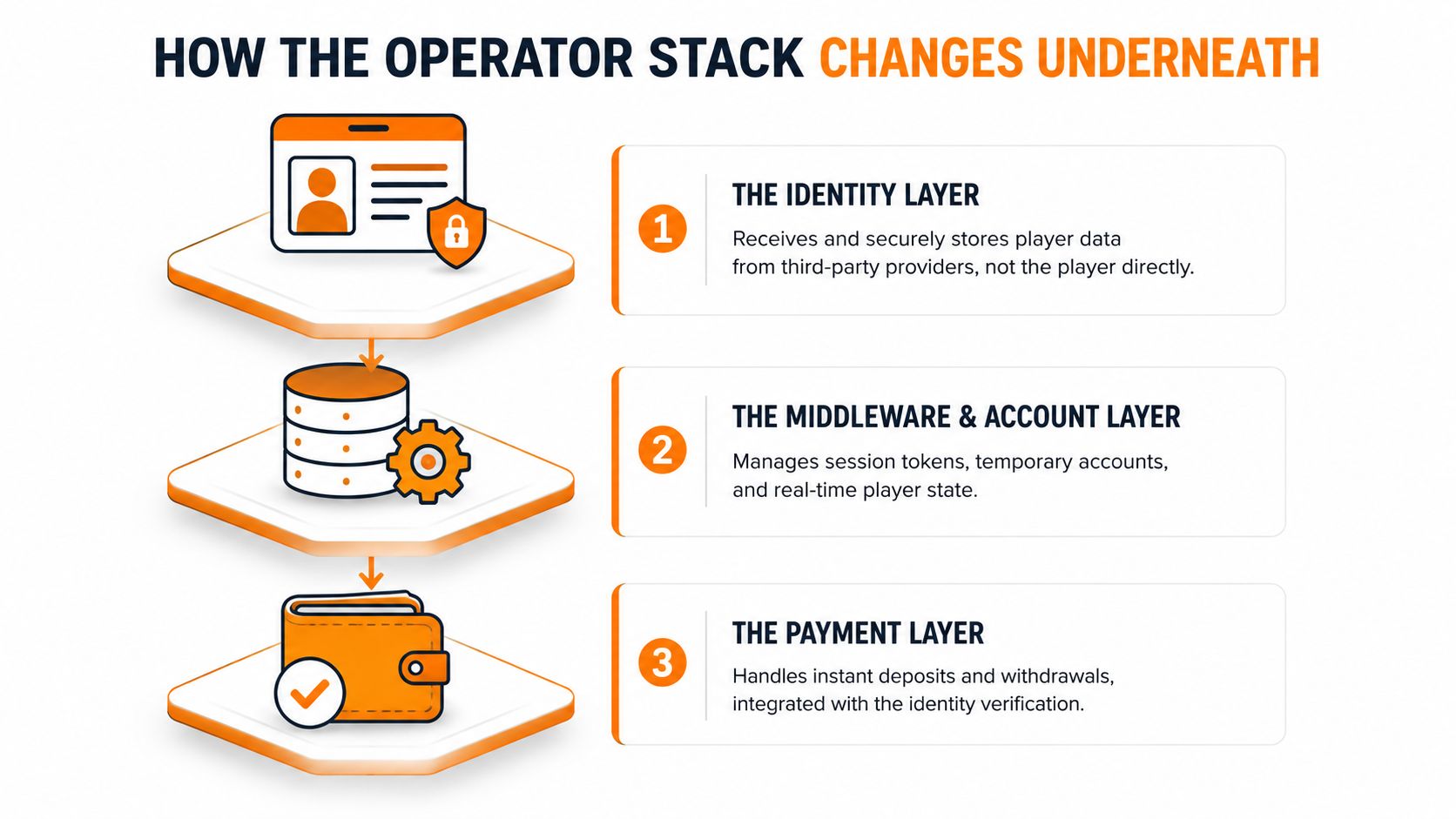
A Pay N Play rollout is an integration project, not a cashier toggle. The front end looks simpler because the hard work has moved into the middleware, where identity, payments, and player state all have to reconcile in real time. That's why teams that treat it like a UI change usually end up with messy account records and awkward exception handling.
What has to move in your backend
The first layer is identity. Your platform has to accept verified attributes from the bank or the provider, store them securely, and map them to the player record in a way that supports later checks. The second layer is middleware and account state, which has to create temporary or persistent accounts, manage session tokens, and keep the player profile aligned with what the bank sent. The third layer is the payment rail, which has to settle the deposit and support withdrawals through the same infrastructure.
That means several internal systems need attention at once. Your registration database can't assume the player typed in every field manually. Your cashier has to handle instant deposit confirmation instead of waiting for a separate verification state. Your bonus engine must know when a player is eligible, because the account may be created as part of the payment event. And your reporting layer has to be able to trace every transaction back to the identity payload that produced it.
The important architectural point is this. Pay N Play isn't just “faster onboarding”. It changes how data moves across the stack, which is why platforms with a unified wallet and prebuilt compliance controls usually have a much easier time implementing it than operators trying to bolt it onto a fragmented legacy backend. A stack designed around a single wallet and shared player state, like the one described on NexGrate's platform overview, is structurally better suited to this model than a patchwork of separate systems.
Operator takeaway: if the identity payload, wallet, and cashier don't speak the same language, Pay N Play will create more work than it removes.
The Compliance Reality Behind a Frictionless Front End
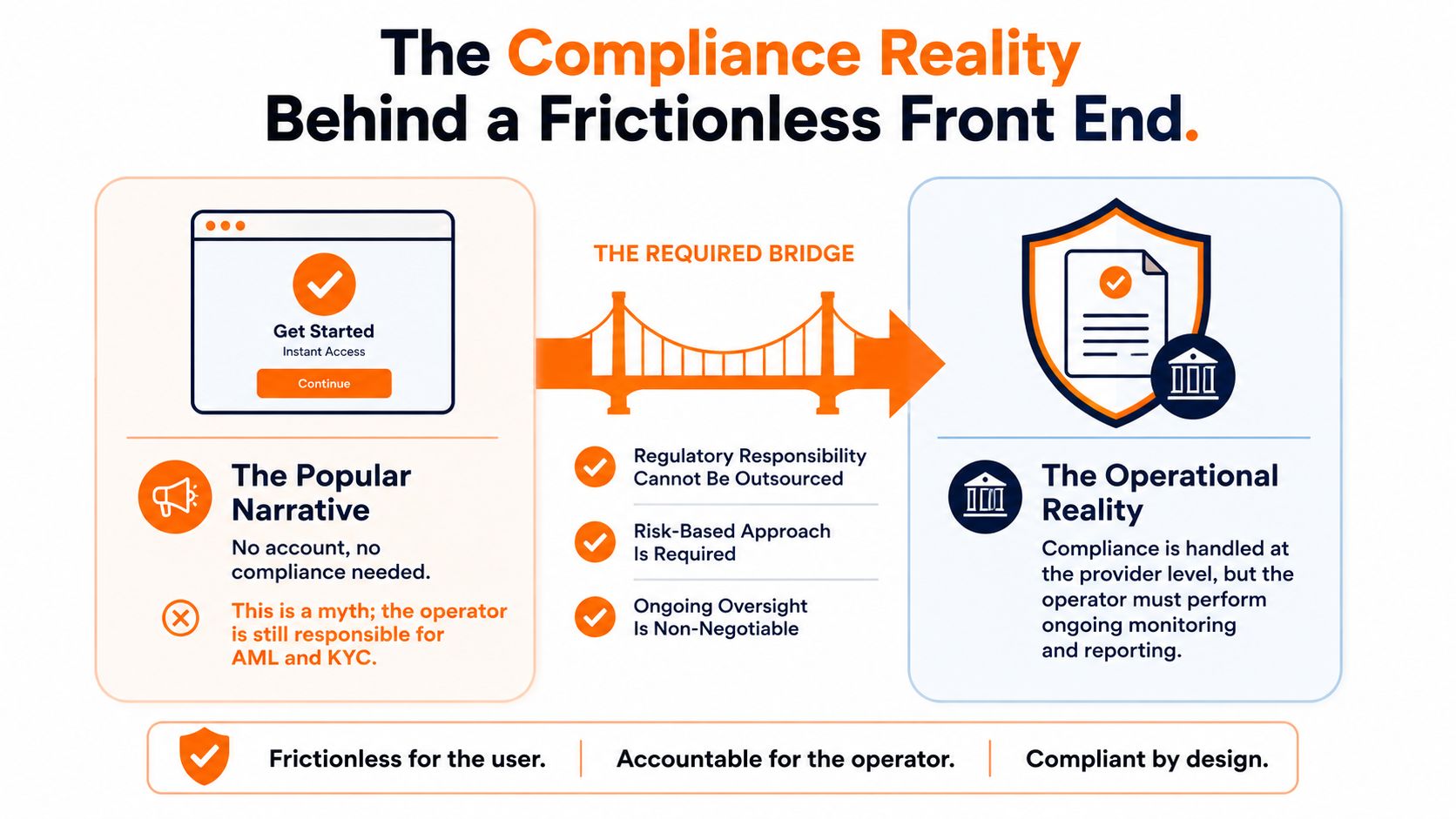
The popular pitch gets one thing wrong. No-account does not mean no-compliance. The front end looks cleaner, but the operator still carries the regulatory load behind the flow, and that obligation stays in place even if the player never sees a signup form.
Why “no account” does not mean “no records”
Pay N Play still creates persistent player records behind the scenes, often called shadow accounts. The operator still needs data architecture, auditability, and jurisdiction-specific controls, even if the player never goes through a conventional registration funnel. The model shifts where the work sits, it does not remove the work itself.
That difference matters because compliance still covers KYC, AML, responsible-gaming, transaction monitoring, self-exclusion handling, and reporting. Bank-authenticated identity can simplify the first step, but the operator still has to make sure the resulting player record meets each market's rules. Pay N Play can make onboarding easier, but it can make multi-market operations harder because the same identity proof has to fit different regulator expectations.
The core issue is backend control. Pay N Play moves compliance from the front door to the plumbing. That lowers friction for the player, but it raises the stakes for the operator's data model, retention policies, and reporting logic. If your compliance team does not control the backend mapping, the faster front end will expose gaps sooner.
For a deeper look at how compliance tooling is built into the platform, see NexGrate's compliance overview. The broader point is also captured in this discussion of transactional infrastructure in iGaming, which treats the model as an infrastructure shift rather than a simple payment feature. That framing is the right one, because the work is in how identity, auditability, and jurisdiction rules coexist.
Operator Benefits, Costs, and Market Limitations
The upside is real, but don't romanticize it. Pay N Play is valuable when your business lives or dies on reducing friction at the first deposit, speeding up account creation, and removing manual document handling from the early journey. It also helps when your players already trust bank authentication more than a traditional sign-up flow, because the bank rail does a lot of the credibility work for you.
The practical benefits are obvious to operations teams. Fewer form fields mean less abandonment. Bank-authenticated onboarding can reduce manual KYC review pressure. Faster withdrawals improve the post-deposit experience, which usually matters more to retention than marketing decks admit. In a model where the bank already validated the user, support tickets also tend to shift away from basic “how do I finish registration?” issues and toward real account questions, which is where your team should want them.
The trade-offs you can't ignore
The costs are just as important. You're taking on provider dependency, because identity and payment become tightly coupled to the same rail or provider relationship. You also have geographic limits, since the model is strongest in markets with mature bank eID coverage and much weaker outside those lanes. On top of that, the operator still has to handle the regulatory complexity described earlier, which means the backend effort doesn't vanish.
So the right question isn't whether Pay N Play is “good” in the abstract. The right question is whether your target markets, your player mix, and your internal architecture can absorb the coupling it creates. If your brand strategy depends on broad payment-method optionality, or if your players don't reliably use the supported bank rails, the model becomes a narrower fit. If your stack is already fragmented, the integration work can outweigh the gain from the cleaner front end.
The best way to describe it is as a long-term transactional infrastructure bet. That's a stronger framing than “faster onboarding” because it captures the operational reality. You're changing how identity, payment, and compliance are orchestrated, not just how the cashier looks.
Choosing a Provider and Planning the Integration
Pick the provider like you'd pick infrastructure, not like you'd pick a promo tool. The main evaluation criteria are simple and essential: coverage of bank eID networks in your target markets, settlement speed, fee structure, the depth of the data payload returned, withdrawal support, fallback options when the rail isn't available, and the quality of the technical documentation.
If a vendor can't show how their data payload maps into your player record, they're not ready for a serious rollout. If they can't explain withdrawal handling as clearly as deposit handling, they're selling you half a solution. And if their documentation doesn't make compliance mapping obvious, your team will spend the next quarter reverse-engineering basic flows.
Vendor questions that actually matter
Ask these questions in the selection meeting:
- Which bank identity networks are covered in each target jurisdiction? Coverage drives usability, and if the bank rail isn't common in your market, the model loses most of its value.
- What identity attributes come back from the provider, and which ones must we still verify ourselves? This determines whether your KYC workload really drops or just shifts.
- How are withdrawals handled, and what exceptions need manual review? Deposits are the easy part. Withdrawal logic is where bad assumptions become operational problems.
- What happens when a bank rail is unavailable or unsupported? You need fallback flows, not optimism.
- How do audit logs and reporting exports map to regulatory requirements? If the answer is vague, the integration will become a compliance risk.
A platform stack that already combines wallet logic, cashier functions, and compliance tooling cuts a lot of custom glue code out of the equation. That's why a pre-integrated environment such as NexGrate's product stack can shorten the build, not because it “solves” Pay N Play, but because it removes the plumbing you'd otherwise have to build yourself.
My recommendation: run Pay N Play alongside legacy onboarding during overlap, then phase traffic by market and payment rail. Don't rip out the old funnel until the new data flow has survived real traffic.
KPIs and an Implementation Checklist
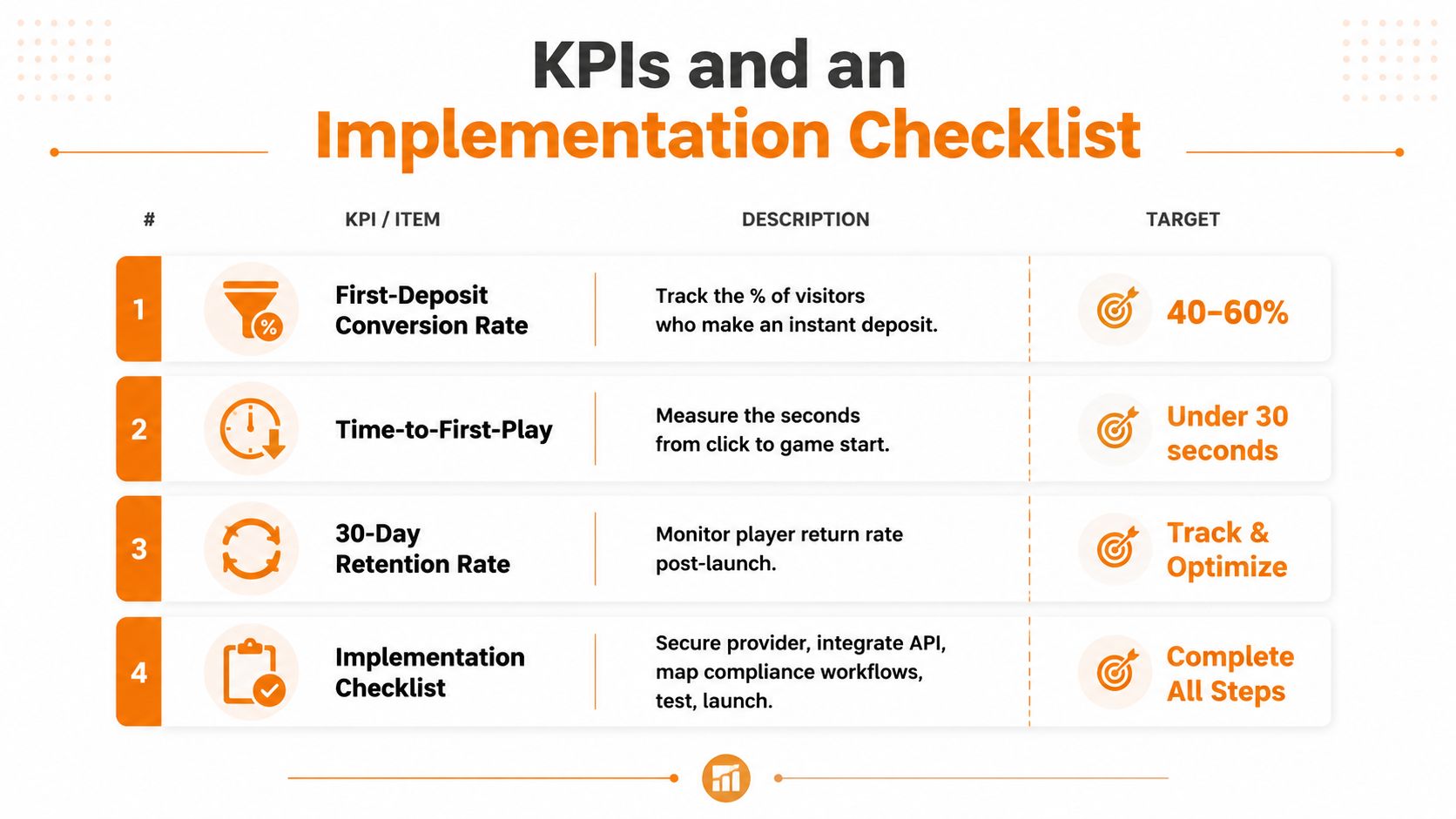
A Pay N Play project should be judged on operational outcomes, not on whether the homepage looks cleaner. If you don't define the metrics before launch, you'll end up arguing about anecdotal improvements instead of proving that the flow is working.
What to measure before you call it a success
Track first-deposit conversion rate by traffic source. That tells you whether the new flow reduces drop-off where it matters. Measure time-to-first-bet, because the whole promise of Pay N Play is that the player reaches gameplay faster. Watch KYC review volume and cost per verified player, since those numbers show whether automation is reducing back-office load. Add deposit success rate and withdrawal turnaround time, because both expose issues that the front end won't reveal on its own.
You should also compare player retention cohorts between Pay N Play users and legacy users, not because retention is easy to interpret, but because onboarding speed only matters if the players you bring in stay active. Finally, monitor responsible-gaming intervention rates so you can see whether your compliance controls are still firing properly in the new flow.
Use this checklist before launch:
- Provider due diligence: confirm market coverage, bank rail support, and identity payload depth.
- Integration milestone review: test account creation, cashier confirmation, and withdrawal routing separately.
- Compliance mapping by jurisdiction: document what the provider covers and what the operator still owns.
- Fallback testing: make sure unsupported banks and temporary outages don't break the journey.
- Monitoring and alerting: set alerts for failed deposits, incomplete identity payloads, and manual-review spikes.
- Soft launch plan: start with limited traffic, then expand only after the core metrics hold.
Launch rule: if you can't explain what “go” and “no-go” mean in one page, the project isn't ready for live traffic.
When Pay N Play Is Worth It and When It Is Not
Pay N Play is worth it when you're operating in regulated markets with mature bank eID coverage, when your brand depends on fast deposit-led conversion, and when your team can support the backend and compliance plumbing that the frontend hides. It's a strong choice for operators who want to treat onboarding as part of their product architecture, not as a separate administrative hurdle.
It's not the right move when your target markets don't support the necessary bank rails, when your player base prefers other payment methods, or when your back office can't absorb the added cross-jurisdiction compliance load. If your stack is already brittle, the model will expose that quickly. If your vendor mix is fragmented, the coupling between identity and payment can become a liability instead of an advantage.
The cleanest way to think about it is this. Pay N Play is a design choice for regulated markets, not a universal best practice. Use it where bank identity is strong and your architecture is ready. Skip it where your stack or your market reality can't support the coupling it creates.
If you're planning a launch or restructuring an existing brand, talk to NexGrate about how to align the cashier, wallet, and compliance layers before you switch the first market live.