An aggregate limit is the absolute maximum an insurer will pay for all covered claims and defense costs combined during a policy period, usually one year. Once that cap is reached, the operator is fully exposed to further losses and legal fees.
The popular advice is to compare the largest number on the declarations page and choose the higher one. That advice is incomplete for an online casino or sportsbook. A large aggregate can look reassuring while defense invoices, repeated player disputes, payment incidents, and partner allegations steadily consume the same pool of coverage.
For iGaming operators, the practical question isn't only “what is an aggregate limit?” It's how quickly can the available limit disappear, and which parts of the policy are spending it?
Table of Contents
- Redefining the Aggregate Limit for iGaming Operators
- Per-Occurrence vs Aggregate Limits in Practice
- The Hidden Risk of Defense-Cost Burn Rates
- Vulnerable Coverage Areas for Casino and Sportsbook Brands
- Navigating Compliance and B2B Contract Requirements
- Strategic Mitigation and Policy Structuring
- Scaling Coverage as Your iGaming Brand Grows
Redefining the Aggregate Limit for iGaming Operators
An aggregate limit is not the largest settlement an insurer will fund. In commercial liability insurance, it is the maximum total amount payable for all covered claims during the policy period, usually one year. After cumulative payments exhaust that cap, further covered losses become the operator's responsibility. IRMI's definition of a general aggregate limit describes the limit as applying across covered claims during the policy period, rather than to one isolated event.
For an iGaming operator, the more useful question is how quickly that capacity can be consumed. A sportsbook may handle recurring allegations involving settlement errors, disputed withdrawals, advertising complaints, or a service provider interruption. Each matter can look manageable. Across a busy claims cycle, however, repeated files can reduce the remaining aggregate before a larger incident arrives.
The stated limit may not be the usable limit
A common policy review error is to treat the aggregate as money reserved only for settlements and judgments. Depending on the wording, defense costs can also sit inside the aggregate. Legal fees, court expenses, expert work, and other defense spending then reduce the balance available for indemnity.
The policy can produce two very different coverage outcomes:
- Outside-the-limits defense: The insurer pays eligible defense expenses separately, preserving the stated limit for settlements or judgments.
- Defense within limits: Defense expenses draw from the same pool used for covered damages and settlements.
An independent explanation of aggregate limits and their importance identifies this distinction and notes that exhaustion can affect the insurer's further duty to defend. The wording therefore matters more than the headline figure on the declarations page.
Practical rule: Treat the aggregate as a finite operating resource. Track what consumes it, not only what the policy promises at inception.
Why iGaming creates accumulation risk
High-frequency, low-severity claims create a slow-burn exposure. One major incident is easier to identify, reserve, and escalate. A stream of player disputes or partner allegations can receive modest budgets on individual files while cumulative defense spending steadily erodes available capacity.
That pattern should influence purchasing, reporting, and governance. Connect the insurance review with best practices for risk management, claims reporting, legal-spend approval, and renewal planning. A high aggregate can still provide weak practical protection if exclusions, sublimits, or defense-within-limits wording reduce the amount available when the operator needs it most.
Per-Occurrence vs Aggregate Limits in Practice
A per-occurrence limit caps the insurer's responsibility for one covered event or claim. The aggregate limit caps the insurer's total responsibility for all covered claims during the policy period. The two limits work together, so reviewing either figure in isolation can produce a misleading risk assessment.
Consider a sportsbook that experiences a localized payment gateway failure. Several players bring separate covered claims, and the operator also faces a related business dispute from a commercial partner. The per-occurrence limit determines how much protection may apply to each matter. The aggregate determines how much capacity remains after all covered matters are counted together.
One large loss versus a slow bleed
A single serious claim can test the per-occurrence limit first. If that claim falls within the per-occurrence cap, the remaining aggregate may still support later claims. Repeated moderate claims create a different pattern. Each claim may stay below the per-occurrence ceiling, but the combined indemnity and defense costs gradually reduce the aggregate until later matters become largely self-funded.
The structure can be read through four operational scenarios:
| Claim Pattern | Per-Occurrence Impact | Aggregate Impact | Operator Risk |
|---|---|---|---|
| One severe covered incident | Tests the maximum available for that event | Uses a substantial portion of the shared policy pool | Later claims may have less remaining capacity |
| Repeated player disputes | Each matter is assessed separately under the occurrence limit | Multiple settlements and defense bills accumulate | Small files can create a large combined exposure |
| Several claims linked to one failure | The insurer may analyze whether matters are separate occurrences | Related claims may draw from the same aggregate | Coverage interpretation and available capacity become critical |
| New claim after exhaustion | No remaining primary capacity may be available | The aggregate ceiling has been reached | The operator may fund further defense and losses itself |
The table isn't a substitute for policy interpretation. Definitions of claim, occurrence, related acts, and covered loss can change how an insurer groups matters. An operator should ask its broker and coverage counsel to explain how the wording treats multiple complaints arising from the same technical or operational event.
Why the larger aggregate can still lose
A high aggregate doesn't repair a weak per-occurrence limit. If one claim exceeds the per-occurrence cap, the operator can face an immediate shortfall even when considerable aggregate capacity remains. Conversely, a generous per-occurrence limit won't help after repeated matters have exhausted the shared aggregate.
The right comparison is therefore not “large limit versus small limit.” It's single-event protection plus remaining policy-period capacity, reviewed alongside exclusions, sublimits, deductibles, and defense treatment. Operators should model both a severe isolated event and a cumulative claims pattern before selecting coverage.
The Hidden Risk of Defense-Cost Burn Rates
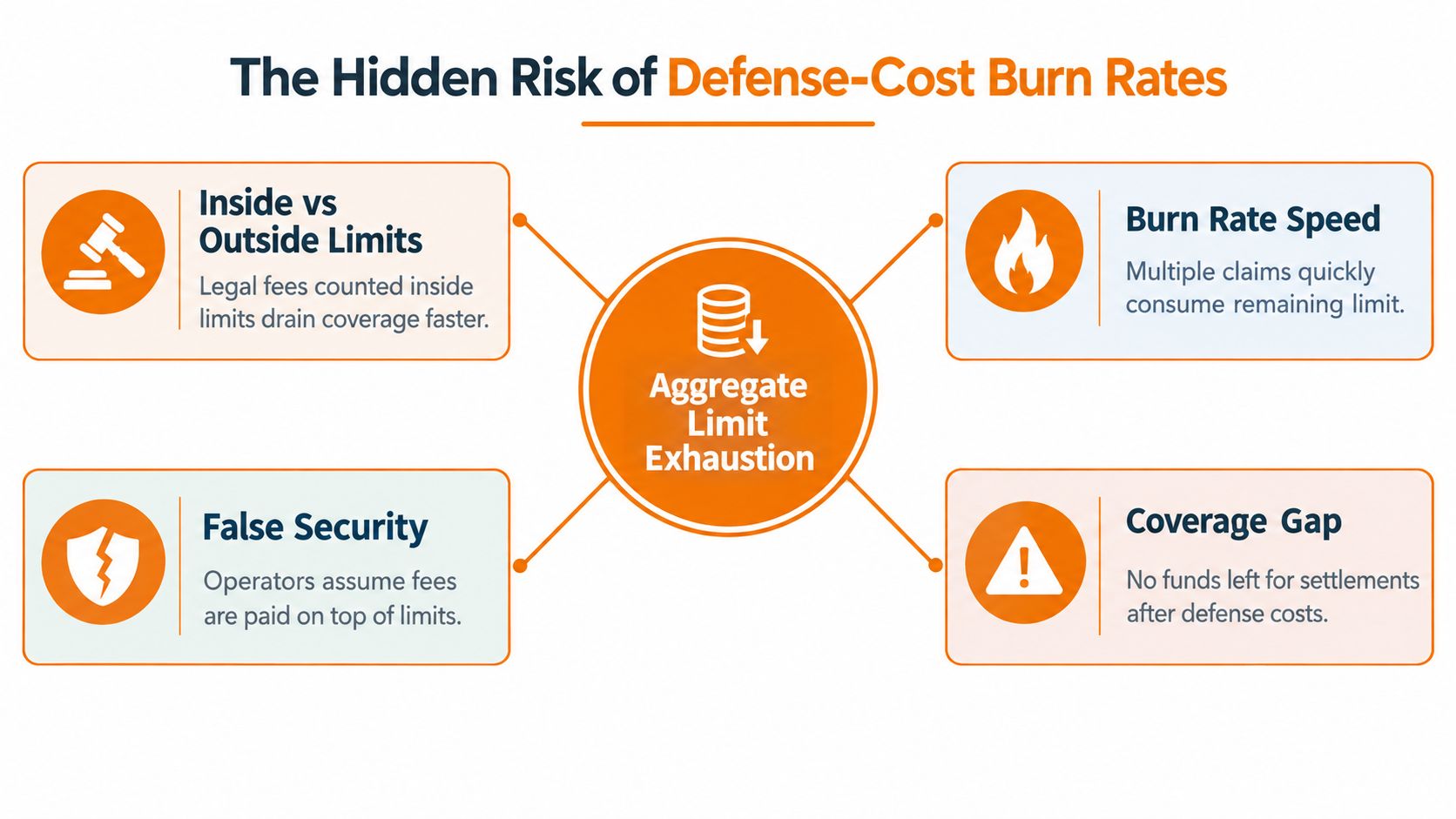
The aggregate can erode long before an iGaming operator pays a large settlement. High-frequency, low-severity complaints may generate a steady defense-cost burn rate through lawyer time, discovery, technical analysis, regulatory coordination, expert review, and negotiations. The operational risk is cumulative legal spend, not only the eventual indemnity payment.
With defense costs inside the limits, each eligible defense invoice reduces the remaining aggregate. That can leave less capacity for later matters, even when earlier claims close without substantial settlements. Exhaustion may also affect whether the insurer must continue defending subsequent claims, depending on the policy wording. Phelps' discussion of aggregate-limit mechanics addresses how defense costs can count toward the limit and how exhaustion can affect continuing defense obligations.
How the burn rate develops
The sequence usually looks like this:
- A covered complaint is reported.
- The insurer appoints counsel or approves defense arrangements.
- Legal work begins before the claim's ultimate value is known.
- Defense invoices reduce available capacity if the wording puts them inside the limit.
- Settlements or judgments draw from the remaining amount.
- Later claims compete for the residual aggregate.
Claim frequency therefore matters even when individual allegations appear weak. An operator may spend heavily defending complaints that produce little or no indemnity payment. Repeated player disputes, payment issues, platform interruptions, or compliance allegations can consume shared capacity through defense activity alone.
Defense-within-limits wording can make legal strategy a coverage decision. The operator is deciding how to defend the current matter while preserving aggregate capacity for claims that may follow.
Read the wording, not the certificate
A certificate confirms that coverage and stated limits exist. It does not explain every mechanism that controls exhaustion. Review the policy wording and endorsements for:
- Defense allocation: Establish whether defense expenses are inside or outside the applicable limit.
- Exhaustion language: Confirm what happens when the aggregate is used and whether the insurer's defense obligation ends.
- Related claims: Determine whether matters linked to one event are treated as one claim or several.
- Sub-limits: Identify narrower caps for particular exposures within the broader policy.
- Notice requirements: Confirm how quickly circumstances, demands, and claims must be reported.
For an operator that depends on continuous availability, prevention affects claims pressure as well. Insurance does not replace operational controls. DDoS protection and hosting controls can reduce incidents that otherwise generate disputes, investigations, and defense activity.
The practical response is disciplined claims management, not delayed notification or suppression of legitimate complaints. Legal, compliance, finance, and risk teams should track paid defense costs, reserved indemnity, open matters, recurring causes, and remaining capacity in one current view. Escalate recurring patterns early, because a series of modest matters can consume the aggregate before management recognizes the coverage problem.
Vulnerable Coverage Areas for Casino and Sportsbook Brands
Aggregate pressure looks different across policy types. A general liability policy may address certain third-party bodily injury, property damage, or advertising-related allegations, but a modern gaming platform also depends on cyber, technology errors and omissions, professional liability, crime, and contractual risk transfer. Each policy can have its own aggregate, sublimits, exclusions, and defense wording.
The operator should map exposures before asking whether the total limit is sufficient.
Cyber and data-related claims
A cyber event can produce several categories of cost at once. Players may allege harm connected to compromised information. Payment providers may investigate operational failures. The operator may need forensic support, notification assistance, public relations advice, and legal coordination.
Those costs may not all fall into one clean bucket. The policy could separate incident response from third-party liability, apply a sublimit to a particular service, or exclude an issue that the operator assumed was covered. A cyber aggregate therefore needs review at the level of triggers and exclusions, not just the total shown on the schedule.
Technology E&O and platform failures
A white-label sportsbook engine, odds feed, wallet, or settlement workflow can create commercial disputes when a defect affects partners or customers. B2B claimants may allege that the operator failed to deliver contracted functionality, miscalculated settlements, or caused business interruption.
Technology E&O coverage can be particularly sensitive to contract language and the distinction between a covered error and an excluded performance guarantee. Repeated claims arising from one software defect may also raise related-claim questions. The operator should determine whether the policy treats each affected customer as a separate claim or groups the matters together.
General liability and specialty buckets
General liability remains relevant, but it shouldn't be treated as the universal solution. A casino brand may face premises-related exposure through offices, studios, events, or promotional activity, while a digital sportsbook's most serious disputes may arise from technology, data, payments, or professional services.
Use a coverage map with clear ownership:
- General liability: Review the shared aggregate and how advertising or premises exposures interact with other covered claims.
- Cyber: Check breach response, third-party liability, regulatory issues, and any event-specific sublimits.
- Technology E&O: Examine software errors, service failures, contractual liability, and related-claim wording.
- Crime and funds transfer: Test whether fraud, social engineering, and payment manipulation receive separate treatment.
- Excess or umbrella: Confirm which underlying policies it follows and whether exclusions create a gap.
A larger general liability aggregate won't automatically protect a cyber or technology E&O exposure. The policy architecture has to match the way the platform operates.
Navigating Compliance and B2B Contract Requirements
Insurance sits at the intersection of risk transfer, licensing, and commercial credibility. Regulators and B2B partners may ask for evidence of financial resilience, but a certificate showing a limit doesn't prove that the policy responds to every operational failure an operator may experience.
An MGA compliance program should therefore connect its insurance schedule with the actual control environment. The review should include the licensed entity, trading names, territories, covered services, technology providers, payment relationships, and reporting responsibilities.
Regulatory alignment
Jurisdictional requirements differ, and policy wording may not track the language used by a regulator. A regulator may expect coverage for a particular activity, while the policy excludes that activity or places it under a restrictive sublimit. The operator needs a documented explanation of how the coverage responds, where it doesn't respond, and which controls address the residual risk.
A practical compliance file should contain:
- Entity confirmation: Verify that the licensed operating entity and relevant affiliates are correctly insured.
- Territorial review: Check whether the policy applies to every market in which the brand accepts activity.
- Coverage mapping: Match regulatory obligations to policy sections, endorsements, exclusions, and sublimits.
- Exhaustion protocol: Document who receives notice when aggregate capacity falls and what escalation follows.
- Renewal evidence: Keep current certificates, policy schedules, endorsements, and broker correspondence together.
Contractual alignment
Game studios, payment processors, platform vendors, affiliates, and distribution partners may impose their own insurance requirements. They may request additional insured status, evidence of specified limits, contractual indemnities, or notice provisions. Meeting a contract's headline requirement doesn't guarantee that the underlying wording works for the exposure.
For example, a payment partner may require protection for an operational failure, while the operator's policy excludes contractual performance obligations. A game provider may request coverage that extends to its own liability, but the endorsement may be narrower than the commercial agreement. Review those documents together with best practices for vendor management.
A certificate satisfies an administrative request. Only the policy wording tells you whether the requested risk has actually moved.
The strongest process gives legal, procurement, compliance, and risk teams a shared contract matrix. Each material agreement should identify required insurance, responsible entity, renewal evidence, indemnity language, and the effect of aggregate exhaustion. That approach prevents a partner requirement from being treated as a checkbox while the operator carries an unrecognized funding obligation.
Strategic Mitigation and Policy Structuring
Buying more aggregate capacity can help, but it shouldn't be the first or only response. Operators get better results when they combine policy design with controls that reduce claim frequency, limit incident scope, and preserve insurance for severe events.
The key question is whether the operator is using insurance to absorb preventable operational friction. If weak KYC controls, poor bonus terms, unclear settlement workflows, or inadequate fraud monitoring generate recurring disputes, a higher limit may finance the same failure pattern.
Build the structure around the exposure
Start with the policy mechanics, then add operational measures:
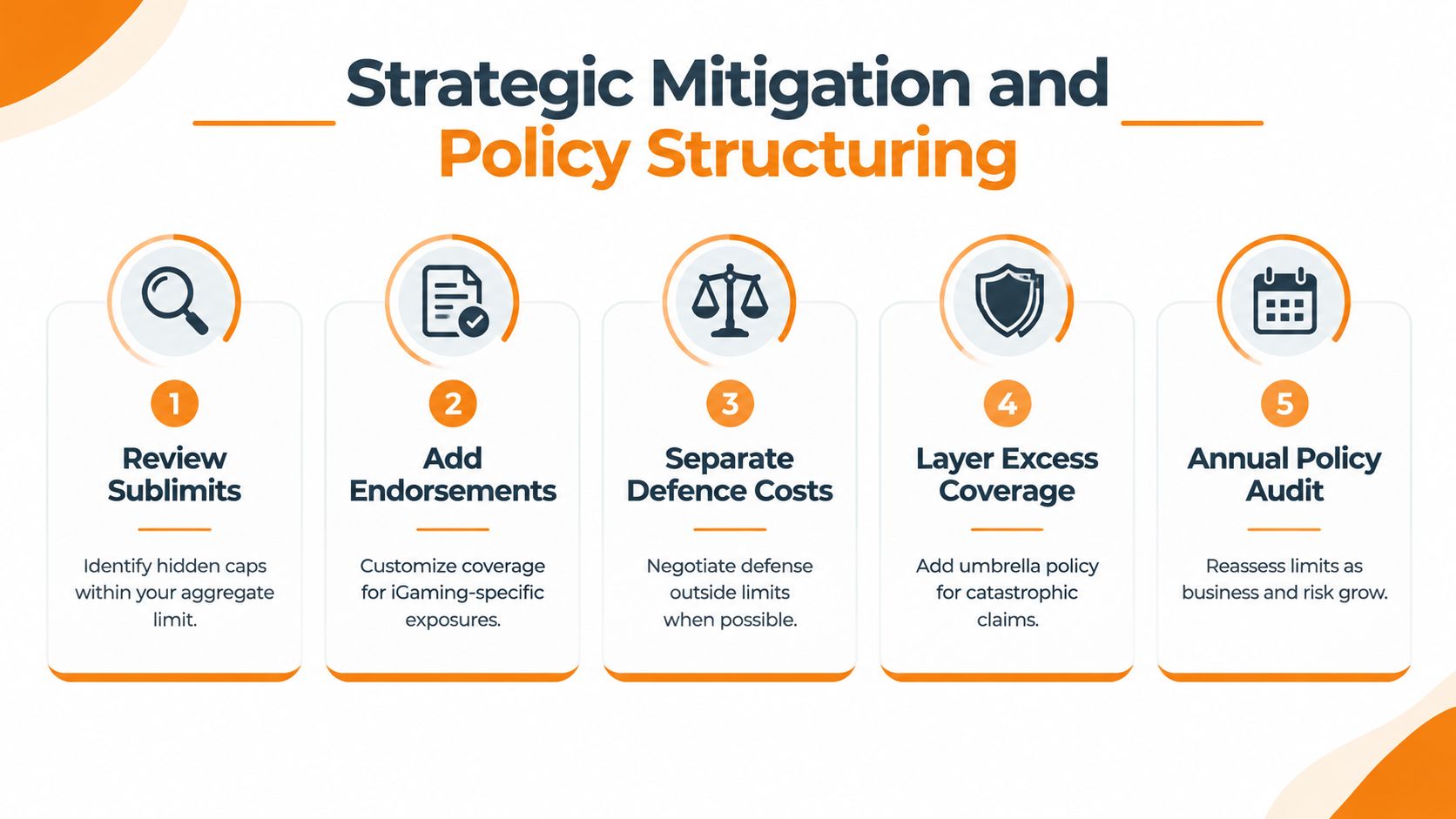
- Review sublimits. Identify caps hidden inside the aggregate for cyber response, funds transfer, advertising injury, technology errors, or other relevant exposures.
- Add targeted endorsements. Modify the policy for the operator's actual services, territories, technology relationships, and contractual obligations.
- Negotiate defense outside limits where possible. This can preserve the indemnity pool, although the insurer may charge more or impose conditions.
- Layer excess coverage. An excess or umbrella policy can extend protection after underlying limits are used, subject to its own terms and exclusions.
- Audit the program annually. Reconcile the policy against current transaction flows, markets, vendors, products, and claims experience.
The fifth step deserves operational ownership. A policy audit should not be a broker-only exercise. Finance can review reserves, legal can review open matters, compliance can test territorial and licensing alignment, and technology leaders can identify changed dependencies.
Reduce the number of claims reaching the policy
Controls should target the causes that repeatedly create disputes:
- KYC and AML workflows: Stop suspicious activity before it becomes a payment, account, or regulatory dispute.
- Fraud rules: Detect bonus abuse, account takeover, payment manipulation, and coordinated play patterns.
- Settlement governance: Reconcile sportsbook results, voided bets, wallet balances, and manual adjustments.
- Player communications: Use clear terms and consistent escalation paths for withdrawals, bonuses, and account restrictions.
- Vendor oversight: Require incident reporting, evidence preservation, and cooperation obligations in commercial agreements.
Insurance remains the backstop. It shouldn't become the primary operating control. The most efficient structure combines adequate limits, carefully negotiated defense treatment, layered coverage, and a platform that reduces avoidable claim volume before legal counsel becomes involved.
Scaling Coverage as Your iGaming Brand Grows
An operator's original aggregate limit reflects an earlier business model. Expansion changes the exposure even when the legal entity and brand remain the same. Entering another regulated market can introduce new contractual, territorial, compliance, and consumer-liability questions. Adding live casino, crypto payments, a new sportsbook engine, or additional affiliates creates more dependencies that may generate claims.
The renewal conversation should start with the operating model, not the premium. Ask what the brand does now that it didn't do when the policy was placed, which providers touch player funds or personal data, and whether several services now share one wallet or account identity.
A practical renewal review
Use the renewal period to test five areas:
- Business volume and claim frequency: Review whether the number and type of disputes have changed, without assuming the prior aggregate remains adequate.
- Jurisdictional footprint: Confirm that new markets, entities, and customer locations fit the policy's territorial scope.
- Product expansion: Assess live casino, sportsbook, crypto, promotions, affiliates, and any newly introduced service.
- Third-party concentration: Identify whether one platform, payment provider, odds feed, or hosting dependency could create multiple related claims.
- Available capacity: Reconcile paid defense costs, indemnity payments, reserves, open claims, sublimits, and excess layers.
A growing operator should also ask how the policy responds when several brands share infrastructure. One technical failure may affect multiple trading names, partners, or markets. Related-claim language and aggregation provisions can determine whether the event consumes one limit or creates broader pressure across the insurance program.
Make the broker conversation concrete
Give the broker a written exposure summary, current vendor list, claims narrative, control changes, and planned market expansion. Request a side-by-side comparison showing per-occurrence limits, aggregate limits, defense treatment, sublimits, exclusions, endorsements, and excess attachment points.
The objective isn't to buy the biggest number available. It's to keep the insurance architecture aligned with the platform's real claim pathways. An operator that monitors legal spend, strengthens controls, and reviews coverage before expansion is better positioned to preserve aggregate capacity and identify gaps while there's still time to fix them.
NexGrate provides a turnkey white-label platform for casino and sportsbook operators, with integrated payments, KYC and AML workflows, fraud controls, compliance tooling, and vendor integrations. Visit NexGrate to evaluate a platform architecture that supports clearer operational risk management as your iGaming brand scales.