Saturday night at a sportsbook is supposed to be loud for the right reasons. Bets are coming in, the cashier is moving, VIPs are logging in from phones and desktops, and the live lobby is updating fast enough that nobody is thinking about the plumbing underneath. Then the cashier starts to lag, a few logins fail, support tickets spike, and the marketing team begins asking whether a promo code broke the funnel.
That's usually the point where DDoS protection hosting stops being a security line item and becomes an operations problem. In iGaming, an attack doesn't just mean a site that looks slow. It means abandoned deposits, unsettled bets, noisy incident logs, and a customer support team trying to separate a real outage from a flood of hostile traffic.
The hard part is that attackers don't care which part of the platform is most business-critical. They'll hit the edge, the login flow, the cashier, the odds feed, or the KYC upload page, depending on what causes the most disruption. A decent hosting stack has to absorb that reality before the first packet lands.
Table of Contents
- What an Attack Looks Like for an Online Casino
- DDoS Protection Hosting Explained Without the Jargon
- The Building Blocks of a Resilient Hosting Stack
- Comparing Mitigation Approaches Side by Side
- A Vendor and Hosting Evaluation Checklist
- Running DDoS Defense on a White-Label iGaming Platform
- Cost, Compliance, and Trade-Off Decisions
- Beyond Bandwidth
What an Attack Looks Like for an Online Casino
A DDoS event in iGaming rarely announces itself with a dramatic crash screen. It usually starts as a small but ugly pattern, the cashier page slows first, then login retries begin to fail, and the support inbox fills with players who think their bonus code or payment method is broken. The business side sees a conversion problem. The platform team sees a traffic problem that's being experienced as a conversion problem.
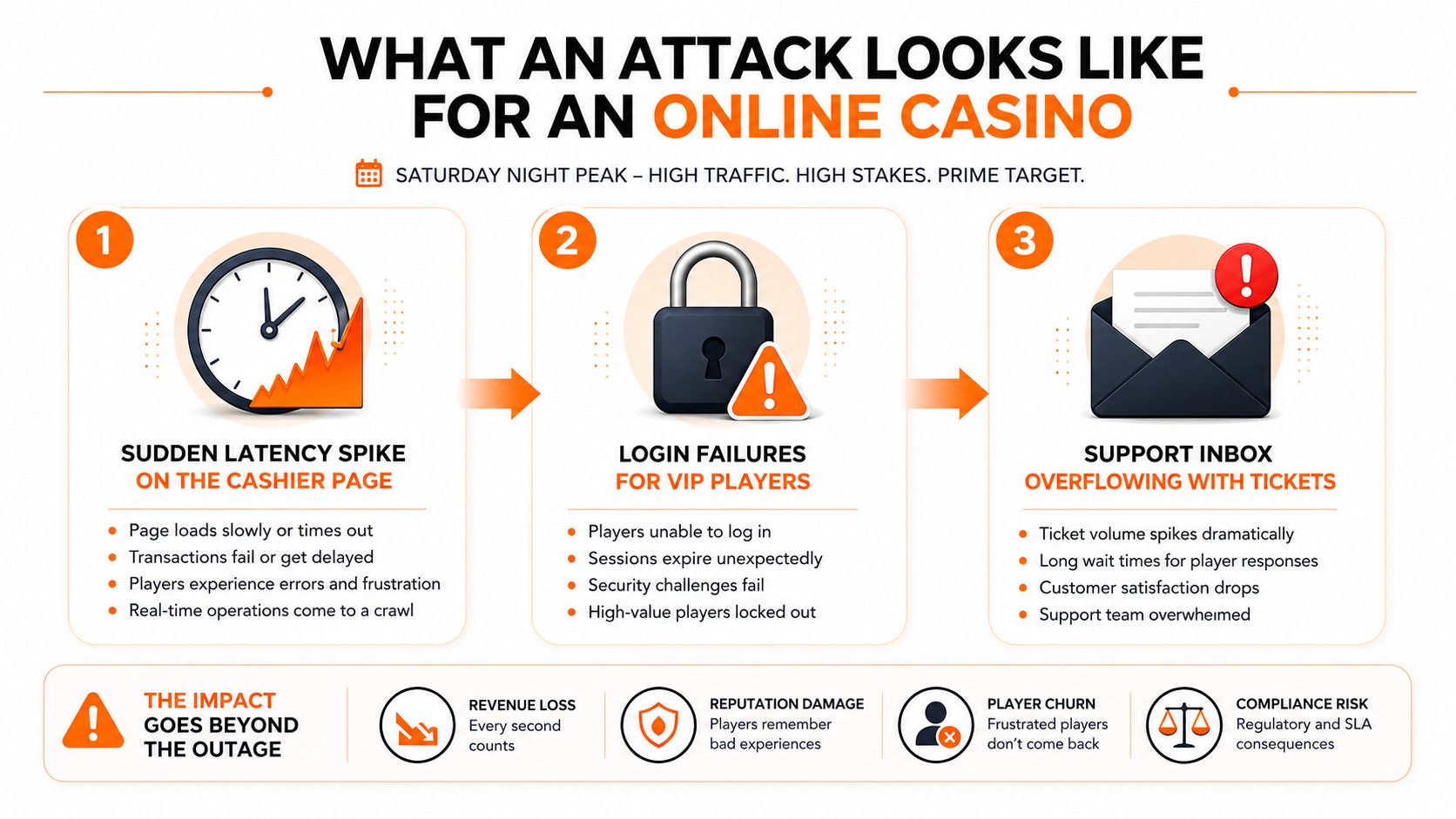
The first failure usually shows up where money moves
The cashier is often the first place operators notice pain because it sits on the shortest path between interest and revenue. If the page loads slowly, deposits fall off. If the login flow stalls, VIPs don't wait around. If support has to manually reassure every player, you've already turned a traffic event into a service event.
That's why hosting-level design matters. A game lobby can tolerate a minor cosmetic delay. A cashier cannot. The platform has to stay reachable even while malicious traffic is trying to exhaust the same shared path that legitimate players use.
The business impact is broader than uptime
A regulated operator also has to think about the paper trail. Incident logs, escalation timestamps, player complaints, and internal handoffs all become part of the story. If the provider can't isolate the attack quickly, the operator ends up with a messy record of what happened and when.
Practical rule: if your player-facing teams are the first ones to notice a traffic attack, the hosting design is already too shallow.
The point is not that every slowdown is a DDoS attack. The point is that an iGaming environment needs enough edge control and visibility to tell the difference quickly. Without that, marketing thinks the promo is broken, finance sees deposit drop-off, and operations gets dragged into an avoidable incident.
DDoS Protection Hosting Explained Without the Jargon
DDoS protection hosting is a hosting environment built to keep a site or application online while it's being flooded with malicious traffic. The useful way to think about it is not as a badge on a sales page, but as a chain of controls that decide what gets blocked, what gets absorbed, and what is still allowed to reach the origin.
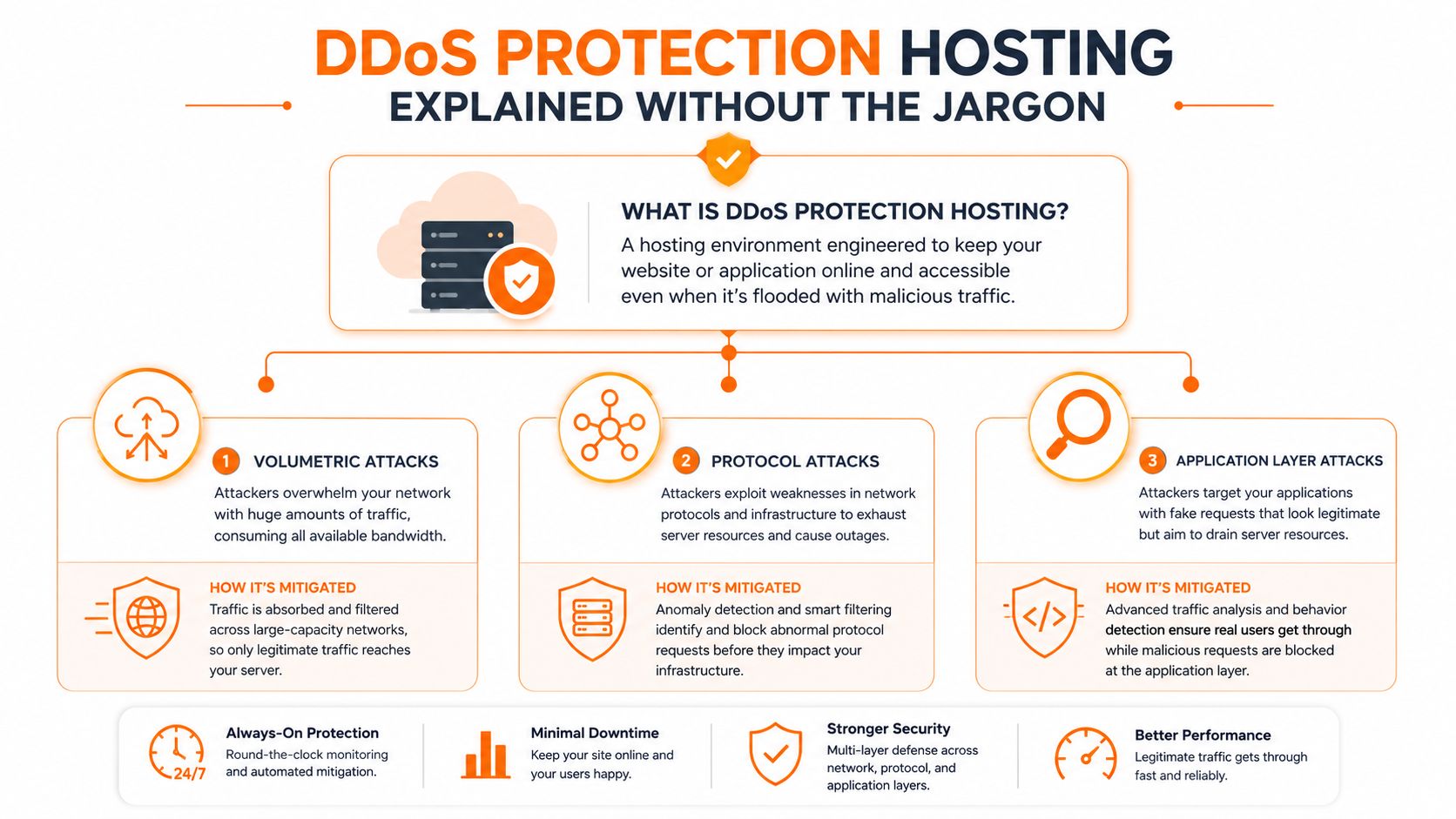
Three attack families behave very differently
A volumetric flood is the stadium-turnstile problem. Too many bodies rush the gate at once, and the entrance collapses before anyone gets inside. The fix is to absorb and discard traffic as far from the origin as possible, which is why guidance from Kentik emphasizes anycast/CDN edge absorption, origin shielding, and planning for both pps and bandwidth, not bandwidth alone. Kentik's DDoS protection guidance makes that layering explicit.
A protocol attack is more like forcing the turnstile machinery to keep state until it runs out of capacity. For operators, that often means login state, connection tables, or load balancer resources get pinned down before a player ever reaches the app.
An application-layer attack is trickier. It looks like normal use, but the behavior is abusive. AWS's DDoS guidance points buyers toward minimizing exposed attack surface, using CDNs and load balancers, and adding WAF controls for application exploits, while also asking whether per-endpoint rate limits and custom WAF rules are available. AWS's DDoS attack protection guidance is useful because it treats L7 abuse as a separate problem, not a bigger version of the same one.
Why iGaming operators need to name the class quickly
A saturated link kills the cashier. A state-exhaustion attack can freeze logins and session handling. A slow, bot-like request pattern can interfere with bet placement, settlement, or KYC uploads. If the team can't identify the class, they'll apply the wrong control and leave the primary path open.
Practical rule: bandwidth floods, protocol floods, and application abuse need different countermeasures, and the hosting stack has to cover all three.
That's also why “DDoS protected” by itself is too vague to be useful. It only means something if the provider can show where traffic is absorbed, how the origin is hidden, and how request-level inspection is done when the attack looks like normal web traffic.
The Building Blocks of a Resilient Hosting Stack
A real DDoS protection hosting stack is layered because one control rarely catches every failure mode. An operator can lose the edge to a packet flood, then lose the origin to request abuse, then lose the recovery window because no one rehearsed the handoff. The practical job is to spread risk across routing, filtering, and application controls, then make sure the team knows which layer takes over when the attack changes shape.
Kentik's guidance is useful because it frames the problem as routing and filtering first. It points to hidden origins, split-horizon DNS, egress ACLs, and enough bandwidth and packet-rate headroom to survive the initial hit. Kentik's DDoS protection guidance fits how these incidents unfold, because the stack only holds if the edge, the network, and the backend are designed to fail in the right order.
Edge absorption and caching do the first job
Anycast spreads ingress across multiple locations, so a flood has to work much harder to pin one site down. CDN caching strips repeat traffic away before it touches origin, which matters for static assets, login surfaces, and any request that does not need fresh computation every time. In practice, those layers buy time, lower origin pressure, and keep the application team from fighting the same traffic twice.
Origin shielding solves a different problem. It keeps the backend out of direct reach, so an attacker cannot bypass the edge after learning the public surface. For regulated iGaming, that matters because the cashier, sportsbook, and live-dealer services may sit under one operating model even when their traffic profiles are very different. The architecture has to protect the shared weak points without turning every request into a long detour.
Scrubbing and WAFs handle the harder cases
Scrubbing centers remove hostile packets before clean traffic is forwarded onward. That is the right layer when the attack is loud, repetitive, and easy to classify. Layer 7 filtering is for the slower abuse that looks like normal browsing but is built to burn CPU, session state, or business logic, and that is where a WAF earns its place.
AWS recommends CDNs, load balancers, and WAFs for application exploits, and it also stresses reducing exposed attack surface. AWS's DDoS attack protection guidance matches what operators see on the wire. Edge controls help with volume. Request inspection matters when the traffic pattern starts to resemble a bot swarm instead of a simple flood.
Capacity has to be measured the right way
The wrong number can hide the actual failure point. One dedicated-server platform with a public server architecture description at NexGrate's platform can illustrate why the stack has to be thought through end to end, not as a single badge on a sales page. Operators need throughput headroom, packet-rate headroom, and enough inspection capacity to keep filtering intact when the traffic mix changes.
A dedicated-server platform also needs visibility into what happens after mitigation kicks in. If the edge absorbs the bulk of the flood but the origin still sees a burst of abusive requests, the runbook has to define who reroutes, who tightens rules, and who verifies that the cashier, account login, and live-dealer entry points still respond. A provider can advertise strong network capacity and still fall short if it cannot show how the application tier is protected under load.
The stack breaks when teams buy for one number and ignore the others.
For iGaming, the mental map stays practical. The odds feed wants fast edge absorption. The cashier needs origin shielding and careful routing. The live-dealer lobby needs low-latency protection. The KYC page needs behavior-aware filtering because real users and malicious automation can look similar at the request layer, and the operator has to test that distinction before the attack arrives.
Comparing Mitigation Approaches Side by Side
The trade-off question is usually not whether to protect a platform. It's which control sits where, and what each one sacrifices. A live-dealer stream cannot afford a lot of extra detour, while a bonus-abuse pattern needs more behavioral judgment than raw speed.
Compare platform options if you're trying to pressure-test these choices in vendor conversations.
| Approach | Best for | Latency impact | L7 coverage | Typical tradeoff |
|---|---|---|---|---|
| Always-on cloud protection | Public casino brands that can't afford a manual failover window | Usually lower operational surprise, because traffic is already flowing through the protection layer | Strong when paired with WAF rules | More continuous overhead and more tuning discipline |
| On-demand scrubbing | Operators that want to activate higher-cost mitigation only during an attack | Can add time during activation and rerouting | Depends on the provider's rule set | A detection delay can leave a gap before protection kicks in |
| In-line appliance | Private network segments and tightly controlled environments | Often minimal if sized correctly | Good when traffic is easy to inspect locally | Hardware becomes a capacity ceiling if the flood grows |
| BGP-announced scrubbing center | Larger distributed estates with multiple services | Can be efficient once traffic is diverted | Moderate to strong, depending on filtering depth | Routing changes have to be precise or legitimate traffic gets caught |
| DNS-based rerouting | Smaller footprints or services that can tolerate propagation delay | More variable, because traffic has to resolve again | Limited compared with request-aware protection | Too slow for some attack conditions and service mixes |
| GRE-tunneled inspection | Teams that need upstream filtering without exposing origin paths | Usually moderate | Good when the inspection layer is well tuned | Tunnel management adds operational complexity |
| Per-domain WAF tuning | Multi-brand or white-label estates with different risk profiles | Usually small if policies are well maintained | Strong for application abuse | Needs active rule management and good telemetry |
| Blanket rate limits | Simple surfaces with predictable traffic | Low initially | Weak for blended or human-like abuse | Easy to over-block legitimate players |
The practical split is not theoretical
Always-on cloud protection is usually easier to live with when player traffic is continuous and the platform can't afford a manual protection switch. On-demand scrubbing can make sense when attack periods are rare, but the operator has to accept that the first minutes are often the most fragile. A protected white-label estate usually ends up with a mix, not a single answer.
Different products need different tolerances
The sportsbook odds feed values continuity and predictable routing. The live-dealer lobby values low added latency. The cashier and KYC pages care more about request correctness and fraud signals than about raw throughput. If a vendor talks only about gigabits and never explains request policy, they're not answering the core question.
A Vendor and Hosting Evaluation Checklist
The first vendor meeting should feel closer to an incident review than a sales demo. If a provider cannot answer operational questions clearly, that weakness will surface under load, during an L7 flood, or when the runbook has to move fast.
Start with capacity and visibility
Ask for published mitigation capacity in both bandwidth and packet rate. Ask how much of that capacity is always-on versus burstable, and whether the figures describe edge absorption, scrubbing, or origin-side protection. DDOS-Guard's public server page is a useful benchmark because it publishes both 3.2 Tbps and 700 Mpps, and pairs those figures with monitoring and L7 protection. DDOS-Guard's server offering shows the kind of clarity buyers should ask for, even if they never buy that exact service.
Ask for telemetry too. The dashboard should show what is happening during an event, what mitigation decisions are being taken, and who receives the alerts. If the only evidence arrives after the incident, the operator is effectively blind when it matters most.
Then test the policy controls
The provider must support custom WAF rules, per-endpoint rate limits, and origin shielding without turning every change into a support ticket. AWS's DDoS guidance makes the same point for buyer evaluation. AWS's DDoS attack protection guidance frames protection as a set of control choices, not a single checkbox.
Ask how the origin IP is concealed. Ask whether split-horizon DNS is used. Ask what happens if an attacker discovers a legacy hostname or a forgotten subdomain. White-label estates leak risk through the long tail of services, not only through the main site.
Finally, pressure-test support and response
You need named escalation contacts, a tested path for live incidents, and a provider that can explain mitigation handoff without jargon. If they cannot say who gets called, what gets blocked first, and how long reporting stays active once the event begins, they are not ready for regulated traffic.
Why this matters: mitigation only helps if the vendor can operate under pressure, not just talk about architecture in calm weather.
For operators that want a consolidated platform view, NexGrate includes hosting and operations support alongside platform functions, which matters because DDoS response rarely stays confined to one team. The vendor must be able to support the runbook, not just the diagram.
Running DDoS Defense on a White-Label iGaming Platform
A white-label stack has to be rehearsed before it's tested by the internet. The cleanest rollout I've seen starts with pre-launch load tests and simulated attacks against the exact player journeys that matter, cashier, login, sportsbook browse, live-dealer entry, and KYC upload. If the team only tests homepage traffic, they're rehearsing the wrong failure.
Build the runbook before the first customer arrives
The operations team needs a written sequence for who notices the anomaly, who calls the mitigation provider, who checks player impact, and who informs compliance if service degradation crosses a reporting threshold. Compliance should not be brought in after the fact. They need to know which logs are preserved, how the incident is time-stamped, and what evidence will exist if a regulator asks for it later.
The support team also needs a script. Players don't care about edge routing or packet drops. They care that deposits didn't land or that a bet didn't submit, and the support response has to match that reality without improvisation.
Rehearse the strange failure modes
Synthetic transactions from key player markets are useful because they tell you whether the platform still behaves normally when traffic is noisy. Test them against the cashier and the sportsbook together, not separately. On a unified wallet system, a cashier issue can quickly spill into bet placement, settlement, and balance reconciliation.
Tabletop exercises should include marketing and finance, not just ops and engineering. A bonus campaign can amplify pressure on the same endpoints that an attacker wants to stress. A finance team that sees delayed wallet updates needs to know whether the delay is a protection side effect or a genuine platform fault.
Learn from the post-incident record
After any mitigation event, review the alarms, the manual actions, and the player complaints side by side. The question is not whether the site stayed up in the abstract. The question is whether the provider detected the attack fast enough, rerouted clean traffic without unnecessary handoffs, and preserved service continuity long enough for the business to keep operating.
That's the operating discipline a white-label casino and sportsbook needs. The stack is only as good as the runbook that sits on top of it.
Cost, Compliance, and Trade-Off Decisions
The commercial shape of DDoS protection hosting usually follows the risk profile. Basic L3 to L4 protection is often bundled with premium hosting. Mid-tier offerings add WAF behavior rules and per-domain tuning. Enterprise setups move into anycast scrubbing, custom rules, deeper telemetry, and more hands-on support.
Review compliance expectations before you choose a tier, because regulated iGaming changes the buying criteria. The cheapest option is rarely the one that gives you the audit trail you'll need later.
Match the tier to the business model
A new brand can often start with solid edge protection, disciplined rate limits, and a clear escalation path. That gives the operator enough room to launch without overbuying complexity. An established sportsbook or casino with frequent traffic peaks usually needs stronger WAF tuning, better origin shielding, and more explicit SLAs around mitigation behavior.
Crypto casinos and multi-jurisdiction operators usually sit closer to the top end because payment patterns, traffic mix, and regulatory exposure are less forgiving. They need evidence that incidents are logged cleanly, failover has been tested, and player balances are protected through the response process.
Compliance is part of resilience
For regulated setups, the issue isn't just whether the site stays online. It's whether the operator can show what happened, when it happened, who acted, and how the platform recovered. Audit trails, tested failover, incident contacts, and restoration procedures all matter because they turn a technical event into a defensible operational record.
Responsible gaming expectations also come into play during high-traffic events. If a provider can't hold service steady during a major sporting peak, the operator can lose both player confidence and internal control over the incident narrative. That's a business risk as much as a technical one.
Use the operator profile as the shortcut
- New brand: start with always-on edge protection and clear support escalation.
- Established operator: add WAF tuning, origin shielding, and better visibility into mitigation behavior.
- Crypto casino or highly regulated estate: prioritize custom rules, strong auditability, tested failover, and operational support that can stand up in a review.
The right decision is rarely “maximum everything.” It's the smallest stack that still gives you clean detection, fast rerouting, and a trustworthy incident record.
Beyond Bandwidth
The old reflex is to ask for more Gbps. That's not wrong, but it's incomplete. A modern buyer should care more about how quickly the host detects a mixed attack, whether rerouting happens without a manual scramble, and whether the provider can explain restoration while the incident is still active.
Resilience signals are operational. You want to see clean telemetry, predictable escalation, and a mitigation path that keeps the cashier and login flow usable while the attack is being filtered. You also want transparency, because a provider that hides the ugly parts usually can't handle them either.
Watch the first real test closely. See whether the host notices the attack before your support team does, whether it keeps legitimate traffic flowing while blocking the noise, and whether it produces a useful post-incident record without being chased for it.
NexGrate supports white-label casino and sportsbook operators with hosting, monitoring, DDoS protection, and uptime management as part of the platform stack. If you're evaluating how to keep a regulated iGaming brand online under attack, visit NexGrate and review how the platform ties operations, compliance, and resilience together.