
You're probably dealing with this right now. Players deposit in one currency, ask to withdraw in another, support tickets pile up over balance mismatches, and your finance team keeps exporting reports into spreadsheets because the cashier, PSP dashboards, crypto processor, and back office all show a different version of the truth.
That's usually the moment an operator realizes a multi currency wallet isn't a cashier feature. It's operating infrastructure.
For a new iGaming licensee, this matters early. If your wallet design is weak, every expansion decision gets harder. New payment methods become custom projects. FX costs hide inside provider pricing. Compliance reviews turn into evidence hunts. If the architecture is sound, the wallet becomes the place where payments, reporting, fund segregation, and player experience stay aligned.
The market direction makes that decision harder to postpone. The global multi-currency wallets market is projected to grow from USD 4.8 billion in 2025 to USD 12.7 billion by 2032, at a 14.5% CAGR, according to Worldwide Market Reports' multi-currency wallets market outlook. Operators aren't moving toward multi-currency support because it sounds modern. They're doing it because fragmented wallet setups don't scale cleanly across jurisdictions.
Table of Contents
- Why Your Wallet Is Your Global Command Center
- Wallet Architecture Single Ledger vs Separate Ledgers
- Managing Fiat and Crypto Payment Flows
- The True Cost of Currency Conversion and FX Strategy
- Ensuring Compliance and Secure Custody
- Platform Integration and Migration Considerations
- The Operator's Multi Currency Implementation Checklist
Why Your Wallet Is Your Global Command Center
A global gaming operation doesn't break at the games layer first. It breaks in the wallet.
If a player in one market deposits through a local card processor, another uses bank transfer, and a third sends crypto, those funds still need to land inside one controlled financial system. That system has to recognize the source rail, preserve the original currency, apply the right balance logic, and make the funds available without exposing you to reconciliation gaps or compliance risk. That's the job of the multi currency wallet.
The wallet is where operations converge
Most new operators think about the wallet as a balance display plus deposits and withdrawals. In practice, it serves as the command center for four separate responsibilities:
- Player fund management: It tracks what the player owns, in which currency, and under what status.
- Payment orchestration: It receives settlement outcomes from card, bank, e-wallet, and blockchain rails.
- Risk and compliance enforcement: It creates the audit path for AML review, source-of-funds review, and fund segregation.
- Treasury control: It determines when you hold, convert, reserve, or release balances.
When that logic is spread across disconnected providers, teams lose control. Support sees one balance. Finance sees another. Compliance asks for evidence that lives in three systems and two CSV files.
Practical rule: If your cashier can accept multiple currencies but your reporting still normalizes everything after the fact, you don't have a true multi currency wallet. You have a patchwork.
What a good wallet changes for an operator
A sound wallet design reduces friction in places operators feel every day:
| Operating area | Weak wallet setup | Strong wallet setup |
|---|---|---|
| Deposits | Currency confusion and failed posting logic | Clear routing and currency-specific crediting |
| Withdrawals | Manual checks and delayed approvals | Rule-driven payout handling by currency and rail |
| Reporting | Spreadsheet reconciliation | Ledger-first reporting |
| Compliance | Hard to prove segregation | Traceable balances and transaction history |
The strategic point is simple. Your wallet isn't one module among many. It's the layer that decides whether your platform behaves like a controlled financial system or a set of loosely connected payment plugins.
Wallet Architecture Single Ledger vs Separate Ledgers
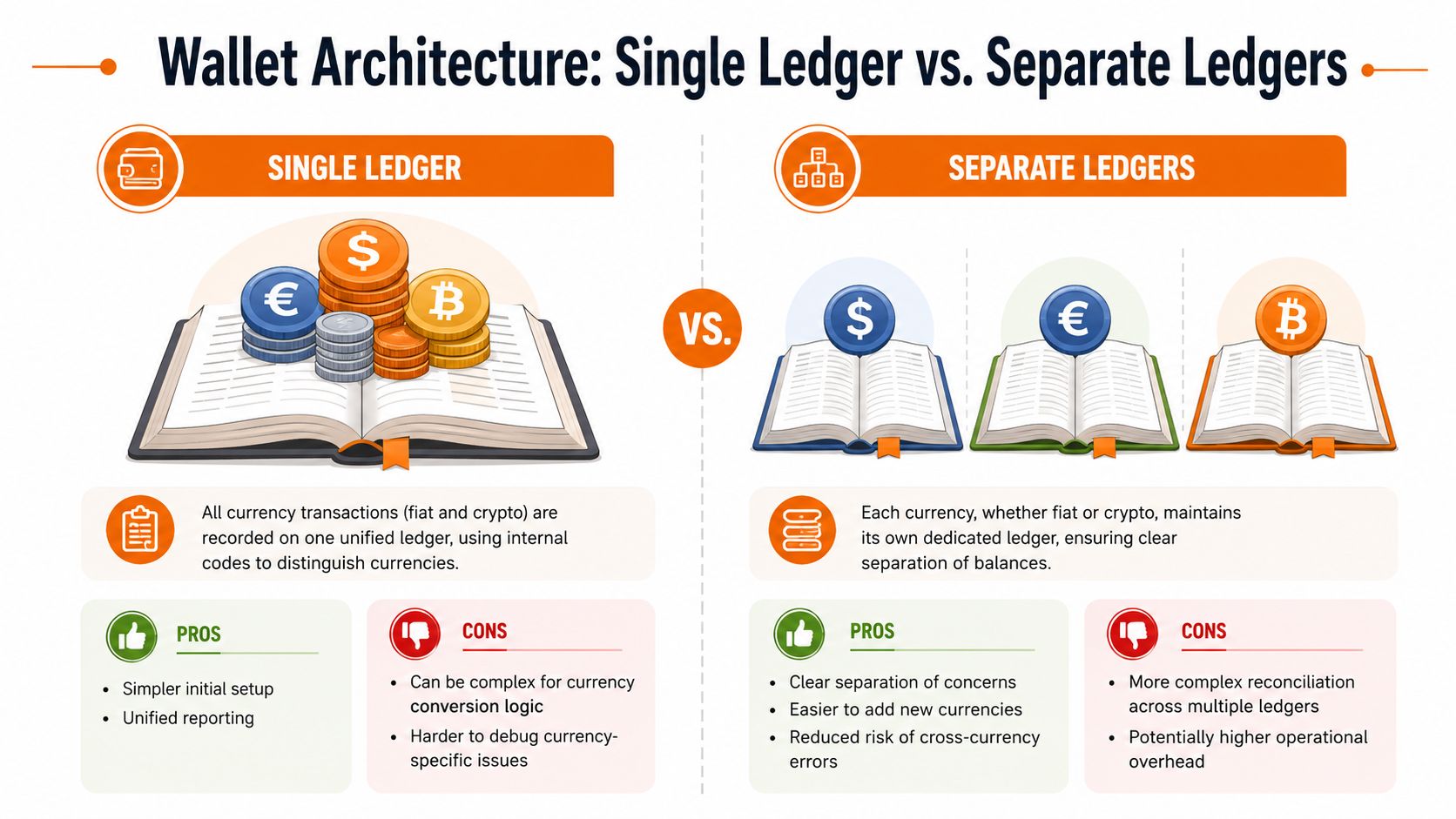
The first design choice is also the one that shapes almost everything after it. Do you keep all balances inside one unified ledger with currency sub-balances, or do you maintain distinct ledgers per currency?
For operators, the difference sounds technical. It isn't. It affects how fast you can add a currency, how cleanly you can reconcile, how safely you can isolate an issue, and how painful an audit becomes.
A simple visual helps before getting into trade-offs.
What the two models really mean
Think of a single ledger as one vault with internal drawers. All value movements post into one accounting framework, and each transaction carries currency context so the system knows whether it belongs to USD, EUR, BTC, or something else.
A separate ledger model is closer to having a dedicated vault for each currency. That gives teams stronger isolation, but it also creates more cross-ledger coordination whenever a player converts funds or a treasury team reconciles pooled balances.
Here's the operational comparison:
| Model | Best quality | Main weakness | Best fit |
|---|---|---|---|
| Single ledger | Unified reporting and simpler treasury view | Cross-currency logic gets harder to debug | Operators prioritizing one financial control plane |
| Separate ledgers | Clear currency isolation and easier fault containment | Reconciliation across ledgers adds overhead | Operators with strict jurisdiction and custody separation needs |
Later, when you compare providers, review how they expose this architecture in practice. A vendor can claim “multi-currency support” while hiding currency logic inside application code instead of a proper ledger layer. That usually surfaces later as exception handling and manual finance work. A structured provider comparison should focus on ledger behavior, not only payment logos, and a platform comparison checklist for iGaming infrastructure is useful for that kind of due diligence.
After the diagram, it helps to see how practitioners discuss these trade-offs in broader payment infrastructure terms:
Where operators get this wrong
The common mistake is choosing architecture based on the current launch footprint instead of the future compliance footprint.
A single-ledger model often looks attractive because reporting is centralized and implementation moves faster. That works well if you need one operational view across casino, sportsbook, and multiple payment rails. It gets harder when teams bolt on jurisdiction-specific restrictions later and discover the ledger wasn't designed for strong isolation.
Separate ledgers solve that isolation problem more cleanly. If one currency or market needs different custody treatment, approval logic, or reconciliation rules, teams can enforce that boundary more directly. The cost is operational complexity. Cross-currency movements now require disciplined orchestration so both sides stay balanced and traceable.
The right architecture is the one your finance, compliance, and ops teams can explain under audit without translating platform quirks into accounting language.
How to choose under real operating pressure
I'd use three filters.
- Choose for reporting integrity: If your team closes books faster with one authoritative ledger and you can still enforce currency separation properly, unified architecture is often the better operational choice.
- Choose for failure isolation: If you expect different custodians, banking structures, or market-specific constraints, separate ledgers reduce blast radius when something goes wrong.
- Choose for expansion discipline: If adding a new currency means rewriting balance logic, your model won't scale well no matter how elegant the demo looks.
What doesn't work is the half-built middle ground. That's when a provider exposes a unified player wallet in the UI but settles, reconciles, and reports through ad hoc currency handling behind the scenes. Those systems usually survive launch and struggle later.
Managing Fiat and Crypto Payment Flows
A wallet is only as good as the money movement it can absorb without confusion.
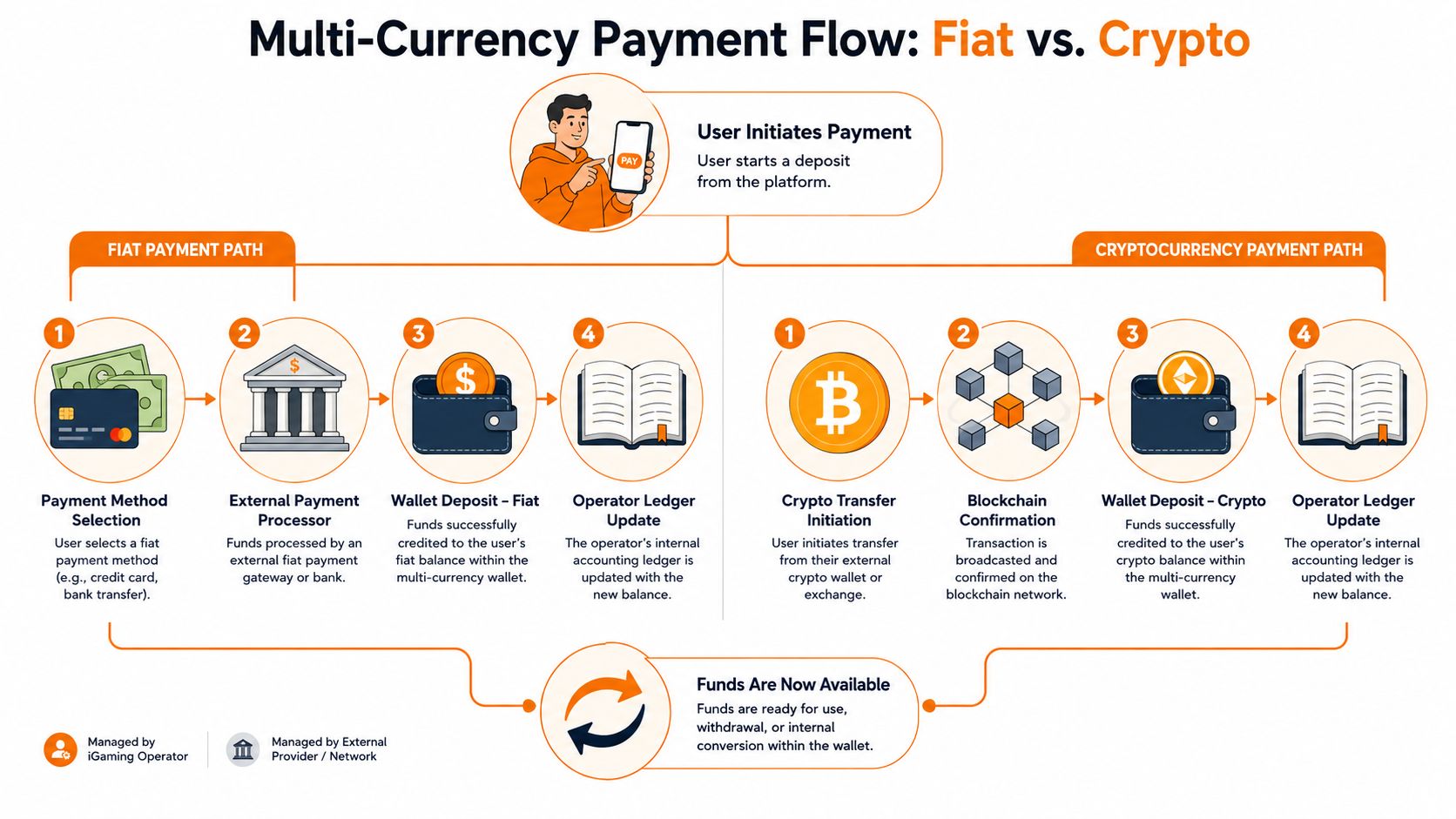
In iGaming, fiat and crypto don't just represent two payment types. They create two very different operational paths. Fiat depends on PSPs, acquirers, settlement files, chargeback exposure, and banking cutoffs. Crypto depends on address management, network confirmation policy, custody rules, and token-specific handling. If both land in the same product, the wallet has to normalize the player experience without flattening the underlying differences.
The scale of wallet usage makes that operational breadth hard to ignore. More than 5.3 billion users are projected to use digital wallets by 2026, and global crypto ownership averages 6.9%, according to Bank of America's digital wallet adoption overview. For operators targeting multiple regions, the wallet has to serve both mainstream payment behavior and crypto-native user expectations.
Fiat and crypto don't fail in the same places
A fiat deposit usually fails before the wallet sees confirmed value. The player selects a method, the transaction routes through a processor or bank, risk checks apply, and only then should the wallet credit funds. If you credit too early, you create exposure. If you credit too late, players think the cashier is broken.
Crypto failures are different. The player can broadcast a transaction correctly, but delays still happen because of confirmation policy, chain congestion, or asset handling rules. The wallet must decide when a pending crypto deposit becomes spendable and whether the player sees that status clearly.
Here's the difference in operator terms:
- Fiat pain points: processor declines, asynchronous settlement notices, reversals, and payout routing failures.
- Crypto pain points: pending confirmations, wrong network selection, token support mismatches, and custody workflow delays.
- Shared pain points: support escalation, reporting mismatches, and unclear balance states.
The handoff points that need control
The cleanest systems treat the wallet as the authoritative internal record after external rails report status. That means no direct provider balance becomes the source of truth for player funds. Providers report events. The wallet posts them. The ledger preserves the state change.
That handoff should cover at least these moments:
Deposit initiation
The cashier captures payment choice, currency, and player account context.External processing
A PSP, bank, or blockchain network handles the movement outside your platform perimeter.Wallet posting
Your internal wallet credits a balance only when the event meets your policy for confirmation and usability.Back office exposure
Finance, risk, and support all see the same posted state, not three different provider views.
Don't let payment providers become your accounting system. They process funds. Your wallet must decide what the player balance actually is.
A mature multi currency wallet also handles withdrawals with the same discipline. For fiat, that means routing to the correct payout rail based on jurisdiction, account type, and supported currency. For crypto, it means validating destination rules, custody approvals, and asset compatibility before release.
What doesn't work is hiding all of that under one generic “processing” label. Players need a simple experience. Operators need precise states underneath it.
The True Cost of Currency Conversion and FX Strategy
Most wallet demos make FX look easy. The player clicks convert, the balance updates, and the interface shows a rate.
That's the surface layer. The critical questions are harsher. What spread did the provider add? How much rate drift is tolerated before the quote updates? What happens when a deposit settles into one currency and a withdrawal request leaves in another during a volatile market window? Those details decide whether FX is a convenience feature or a slow margin leak.
Real-time rates are not the same as fair rates
The least transparent cost in many wallet stacks is the spread between the provider's rate and the underlying market rate. Operators often hear “competitive FX” and assume the economics are reasonable. That assumption can be expensive.
A practitioner-focused review from Meegle on e-wallets with multi-currency support notes that providers often embed hidden spreads of 1.5% to 3% above mid-market rates, and that can erode casino margins by 2% to 4% annually on high-volume betting. For crypto-to-fiat flows, spread volatility can exceed 5% during market turbulence. Those aren't abstract finance metrics. They show up in weaker net revenue and harder-to-explain player outcomes.
The speed of conversion matters too. Technical benchmarks cited by SuisseBank's review of multi-currency wallet features say live FX conversion needs to execute within 200 to 400 milliseconds. When systems miss that threshold, operators see a 12% to 18% drop in player conversion during cross-border transactions because stale rates create balance mismatches and friction at deposit or withdrawal time.
When to convert and when to hold
There isn't one correct FX policy for every operator. The choice depends on your player mix, settlement patterns, and treasury discipline.
A few working rules tend to hold up:
- Convert on deposit when you want immediate simplicity in reporting and bonus settlement, and when the target market mostly plays in one base currency.
- Hold native balances when players regularly deposit and withdraw in the same non-base currency, or when repeated conversion would stack unnecessary spread costs.
- Use controlled internal conversion when the platform can show the player a clear rate, a clear resulting balance, and a clear audit trail.
Fast conversion matters, but transparent conversion matters more. A player will tolerate a clearly shown rate. They won't tolerate a balance that changes in ways support can't explain.
High-performance operators reduce FX damage with two mechanisms. First, they aggregate liquidity from multiple forex providers instead of relying on a single quoted source. Second, they use pre-quoted rate locks so the player sees one valid rate during a brief execution window, instead of watching the cashier recalculate mid-transaction.
What doesn't work is blanket auto-conversion everywhere. That creates simplicity for the platform vendor and hidden cost for the operator.
Ensuring Compliance and Secure Custody
For a regulated operator, the wallet is evidence. It proves where player funds sit, how they moved, who approved what, and whether balances were isolated properly when money crossed currencies or jurisdictions.
That's why compliance teams care less about the wallet interface than about the ledger underneath it. If your system can't demonstrate segregation, traceability, and rule enforcement at transaction level, the brand carries the risk even if the front end looks polished.
Segregation must exist in the ledger and in the bank layer
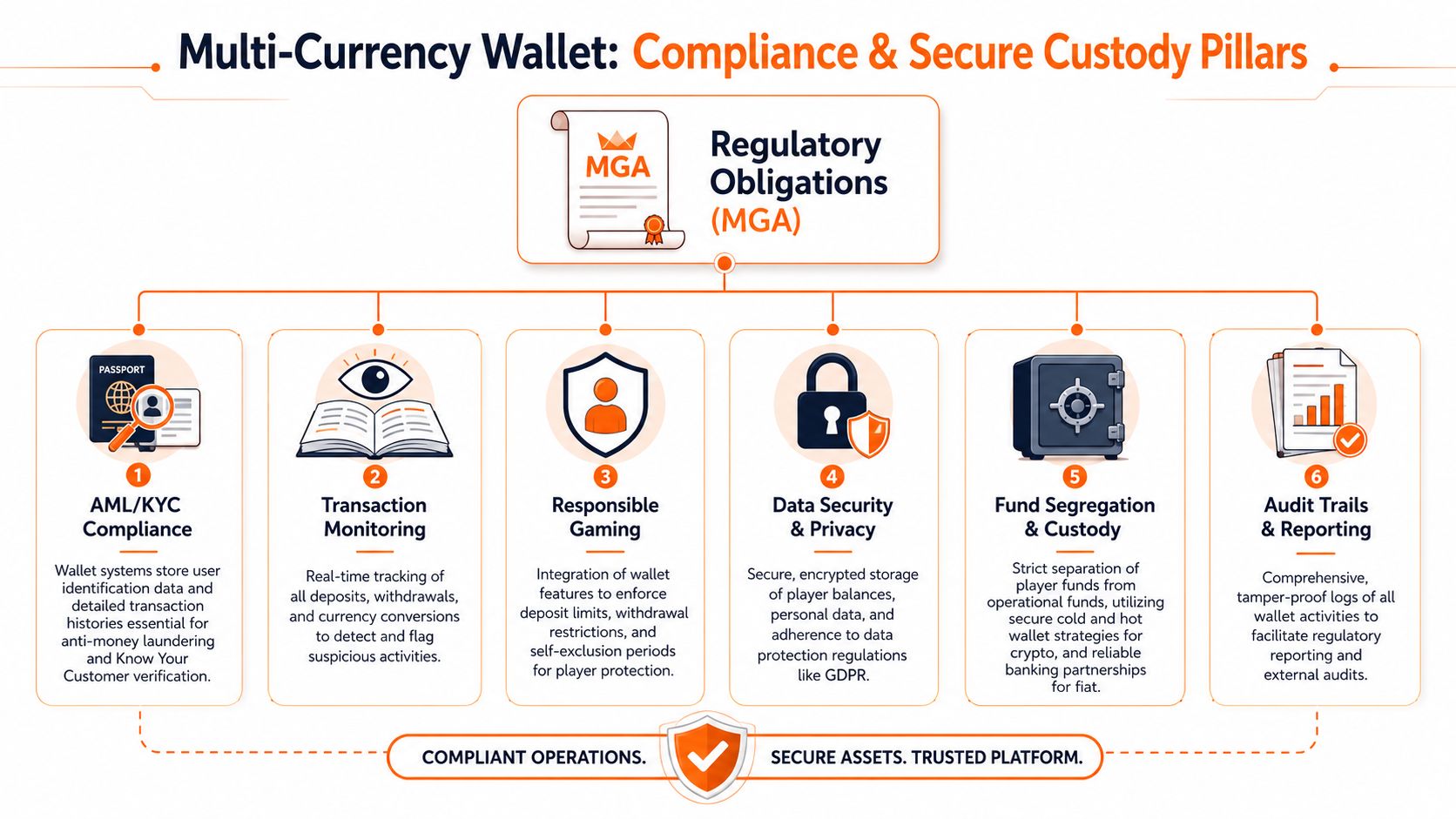
In regulated iGaming, wallets must use real-time, segregated ledger accounting where each currency balance maps to a distinct virtual sub-account backed by tier-1 bank clearing accounts, according to Airwallex's explanation of multi-currency wallet structure. That design prevents cross-currency liability contagion. If one currency pool has a shortfall, other currency balances aren't supposed to absorb it.
That point matters more than many new licensees expect. A player's EUR balance can't be treated as a generic claim against a mixed treasury pot just because the UI displays separate balances. The underlying records and custody arrangements must support that separation.
If you're evaluating how a provider maps wallet behavior to licensing obligations, review the actual controls tied to iGaming compliance infrastructure and operational safeguards. The useful questions are never only about KYC screens. They're about whether the ledger, reporting, approval logic, and custody model all align.
Compliance controls that belong inside the wallet
A compliant multi currency wallet should enforce controls through system design, not team memory.
That usually means:
- Transaction monitoring tied to currency context: Unusual patterns across deposits, conversions, and withdrawals need to remain visible in their original denomination and route.
- Immutable audit trails: Every balance-affecting event needs a traceable record with status history.
- Controlled approvals: High-risk withdrawals, manual adjustments, and exceptional conversions should require role-based handling.
- Custody separation: Fiat custody needs dependable banking structure. Crypto custody needs clear hot and cold wallet policy, access control, and movement authorization.
- Responsible gaming hooks: Deposit limits and restriction logic should apply cleanly even when players move between balances.
A wallet that only stores balances and delegates the rest outward will create compliance gaps. Teams then fill those gaps with offline reviews, manual signoffs, and exception spreadsheets. That might work at low volume. It won't hold up well under audit or market expansion.
Compliance becomes manageable when the wallet records the reason for every balance state, not only the amount.
Platform Integration and Migration Considerations
A multi currency wallet never lives alone. It touches your player account system, bonus engine, fraud tooling, cashier front end, payment connectors, reporting layer, and support workflows.
That's why wallet projects often fail even when the wallet itself is competent. The weak point is usually the integration boundary. One system thinks in base currency. Another expects raw transaction currency. A bonus engine credits rewards without understanding the player's active balance. A sportsbook reserve is placed in one module and released differently in another. Those inconsistencies create real money problems quickly.
A wallet touches more systems than most operators expect
In a modern stack, the wallet should behave like a shared financial service for the whole platform. Casino bets, sportsbook stakes, bonuses, manual adjustments, affiliate credits, payment events, and withdrawal holds all need to call the same balance logic.
The integration questions that matter most are practical:
| Connected system | What the wallet must handle |
|---|---|
| PAM | Identity, account state, and entitlement mapping |
| Bonus engine | Issuance, wagering locks, and settlement in the correct currency |
| Sportsbook and casino engines | Reservation, stake deduction, win crediting, rollback handling |
| Back office | Searchable transaction history and operator controls |
| Reporting | Currency-aware exports and reconciliation views |
That's why API shape matters as much as feature count. If the wallet exposes clean, atomic balance operations, platform modules can behave predictably. If not, teams work around missing behavior with custom middleware and manual exception logic. Operators planning a broader backend refresh should evaluate how the underlying iGaming platform architecture supports shared wallet logic, not just whether each module works in isolation.
Migration fails when balance logic is treated as a data import
Moving from a legacy single-currency system to a real multi currency wallet is not a CSV exercise.
The difficult part isn't copying balances. It's mapping meaning. You need to decide how legacy balances map to wallet accounts, how pending withdrawals are represented, how bonus-linked funds move, and what happens to historical reporting after the cutover. If you skip that design work, the migration may technically complete while operations inherit a finance mess.
The cleaner migrations usually follow this pattern:
Classify balance types first
Separate cash, bonus, pending withdrawal, reserve, and manual adjustment states before migration.Map historical currency assumptions
Legacy systems often treated everything as one base currency even when payment rails were multi-region.Run a dry reconciliation
Test migrated balances against expected player and treasury totals before any public launch.Prepare support scripts
Player communication matters because even accurate migrations generate questions when balance views change.Keep rollback logic defined
If cutover creates an inconsistency, teams need a controlled recovery path.
What doesn't work is migrating only the visible player balance and assuming the rest can be reconstructed later. The hidden states are usually the ones that matter most.
The Operator's Multi Currency Implementation Checklist
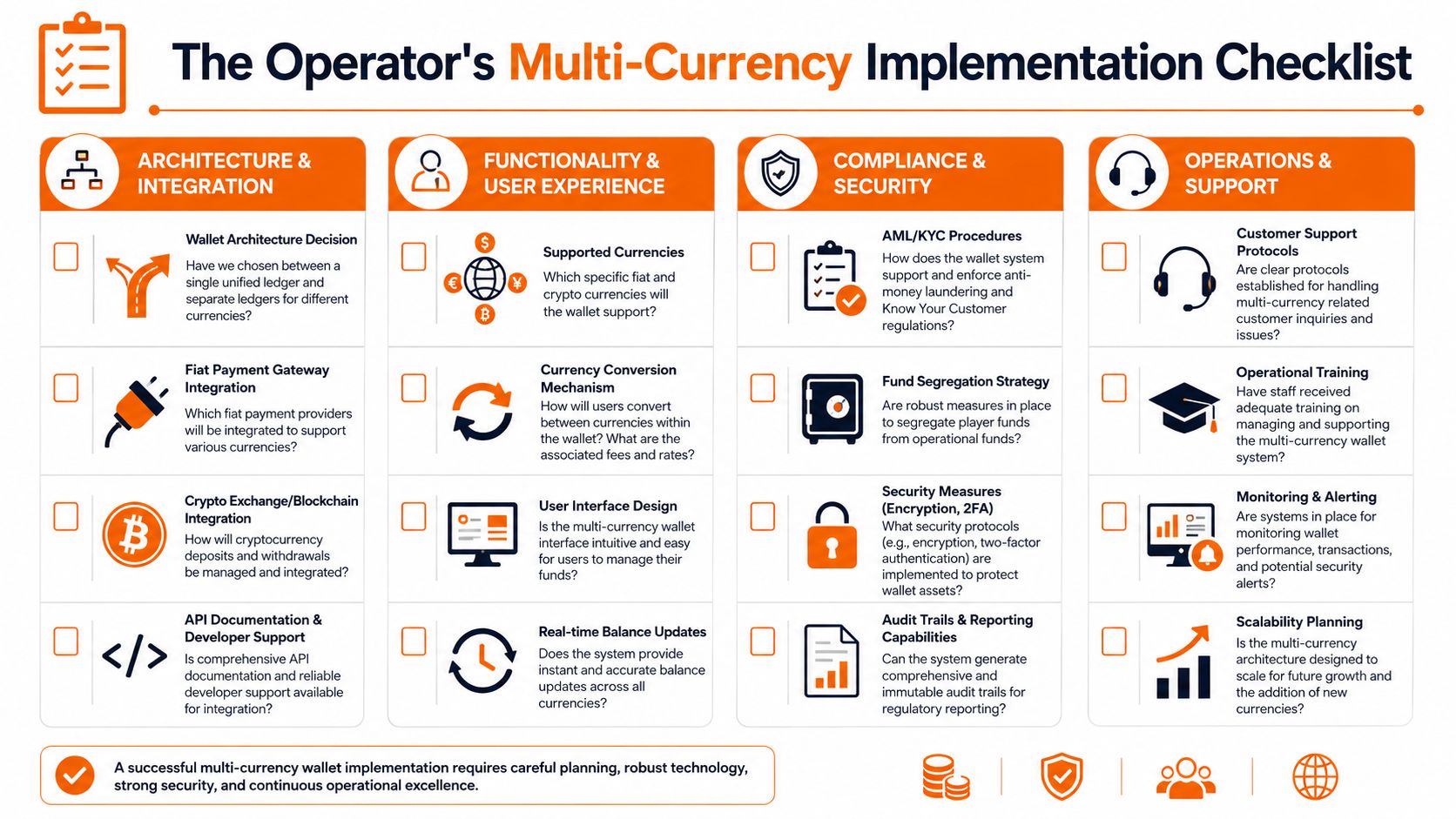
Most wallet mistakes happen before launch, during procurement. Operators ask whether the platform supports currencies, crypto, and withdrawals. They don't ask how balances are separated, how FX is priced, how audit trails are generated, or how failures are resolved when a provider returns an inconsistent status.
That's where this checklist helps. Bring it to demos. Use it in vendor workshops. If a provider can't answer these clearly, the missing detail won't stay hidden for long.
Questions to ask before you sign
- How is the wallet ledger structured? Ask whether currency balances are segregated at the ledger level or only separated in the interface.
- What triggers a posted balance change? You need to know exactly when fiat deposits, crypto deposits, reversals, and withdrawals become authoritative.
- How is FX quoted and priced? Don't accept “real-time rate” as a complete answer. Ask how spreads are applied and how rate validity is handled.
- How are failed or partial states represented? Deposits pending review, withdrawals awaiting approval, and reversals should all have explicit balance logic.
- What evidence is available for audit? Review transaction history, operator action logs, and reporting outputs before contract signature.
- How does the wallet interact with bonuses and bet reserves? Multi-currency balance control gets messy fast if promotional funds and real funds aren't modeled clearly.
The mistakes that create expensive rework
Some problems don't appear in launch week. They appear when you expand, get audited, or add a second treasury workflow.
Watch for these warning signs:
- UI-first wallet design: The demo looks polished, but the vendor can't explain the ledger.
- Provider dependency for truth: PSP or crypto processor dashboards act as the fallback record for balance disputes.
- No explicit FX policy: Conversion exists, but nobody can explain when the system holds native currency versus auto-converts.
- Weak migration planning: Historical balances and pending states are treated as cleanup work for after go-live.
- Operations left out of design: Finance, risk, and support only see the implementation once it's already fixed in code.
A strong multi currency wallet should make daily operations boring in the best sense. Deposits post predictably. Withdrawals follow known states. FX is explainable. Compliance evidence is already in the system when someone asks for it.
If you're evaluating wallet architecture as part of a new casino or sportsbook launch, NexGrate provides a white-label iGaming platform with unified payments, wallet management, back office controls, and compliance tooling built for operators that need to scale across currencies and markets without stitching the stack together by hand.