
Retention often starts before a player decides to leave. In subscription commerce, one 2026 benchmark summary reported 24% churn in month one, 16% in month two, and 12% in month three, with total churn reaching 52% by the end of the first year (Rework's subscription churn management guidance). The lesson applies to gambling brands even though the operating signals differ: churn is usually a chain of detectable friction points, not one failed promotion.
A player may stop returning after a stalled onboarding journey, a failed deposit, irrelevant game discovery, a confusing bonus, weak cross-product access, or a message that arrives at the wrong moment. A sportsbook user may also disengage after repeated payment friction or because the available markets don't match their preferences. Responsible operators must account for those causes without turning retention into pressure to play.
The operator's job is to identify declining engagement early, remove account and payment barriers, deliver relevant content, communicate with discipline, use loyalty mechanics carefully, protect players responsibly, and measure incremental retention rather than mistaking activity for loyalty. The ten churn reduction strategies below follow that workflow across casino and sportsbook operations, with practical NexGrate applications for its unified wallet, bonus systems, segmentation, analytics, KYC, payments, content integrations, and responsible gaming controls.
Table of Contents
- 1. Personalized Loyalty and VIP Tier Programs
- 2. Proactive Win-Back and Re-Engagement Campaigns
- 3. Dynamic Pricing and Offer Personalization
- 4. Unified Account and Payment Experience Across Products
- 5. Intelligent Game and Content Rotation Strategy
- 6. Multi-Channel Retention Communication
- 7. Responsible Gaming and Player Protection Transparency
- 8. Predictive Churn Scoring and Early Intervention
- 9. Gamification and Achievement Systems
- 10. Geographic and Regulatory Market Expansion with Localization
- 10-Strategy Churn Reduction Comparison
- Turn Churn Signals Into an Operating System
1. Personalized Loyalty and VIP Tier Programs
A loyalty program works best when it recognizes meaningful customer behavior without reducing every relationship to a spend target. Tiered rewards, status benefits, custom bonuses, and exclusive access can give players a clearer reason to return, but only when the operator understands which benefits matter to each cohort.
NexGrate's loyalty tiers, segmentation, and bonus systems provide the operating foundation. An operator can separate high-value active players from long-tenure but low-engagement accounts, recently activated players, and players showing declining activity. Each group should receive a different treatment. A VIP player may value dedicated service or exclusive events, while an at-risk recreational player may respond better to a simple free-spin offer or a non-monetary status benefit.
Examples from the market include DraftKings VIP Rewards, with tier-based cashback and exclusive events, Caesars Rewards, which connects points redemption and tier benefits across its ecosystem, and 888 Casino's Gold Club, where higher tiers accelerate rewards.
Build tiers around profitable behavior
Set thresholds using actual profitability, player value, product usage, and risk controls, rather than arbitrary activity targets. Review the economics regularly. A reward that brings back a player but costs more than the incremental value created isn't retention. It's subsidized activity.
Use NexGrate segmentation to identify at-risk players before they disappear from the active base. Then make the offer specific:
- Clear progression: Show what the player has earned and what the next tier provides.
- Relevant benefits: Match incentives to casino, sportsbook, or cross-product behavior.
- Aspirational status: Include recognition, access, and service benefits, not only monetary rewards.
- Transparent communication: Explain tier rules in-app and through consented lifecycle messaging.
For a practical framework on structuring benefits, review NexGrate's guide to gaming loyalty programs. Measure tier progression, repeat deposits, product breadth, offer redemption, contribution margin, and churn by tier. Don't judge the program by points issued or sessions alone.
2. Proactive Win-Back and Re-Engagement Campaigns
A win-back campaign needs a diagnosed trigger before it needs an offer. Dormancy, fewer sessions, a failed payment, an unresolved KYC issue, and dissatisfaction with content require different workflows. Sending one bonus to every inactive player may be simple to launch, but it produces weak learning and can waste margin.
Use NexGrate campaign analytics, segmentation, and marketing automation to trigger outreach from last login, declining sessions, product affinity, or inactivity thresholds. Coordinate email, SMS, push, and in-app messages around consent, channel preferences, and frequency limits. Payment failures and KYC blockers should route to resolution messaging rather than promotional messaging.
The offer should reflect prior behavior. A poker player may respond to tournament access, while a slots player may prefer targeted free spins. Market examples include PartyCasino's reactivation emails, Betsson's SMS offers, and GG Poker's tournament re-entry campaigns. Treat these as patterns to test, not templates to copy.
Measure recovery separately from prevention
Keep dormant players separate from those contacted before inactivity. This distinction shows whether outreach prevented churn or recovered an already-lost session.
Track the operating results:
- Return rate: Did the player log in again?
- Return deposit rate: Did reactivation produce a deposit?
- Product re-entry: Did the player return to the relevant product?
- Sustained activity: Did behavior continue beyond the first response?
- Incremental value: Did contacted players outperform a comparable holdout?
Use known audience patterns to schedule campaigns, then test whether timing changes outcomes. Frequency caps limit fatigue. Suppress players with responsible gaming concerns, self-exclusion status, or unresolved compliance restrictions, and record those exclusions for auditability.
A recovered login is not a retained player. Judge the workflow by sustained activity, incremental value, and the cost of recovery. Win-back can restore attention, but it cannot compensate for unresolved product, payment, or compliance problems.
3. Dynamic Pricing and Offer Personalization
Fixed promotions are easy to operate, but they often ignore why a player is becoming inactive. A price-sensitive player may need a different offer from someone seeking tournament access, cashback, or a simpler bonus structure. Offer personalization should match the intervention to the player's context, while keeping eligibility and cost controls visible.
NexGrate's bonus system and segmentation engine let operators create differentiated offers for defined cohorts. Teams can vary bonus terms, free-spin values, cashback mechanics, bet limits, or permitted non-monetary benefits according to regulation and internal policy. Begin with broad, explainable groups. Comparing a high-risk cohort with a stable cohort produces clearer operating decisions than relying on a model the team cannot interpret.
Test value without creating unfairness
Run controlled tests on offer mechanics and terms. A defined cohort might receive either a smaller or larger deposit incentive, with results assessed through incremental deposits, net gaming revenue, bonus cost, repeat activity, and later churn. The operating objective is the lowest-cost intervention that produces durable value, not the largest reward for the most responsive player.
Build each offer through a documented review:
- Cohort definitions: Record the behavior and risk conditions behind the segment.
- Offer eligibility: Apply responsible gaming, compliance, and fraud exclusions before activation.
- Clear terms: Present wagering, expiry, and withdrawal conditions in language players can understand.
- Profitability review: Include payment costs, bonus cost, support effort, and expected value.
- Holdout measurement: Compare treated players with similar players who receive no offer.
Personalization also needs a control path. NexGrate's limits engine and responsible gaming controls should be checked during decisioning, before campaign creation and delivery. Do not use dynamic incentives to exploit vulnerability. Exclude restricted players, document the decision rules, and monitor offer cost alongside sustained activity and churn.
4. Unified Account and Payment Experience Across Products
Account and payment friction often appears during product switching. Separate logins, balances, cashier journeys, or verification steps can interrupt a player who moves between casino and sportsbook. A unified flow reduces repeated work while preserving the controls required for each product and jurisdiction.
NexGrate's unified backend, single wallet, and integrated payment processing connect casino and sportsbook operations across cards, banking, crypto, multiple currencies, and wallet management. Shared infrastructure supports easier discovery, but operators must retain product-level limits, verification rules, and access controls where regulations require them.
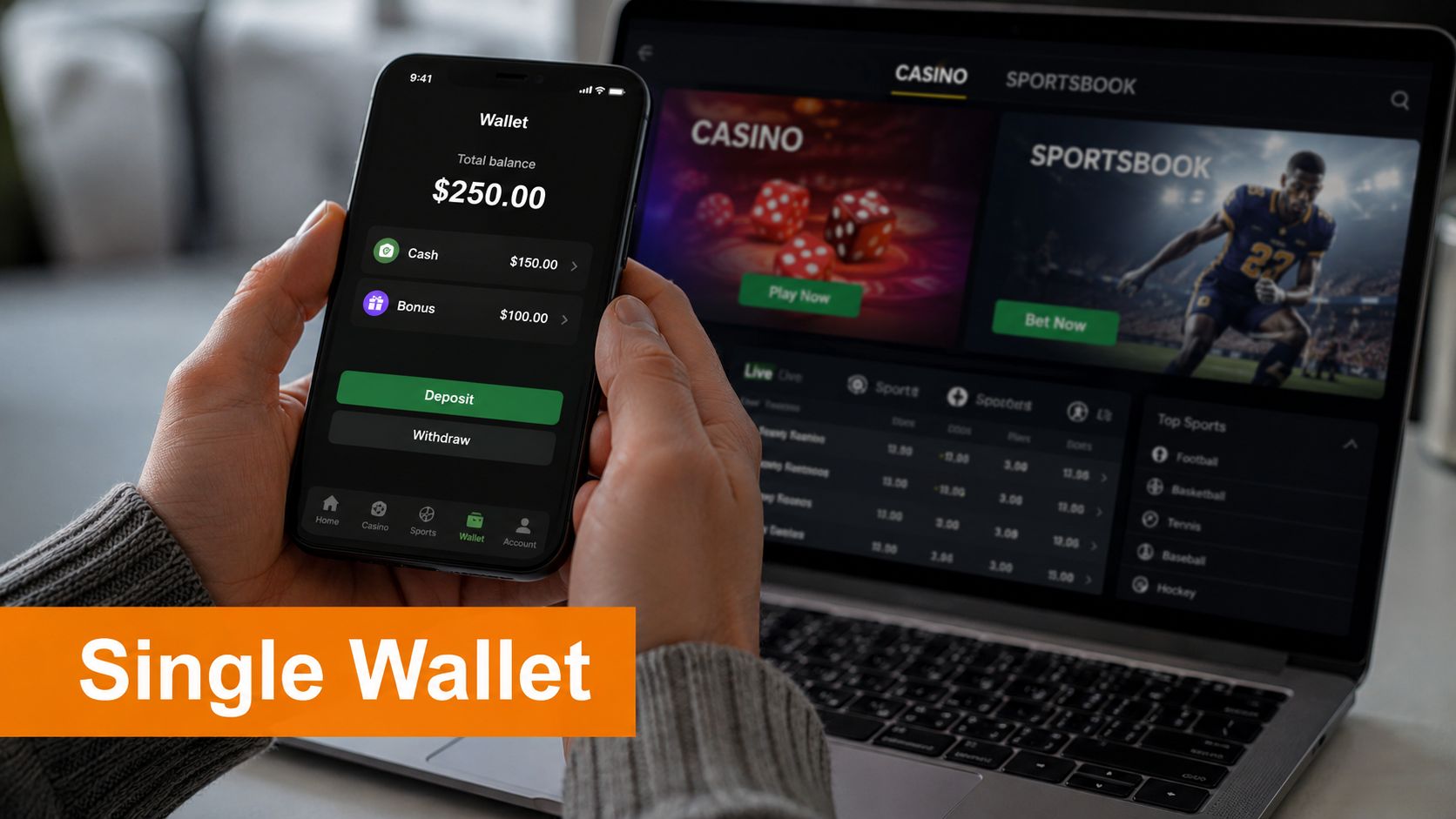
Examples include DraftKings' connected DFS, sportsbook, and casino account experience, FanDuel's integrated wallet, and bet365's movement between sports, casino, and poker. The retention value comes from removing unnecessary barriers, not directing every player toward every product.
Start with the switch itself. Keep product navigation visible, display the available balance clearly, and retain payment preferences where legally and technically appropriate. Identify single-product players through the unified backend, then present relevant discovery based on activity rather than broad cross-sell.
Track the experience through:
- Login and authentication completion
- KYC completion and resubmission rates
- Deposit authorization and payment completion
- Withdrawal completion and exception rates
- Casino-to-sportsbook and sportsbook-to-casino transitions
- Support contacts caused by wallet or payment issues
Test payment capacity around major sporting events. A failed deposit or delayed withdrawal at peak demand can become a retention problem, even when the underlying issue began as infrastructure pressure.
Operators supporting several currencies or payment methods can apply NexGrate's multi-currency wallet capabilities to cashier and account design. The player-facing experience still needs clear transaction status, concise guidance, and an understandable explanation whenever verification or payment checks delay access.
5. Intelligent Game and Content Rotation Strategy
A large library does not guarantee a useful lobby. Players may still encounter repetitive recommendations, difficult navigation, or content that does not match their interests. Content rotation should help each player find relevant options while keeping familiar titles easy to access.
NexGrate's content integrations and single API support rotation across RNG games, live casino content, jackpots, and sportsbook markets. Operators can combine game affinity, session behavior, product preference, and recent interactions when deciding what to feature. A slots player should not see the same lobby as a table-game player because both logged in that day.
Set the lobby mix from operating data
Use proven performers to anchor navigation, then place new or trending titles where relevant segments can discover them. A practical starting point is a 60% and 40% real-estate split between proven high-hold titles and new or trending content. Adjust that allocation using hold, discovery, conversion, commercial, and responsible gaming data. It is a testable operating choice, not a permanent rule.
Review rotation decisions through:
- Game starts and completed sessions
- Player count by title
- Average stake and deposit behavior
- Repeat visits to featured content
- Content-to-product conversion
- Volatility and loss-related risk signals
Run controlled tests on placement, labels, recommendation logic, and lobby order. Session length alone is an incomplete KPI. Longer sessions can indicate interest, confusion, or harmful behavior, so pair it with repeat visits, product conversion, loss-related signals, and protection interventions.
Responsible gaming controls belong in the rotation workflow. Show relevant prompts when risk signals warrant them, especially around high-volatility content or repeated loss patterns. Recommendations should remain useful rather than invasive. Explain categories clearly, avoid manipulative urgency, and let players control discovery with search, favorites, and product filters. Segment-level review also helps operators identify when a popular title is receiving attention without producing healthy, sustainable engagement.
6. Multi-Channel Retention Communication
Retention communication improves when each message has a clear job, a relevant trigger, and an easy way for players to manage contact preferences. NexGrate connects account management, campaign tools, segmentation, and analytics so operators can coordinate email, SMS, push, and in-app messaging against one player record.
Build the workflow around player events, not a shared campaign calendar. Use in-app messaging for account actions, push for time-sensitive updates, email for detailed offers or explanations, and SMS only when consent and urgency support it. Casino content and sportsbook markets also require different contexts, so segment both the message and its timing.
Route every event to the right message
A low balance does not automatically justify a deposit prompt. A failed payment may call for service information. A responsible gaming signal should route the account toward protection support, not promotion. Define these paths before campaigns go live.
Operational controls should include:
- Consent tracking: Store permissions and channel preferences at account level.
- Trigger governance: Specify which events can start promotional or service messages.
- Frequency caps: Stop campaigns from different teams competing for the same player.
- Suppression rules: Exclude self-excluded, restricted, or protection-flagged players.
- Cohort reporting: Compare channel activity with incremental retention, rather than clicks alone.
Measure delivery, opt-outs, return sessions, deposits, payment completion, and post-campaign churn. Review results by product, cohort, channel, and trigger. An open or click shows attention, not loyalty. A message may create immediate activity while increasing fatigue or encouraging behavior that responsible gaming teams would reject.
Practical communication usually performs the most useful work: explain a payment issue, clarify a bonus, surface a relevant market, or provide a clear route to limits and support. Let those service outcomes guide campaign design, rather than treating every interaction as a promotional opportunity.
7. Responsible Gaming and Player Protection Transparency
Player protection is a trust requirement, not a retention tactic. Some players disengage when gambling no longer feels controlled. Others lose confidence when deposit limits, self-exclusion, or reality checks are difficult to locate. Keep these controls visible in the account experience, with plain explanations of their effects and clear routes to specialist support.
NexGrate supports deposit limits, session time limits, self-exclusion, and reality checks. Place each control where players can reach it without searching through obscure settings. Record the player's choices, confirmation status, and any required follow-up so support and compliance teams work from the same account history.
Implementation should follow the applicable jurisdiction, regulator, licence conditions, and approved safer-gambling procedures. Visible deposit-limit and self-exclusion controls, UK Gambling Commission requirements, and GambleAware education resources illustrate the types of practices operators may need to accommodate, but local rules determine the final workflow.
Run protection as its own operating path
A concerning behavioral change should route an account to review, limits, reality checks, customer support, or exclusion processes. It should not start a promotional reactivation journey. Configure suppression before campaigns are activated, and prevent vulnerability signals from becoming targeting inputs.
Track protection performance through deposit-limit adoption, session-limit and reality-check usage, self-exclusion processing, intervention completion, support response and resolution, and promotional suppression accuracy. Review both completion and handling time. A high volume of recorded interventions means little if players cannot access the requested control or support promptly.
Customer-facing explanations should remain direct and non-judgmental. Content about odds, bankroll management, and gambling-related harm can support informed decisions, but it must not imply that players can control outcomes.
For connected reporting and control records, NexGrate's compliance reporting approach can help align operational evidence with regulatory workflows. Sustainable retention depends on protecting players, including when protection reduces short-term activity.
8. Predictive Churn Scoring and Early Intervention
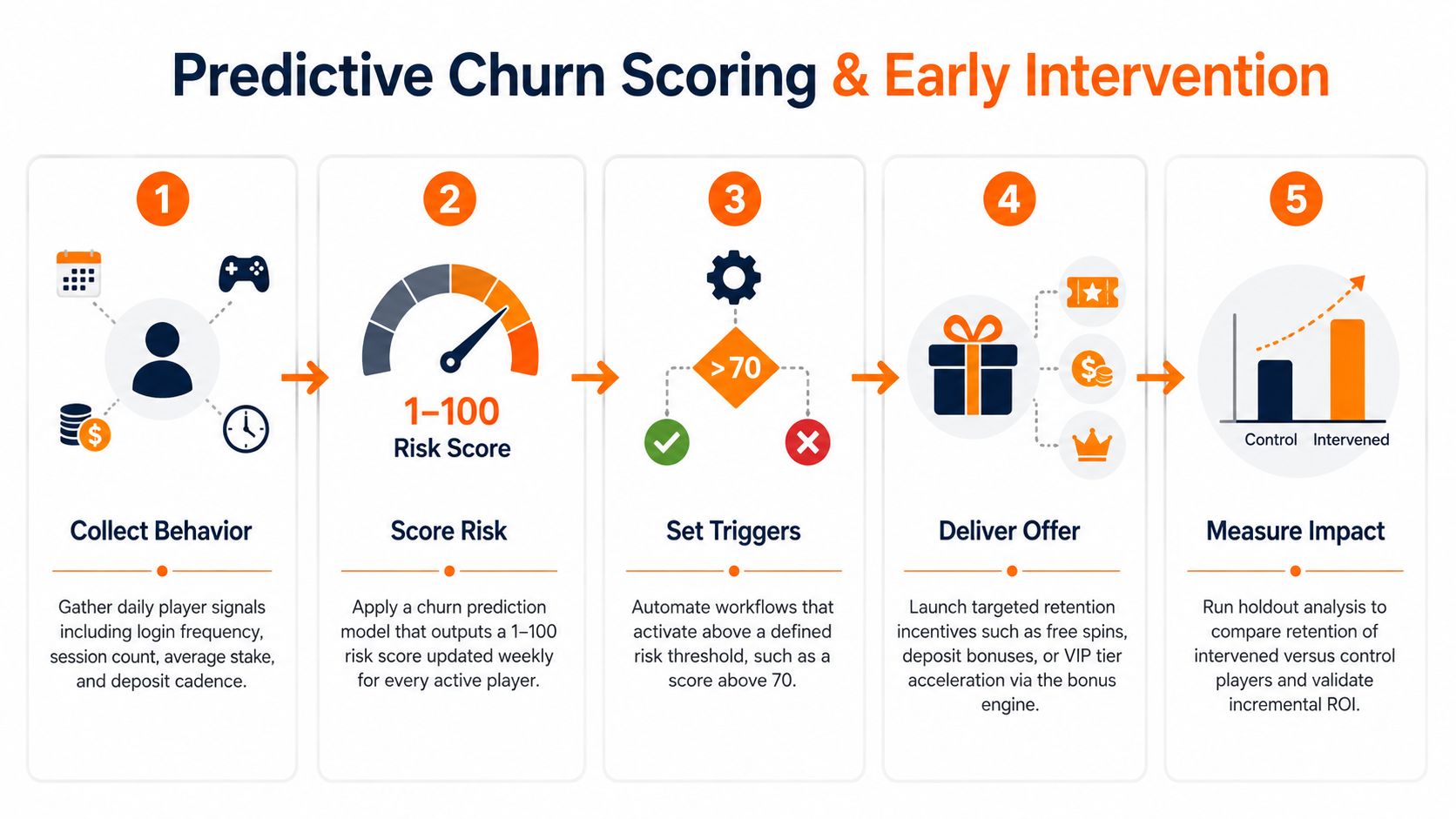
A useful churn score doesn't predict the future perfectly. It helps a team decide who needs attention, why the account may be at risk, and what action is appropriate. Mature monitoring commonly uses login frequency, feature-usage depth, and support-ticket volume to flag risk weeks or months in advance (Count's churn-rate reference).
For gambling operators, additional signals may include declining session frequency, longer gaps between logins, reduced average bet, product abandonment, payment problems, and repeated losses. These signals must be interpreted carefully. Reduced play can indicate healthy self-control, not churn risk, and should never trigger an aggressive retention campaign automatically.
Start with an explainable model
Build an initial score from a small set of signals that the team can validate. Segment by player type because casual, regular, and high-value players can show different patterns. NexGrate's player behavior analytics and CRM capabilities can supply the events, cohorts, and campaign history needed to connect risk detection with action.
Validate the model before putting it into production. Use a holdout group, check calibration, and review false positives. A score that flags too many stable players creates alert fatigue and invites inappropriate messaging.

Practical rule: A risk score should recommend a controlled next action, not authorize a promotion by itself.
Measure prediction accuracy, intervention coverage, retention by risk band, incremental value against control, and responsible gaming outcomes. The point is to intervene earlier with better judgment, not to automate pressure at scale.
9. Gamification and Achievement Systems
Gamification can give players structure and discovery, but it can also create unhealthy pressure if it rewards excessive activity or frames loss as progress. Use achievement systems to recognize exploration, learning, and status rather than just increasing wager volume.
NexGrate's bonus systems and campaign analytics can support badges, challenges, milestones, and leaderboard mechanics. A “Sportsbook Explorer” achievement could recognize engagement across different markets, provided the design doesn't require harmful or excessive play. Non-monetary rewards, status markers, cosmetics, and access benefits can create motivation without making every achievement a cash incentive.
Design mechanics around safe behaviors
Keep early milestones understandable and achievable. Rotate challenges to preserve novelty, but don't create artificial urgency that pushes players to exceed their intended limits. Review each mechanic with compliance and responsible gaming teams before launch.
Measure:
- Achievement visibility and adoption
- Completion by segment
- Repeat visits
- Cross-product discovery
- Incremental retention
- Limit use and protection signals
Avoid leaderboards that publicly expose sensitive financial behavior. Use aliases, opt-in participation, and clear rules. A leaderboard may increase engagement for one cohort and alienate another, especially if it rewards only the highest spenders.
The strongest achievement systems reinforce product value: discovering a new game category, completing a tutorial, exploring available markets, or using account controls. They shouldn't disguise retention pressure as entertainment.
10. Geographic and Regulatory Market Expansion with Localization
Expansion can reduce dependence on a single market, but entering a new jurisdiction without localizing the experience exports the same churn problems. Players need familiar payment methods, understandable language, local currency support, relevant content, reliable customer service, and responsible gaming information that fits local expectations.
NexGrate's white-label architecture, multi-currency support, geofencing, compliance toolkit, and unified backend can support market-specific operations without forcing every brand into a fragmented technology stack. The platform's casino, sportsbook, payments, KYC/AML, reporting, and content integrations can be configured around the requirements of each regulated market.
Localize the operating journey
Prioritize markets with a viable regulatory framework, player demand, and workable licensing and tax conditions. Then validate the full journey, not only the front end:
- Payments: Confirm local methods, settlement behavior, limits, and failure handling.
- Compliance: Map KYC, AML, geolocation, reporting, and audit requirements.
- Content: Match game categories, sportsbook markets, language, and cultural expectations.
- Support: Provide local-language assistance and clear escalation paths.
- Protection: Adapt limits, messaging, self-exclusion, and support referrals to local rules.
Payment friction is particularly damaging in a new market because players haven't built trust in the brand. Monitor registration completion, KYC completion, first deposit completion, payment failure, withdrawal processing, support contacts, and early churn by jurisdiction.
Use local partners where they improve payments, support, compliance execution, or acquisition quality. A unified backend should reduce fragmentation, but it must not erase the operational differences that regulators and players expect.
10-Strategy Churn Reduction Comparison
| Strategy | 🔄 Implementation Complexity | ⚡ Resource Requirements | 📊 Expected Outcomes | 💡 Ideal Use Cases | ⭐ Key Advantages |
|---|---|---|---|---|---|
| Personalized Loyalty and VIP Tier Programs | Medium–High, tier logic + integrations | ⚡ Moderate, CRM, campaign ops, budget for rewards | 📊 Increases repeat play and LTV; reduces churn ~15–25% (mid/VIP) | 💡 Operators with sizable high-value cohorts seeking retention | ⭐ Strong personalization; efficient promo spend; higher VIP retention |
| Proactive Win-Back and Re-engagement Campaigns | Medium, automation + segmentation | ⚡ Low–Moderate, marketing channels, compliance checks | 📊 Lower CAC for reactivation (3–5x cheaper than acquisition); good ROI when targeted | 💡 Dormant players (30–90 days); lapsed cohorts | ⭐ Cost-effective reactivation using existing data |
| Dynamic Pricing and Offer Personalization | High, real-time rules & analytics | ⚡ High, data science, rules engine, compliance review | 📊 Improves promo ROI; higher conversion for at-risk players while protecting margins | 💡 Competitive markets; high-value or price-sensitive segments | ⭐ Maximizes ROI by matching offer intensity to churn risk |
| Unified Account and Payment Experience Across Products | High, backend unification & payment integrations | ⚡ High, engineering, payment partners, regulatory work | 📊 Increases cross-product usage; cross-product players show materially lower churn (~40–50%) | 💡 Operators offering casino + sportsbook or multi-product ecosystems | ⭐ Eliminates friction; raises LTV and simplifies compliance |
| Intelligent Game and Content Rotation Strategy | Medium–High, recommendations & content APIs | ⚡ Moderate, analytics, content management, provider integrations | 📊 Increases session duration and discovery; reduces boredom-driven churn | 💡 Large content catalogs needing better surfacing and freshness | ⭐ Keeps library fresh; improves engagement and new-game ROI |
| Multi-Channel Retention Communication (Email/SMS/Push/In-App) | Medium, orchestration across channels | ⚡ Moderate, messaging platforms, consent management | 📊 Higher engagement and conversions; improved opt-in compliance | 💡 Broad player bases with varied channel preferences | ⭐ Better reach and conversion; targeted, consented messaging |
| Responsible Gaming and Player Protection Transparency | Medium, UI + compliance workflows | ⚡ Moderate, compliance, education content, tooling | 📊 Increases trust and regulatory compliance; indirect churn reduction | 💡 Regulated markets and brands prioritizing player safety | ⭐ Differentiates brand; reduces reputational and regulatory risk |
| Predictive Churn Scoring and Early Intervention | High, ML models, feature pipelines | ⚡ High, data science, infrastructure, testing | 📊 Prevents churn proactively; estimated 2–3x better ROI vs reactive win-back | 💡 Operators with rich behavioral data and analytics teams | ⭐ Targets highest-risk players with timely, measurable interventions |
| Gamification and Achievement Systems | Medium, UX/game mechanics + tracking | ⚡ Low–Moderate, development, design, analytics | 📊 Boosts session frequency 20–40%; increases social engagement | 💡 Younger or social audiences; drive non-monetary engagement | ⭐ High engagement ROI; low direct monetary cost |
| Geographic and Regulatory Market Expansion with Localization | High, legal, localization, payments, geofencing | ⚡ High, legal teams, local ops, payment partners | 📊 Diversifies revenue, reduces single-market risk; increases total addressable market | 💡 Operators seeking growth and market diversification | ⭐ Access to new player pools; leverages platform for rapid entry |
Turn Churn Signals Into an Operating System
Churn reduction becomes manageable when operators stop treating it as a campaign theme and start treating it as an operating system. The first task is to establish a baseline that separates what is happening from what the team hopes is happening. Track churn, retention, reactivation, payment completion, KYC completion, cross-product usage, campaign incrementality, and responsible gaming adoption by product, jurisdiction, cohort, and value tier.
A useful baseline should also distinguish voluntary and involuntary churn. The remedies differ. Onboarding, engagement, pricing, content, and save offers address voluntary churn, while payment retries, account updaters, and dunning address involuntary churn. Industry guidance increasingly treats this split as a core operational discipline, supported by health scoring, at-risk flags, and structured exit-survey reason codes (Rework's subscription churn management guidance).
Sequence the work instead of launching every tactic simultaneously.
- Fix account and payment friction first. Improve registration, KYC handoffs, cashier reliability, wallet clarity, withdrawal communication, and payment-failure recovery. These problems can block otherwise valuable retention efforts.
- Make risk visible. Build segmentation around engagement, product behavior, value, lifecycle stage, payment status, and protection signals. Add predictive scoring only after the underlying data is reliable.
- Assign an intervention. Every risk state needs an owner, a permitted action, a suppression rule, and a follow-up date. A score without an action is just another dashboard.
- Scale relevant experiences. Use loyalty, content rotation, communication, gamification, and localization only after the operator can measure which cohort receives what and why.
- Review profitability and protection together. A retention program isn't successful if it increases bonus cost, support burden, compliance exposure, or player harm faster than it preserves sustainable value.
Controlled holdouts are essential. Compare an intervention cohort with a similar group that doesn't receive the intervention, then evaluate sustained retention, net value, payment completion, and responsible gaming outcomes. Don't use opens, clicks, deposits, or sessions as standalone proof. Those are activity measures, not evidence that the player relationship improved.
Cohort reporting should preserve the full journey. Review first deposit, first product use, cross-product transition, failed payment, KYC completion, support contact, bonus redemption, protection-tool adoption, and churn reason. Early lifecycle behavior deserves particular attention because the benchmark summary cited earlier shows that churn concentrates soon after signup. Waiting until a player is fully dormant leaves fewer responsible and commercially sound options.
Consent and suppression controls must be part of the architecture. Promotional campaigns should respect channel permissions, self-exclusion, limits, jurisdiction, affordability procedures, and internal risk policies. Keep compliance, CRM, payments, product, and customer support aligned around the same player record so one team doesn't promote an account another team has restricted.
NexGrate is designed for this connected model. Its white-label casino and sportsbook platform brings together games, betting engines, wallets, payments, KYC/AML workflows, risk controls, compliance reporting, content integrations, bonus systems, loyalty tiers, segmentation, campaign analytics, hosting, and operational support. That unified backend can reduce the handoffs that make churn signals difficult to interpret and interventions difficult to execute.
Operators don't need ten disconnected projects. They need a clear baseline, reliable signals, responsible decision rules, and a measurement loop that shows which actions preserve value. Start with the highest-friction account and payment failures, document the risk-to-action workflow, and expand only after controlled reporting confirms that the intervention is both effective and sustainable.
NexGrate brings casino, sportsbook, wallet, payments, KYC/AML, compliance, content, and retention operations into one turnkey platform for iGaming operators. Use NexGrate to connect churn signals with practical workflows, responsible controls, and scalable multi-market operations.