Most operators reach the loyalty discussion too late. The brand is already picking game content, negotiating payments, wiring up CRM flows, and someone says, “We'll add points and VIP tiers before launch.” That's how weak gaming loyalty programs get built. They start as a marketing add-on instead of a core operating system.
In practice, a loyalty program touches almost everything that matters. Wallet logic. game event tracking. bonus controls. segmentation. fraud handling. responsible gaming rules. reporting. If any of those pieces are loose, the program either leaks money, creates support debt, or attracts the wrong player behavior.
The market isn't moving away from this model. The global gamification and loyalty engagement market is projected to reach $30.7 billion by 2025, driven by digital transformation and AI-enabled personalization across industries including iGaming, according to Goover market reporting on gamification and loyalty engagement. That tells you one thing clearly. Loyalty is no longer a side feature. It's part of the product.
Table of Contents
- Blueprinting Your Loyalty Program Strategy
- Designing a Rewarding and Sustainable Player Experience
- Building an Unbreakable Technical Architecture
- Navigating Compliance and Responsible Gaming Mandates
- Launching and Optimizing Your Program with Precision
- Frequently Asked Questions on Gaming Loyalty Programs
Blueprinting Your Loyalty Program Strategy
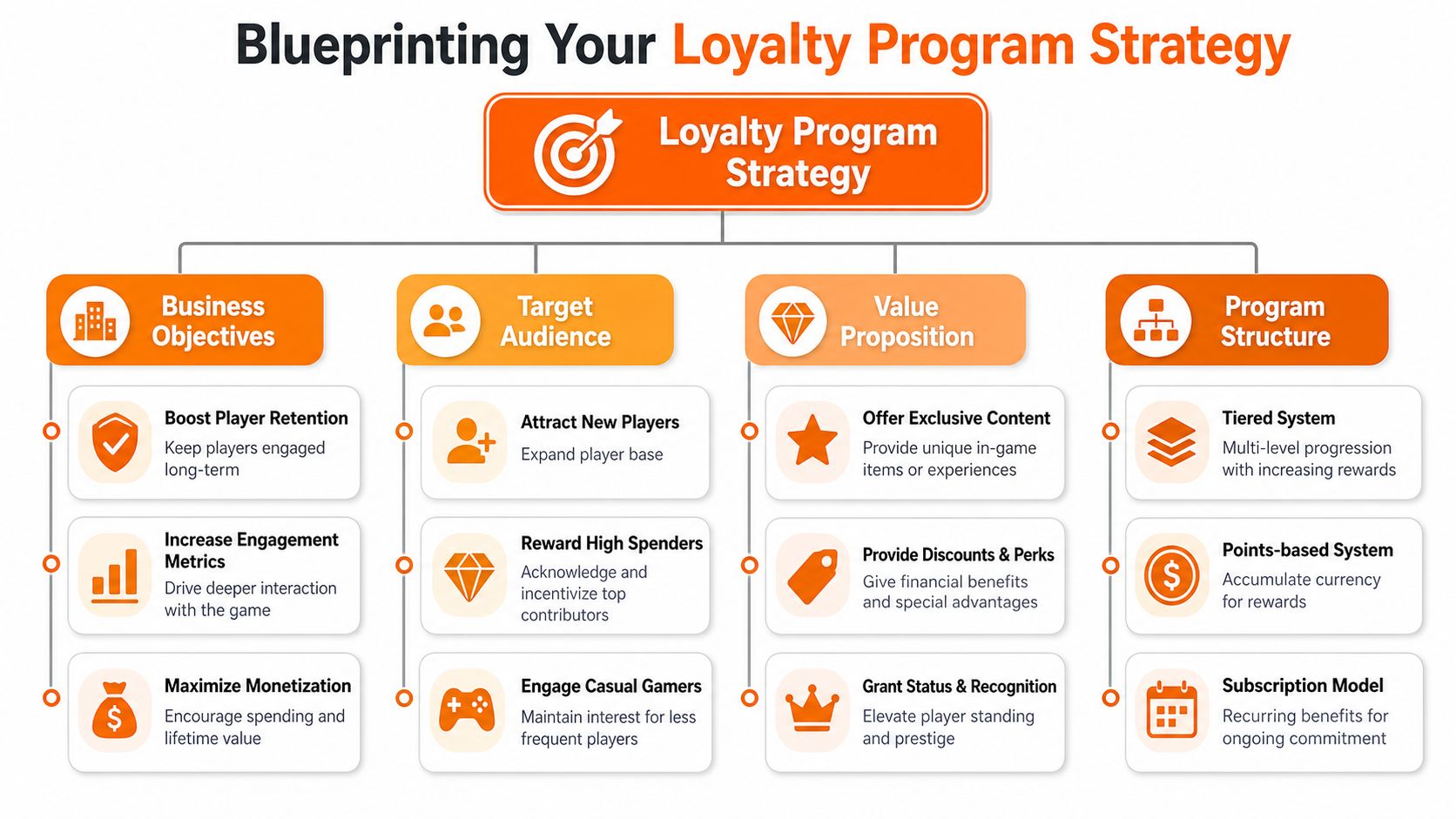
The first mistake is choosing rewards before choosing structure. Operators usually debate cashback, free spins, and VIP gifts. The better question is simpler. What behavior are you trying to shape, and what kind of player are you serving?
Choose the model before the mechanics
Most gaming loyalty programs fall into three practical models.
| Model | Best fit | Common strength | Common failure |
|---|---|---|---|
| Points-based | Broad casino or sportsbook audiences | Easy to understand | Turns into a generic rebate system |
| Tiered VIP | High-value segmented brands | Creates status and service differentiation | Becomes too dependent on raw spend |
| Mission-based gamification | Younger, more active, promo-responsive audiences | Drives repeat sessions and feature adoption | Breaks when mission logic is sloppy |
A pure points model works when you need simplicity. Players understand accrual quickly, support teams can explain it, and finance can forecast cost more cleanly. But if that's all you build, you often train players to value extraction rather than progression.
Tiered structures are different. They work well when your brand wants visible status, service perks, withdrawal prioritization, or exclusive access. They're powerful for retention, but only if movement between tiers feels achievable and fair.
Mission systems are the most flexible and the easiest to get wrong. They can push traffic to a new slot provider, encourage same-week return sessions, or reward cross-vertical play between casino and sportsbook. They also create the most operational complexity because every mission needs event definitions, settlement rules, edge-case handling, and support logic.
Practical rule: If your team can't explain how points are earned, how status changes, and how rewards are released in one page of internal documentation, the model is too complicated for launch.
Set objectives that operations can actually execute
A loyalty program needs product logic, not campaign language. “Increase engagement” is too vague to build from. Good operators define the specific commercial outcome first, then choose the mechanic that supports it.
Start with questions like these:
- Retention problem: Are players depositing once and disappearing after onboarding?
- Portfolio problem: Are players clustering around a narrow set of titles while newer games get ignored?
- Cross-sell problem: Does sportsbook activity sit in a different rhythm from casino play?
- Margin problem: Are rewards over-indexing on low-value segments?
That exercise usually reveals whether your program should reward frequency, depth, breadth, or status.
A mass-market sportsbook brand often needs habit loops. A casino brand built around VIP handling may care more about recognition, service layers, and controlled discretionary rewards. A crypto-first operation may prioritize transparency in accrual, fast redemption, and a cleaner on-platform economy.
The strategic point is straightforward. Loyalty isn't a widget. It's a product with its own rules, liabilities, and player psychology. If you define it properly at the start, the rest of the stack has a chance to work.
Designing a Rewarding and Sustainable Player Experience
Plenty of reward tables look attractive in a pitch deck and collapse in live operations. The reason is almost always the same. The player-facing experience was designed without enough attention to cost, game mix, and player behavior.
What players respond to and what operators often miss
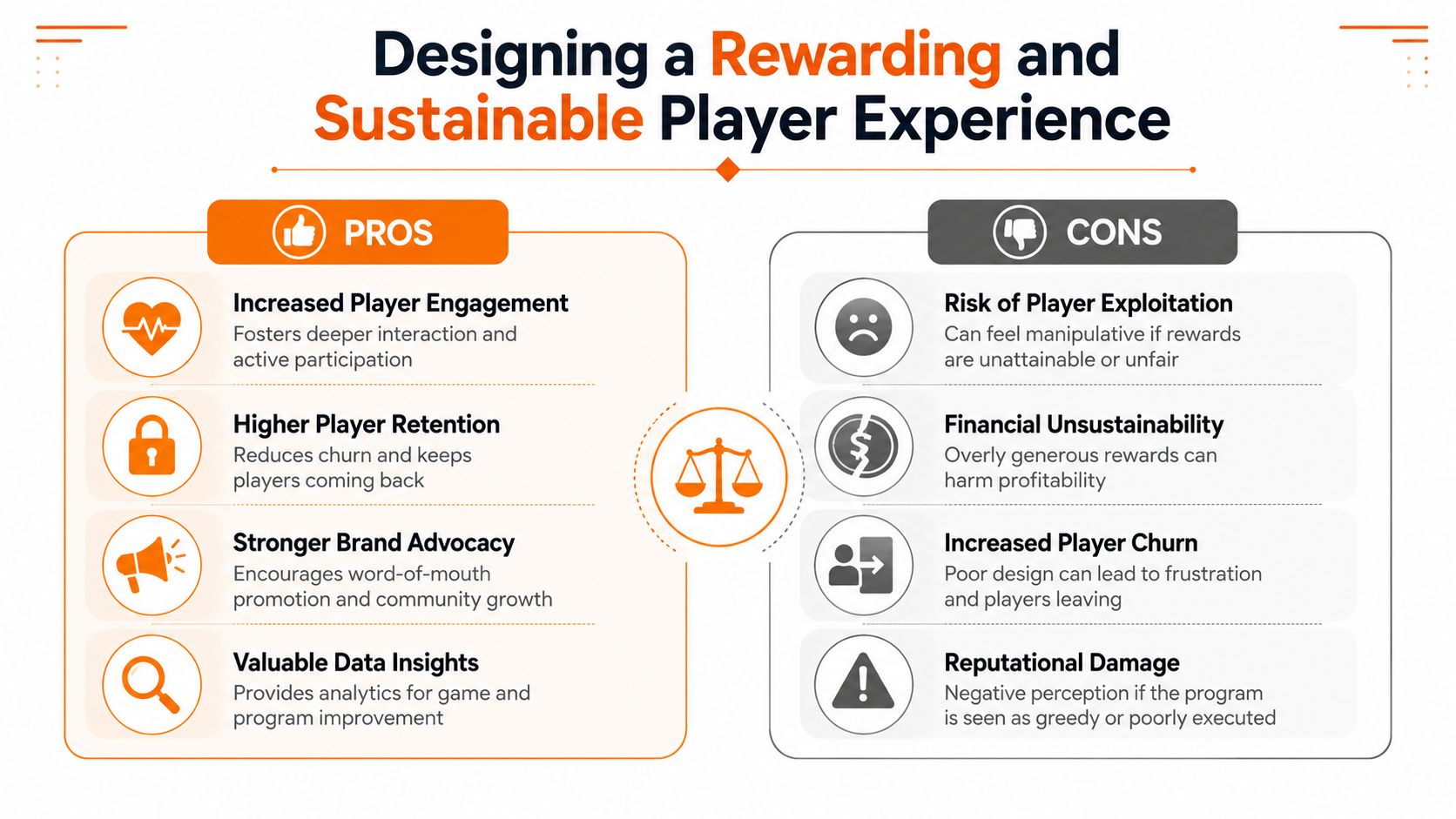
Players don't experience a loyalty program as a finance model. They experience it as momentum. Can they see progress, obtain something desirable, and feel the next milestone is worth chasing?
That's why bland cashback alone rarely carries a modern program. It has value, but it doesn't create much texture. The stronger setups mix financial rewards with experiential ones. Free spins, tournament entries, exclusive missions, faster support, early access to content, and visible status markers all serve different motivations.
Research on Ontario Lottery and Gaming Corporation's Winner Circle Rewards program is useful because it shows how reward design changes actual play. The program awarded 1 cashback point for every $10 played on slot machines, and the study found that loyalty participation increased spending on slots, while the same effect didn't appear on table games, according to GREO's summary of the OLG Winner Circle Rewards research%20Loyalty%20programs%20in%20the%20gambling%20industry.pdf).
That matters operationally. If slots already carry a central role in revenue mix, a reward model tied tightly to slot turnover can amplify the behavior you already monetize best. It can also distort your portfolio if you don't intend it.
Reward structure isn't neutral. It pushes players toward some products and away from others.
Build an economy that survives contact with real play
A sustainable reward economy needs both perceived value and control. Those two things often pull in opposite directions.
Here's where operators usually get into trouble:
- Rewards earn too slowly: Players ignore the program because progress feels invisible.
- Rewards earn too fast: Finance sees a ballooning liability and starts clawing back generosity after launch.
- Tier gaps are too wide: Mid-value players stop trying.
- Everything is cash-equivalent: The program becomes expensive without adding brand differentiation.
A practical way to balance the system is to separate reward types by purpose.
| Reward type | Good use | Main risk |
|---|---|---|
| Cashback-style value | Retention and reactivation | Margin pressure |
| Free spins or bonus value | Content promotion and session extension | Abuse if release rules are weak |
| VIP service perks | High-value player recognition | Creates entitlement if tiers are unstable |
| Missions and seasonal unlocks | Habit formation and return frequency | Fatigue if repeated without variation |
The healthiest gaming loyalty programs feel active without feeling compulsory. Players should have multiple ways to perceive progress. Some want immediate value. Others want status. Others respond to novelty.
If every benefit maps only to wagering volume, you don't have a rounded player experience. You have a rebate engine wearing loyalty branding.
Building an Unbreakable Technical Architecture
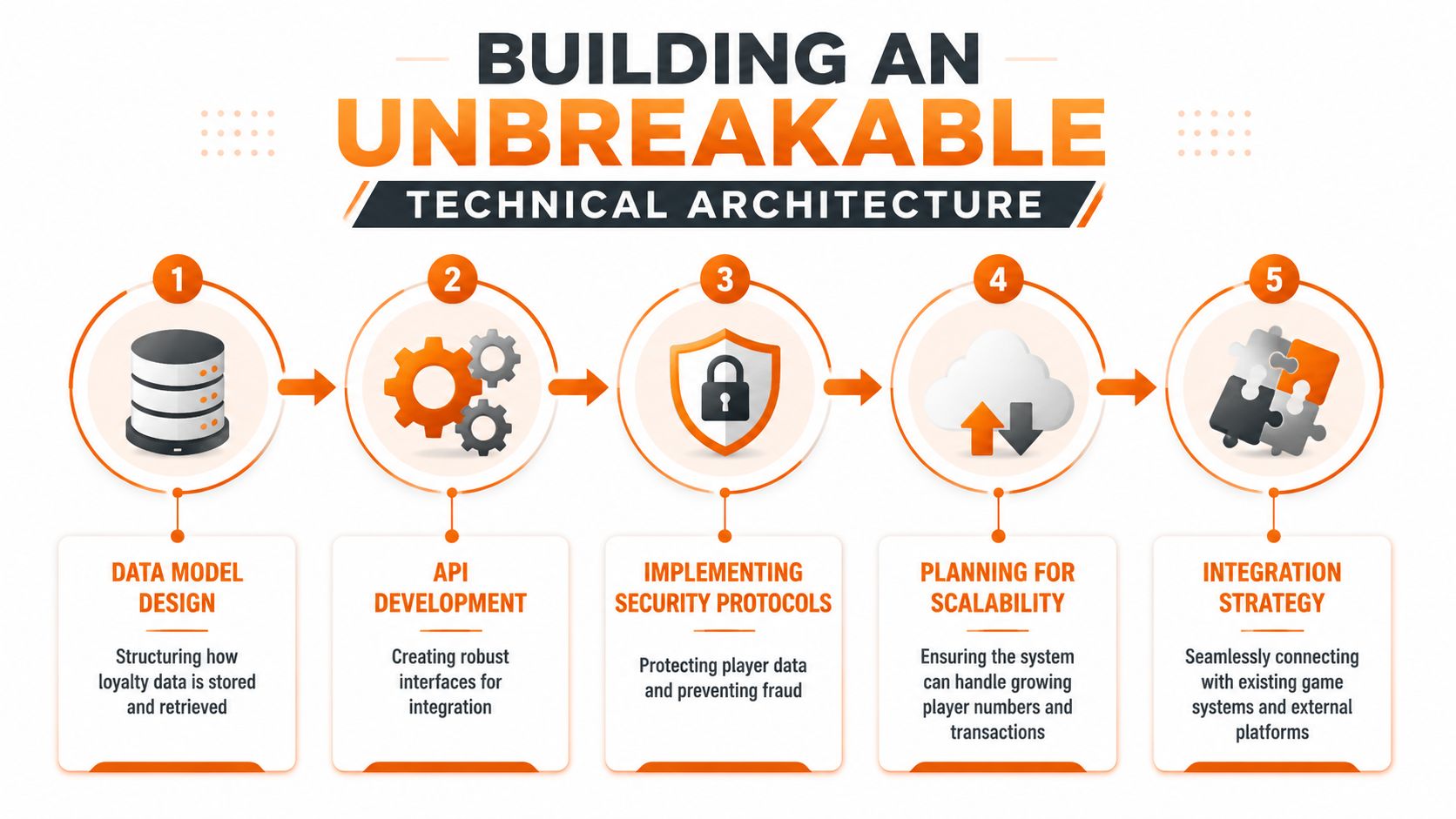
A loyalty program fails in the backend long before players complain in the frontend. The banners can look sharp, the lobby can show progress bars, and the CRM can send polished messages. None of that matters if your event flow, ledgering, and reward release logic are weak.
The ledger matters more than the lobby
At minimum, the architecture needs one source of truth for player identity, wallet activity, bet settlement, bonus state, and loyalty accrual. If casino and sportsbook events arrive through separate logic paths without unified reconciliation, support and finance will spend their time cleaning up exceptions.
A critical control is server-side verification. High-integrity gaming loyalty systems require Server-Side Security endpoints that receive verified notifications directly from the betting engine server. Without that S2S architecture, operators face a 15 to 25 percent revenue leakage risk from fraudulent point generation, according to adjoe's explanation of S2S loyalty security.
That's the technical line many teams underestimate. Client-side triggers are convenient for prototypes. They are not acceptable for real-money loyalty accounting. If a mobile app, web client, or third-party front end can influence reward issuance without authoritative server confirmation, abuse will show up fast.
A durable architecture usually includes these components:
- Event ingestion layer: Captures bet placement, settlement, game rounds, deposits, withdrawals, and mission actions.
- Rules engine: Applies earn rules, tier conditions, exclusions, and reward triggers.
- Loyalty ledger: Stores every accrual, reversal, redemption, and manual adjustment with auditability.
- Wallet and bonus sync: Prevents conflicts between cash balance, bonus balance, and loyalty value.
- Admin controls: Gives operations teams override capability with full logs.
Build loyalty like a financial product, not a front-end promotion.
Why fragmented integrations usually fail
The hardest implementations are usually the stitched ones. One vendor owns CRM. Another owns bonus tooling. The sportsbook has its own event feed. Casino providers report differently. Payments sit in another back office. Then loyalty logic is added on top as a separate layer.
That setup creates familiar failure points:
- Settlement mismatch: Points are issued on bet placement instead of post-settlement logic.
- Duplicate events: The same round or transaction enters the earn engine more than once.
- Tier lag: Front-end status updates don't match back-office status.
- Support blind spots: Agents can't explain why a reward was or wasn't granted.
This is why operators moving toward a unified stack usually get cleaner loyalty execution. A consolidated architecture shortens the path between game event, eligibility check, wallet update, and audit output. If you're evaluating what that looks like in practice, NexGrate's platform architecture is a useful example of how operators can centralize casino, sportsbook, wallet, and back-office functions in one environment.
The operational advantage isn't abstract. Fewer integration seams mean fewer points of failure, faster troubleshooting, and less dependence on custom glue code every time marketing wants to launch a new mission set.
Navigating Compliance and Responsible Gaming Mandates
Many loyalty programs are still designed around a shallow assumption. More engagement means more value. In iGaming, that assumption can create regulatory risk very quickly.
The dangerous assumption behind most loyalty designs
When rewards are tied tightly to wagering volume, the program doesn't just recognize activity. It can actively encourage more of it. That becomes a serious issue when the reward structure pushes players toward higher-intensity behavior without regard to risk profile.
A critical warning sign appears in the research. Sixty-eight percent of gambling loyalty members earn points primarily through wagering, and regulatory scrutiny is increasing around whether incentives compromise player safety, according to Taylor & Francis research on gambling loyalty programs and player risk.
That number should change the way operators think about design. If most point accumulation is driven by wagering, then the mechanics of earning are not just promotional. They are behavioral levers.
Common problem patterns include:
- Net-spend bias: Higher loss activity earns faster recognition.
- Game bias: Earn rates make some higher-risk categories disproportionately attractive.
- VIP escalation pressure: Players feel they must maintain volume to preserve status.
- Opaque triggers: Players don't understand why they are being pushed into specific actions.
None of those issues are theoretical. They affect compliance reviews, safer gambling oversight, customer complaints, and internal governance.
A loyalty program should never force your compliance team to explain away the incentive logic after launch.
Controls that should exist before launch
Responsible gaming logic has to be part of the reward engine. It can't live only in a separate policy document or an isolated safer gambling tool.
A safer framework usually includes operational controls like these:
- Risk-aware earn rules: Lower or suspend loyalty accrual when player risk indicators rise.
- Exclusion mapping: Remove certain products, sessions, or behaviors from mission qualification.
- Tier review triggers: Prevent automated prestige upgrades from overriding player protection logic.
- Audit trails: Show regulators exactly why points were granted, limited, or withheld.
- Manual governance: Let compliance teams intervene without rebuilding campaign logic.
Operators also need alignment between marketing and compliance. The campaign team should never deploy a mission that bypasses responsible gaming review because it sits inside loyalty rather than bonuses.
For teams operating in regulated environments, NexGrate's compliance tooling is the kind of infrastructure worth looking for because loyalty controls only work when they're tied into broader audit, reporting, and responsible gaming workflows.
The practical standard is simple. If your loyalty engine can accelerate value, it must also be able to slow down, cap, or stop incentives when player safety requires it.
Launching and Optimizing Your Program with Precision
Most launch problems aren't caused by a bad concept. They come from exposing untested logic to real traffic. In loyalty, that's expensive because players notice reward errors immediately, fraud teams see abuse patterns early, and support gets flooded before product has a clean diagnosis.
Run shadow mode before you expose rewards to players
A disciplined rollout has a dry-run period where the loyalty engine processes live event flow without granting visible rewards. That's where you validate ledger entries, mission state changes, exceptions, and reversals against actual betting behavior.
A rigorous deployment method calls for a shadow-mode dry run during Days 11 to 30, followed by a live launch during Days 31 to 45 with A/B testing across city, device, and acquisition source. Skipping shadow testing correlates with a 35 percent higher rate of bonus abuse, according to NOWG's methodology for launching gaming loyalty programs.
That sequence is correct for a reason. The first days after technical implementation are rarely clean enough for public exposure. You need to see how missions behave when there are voided bets, partial settlements, duplicate provider callbacks, mixed-device sessions, and support-side manual adjustments.
A launch checklist should include:
- Event validation: Confirm every earn-triggering event has one authoritative source.
- Ledger reconciliation: Match accruals and reversals against wallet and bet records.
- Mission simulation: Test edge cases such as canceled bets, refunded spins, and session interruptions.
- Segmentation review: Ensure campaign cohorts don't accidentally overlap in conflicting ways.
- Support readiness: Give agents clear reason codes and resolution paths.
Shadow mode is where you discover whether your loyalty logic works under betting volume, not just in product documentation.
What to measure after go live
After release, don't judge performance only by how many players enrolled or how much promotional noise the program created. Good optimization starts with behavioral quality.
The most useful post-launch views usually include:
- Completion behavior: Which missions are attempted, completed, abandoned, or ignored
- Redemption pattern: Which rewards are attractive enough to claim without destroying economics
- Tier movement: Whether players are progressing naturally or stalling too early
- Channel response: How acquisition source, device type, and geography affect reward economics
- Integrity signals: Whether specific mission types attract exploitative behavior
A/B testing matters here because loyalty rarely behaves uniformly across segments. The same challenge cadence can feel engaging on mobile and annoying on desktop. The same reward can appeal to sportsbook-first players and do nothing for slot-led cohorts.
If you want to see how a launch process fits into a broader operating environment, requesting a NexGrate demo is a practical way to assess how unified tooling can support rollout, monitoring, and post-launch iteration.
The programs that last aren't static. Operators tune thresholds, rotate missions, remove weak reward paths, and tighten abuse controls continuously.
Frequently Asked Questions on Gaming Loyalty Programs
How do you reduce bonus abuse in a loyalty program
Start with architecture, not with blacklists. Abuse usually appears when points are awarded before verified settlement, when event duplication goes undetected, or when mission rules can be gamed through narrow repetitive behavior. Use server-side event validation, isolate the loyalty ledger, review unusual earning velocity, and give fraud and support teams access to the same audit trail. If those teams are looking at different systems, abuse investigations slow down.
How often should you refresh a loyalty program
Refresh cadence should follow player fatigue signals, not a fixed marketing calendar. Mission pools, seasonal themes, and redemption options need rotation before the experience starts feeling repetitive. Tier structures should change much less often because players need stability to trust them. As a working rule, keep the core economy consistent and refresh the wrappers, challenges, and featured content around it.
What does healthy engagement actually look like
One of the clearest benchmarks is challenge completion rate. It should exceed 65 percent to sustain engagement, and programs below that line often fall into the “compulsory challenge” problem where players feel pushed rather than motivated, according to Propello's analysis of challenge completion in gamified loyalty.
That number is useful because it forces honesty. If completion is weak, the missions are probably too complex, too difficult, too repetitive, or too poorly matched to the audience. Good engagement doesn't mean players see the challenge. It means they can understand it, want it, and finish it without friction.
NexGrate helps operators build and run online casino and sportsbook brands with a unified backend that covers wallet logic, back office, payments, compliance controls, and retention tooling. If you're evaluating how to launch gaming loyalty programs without stitching together separate vendors, explore NexGrate.