A risk queue rarely fails because the operator lacks data. It fails because the data arrives in separate systems, at different speeds, with no consistent decision attached to it. A withdrawal can look normal in the wallet, unusual in the payment gateway, and highly suspicious once the device graph and betting history are visible together.
That's why a practical risk scoring system must do more than label a player low, medium, or high risk. It needs to combine signals, explain the reasoning, respect compliance controls, and route each event to an action that a reviewer can defend.
Table of Contents
- The Operator Problem Risk Scoring Is Built to Solve
- What a Risk Scoring System Actually Does in iGaming
- Scoring Methodologies Operators Choose Between
- How Real-Time Scoring Works Inside an Operator Stack
- Integration Points Across Wallet, KYC, Payments, and Odds
- Compliance, Responsible Gaming, and the Multi-Dimensional Score
- KPIs, Validation, and Tuning That Keep the Score Honest
- A Practical Rollout Plan for B2B Operators
The Operator Problem Risk Scoring Is Built to Solve
A mid-sized operator can start a shift with a crowded registration queue, a growing withdrawal backlog, and several teams asking for answers from different dashboards. Fraud analysts inspect payment methods, KYC staff review identity evidence, responsible-gaming teams watch behavioral changes, and sportsbook risk specialists monitor unusual markets. Each team may have a valid concern, but the operator still needs one coordinated decision on the player or event.
Manual review can't scale when every analyst must reconstruct the same context by hand. Thresholds hard-coded in SQL create another problem. They're quick to launch, but they become difficult to maintain when payment methods, jurisdictions, products, bonus campaigns, or regulatory expectations change. A rule that once identified card abuse can later block legitimate customers, especially high-value players with complex payment behavior.
The recurring failure modes are familiar:
- Fragmented evidence: Reviewers switch between KYC, wallet, payments, device intelligence, CRM, and odds tools.
- False positives: Legitimate deposits, withdrawals, or VIP activity get delayed because one signal crosses a rigid threshold.
- False negatives: Coordinated account abuse looks harmless when each account is assessed in isolation.
- Unclear ownership: Fraud, AML, payments, and responsible gaming teams receive alerts without a shared action model.
- Weak audit trails: An analyst can see that a rule fired, but not always why the final decision was proportionate.
Practical rule: A score has operational value only when it changes what the team does next.
Risk scoring addresses this by converting fragmented observations into a ranked worklist. The system doesn't replace judgment. It helps reviewers spend that judgment where the combined evidence indicates the greatest need for investigation, enhanced verification, a payment hold, or immediate intervention.
The statistical foundation is well established. A review of clinical prediction modeling describes points-based scoring as a way to summarize multivariable relationships between risk factors and outcomes, with the Framingham Risk Scores among the oldest and most recognized examples. The same review traces the development of widely adopted models such as GRACE and TIMI, showing why modern scoring engines combine multiple inputs instead of relying on one threshold. See the review of risk-scoring systems and clinical prediction models for that historical context.
What a Risk Scoring System Actually Does in iGaming
Think of the engine as air-traffic control for player and transaction events. Air traffic control doesn't decide where every aircraft should go from one fact alone. It combines location, speed, route, weather, priority, and surrounding traffic, then assigns an action. An iGaming risk engine follows the same pattern.
Signals become usable evidence
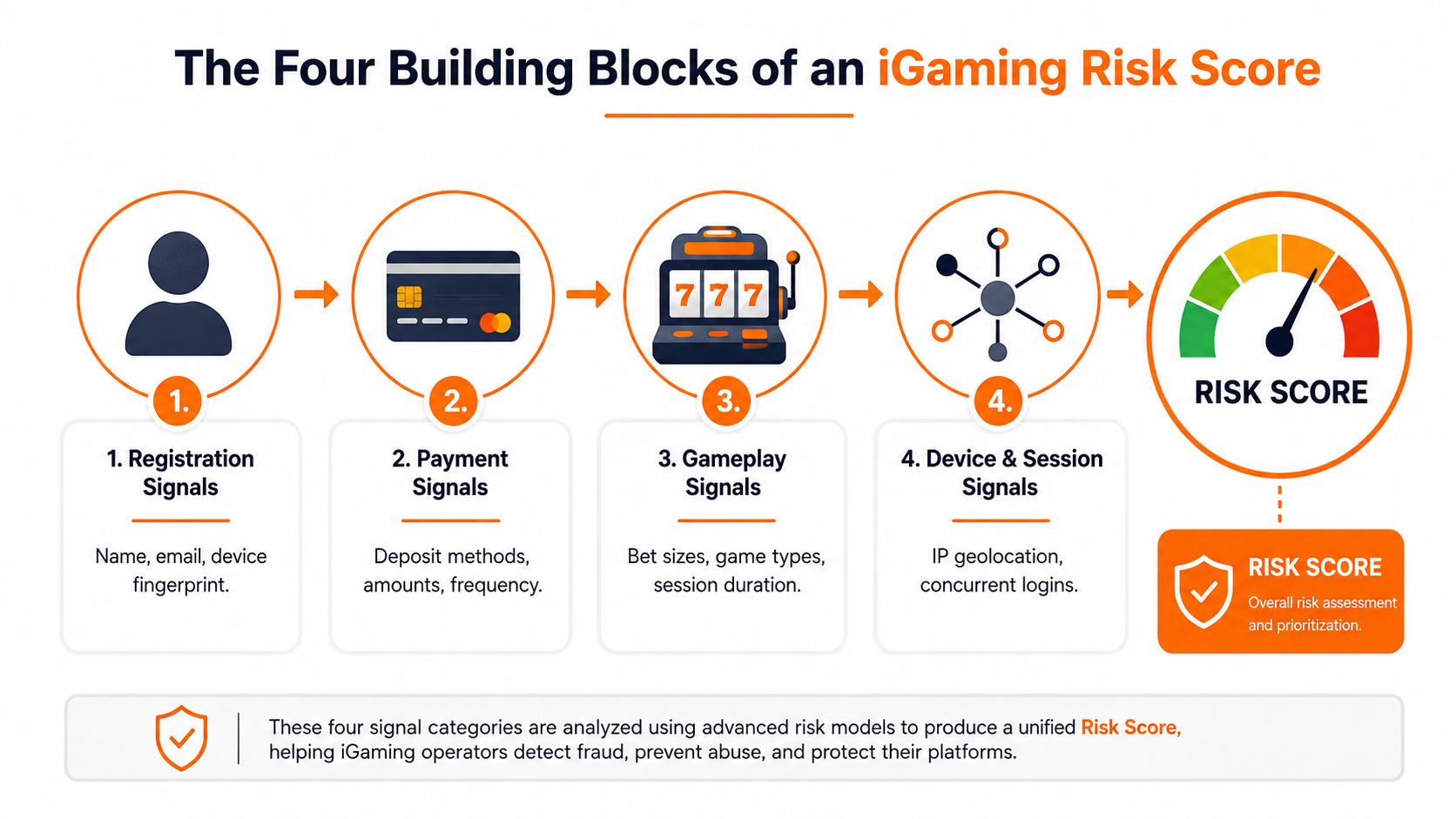
The first layer collects raw signals from registration, payments, gameplay, devices, and sessions. Examples include identity details, deposit methods, transaction history, bet behavior, geolocation, device fingerprints, login concurrency, and network relationships. A real-time fraud architecture can ingest hundreds or even thousands of signals for a single event, including user behavior, device intelligence, geolocation, transaction history, and linked entities, as described in this overview of fraud risk scoring software for banks.
Raw data isn't yet a decision. The platform transforms it into engineered features that make behavior comparable. Useful features include deposit velocity, the ratio of IP addresses to accounts, the distribution of bet sizes compared with a player's history, repeated payment-method usage, and changes in session intensity.
The score needs an action contract
The score itself should be calibrated to a defined scale, such as a 0 to 1000 score, alongside interpretable bands such as low, medium, high, and critical. The exact scale matters less than consistency. Analysts need to know which evidence moved the score, how much confidence the system has, and what each band permits.
The action layer maps the result to an operational route:
- Auto-approve: Release the event when controls are satisfied and risk is within tolerance.
- Soft review: Request an additional verification step without immediately blocking the customer.
- Manual hold: Pause the transaction and open a case with the relevant evidence attached.
- Hard block: Stop the event where policy, sanctions, self-exclusion, or confirmed abuse requires it.
A unified decision packet should contain the event, score, contributing features, triggered rules, model reason codes, prior actions, and recommended next step. That approach aligns with risk-management best practices, because the score becomes part of a controlled workflow rather than another dashboard metric.
Scoring Methodologies Operators Choose Between
Operators usually adopt methodologies as a maturity ladder, not as mutually exclusive alternatives. Rules provide hard boundaries, statistical models add calibrated weighting, and machine learning helps detect patterns that fixed logic can't express.
Rule-based scoring
Rule-based systems use explicit conditions, blacklists, velocity caps, and policy thresholds. They're fast, transparent, and easy to explain during an audit. If a payment method is linked to a confirmed abuse network, or a prohibited jurisdiction is detected, a deterministic rule can enforce the control without waiting for a model interpretation.
The weakness is brittleness. Rules tend to multiply as analysts respond to new incidents, and overlapping exceptions can produce contradictory outcomes. Pure rules also struggle with behavior that is suspicious only in combination. A deposit may be ordinary, a device may be common, and a betting pattern may be plausible, yet the relationship between all three can indicate coordinated abuse.
Statistical and scorecard models
Weighted-sum, logistic, and scorecard models sit between rigid rules and opaque machine learning. They assign interpretable weight to variables and can estimate the relationship between signals and outcomes. This makes them useful for operators with a capable data analyst who needs more nuance without losing a clear explanation.
Statistical models still need sound labels, stable features, calibration, and validation outside the training sample. They also depend on the operator defining the outcome carefully. Chargeback risk, bonus abuse, AML escalation, and responsible-gaming intervention aren't interchangeable targets.
Machine learning
Machine-learning models can capture non-linear relationships across large event histories. Gradient-boosted trees are often practical for tabular player and transaction data, while sequence models can represent changes across sessions. The trade-off is governance. A model may rank risk effectively while making it harder for an analyst to explain the decision to a customer, regulator, or payment partner.
AML guidance recommends a hybrid approach, using rules for policy-driven controls and machine learning for behavioral and network risk. It also stresses validation, explainability, and documentation. In one reported AML implementation benchmark, the model produced a ROC score of 0.86 on training data and 0.83 on validation data, demonstrating retained discrimination outside the training set, as reported in this guide to effective AML risk-scoring models.
| Dimension | Rule-Based | Statistical / Scorecard | Machine Learning |
|---|---|---|---|
| Best fit | Explicit policy and compliance controls | Weighted, explainable prioritization | Complex and changing behavioral patterns |
| Strength | Fast, auditable, deterministic | Clear contribution of variables | Captures interactions and non-linear patterns |
| Weakness | Brittle and maintenance-heavy | Depends on stable labels and calibration | Harder to explain and govern |
| Operator requirement | Strong policy ownership | Data analysis and validation capability | Reliable historical data, monitoring, and model governance |
| Recommended role | Hard floor for prohibited or mandatory actions | Baseline risk layer | Long-tail detection and ranking |
For most operators, the sensible default is hybrid. Rules enforce mandatory controls, statistical logic creates a stable baseline, and ML ranks ambiguous cases. Every manual override should be logged with the user, reason, timestamp, and resulting action. Teams designing a broader sportsbook risk-management operating model should also separate product risk from player risk, because an unusual market can affect exposure even when the customer appears legitimate.
How Real-Time Scoring Works Inside an Operator Stack
A live scoring loop starts when the event bus receives a meaningful event. That might be a KYC submission, deposit, withdrawal, bet placement, login, payment-method change, or account-linkage update. The event should carry a stable player identifier, product context, jurisdiction, currency, channel, and transaction metadata so the engine can evaluate it consistently.
The scoring service then retrieves the relevant feature state. It may pull a device fingerprint, velocity counters, historical player profile, payment-method relationships, prior case outcomes, KYC status, and current wallet exposure. The engine combines those features with applicable rules and model outputs, then returns a decision packet within the operator's defined latency budget. A fast path can support immediate approve, review, or block decisions, while heavier investigations run asynchronously.
Consider three different events:
- First-time payment behavior: A first-time €500 Skrill deposit can be routed to source-of-funds review when the player's identity confidence, payment history, and jurisdictional requirements don't support automatic release.
- Deposit and withdrawal symmetry: A same-method deposit-withdrawal pattern can trigger a chip-dumping or payment-cycling check when the transaction sequence conflicts with expected play.
- Linked-account activity: Several accounts sharing a device cluster, payment relationship, or network pattern can be escalated to fraud operations even if no single account crosses a hard threshold.
The score must remain connected to the workflow. An engine that returns a number but leaves orchestration to manual interpretation hasn't solved the operator's problem.
| Event Type | Key Features Pulled | Target Latency | Score Outcome | Routing Action |
|---|---|---|---|---|
| KYC submission | Identity confidence, document status, jurisdiction, linked accounts | Real time | Identity and compliance risk | Approve, step-up, or KYC queue |
| Deposit | Method history, velocity, device, player profile | Real time | Payment and fraud risk | Release, monitor, or hold |
| Withdrawal | Turnover context, payment relationships, prior alerts | Real time | Payout and AML risk | Release, enhanced review, or hold |
| Bet placement | Market, stake behavior, account links, device context | Real time | Product and behavioral risk | Accept, limit, review, or block |
| Session update | Login pattern, geolocation, concurrent access | Near real time | Account-integrity risk | Continue, challenge, or escalate |
Between sessions, asynchronous jobs should update counters, graph relationships, labels, and player profiles. The next decision then starts with a warm feature state instead of reconstructing history from scratch. IBM's description of milestone risk estimation illustrates the same operating principle in another domain. Its model uses historical work items, estimates the probability of non-completion, and updates the dataset daily to improve predictions, as explained in IBM's milestone risk estimation documentation.
Integration Points Across Wallet, KYC, Payments, and Odds
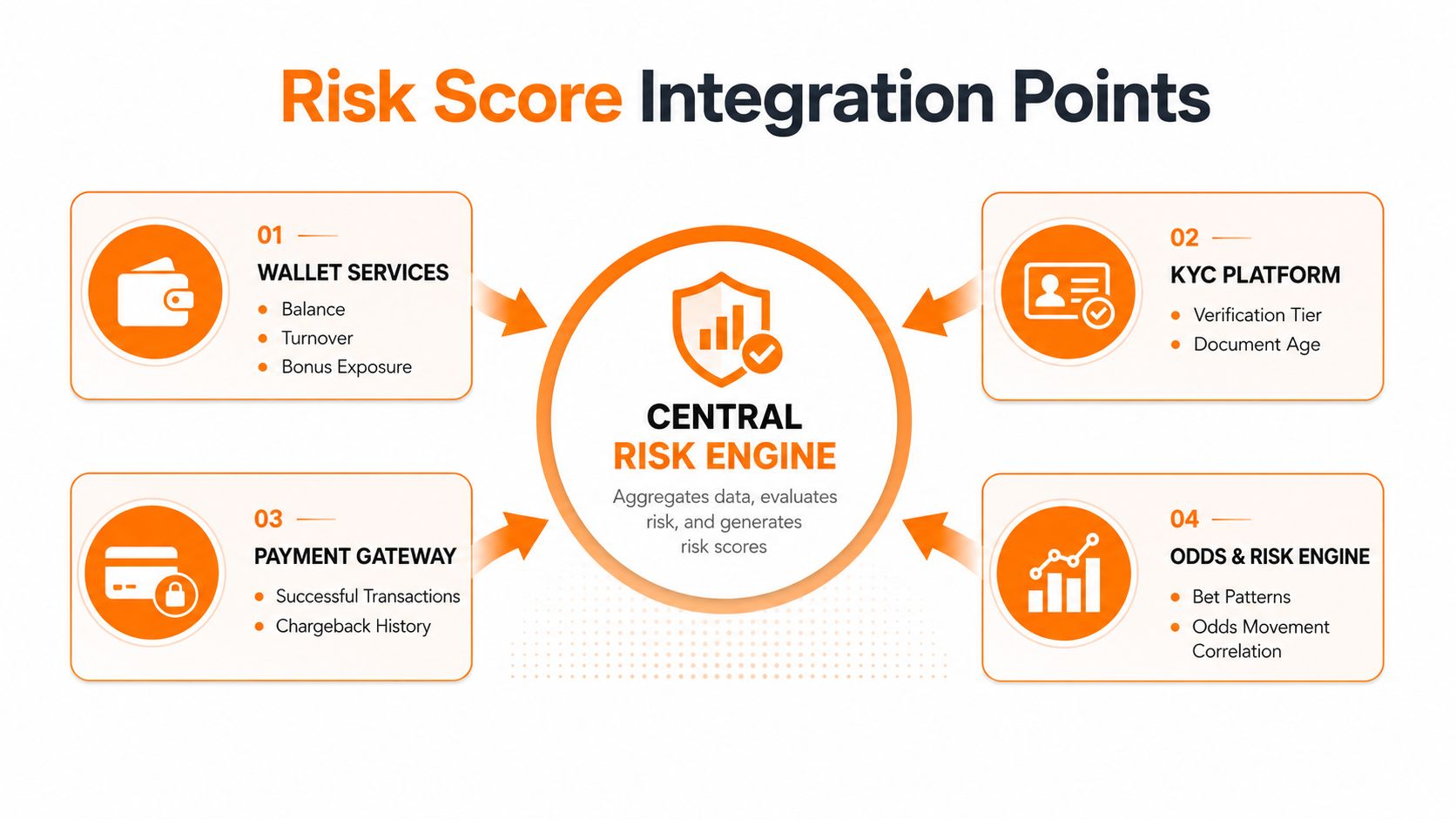
A risk engine works best beside the transactional services, not as a detached after-the-fact reporting tool. The wallet knows the financial state, KYC knows identity confidence, payments know processor behavior, and the odds or trading layer knows product exposure. The score service combines those inputs, while orchestration decides whether to release, hold, challenge, or escalate.
The integration map
Wallet services       \
KYC and AML platform   \
Payment gateway         >  Risk engine  >  Orchestration  >  Approve, hold, challenge, block
Odds and trading feed  /
Device and session data/
The wallet should provide balance, turnover, bonus exposure, pending withdrawals, and currency context before every relevant score call. Without that state, the same deposit can look identical for a new player and an established player with a long, consistent history.
KYC and AML services contribute verification tier, document freshness, sanctions and PEP results, source-of-funds status, and account relationships. Payment gateways add successful transaction history, declined attempts, processor risk signals, chargeback history, and method velocity. The odds and trading feed adds bet patterns, market type, odds movement correlation, and exposure context, especially for live or unusual markets.
The contract between modules should be explicit:
- Risk service: Reads event and player state, calculates signals, returns score, reason codes, and recommended action.
- Transactional services: Own balances, payments, bet acceptance, settlement, and identity records.
- Orchestrator: Applies jurisdiction, product, and policy controls, then executes release, hold, challenge, or escalation.
- Case management: Stores evidence, analyst decisions, overrides, communications, and closure outcomes.
A unified wallet architecture can reduce the handoffs between casino and sportsbook activity. The practical value of a multi-currency wallet isn't only payment convenience. It also gives the scoring layer a consistent view of balances, turnover, exposure, and movement across products and currencies.
The score service should remain read-only on transactional state. That separation prevents a model response from directly mutating a balance or settling a bet, while still allowing orchestration to enforce a controlled decision.
Compliance, Responsible Gaming, and the Multi-Dimensional Score
A fraud score isn't the same thing as an overall player-risk score. iGaming operators manage several different risk dimensions, and a single number can hide the distinction between a payment threat, an AML concern, an identity problem, and a responsible-gaming intervention.
A practical composite model should combine likelihood, financial impact, regulatory exposure, and operational or reputational impact. Recent compliance guidance argues for recurring model updates rather than one-time static heat maps, with the weighting adjusted as business mix, channels, and jurisdictions change. The guidance on compliance risk assessments addresses that broader approach.
Four dimensions need separate evidence
Payment and bonus fraud focuses on the likelihood of chargebacks, payment abuse, promotion exploitation, collusion, and account takeover. The relevant evidence includes payment relationships, device clusters, deposit and withdrawal sequences, bonus qualification behavior, and transaction velocity.
AML and sanctions exposure uses a different evidence set. It may include PEP or sanctions results, source-of-funds evidence, transaction patterns, jurisdiction, adverse information, and network relationships. A high AML score shouldn't automatically be interpreted as proof of fraud. It should trigger the documented control appropriate to the jurisdiction and risk appetite.
Identity integrity measures confidence that the account belongs to the person represented by the registration and KYC evidence. Document mismatch, repeated identities, synthetic information, age concerns, and linked accounts belong here.
Behavioral risk covers player protection signals. Loss chasing, deposit spikes, unusual session intensity, rapid changes in stake behavior, and repeated interaction with responsible-gaming controls may require intervention even when payment fraud likelihood is low.
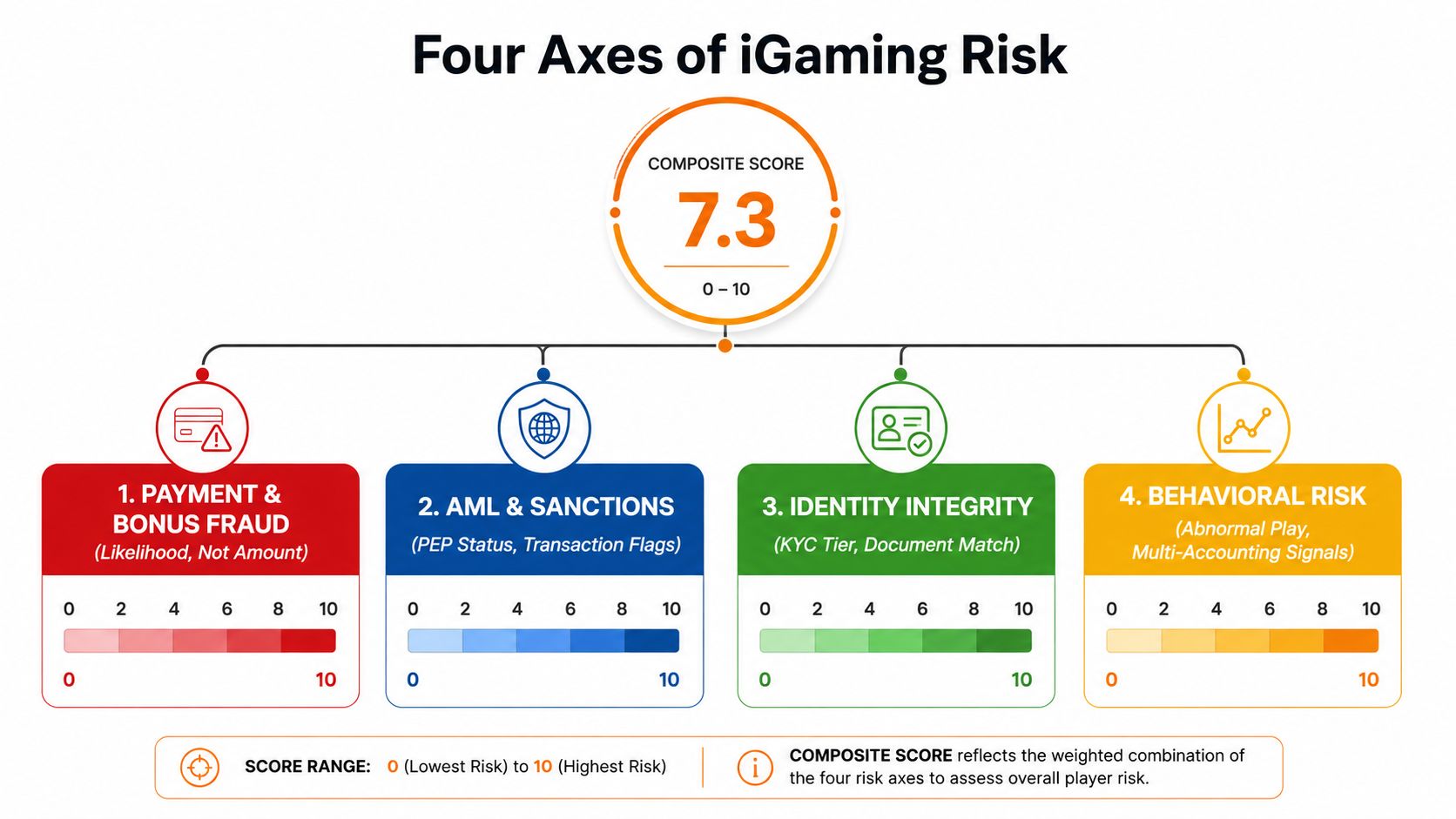
The analyst screen should show a composite score plus an axis breakdown. Compliance needs to understand the AML rationale, responsible-gaming officers need behavioral context, and finance may need payout exposure. That design keeps MGA, NJR, and AMLD controls auditable without forcing every team to interpret the same opaque label.
A score must also respect hard controls such as self-exclusion matches, sanctions restrictions, and mandatory verification requirements. Those controls should override a favorable aggregate score. A player can have low payment risk and still require an immediate responsible-gaming or identity action.
KPIs, Validation, and Tuning That Keep the Score Honest
Launching a model doesn't make it accurate. An operator needs a validation routine that compares predictions with outcomes, tracks operational cost, and detects drift as player populations and campaigns change.
The first review cycle should examine both technical and operational performance. For AML, precision and recall describe an important trade-off. Precision improves as false positives fall, while recall improves as false negatives fall. A threshold that maximizes one can damage the other, so calibration must reflect review capacity, regulatory obligations, and the consequence of missed activity.
A first-90-day validation checklist
- Backtesting: Compare score distributions with known chargebacks, multi-account findings, confirmed bonus abuse, and SAR outcomes where legally and operationally appropriate.
- Cutoff analysis: Measure precision and recall at each proposed action band instead of selecting thresholds by intuition.
- Queue economics: Track alert-to-action ratio, reviewer throughput, queue depth, and the time required to reach a defensible decision.
- Override review: Record how often analysts override the engine, which bands produce the most overrides, and whether override reasons reveal missing features.
- Drift monitoring: Separate population changes from model deterioration. A large promotion, new payment method, or new jurisdiction can alter behavior without indicating a broken model.
- Outcome feedback: Feed closed-case results back into labels, but keep confirmed, suspected, and unresolved outcomes distinct.
| KPI Category | Metric | Target / Threshold | Owner |
|---|---|---|---|
| Model quality | Precision and recall by cutoff | Set from risk appetite and review capacity | Data science and compliance |
| Discrimination | AUC or KS | Compare with approved validation baseline | Model owner |
| Stability | PSI and feature drift | Escalate material distribution change | Data science |
| Operations | Mean time to decision | Define by event type and control requirement | Fraud operations |
| Workflow | Override rate | Investigate persistent band or feature problems | Risk operations |
| Capacity | Manual-review queue depth | Keep within staffed handling capacity | Operations leadership |
| Governance | Documented model and rule changes | Require approval and audit trail | Compliance and model governance |
Vendor-provided scores aren't automatically calibrated for your player base, products, or jurisdictions. A sportsbook score may behave differently from a casino score, and a payment event may require a different action threshold from a bet placement.
A quarterly review should bring together data science, compliance, fraud operations, payments, responsible gaming, and CRM. Review outcomes, campaign effects, new attack patterns, and analyst feedback. Then adjust features, weights, rules, and action bands under change control rather than editing production logic informally.
A Practical Rollout Plan for B2B Operators
Start with visibility, not sophistication. A platform team should inventory event sources across KYC, wallet, payments, odds, device intelligence, CRM, and case management, then confirm that the events needed for scoring are captured with stable identifiers and usable timestamps.
The first week
Select one high-volume abuse vector, such as bonus abuse or card fraud, and build a rule-based minimum viable system around it. Run the rules in shadow mode first. The engine should calculate scores and recommended actions without changing customer outcomes, allowing the team to compare alerts with analyst decisions and identify missing context.
Assign ownership immediately. Compliance should approve policy boundaries, fraud operations should define case actions, engineering should own reliability and event contracts, and a named model owner should control changes.
The first month
Add a statistical layer and define documented risk bands. Each band needs an owner, action, evidence requirement, and escalation path. Connect the result to case management so analysts don't copy findings between tools.
Align KYC, payment, AML, bonus, sportsbook, and responsible-gaming triggers to a shared orchestration model, while preserving the separate axis explanations described earlier. A unified score should simplify routing, not erase accountability between teams.
The first quarter
Introduce supervised machine learning for the most valuable risk types once labels and feedback are reliable. Run shadow scoring beside the rules engine, compare disagreements, validate the model outside its training data, and test whether the new ranking improves reviewer decisions without creating unacceptable friction.
Formalize recurring tuning. Record who can alter a threshold, who can override a result, what evidence an override requires, and how long those decisions remain reviewable. Keep model versions, rule versions, feature definitions, and action policies connected in the audit record.
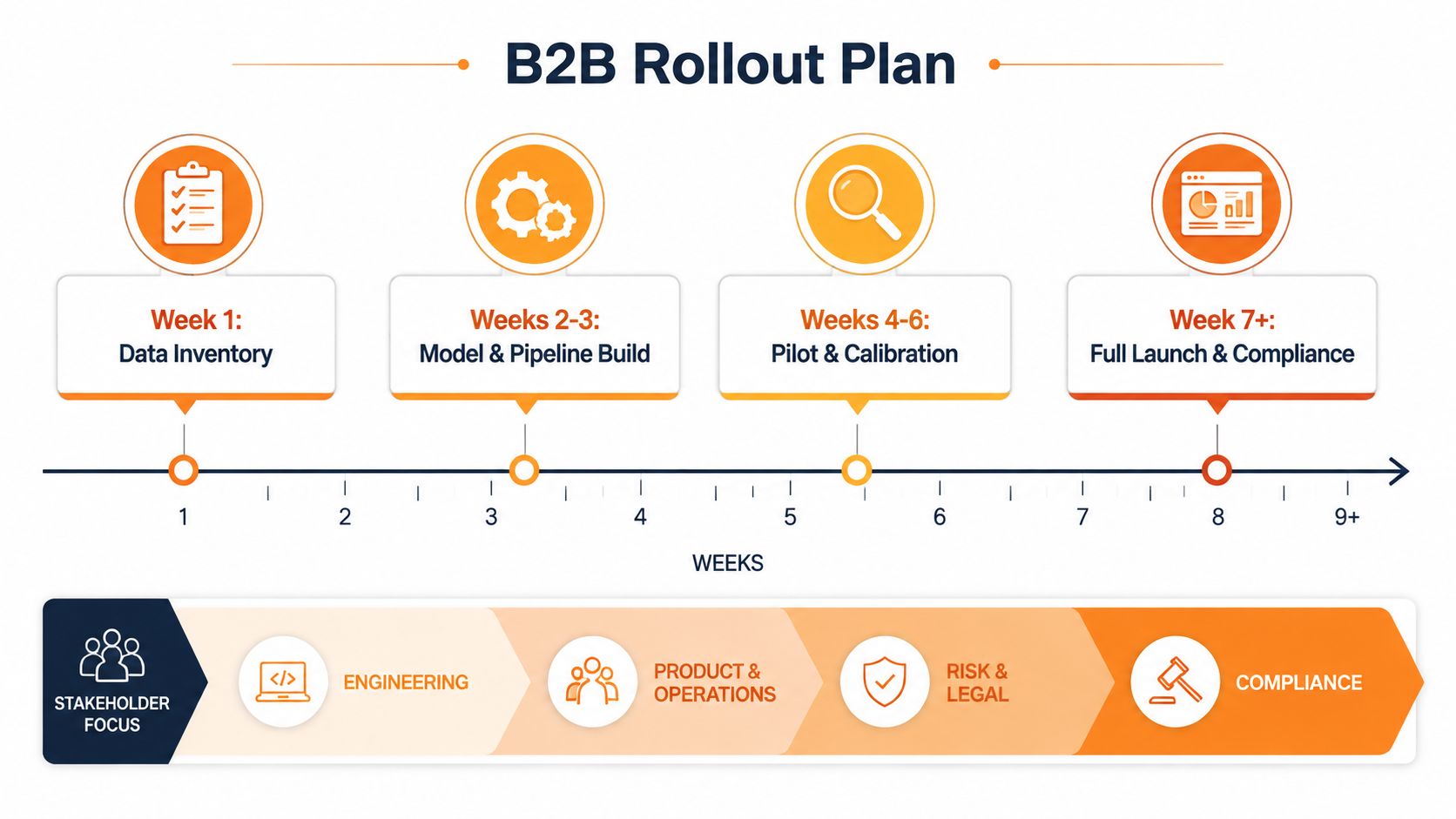
The architecture should make this rollout achievable without stitching every signal through fragile point-to-point integrations. A consolidated iGaming platform can bring the wallet, payments, KYC, sportsbook, casino, and compliance controls into one operational context, reducing the number of handoffs the scoring team must maintain.
NexGrate provides a turnkey white-label iGaming platform with unified casino and sportsbook operations, wallet services, payments, KYC/AML workflows, risk rules, responsible-gaming controls, and audit-ready compliance tooling. Visit NexGrate to explore how its integrated architecture can help your team turn fragmented player and transaction signals into faster, more explainable risk decisions.