
Most advice on sportsbook risk management starts and ends with one instruction: balance the book. That advice is incomplete. A modern operator can balance exposure on a market and still lose control through fraud, weak settlement logic, poor wallet controls, or compliance failures that block profitable activity after the bet has already reached the front end.
The bigger mistake is organizational. Many teams still treat risk as a trading-desk function instead of a platform capability. That worked when pre-match books moved slowly and manual intervention could cover the gaps. It breaks down when in-play odds move constantly, promotions are personalized, wallets update instantly, and compliance teams need enforceable controls rather than policy documents.
The practical version of sportsbook risk management sits across the whole stack. Odds feeds shape price risk. Wallet behavior shapes fraud signals. KYC and affordability controls shape what action is legally acceptable. Back-office rules decide whether a bet is accepted, repriced, limited, referred, or blocked. The operators that build risk this way don't just protect margin. They create a business that can keep trading under pressure.

A lot of teams learn this late. They buy a sportsbook feed, configure basic limits, and assume the rest can be handled with manual review. It can't. If your trading, payments, and player protection controls don't share data, you'll spend your time reacting to avoidable problems instead of running a disciplined operation. That's why strong compliance workflows have to be connected to sportsbook decisioning from the start, not layered on after launch.
Table of Contents
- Introduction Beyond Balancing the Books
- The Six Core Pillars of Sportsbook Risk
- Designing and Automating Your Risk Rules
- Active Trading and Dynamic Limit Strategies
- Mastering In-Play Exposure and Monitoring
- Tech Integration on a White-Label Platform
- A Phased Roadmap for Implementation
Introduction Beyond Balancing the Books
Calling risk management “book balancing” is like calling air traffic control “runway scheduling.” It describes one visible task and ignores the system that keeps the operation safe. In sportsbook operations, that narrow view leads to bad architecture. Teams optimize for payout exposure while leaving identity, wallet events, settlement exceptions, and compliance triggers in separate tools that don't talk to each other.
That separation creates the wrong incentives. Traders may want to take a profitable bet. Compliance may need to stop it. Fraud may already have flagged the account behind it. If those decisions don't meet in one rules layer, the operator gets inconsistency at the exact moment consistency matters most.
A more durable model treats sportsbook risk management as a set of connected controls with a single operational purpose: accept the right bets, reject the wrong ones, and document every decision. That sounds simple. It isn't.
Risk isn't one queue in the back office. It's every point where the platform decides whether activity is acceptable, affordable, authentic, and financially tolerable.
The primary dividing line in 2026 isn't whether an operator has a trading team. It's whether the platform can pass signals between odds, wallet activity, identity status, promotional eligibility, and settlement logic fast enough to support that team. Operators that still rely on manual reconciliations usually discover the weakness during peak live trading, not during testing.
The Six Core Pillars of Sportsbook Risk
A sportsbook that only tracks exposure is underbuilt. Real risk control sits across pricing, account behavior, wallet movement, settlement, and regulatory enforcement. On a modern white-label sportsbook platform stack, those signals have to meet in one operating layer or the team will make conflicting decisions under pressure.
Operations usually start with three practical pillars. Liability management, stake acceptance, and player profiling still form the base because they answer the first three questions every book faces. What can we lose, what should we take, and who is trying to bet? That framing aligns with Kambi's breakdown of sportsbook risk management pillars.

That base is not enough for day-to-day control. In production, losses and compliance failures usually cross systems. A bad price can become a fraud event. A settlement error can become a wallet dispute. A player protection trigger can force a trading decision.
Liability and market risk
Liability risk is the direct payout threat on a given outcome, market, event, or related cluster of selections. If exposure builds faster than your traders or automated limits react, one result can wipe out margin for the day. The practical controls are familiar. Caps by market, trader alerts, auto-suspension thresholds, and limit rules tied to event state.
Market risk is a pricing problem with an operational tail. It appears when odds no longer reflect the best information available or when the feed, model, and trader desk fall out of sync. That can happen after a lineup change, a feed delay, unusual action in lower-tier competitions, or poor handling of correlated derivatives. Books often focus on total liability and miss the fact that the price itself has already become the bigger weakness.
| Pillar | Main question | Typical control |
|---|---|---|
| Liability | What do we lose if this outcome lands? | Exposure caps, suspensions, stake limits |
| Market | Are our prices still defensible right now? | Odds adjustment, feed validation, trader intervention |
The trade-off is straightforward. Tight liability controls protect the book but can push away profitable volume if they trigger too early. Loose controls buy turnover but leave traders trying to repair exposure after the market has already moved.
A short explainer helps here before the video:
Credit and fraud risk
Credit risk matters anywhere the sportsbook confirms value before funds are fully settled or before payment behavior is understood. The exact shape depends on the operating model. Some books see it mainly in chargebacks, payment reversals, and withdrawal timing. Others face it through agent structures, deferred settlement arrangements, or weak payment routing controls.
Fraud risk cuts across onboarding, payments, promotions, and trading. It includes account takeover, synthetic identity use, coordinated bonus abuse, collusive betting, wallet cycling, and attempts to exploit slow manual reviews. In practice, fraud controls fail when each team sees only its own slice of the account.
Operational test: If a user can move from onboarding to bonus claim to bet placement to withdrawal without a shared risk score following them, your controls are fragmented.
This is where platform design matters. If fraud flags do not reach the bet acceptance layer in real time, the sportsbook keeps taking action from accounts the payments or compliance team already distrusts.
Settlement and regulatory risk
Settlement risk starts as a grading problem and quickly becomes a platform problem. An incorrect or delayed result affects wallet balances, bonus qualification, customer communications, affiliate calculations, and support queues. If the platform cannot trace and reverse those dependencies cleanly, a small trading mistake turns into a multi-team incident.
Regulatory risk now sits inside sportsbook operations, not beside it. Operators have to connect affordability checks, safer gambling controls, geo-restrictions, document status, and audit logging to the same decision flow that handles odds, limits, and acceptance. If those controls live in separate tools with delayed sync, the sportsbook will eventually accept bets it cannot justify or block bets it should have taken.
The sixth pillar is reputational risk. It usually shows up after one of the other five has already failed. Customers rarely see the root cause. They see voided bets, inconsistent limits, delayed withdrawals, or different answers from support and trading. That damage comes from weak coordination across the platform, not from one bad weekend of results.
Designing and Automating Your Risk Rules
The back office shouldn't just store settings. It should make decisions. If your rules engine only supports static max stakes and a basic country blacklist, you're not automating sportsbook risk management. You're preserving manual work.
The first upgrade is conceptual. Build rules around player state and market state together. A stake request should never be judged on amount alone. It should be evaluated against account verification status, recent deposit behavior, promo status, wallet activity, betting pattern, market liquidity, and current exposure on related selections.
Build rules around player state, not just bet size
A practical rules stack usually includes:
- Identity-driven rules that tighten access when KYC is incomplete, documents are pending, or account details don't align with prior activity.
- Velocity rules that react to rapid deposits, frequent bet placement bursts, repeated stake resizing, or unusual combinations of cash-in and cash-out behavior.
- Segment rules that distinguish experienced price-sensitive bettors from recreational players and route their bets differently.
- Correlation rules that stop apparently separate wagers from creating concentrated risk on one match narrative.
These rules work best when they trigger actions, not just alerts. A modern platform should be able to accept automatically, refer to manual review, lower the maximum stake, remove a promotion, suspend a feature, or reject the bet with an audit trail.
That audit trail matters. Teams often focus on the decision and forget the record. But when support asks why a bet was refused, or compliance asks why a player was restricted, “the model said so” isn't enough.
For operators evaluating architecture, the important question isn't whether a system has a risk page. It's whether the sportsbook, wallet, promotions engine, and player controls share one decision layer through an integrated product stack.
Connect fraud signals to promo and pricing decisions
Many setups break under these circumstances. Fraud tools flag accounts. Marketing keeps sending offers. The sportsbook still prices bet-builders and parlays the same way for everyone. That separation leaks value.
The gap is well described in LSports' discussion of risk-tiered bonus logic, which notes that operators need ways to adjust promotion value and bet-builder pricing for higher-risk users without creating avoidable churn or fairness complaints. That's the right operational problem. “Use AI” isn't the answer on its own.
What works better is a controlled hierarchy of responses:
- Reduce promotional generosity first for suspicious but not yet blocked accounts.
- Constrain specific products next such as bet-builders or high-variance combinations.
- Tighten stake acceptance where risk remains unresolved.
- Escalate to review or restriction when signals persist across wallet, identity, and betting behavior.
Don't jump straight from “normal customer” to “fully blocked.” Most profitable control frameworks use graduated friction.
What doesn't work is global punishment. When operators apply blunt restrictions to the full player base, they protect the book badly and damage retention at the same time. Better rules isolate the segment creating the risk and change the economics around that segment only.
Active Trading and Dynamic Limit Strategies
Automation handles repeatable logic. Traders handle context. A serious sportsbook still needs people who can interpret flow, challenge model assumptions, and act when the feed, the market, and the betting pattern stop agreeing with each other.
The biggest misunderstanding about trading is that it's mostly about line movement. It isn't. Good active trading is a sequence of decisions about confidence. How confident are you in the feed? In the opener? In the reaction speed? In the player hitting the number? In the relationship between this market and the rest of the event book?
Why trading precision is unforgiving
The margins are tighter than many new operators appreciate. Research published through the National Library of Medicine analysis on sportsbook pricing precision notes that with a 4.5% vig, a sportsbook has to estimate the true median outcome within 2.4 percentiles to maintain positive expected profit. That is a very small margin for error, and it explains why loose pricing discipline gets punished quickly.
This is also why arguments about “good enough odds” usually come from teams that haven't traded real volume under pressure. You don't need to be wildly wrong to become vulnerable. You only need to be wrong often enough, or slow often enough, in the same places sharp customers are paying attention.
A disciplined trading desk usually separates decisions into three lanes:
| Trading lane | Primary responsibility | Typical action |
|---|---|---|
| Opening | Set a defensible initial price | Launch with conservative confidence limits |
| Reactive | Adjust after information or flow changes | Reprice, limit, or suspend |
| Protective | Manage concentrated exposure | Reduce acceptance, hedge externally where allowed, close related markets |
Limits should reflect customer type and market conditions
Static limits are easy to configure and hard to defend. They ignore who the customer is and what the market can support. A sharper approach uses different acceptance logic across segments and market types.
Examples of practical limit behavior include:
- Recreational players in liquid markets can often be accepted faster and more generously because their action is useful and less likely to target stale prices.
- Known professional or highly efficient bettors may still be welcomed, but at lower limits or with more referral logic, especially on low-coverage events.
- Niche and lower-information markets need tighter ceilings even when the customer profile looks benign.
- Breaking-news moments call for immediate temporary tightening until price confidence returns.
A trading desk that can't change stake acceptance in seconds is forced to solve every problem through price alone. That's slow and expensive.
What doesn't work is pretending all customers should be treated identically at the sportsbook layer. Uniformity sounds fair. Operationally, it means you either over-limit valuable casual traffic or under-protect vulnerable markets.
Mastering In-Play Exposure and Monitoring
In-play is where weak operating models get exposed fast. Pre-match risk gives you time to review, discuss, and adjust. Live markets don't. Odds shift repeatedly, customers react to broadcast and data latency, and one event can reprice an entire cluster of linked markets in seconds.
That changes the job of monitoring. A risk dashboard for live betting isn't a reporting tool. It's a control surface.
The in-play desk needs a live operational view
Traders need to see live exposure by event, by market, and by outcome. They also need to understand how much of that exposure is recent, how much sits in high-volatility products, and whether suspicious activity is concentrated around specific accounts or entry points. If the dashboard only shows aggregate open bets, the desk is flying blind.
The same applies to margin. A headline hold view is useful for executives. It doesn't help the live desk if it masks a single market where payout risk is building quickly. Granularity matters more than elegance during a match.
A practical in-play setup should surface:
- Exposure concentration across primary and derivative markets
- Open suspension reasons so traders know whether the feed, price logic, or manual intervention caused the stop
- Bet acceptance latency because delays create avoidable stale-price exposure
- Unusual account clustering around a market just before a key event
What traders should see in real time
The best live desks use thresholds and escalation paths, not just visuals. An alert should force a next action. That may mean a limit cut, a temporary suspension, a review of the data feed, or a referral to fraud and compliance if account behavior looks coordinated.
A good operator also keeps settlement visibility close to the in-play team. Some of the worst live incidents don't come from taking the wrong bet. They come from reopening, resettling, or voiding badly after a fast sequence of market changes.
Plainly put, in-play sportsbook risk management is won by response design. Dashboards matter. But the value comes from linking every alert to a permitted action and making sure the people on shift can execute it without waiting for three departments to agree.
Tech Integration on a White-Label Platform
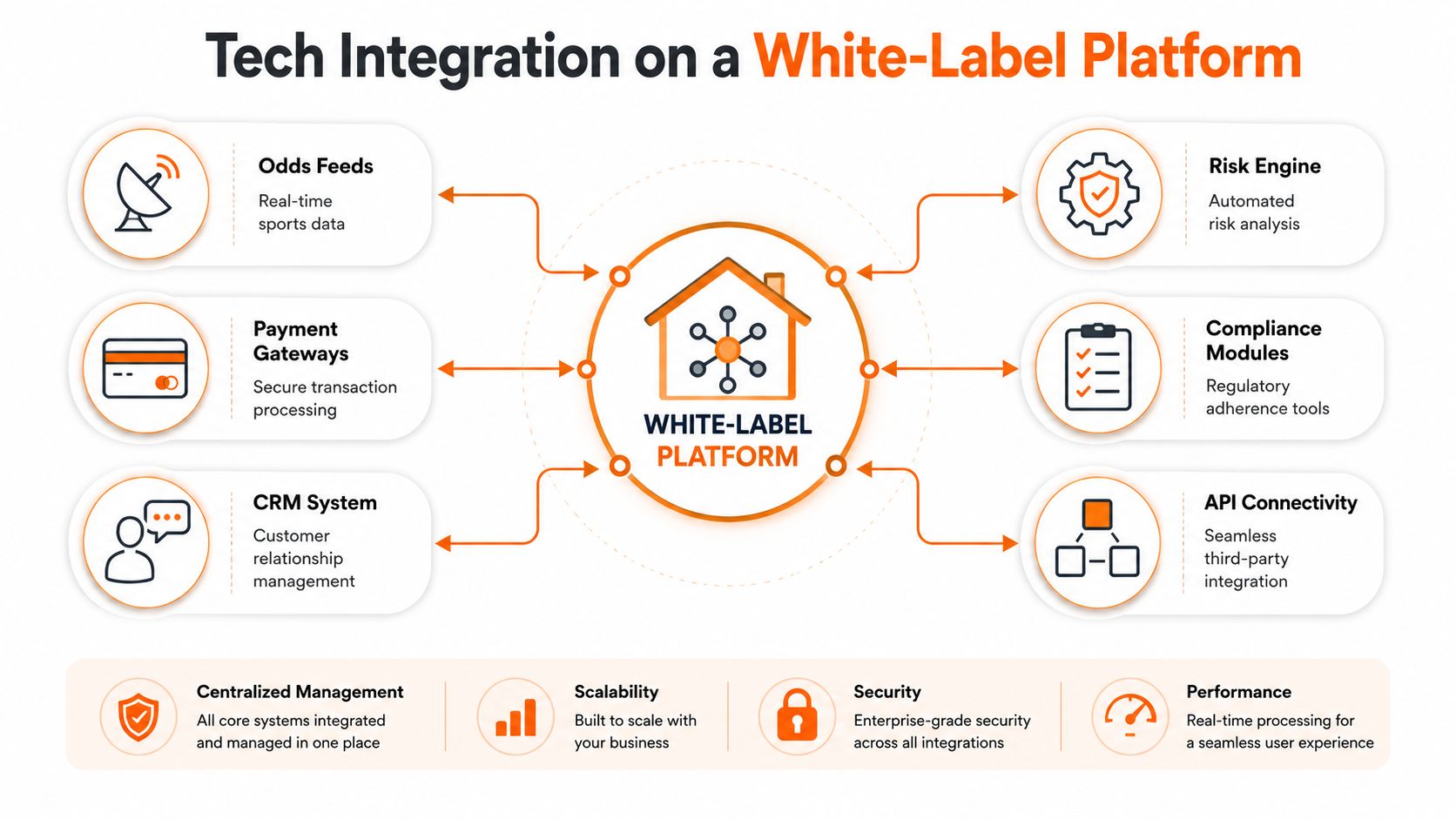
A white-label platform only helps risk if the integrations are deep enough to support decisioning. Putting sportsbook, payments, PAM, and compliance under one commercial contract isn't the same as running one operational system. The test is whether one event in one module can change behavior in another module immediately and predictably.
How the data should move
A strong integrated stack follows a clean flow:
| Component | What it contributes | Risk impact |
|---|---|---|
| PAM and wallet | Identity status, balance, transaction history, restriction flags | Defines account eligibility and behavioral context |
| Odds feed and trading engine | Market state, pricing, suspensions, confidence level | Defines current price and acceptance conditions |
| Bet processing and settlement | Wager validation, result application, exception handling | Prevents downstream disputes and wallet errors |
| Compliance and risk engine | KYC, affordability, AML, RG triggers, rule actions | Governs whether action is allowed at all |
When these components are connected properly, one signal can trigger a chain of controls. A verification issue can reduce stake acceptance. A responsible gaming flag can stop a bonus offer before the next login. A settlement exception can halt withdrawals until finance and trading confirm the correction path.
Sportsbook risk rarely begins and ends inside the sportsbook engine, so operators looking at platform-level architecture for betting operations should judge it by signal sharing and action orchestration, not by the number of modules on a features page.
What breaks on fragmented stacks
Fragmented systems create three recurring failures.
First, decision lag. The fraud system knows something the sportsbook doesn't know yet. By the time the information is passed manually, the account has already placed more bets or redeemed more value.
Second, contradictory outcomes. Compliance restricts a player, but the CRM engine still sends an offer. Support promises one thing, trading enforces another. Customers notice inconsistency faster than back-office teams expect.
Third, poor auditability. Each vendor logs its own view, but nobody can reconstruct the full decision path easily. That becomes painful during disputes and worse during regulatory review.
Integrated risk isn't about convenience. It's about making one policy executable across the whole player lifecycle.
The white-label advantage appears when the platform behaves like one operating system for risk. Without that, the operator still carries the coordination burden even if the stack looks unified on paper.
A Phased Roadmap for Implementation
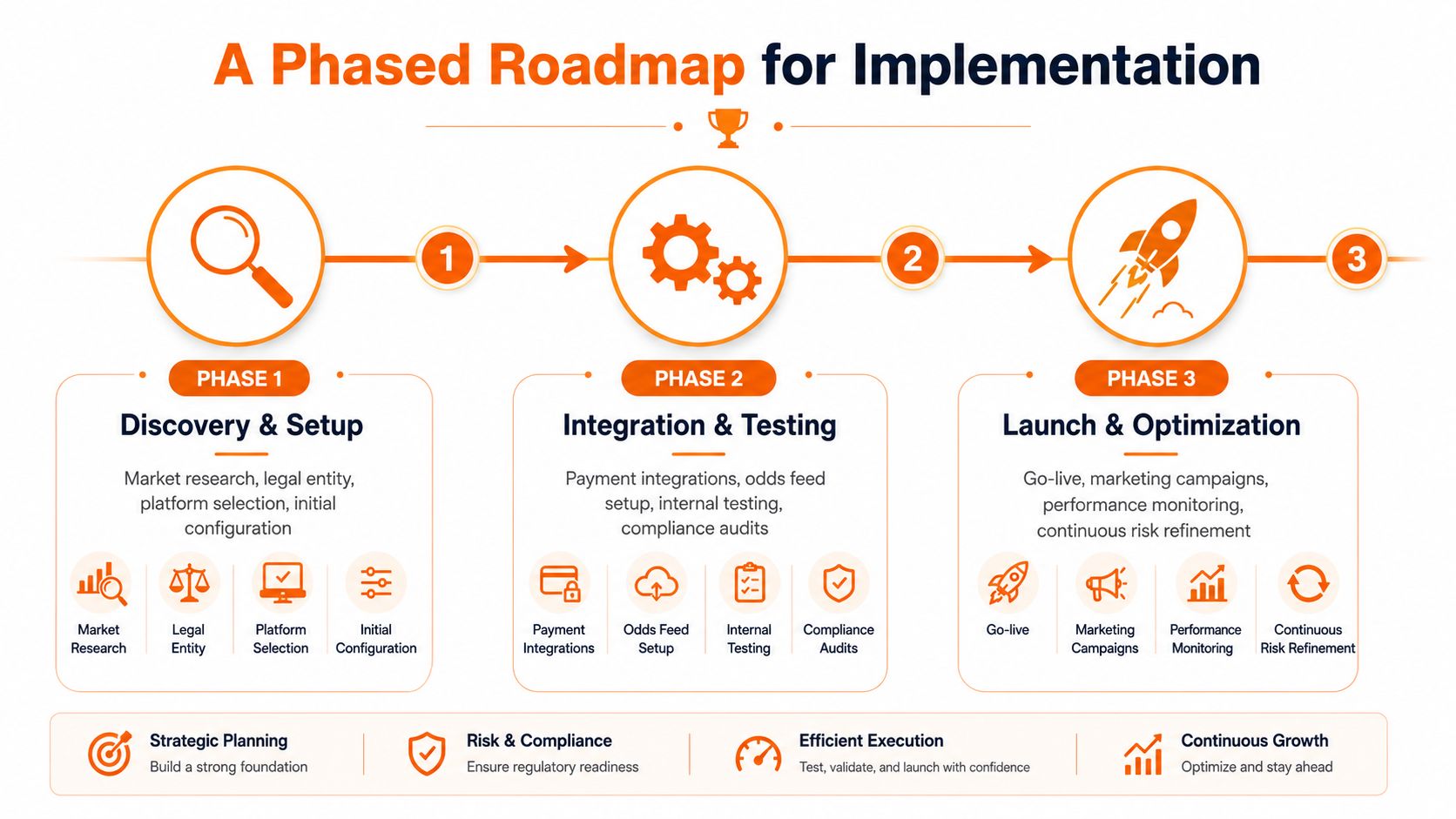
Risk setup is not a post-launch tidy-up task. It sets the commercial boundary of the book. If the platform can price and accept bets faster than it can assess wallet status, player restrictions, referral rules, and settlement exceptions, the operator is taking exposure it does not fully control.
Build the roadmap around operational dependency, not around a generic project plan. Some components can mature after launch. The controls that govern acceptance, restriction, and audit trail cannot.
Phase one setup and control baseline
Phase one is about making sure every accepted bet passes through the same control spine. That means global and market-level stake limits, exposure caps, trader permissions, wallet controls, KYC and AML status checks, responsible gaming restrictions, and manual referral paths must already be wired into the sportsbook workflow before day one.
On a white-label platform, this is the stage where integration quality shows up fast. Odds feed ingestion, wallet balances, player tags, compliance statuses, and back-office permissions all need to affect the acceptance decision in one sequence. If those checks sit in separate tools and rely on manual handoff, the launch team will spend its first month managing exceptions instead of managing the book.
Keep the launch scope tighter if needed. Fewer markets with clean acceptance logic, clear escalation paths, and complete audit logs beat a wide market menu that depends on operators fixing edge cases by hand.
Phase two live tuning and team routines
After launch, the job changes. The question is no longer whether controls exist. The question is whether they are calibrated well enough to handle real betting behavior without choking good volume.
Set a daily operating cadence early. Trading, fraud, compliance, payments, and support should review the same queue of referrals, rejected bets, disputed settlements, account restrictions, and false positives. Shared review matters because the fix is often upstream. A payments pattern may require a player tag change. A support dispute may expose a settlement rule gap. A cluster of manual referrals may point to a market limit that is too blunt.
Use the first live period to tune four areas:
- Player segmentation based on observed staking patterns, payment behavior, bonus usage, and account history
- Market acceptance rules where confidence, liquidity, and latency differ by sport and market type
- Alert thresholds so teams see the few signals that need action, not a wall of low-value noise
- Referral criteria so similar cases reach similar outcomes across shifts and teams
A common mistake here is broad restriction after a few sharp losses. In practice, that usually means segmentation is too coarse, limits are too static, or referral logic is not distinguishing informed action from normal variance.
Phase three automation and optimization
Once the baseline is stable, automate the repeatable decisions first. Limit changes for known low-risk segments, promo restrictions tied to player status, correlation checks, settlement exception routing, and account review triggers can move faster when the rules engine, wallet, and compliance modules share the same event stream.
The trade-off is straightforward. Automation cuts delay and reduces inconsistent handling. It also spreads bad logic quickly if the rule design is weak. For that reason, mature operators keep approval layers around high-impact decisions such as premium account treatment, major withdrawal holds, regulatory escalations, and disputes with reputational risk.
The target state is not maximum automation. It is controlled automation with clear ownership, override rules, and a full decision log.
A mature risk function accepts sustainable action, contains unsafe or unprofitable behavior early, and leaves a defensible record of why each decision was made.
If you're evaluating how to launch or upgrade sportsbook operations without stitching together separate systems, NexGrate offers a white-label platform that brings sportsbook, wallet, back office, payments, and compliance controls into one operating environment. That kind of integration makes risk rules easier to enforce, easier to audit, and easier to adapt as your book grows.