A player clears KYC, deposits successfully, and expects to place a bet. Instead, the casino team waits for a risk analyst, the sportsbook team checks a separate balance, finance reconciles a payment provider, and compliance searches across disconnected records. Nobody sees a single broken step, yet the player experiences one delayed operation.
That pattern is familiar to operators running separate casino, sportsbook, payment, CRM, and compliance tools. Workflow optimization isn't about adding another dashboard. It's about removing duplicate entry, unclear ownership, approval loops, and system gaps from the player journey while preserving the controls that regulated operations require.
Table of Contents
- Why Workflow Optimization Makes or Breaks iGaming Operations
- How to Audit Your Current Workflows and Define Success Metrics
- Optimizing the Seven Core iGaming Workflows on a Unified Platform
- Where Automation Delivers ROI and Where Human Review Must Stay
- Migration and Launch Checklist for Moving to a Unified Stack
- Sustaining Gains and Scaling Workflow Optimization Over Time
Why Workflow Optimization Makes or Breaks iGaming Operations
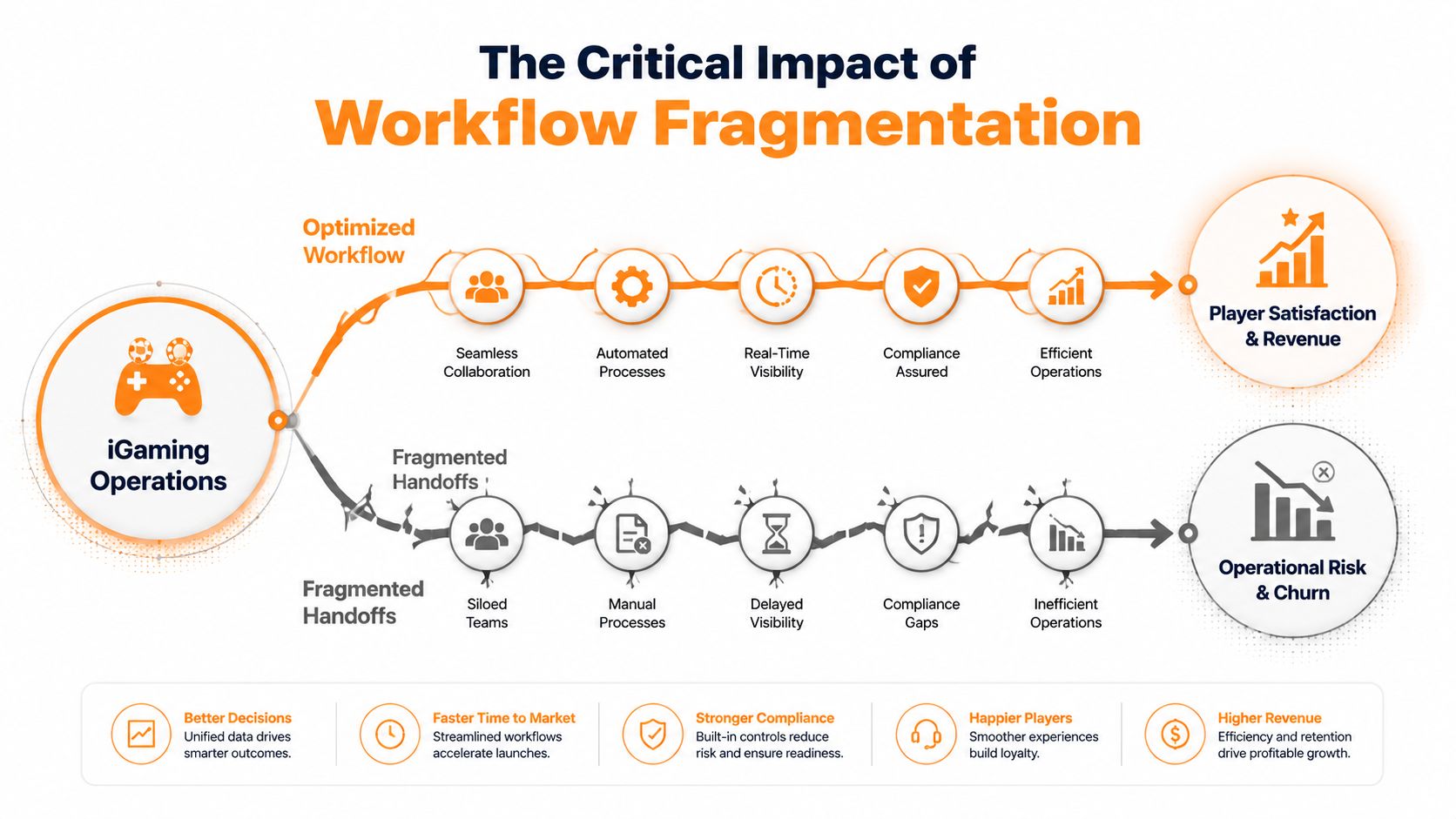
An iGaming operation can look busy and still perform poorly. A support agent may resolve a withdrawal query, a fraud analyst may review the same player, and a payments specialist may request information that already exists in the back office. Each team is working, but the workflow is forcing them to repeat work.
The hidden cost appears in places operators already measure: onboarding time, payment success, settlement accuracy, bonus redemption, complaint volume, and unresolved exceptions. A failed handoff between KYC and cashier can delay a legitimate withdrawal. A disconnected sportsbook settlement process can leave finance reconciling one result while trading works from another. A promotion launched without wallet logic can create manual bonus corrections and player disputes.
Fragmentation creates operational drag
The problem isn't limited to speed. Fragmentation makes accountability difficult. When a player record sits in one system, payment status in another, and risk notes in a third, the next employee has to reconstruct the situation before taking action. That delay also increases the chance of inconsistent decisions.
A unified platform changes the operating model by giving teams shared records, common wallet logic, consistent permissions, and connected approval paths. The objective isn't to remove every human decision. It's to ensure that people spend time on exceptions, judgment, and player protection rather than copying data between tools.
The business case is structural. A widely cited workflow benchmark says 60% of employees could save 30% of their time by automating routine tasks, while 74% of IT and engineering leaders say process automation has already helped their workforce save 11% to 30% of time spent on manual processes (workflow automation statistics). For an operator, the relevant lesson is that gains usually come from eliminating repetitive handoffs, validations, and approvals, not from attempting to automate an entire department.
A single wallet changes the economics
Casino and sportsbook teams often treat balances as a shared concern but manage them through separate operational routines. A single wallet gives both products one source of truth for deposits, withdrawals, bonus funds, wagering outcomes, and account restrictions. That reduces the need to reconcile the same player across separate ledgers.
The effect is strongest when configuration matches the operating model. KYC status should influence withdrawal rules. Risk flags should trigger the right review queue. Bonus funds should remain distinct from cash balances where the promotion requires it. Responsible gaming restrictions should apply consistently across products.
Operators don't need more isolated automation. They need connected workflow logic that follows the player from registration through payment, play, settlement, support, and retention.
How to Audit Your Current Workflows and Define Success Metrics
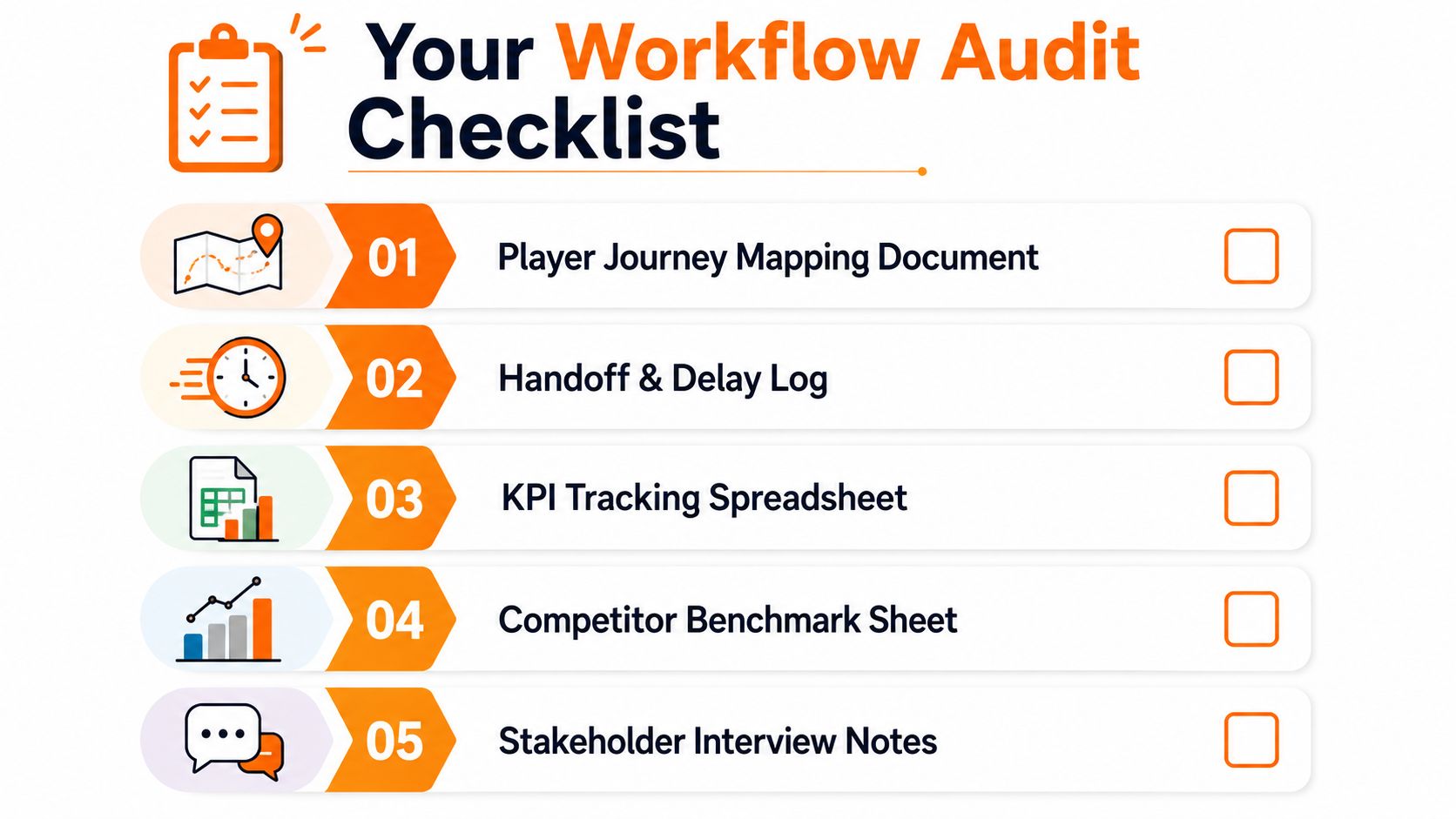
Start with evidence, not platform features. Before changing a rule or migrating a provider, select a real player journey and document every action from trigger to resolution. Record who owns the step, which system they use, what data they need, what decision they make, and where the case goes next.
A useful audit doesn't describe an ideal process. It captures the process employees follow, including spreadsheets, chat messages, manual overrides, and unofficial workarounds.
Build the baseline before automation
Map workflows using a consistent record for each step:
- Trigger: Identify the event that starts the workflow, such as registration, deposit, withdrawal, bet placement, or a risk alert.
- Owner: Name the team responsible for taking action and the person or queue responsible for escalation.
- Input: List the data required to make a decision, including KYC level, payment status, jurisdiction, balance, device information, and betting activity.
- System: Note whether the step happens in the back office, payment provider, CRM, sportsbook engine, spreadsheet, or communication tool.
- Outcome: Define the accepted, rejected, paused, escalated, or completed state.
- Exception path: Document what happens when data is missing, a provider fails, or a rule produces an uncertain result.
Track baseline KPIs beside the map. Onboarding time and KYC pass rate belong to registration. Payment success rate and withdrawal review time belong to cashier operations. Settlement accuracy belongs to sportsbook finance. Bonus redemption and campaign eligibility belong to marketing. Don't combine unrelated metrics into one broad efficiency score, because it can hide a serious failure in a sensitive workflow.
Prioritize the bottleneck, not the loudest complaint
A team may complain about a slow dashboard while the actual constraint sits in an approval queue. Review volume, rework, queue age, escalation frequency, and manual touches together. Then rank workflows by player impact, operational volume, compliance sensitivity, and ease of stabilization.
Set an explicit target for each priority process. McKinsey reports that 61% of respondents said their companies met automation targets, with reported success at 65% for smaller companies and 55% for large organizations (McKinsey's automation success research). The practical implication is clear: larger operators need stronger ownership, standardization, governance, and change management before they scale a workflow.
For regulated processes, document who can change a rule, who can approve an override, and which audit record must be retained. Operators that need a clearer framework for evidence, review, and control can use this guide to understand compliance reporting. The audit should finish with a prioritized backlog, an agreed baseline, and a named owner for every workflow.
Optimizing the Seven Core iGaming Workflows on a Unified Platform
A unified platform only improves operations when the configuration reflects how teams make decisions. The following seven workflows cover the areas where fragmented tools most often create duplicated work.
Player onboarding and KYC
Route registration data into one player record, then apply jurisdiction, age, identity, and document rules before granting the relevant account permissions. Use permission keys to separate what support, payments, risk, and compliance staff can view or change. A failed verification should create a clear review state, not an unowned email thread.
Payments and cashier
Connect card, bank, and cryptocurrency methods to common wallet logic. Keep deposit, withdrawal, cash, and bonus balances distinct where the business rule requires it, and make payment status visible to support without exposing unnecessary financial data. Configure withdrawal holds to trigger the right KYC or risk queue rather than forcing payments staff to search manually.
Game and content integration
Use a single API and consistent content metadata for RNG, jackpot, table, and live-dealer titles. Standardize launch status, jurisdiction availability, limits, and maintenance states. When a provider changes availability, the content team should update one operational record rather than several product catalogs.
Sportsbook settlement and margin control
Connect odds feeds, bet records, settlement outcomes, and wallet entries to one player account. Define ownership for voids, re-settlements, palpable errors, and manual adjustments. Finance should be able to trace the movement from accepted bet to wallet result without reconciling separate customer identities.
Risk and fraud controls
Start with transparent rules for velocity, payment behavior, device patterns, bonus abuse, and unusual betting activity. Send alerts to a review queue with the relevant evidence attached. Analysts should be able to record a decision and convert a proven pattern into a controlled rule, rather than repeating the same investigation for every similar account.
Marketing and retention
Use shared player segments, bonus escrow, free-spin rules, loyalty tiers, affiliate attribution, and campaign exclusions. A player restricted from a promotion shouldn't receive a conflicting offer through another channel. Marketing automation must respect KYC, responsible gaming, jurisdiction, and account status.
Support, reporting, and compliance
Give agents a consolidated view of account status, wallet events, payment history, verification state, bonus activity, and relevant restrictions. Route reporting and compliance reviews from the same operational records, with approval history and audit logs preserved. This reduces the need for support to ask other departments for basic facts.
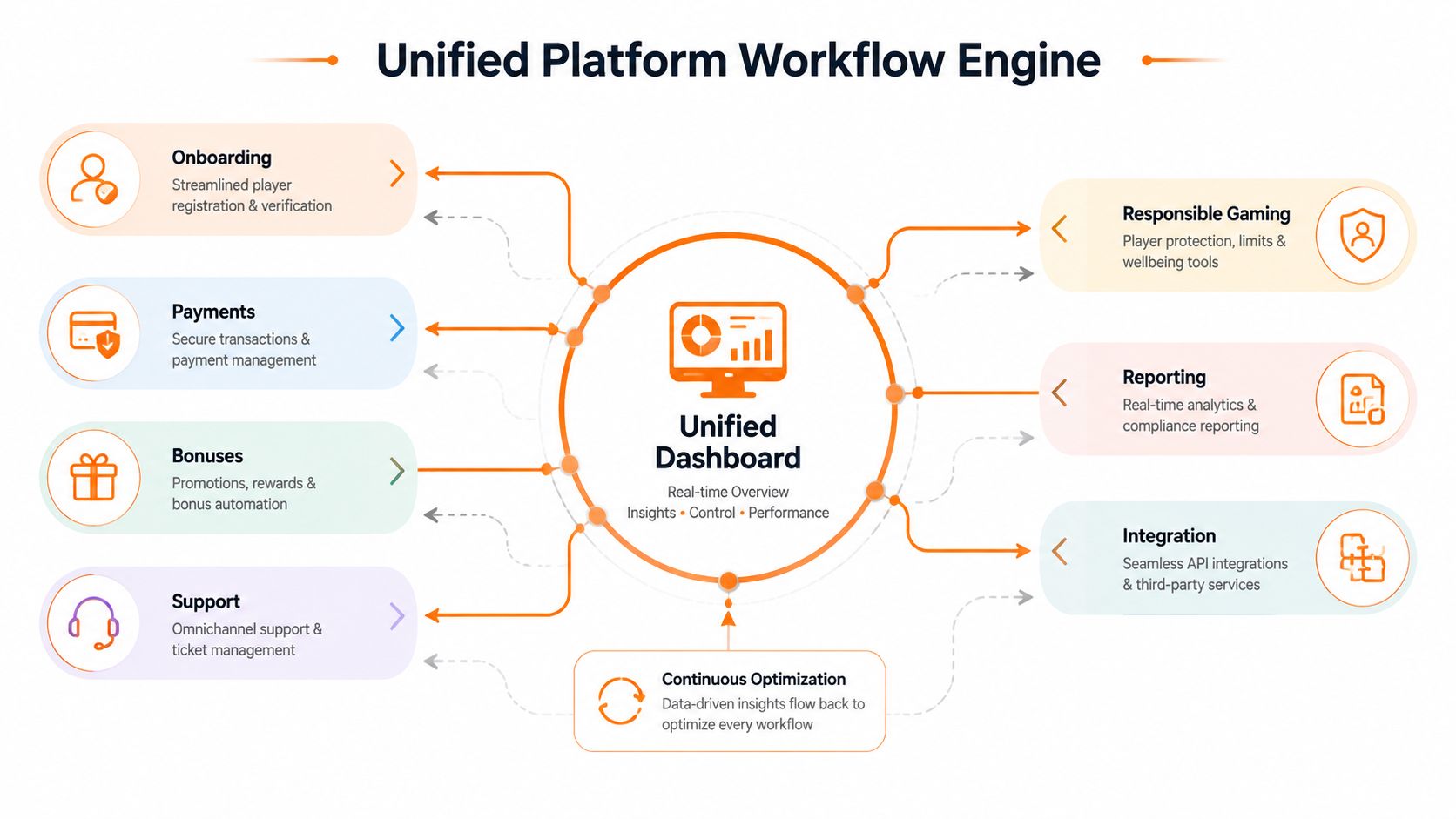
The useful configuration principle is simple: one event should create one reliable record and trigger the next accountable action. NexGrate provides a white-label operating stack with casino and sportsbook modules, a shared wallet, KYC and risk controls, payment integrations, reporting, and content connectivity. Its relevance depends on whether the operator configures ownership, permissions, exceptions, and approval paths rather than treating the platform as a passive collection of modules.
A unified workflow engine can also expose problems that siloed tools conceal. Watch the short platform overview below for a visual explanation of connected operational modules.
Where Automation Delivers ROI and Where Human Review Must Stay
Automation works best when the rule is stable, the input is reliable, and the outcome is reversible or easy to audit. It works poorly when the process contains undocumented judgment, conflicting ownership, or sensitive decisions that staff haven't standardized.
Industry summaries report 25% to 30% productivity gains, 40% to 75% error reduction, and cycle-time cuts of 30% to 70% for workflow automation, with many organizations reporting positive ROI within 6 to 12 months (workflow automation statistics and implementation guidance). These figures should guide sequencing, not serve as a promise. An operator that automates an unstable withdrawal or fraud process may accelerate inconsistency instead of creating efficiency.
Practical rule: Automate the predictable path, then design a visible human queue for exceptions.
Use a decision matrix
| Workflow Task | Automate First | Keep Human Review | Risk If Automated Too Early |
|---|---|---|---|
| Document completeness checks | File validation, expiry checks, routing | Ambiguous identity or jurisdiction cases | Legitimate players may be blocked |
| Deposit reconciliation | Status matching and exception alerts | Provider disputes and unexplained reversals | Incorrect wallet updates |
| Withdrawal routing | Rule-based holds and queue assignment | High-risk withdrawals and manual overrides | Funds may move without adequate review |
| Bonus eligibility | Segment checks, wagering tracking, expiry events | Abuse patterns and discretionary goodwill | Promotion liability and inconsistent treatment |
| Sportsbook settlement | Standard result ingestion and wallet posting | Voids, disputes, and unusual market events | Incorrect player balances |
| Fraud monitoring | Known patterns, velocity alerts, evidence collection | Account closures and complex investigations | False positives or missed context |
| Compliance reporting | Data collection, report assembly, approval routing | Final sign-off and regulatory interpretation | Incomplete or unsupported submissions |
The strongest first candidates are repetitive validation, routing, reconciliation, notifications, and evidence collection. Keep humans responsible for account closure, responsible gaming interventions, unusual source-of-funds questions, ambiguous identity cases, and compliance-sensitive approvals.
Orchestration is harder than task automation
Automating a single check is relatively straightforward. Coordinating KYC, payments, risk, wallet restrictions, support visibility, and reporting is harder because one event can affect several departments. A payment failure may be a provider issue, a player issue, a risk signal, or a compliance hold. The workflow needs context before it chooses an outcome.
The same issue appears with AI. Celonis' process optimization research found that 99% of 1,620 business leaders said their organizations already deploy some form of AI, while 58% were concerned that process conditions could limit AI effectiveness and 89% said AI needs business context to be deployed effectively (Celonis Process Optimization Report, AI Edition). The operator lesson is to redesign visibility and decision logic before adding an AI agent to the process.
For risk teams, automation should support judgment rather than disguise its absence. These risk management best practices are useful when defining escalation thresholds, review evidence, and ownership.
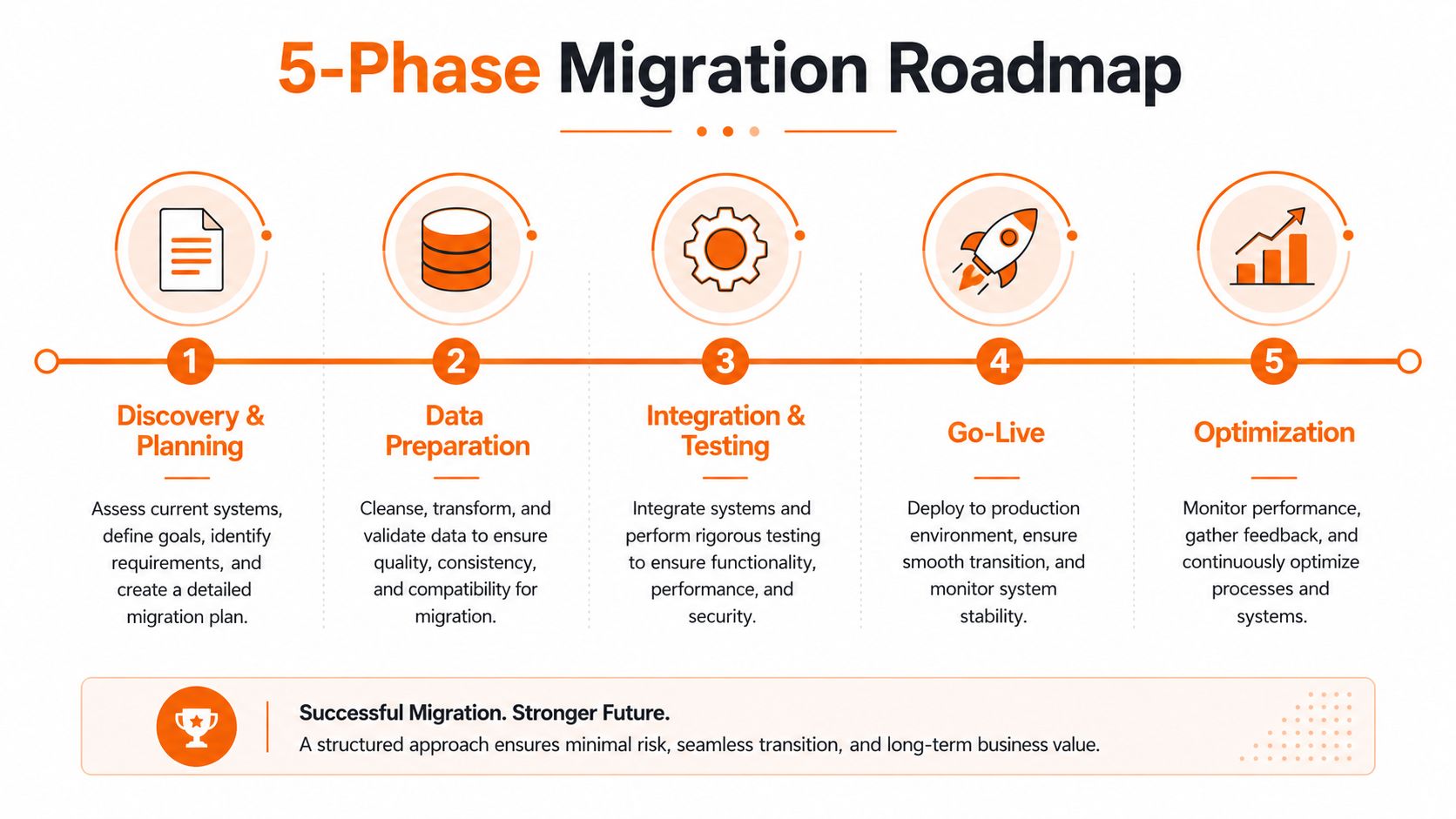
Migration and Launch Checklist for Moving to a Unified Stack
A migration fails when the operator treats it as a data transfer. The core work is transferring rules, account states, ownership, provider dependencies, permissions, and exception handling without carrying broken assumptions into the new environment.
Start by freezing the current operating model in documentation. Record every workflow rule, input, approval, escalation path, manual override, and report dependency. Mark each item as retained, redesigned, retired, or awaiting a business decision.
Prepare the records that affect player outcomes
Data mapping needs more than player names and email addresses. Define how the target platform will represent:
- Player identity: Account IDs, registration attributes, jurisdiction, status, and communication preferences.
- Wallet state: Cash balances, bonus balances, pending withdrawals, chargebacks, reversals, and transaction history.
- KYC position: Verification level, document status, source-of-funds evidence, review notes, and restrictions.
- Bonus obligations: Active offers, wagering progress, expiry rules, free spins, loyalty status, and excluded promotions.
- Product history: Casino activity, sportsbook bets, open markets, unsettled events, and responsible gaming controls.
- Audit evidence: Previous decisions, approvals, account actions, and records required for internal or regulatory review.
Don't migrate ambiguous values without logging them. Create a quarantine queue for records that need review, and give each exception a named owner.
Test integrations and permissions as one system
Validate games, odds feeds, payment providers, identity services, geolocation, CRM events, reporting exports, and monitoring. Test failure states as carefully as successful transactions. A payment provider outage, delayed odds update, duplicate callback, or rejected document should produce a controlled state and an actionable alert.
Configure role-based access before users receive production credentials. Support should see enough to resolve a player issue, while payments, risk, compliance, and finance retain separate capabilities. Audit logs should record sensitive changes, approvals, manual wallet actions, rule edits, and account restrictions in a way that supports MGA-grade control expectations.
Run the cutover in controlled stages
Use a parallel run or staged launch where practical. Compare player balances, KYC statuses, payment outcomes, bonus states, settlement results, and reports against the legacy environment. Reconcile differences before expanding the scope.
The final go-live plan should include rollback criteria, provider contacts, incident ownership, player communication, and a freeze window for high-risk configuration changes. Choose a platform only after checking its operating model, integration coverage, compliance tooling, and support responsibilities. This guide to iGaming software providers can help structure that evaluation.
A unified stack should make the operation easier to govern. It shouldn't merely place the same disconnected processes behind a newer interface.
Sustaining Gains and Scaling Workflow Optimization Over Time
Launch isn't the finish line. It's the point at which the operator can finally observe the workflow as a connected system instead of a collection of team complaints.
Keep a small operational scorecard for each priority flow. Review onboarding time, KYC outcomes, payment success, withdrawal exceptions, settlement accuracy, bonus issues, fraud queue age, support rework, and reporting approvals. Pair each KPI with an owner and a defined response, so a deteriorating result triggers investigation rather than passive reporting.
Review exceptions before adding more automation
The exception queue is where the next improvement usually sits. Group cases by cause, not by department. If payment exceptions repeatedly require a KYC check, connect those states. If support keeps asking risk for the same account detail, expose the approved data in the support view. If finance corrects settlement records manually, inspect the feed, event mapping, and approval logic.
The fastest route to scale is often removing the reason a case leaves the standard path.
Run regular bottleneck reviews with operations, payments, risk, compliance, finance, support, and marketing. The meeting should end with a small number of owned changes, not a long list of observations. Test each change against player impact, control quality, reporting completeness, and operational effort.
Scale context before scaling AI
McKinsey's global AI survey found that 88% of organizations use AI in at least one function, but only 39% report a measurable bottom-line effect (McKinsey's 2025 global AI survey). That gap matters for iGaming operators because an agent can speed up a local task while leaving the end-to-end journey broken.
PwC reports that 66% of organizations adopting AI agents report increased productivity, while mindset, change readiness, and workforce engagement remain major barriers (PwC's AI Agent Survey). KPMG also reports that the share of organizations orchestrating multiple agents across workflows rose from 9% to 18%, which indicates that multi-step orchestration is emerging rather than mature (KPMG AI research).
For operators, the sequence is clear. Stabilize ownership, data, controls, and handoffs first. Then connect automation across onboarding, cashier, risk, support, compliance, and marketing with clear escalation to people. A unified platform earns its value when teams can expand into new products or regulated markets without rebuilding the same workflow in another silo.
Review the current operation, select one high-volume process, establish its baseline, and redesign the exception path before migrating the next workflow. That discipline turns workflow optimization from a software project into an operating capability.
NexGrate provides a white-label iGaming platform with casino and sportsbook operations, a shared wallet, payments, KYC, risk controls, reporting, and content integrations in one back office. Visit NexGrate to discuss a migration plan that connects your player, payment, compliance, and trading workflows without recreating the same handoffs.