Suspicious-activity reporting is already operating at a scale that makes manual, disconnected monitoring unworkable. FinCEN data shows that U.S. Suspicious Activity Report filings rose from 4.3 million in FY2022 to 4.6 million in FY2023 and 4.7 million in FY2024, with approximately 12,870 SARs filed every day in FY2024. FinCEN's FY2024 reporting data makes the operational point clear. Monitoring teams need prioritization, reliable data, documented decisions, and workflows that can handle volume without burying investigators.
For iGaming, that operating model must connect casino deposits, sportsbook wagers, fiat and crypto wallets, KYC results, responsible gaming signals, payment methods, geolocation, linked accounts, investigations, and regulatory reporting. A deposit followed by rapid wagering and withdrawal can mean something very different depending on the player's profile, device links, source of funds, jurisdiction, and previous activity.
The following transaction monitoring best practices focus on implementation rather than slogans. They explain what to monitor, how to segment risk, where automation helps, when investigators need to intervene, and how to improve controls without creating unnecessary friction for legitimate players. NexGrate is a relevant example of a unified casino, sportsbook, wallet, KYC, AML, and reporting environment, but no platform removes the need for sound governance and accountable compliance decisions.
Table of Contents
- 1. Real-Time Transaction Screening and Alert Systems
- 2. Customer Risk Segmentation and Tiered Due Diligence
- 3. Behavioral Analytics and Anomaly Detection
- 4. Integrated Transaction Reporting and Audit Trails
- 5. Sanctions and PEP List Compliance with Continuous Refresh
- 6. Suspicious Activity Reporting and Structuring Detection
- 7. Cross-Border and Multi-Channel Money Flow Tracking
- 8. Responsible Gaming Integration with Transaction Monitoring
- 8-Point Transaction Monitoring Best Practices Comparison
- Turn Monitoring Rules Into a Living Control System
1. Real-Time Transaction Screening and Alert Systems
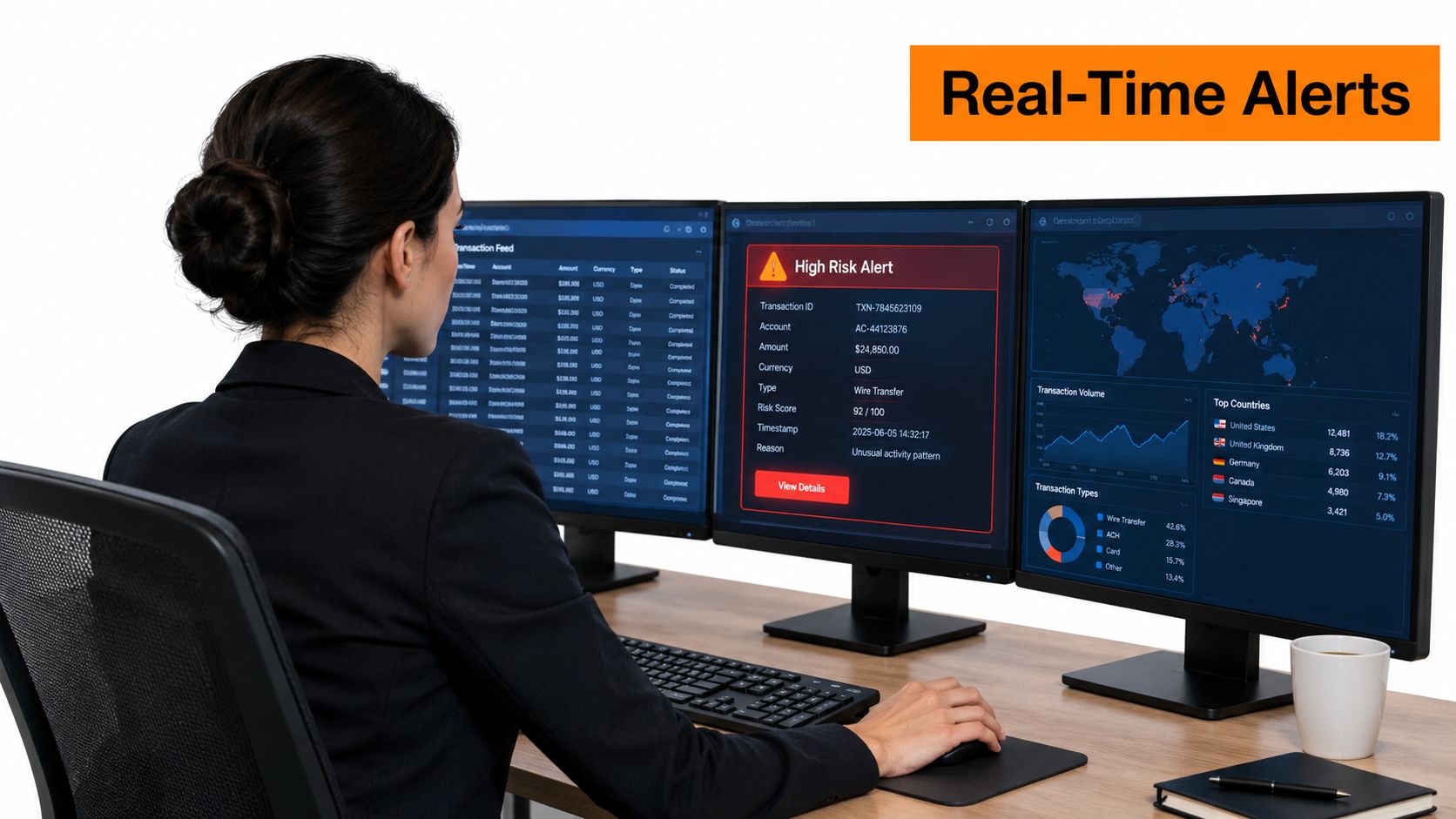
Real-time screening is useful when it sits inside a governed investigation workflow, not when it blocks or flags every transaction that matches a rigid condition. FATF guidance expects institutions to identify unusual movement of funds, route alerts into appropriate case-management systems, investigate them promptly, determine whether activity is suspicious, and report qualifying cases to the relevant financial-intelligence unit. FATF's risk-based banking guidance supports a connected process of detection, review, escalation, reporting, and audit history.
For an iGaming operator, screening should run across deposits, withdrawals, wallet transfers, sportsbook settlements, casino activity, and crypto movements. The system should capture the transaction context before an alert reaches an investigator. That context includes the player's risk tier, payment instrument, geography, device, linked accounts, velocity, cumulative exposure, and wagering behavior.
Design the alert path before writing the rule
A practical severity model might route activity into three paths:
- Immediate intervention: Restrict or hold activity when the event presents a clearly defined sanctions, account-takeover, or prohibited-party risk, subject to local legal and operational requirements.
- Investigator review: Send contextual alerts to a queue when the behavior needs human judgment, such as a rapid deposit, wagering, and withdrawal cycle.
- Passive monitoring: Record lower-risk anomalies for trend analysis without automatically disrupting the player journey.
Every rule needs an owner, a rationale, a version history, and a documented response. Test rules against historical and synthetic activity before deployment, then review whether they produce useful cases or repetitive noise. A rule that generates alerts without improving investigation quality is an operating cost, not an effective control.
Practical rule: Screen the event in real time, but judge the risk in context. A threshold isn't a conclusion.
For NexGrate operators, a unified wallet and back office can apply consistent screening across casino and sportsbook activity. The important design decision is to preserve the event trail, including the rule that fired, the evidence reviewed, the person who made the decision, and the reason for escalation or closure.
2. Customer Risk Segmentation and Tiered Due Diligence
Uniform monitoring treats every player as if the same behavior carries the same risk. That approach creates friction for legitimate customers and still misses patterns that only become meaningful when viewed against a player's profile.
Risk segmentation should combine customer information, geography, payment method, source of funds, product usage, account links, and behavior over time. FATF's risk-based approach supports differentiated treatment. Customers and transactions don't need identical monitoring, monetary thresholds may be used, thresholds should be reviewed, and monitoring results should be documented.
A player using a bank transfer for ordinary activity may require a different control path from a player funding a wallet through crypto, moving between several accounts, and withdrawing through a different rail. The transaction amount alone doesn't resolve that distinction. A low-value account can present more concern than a high-value account when it shows rapid funding, little genuine play, repeated withdrawals, or links to other players.
Build risk tiers that change with behavior
Risk tiers should be operational, not decorative labels in a KYC record. Each tier needs clear consequences for verification, transaction review, source-of-funds requests, withdrawal handling, and investigator escalation.
- Profile risk: Consider jurisdiction, customer information, occupation or expected activity, and source-of-funds evidence.
- Channel risk: Treat cards, bank transfers, e-wallets, and crypto as different data and control environments.
- Behavioral risk: Reassess the player when velocity, wagering, device use, or linked-account behavior changes.
- Escalation risk: Trigger re-verification or enhanced review when activity no longer fits the existing profile.
The risk management guidance from NexGrate can sit alongside this operating model, but the operator still needs to define its own risk appetite and escalation criteria. A platform can automate the workflow. Compliance leaders must decide what evidence is sufficient.
Review segmentation criteria on a scheduled basis and after meaningful changes in products, payment rails, jurisdictions, or internal suspicious-activity trends. Don't let a player remain in a low-risk segment indefinitely because the initial onboarding assessment was clean.
3. Behavioral Analytics and Anomaly Detection
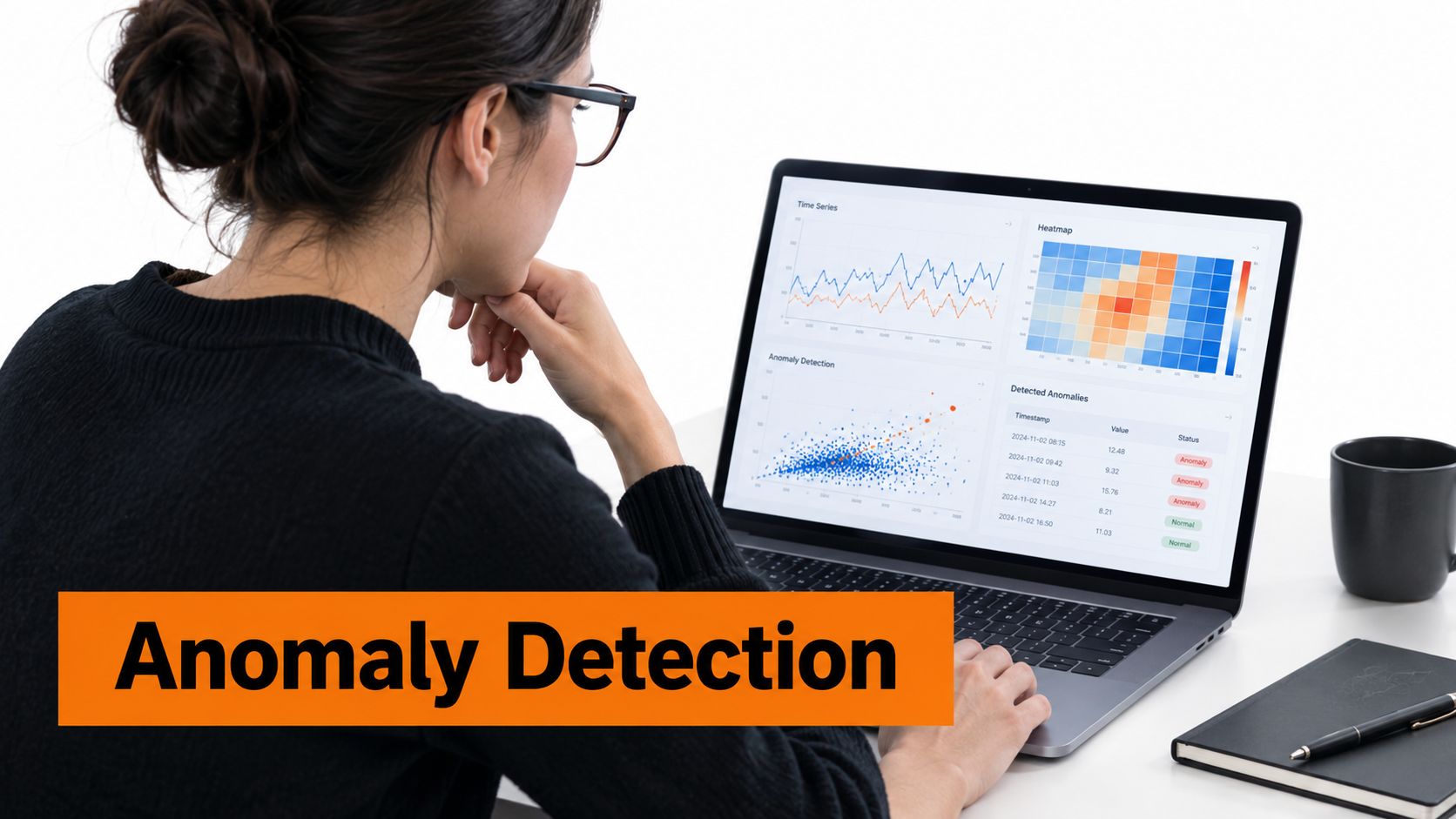
Static rules answer a narrow question, such as whether activity crossed a threshold. Behavioral analytics asks a more useful question: does this activity make sense for this player, this account network, and this product combination?
That distinction matters in iGaming because the signal can be distributed across logins, deposits, wagering, withdrawals, game selection, devices, IP addresses, geolocation, bonuses, and linked patrons. The American Gaming Association identifies indicators including minimal gaming with large transactions, structuring, account sharing, geolocation evasion, coordinated activity, and deposits or withdrawals without meaningful wagering. The AGA's 2025 AML best-practices guidance also reinforces the need to assess the wider player journey.
Combine models with investigator judgment
Start by establishing meaningful player and account segments. A new sportsbook player, a long-standing casino player, a crypto-funded account, and a high-frequency bettor shouldn't share one behavioral baseline. Models can then identify deviations within each segment, while rules preserve explainable controls for known typologies.
Useful signals include:
- Funding behavior: Changes in deposit frequency, payment instruments, or deposit-to-withdrawal timing.
- Wagering behavior: Sudden changes in bet size, market selection, bet-slip composition, or casino product use.
- Access behavior: New devices, unusual geolocation, impossible travel patterns, or multiple accounts using common infrastructure.
- Network behavior: Coordinated activity across accounts, shared wallets, common payment methods, or synchronized actions.
FATF material describes behavioral profiling using device, IP, geolocation, and digital-behavior data, and discusses machine-learning systems that assess transaction risk across more than 60 variables. FATF's financial-inclusion and AML guidance also makes the governance requirement clear. Advanced analytics needs explainability, validation, and human oversight.
A model should retain the features and decision path behind an alert. Investigators need to know why the system changed a risk score, what evidence supported the outcome, and whether a human override was justified.
The video below can help teams discuss anomaly detection concepts with operations and compliance stakeholders.
4. Integrated Transaction Reporting and Audit Trails
A transaction record without its decision history is incomplete. Investigators and auditors need to reconstruct what happened, which rule or model generated the alert, what evidence was available, who reviewed it, and why the case was closed, escalated, or reported.
FATF guidance emphasizes documented monitoring results and an auditable investigative process. For iGaming, the record should cover more than deposits and withdrawals. It should connect casino wagers, sportsbook bets, settlements, bonuses, wallet movements, KYC events, responsible gaming interventions, device data, geolocation, payment instruments, and account relationships.
Store evidence with the decision
A strong audit trail answers practical questions quickly:
- What happened: Capture event type, timestamp, amount, currency, product, account, and payment channel.
- Why it mattered: Record the triggering rule, model signal, customer risk context, and related activity.
- Who acted: Preserve the assigned investigator, review timestamps, approvals, overrides, and escalation path.
- What followed: Link the disposition, reporting decision, account action, and supporting rationale.
Access should be role-based. Investigators may need full case detail, operations teams may need restricted operational views, and executives may need trend reporting rather than personal data. Immutable or tightly controlled logs are preferable to editable notes that can't show the history of a decision.
The compliance reporting overview from NexGrate is relevant to operators designing a consolidated reporting layer. The implementation should still include tested data lineage, controlled retention, and reliable retrieval. A report that exists in theory but can't be reconstructed during a regulatory request isn't a dependable control.
Automated SAR or STR drafting can reduce repetitive work by populating narratives from verified alert and case data. It must not replace investigator review. The final filing needs to reflect the actual facts, the reasoning behind suspicion, and the requirements of the relevant financial-intelligence unit.
5. Sanctions and PEP List Compliance with Continuous Refresh
Sanctions screening and transaction monitoring solve different problems. Screening checks whether a person, wallet, or counterparty may match a restricted list. Monitoring examines behavior over time. An iGaming operator needs both, with clear handling for confirmed matches, potential matches, and false positives.
Run identity screening at onboarding and again when relevant lists change. Continuous refresh matters because a customer who passed screening earlier can later become subject to restrictions. The same principle applies to crypto deposits, where the risk may be associated with a wallet or transaction path rather than the name on the player account.
Make match handling explainable
A reliable screening workflow should define:
- List coverage: Record which sanctions, watchlist, PEP, and internal-risk sources are used for each jurisdiction.
- Matching logic: Configure name variation, transliteration, date-of-birth, address, nationality, and other available identifiers.
- Review outcomes: Separate confirmed matches, possible matches, and false positives, with a rationale and review date.
- Escalation actions: Specify who can hold a transaction, restrict an account, seek additional information, or approve release.
- Change control: Preserve list versions, screening timestamps, rule changes, and system availability records.
PEP status isn't automatically proof of wrongdoing. It can justify a different level of due diligence and ongoing review, particularly when combined with source-of-funds concerns, unusual activity, or connections to other accounts. Investigators should avoid turning a screening match into an unsupported conclusion.
For crypto operations, blockchain analytics can add wallet exposure and transaction-path context. A wallet associated with a risk indicator should produce a reviewable signal, not an unexplained automatic accusation. The operator needs a documented process for assessing the signal, recording the evidence, and deciding whether the activity can proceed.
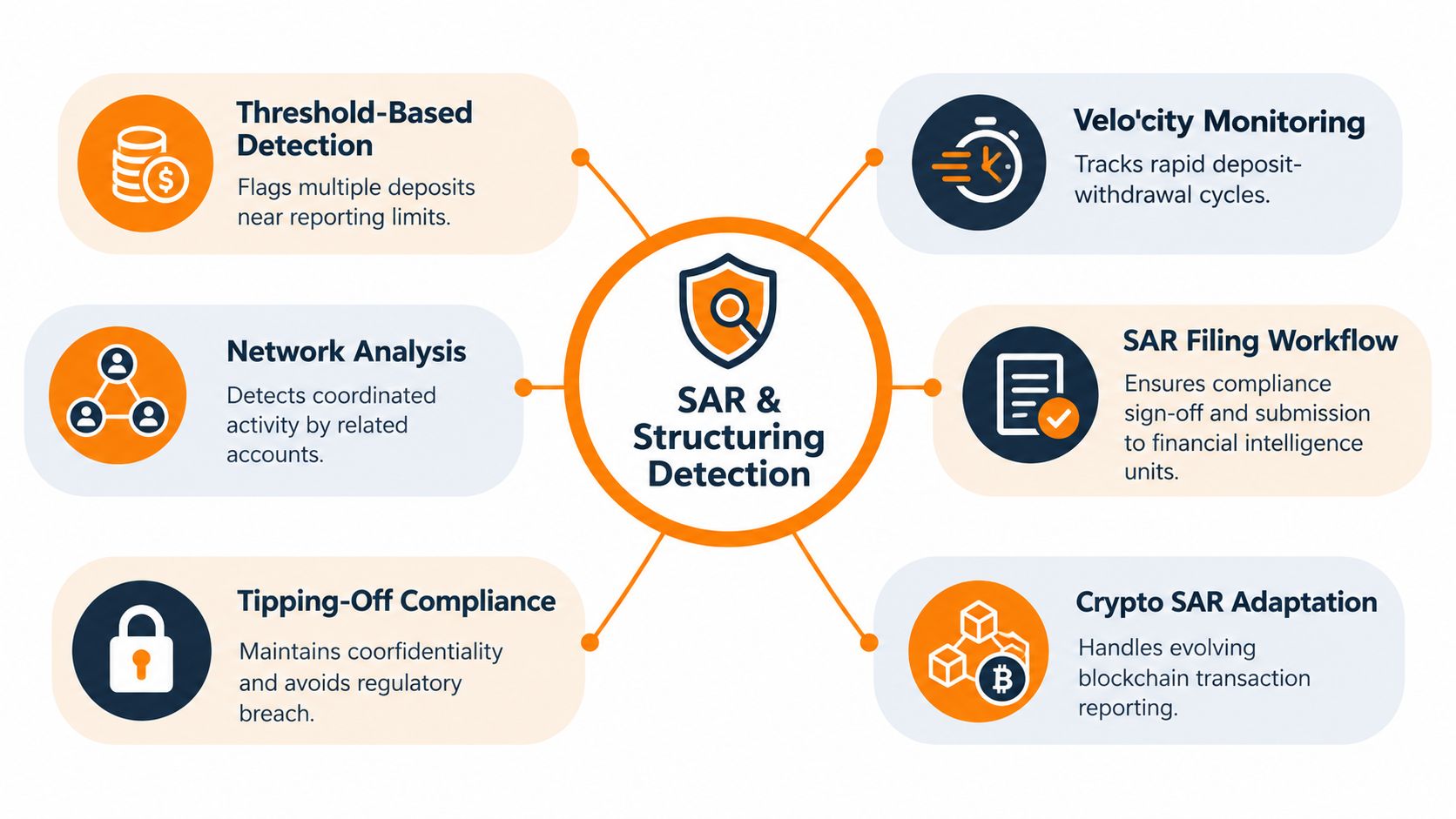
6. Suspicious Activity Reporting and Structuring Detection
Suspicious activity reporting is the point where monitoring becomes a regulated decision process. FATF Recommendation 20 requires reporting when there is suspicion, or reasonable grounds to suspect, that funds are criminal proceeds or connected to terrorist financing. FATF's guidance supports prompt reporting through the relevant channel, but the exact filing obligation and terminology depend on the jurisdiction.
Structuring detection shouldn't focus only on transactions that sit just below a reporting threshold. In an iGaming environment, investigators should examine repeated deposits, rapid withdrawals, minimal wagering, synchronized account activity, changing payment methods, and movement between casino and sportsbook wallets. The pattern may be spread across accounts rather than visible in one player's ledger.
Measure reporting quality, not just filing volume
FinCEN's reporting volume illustrates why teams need scalable triage and quality controls. Its data shows that Currency Transaction Reports reached 20.5 million in FY2024, approximately 56,160 per day, across a reporting environment involving approximately 324,000 registered financial institutions and other e-filers. FinCEN's reporting infographic supports a practical conclusion. Analysts need to spend time on consequential cases, not process undifferentiated alerts.
Track:
- Alert-to-case conversion: Which scenarios produce investigations rather than routine closures.
- Investigation aging: How long cases remain open and where approvals delay action.
- Filing timeliness: Whether qualifying cases reach the correct FIU promptly.
- Disposition quality: Whether investigators record evidence, rationale, and next steps.
- Typology coverage: Whether controls address current risks across casino, sportsbook, fiat, and crypto.
An Asia-focused AML technology survey found that 63.2% of respondents escalated fewer than 15% of transaction-monitoring or screening alerts into suspicious-transaction or matter reports. The Asia-Pacific AML Barometer makes alert-to-case conversion a more useful benchmark than raw alert count. It doesn't prescribe a universal target for iGaming. It shows why every rule and segment should be evaluated for useful investigative yield.
Keep sensitive reporting records separate from general operations, restrict access, and train staff on confidentiality and tipping-off risks.
7. Cross-Border and Multi-Channel Money Flow Tracking
A player can fund an account through one channel, wager across several products, move value through a wallet, and withdraw through another rail. If the monitoring system stores those events in separate systems, investigators may see ordinary transactions instead of one connected flow.
Build a unified transaction graph around players, accounts, wallets, payment instruments, devices, IP addresses, jurisdictions, and counterparties. Transactions become edges between those entities. The graph doesn't need to make a final decision automatically. Its first job is to help investigators see relationships that a flat transaction list hides.
Reconstruct the complete value path
A useful cross-channel view should show:
- Entry point: Fiat deposit, crypto transfer, card payment, bank funding, or e-wallet activity.
- Product use: Casino wagers, sportsbook bets, bonuses, settlements, and transfers.
- Account connections: Shared devices, addresses, payment instruments, wallet identifiers, and other relationship signals.
- Exit point: Withdrawal method, destination wallet, currency conversion, and timing.
- Jurisdiction context: Customer location, payment origin, operational market, and destination risk.
Don't automatically treat every shared IP or device as proof of common control. Households, shared networks, and legitimate account access can create false connections. Use linkage as an investigative signal, then combine it with transaction timing, behavior, KYC information, and other evidence.
Operators designing a multi-currency wallet should consider how balances, conversions, transfers, and withdrawals are represented in one ledger. The NexGrate multi-currency wallet resource is relevant to that architecture. Control owners should also define data access, correction procedures, graph refresh frequency, and escalation when identifiers conflict.
A unified wallet can enforce a product-transfer restriction, or it can allow transfers while treating them as risk signals. Neither choice is universally correct. The decision should follow the operator's risk assessment, product design, licensing obligations, and ability to explain the resulting monitoring logic.
8. Responsible Gaming Integration with Transaction Monitoring
Responsible gaming and AML monitoring have different purposes, but they rely on overlapping evidence. Deposit velocity, wagering intensity, rapid changes in behavior, account limits, session patterns, and product transfers can matter to both player protection and financial-crime investigations.
The UK Gambling Commission says monitoring should cover all customer activity, follow the operator's risk assessment, and apply greater scrutiny to higher-risk customers rather than relying only on spend-based triggers. That principle supports a shared player timeline. A sudden increase in deposits may justify a responsible gaming intervention, an AML review, both, or neither, depending on context.
Share signals without collapsing the controls
Responsible gaming teams and AML investigators should have defined rules for information sharing, access, confidentiality, and action ownership.
- Player protection signals: Changes in deposit behavior, chasing losses, rapid play, limit breaches, and repeated attempts to increase exposure.
- AML signals: Minimal wagering, rapid movement of funds, linked accounts, unexplained source of funds, sanctions exposure, and suspicious counterparties.
- Shared context: Product use, payment method, device, location, session history, and prior interventions.
- Separate decisions: A player-protection intervention isn't automatically evidence of money laundering, and an AML alert isn't automatically evidence of problem gambling.
Use proportionate interventions. A new player showing volatile behavior may need a prompt, limit review, or human contact. A long-standing player with stable activity may need less friction. Account restrictions should be based on documented criteria and communicated appropriately.
For an integrated casino and sportsbook, apply limits and interventions across the player relationship rather than allowing a player to bypass a casino control through sportsbook activity. Audit whether limits, self-exclusions, cooling-off measures, and intervention workflows operated as designed. Responsible gaming data can strengthen the wider risk picture, but operators must protect sensitive information and ensure each team uses it for a legitimate purpose.
8-Point Transaction Monitoring Best Practices Comparison
| Approach | 🔄 Implementation Complexity | 💡 Resource Requirements | ⭐ Expected Outcomes | 📊 Ideal Use Cases | ⚡ Key Advantages |
|---|---|---|---|---|---|
| Real-Time Transaction Screening and Alert Systems | High, real-time APIs, legacy payment integration, frequent updates | Significant, watchlist licenses, infra, ops staff | ⭐⭐⭐⭐, strong prevention of illicit flows and timely blocking | High-volume casinos/sportsbooks; crypto operations; payment-integrated platforms | Immediate blocking and audit trails; reduces regulatory exposure |
| Customer Risk Segmentation and Tiered Due Diligence | Medium–High, scoring models + policy maintenance across jurisdictions | Moderate, KYC providers, scoring engines, periodic reviews | ⭐⭐⭐⭐, efficient allocation of compliance effort, faster onboarding | Rapid acquisition brands; high-value depositors; crypto user cohorts | Proportional controls; lower friction for low-risk players; cost-efficient |
| Behavioral Analytics and Anomaly Detection | High, ML models, data pipelines, explainability tooling | High, historical data, data science, compute, labeling | ⭐⭐⭐⭐⭐, detects sophisticated laundering, fraud, account takeover | Sportsbooks, fraud-prone environments, coordinated-bet detection | Learns normal behavior; finds novel patterns; reduces alert fatigue over time |
| Integrated Transaction Reporting and Audit Trails | Medium, schema design, tamper-evident logging, retention rules | Moderate–High, storage, data platforms (warehouses/lakes), access controls | ⭐⭐⭐⭐, rapid audit response and complete investigative context | Regulated operators requiring SAR/STR filings and audits | Centralized evidence for regulators; faster investigations and reporting |
| Sanctions and PEP List Compliance with Continuous Refresh | Medium, vendor integration, fuzzy-matching, re-screen workflows | Moderate, data subscriptions, matching logic, review queue | ⭐⭐⭐⭐, prevents processing for newly designated individuals/entities | Multi-jurisdictional operators; sanctions-exposed markets; crypto | Continuous catch of new listings; automated escalation and blocking |
| Suspicious Activity Reporting (SAR) and Structuring Detection | Medium, rule sets, workflow, tipping-off safeguards | Moderate, compliance analysts, legal review, secure SAR storage | ⭐⭐⭐⭐, proactive identification of structuring and coordinated abuse | Platforms required to file SARs; cross-border transaction networks | Pattern-based detection; standardized SAR generation and filing workflows |
| Cross-Border and Multi-Channel Money Flow Tracking | Very High, multi-processor integration, graph modeling, FX audit | High, integrations, graph DBs, blockchain analytics, data governance | ⭐⭐⭐⭐⭐, uncovers layering, circular flows, cross-channel laundering | Multi-currency/crypto platforms; global operators with many rails | Reconstructs end-to-end flows; network-level detection of laundering rings |
| Responsible Gaming Integration with Transaction Monitoring | Medium, policy mapping to monitoring and intervention logic | Moderate, UX, intervention tooling, jurisdictional rule sets | ⭐⭐⭐⭐, reduces player harm and supports AML through shared signals | Jurisdictions with RG mandates; operators emphasizing CSR | Dual benefit for AML + player protection; automated interventions and limits |
Turn Monitoring Rules Into a Living Control System
The strongest transaction monitoring programs don't behave like collections of isolated rules. They operate as a connected control system that links every transaction channel to customer risk, product behavior, account relationships, investigator decisions, reporting obligations, and feedback from completed cases.
That operating loop starts with data. Map casino deposits and wagers, sportsbook bets and settlements, fiat payments, crypto transfers, wallet movements, KYC events, responsible gaming interventions, devices, geolocation, and linked accounts. Document which system owns each field, how events are timestamped, how corrections are handled, and what happens when a critical data feed is unavailable.
Next, define the risk model. Segment players and transactions by product, payment rail, jurisdiction, customer profile, velocity, and behavioral context. Build rules around documented typologies, then add behavioral analytics where it improves context. Don't deploy a model only because it sounds advanced. Require feature documentation, decision logs, validation, drift monitoring, investigator feedback, and a clear human override process.
The alert workflow needs equal attention. Establish severity levels, queue ownership, investigator service levels, approval requirements, escalation paths, and closure reasons. FATF guidance expects alerts to move into appropriate case-management processes, be investigated in a timely manner, and lead to prompt reporting when the legal standard is met. A rules engine that creates alerts without a controlled resolution process isn't a complete monitoring program.
The operational objective isn't maximum alert generation. It's consistent identification, investigation, documentation, and reporting of genuinely suspicious activity.
Test the reporting layer before relying on it. Confirm that a case can be reconstructed from source events, that investigators can retrieve supporting evidence, that access controls work, and that the system can produce the information required by each relevant authority. Test both ordinary and adverse scenarios, including missing data, duplicate events, failed screening feeds, linked accounts, crypto wallet exposure, and cross-product movement.
Then measure quality. A 2025–26 financial-crime survey reported that more than 70% of institutions had false-positive rates above 25%, while 8.3% didn't track the metric. The 2025–26 FinCrime Frontier Survey shows why false-positive governance can't be an afterthought. Track false positives by scenario, market, payment method, product, and risk tier. Review alert-to-case conversion, confirmed-risk yield, investigation aging, analyst effort, reporting timeliness, and missed typologies together.
A practical implementation sequence is straightforward:
- Map the operating environment: Connect casino, sportsbook, wallet, fiat, crypto, KYC, responsible gaming, and reporting data.
- Define risk-based controls: Set customer, product, channel, jurisdiction, and behavioral criteria.
- Build the investigation workflow: Assign severity, ownership, service levels, evidence requirements, and escalation decisions.
- Test before launch: Replay historical activity, use synthetic scenarios, and compare threshold settings in a controlled environment.
- Tune with discipline: Review false positives, confirmed cases, investigator feedback, and emerging typologies on a scheduled basis.
- Prove auditability: Retrieve the full event, alert, evidence, decision, approval, and reporting history.
A unified backend such as NexGrate can reduce fragmentation by bringing casino, sportsbook, payments, wallets, KYC and AML workflows, reporting, and responsible gaming controls into one operating environment. It doesn't replace governance. Compliance leaders still need to define the risk appetite, approve rules, validate models, train investigators, and challenge whether the system is producing useful decisions.
Transaction monitoring becomes durable when teams treat every alert as part of a broader player and money-flow story. Connect the data, preserve the evidence, route work by risk, and use outcomes to improve the next decision.
NexGrate provides a unified white-label platform for casino and sportsbook operators, with integrated wallets, fiat and crypto payments, KYC and AML workflows, risk rules, reporting, audit logs, and responsible gaming features. Visit NexGrate to evaluate how a connected operating environment can support more consistent transaction monitoring and investigation workflows.