
At its peak, Macau had 235 licensed junket operators, and industry coverage said they contributed as much as 70% of gross gaming revenue. That scale changes the question. A junket wasn't merely a complimentary trip or a casino host. It was a third-party recruitment, credit, and settlement network embedded inside the VIP gambling economy. Industry coverage of Macau's junket system shows why the model still matters to casino strategists, even after its contraction.
For operators, the important lesson isn't nostalgia for high-roller rooms. It's structural. Whenever a business outsources player acquisition, credit decisions, payment handling, or VIP relationship management to an intermediary, it can inherit risks without seeing the full transaction chain. Understanding what are junkets therefore means tracing who finds the player, who advances the money, who absorbs the loss, and who remains accountable when the records don't line up.
Table of Contents
- What Are Junkets and Why Operators Still Talk About Them
- The Three Meanings of the Word Junket
- How a Casino Junket Operator Actually Works
- The Credit and Money Flow Behind Every Junket
- Why the Macau Junket Model Collapsed
- Junkets Outside Macau and Online
- Alternatives to Junkets for iGaming Operators
- Evaluating and Integrating VIP Partners on a Unified Platform
What Are Junkets and Why Operators Still Talk About Them
Macau's 2004 Gaming Credit Law gave concessionaires and junkets a formal route to extend credit to players. That legal change clarifies what a casino junket does operationally: it manages a VIP channel that can include player recruitment, casino access, credit arrangements, and settlement. Travel and accommodation may support the relationship, but the financial workflow gives the intermediary its strategic importance.
The junket therefore affects more than hospitality. It can help determine which customers enter a VIP room, what credit terms they receive, how losses are pursued, and how balances are reconciled between player and operator. A hotel or conventional casino host may arrange a stay or introduction. A junket can sit across the commercial and financial relationship, where customer identity, funds, and liability become harder to separate.
That position creates value for the operator. The promoter supplies access to high-value players and relationships that the casino might otherwise have to build directly. Compensation is tied to gambling activity, while the casino receives a concentrated VIP audience and may rely on the promoter's travel, relationship, and collection capabilities.
The arrangement also moves risk alongside revenue. Weak due diligence by the promoter can leave the casino answering questions about source of funds or deposit origins. Credit extended by the junket can create disputes when collection fails. Multiple agents handling one customer can obscure beneficial ownership, payment routing, and the relationship between the final wager and the money used to support it.
Practical rule: Treat a third-party VIP promoter as part of the operator's financial-control perimeter, not as a marketing supplier.
Macau's history shows how quickly that intermediary role can become institutional. The modern model grew with casino expansion after Casino Lisboa opened in 1970. The history of Macau's junket ecosystem describes the sector's development, while the 2004 Gaming Credit Law formally permitted concessionaires and junkets to extend player credit. Legal recognition strengthened the promoter's position as a financial intermediary, increasing the importance of oversight over credit, collections, and records.
Platform-led operators still examine the model because its functions have migrated into newer commercial structures. An affiliate group, VIP manager, aggregator, or white-label partner may recruit players, shape payment behaviour, and manage relationships without using the word junket. The label matters less than the control test: does the operator control the customer relationship and money flow, or has it delegated both to an opaque intermediary? That answer determines whether VIP acquisition is an auditable operating function or an inherited compliance liability.
The Three Meanings of the Word Junket
The word junket carries three distinct meanings in modern usage. The first is a sponsored or publicly funded trip, often arranged for officials, clients, staff, or other invited participants. The second is a promotional press trip, where media representatives receive concentrated access to talent, products, or events. The third is the casino meaning, where a promoter recruits VIP gamblers and supports their access to gaming facilities.
Dictionary coverage reflects these different senses, including the official, promotional, and gambling-related uses of the term in Merriam-Webster's definition of junket. The word can therefore describe a harmless business event in one document and a regulated gaming intermediary in another.
Why the distinction matters
A press or corporate junket normally concerns hospitality and access. Its compliance questions may involve disclosure, editorial independence, expense approval, or public-sector ethics. A casino junket introduces different issues, including player identification, credit exposure, source of funds, gambling-related deposits, and the ownership of money moving through a casino account.
The political meaning creates another layer of confusion. A publicly funded trip may be described as a junket because the recipient appears to receive an improper benefit. That sense carries a strong disapproval meaning, while casino operators may use the same word as a technical description of a commercial partner. Dictionary.com's coverage of junket captures how the term remains active in both media and gaming contexts.
One word, different control frameworks
This is more than a vocabulary problem. A compliance officer reviewing a “junket agreement” needs to know whether the document concerns travel, promotion, or gambling activity. A payments team needs to know whether a “host” is merely referring customers or is collecting funds and extending credit. A licensing reviewer may classify the same partner as a regulated gaming promoter if it controls player access and settlement.
For the rest of this article, junket means a casino VIP promoter, not a press event, public-sector trip, or general hospitality package. That narrower definition keeps the operational analysis focused on the part of the model that creates the greatest exposure: the intermediary's involvement in recruitment, credit, and money movement.
How a Casino Junket Operator Actually Works
A junket's operating model can be understood as a chain of decisions. The promoter doesn't send a customer to a casino. It helps decide which customer is valuable, what access that customer receives, how credit is made available, and how the resulting balance is reconciled.
Recruitment starts before the casino visit
The promoter develops relationships with wealthy gamblers through personal networks, agents, and sub-promoters. Those contacts may identify a player's preferred games, expected level of play, appetite for credit, and willingness to travel. The first risk appears here. A customer can be commercially attractive while still presenting unresolved questions about identity, beneficial ownership, source of wealth, or links to other accounts.
The promoter then packages the visit. That may include transport, accommodation, introductions, VIP-room access, and arrangements for funds or chips. Hospitality reduces friction for the player, but it also creates a dense relationship in which the same intermediary may know the customer's movements, financial expectations, and gaming behaviour.
Credit changes the relationship
In a direct casino model, the operator decides whether a customer may receive credit and records that exposure in its own systems. In a junket model, the promoter can stand between the casino and player. It may decide how much support the player receives, while the operator sees only the deposit, chips, wagers, and settlement events that reach its own records.
That arrangement shifts visibility without necessarily removing liability. The operator may not have made the original credit decision, but it can still be drawn into disputes about deposits, unpaid balances, or the conduct of the promoter inside the gaming environment.
Settlement is where opacity compounds
VIP play can involve different chip categories, rolling activity, cash movements, and accounts managed by multiple people. A promoter may reconcile with the customer separately from the casino's own reconciliation. Sub-promoters can also receive compensation from the primary promoter, creating additional layers between the player's funds and the operator's ledger.
The commercial model usually pays the promoter for the value of the play it generates, but the exact basis depends on the agreement. It may relate to turnover, theoretical value, or another agreed measure. The operator should therefore verify not only the commission calculation but also which player, payment, and transaction records support it.
A safer control sequence is straightforward:
- Identify the customer directly. The operator should perform its own KYC and source-of-funds review rather than treating the promoter's introduction as proof of eligibility.
- Separate credit approval from recruitment. The person who brings a player shouldn't have unchecked authority to determine credit exposure.
- Record every settlement event. Deposits, withdrawals, chip movements, commissions, and adjustments should connect to a verified player account.
- Reconcile the full chain. Finance and compliance teams should be able to trace the customer, promoter, sub-promoter, payment instrument, and final gaming outcome.
The defining weakness of the old model was not that promoters earned money. It was that recruitment, credit, hosting, and settlement could sit in one external relationship while the operator remained responsible for the gaming environment.
The Credit and Money Flow Behind Every Junket
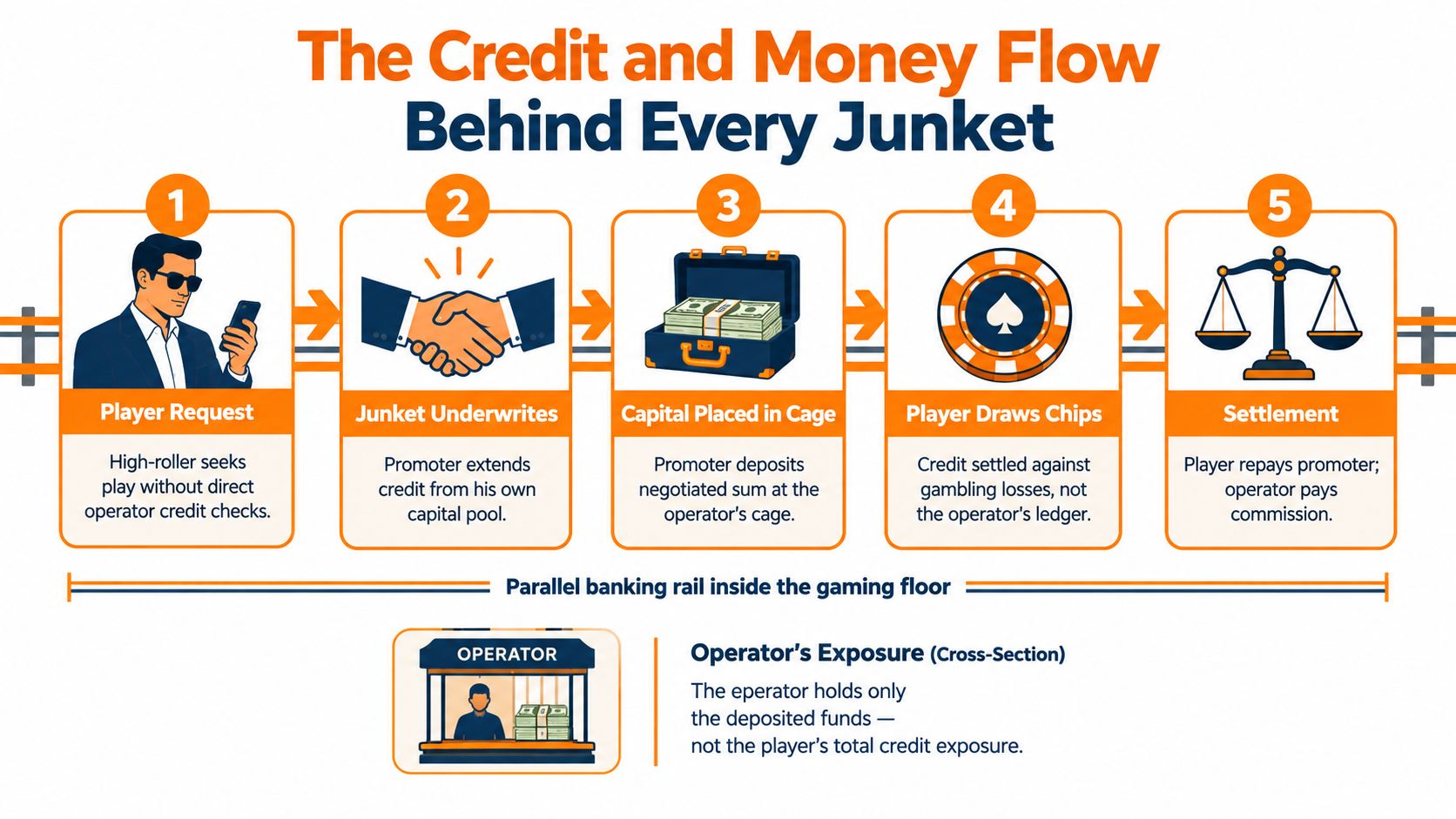
A gambling junket operates as a parallel credit and settlement rail inside the gaming floor, rather than as a simple referral channel. The promoter recruits the player, establishes trust, and may arrange chips or credit before the casino has formed a direct financial relationship with that customer. This shifts part of the operator's exposure away from its own systems and into an intermediary relationship.
The model was particularly relevant to mainland Chinese players because China has long enforced strict foreign-currency controls, including a widely cited annual cap of US$50,000 per citizen, as described in the analysis of junkets and cross-border finance. An intermediary could therefore add value by recruiting the player, arranging casino credit, and coordinating repayment across jurisdictions.
The five-stage flow
The process begins with a player requesting access to gaming credit. A high roller approaches the promoter rather than entering the casino's direct credit process. The promoter then assesses the relationship through its own capital, a related pool of funds, or arrangements with other parties. That assessment may be based on prior dealings and informal knowledge, leaving the operator with limited visibility into the original decision.
The promoter next places funds with the casino or establishes an agreed credit position. The player receives chips or table access under those terms. The casino records the wagers and results, while the promoter may remain responsible for repayment and for much of the customer relationship.
After play, the promoter reconciles the result with the casino and separately with the player. A win, loss, disputed balance, or unpaid obligation can create multiple ledgers for one economic event. The difficult control question is whether the same beneficial owner, payment source, exposure, and liability appear consistently across all of them.
A multi-currency wallet can reduce payment friction for international players, but it does not establish who owns the funds or who controls settlement. Operators reviewing multi-currency wallet functionality should assess transaction monitoring, account ownership, payment permissions, and the audit trail alongside the wallet's currency features.
Why the structure creates regulatory pressure
Promoter-controlled credit and collection weaken the operator's view of both repayment capacity and source of funds. Cross-border settlement can introduce additional intermediaries, informal exchanges, or accounts whose names do not match the player registered with the casino. The same structure that made access convenient also separated gaming activity from financial accountability.
Three risks follow:
- Credit risk: the promoter may fail to collect, leaving the player, promoter, and operator with different views of the outstanding obligation.
- Beneficial-ownership risk: the person placing the bets may not be the person who supplied or controls the funds.
- Settlement risk: repayment may occur outside the operator's systems, limiting reconciliation and suspicious-activity review.
A platform that reproduces these steps through informal agents or digital channels has not removed the exposure. It has moved the parallel rail away from the casino cage, where ownership, credit approval, and settlement become harder to verify.
Why the Macau Junket Model Collapsed
Macau's junket contraction exposed a structural mismatch between intermediary-led VIP growth and regulators' demand for direct accountability. The model concentrated customer acquisition, credit access, room operations, and parts of the collection process in businesses that sat outside the concessionaire's core controls.
The change in scale was decisive. Macau had 235 licensed junket operators at its 2013 to 2014 peak, while the number fell to 36 by 2023, a decline of about 85%, according to the analysis of Macau's regulatory reset. A contraction of that size points to a weakened operating model, not routine partner rationalisation.
Three pressure lines
First, cross-border financial controls made promoter-led credit and collection harder to defend. The arrangement helped wealthy players obtain casino liquidity, but it could also obscure how funds moved between jurisdictions, who controlled repayment, and whether the money supported legitimate gaming activity. As enforcement scrutiny increased, promoters faced exposure that extended beyond commercial performance into financial-crime compliance.
Second, Macau's updated gaming framework removed functions that had given junkets their influence. The 2023 gaming law barred junkets from issuing credit or managing VIP rooms, while limiting each junket to one concessionaire relationship. Those restrictions changed the economics of the relationship. Promoters could no longer combine independent credit, room management, and access to several operators in one operating structure.
Third, the regulator reduced the promoter population to a smaller group that could be supervised more directly. Fewer approved entities meant fewer channels for VIP recruitment and less room for fragmented responsibility across operators, agents, and customers.
| Metric | Peak, 2013 to 2014 | Post-2022 reset |
|---|---|---|
| Licensed junket operators | 235 | 36 by 2023 |
| Change in licensed operators | Baseline peak | Down about 85% |
| Credit and VIP-room role | Promoters could play a central intermediary role | 2023 law barred credit issuance and VIP-room management |
| Relationship model | Broad promoter participation | One concessionaire relationship per junket |
The commercial lesson is clear. A third party can generate VIP volume while keeping the operator distant from the underlying credit decisions, customer relationships, and obligations. Macau's response was to remove the intermediary's most valuable functions, rather than rely on better documentation around the same structure. For platform-led operators, that points toward direct control of VIP eligibility, credit policy, customer data, and settlement records.
Junkets Outside Macau and Online
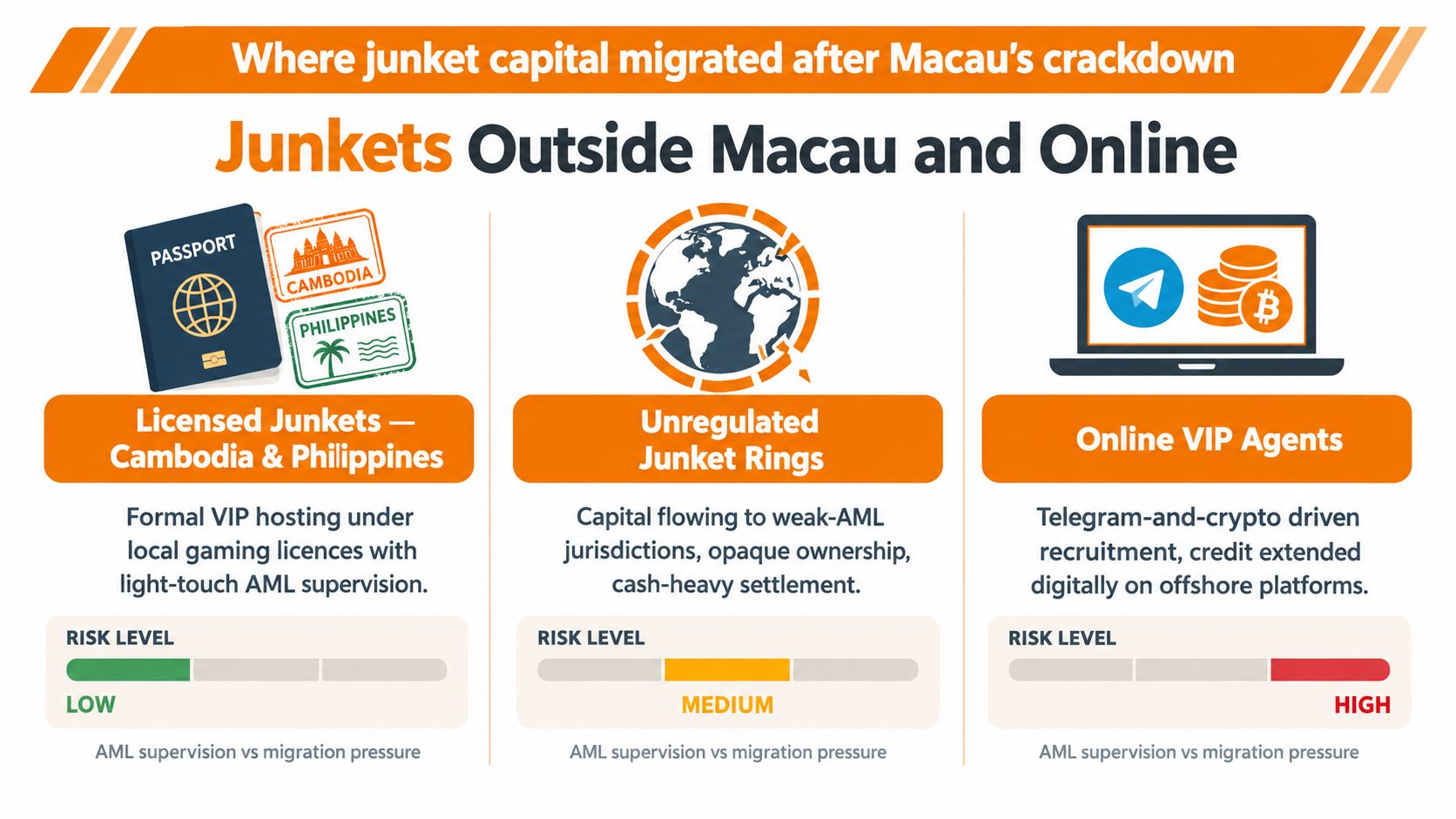
The junket model didn't need to survive under its old name. Its functions can reappear through local VIP agents, offshore promoters, affiliate groups, or online hosts. The relevant question isn't whether a partner calls itself a junket. It's whether that partner recruits players, influences credit, handles settlement, or controls information that the operator should hold directly.
Three variants appear in strategic reviews.
Licensed or semi-formal local promoters operate around land-based venues where VIP hosting and referral relationships remain commercially useful. Their licence status may provide some structure, but it doesn't automatically prove that the operator can see the full source of funds, agent hierarchy, or customer ownership.
Unregulated promoter networks rely on personal relationships and informal settlement. These networks can move between jurisdictions when enforcement increases in one market. Their apparent flexibility is also their weakness. Layered entities, cash-heavy activity, and unclear responsibility make it difficult to establish who accepted the money or who must repay it.
Online VIP agents reproduce the same functions through messaging channels, affiliate dashboards, private customer groups, and digital wallets. An agent can recruit a player for several brands, negotiate preferential treatment, or arrange credit outside the operator's formal cashier. The customer may experience a VIP service while the operator sees fragmented accounts and incomplete context.
Online branding doesn't remove the underlying exposure
An offshore licence, crypto payment, or white-label arrangement can change the legal perimeter, but it doesn't change the basic risk pattern. If an intermediary supplies credit, the operator may not know the true creditor. If the intermediary settles outside the platform, the operator may not know whether the person paying is the person playing. If an aggregator controls several brands, the operator may not see a customer's activity across the network.
Online operators should therefore classify partners by function, not label. A partner that only sends traffic is different from one that selects VIPs, negotiates credit, receives repayments, and directs customers between brands. The second partner resembles a junket even if its contract uses the language of affiliate marketing.
The safest migration path is to bring the relevant functions back into a controlled platform. Acquisition can remain external, but identity, wallet ownership, credit approval, incentives, and settlement need a single source of truth.
Alternatives to Junkets for iGaming Operators
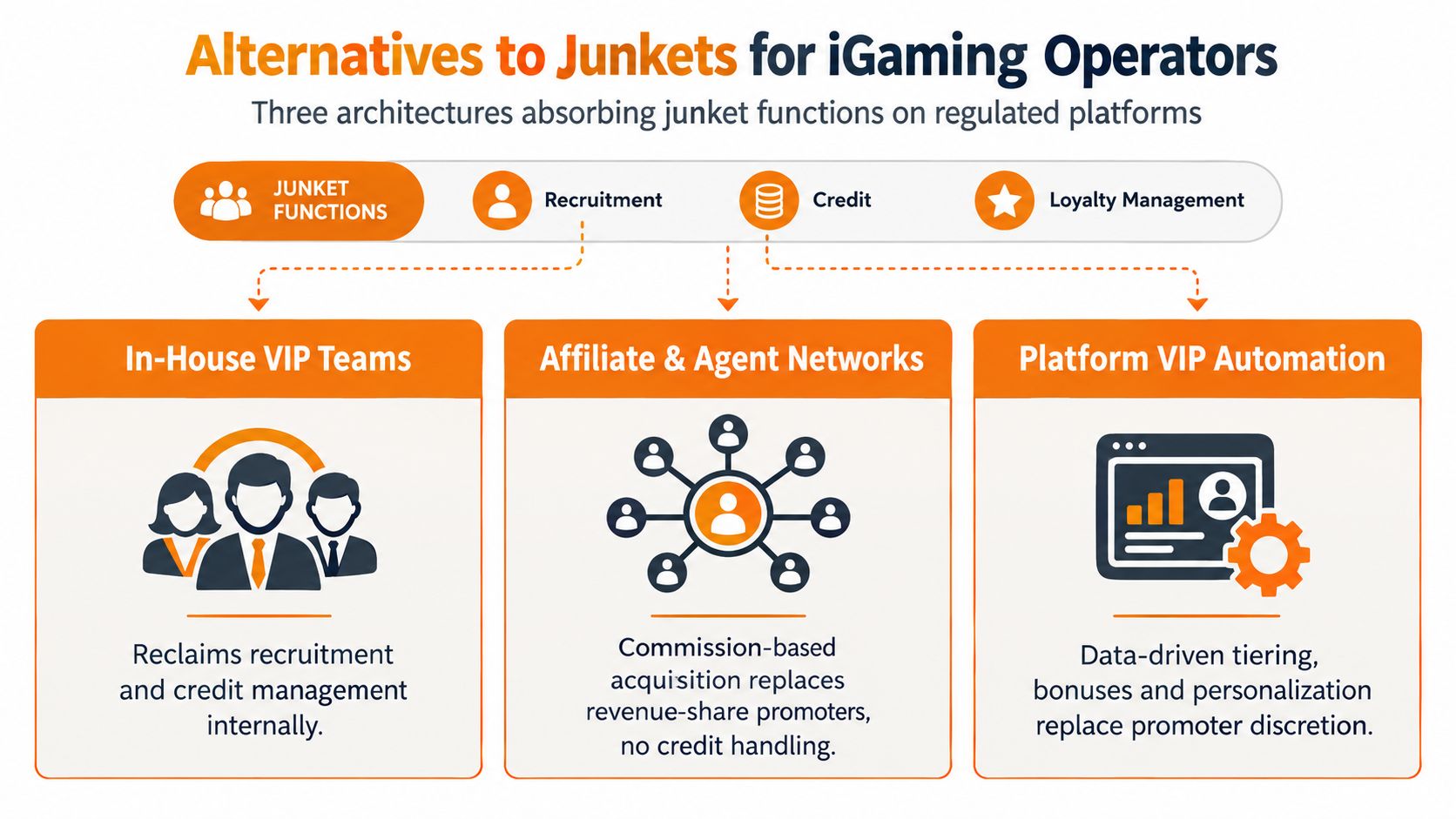
A regulated iGaming operator doesn't need to choose between unmanaged VIP promotion and abandoning high-value customers. It can separate the functions that junkets bundled together, then assign each function to a controlled system or accountable internal team.
In-house VIP teams
An internal VIP team absorbs recruitment, relationship management, and credit assessment. The operator owns the player record, applies its own KYC and source-of-funds standards, and decides whether any credit or promotional exposure is acceptable.
The revenue model is direct gaming revenue, less approved incentives and operating costs. Credit loss remains with the operator, but so does the control. The team can see the customer's deposits, withdrawals, game activity, bonus history, and responsible-gaming indicators in one environment. That visibility makes it easier to pause an account when behaviour changes.
The weakness is governance. Internal staff may become overconfident around profitable customers, especially when a VIP asks for exceptions. Credit limits, approval thresholds, second-person review, and documented escalation must prevent commercial pressure from overriding risk controls.
Affiliate and VIP-manager networks
An affiliate or external VIP manager can replace the acquisition function without receiving customer funds or extending credit. The operator pays a commission for verified activity under a documented agreement, while the player remains onboarded, funded, and monitored by the operator.
This architecture keeps credit loss and payment accountability with the operator. It also makes the partner's role narrower. The affiliate can introduce the customer and support communication, but it shouldn't decide whether funds are legitimate, accept repayments, or operate a parallel ledger.
Contracts should define commission eligibility, prohibited marketing, player ownership, audit rights, and clawbacks for fraud or chargebacks. A partner that asks to control the wallet or settle outside the cashier is no longer functioning like a simple affiliate.
Platform-led VIP automation
Automation replaces promoter discretion with rules for tiering, bonuses, segmentation, and personalisation. A platform can assign VIP status using verified activity and risk signals, then apply offers consistently across casino and sportsbook products.
This approach doesn't make compliance automatic. It does make decisions more reproducible. A rule can prevent a high-value customer from receiving a larger incentive while an affordability or identity review is unresolved. A unified wallet can also connect deposits, withdrawals, wagering, and rewards rather than leaving the VIP relationship in private messages.
A pay and play architecture can reduce unnecessary onboarding friction, but it shouldn't be treated as a replacement for appropriate KYC or transaction monitoring. Payment convenience solves a conversion problem. It doesn't transfer responsibility for the player to a third party.
The strongest design combines the three approaches selectively. Internal teams own risk decisions, external partners support acquisition without touching funds, and automation applies consistent loyalty rules. That division removes the most dangerous junket feature, the concentration of recruitment, credit, and settlement authority in one opaque relationship.
Evaluating and Integrating VIP Partners on a Unified Platform
A VIP partner should pass the same functional test as any other regulated supplier. The question isn't whether the partner has a polished brand or a strong player network. The question is whether the operator can identify the people behind the relationship, control the money, and reproduce every important decision from an auditable record.
Before onboarding
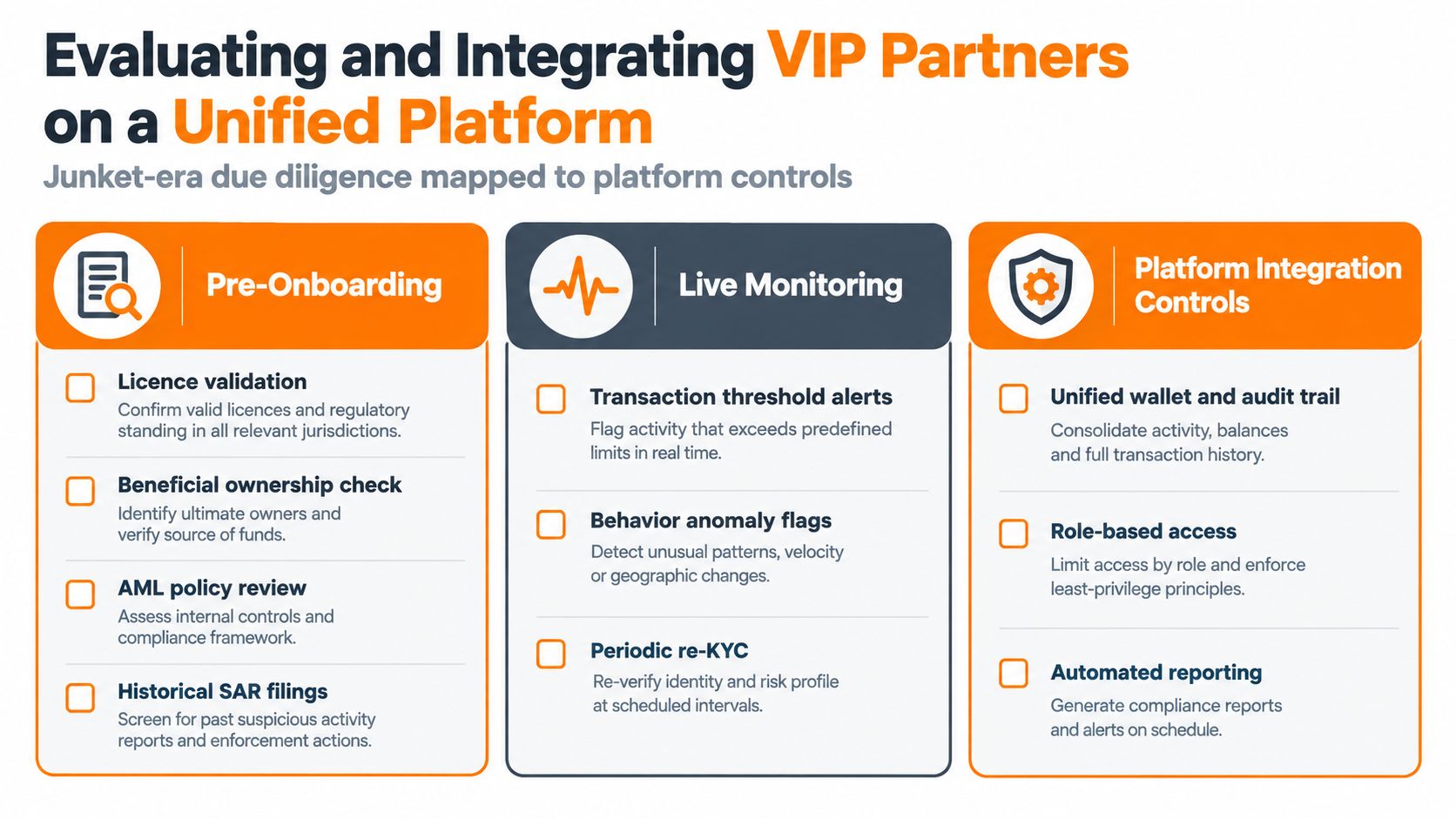
Start with the entity, not the sales forecast. Validate the partner's licence and corporate registration, identify beneficial owners, review its AML policy, and examine its compliance history. If the partner can't explain how it identifies players, handles suspicious activity, or preserves records, it isn't ready to receive access to a VIP programme.
Require re-KYC on the operator's own stack. A partner's customer file can support onboarding, but it shouldn't replace the operator's verified identity record. The same principle applies to source of funds and source of wealth. The operator needs evidence it can retrieve, test, and present during an audit.
Contractual controls
The agreement should prohibit the partner from holding player funds, extending unauthorised credit, or settling balances outside approved payment channels. Set per-player exposure limits, velocity controls, approval requirements, and clear rules for commissions and reversals.
Keep player funds separate from partner compensation. A commission ledger must never become a substitute for a player wallet. Give the operator real-time access to transaction records and the right to suspend the relationship when the partner breaches a control or refuses an investigation.
A partner can generate the customer, but it can't own the customer ledger.
Live integration and monitoring
Route partner-referred players through the same wallet, payments, risk, CRM, and reporting layers used for direct customers. Don't create a “VIP exception” that bypasses standard controls. That exception becomes the parallel rail the Macau model made difficult to supervise.
Configure alerts for unusual deposits, rapid movement between products, repeated payment-instrument changes, abnormal activity by agent, and attempts to move funds between related accounts. Review performance by partner and sub-partner, not only by brand. A clean brand-level report can conceal concentration around one agent or one beneficial owner.
The best practices for vendor management should extend into ongoing partner reviews. Recheck ownership, licences, controls, access rights, and risk indicators at defined intervals. Remove dormant accounts and restrict staff permissions so a partner can't retain operational access after its commercial relationship ends.
The strategic lesson is simple. A platform-led VIP programme should absorb the useful parts of the junket model, player service, targeted acquisition, and loyalty management, while rejecting the opaque credit and settlement chain. Operators that keep every partner inside one controlled data and payments architecture can serve high-value customers without making an external promoter the de facto bank, cashier, and compliance gatekeeper.
NexGrate gives iGaming operators a unified white-label platform for casino, sportsbook, payments, wallets, KYC and AML workflows, VIP management, and audit-ready operations. If you're replacing informal VIP intermediaries with controlled partner integrations and platform-led loyalty, visit NexGrate to explore the infrastructure.