
A player sends a short message to support: “Please close my account and stop me from gambling.” The request looks simple. In a live casino stack, it can touch the account service desk, player profile, wallet, game providers, payment gateway, CRM, fraud controls, and regulatory audit trail. If one of those systems treats the request as a note instead of an enforceable state change, the operator has a protection failure.
Responsible gaming tools work when they're wired into the backoffice as platform controls, not displayed as disconnected switches in the player interface. The practical test is whether a limit, exclusion, or behavioural alert changes what the wallet authorises, what providers accept, what staff can do, and what the operator can prove later.
Table of Contents
- When a Player Asks to Be Excluded
- The Eight Categories of Player Protection
- How Limits Interact with Wallets, KYC, and Reporting
- Comparing Self-Exclusion, Limits, Reality Checks, and Behavioural Monitoring
- A Phased Rollout From Policy to Production
- What to Measure Once the Tools Go Live
- Choosing a White-Label or Vendor Partner
When a Player Asks to Be Excluded
A Tier-2 operator in Malta receives an MGA finding after a player's self-exclusion request remains stuck in a limit-engine event queue. The player continues depositing for nine days because the account service desk records the request, but the exclusion state never reaches the wallet or payment layer. The frontend says the account is restricted. The transaction path says otherwise.
That failure usually isn't caused by one careless employee. It comes from treating self-exclusion as a customer-service workflow rather than as a high-priority account state. The request should create an idempotent event immediately, lock the player profile, suspend deposits and wagering synchronously, stop promotional contact, and send the exclusion state to every connected product and provider.
The propagation path
The service desk or account API should first validate the player identity and create a permanent audit record containing the request time, channel, operator identity, reason code where available, and effective scope. The limit service then publishes the state to the wallet authorisation layer. The wallet must reject new deposits, stakes, and any transaction that would allow continued play, rather than waiting for a later reporting process.
The event also needs to reach:
- Game providers: Disable play through provider APIs and reconcile any active sessions.
- Payment processors: Reject deposits linked to the excluded player, including retries and queued payment attempts.
- CRM and marketing: Remove the player from campaigns, bonus journeys, affiliate audiences, and outbound contact lists.
- KYC and account linkage: Associate the exclusion with the verified customer identity, not only one username or brand account.
- Backoffice queues: Route exceptions to compliance or the Social Responsibility Officer with a visible deadline and owner.
Practical rule: A self-exclusion request should be enforced on the transaction path first and reported asynchronously afterward.
The common sync failures are predictable. A provider may hold a separate player identifier. A payment gateway may receive only a merchant account reference. A white-label brand may maintain its own CRM list. A delayed message consumer may process an old “account active” event after the exclusion event. Each integration needs a canonical player ID, event version, effective timestamp, replay protection, and a reconciliation job that compares source and destination states.
Auditability matters just as much as enforcement. The operator should be able to reconstruct who received the request, which systems acknowledged it, which transactions were blocked, and whether any funds require review. That evidence belongs in the operator's compliance reporting workflow, not in an isolated support ticket.
This is the architecture that prevents the Malta finding: self-exclusion, deposit limits, cooling-off periods, and behavioural flags become first-class objects in one player-protection layer. The interface remains important, but the backoffice owns the decision and every revenue-generating path obeys it.
The Eight Categories of Player Protection
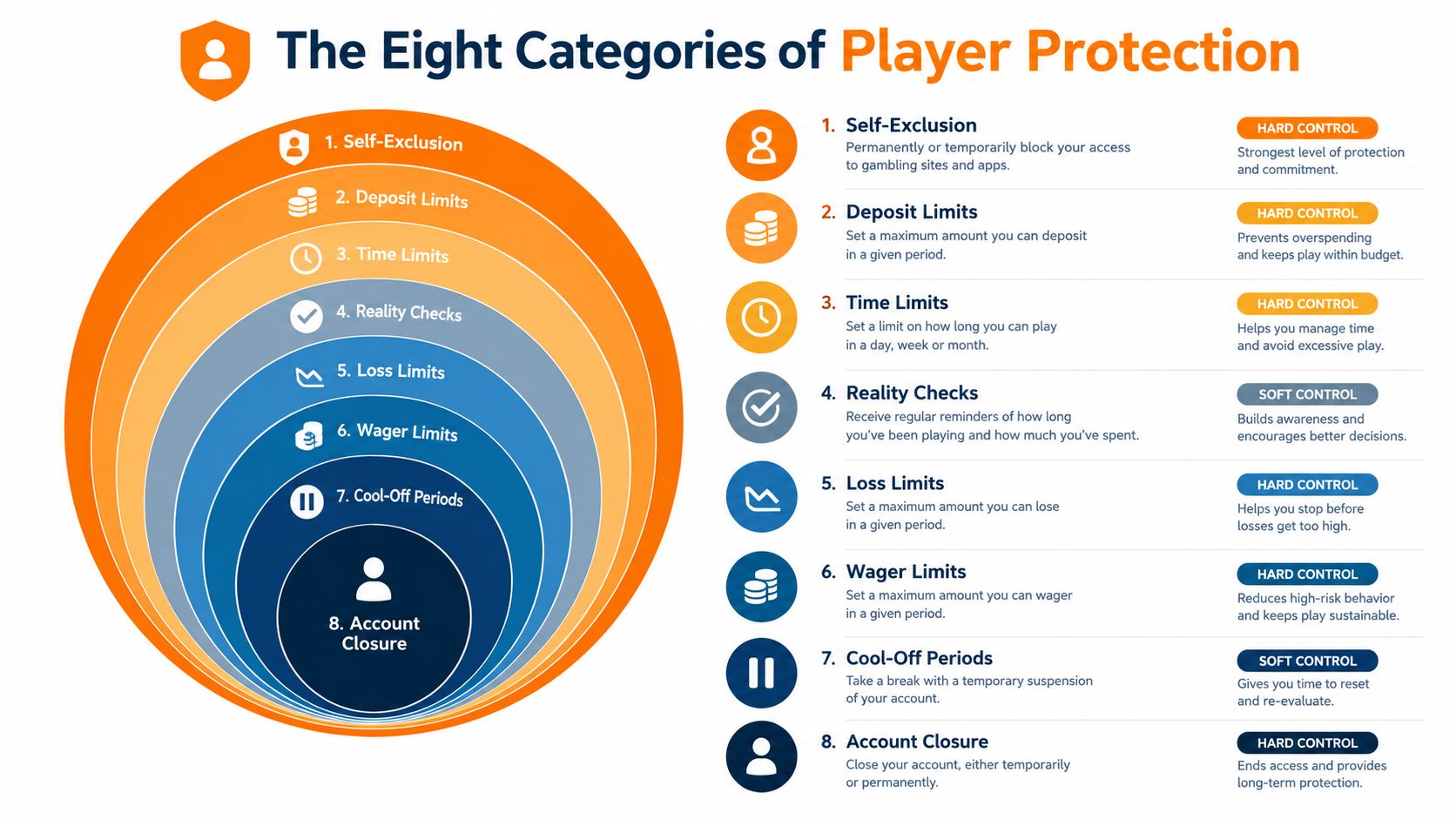
A useful platform model separates controls by how directly they can stop play. The evidence base reviewed in a 2024 narrative review covered 55 peer-reviewed studies and grouped responsible-gaming interventions into eight technical categories: voluntary self-exclusion, voluntary limit-setting, pop-up messages, passive personalized feedback, active personalized behavioural feedback, forced breaks, third-party exclusion, and speed-of-play interventions. The review also shows why operators shouldn't assume that every visible tool has the same evidential weight.
Layer one, hard controls
The wallet should own the controls that can prevent a transaction or account access:
- Voluntary self-exclusion blocks the player for the selected scope and duration.
- Voluntary limit-setting applies deposit, loss, wager, or session boundaries.
- Forced breaks interrupt play after configured activity or time conditions.
- Third-party exclusion connects operator action with an external exclusion source where the jurisdiction requires it.
These controls need clear precedence rules. A permanent exclusion must override a promotional campaign, a pending withdrawal workflow, and any attempt to reduce a stricter limit. A cooling-off request should have an effective start and end time that the wallet evaluates consistently, including across daylight-saving changes and multiple currencies.
Layer two, in-session prompts
Pop-up messages, reality checks, and passive personalized feedback sit closer to the active session. They can show spend summaries, elapsed time, recent deposits, or a reminder to review limits. They create less friction than a blocked transaction, but a generic warning that appears at an arbitrary moment can quickly become background noise.
Layer three, risk detection
Active personalized behavioural feedback and speed-of-play interventions depend on telemetry. The platform watches deposit velocity, wager patterns, session duration, cancelled withdrawals, rapid product switching, and repeated limit changes. A rules engine or model can then choose an intervention, but it should expose the signal and decision path to trained staff rather than turn an opaque score into an automatic judgement.
Layer four, remediation
Refund and restriction workflows complete the stack. They handle cases where a control failed, a player was allowed to continue after exclusion, or an operator needs to review transactions and communications. The risk-management practices used by the backoffice should define ownership, approval paths, evidence retention, and escalation.
The concept diagram is straightforward:
Wallet enforcement → Session intervention → Behavioural detection → CRM and compliance remediation
A mature platform supports all four layers. A product with only player-facing toggles may look complete while leaving the transaction and identity layers untouched.
How Limits Interact with Wallets, KYC, and Reporting
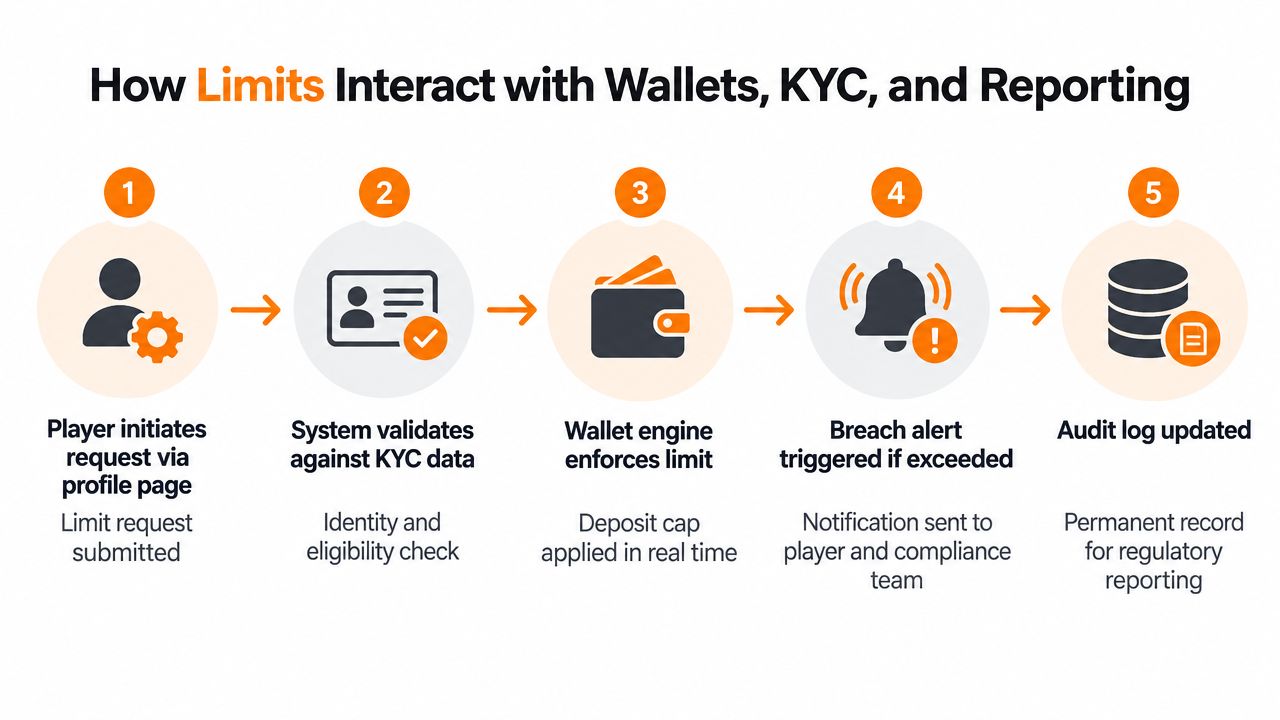
Consider a player setting a EUR 500 weekly deposit limit. The player profile service receives the request, validates the account state, and passes it to the limit engine with a canonical player ID, currency, limit type, start time, reset rule, and source channel. The limit engine should calculate eligible deposits against settled and pending transactions according to the operator's policy, then return an enforceable decision to the wallet.
Synchronous enforcement
The wallet authorisation call must be synchronous for a deposit or wager. It checks the active limit, the amount already counted in the current period, the player's account restrictions, and any cooling-off or exclusion state. If the request would exceed the limit, the wallet rejects it before the payment processor or game provider completes the action.
A multi-currency wallet adds another decision. The platform needs a defined base currency or a reliable conversion snapshot, so the same limit isn't evaluated differently depending on the deposit rail. The multi-currency wallet design should preserve the original amount, conversion rate, timestamp, and resulting limit value for audit purposes.
KYC data supplies identity and eligibility context. It can include verification status, jurisdiction, account linkage, source-of-funds outcomes, and affordability information where the operator's policy requires it. The limit service must not approve a relaxation request while an AML review, suspicious-activity alert, or unresolved identity conflict is active. Those checks may be asynchronous for ongoing monitoring, but the approval decision needs a current risk-state lookup.
Asynchronous evidence
After enforcement, the platform emits events to AML monitoring, compliance reporting, analytics, customer service, and notification services. Each event needs an idempotent identifier and version. If a consumer retries or processes messages out of order, the operator must still be able to distinguish the original limit request from a duplicate and establish the final state.
The audit record should include the requested value, previous value, effective time, actor, decision, reason code, wallet outcome, and downstream acknowledgements. Reporting can process asynchronously, but it must not become the only place where the control exists.
Operators often discover here that a limit engine is technically present but operationally weak. If the wallet can't query it during authorisation, if provider balances bypass the central wallet, or if KYC linkage exists only in a separate system, the limit is a display feature rather than a control.
Comparing Self-Exclusion, Limits, Reality Checks, and Behavioural Monitoring
The controls differ in trigger, friction, and evidence. Treating them as interchangeable leads to weak implementation decisions.
| Control | Trigger | Operator Friction | Evidence of Impact |
|---|---|---|---|
| Self-exclusion | Player-initiated, or operator-imposed | High. Blocks access, deposits, play, and marketing | Strong harm-reduction rationale, but adoption depends on awareness, scope, and reliable enforcement |
| Deposit and loss limits | Usually player-initiated, sometimes operator-imposed | Medium to high at wallet authorisation | AGA research reports broad awareness and majority-perceived usefulness for deposit and credit restrictions, with details in the responsible gaming baseline |
| Time limits and cooling-off | Player-initiated, with system enforcement | Medium during sessions and account access | Useful as configurable interruption controls, though effectiveness depends on adoption and timing |
| Reality checks | System-triggered during a session | Low to medium, depending on whether acknowledgement is required | Helpful as a prompt, but generic messages don't substitute for limits or exclusion |
| Affordability assessments | System-triggered from KYC, financial, or risk data | Medium to high, especially when documents or manual review are required | Valuable for risk governance, but data quality and proportionality determine usefulness |
| Behavioural monitoring | System-detected from telemetry and account history | Low for the player, high for the operator | A tracking and feedback study found reductions in deposited and wagered amounts among at-risk users, persisting from the week after enrolment to 24 weeks later. Study details |
| Refund and restriction workflows | Operator-triggered after a failure, complaint, or review | High, because staff must investigate and document the outcome | Important for remediation and accountability, but it's reactive rather than preventive |
Self-exclusion creates the greatest immediate friction because it removes the player's ability to continue. That's also why the control must be handled carefully. Historical Great Britain research found that self-exclusion awareness and use changed over time, while international evidence showed a substantial gap between policy availability and actual adoption. The historical analysis supports a practical conclusion: operators shouldn't rely on self-exclusion alone.
A low-friction control can identify risk early, but only a hard control can reliably stop a transaction.
Deposit limits can change spend trajectories when players set and follow them. Behavioural monitoring can reach players who haven't configured a limit, but it depends on complete wallet telemetry, accurate identity linkage, calibrated thresholds, and a human response path. Reality checks are useful at the session boundary, yet they won't repair a provider integration that continues accepting stakes after an exclusion.
MGA expectations and UKGC vulnerability guidance therefore make more sense as a layered operating model than as a feature checklist. Each control catches a different failure mode. The operator's job is to define precedence, connect the data, and make sure a weaker nudge can't override a stronger restriction.
A Phased Rollout From Policy to Production
Responsible gaming tools should enter production through the same discipline used for payments and identity. The rollout needs a shared acceptance bar for compliance, product, engineering, and operations.
Phase one, policy mapping
Start by mapping MGA requirements and concurrent jurisdiction rules to explicit product behaviours. Define which controls are mandatory, who can impose them, how long they remain active, and what happens to open bets, pending deposits, withdrawals, bonuses, and marketing permissions.
The checkpoint is a signed control matrix. It should specify the precedence of permanent exclusion over every other state, the permitted limit-change workflow, and the Social Responsibility Officer review cycle.
Phase two, data-model design
Create one player-protection object model linked to the canonical identity, wallet, KYC profile, AML state, session record, CRM permissions, and provider identifiers. Store effective and expiry times, source channel, actor, reason, jurisdiction, currency, and event version.
The acceptance test is a replayable event sequence. A reviewer should be able to reconstruct a limit request, a breach, a notification, a manual decision, and the resulting wallet state without joining undocumented spreadsheets.
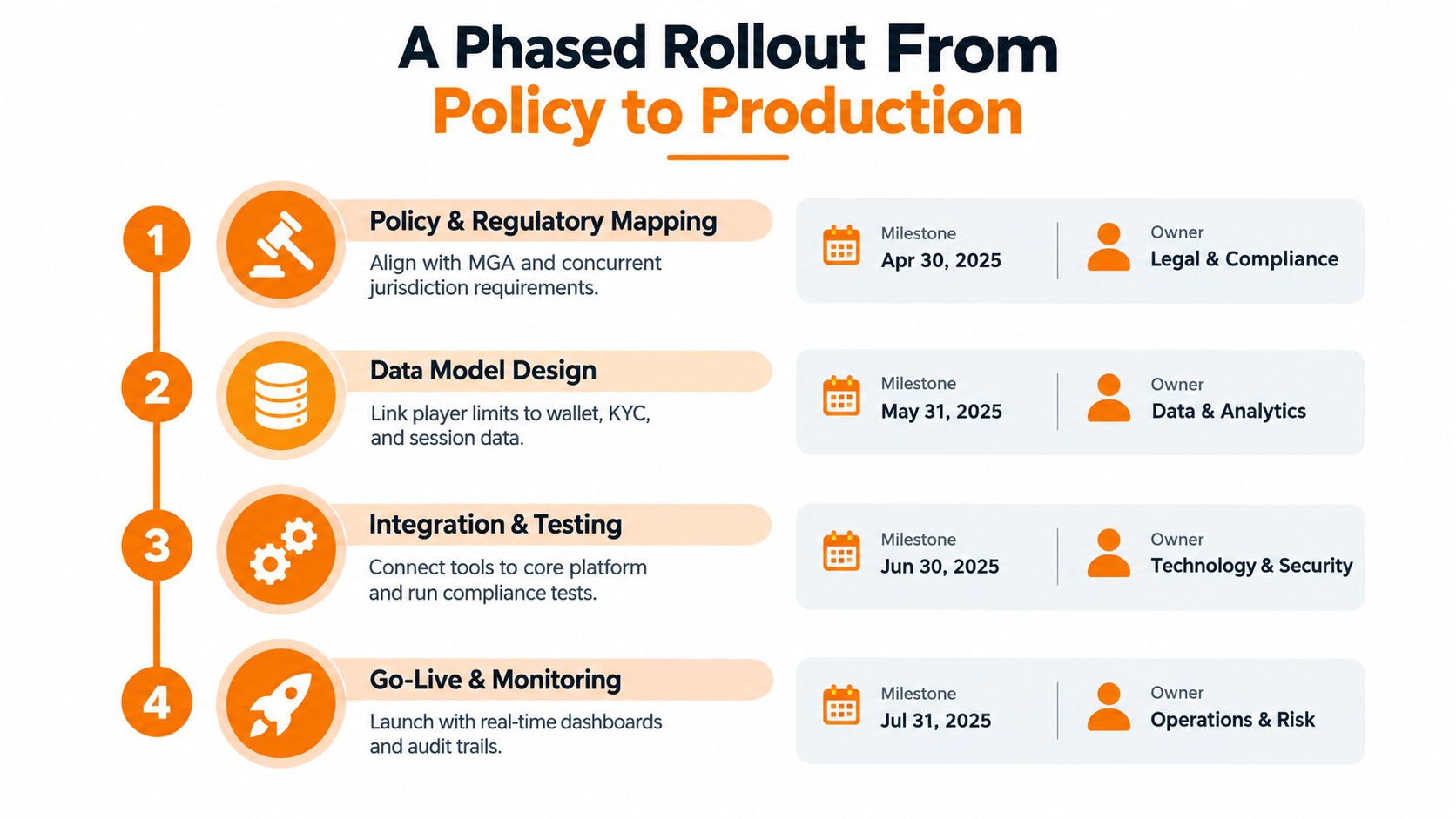
Phase three, integration and testing
Connect the limit engine to the wallet authorisation path, provider adapters, payment processors, CRM suppression lists, KYC services, and AML monitoring. Test both the happy path and failure path. A provider timeout shouldn't default to allowing play when the player has an active exclusion.
UAT should cover a mid-session deposit attempt, concurrent withdrawal and exclusion requests, repeated webhook delivery, stale provider identifiers, account recovery attempts, currency conversion, and an AML alert arriving while a player asks to raise a limit.
Phase four, go-live and monitoring
Launch with dashboards that show active restrictions, unacknowledged events, provider sync failures, blocked transactions, unresolved manual reviews, and notification outcomes. Assign an owner to each queue and define escalation windows before launch.
The go-live checkpoint is operational, not visual. Compliance can demonstrate the control, support can explain it, engineering can trace it, and finance can reconcile any refund or reversal without relying on a developer.
What to Measure Once the Tools Go Live
A player setting a limit proves intent, not protection. The AGA baseline reports that 56% of online casino players said they always or usually set a budget before gambling, and 78% of those budget-setters said they stick to it. The same research is useful for context, but an operator still needs transaction-level evidence to know whether its own controls work.
Track the journey from intention to outcome. Segment every measure by jurisdiction, product, risk tier, acquisition source, payment method, and account age where lawful and operationally useful. Aggregate awareness can hide a serious failure in a high-risk segment.
| KPI | Definition | Operational Owner | Review Cadence |
|---|---|---|---|
| Control uptake rate | Players activating each control, separated by control type and segment | Product and responsible-gaming teams | Weekly operational review |
| Mean limit value | Average active limit, adjusted for player segment and currency | Risk analytics | Monthly calibration |
| Breach-and-rescue rate | Breaches followed by a completed intervention, restriction, or support outcome | Compliance operations | Weekly queue review |
| Trigger-to-action time | Elapsed time from behavioural alert to approved intervention | Social Responsibility Officer | Daily exception monitoring |
| Refund and reversal volume | Transactions reviewed, refunded, reversed, or rejected after a control failure | Finance and compliance | Monthly reconciliation |
| Reactivation pattern | Attempts to return after cooling-off or exclusion, including blocked and escalated attempts | Account services and compliance | Weekly trend review |
The most important measure is often operational latency. A behavioural flag that sits in a queue until the next business day may be less useful than a simpler rule that reaches the player and an agent during the active risk window.
The platform should feed findings back into configuration. If reality checks are ignored, review their placement and wording. If players repeatedly approach a limit through rapid deposits, evaluate the deposit-velocity rule and the support route. If self-exclusion attempts reveal cross-brand gaps, expand identity linkage and external blocking rather than adding another warning.
Over 70% of players in a 2026 Responsible Online Gaming Association study reported setting personal limits before play, while more than 30% were unaware of tools or didn't know how to use them. That research points to a discoverability problem, but the backoffice still has to measure whether discovery becomes an enforced, observable action.
Choosing a White-Label or Vendor Partner
Procurement should begin with the transaction path, not the screenshots. Ask the vendor to demonstrate what happens when a player sets a restriction, deposits through a second payment rail, opens a new product, changes currency, or contacts support while an AML alert is active.
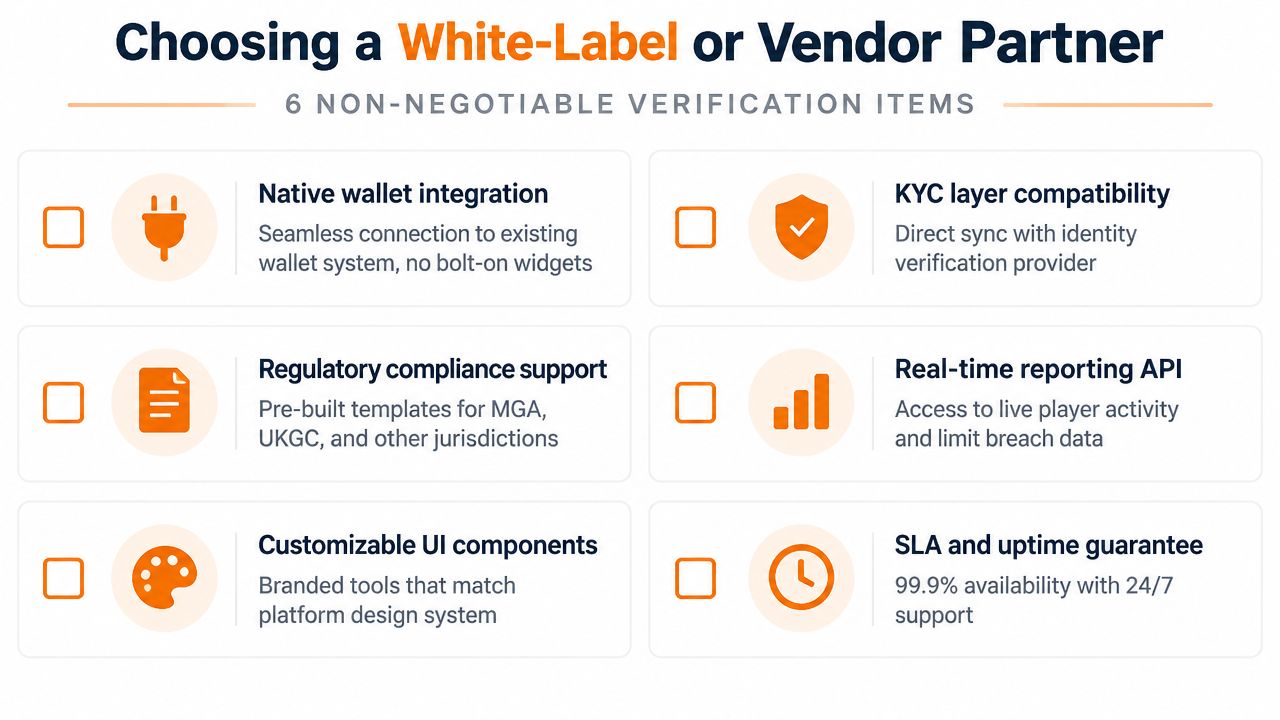
Technical non-negotiables
- Native wallet integration: The tool must participate in real-time deposit and wager authorisation, not merely display a limit in a profile page.
- KYC compatibility: The vendor should consume the operator's verified identity and account-linkage data without creating a parallel customer record.
- Jurisdictional rule packs: The system should support configurable policies for MGA, UKGC, Spelinspektionen, ADM, and any other target market, with versioned changes.
- Immutable audit events: Logs need effective timestamps, actor identity, event IDs, decision reasons, acknowledgements, and replay or export capability.
- Provider coverage: Self-exclusion and restriction states must propagate to game, payment, sportsbook, CRM, and affiliate systems.
- Operational controls: Compliance teams need queues, escalation paths, manual review permissions, and a documented separation of duties.
White-label aggregators can shorten launch work by combining wallet, payments, games, reporting, and safer-gambling features in one environment. The trade-off is dependency. Confirm who owns player data, how an operator exports it, what happens at termination, and whether the aggregator can support jurisdiction-specific control changes without a long product queue.
Specialist responsible-gaming vendors may offer deeper behavioural analytics or intervention tooling. They can also introduce another identity map, event bus, support queue, and reconciliation burden. The integration contract should define enforcement latency, fail-safe behaviour, retry handling, service-level commitments, and responsibility when a downstream provider doesn't acknowledge a restriction.
Avoid commercial structures that reward prolonged activity without transparent safeguards. Per-player pricing can misalign incentives if the vendor benefits from account volume while the operator bears the protection risk. Opaque machine-learning scores, weak exclusion-database coverage, unclear data retention, and no credible exit clause are procurement blockers, not minor contract details.
NexGrate provides a white-label platform with a shared backend for casino and sportsbook operations, including wallets, KYC and AML workflows, reporting, audit logs, and responsible gaming controls such as deposit limits, loss limits, session timeouts, self-exclusion options, and reality checks. Operators evaluating that model can review the platform capabilities and integration approach at NexGrate.
NexGrate can help operators connect responsible gaming controls with the wallet, KYC and AML workflows, payment rails, provider integrations, and audit reporting in one operational stack. Review your current exclusion and limit flows, identify every unsynchronised system, and visit NexGrate to discuss a practical path from policy to production.