A player's account has just triggered several alerts. Deposits arrive through different payment methods, withdrawals follow soon after, the KYC address doesn't match recent account information, and the player's activity crosses more than one product. The operations queue shows an alert, but the alert itself doesn't answer the question that matters: is this suspicious activity reporting case, or is it a false positive that should be closed?
That decision is where many iGaming teams struggle. A transaction amount alone rarely explains the full risk. Operators need to connect identity data, payment behavior, gameplay, device signals, geography, and account history before they can make a defensible decision.
Suspicious activity reporting protects more than a compliance checklist. It supports financial crime prevention, helps preserve licensing relationships, and reinforces player trust. The challenge is operational: teams must identify meaningful patterns without turning every unusual event into a report.
Table of Contents
- Introduction to Suspicious Activity Reporting in iGaming
- What Suspicious Activity Reporting Really Means
- Regulatory Obligations and Thresholds Operators Must Know
- KYC Triggers and Behavioral Signals That Warrant Attention
- What to Include in a Strong Suspicious Activity Report
- From Alert to Filing, A Practical SAR Workflow Example
- How NexGrate Supports Compliant Suspicious Activity Reporting
Introduction to Suspicious Activity Reporting in iGaming
An iGaming operator sees thousands of ordinary events every day. Players deposit, place bets, move between casino and sportsbook products, claim promotions, and request withdrawals. Most of that activity is legitimate. The difficult cases are the ones where several individually explainable actions combine into a pattern that no longer makes commercial or behavioral sense.
Consider the player from the opening scenario. A fragmented deposit pattern might have a reasonable explanation, such as payment limitations or a preferred funding method. A rapid withdrawal might also be normal. A KYC mismatch could result from an outdated address. The risk changes when those signals appear together, especially if the player avoids source-of-funds questions, uses several payment instruments, or moves funds without meaningful gaming activity.
Suspicious activity reporting is not a reaction to one alert. It's the outcome of an evidence-based decision pipeline.
The operator first detects activity, then enriches the event with customer and transaction context, and finally decides whether the combined facts create a reasonable basis for suspicion. That process must work across casino and sportsbook activity, fiat and crypto payments, multiple brands, and jurisdictions with different reporting expectations.
iGaming creates particular operational pressure because transactions and gameplay can move quickly across connected systems. Cross-border access, payment providers, digital wallets, bonus mechanics, and crypto rails can make the customer journey difficult to reconstruct if data sits in separate tools. A compliance analyst may need to compare KYC documents, deposits, withdrawals, bets, bonus use, device information, and account communications before reaching a conclusion.
The regulatory value of a SAR is therefore its intelligence, not merely its existence. A well-prepared report gives the relevant authority a coherent account of who was involved, what happened, when it happened, where the activity occurred, and why the pattern raised suspicion. A weak report adds noise and leaves investigators to rebuild the story themselves.
This guide treats SAR as an operational decision rather than a filing threshold. It focuses on the distinction between an alert and a reportable suspicion, the patterns that deserve attention, the evidence a narrative should contain, and the platform controls that make both filing and no-file decisions easier to defend.
What Suspicious Activity Reporting Really Means
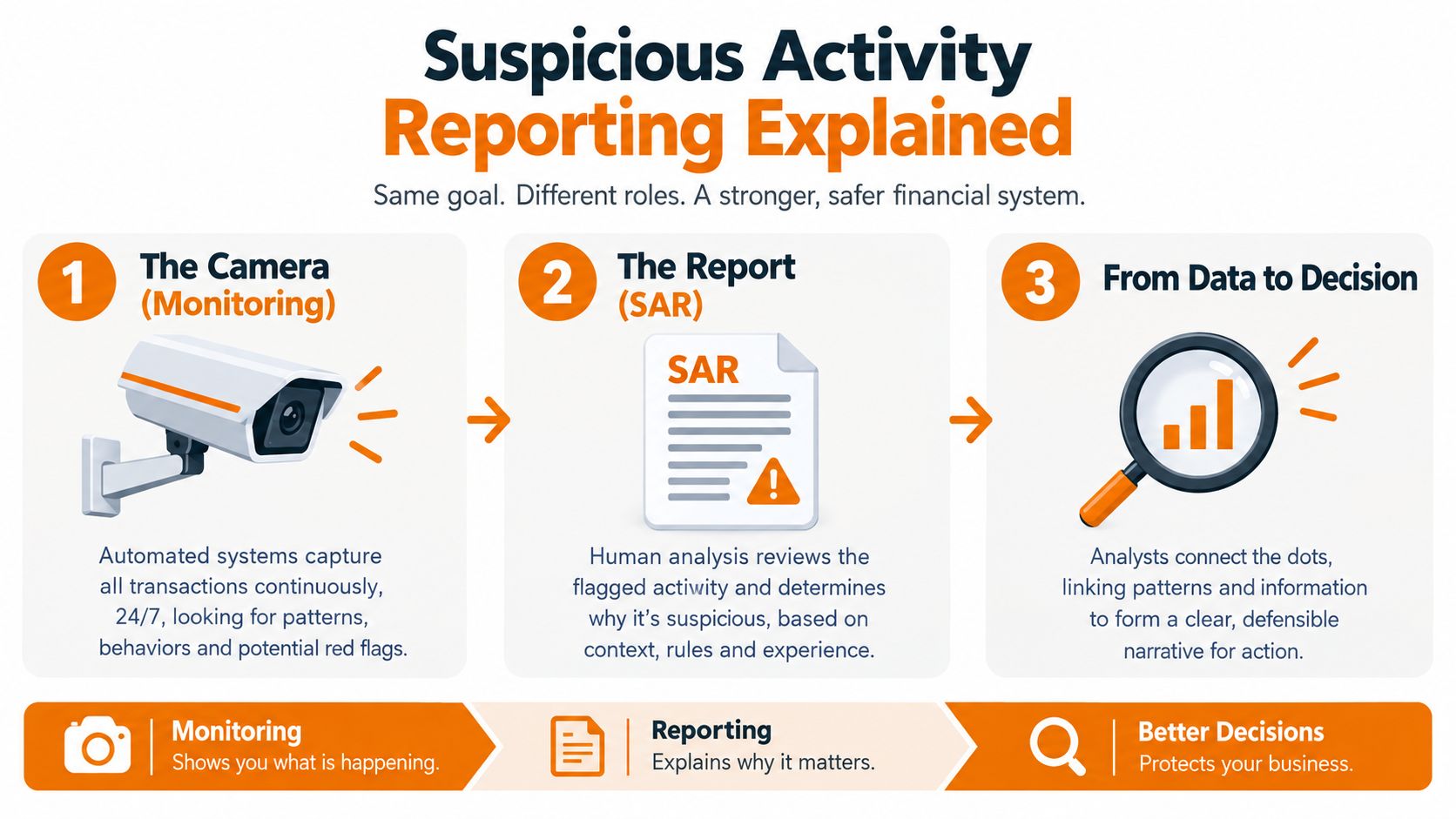
Think of transaction monitoring as a security camera. The camera records movement continuously. It may detect a person entering a restricted area, but it doesn't know whether that person is an employee, a contractor, or an intruder.
A SAR is closer to the security report written after someone reviews the footage. The report connects events, identifies the relevant person or account, explains the unusual behavior, and states why the facts create suspicion. Monitoring produces signals. Suspicious activity reporting produces an informed conclusion.
An alert isn't a SAR
An automated rule might flag rapid deposits followed by withdrawals, a change in country access, repeated failed verification, or a wallet address associated with heightened risk. None of those events automatically proves criminal conduct. The rule has identified a fact pattern that needs review.
The analyst's job is to ask structured questions:
- Does the activity fit the player's known profile?
- Is there a credible explanation supported by evidence?
- Do separate accounts, payment methods, or devices connect the activity?
- Is the customer attempting a transaction, or has the transaction already taken place?
- Does the overall pattern suggest money laundering, fraud, evasion, or another suspicious purpose?
A report doesn't require proof that a crime occurred. It requires a defensible basis for suspicion under the rules that apply to the operator. The narrative should separate confirmed facts from interpretation. “The player used three funding methods and requested a withdrawal shortly after each deposit” is a fact. “The player is laundering money” is a conclusion that may go beyond the available evidence.
Human judgment completes the control
Rules are useful because they apply consistently and surface activity at scale. They can't replace context. A player who deposits and withdraws frequently may be using a payment method with strict limits. Another player showing the same pattern may be cycling funds through several accounts, avoiding KYC questions, and placing minimal bets.
The decision pipeline should therefore have three distinct outcomes:
- Close the alert, when the evidence supports an ordinary explanation.
- Continue investigation, when information is incomplete or the pattern needs more context.
- Escalate for SAR consideration, when the combined facts create reasonable suspicion.
Treating every alert as a report weakens the signal received by investigators. Treating every alert as harmless creates a different risk. Good suspicious activity reporting depends on disciplined separation between detection, investigation, and decision.
Regulatory Obligations and Thresholds Operators Must Know
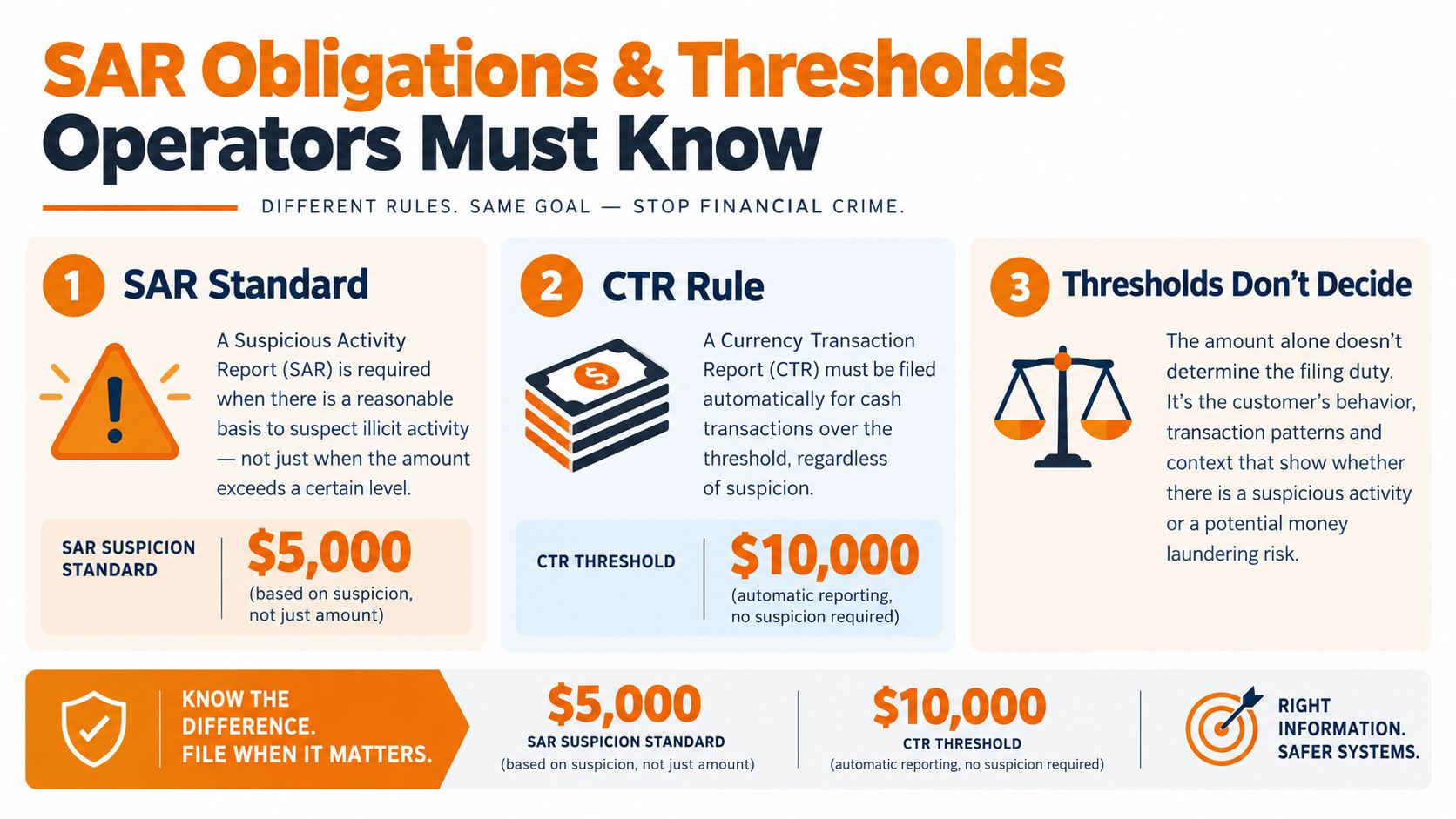
Thresholds matter, but they don't make the filing decision by themselves. Operators often confuse suspicious activity reporting with currency transaction reporting because both involve financial activity and regulatory submissions. They serve different purposes.
In the United States, FinCEN says banks must file a SAR for transactions or attempted transactions aggregating $5,000 or more when they know, suspect, or have reason to suspect money laundering, evasion of Bank Secrecy Act rules, or activity with no apparent lawful purpose, as described in the FinCEN Year in Review. The key condition is suspicion. The amount helps define the U.S. reporting obligation in that context, but the operator still needs to assess purpose, behavior, and customer context.
Currency transaction reporting is different. A CTR generally concerns qualifying cash activity over the applicable threshold, regardless of whether the institution suspects criminal conduct. That distinction is especially important for digital operators, where deposits and withdrawals may involve cards, bank transfers, e-wallets, or crypto rather than physical cash.
Why amount alone fails
Many suspicious transactions have no minimum amount at all. FFIEC guidance explains that management information systems and vendor reports may use discretionary dollar thresholds to identify unusual activity, while the underlying reporting obligation can depend on suspicion rather than a preset amount. The same guidance also notes that jurisdictions such as the UAE and Malaysia require reporting of suspicious or attempted transactions regardless of amount, as described in the FFIEC BSA and AML manual.
That creates a practical architecture requirement. A monitoring program should combine:
- Rules, to identify known risk patterns.
- Behavior profiling, to detect activity outside the player's normal use.
- Customer context, including KYC, source-of-funds information, geography, and linked accounts.
A single global rule set can create gaps. A U.S. workflow may emphasize the local suspicion standard and filing requirements, while another market may require reporting of attempted activity regardless of amount. Local obligations, licensing conditions, and the operator's own policies must be mapped before teams configure thresholds.
Volume changes the operating model
FinCEN's reported SAR volume rose from 4.3 million in FY 2022 to 4.6 million in FY 2023, 4.7 million in FY 2024, and 4.8 million in FY 2025. Its FY 2025 themes included 3.2 million reports marked Other Suspicious Activity, 2.0 million linked to money laundering, 1.8 million tied to fraud, and 1.25 million associated with structuring, according to the FinCEN Year in Review PDF.
The lesson for iGaming teams isn't to file mechanically. It's to build automated triage, clear escalation ownership, and analyst workflows that can absorb high alert volumes while protecting narrative quality. Operators can also use this guide to compliance reporting when mapping SAR controls to broader regulatory reporting processes.
KYC Triggers and Behavioral Signals That Warrant Attention
A useful investigation begins with observable facts. The strongest alerts usually combine customer information with behavior rather than relying on a single transaction rule.
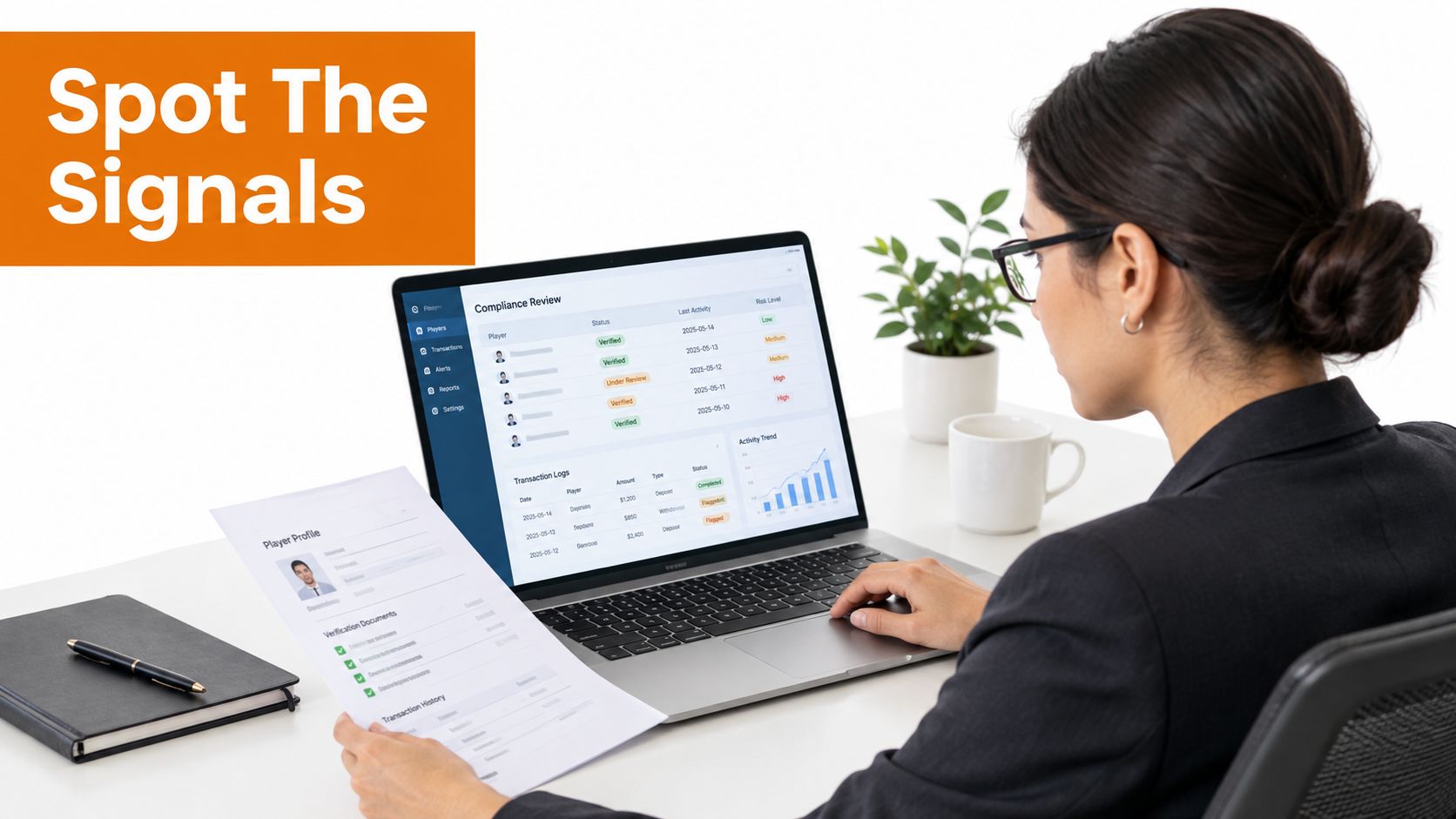
KYC inconsistencies deserve attention when they affect the reliability of the customer profile. Examples include a name that differs across payment and identity records, an address that conflicts with geolocation data, documents that don't match account ownership information, or repeated attempts to change personal details after a withdrawal request. One mismatch doesn't automatically make the activity suspicious. It becomes more significant when the player refuses reasonable clarification or the inconsistency appears alongside unusual movement of funds.
Source-of-funds behavior can provide another layer. A player may provide incomplete information, avoid questions, submit documents that don't explain the funding pattern, or repeatedly change the explanation for deposits. Analysts should record what the player provided and what remains unverified. They shouldn't convert an information gap into an accusation.
Behavioral patterns need context
Structuring-like behavior can appear as repeated deposits designed to avoid internal review, especially when the player uses several instruments or accounts. The pattern matters more than the individual amount. Under the FinCEN suspicious activity reporting FAQs, activity near a CTR threshold alone isn't enough to establish suspicion of structuring. Analysts need evidence that the activity may be designed to evade a reporting requirement.
Gameplay adds another dimension. Risk indicators may include:
- Chip dumping or coordinated play, where accounts appear to transfer value through gameplay rather than ordinary wagering.
- Bonus abuse combined with withdrawals, particularly when promotional activity seems to be used primarily to move funds.
- Crypto and fiat cycling, where deposits and withdrawals move through different rails without an apparent lawful purpose.
- Linked-account activity, such as shared devices, payment instruments, addresses, or unusual account access patterns.
- Minimal gameplay, where substantial financial movement occurs with little activity consistent with the stated gaming purpose.
The operator should compare each signal with the player's history, stated profile, product use, and explanations. The risk management best practices can help teams formalize that comparison instead of leaving decisions to individual intuition.
Practical rule: An alert becomes stronger when independent data sources tell the same story.
The correct outcome may still be closure. If a player explains an address mismatch, provides credible documentation, and shows ordinary behavior after review, the analyst may have a sound basis to close the case. If the explanation conflicts with payment, gameplay, and access data, escalation becomes more defensible.
What to Include in a Strong Suspicious Activity Report
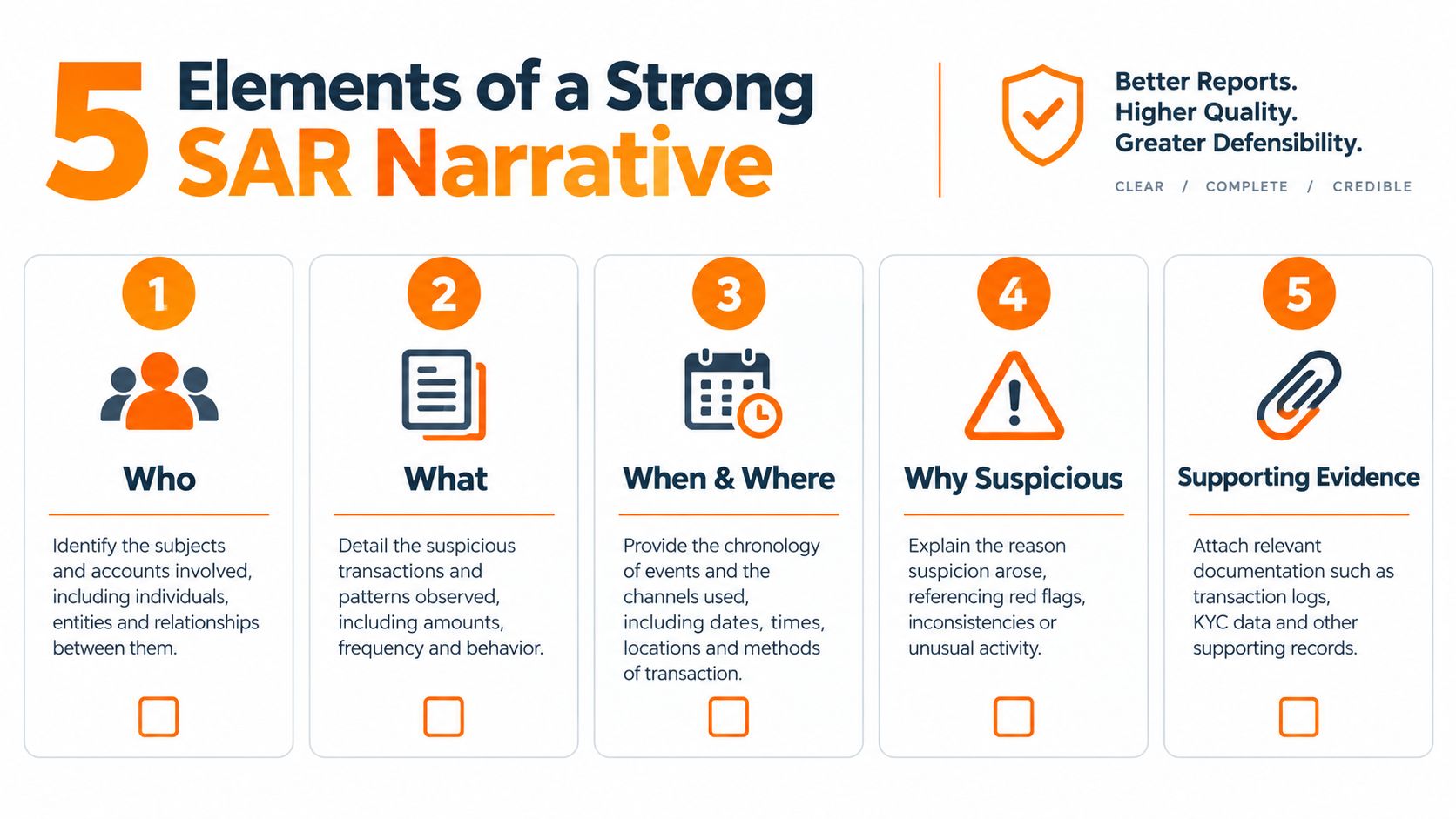
A strong report lets an investigator understand the case without guessing how the analyst reached the conclusion. The narrative should be factual, chronological, and specific enough to connect the customer to the activity.
Use five questions as the writing framework:
- Who is involved?
- What happened?
- When did it happen?
- Where did the activity occur?
- Why does the combined pattern appear suspicious?
Build the narrative around evidence
Start with the subject and account identifiers available to the operator. Include relevant customer details, linked accounts, payment instruments, wallet identifiers, and other identifiers that help distinguish the subject from unrelated users.
Then explain the activity in sequence. A useful chronology might begin with account registration, move through verification events, describe deposits and gameplay, and end with withdrawals, account restrictions, or customer explanations. Use precise dates and channels where the filing system requires them, but don't add information the operator doesn't know.
The “why” should connect facts without overstating them. For example, an analyst might explain that the player used multiple funding methods, made rapid withdrawal requests, supplied inconsistent KYC information, and provided no credible explanation for the movement. The narrative can state that these facts created suspicion of money laundering or another relevant typology. It shouldn't claim that the player committed an offence unless the evidence and legal framework support that statement.
Supporting evidence may include transaction records, KYC documents, payment-provider information, account links, device or session records, relevant communications, and internal review notes. The report should explain what each item demonstrates. A document list without context forces the investigator to perform the analysis again.
Analyst self-review checklist
Before submission, ask:
- Subject clarity: Can another reviewer identify the account, person, and connected entities?
- Chronology: Does the sequence show how the pattern developed?
- Transaction scope: Are deposits, withdrawals, transfers, bets, and attempted activity described accurately?
- Geographic context: Does the report identify relevant countries, channels, products, or access locations?
- Reason for suspicion: Does the narrative explain the concern using facts rather than assumptions?
- KYC context: Does it distinguish verified information from missing or contradictory information?
- Evidence trail: Can the operator retrieve the records referenced in the narrative?
- Continuing activity: If the concern continued, does the report explain what changed or persisted?
FinCEN guidance also addresses report completeness and the use of known information in relevant fields. Teams should configure filing controls so analysts can provide available data, mark information as unknown where the form requires it, and preserve a copy through approved secure recordkeeping processes.
A report should read like a clear handoff to an investigator, not like an export from an alert queue.
From Alert to Filing, A Practical SAR Workflow Example
A player receives a high-velocity funding alert after several deposits and a withdrawal request. The monitoring engine opens a case, but it doesn't send a report automatically. The first-line operations analyst checks whether the activity reflects a known payment limitation, an approved account change, or a normal wagering pattern.
The analyst then enriches the case. The review combines the player profile, KYC documents, source-of-funds responses, payment methods, wallet movements, sportsbook and casino activity, linked accounts, geolocation, device information, and customer communications. The purpose is to replace isolated events with a timeline.
The decision point
Suppose the player provides a credible explanation for the address difference, the payment accounts belong to the verified customer, and gameplay is consistent with prior activity. The analyst closes the alert as no-file and records the decision in the case system, including the evidence reviewed and the reason the pattern did not meet the internal escalation standard.
Now change the facts. The player can't explain the use of connected accounts, the KYC information conflicts across systems, deposits move rapidly into withdrawals, and the account shows little meaningful gameplay. The analyst escalates the case to the designated compliance reviewer or committee under the operator's procedure.
The reviewer validates the scope, checks for duplicate or related cases, confirms the applicable jurisdiction, and approves the narrative. The authorized filer submits the report, while the platform preserves the underlying evidence, decision history, permissions, and submission record for later review.
No-file decisions still need discipline
Recent FinCEN guidance says institutions aren't required to file a SAR merely because activity is near the $10,000 CTR threshold, don't have to perform a separate post-SAR review solely to check whether activity continued, and aren't required to document no-SAR decisions. The analysis of FinCEN's updated guidance also highlights that institutions are encouraged to document decisions as a prudent practice.
For iGaming operations, a proportionate record is usually more useful than a long memo. Capture the alert reason, evidence reviewed, analyst conclusion, reviewer outcome where required, and any follow-up control. That creates an audit trail without turning every closed alert into an unnecessary investigation file.
How NexGrate Supports Compliant Suspicious Activity Reporting
SAR quality depends on data quality. If casino activity sits in one system, sportsbook transactions in another, KYC documents in a third, and payment data with external providers, analysts may struggle to establish whether separate events belong to the same customer or pattern.
A unified operating environment can bring together player management, wallets, KYC and AML workflows, risk rules, fraud controls, audit logs, reporting, payment activity, and product usage. That doesn't make the filing decision automatic. It gives the analyst a clearer evidence base and gives compliance managers more control over permissions, escalation paths, and review history.
NexGrate provides a white-label iGaming platform with casino and sportsbook operations, player accounts, wallets, fiat and cryptocurrency payment support, KYC and AML workflows, risk rules, geofencing, audit logs, and regulatory reporting capabilities. Its compliance platform is relevant to SAR operations because a live fraud dashboard can surface open alerts, high-risk players, country anomalies, and velocity outliers, while a fraud analyst workflow can place session information, transaction history, and KYC documents side by side for review.
Evaluate readiness before an audit
Operations and compliance leaders should test three capabilities:
- Data centralization: Can an analyst reconstruct a player's financial and gameplay timeline without manual searches across disconnected systems?
- Workflow configurability: Can the operator assign alerts, set review stages, apply jurisdiction-specific rules, and separate first-line triage from final approval?
- Auditability: Can the business show who reviewed the case, what evidence supported the decision, when the outcome was approved, and which records informed the narrative?
The strongest setup treats SAR as one part of a broader control system. Monitoring identifies patterns, KYC establishes customer context, risk rules prioritize work, analysts investigate, and reporting tools preserve the final decision. Operators should also verify that geofencing, crypto and fiat coverage, responsible gaming controls, and MGA-aligned processes reflect the markets in which they operate.
A platform can't replace trained judgment or jurisdiction-specific legal advice. It can reduce friction when the underlying data is unified, permissions are controlled, and the case history remains available for examination.
NexGrate offers a unified white-label casino and sportsbook platform with player management, wallets, KYC and AML workflows, risk monitoring, crypto and fiat payment support, reporting, and audit logs. Visit NexGrate to assess how its compliance and operational controls can support more defensible suspicious activity reporting decisions.