It's late, the cashier is busy, and a player's account has just moved funds through several channels. A card deposit is followed by casino play, a sportsbook wager, a withdrawal request, and a crypto transfer. Each event looks ordinary on its own. Together, they may tell a very different story.
That's the operating reality for a regulated iGaming brand. A transaction monitoring system must do more than inspect isolated payment records. It needs to connect wallet activity with casino and sportsbook behavior, distinguish normal player variation from meaningful risk, and give investigators enough context to act without drowning in alerts. This guide explains how that works, how to measure effectiveness, and how to assess a unified approach across fiat and crypto operations.
Table of Contents
- Why Transaction Monitoring Matters on Day One of Operations
- What a Transaction Monitoring System Actually Does
- Core Capabilities Every iGaming Monitoring System Needs
- How Transaction Monitoring Connects to the NexGrate Unified Platform
- Detection Rules and KPIs You Can Put Into Practice
- Implementation and Compliance Checklist for Regulated Markets
- Choosing and Running a Transaction Monitoring System for Long Term Success
Why Transaction Monitoring Matters on Day One of Operations
At launch, an operator's attention naturally goes to game integrations, payment approval rates, player support, and marketing. Compliance can feel like a control that becomes important after the brand has volume. In practice, the first deposit and the first withdrawal already create a monitoring responsibility.
Consider a new player who deposits by card, receives a bonus, places a few bets, shifts activity between casino and sportsbook, and requests a withdrawal soon afterward. Another player may use several payment methods, play live dealer games, and move funds through a crypto wallet. Neither pattern automatically proves wrongdoing. The operator still needs a way to assemble the events, compare them with the player's profile and limits, and route unusual activity for review.
That's why monitoring belongs in the operating design from the beginning, alongside the broader risk management best practices for iGaming operators. A control added later may inherit inconsistent data, undocumented exceptions, and workflows that weren't designed for investigators.
Practical rule: A transaction is rarely meaningful in isolation. The surrounding wallet, product, payment, identity, and timing context often determines its risk.
The business consequences extend beyond regulatory review. A clear monitoring process can help protect player balances, support fraud investigation, preserve trust after a payment dispute, and show auditors how the operator made and documented decisions. It also gives operations teams a common process when a player uses several products or payment rails.
This guide is for casino and sportsbook operators, compliance leads, fraud teams, and platform owners who need to decide what their monitoring environment should see, how it should respond, and which measures demonstrate real effectiveness. The learning path starts with the basic operating model, moves through system capabilities and unified data, and finishes with practical rules, implementation checks, and vendor decisions.
What a Transaction Monitoring System Actually Does
Think of a transaction monitoring system as an airport control tower. The tower doesn't treat every aircraft as an emergency. It receives signals from many sources, understands where each aircraft is going, applies safety rules, and directs controllers toward the situations that need attention.
An iGaming system performs a similar job across a busy operating environment.
It receives the full event picture
The first function is ingestion. The system receives deposits, withdrawals, refunds, chargebacks, wallet transfers, payment-method changes, and balance adjustments. It can also receive casino events such as spins, table sessions, live dealer activity, and game outcomes, together with sportsbook events such as pre-match bets, in-play wagers, settlements, and voids.
The point isn't to create a larger event log. The point is to avoid blind spots. A withdrawal can look low risk until the system connects it to a recent deposit, a bonus conversion, unusual betting behavior, or movement between linked wallets.
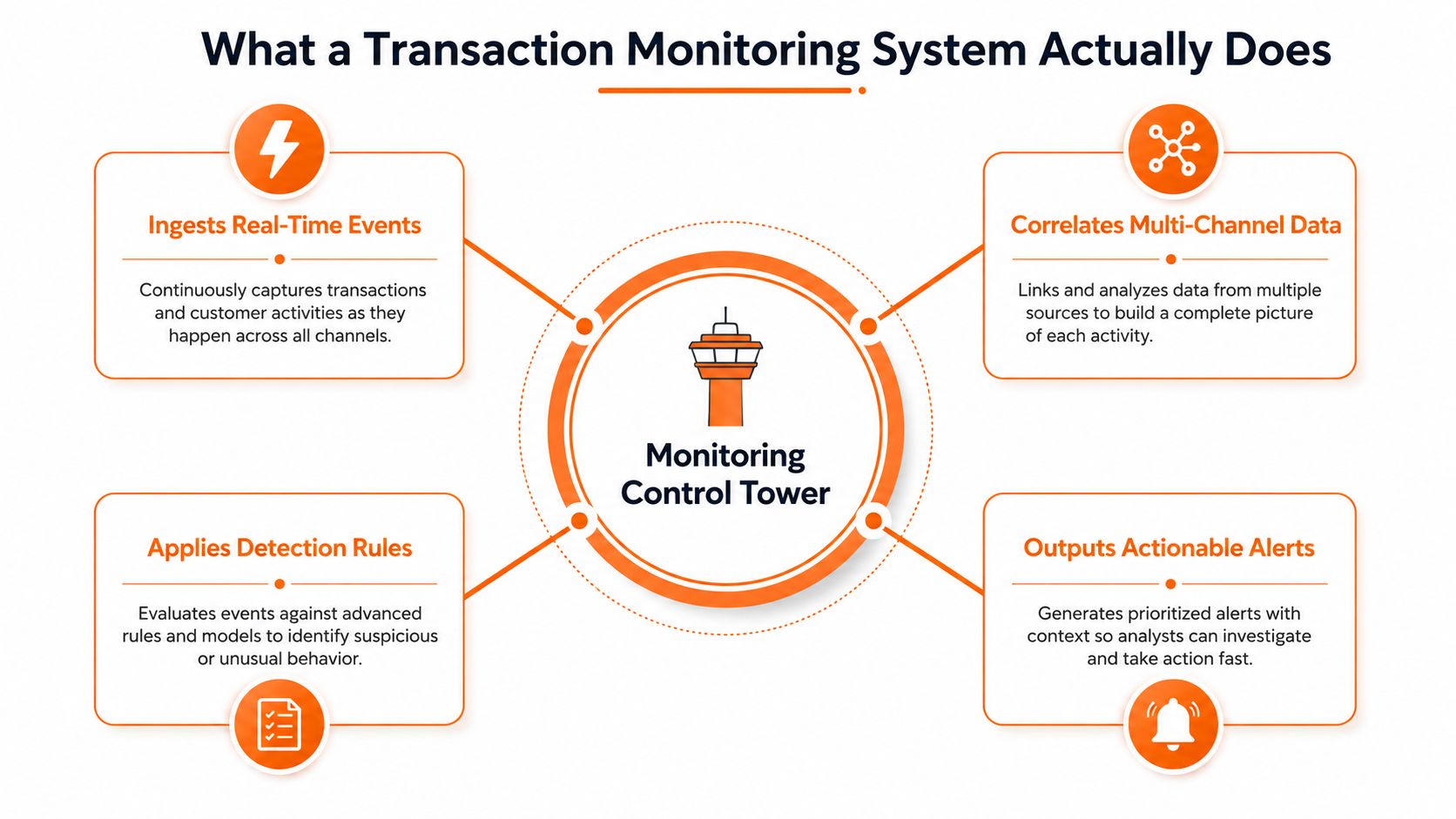
It normalizes and correlates events
Different providers describe the same activity in different ways. One payment processor may call an event “settled,” while another uses “completed.” A monitoring layer needs a consistent event model so analysts can compare activity across cards, bank rails, crypto, casino products, and sportsbook products.
Correlation adds the player and account context. The system may connect a wallet ID, player account, KYC status, jurisdiction, device information, VIP rank, payment instrument, and linked accounts. That context helps the engine distinguish a long-established player's normal activity from a new account that rapidly changes behavior.
It applies detection logic continuously
KYC answers questions about identity and onboarding. Fraud controls often focus on payment abuse, account takeover, or unauthorized activity. Responsible gaming controls address player protection and limits. Monitoring supports AML and broader financial crime investigation by examining behavior over time and across channels.
Continuous monitoring doesn't mean every event needs human review. It means the system evaluates activity as it arrives, applies configured scenarios and risk signals, and escalates only the combinations that warrant attention.
It produces an action, not just a warning
A useful output may be an alert, a case, a request for enhanced due diligence, a temporary review hold, or a recommendation to escalate. The response depends on the operator's policy and the facts available to the investigator.
A raw alert count says little by itself. The valuable output is an explainable alert with linked transactions, triggered logic, relevant player context, analyst notes, and a clear next action.
Core Capabilities Every iGaming Monitoring System Needs
A production-ready platform needs more than a rules screen and an alert inbox. It should connect detection, processing, investigation, and reporting so that an analyst can move from an event to a defensible decision without reconstructing the account manually.
The transaction monitoring market was valued at USD 19.98 billion in 2025 and is projected to reach USD 23.13 billion in 2026 and USD 48.06 billion by 2031, with a projected 15.74% CAGR from 2026 to 2031, according to Mordor Intelligence's transaction monitoring market analysis. AML represented 41.65% of revenue in 2025, which indicates that monitoring is increasingly treated as core compliance infrastructure rather than a specialist add-on. That investment makes capability quality more important, not less.
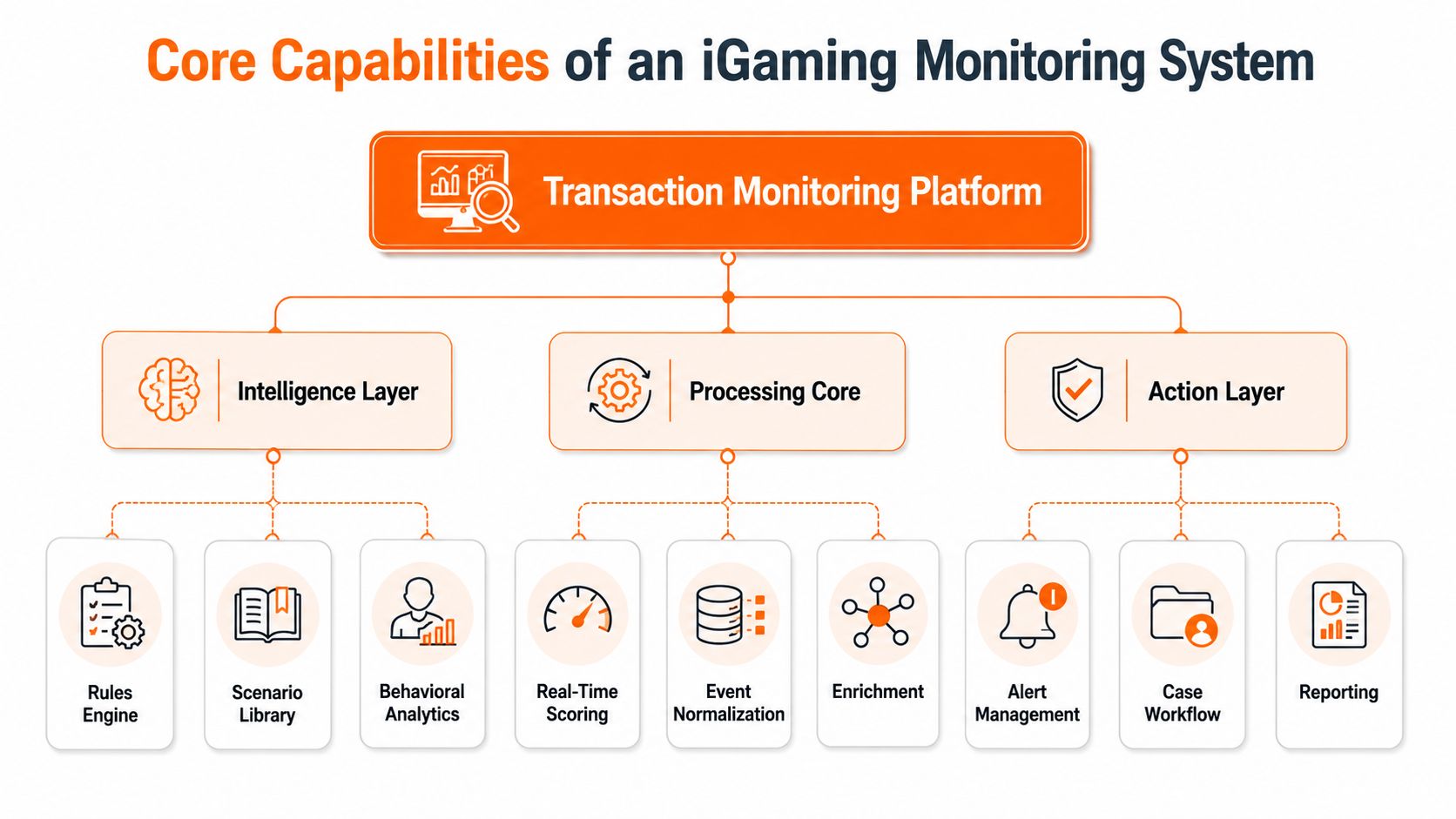
Detection intelligence
A rules engine lets the operator express risk policies in operational terms. A scenario library provides reusable patterns, while behavioral analytics helps identify deviations from a player's expected activity.
Good production behavior includes versioned rules, documented rationale, configurable thresholds, and the ability to combine conditions. Without that flexibility, teams tend to choose between rigid scenarios that miss risk and broad scenarios that generate noise.
Real-time processing
Event normalization, enrichment, and real-time scoring form the processing core. The system should identify which player, wallet, product, payment channel, jurisdiction, and account relationship belong to an event before scoring it.
Batch reporting can support reconciliation and management information, but it creates a delay between behavior and intervention. Detection latency should therefore be reviewed alongside alert quality. An alert that arrives after the relevant funds have moved may have limited operational value.
Alert and case management
Alert management should prioritize work rather than sort it only by timestamp. Analysts need to see why an alert fired, which events contributed to it, whether related accounts or wallets are involved, and what previous reviews concluded.
Case management turns an alert into a controlled investigation. It should support ownership, notes, evidence, escalation, closure reasons, attachments, and approval steps. Audit logs should preserve the history of rule versions, decisions, and changes to the case.
Reporting and governance
Dashboards should show more than activity volume. Useful views connect alerts to investigations, escalations, suspicious activity reports, unresolved backlog, review time, and channel coverage. Regulatory reporting should use consistent data and preserve the evidence behind the submission.
False positives deserve the same operational attention as missed risk. In 2026, 53% of banks reported false-positive rates above 20%, while 26% were above 40%, as reported in Liminal's state of AML compliance coverage. Those figures come from banking rather than iGaming, but the lesson applies directly to analyst capacity. If the queue expands faster than investigators can review it, genuine risk can disappear inside the backlog.
A falling false-positive rate isn't proof of effectiveness if unresolved cases continue to accumulate.
How Transaction Monitoring Connects to the NexGrate Unified Platform
Monitoring works best when it sees the same operating reality that the cashier, player account team, fraud desk, and compliance team see. A separate payment monitor may know that money arrived. A separate gaming database may know that the player wagered. A separate crypto service may know that funds moved on-chain. The risk picture emerges only when those records are connected.
A unified iGaming architecture starts with a common API layer and wallet model. Fiat cards, bank rails, crypto deposits, crypto withdrawals, and operator wallet movements can feed one event stream. The same stream can connect casino RNG activity, live dealer sessions, sportsbook pre-match bets, in-play activity, settlements, and balance changes.
Context travels with the event
The monitoring engine needs more than an amount and a timestamp. It needs the account's KYC level, jurisdiction, player limits, VIP rank, linked payment methods, account age, and relevant product history. That context supports risk-based decisions without forcing an analyst to search across disconnected screens.
For example, a crypto withdrawal may deserve a different review path depending on whether the player has an established verified profile, whether the funds came from ordinary play, and whether the account has recently moved between payment instruments. The system shouldn't decide risk from one field. It should assemble the evidence.
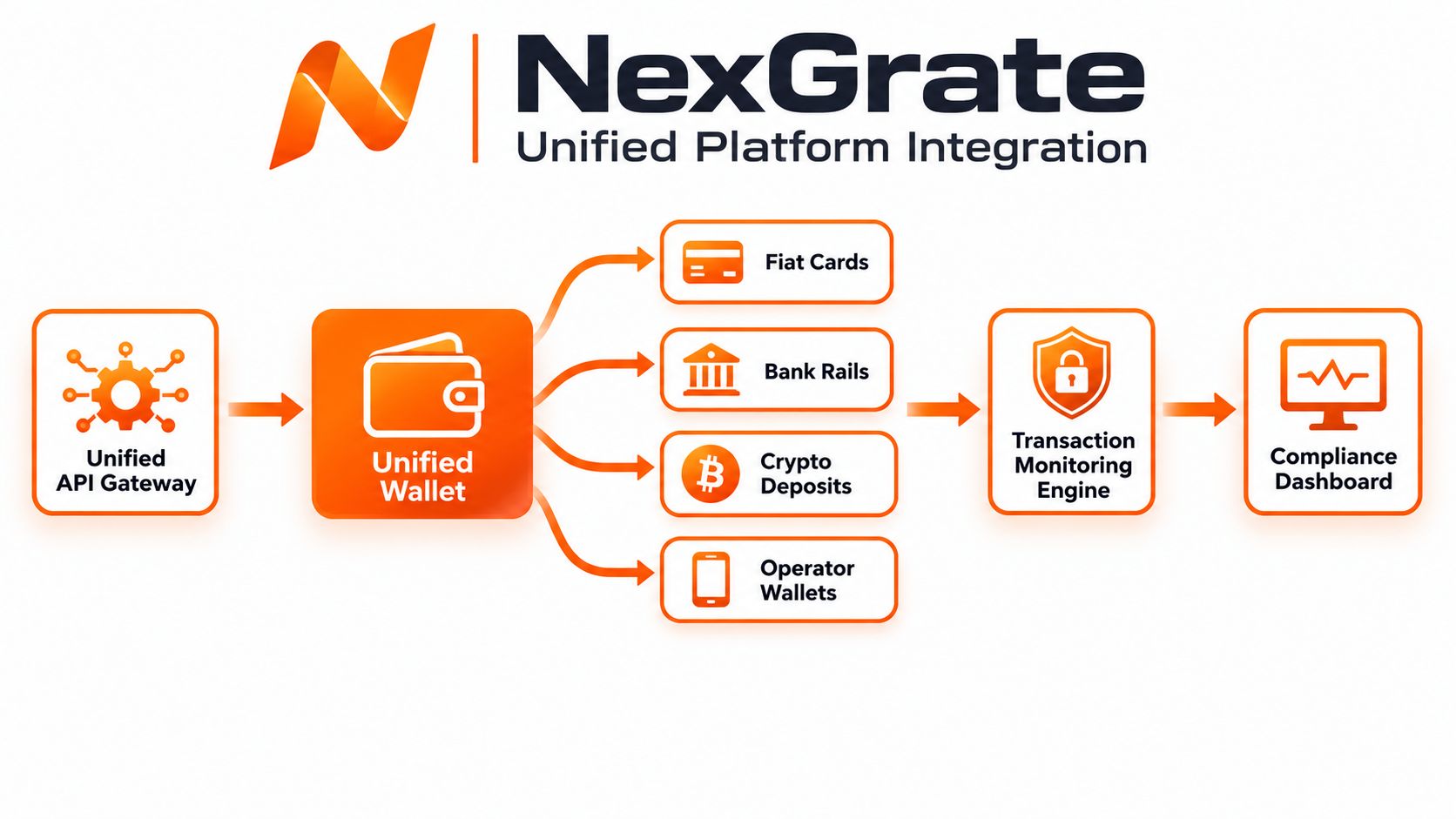
The back office becomes the operating record
A unified back office can reduce the gaps created when casino and sportsbook teams work from different account views. It can also support geofencing, audit logs, compliance reporting, and jurisdiction-specific operational controls in the same environment.
That doesn't remove the need for governance. Teams still need to define ownership, approve scenarios, document exceptions, and validate reports. It does give them a consistent data foundation, which makes those controls easier to operate and explain. Operators evaluating this architecture can review the NexGrate unified platform as an example of how payments, wallets, gaming products, and compliance functions can be consolidated.
The architectural advantage is simple: fewer handoffs mean fewer opportunities for context to be lost. When the wallet, casino, sportsbook, fiat, and crypto records share a common identity and event model, analysts can investigate behavior rather than spend their time reconciling systems.
Detection Rules and KPIs You Can Put Into Practice
Rules should reflect the way players use an iGaming platform. A threshold applied to one payment event may be weak, while a scenario that links deposits, bets, bonuses, withdrawals, and wallets can provide useful context.
| Detection Rule | Typical Trigger | Analyst Focus |
|---|---|---|
| Velocity breach | Repeated deposits, withdrawals, or wallet movements within a short operating window | Check payment instruments, account history, linked accounts, and whether the activity matches the player's established behavior |
| Structuring across wallets | Related activity divided across several player or operator wallets | Establish beneficial ownership, identify common devices or payment methods, and reconstruct the full value flow |
| Chip dumping pattern | Repeated transfers or game outcomes that appear concentrated between connected players | Review game history, counterparties, session context, and relationship indicators |
| Bonus abuse | Multiple accounts showing similar funding, wagering, or withdrawal behavior around promotional benefits | Compare identity, device, payment, and gameplay signals, then check the promotion's terms |
| Deposit and betting mismatch | Funding activity that doesn't align with subsequent play or account behavior | Review source and destination of funds, product use, withdrawal timing, and any prior explanations |
| Crypto-to-fiat rapid cashout | Crypto funding followed by quick conversion and withdrawal through fiat rails | Trace wallet activity, assess risk exposure, and connect the crypto event with the player's KYC and account history |
The analyst's job isn't to confirm that a rule fired. It's to determine whether the activity is explainable, requires more information, or should move into escalation and reporting.
KPIs that test effectiveness
Alert-to-SAR conversion can show whether alerts are producing cases with meaningful suspicious-activity outcomes. It shouldn't be treated as a target to maximize, because a low conversion rate may reflect broad rules while a high rate may reflect narrow coverage.
False-positive rate shows how often alerts close without a suspicious finding. Review it by scenario, channel, jurisdiction, and player segment rather than using one blended number.
Detection latency measures the time between relevant activity and alert availability. Case throughput shows whether investigators can resolve work at the pace it arrives. Cross-channel coverage checks whether the system connects fiat, crypto, casino, sportsbook, and wallet events instead of monitoring each stream separately.
Industry coverage in 2026 points toward measuring the complete detection journey, including alert-to-SAR outcomes and integration quality, rather than relying on alert counts alone. Zyphe's 2026 transaction monitoring analysis also describes the operational risk of stale rules, threshold-only monitoring, disconnected systems, and backlogs that create a gap between alerts received and risk reviewed.
Implementation and Compliance Checklist for Regulated Markets
Implementation should progress from data certainty to controlled production use. Operators create alert overload when they configure scenarios before understanding the events those scenarios will consume. They create dead zones when important channels never reach the monitoring layer.
1. Plan the operating model
Map every source, including payment providers, wallets, casino systems, sportsbook feeds, KYC records, limits, bonus systems, and crypto services. Define ownership for triage, investigation, escalation, reporting, and rule approval. Agree on KPIs before launch so the team knows how it will judge performance.
2. Build a consistent event model
Normalize status values, timestamps, currencies, player identifiers, wallet identifiers, and product events. Confirm that the system can link a deposit to the resulting balance, wagering activity, withdrawal, and related account history.
3. Test before production
Backtest scenarios against representative historical activity, then review the results with compliance and operations staff. Calibrate thresholds, document whitelisting decisions, and test edge cases such as refunds, voided bets, chargebacks, bonus reversals, and crypto conversion paths.
4. Launch with controlled access
Align roles and permissions with the operating model. A reviewer may need to investigate alerts, while a senior compliance user approves escalation or reporting. Validate that every action produces an audit record and that critical accounts can be handled without bypassing the control framework.
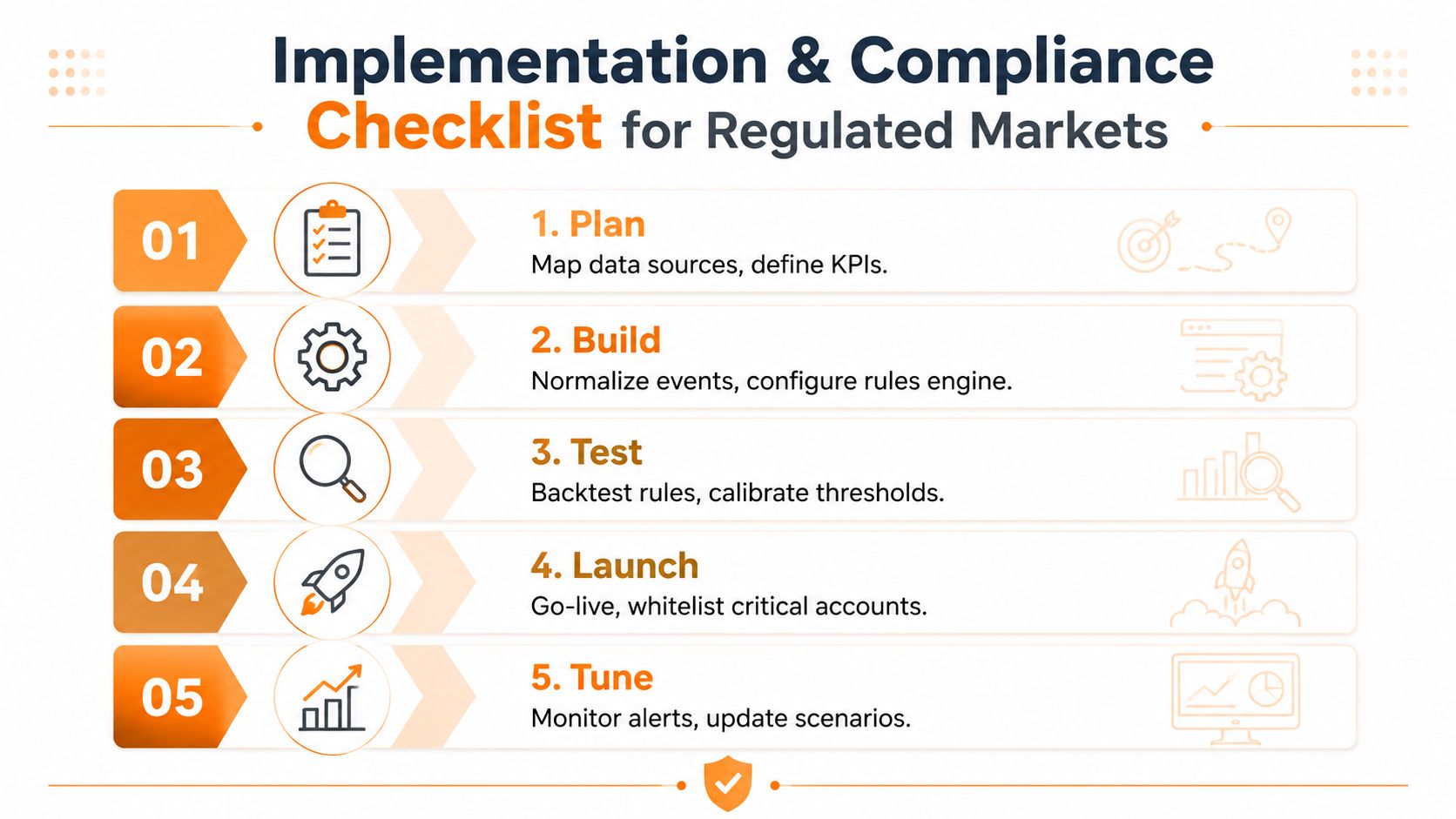
5. Tune continuously
Track alert queues, backlog age, case throughput, false positives, and detection latency after go-live. Review scenarios when products, payment methods, jurisdictions, player segments, or criminal typologies change. Validate regulatory outputs and supporting evidence through the same process used for compliance reporting.
The sequence matters. Data mapping supports reliable rules, testing supports sensible thresholds, permissions support accountability, and ongoing tuning keeps the program aligned with actual operations.
Choosing and Running a Transaction Monitoring System for Long Term Success
Vendor selection should start with the operator's transaction map, not a feature checklist. Ask whether the system connects casino and sportsbook events to the wallet, whether it handles both fiat and crypto rails, and whether it can monitor activity continuously rather than only through batch files.
Compare platforms across a few practical trade-offs:
- Integration depth: A shallow payment connector may be quick to deploy but leave gaming context outside the investigation.
- Detection flexibility: Static rules are easy to understand, while hybrid rules and behavioral analytics can identify more complex patterns. The operator still needs explainability and governance.
- Operational workflow: An alert screen isn't enough if analysts must export data to investigate, document, and report.
- Auditability: Look for rule history, timestamps, evidence links, closure reasons, and access records.
- Scalability: Confirm that the architecture can support additional brands, products, currencies, payment rails, and regulated markets without creating separate monitoring silos.
Running the system also requires discipline. Review scenarios regularly, connect alerts across channels, train fraud and compliance teams together, and measure resolved cases rather than celebrating a growing alert queue. Effectiveness means the team can detect relevant risk, investigate it with context, and document the decision.
For operators seeking a turnkey route, the strongest architecture is one that brings the wallet, casino, sportsbook, payment, crypto, and compliance layers into a consistent operating environment. That design gives the monitoring team a clearer view and gives the business a more practical foundation for regulated growth.
NexGrate provides a unified white-label platform that connects casino, sportsbook, wallets, fiat and crypto payments, and compliance workflows for iGaming operators. Visit NexGrate to evaluate how its integrated architecture can support transaction monitoring from launch through ongoing multi-market operations.