
A turnkey solution is a prebuilt, end-to-end system ready to use after deployment with minimal customization. The term goes back at least to 1919, with broader adoption accelerating in the early 1960s, and the important distinction today is this: something can be ready to launch without being fully ready to run.
If you're evaluating platform options right now, you're probably staring at a familiar mess. One vendor offers player accounts. Another handles payments. A third brings game content. Then someone else covers sportsbook, and suddenly you need separate conversations about KYC, reporting, bonus rules, fraud controls, hosting, and support.
That setup sounds flexible on paper. In practice, a new operator often ends up acting like a systems integrator. You don't just buy software. You coordinate dependencies, settle arguments between vendors, chase missing data flows, and own every gap between one module and the next.
That's why turnkey matters. In current platform buying, especially in iGaming, providers are increasingly packaging launch infrastructure as bundled stacks rather than isolated modules. For a new brand, that can remove a lot of assembly work upfront. But it also creates a dangerous misunderstanding. Buyers hear "ready to use" and assume the provider owns everything after go-live.
Usually, they don't.
A turnkey platform may give you the cashier, PAM, content integrations, reporting tools, and back office in one place. It may even reduce technical complexity dramatically. But in regulated markets, the hard questions don't disappear. Who holds the license. Who monitors KYC escalations. Who answers for AML controls. Who reviews suspicious play, payment failures, bonus abuse, and regulatory reporting. That's the difference between buying a launch package and operating a business.
Table of Contents
- Introduction to Turnkey Solutions
- What a Turnkey Solution Really Means
- Core Components Inside a Turnkey Platform
- Turnkey Versus Custom Builds Compared
- Time to Market and Cost Considerations
- How Turnkey Solutions Work in iGaming
- How to Evaluate a Turnkey Provider Before You Commit
Introduction to Turnkey Solutions
A lot of operators first encounter the phrase what is a turnkey solution at the exact moment they're under pressure to move fast. Maybe the brand is approved internally, affiliates are lined up, a domain is parked, and everyone wants a launch date. Then the procurement calls begin, and every decision branches into five more.
You ask for an online casino stack. One provider says they can give you frontend templates but not payments. Another gives you games but not player account management. A sportsbook vendor can add odds and settlement, but only if your wallet logic works a certain way. Compliance tooling sits somewhere else. Now your "platform strategy" is really a dependency map.
That is where turnkey earns its value. Instead of buying separate moving parts and stitching them together yourself, you buy a package that is already assembled for a specific operational outcome.
A useful way to think about it is this. A turnkey offer doesn't just sell software features. It sells a narrower set of unknowns.
In iGaming, that changes the conversation from "Which vendors do we need?" to "Which responsibilities still stay with us?" That second question is the one many generic explainers skip, and it's the one operators should ask first.
Why operators get confused
The confusion usually comes from two ideas getting blended together:
- Ready to deploy: The platform is technically assembled and can be configured quickly.
- Ready to operate: Your business has the people, approvals, workflows, and controls to run it day to day.
- Managed for you: The provider actively owns ongoing execution, which is a separate service question.
- Compliant by design: The platform includes compliance tools, but your team may still own regulatory accountability.
Those aren't the same thing.
A turnkey product can make launch much cleaner. It can reduce handoffs, shorten integration work, and simplify vendor management. But if you're the operator, you still need to know where platform responsibility ends and operational responsibility begins. That boundary decides whether your first months are controlled or chaotic.
What a Turnkey Solution Really Means
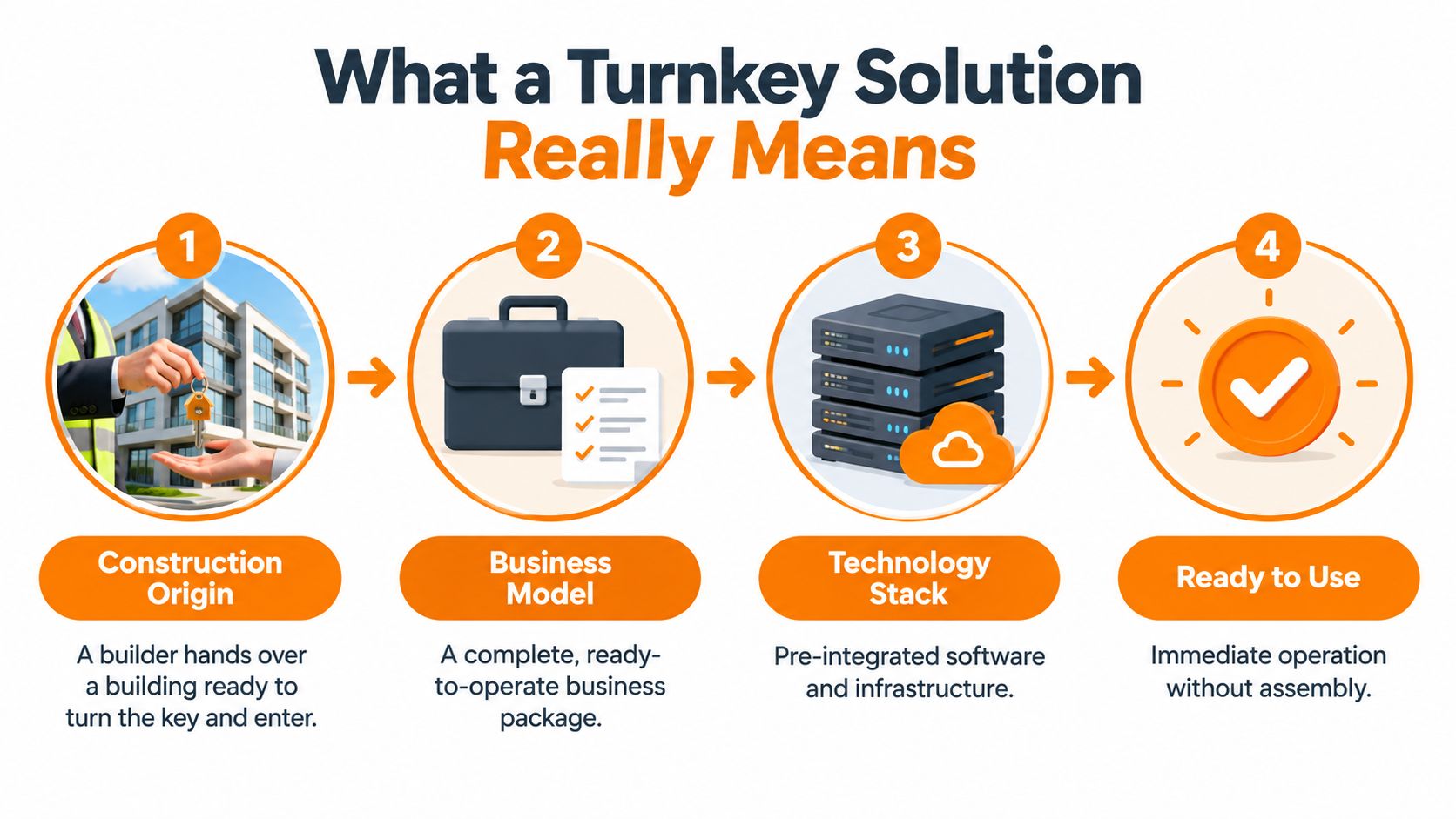
The original meaning is more literal than most software buyers realize. A turnkey solution began in construction, where a builder hands over a finished property that's ready for the buyer to enter and use. The phrase later expanded into business and technology, but the core idea stayed the same: the customer receives something complete enough to start using immediately with no modifications required. Historical usage traces place early mentions of “turnkey project” as far back as 1919, with broader adoption accelerating in the early 1960s, which shows this is a long-established commercial model rather than a new software trend, as explained in this history of turnkey solutions.
Start with the construction analogy
Think of the difference between buying a furnished apartment and building a house from separate contractors.
With the furnished apartment, the walls are up, utilities work, the kitchen is installed, and you can move in. You might change the art or replace the sofa later, but the place functions on day one.
With the custom house, you choose more details. You also own more decisions, more sequencing, and more risk if one contractor delays another.
That same logic applies in software.
How the term works in business and technology
In a business setting, a turnkey solution is a prebuilt end-to-end system. In technology, that means the main capabilities, infrastructure, and workflows are already coordinated before the buyer arrives. The customer still configures parts of it, but they don't start from disconnected components.
Common examples include:
- Retail formats: A business package with premises, systems, branding, and operating setup already prepared.
- Industrial systems: Equipment delivered as a complete production environment rather than a pile of parts.
- Software platforms: Frontend, backend, integrations, and operational tooling already assembled into one stack.
Practical rule: If the provider has already solved the dependencies between core components before you sign, you're looking at a turnkey model.
What turnkey doesn't mean
This is where buyers slip.
Turnkey doesn't automatically mean unlimited flexibility. It doesn't automatically mean your operator team can be lean forever. And it doesn't automatically mean the provider takes over your legal or compliance obligations.
In other words, turnkey means pre-integrated, not responsibility-free.
That distinction matters most in regulated sectors like iGaming, where software readiness and operational readiness aren't the same thing.
Core Components Inside a Turnkey Platform
When people hear "turnkey platform," they often picture a branded frontend and a login screen. That's the visible layer. The value sits underneath, in the shared services that connect everything an operator has to control.
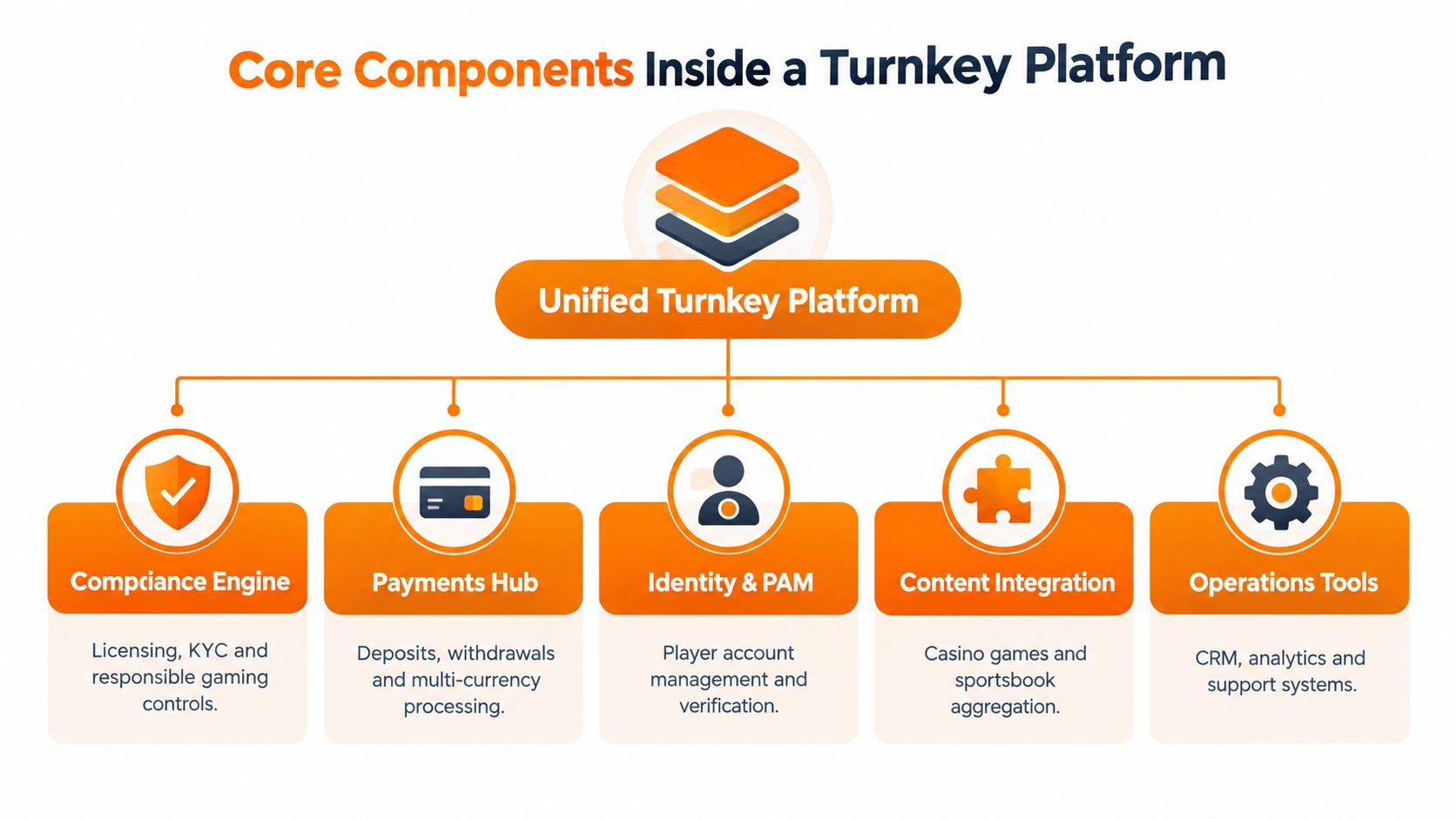
In regulated platforms, the most important technical value is that compliance, payments, identity checks, and reporting are implemented as shared platform services rather than isolated point integrations. That architecture reduces operational fragmentation and makes controls easier to audit because the same system can enforce wallet rules, KYC and AML workflows, logging, and market-specific configuration from one backend, as outlined in this explanation of turnkey architecture in regulated systems.
What lives inside the stack
A real turnkey iGaming platform usually combines several operating layers into one coordinated environment.
- Player account management: Registration, verification status, account restrictions, balances, and lifecycle events.
- Payments and wallet logic: Deposits, withdrawals, multiple payment methods, wallet rules, and transaction histories.
- Compliance controls: KYC workflows, AML reviews, geofencing, responsible gaming limits, audit logs, and reporting.
- Content and betting systems: Casino aggregation, sportsbook feeds, bet placement, settlement, and bonus interactions.
- Operations tooling: CRM workflows, support views, fraud checks, campaign rules, and analytics.
The important point isn't just that these tools exist. It's that they interact through one backend logic instead of behaving like separate products taped together.
Why shared services matter
Let's make that concrete.
If your payments provider, PAM, sportsbook, casino wallet, and reporting tools all sit in different systems, every exception creates a support problem. A failed withdrawal might affect player trust, bonus eligibility, risk review, and reporting status all at once. If those areas don't share the same operating context, your team spends time reconciling instead of resolving.
In a unified setup, one rule can travel across the stack. A restriction on an account can affect deposits, gameplay access, withdrawal review, and support visibility without separate manual coordination.
One example of this model is a consolidated casino and sportsbook environment such as NexGrate, which combines game content, betting engines, payments, and compliance controls within one operator-focused stack. The point isn't the brand name. The point is the operating model: fewer disconnected systems mean fewer internal handoffs.
Centralization isn't about convenience alone. It gives operations, payments, support, and compliance teams a common source of truth.
The hidden benefit operators feel later
At launch, buyers focus on setup speed. A few months later, they usually care more about consistency.
The strongest turnkey platforms don't just shorten implementation work. They reduce the number of times your team has to ask, "Which system owns this issue?" That's a major operational advantage, especially once casino and sportsbook activity start crossing the same wallet, account, and reporting framework.
Turnkey Versus Custom Builds Compared
The cleanest way to compare these models is to ask one question first: do you want to assemble a platform, or do you want to operate a brand?
A turnkey solution is a prebuilt, end-to-end system ready for immediate use after deployment, and its main technical advantage is a reduced integration surface. Instead of assembling separate vendors for core functions, the buyer configures one coordinated stack and avoids repeated handoffs between modules, as described in this breakdown of turnkey software solutions.
Where turnkey usually wins
Turnkey is strong when speed, coordination, and predictable scope matter more than deep architectural freedom.
You don't need to solve every dependency yourself because the provider already has. Wallet behavior, content flows, reporting structures, and back-office relationships are usually defined in advance. That reduces implementation friction and cuts down on multi-vendor blame cycles.
Turnkey often suits:
- New operators: You need a functioning platform before you need a unique technical architecture.
- Migration projects with pressure: You can't afford a long rebuild before replacing a legacy setup.
- Lean teams: You have commercial and operational goals, but limited internal engineering bandwidth.
Where custom builds usually win
Custom is stronger when your differentiation depends on product behavior the packaged platform can't support easily.
That might include unusual wallet mechanics, proprietary trading logic, market-specific user journeys, or a long-term plan to control your own roadmap in detail. But the trade-off is clear. You inherit the integration burden, architecture decisions, release coordination, and support complexity.
If you're weighing those paths in detail, this guide to online casino software development is useful background because it frames what has to be built and maintained in a live gaming environment.
Turnkey vs Custom Build Decision Matrix
| Evaluation Criteria | Turnkey Solution | Custom Build |
|---|---|---|
| Launch speed | Faster because the core stack is already assembled | Slower because components must be built or integrated |
| Integration effort | Lower. One coordinated platform reduces handoffs | Higher. Multiple services need orchestration |
| Product control | Moderate, within platform constraints | High, if you can fund and manage it |
| Operational complexity | Lower at the platform layer | Higher across vendors, systems, and releases |
| Differentiation potential | Good for brand, content mix, promotions, and market setup | Stronger for unique workflows and proprietary features |
| Internal team requirement | Smaller engineering footprint to start | Larger product, engineering, and QA commitment |
| Risk profile | More provider dependency | More execution dependency on your own team |
Custom gives you more room to shape the machine. Turnkey gives you a machine that already runs.
The mistake is treating one model as universally better. The right choice depends on what you're trying to own: speed, flexibility, or complexity.
Time to Market and Cost Considerations
A turnkey model is attractive because it compresses work that would otherwise sit on your side. In complex industries, that matters a lot. Turnkey delivery is especially relevant where design, execution, and handover need to sit in one responsibility chain. Industrial automation offers a useful comparison: turnkey systems are described as combining robots, welding power sources, fixturing, safety systems, controls, and software into a fully engineered cell ready for immediate production, as noted in this overview of turnkey delivery in industrial systems.
That same principle shows up in iGaming. The platform vendor doesn't just hand you isolated tools. They hand over a working operating environment, or at least they should.
What usually speeds launch
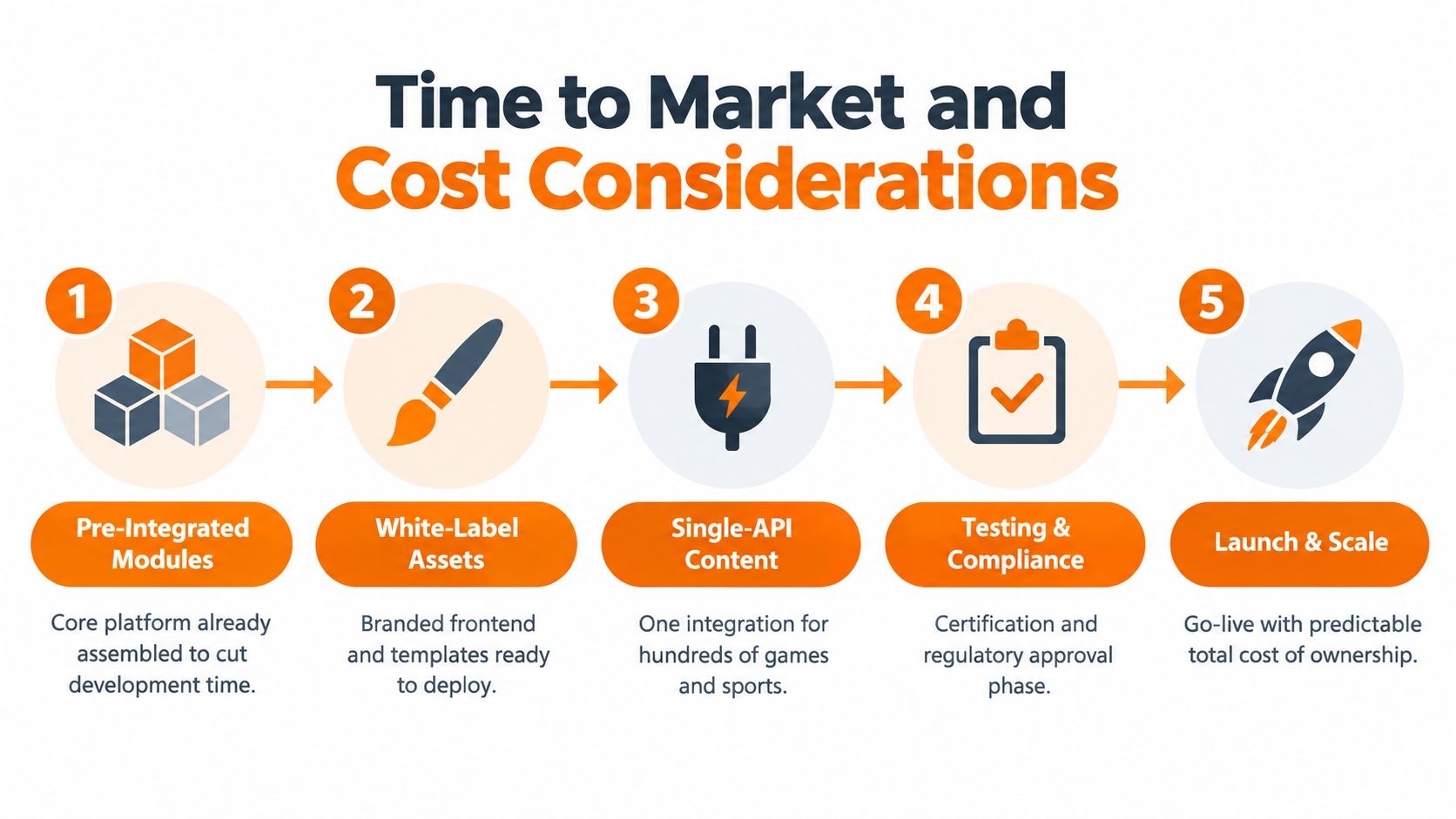
Several platform choices tend to accelerate rollout in practical terms:
- Pre-integrated modules: Core functions like PAM, wallets, cashier, and reporting are already connected.
- White-label assets: Frontend templates, branding layers, and standard pages shorten design and setup work.
- Single-API content access: Casino and sportsbook content can be activated without separate direct integrations to every provider.
- Unified back office: Support, payments, and compliance teams work from one operating layer instead of separate consoles.
Those factors don't remove all work. They reduce assembly work.
What buyers underestimate
The hidden cost isn't always technical build time. It's the operating burden after deployment.
Licensing steps, KYC review processes, AML escalations, market rules, support staffing, fraud monitoring, reconciliation, and reporting discipline still need owners. If your internal team isn't prepared for that, a fast deployment can bring your operational problems forward sooner.
The fastest launch plan can still become the most expensive operating model if the team assumes the platform replaces internal accountability.
Ready to launch versus ready to run
This distinction should shape your budget discussions from the start.
"Ready to launch" covers the delivered stack. "Ready to run" includes the people, procedures, approvals, and controls that keep the business stable after go-live. If you don't price both, you don't have total cost of ownership. You only have implementation cost.
How Turnkey Solutions Work in iGaming
In iGaming, the turnkey model becomes easier to understand when you follow a normal operator day rather than a feature list.
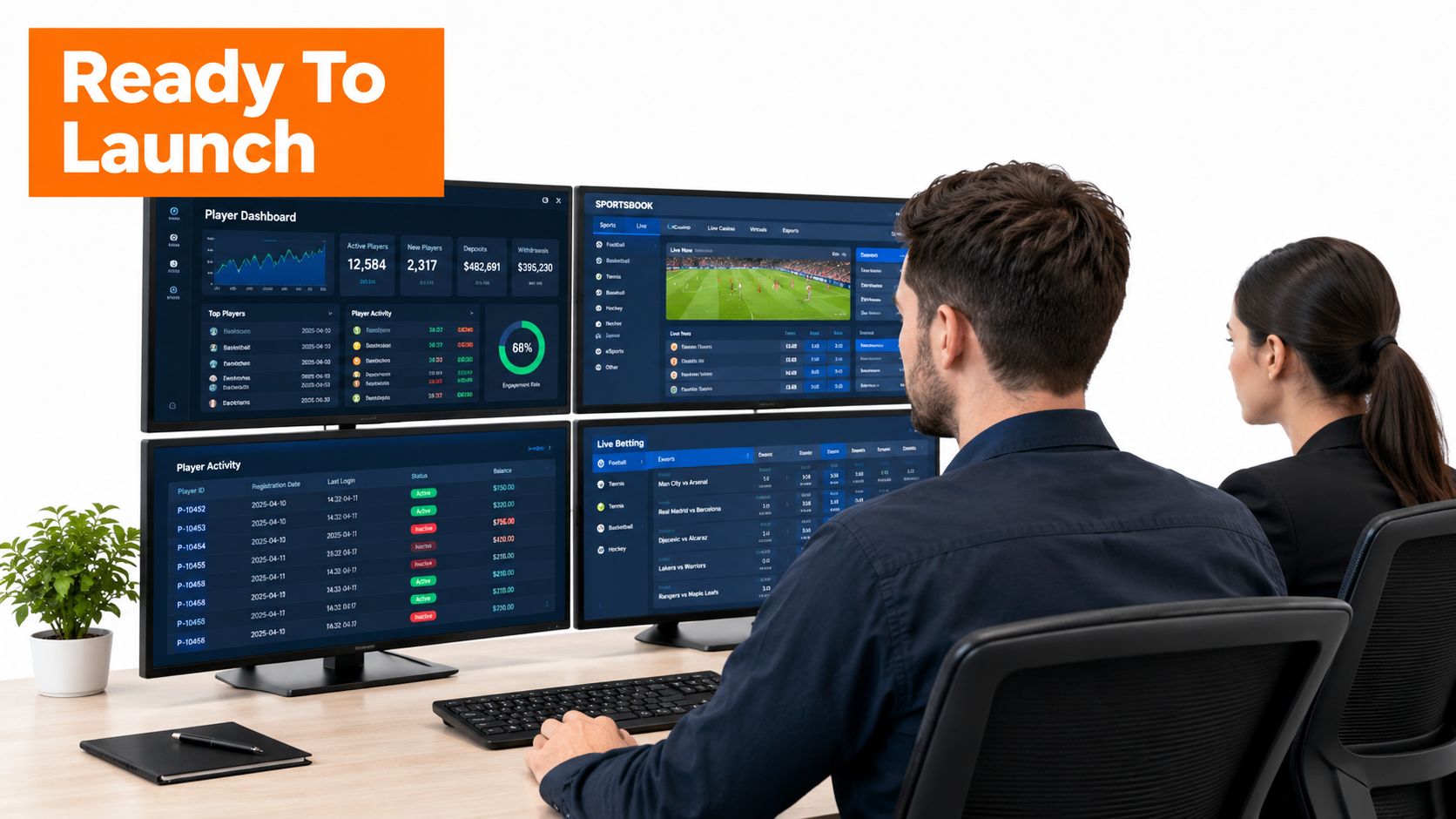
A new brand starts by selecting its frontend style, content mix, payment coverage, and market rules. The provider configures the environment, connects game and sportsbook feeds, sets up cashier behavior, and prepares the back office. From the operator's side, the goal is simple: launch under your own brand without having to source and integrate every core component separately.
A day-one player journey
A player lands on the site, registers, and enters the verification flow. Their account is created in the PAM. Their wallet is initialized. If they deposit, the cashier processes the payment and updates balances. If they claim a bonus, the promotion engine applies the relevant rules. If they place a sports bet or spin a slot, those activities still connect back to the same account and wallet logic.
From the player's point of view, that's one product.
From the operator's point of view, it's many coordinated systems acting as one.
That coordination is why operators often choose a white-label gaming solution rather than assembling a platform from separate casino, sportsbook, and payment contracts. The white-label route doesn't remove operational ownership, but it does package the technology into a more manageable base.
What the back office team actually does
After launch, most operator effort moves to control and response.
Support teams handle account issues and payment questions. Risk and compliance teams review verification exceptions, monitor suspicious activity, and maintain reporting discipline. CRM teams configure offers, loyalty rules, and segmentation. Finance teams reconcile payment activity and monitor cash flow behavior across methods and currencies.
Here is a useful visual explanation of how these workflows sit inside a modern platform:
Why unified casino and sportsbook matters
Many operators underestimate how much friction appears when casino and sportsbook sit in different environments.
Separate systems often create duplicate support work, uneven account status handling, and wallet inconsistencies. A unified stack keeps one player profile, one back office logic, and one operating context across both product lines. That doesn't make operations easy, but it makes them far less fragmented.
How to Evaluate a Turnkey Provider Before You Commit
Most explainers define turnkey as something ready to use with minimal setup, but they often skip the most important buyer question: who still owns the hard parts after handoff. In iGaming and other regulated industries, the buyer may still be responsible for ongoing operations, licensing, and compliance even when the platform is delivered as a pre-built package, as discussed in this explanation of turnkey ownership boundaries.
That means provider evaluation shouldn't stop at demos. You need to test the operating model.
Questions that reveal the real offer
Use these checks when shortlisting providers:
- Platform coverage: Does the stack include PAM, wallet, cashier, casino, sportsbook, bonus tools, reporting, and support views, or are some of those third-party add-ons?
- Compliance ownership: Which controls are built in, and which obligations still sit with your team?
- Payments depth: Which payment methods, currencies, and withdrawal workflows are supported in the same operating environment?
- Content operations: How are games and sports feeds managed, updated, and reconciled?
- Back-office usability: Can support, fraud, and compliance teams work from one place without exporting issues into other tools?
- Market expansion: How easily can the same platform be configured for new jurisdictions, local rules, and reporting demands?
- Support model: Who handles incidents, release management, and day-to-day technical escalation after launch?
The red flags to catch early
Some providers sell "turnkey" when they really mean "template plus integrations."
Watch for signs like unclear licensing responsibility, vague answers on reporting ownership, fragmented support tools, and payment logic that depends on separate third-party dashboards. Those don't always kill a deal, but they do increase operational drag.
A second useful check is to compare vendors that focus on operator infrastructure, using resources like this overview of iGaming software providers. The point isn't to chase the longest feature list. It's to find the provider whose boundaries are clearest.
If a provider can't explain what your team still has to own after go-live, the product isn't truly turnkey in the way operators usually need.
The strongest buying decision usually comes from one final test. Ask the provider to walk through a failed withdrawal, a KYC exception, a bonus dispute, and a suspicious activity review. If their answer jumps between multiple systems and unclear responsibilities, you'll feel that friction every day after launch.
NexGrate offers a turnkey white-label platform for online casino and sportsbook operators that brings together game content, betting engines, payments, and compliance controls in one stack. If you're trying to separate "ready to launch" from "ready to run," it's a useful example of the kind of unified operator platform discussed throughout this guide. You can explore the platform and its operating model at NexGrate.