A gaming operator usually feels AML pressure long before the first regulator email arrives. It starts earlier, when player onboarding stalls, payments queue up for review, support asks why VIP withdrawals are delayed, and launch plans start slipping because compliance lives in three disconnected tools and two spreadsheets.
That's why AML KYC software matters so much in gaming. It isn't just a document checker bolted onto registration. In practice, it sits in the middle of player onboarding, payment approvals, risk escalation, reporting, and audit preparation. If it's weak, the whole operation gets noisy. If it's well designed, teams move faster without losing control.
The category has also become much bigger than a niche regtech add-on. MarketsandMarkets projects the global AML market will grow from USD 4.13 billion in 2025 to USD 9.38 billion by 2030, with a 17.8% CAGR, while Burton-Taylor estimates global spending on AML/KYC data, information, and services at about $2.5 billion in 2024, up 14.7% year over year with a 5-year CAGR of 22.2% according to the same market overview at MarketsandMarkets' anti-money laundering solutions market page. That tells you where operator budgets and vendor development are going. This is now core infrastructure.
Table of Contents
- Introduction Why AML KYC Software Matters for Gaming Operators
- What AML KYC Software Is and How It Works
- Core Features Every Gaming Platform Needs
- How Identity Verification Monitoring and Reporting Work Together
- Integration and Deployment Considerations for B2B Platforms
- How to Choose AML KYC Software and Map It to MGA Requirements
- Conclusion Building Continuous Compliance That Scales
Introduction Why AML KYC Software Matters for Gaming Operators
A common launch scenario looks like this. The casino frontend is ready, the games are integrated, the cashier works, and acquisition is lined up. Then compliance becomes the bottleneck. One provider handles ID checks, another screens sanctions lists, the payments team reviews unusual deposits manually, and nobody can produce a clean audit trail without pulling records from several systems. Go-live doesn't fail because the brand lacks content. It slips because operational control isn't joined up.
That's where many operators get AML/KYC wrong. They buy a verification step, but what they need is a workflow engine. Gaming isn't just about checking a passport at signup. It's about deciding who can deposit, when enhanced review should start, who approves exceptions, what gets logged, and how evidence is retained when an auditor asks questions months later.
Why gaming teams feel the pressure first
Gaming operators work in a fast-moving environment where player activity can change quickly. A low-risk customer at signup can become a high-attention case later because of transaction behavior, geography, payment patterns, or source-of-funds questions. If your controls only exist at registration, your team ends up reacting late.
A second source of confusion is ownership inside the business. Compliance may own policy, but operations owns queues, payments owns friction, product owns player flow, and support absorbs player complaints. That's why AML KYC software has to be understood as an operational system, much like a cashier or wallet service.
For teams building out reporting processes, it helps to think of AML/KYC as part of a wider compliance record, not a separate island. A useful primer on that broader discipline is this overview of compliance reporting, because many software evaluation mistakes start when teams separate player checks from evidence management.
Practical rule: If your compliance process depends on people remembering what happened, your tooling is too manual.
By the time you finish this guide, you should be able to look at an AML/KYC platform and judge whether it supports real gaming operations, especially for MGA-style and multi-jurisdictional setups, or whether it only looks good in a vendor demo.
What AML KYC Software Is and How It Works
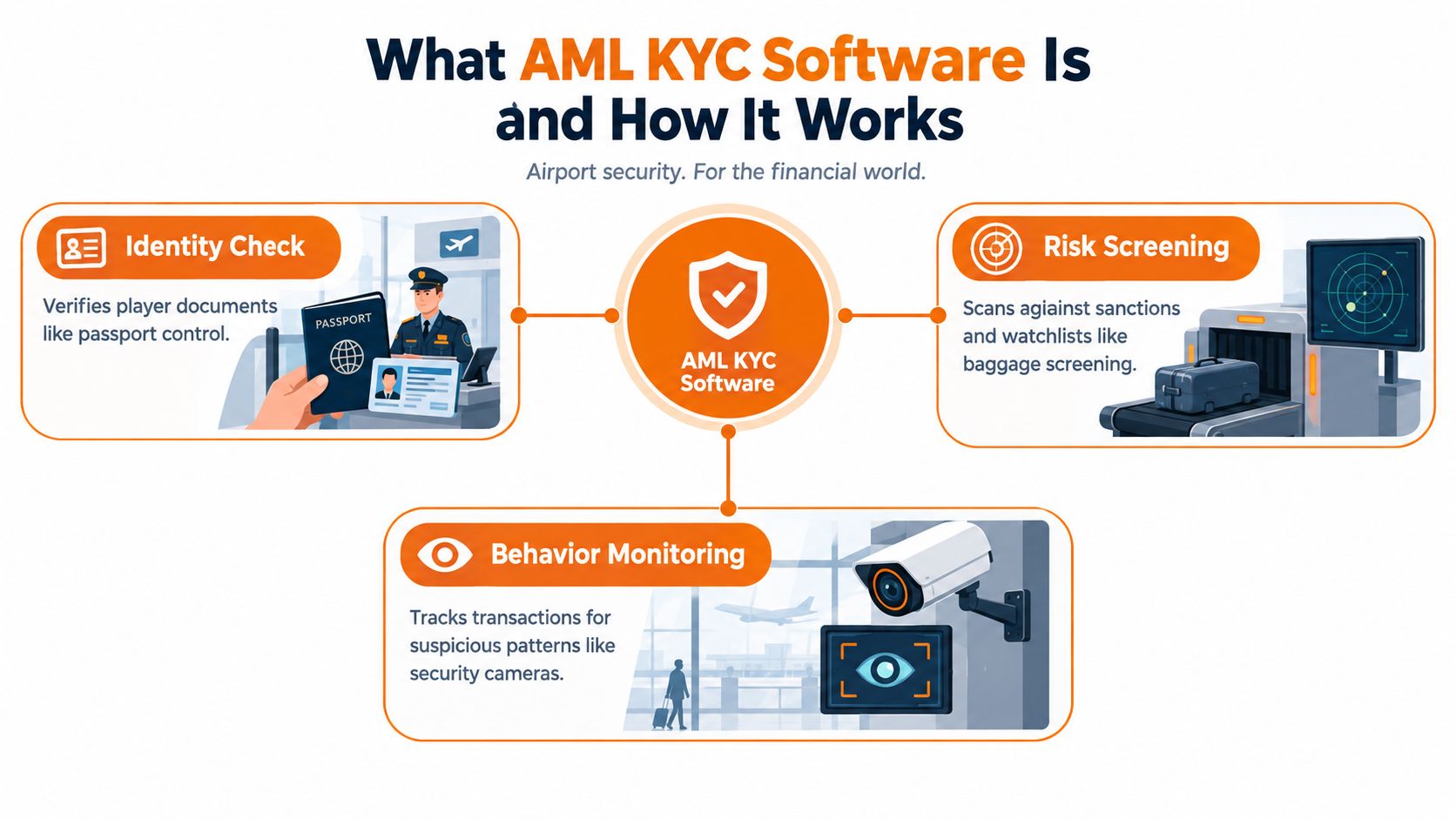
The simplest way to understand AML KYC software is to compare it to airport security.
At an airport, staff don't ask just one question. They check identity, compare names to restricted lists, inspect what a traveler is carrying, and keep watching movement through the terminal. Gaming compliance works in a similar way. The platform verifies who the player is, screens whether that person matches sanctions or politically exposed person records, and keeps monitoring activity after the account is opened.
AML and KYC are different, but operators use them together
KYC means knowing who the customer is. In gaming, that usually covers identity verification, age checks, document review, address review where needed, and sometimes source-of-funds steps for higher-risk situations.
AML is broader. It focuses on detecting and managing money laundering risk. That includes screening, transaction monitoring, alert generation, case review, and reporting.
Operators often bundle the two because the same player data drives both. If a player submits an ID, that identity data should flow into screening. If screening finds a possible match, that decision should affect payment handling and manual review. If unusual deposit and withdrawal behavior appears later, the case should connect back to the original onboarding file.
Why the software changed so much
Older setups leaned heavily on manual reviews. Staff compared names, checked documents, and passed cases by email. As digital finance expanded, that stopped scaling. One industry summary reports that standard retail KYC onboarding used to take 7 to 10 days before AI-driven automation, while AI-enabled workflows can reduce that to under 24 hours. The same source says 46% of AML/KYC tasks are technically automatable, and cites Celent's estimate that AI already accounts for 45% of AML technology market revenue at Stealth Agents' AI KYC and AML automation statistics overview.
That history matters because many people still think AML KYC software is just document capture. It isn't. It evolved into a connected operating layer for screening, monitoring, and case handling.
Gaming teams exploring lower-friction onboarding models also run into adjacent concepts such as Pay N Play, where speed and compliance have to coexist. The software question then becomes less about whether a player can upload a document and more about how identity confidence, payment signals, and jurisdictional rules work together.
Airport security doesn't stop after passport control. Good AML/KYC software doesn't stop after signup either.
Core Features Every Gaming Platform Needs
When operators shop for AML KYC software, feature lists can get misleading fast. What matters more is the job each function performs inside the player lifecycle.
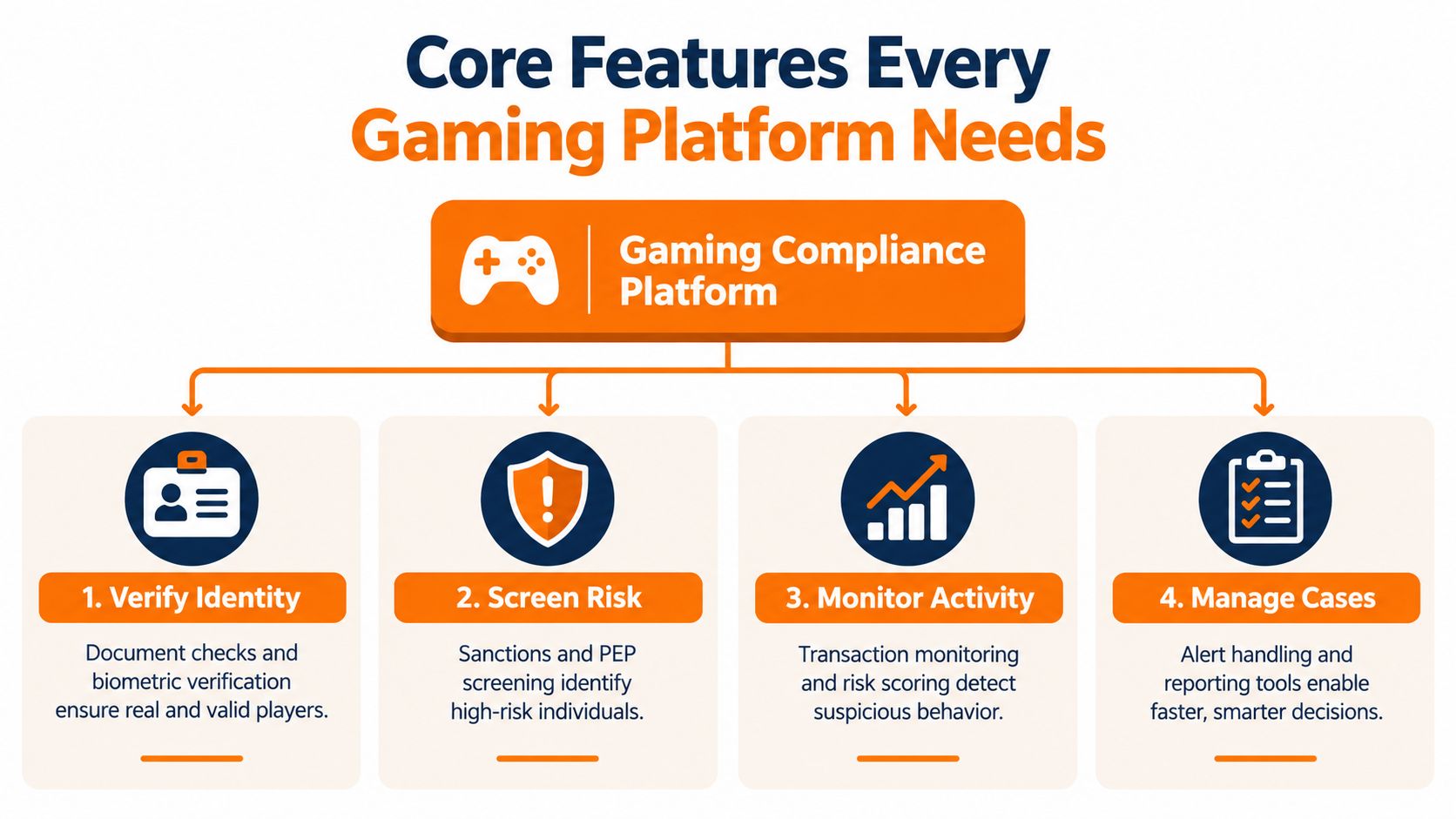
The four core jobs are visible in the structure below.
Verify identity at the right depth
The first job is proving the player is real and eligible to use the service. That usually starts with account basics, then moves into document checks and, where appropriate, additional review such as address confirmation or source-of-funds evidence.
What confuses many teams is that identity verification shouldn't be equally heavy for every customer. A sportsbook account making a small initial deposit may not need the same review path as a high-value casino player using multiple payment methods. Good systems let operators tune depth by risk, jurisdiction, and trigger conditions.
Screen names before risk becomes operational
The second job is screening. This includes sanctions checks, PEP checks, and other watchlist comparisons. Screening should happen at onboarding, but it also needs to continue later when records update or customer circumstances change.
Matching quality matters. A tool that flags too many harmless name similarities doesn't just annoy analysts. It slows cashier decisions, creates support backlogs, and weakens trust in the queue. RegtechRev notes that automated screening systems can generate false-positive rates in the 90% to 95% range in some large institutions, which is why tunable matching logic, risk scoring, and exception workflows matter so much in practice at RegtechRev's review of automated KYC and AML screening systems.
Monitor activity after the account is live
A player who passes onboarding can still become a risk later. That's why transaction monitoring is a core function, not a nice extra.
In gaming, monitoring often looks at deposit and withdrawal behavior, repeated payment changes, sudden shifts in staking patterns, high-velocity account activity, or other signals your policy defines as higher attention. The point isn't to punish unusual behavior automatically. It's to route cases into the right review path.
Key takeaway: The market is moving from one-time KYC to ongoing KYC. Operators need software that keeps risk current, not just software that clears signup faster.
Turn alerts into managed work
The fourth job is case management. Alerts become action. Analysts need queues, statuses, notes, escalation paths, evidence attachment, and reporting outputs that stand up in an audit.
That operational layer is often underbought because it looks less exciting than biometrics or AI. In reality, it's what determines whether your compliance team can keep pace during launch growth, payment spikes, or regulator review.
Here's a useful way to think about the full stack:
- Identity controls catch fake, mismatched, or incomplete customer records early.
- Screening controls determine whether the operator can safely accept or continue the relationship.
- Monitoring controls watch for changing risk after the first deposit.
- Case tools make sure decisions are documented, reviewable, and reportable.
A short walkthrough helps make those connections concrete.
How Identity Verification Monitoring and Reporting Work Together
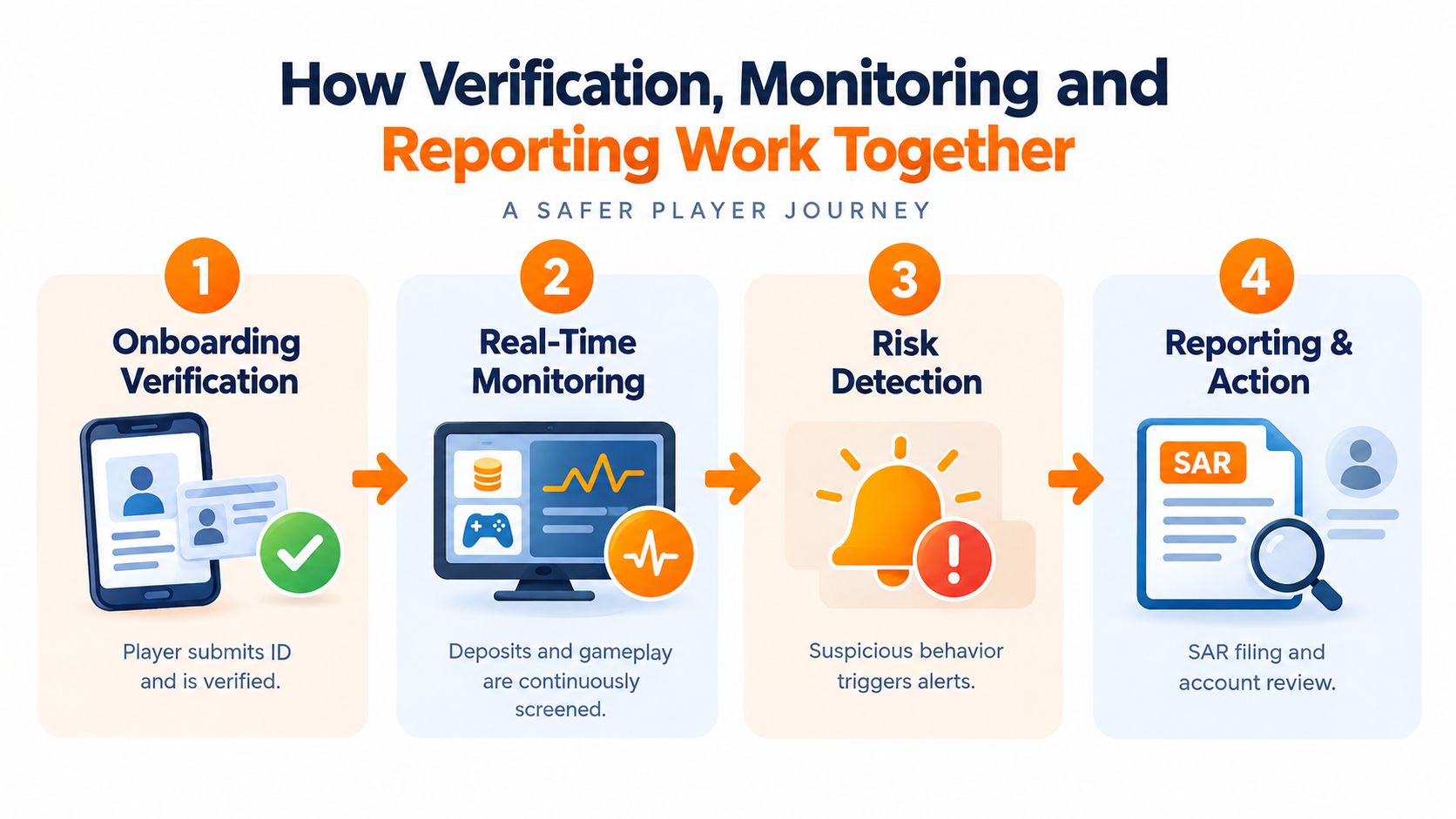
A good way to test software is to follow one player from signup through ongoing play and ask what the system does at each stage.
Step one starts before the first bet
A player creates an account, enters personal details, and submits identity material. The software checks completeness, validates the record, and runs screening in the background. If the result is clean and the risk profile is low, the player moves ahead with minimal friction. If something needs review, the platform should route the case to an analyst rather than leaving support or payments to guess.
Operators often underestimate workflow design. “Needs review” is not a single state. A useful system separates missing information, probable document problems, possible watchlist matches, and higher-risk source-of-funds questions into different paths.
Monitoring begins once money starts moving
After onboarding, the system should connect identity context with payment and gameplay behavior. Deposits, withdrawals, reversals, repeated payment method changes, or sudden account pattern shifts can all trigger rules depending on your policy and market obligations.
The important point is continuity. Monitoring isn't a separate compliance island. It should inherit customer identity, prior screening outcomes, jurisdiction settings, and past analyst decisions so the software can treat repeat events intelligently.
A weak stack creates isolated alerts. A mature stack creates a timeline.
Alert handling determines team workload
When an alert fires, the software should present the reason, related activity, prior decisions, and next action options in one place. If analysts need to jump between a KYC portal, a payments dashboard, and a CRM to understand one case, review times expand and consistency drops.
This is also where long-term records matter. In casino contexts, operators are commonly required to retain KYC documentation, transaction logs, and compliance reports for 5 to 7 years depending on jurisdiction, which makes auditability and durable record retention a design requirement according to Online United States Casinos' guide to online casino compliance standards. For gaming operators, that means every decision should leave a reliable trail: what triggered review, who handled it, what evidence was considered, and what outcome followed.
Reporting is the end of the workflow, not an extra module
By the time a case reaches reporting, all the earlier steps should already be connected. The best reporting outputs don't ask analysts to reconstruct the story manually. They pull from the underlying workflow and preserve the chronology.
That's why immutable logging matters so much in practice. If your operator can prove what happened, when it happened, and why a decision was made, audit conversations become much more manageable. If it can't, even a reasonable compliance decision becomes hard to defend.
Integration and Deployment Considerations for B2B Platforms
Most implementation trouble doesn't come from the policy itself. It comes from how the AML/KYC layer connects to the rest of the gaming stack.

Single API versus prebuilt adapters
Some operators prefer a single API aggregation model. In that setup, one integration layer routes identity checks, screening, monitoring events, and case updates through a common service. The advantage is cleaner architecture and fewer direct vendor relationships.
Others prefer prebuilt adapters tied to games, wallets, payments, or specific KYC providers. That can speed rollout when the wider platform already uses those connectors, but it can also create fragmented logic if each component owns its own compliance signals.
A simple comparison helps:
| Deployment pattern | Where it helps | Where it gets messy |
|---|---|---|
| Single API layer | Centralized rules, shared audit trail, fewer moving parts for operations | Requires strong orchestration design and disciplined data mapping |
| Prebuilt adapters | Faster connection to known providers, useful for white-label stacks | Can create duplicated checks, uneven workflows, and split reporting |
| Hybrid approach | Flexible for multi-provider environments | Governance gets harder if ownership is unclear |
Data quality matters more than the demo
A polished vendor demo usually shows structured data, perfect names, and clear alert reasons. Production environments are rarely that tidy. Payment metadata arrives in different formats. Player records may be incomplete. Legacy brands often carry historical inconsistencies into the new system.
That gap explains why implementation often stalls. A global ACAMS survey found only 18% of AML professionals had AI/ML in production, while 18% were still piloting and 40% had no current adoption plans. The same summary notes another benchmarking survey where 94% of banks cited high manual workloads as their primary AML/KYC challenge, yet 60% still relied on manual intervention for more than half of their processes, as reported by SAS in its anti-money-laundering survey on AI and machine learning.
Those figures are from banking, but the operational lesson carries into gaming. The software only helps if your data model, ownership rules, and review workflow are ready for it.
Don't ask only whether the platform has AI. Ask whether your data, queues, and exception paths let the team use it safely.
For B2B gaming platforms, hosting model, uptime practices, data residency, and audit log access also matter. A white-label operator doesn't just need compliance logic. It needs that logic to fit into wallets, cashier rules, CRM actions, geofencing, and back-office reviews without creating hidden manual work.
How to Choose AML KYC Software and Map It to MGA Requirements
Buying AML KYC software for gaming isn't about finding the vendor with the longest feature page. It's about finding the platform that matches how your business operates across jurisdictions.
What to score before you buy
The table below is a practical screening tool for operator and compliance teams.
| Evaluation Criteria | What Good Looks Like | MGA Relevance |
|---|---|---|
| Risk-based configurability | Rules can vary by player type, trigger, payment behavior, and market without custom rebuilds | Supports different due diligence paths and jurisdiction-specific handling |
| Screening precision | Match logic is tunable, analysts can disposition alerts clearly, repeat false matches are easier to suppress | Helps reduce unnecessary friction while maintaining sanctions and PEP control |
| Workflow automation | Review queues, escalations, approval steps, and evidence capture are built into the process | Useful for structured internal controls and clear accountability |
| Reporting and audit readiness | Logs are searchable, case histories are chronological, exportable records are easy to produce | Important for audits, regulator requests, and internal monitoring |
| Multi-jurisdiction adaptability | The platform can support different document needs, geographies, and market policies in one operating model | Relevant for operators expanding beyond one licensing environment |
| Operational support | Vendor support, implementation guidance, and integration documentation are strong | Reduces deployment risk for teams managing launch timelines |
The market is shifting toward continuous risk updates
A lot of software buying still focuses on signup speed. That's too narrow for where the market is heading. Industry coverage points to perpetual KYC, beneficial ownership transparency, and crypto Travel Rule enforcement as major forces shaping AML compliance. The same overview says 75% of institutions plan to buy transaction monitoring technology within three years, 69% plan to invest in KYC automation, 67% in workflow tooling, and 80% say technology is the area needing the most investment. It also notes that poor data quality and integration were cited by 65.6% of respondents as the biggest drag on AML performance at Didit's review of AML compliance trends for 2026.
For gaming operators, that changes the buying question. Instead of asking only, “How quickly can this vendor verify players?” ask, “How does this platform keep player risk current across payments, gameplay, and jurisdiction changes?”
Mapping software choices to MGA-style realities
MGA-aligned environments usually push operators toward a broader compliance toolkit. That includes geofencing controls, audit logs, responsible gaming support, and reporting discipline that fits a regulated operating model. Your AML/KYC layer doesn't need to do every one of those jobs alone, but it does need to work cleanly with them.
One option in this category is NexGrate, which provides a turnkey white-label platform with casino, sportsbook, payments, and compliance tooling in one environment. For operators, that matters less as a branding point and more as an architectural one. A unified backend can reduce handoff problems between KYC review, cashier actions, and reporting.
If you're comparing platform models more broadly, this overview of iGaming software providers is useful because software selection in gaming rarely happens in a compliance vacuum. The AML/KYC choice has to fit your full stack.
“Fast onboarding” is only valuable if the same system can support refresh, escalation, and audit defense later.
Conclusion Building Continuous Compliance That Scales
The biggest mistake operators make is treating KYC as a gate at the front door. In gaming, it's closer to a control loop. You verify identity, screen risk, monitor behavior, escalate when needed, document decisions, and keep the customer record current over time.
That's why AML KYC software should be evaluated as an operational workflow engine, not just a verification tool. The useful questions are practical ones. Can it route cases cleanly? Can it cope with messy data? Can it connect onboarding, payments, monitoring, and reporting without forcing analysts into manual workarounds?
A sensible next-step checklist usually looks like this:
- Check data readiness: Confirm where player, payment, and gameplay data lives, and whether records are consistent enough to support rules.
- Define review ownership: Decide who handles sanctions alerts, source-of-funds requests, payment exceptions, and escalation approvals.
- Set refresh triggers: Establish what should prompt renewed screening or deeper due diligence after onboarding.
- Test auditability: Make sure the team can reconstruct a full case history without stitching it together by hand.
- Review jurisdiction fit: Validate that the workflow can adapt across MGA-style requirements and other regulated market expectations.
- Plan for continuity: Include beneficial ownership complexity, crypto exposure, and long-term record retention in the design from the start.
The direction of travel is clear. Compliance is moving toward continuous risk recalibration, not one-time approval. Operators that build around that reality tend to scale with less friction, fewer surprises, and better control when regulators ask hard questions.
NexGrate offers a turnkey white-label platform for online casino and sportsbook operations that combines payments, player management, and compliance tooling in one environment. If you're assessing how AML KYC software should fit into launch, cashier, and back-office workflows, visit NexGrate to see how an integrated gaming stack can support those requirements.